

|
시장보고서
상품코드
2114754
항응고제 시장 : 점유율 분석, 업계 동향과 통계, 성장 예측(2026-2031년)Anticoagulants - Market Share Analysis, Industry Trends & Statistics, Growth Forecasts (2026 - 2031) |
||||||
 Mordor Intelligence
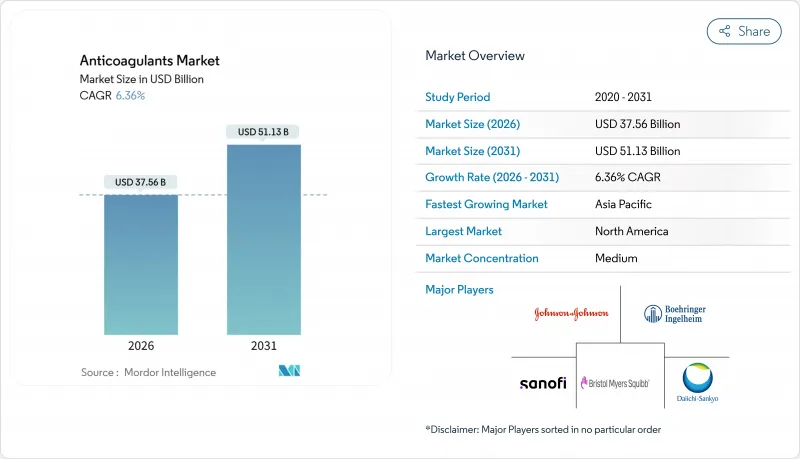
Mordor Intelligence에 의하면, 항응고제 시장 규모는 2026년에 375억 6,000만 달러로 추정되고 있어 예측 기간(2026-2031년)에서 CAGR 6.36%로 성장을 지속하여, 2031년까지 511억 3,000만 달러에 이를 전망입니다.
본 보고서는 약물 분류별(신규 경구용 항응고제, 헤파린 및 저분자량 헤파린(LMWH), 비타민 K 길항제, 제XIa 인자 억제제, 비경구용 직접 트롬빈 억제제),투여 경로(경구, 주사제 등), 적응증(심방세동 및 심근경색 등), 유통 채널(병원 등), 그리고 지역별로 분류되어 있습니다. 시장 예측은 금액(미화) 기준으로 제시되어 있습니다.
전 세계 항응고제 시장 동향 및 인사이트
심혈관 질환 및 심방세동의 유병률 증가
세계 심방세동 환자 수는 2024년에 5,970만 명에 달했으며, 인구 고령화와 중소득 국가에서의 대사증후군 확산에 따라 계속해서 증가 추세를 보이고 있습니다. 2024년에 개정된 유럽 지침에서는 경구용 항응고 요법의 적응 기준이 완화되어 대상 환자 수가 약 15% 확대되었습니다. 미국의 뇌졸중 데이터에 따르면, 심방세동(AF)과 관련된 사건에서 30일 내 사망률은 25%를 초과하고 있어, 이에 따라 보험사들은 예방 요법으로의 전환을 강요받고 있습니다. 또한, 심방세동과 동반되는 경우가 많은 ‘박출률 보존형 심부전’ 증가도 추가적인 압박 요인으로 작용하고 있습니다. 심방세동 감지 알고리즘이 탑재된 웨어러블 기기의 이용 확대에 따라 진단률은 더욱 향상되고 있습니다. 이러한 요인들이 복합적으로 작용하여, 현재의 예측 기간을 넘어 지속될 장기적인 수요를 뒷받침하고 있습니다.
와파린을 대체하는 NOAC의 급속한 보급
모니터링 부담 경감과 우수한 안전성 프로파일에 힘입어, 2025년 시점에서 미국 내 신규 처방전의 70% 이상을 직접 경구용 항응고제(NOAC)가 차지할 것으로 전망됩니다. 아픽사반, 리바록사반, 에도사반, 다비가트란의 전 세계 총 매출액은 제네릭 의약품의 광범위한 진입이 시작되기 전인 2024년 기준에서 이미 150억 달러를 넘어섰습니다. 과학 기관의 보고에 따르면, 와파린에 비해 두개내 출혈 발생률이 약 50% 낮은 것으로 나타나, 이에 따라 임상의들의 신뢰도가 높아지고 있습니다. 현재 와파린의 사용은 주로 인공 심장 판막, 중증 신장 기능 장애 또는 항인지질 증후군으로 제한되어 있습니다. 조만간 시작될 제네릭 의약품의 출시로 인해 비용에 민감한 지역에서는 가격 균등화가 진행되어 전환이 가속화될 것으로 예측됩니다.
주요 NOAC의 특허 만료와 제네릭에 의한 시장 잠식
아피사반은 2024년에 EU 여러 국가에서 독점권을 상실했으며, 12개월 이내에 브랜드 제품 매출이 약 30% 감소했습니다. 리바록사반도 유사한 압박에 직면하여, 제네릭 의약품이 판매량의 25%를 차지하게 된 결과, 바이엘의 유럽 내 매출은 12% 감소했습니다. 2026년 미국에서 발생할 특허 만료의 물결로 인해 이러한 가격 측면의 압박은 더욱 확대될 전망입니다. 각 제약사는 브랜드 가치를 지키기 위해 환자 지원 앱 및 실세계 데이터에 대한 투자를 통해 대응하고 있습니다. 이익률은 축소되겠지만, 가격 하락으로 인해 저소득 시장에서의 접근성이 확대됨에 따라 전반적인 성장에 미치는 부정적 영향은 완화될 전망입니다.
부문별 분석
제약사들이 유효성과 출혈 위험을 분리하는 방안을 모색하는 가운데, 제XIa 인자 억제제는 2026년부터 2031년까지 연평균 성장률(CAGR) 8.33%를 기록할 전망이며, 이는 각 약물군 중 가장 높은 성장률입니다. 바이엘의 아순데크산은 2024년 아피사반에 대한 비열등성 시험의 주요 평가 지표를 달성하지 못했으나, 작용기전의 검증이 진행됨에 따라 경쟁사들의 관심이 지속되고 있습니다. 브리스톨-마이어스 스퀴브와 얀센은 밀베크시안의 후기 임상시험을 추진 중이며, 안소스 테라퓨틱스의 월 1회 투여형 아베라시맙은 계속해서 유망한 안전성을 보여주고 있습니다. 신규 경구용 항응고제(NOAC)는 2025년 매출의 42.53%를 차지했으나, 판매량 증가만으로는 제네릭 의약품의 진입으로 인한 매출 감소를 완전히 상쇄할 수는 없습니다. 한편, 헤파린은 급성기 치료의 주류로 자리 잡고 있으며, 비타민 K 길항제는 틈새 시장에서의 역할을 공고히 하고 있습니다. 이러한 양극화로 인해 가격 경쟁력이 뛰어나고 판매량이 많은 NOAC 부문과, 치료의 한계를 재정의할 것으로 기대되는 프리미엄 고성장 제XIa 인자 부문이 형성되고 있습니다.
안티센스 올리고뉴클레오티드 등의 2세대 바이오의약품은 투여 빈도 감소를 목표로 하고 있으며, 안전성이 확립된다면 차별화의 가능성을 지니고 있습니다. 그러나 장기적인 유전자 침묵화에 관한 규제상의 명확화는 여전히 진행 중인 단계입니다. 항응고제 시장 전체적으로는 확립된 블록버스터 카테고리와, 우수한 안전성을 발휘할 경우 프리미엄 가격을 책정할 가능성이 있는 신흥 치료법 간의 균형을 맞추어야 합니다.
경구제는 환자의 선호도와 투여 횟수가 고정되어 있다는 편의성 덕분에 2025년 매출의 59.37%를 차지했습니다. 그러나 기업들이 매일 복용해야 하는 부담을 줄여주는 저장형(데포) 기술을 추구하는 가운데, 이식형 및 지속형 투여 솔루션은 연평균 성장률(CAGR) 9.67%로 확대되고 있습니다. FDA는 2024년, 수술 후 예방을 목적으로 하는 7일간 지속 방출형 피하 투여용 팩터 Xa 제제를 승인하여 간호 부담을 줄이고 조기 퇴원에 따른 위험을 감소시켰습니다.
생분해성 마이크로스피어 및 바이오마커 반응형 포트에 대한 연구는 경구 요법의 첫 1년 동안 관찰되는 30%의 투여 중단률을 해소하는 것을 목표로 하고 있습니다. 의약품 및 의료기기 복합 제품에 대한 규제 절차는 여전히 복잡하며, FDA의 서로 다른 센터에 병행 신청이 필요하기 때문에 상용화가 지연되고 있습니다. 이러한 장벽이 있음에도 불구하고, 혁신적인 기업들은 기존 정제가 제네릭 의약품으로 인해 상품화되는 상황에 직면함에 따라 이식형 제품을 전략적 헤지 수단으로 간주하고 있습니다.
지역별 분석
북미는 2025년 매출의 32.65%를 차지하며, 메디케어 파트 D에 의한 NOAC의 광범위한 보험 적용과 복약 순응도 지표에 연동된 민간 가치 기반 계약이 이를 뒷받침하고 있습니다. 캐나다에서는 2024년 처방약 목록에 추가됨에 따라 판매량이 확대된 반면, 멕시코는 와파린과 동등한 비용을 실현하기 위해 제네릭 제조업체와 일괄 계약을 체결했습니다. 시장 침투율이 포화 상태에 가까워짐에 따라 성장은 점차 둔화되겠지만, 유리한 가격 동향 덕분에 수익성은 여전히 가장 높은 수준을 유지하고 있습니다.
이어 유럽에서는 독일, 영국, 프랑스, 이탈리아, 스페인이 지역 매출의 60% 이상을 차지했습니다. 2024년 EU에서 아픽사반 및 리바록사반의 제네릭 의약품이 승인됨에 따라, 대체가 의무화된 시장에서는 40-50%의 가격 인하가 이루어졌습니다. 영국에서는 NOAC가 1차 치료제로 지정되어, 저렴한 제네릭 의약품이 존재함에도 불구하고 처방량이 18% 증가했습니다. 지정학적 긴장으로 인해 동유럽공급이 차질을 빚으면서, 현지 와파린 및 헤파린 생산에 의존할 수밖에 없게 되었습니다.
아시아태평양은 가장 성장세가 두드러지는 지역으로, 광범위한 보험 적용 확대에 힘입어 연평균 성장률(CAGR) 8.37%가 예상됩니다. 중국에서는 2025년에 에도사반이 국가 보험 적용 목록에 추가되어 환자의 본인 부담금이 70% 감소했습니다. 일본에서는 체중 프로파일에 맞춘 저용량 아피사반 제제에 대해 우선 심사가 승인되어, 그동안의 출혈에 대한 우려가 해소되었습니다. 인도에서는 기존 가격보다 60% 저렴한 가격대의 제네릭 의약품이 출시되어, 2급 및 3급 도시에서 수요가 촉진되고 있습니다. 호주에서는 보조금 확대로 인해 2025년 초 처방량이 22% 증가했습니다.
중동 및 아프리카 및 남미 시장은 가격 부담과 규제 불균형으로 인해 여전히 발전 단계에 있습니다. 걸프협력회의(GCC) 회원국 및 브라질에서 시행 중인 시범적 보험 환급 프로그램은 2031년 이후를 향한 초기 단계이긴 하지만 유망한 시장 확대 기회를 시사하고 있습니다. 이러한 다양한 동향이 결합되어, 성숙한 고부가가치 지역과 급속히 규모를 확대하고 있는 신흥 경제국 간의 균형이 잡힌 세계 항응고제 시장이 형성되고 있습니다.
기타 혜택:
- 엑셀 형식 시장 예측(ME) 시트
- 3개월간의 애널리스트 지원
자주 묻는 질문
목차
제1장 서론
제2장 조사 방법
제3장 주요 요약
제4장 시장 구도
제5장 시장 규모와 성장 예측
제6장 경쟁 구도
제7장 시장 기회와 향후 전망
JHS 26.08.26According to Mordor Intelligence, the anticoagulants market size is estimated at USD 37.56 billion in 2026, and is expected to reach USD 51.13 billion by 2031, at a CAGR of 6.36% during the forecast period (2026-2031).
This report is Segmented by Drug Class (Novel Oral Anticoagulants, Heparin & LMWH, Vitamin K Antagonists, Factor XIa Inhibitors, Parenteral Direct Thrombin Inhibitors), Route of Administration (Oral, Injectable, and More), Application (Atrial Fibrillation & Myocardial Infarction, and More), Distribution Channel (Hospital, and More), and Geography. Market Forecasts are Provided in Terms of Value (USD).
Global Anticoagulants Market Trends and Insights
Growing Prevalence of Cardiovascular Diseases & Atrial Fibrillation
Global atrial fibrillation cases reached 59.7 million in 2024 and continue to climb as populations age and metabolic syndrome spreads in middle-income nations. Updated 2024 European guidelines lowered oral anticoagulation thresholds, enlarging the eligible pool by about 15%. U.S. stroke data show AF-related events carry 30-day mortality above 25%, steering payers toward preventive therapy. Added pressure comes from rising heart failure with preserved ejection fraction, a condition that typically coexists with AF. Growing use of wearables with AF detection algorithms further boosts diagnosis rates. Together, these factors sustain long-term demand that outlasts the current forecast window.
Rapid Adoption of NOACs Over Warfarin
Direct oral agents account for more than 70% of new U.S. prescriptions as of 2025, driven by reduced monitoring burdens and superior safety profile. Combined global sales of apixaban, rivaroxaban, edoxaban, and dabigatran exceeded USD 15 billion in 2024, even before widespread generic entry. Scientific bodies report roughly 50% lower intracranial hemorrhage rates versus warfarin, reinforcing clinician confidence. Warfarin use is now largely limited to mechanical heart valves, severe renal impairment, or antiphospholipid syndrome. Imminent generic launches are expected to drive price parity in cost-sensitive regions, accelerating the switch.
Patent Expiries & Generic Erosion of Key NOACs
Apixaban lost exclusivity in several EU states in 2024, trimming branded revenue by about 30% within 12 months. Rivaroxaban experienced similar pressure as generics gained a 25% volume foothold, leading to a 12% revenue drop for Bayer in Europe. U.S. patent cliffs in 2026 will extend these pricing pressures. Manufacturers respond by investing in patient-support apps and real-world evidence to defend brand value. While margins shrink, lower prices broaden access in lower-income markets, moderating the negative impact on overall growth.
Other drivers and restraints analyzed in the detailed report include:
- Favorable Clinical Guidelines for VTE Prophylaxis
- AI-Driven Personalized Anticoagulation Dosing Tools
- Bleeding-Risk Concerns Limiting Adoption
For complete list of drivers and restraints, kindly check the Table Of Contents.
Segment Analysis
Factor XIa inhibitors are poised for an 8.33% CAGR between 2026 and 2031, the fastest among classes, as drug makers seek to uncouple efficacy from bleeding risk. Bayer's asundexian did not meet the primary endpoint for non-inferiority versus apixaban in 2024, yet mechanistic validation kept competitors engaged. Bristol-Myers Squibb and Janssen push milvexian through late-stage trials, and Anthos Therapeutics' monthly abelacimab continues to show encouraging safety. Novel Oral Anticoagulants retained 42.53% of 2025 revenue, but rising volumes will not fully offset erosion from generic entry. Meanwhile, heparins remain acute-care staples, and vitamin K antagonists settle into niche roles. This bifurcation yields a price-competitive high-volume NOAC segment and a premium high-growth Factor XIa segment set to redefine therapeutic ceilings.
Second-generation biologics such as antisense oligonucleotides target infrequent dosing, offering potential differentiation once safety is established. However, regulatory clarity on long-term gene-silencing is still evolving. The anticoagulants market overall must balance established blockbuster categories with emergent therapies likely to command premium pricing if they deliver superior safety.
Oral agents captured 59.37% of 2025 revenue due to patient preference and fixed dosing convenience. Yet, implantable and long-acting delivery solutions are expanding at a 9.67% CAGR as companies pursue depot technologies that alleviate daily pill fatigue. The FDA cleared a 7-day extended-release subcutaneous Factor Xa formulation in 2024 for post-surgical prophylaxis, reducing nursing burden and early discharge risks.
Research into biodegradable microspheres and biomarker-responsive ports aims to tackle the 30% discontinuation rate observed within the first year of oral therapy. Regulatory pathways for combination drug-device products remain complex, requiring parallel submissions to different FDA centers, which slows commercialization. Despite these hurdles, innovators view implantables as strategic hedges in a landscape where traditional tablets face generic commoditization.
Complete Report Scope:
- By Drug Class
- Novel Oral Anticoagulants (NOACs)
- Heparin & Low-Molecular-Weight Heparin (LMWH)
- Vitamin K Antagonists
- Factor XIa Inhibitors
- Parenteral Direct Thrombin Inhibitors
- By Route of Administration
- Oral Anticoagulants
- Injectable Anticoagulants
- Implantable / Long-acting Delivery Systems
- By Application
- Atrial Fibrillation & Myocardial Infarction
- Deep Vein Thrombosis
- Pulmonary Embolism
- Cancer-Associated Thrombosis
- Mechanical Heart Valves & Other Cardiac Uses
- By Distribution Channel
- Hospital Pharmacies
- Retail Pharmacies
- Online Pharmacies
- Specialty Clinics
- By Geography
- North America
- United States
- Canada
- Mexico
- Europe
- Germany
- United Kingdom
- France
- Italy
- Spain
- Rest of Europe
- Asia-Pacific
- China
- Japan
- India
- South Korea
- Australia
- Rest of Asia-Pacific
- Middle East & Africa
- GCC
- South Africa
- Rest of Middle East & Africa
- South America
- Brazil
- Argentina
- Rest of South America
- North America
Geography Analysis
North America generated 32.65% of 2025 revenue, anchored by broad NOAC coverage under Medicare Part D and private value-based contracts tied to adherence metrics. Canada's 2024 formulary expansion boosted volumes, while Mexico negotiated bulk deals with generic makers to reach cost parity with warfarin. Growth will gradually moderate as penetration nears saturation, yet profitability remains highest due to favorable pricing dynamics.
Europe followed, with Germany, the United Kingdom, France, Italy, and Spain accounting for more than 60% of regional revenue. EU approval of generic apixaban and rivaroxaban in 2024 drove price cuts of 40-50% in substitution-mandated markets. The U.K. designated NOACs as first-line therapy, prompting an 18% prescription increase despite cheaper generics. Geopolitical tensions disrupted supply in Eastern Europe, forcing reliance on local warfarin and heparin production.
Asia-Pacific is the fastest-growing region, set for an 8.37% CAGR, driven by broad reimbursement wins. China added edoxaban to the national reimbursement list in 2025, slashing patient out-of-pocket costs by 70%. Japan granted priority review to a reduced-dose apixaban formulation tailored to body-weight profiles, addressing previous bleeding concerns. India's generic launches at 60% lower price points are unlocking demand in tier-2 and tier-3 cities. Australia's expanded subsidies lifted prescription volumes 22% in early 2025.
The Middle East & Africa and South America remain nascent, constrained by affordability and regulatory fragmentation. Pilot reimbursement programs in Gulf Cooperation Council states and Brazil indicate early but promising expansion opportunities beyond 2031. Collectively, these diverse trajectories reinforce a global anticoagulants market that balances mature high-value regions with rapidly scaling emerging economies.
- Alexion Pharmaceuticals Inc.
- Anthos Therapeutics
- Aspen Pharma Holdings Ltd.
- Astellas Pharma
- Bayer
- Boehringer Ingelheim
- Bristol-Myers Squibb
- Daiichi Sankyo Co. Ltd.
- Dr. Reddy's Laboratories
- Roche
- Ionis Pharmaceuticals
- Johnson & Johnson
- Leo Pharma
- Merck
- Mitsubishi Tanabe Pharma
- Nektar Therapeutics
- Novartis
- Pfizer
- Sanofi
Additional Benefits:
- The market estimate (ME) sheet in Excel format
- 3 months of analyst support
TABLE OF CONTENTS
1 Introduction
- 1.1 Study Assumptions & Market Definition
- 1.2 Scope of the Study
2 Research Methodology
3 Executive Summary
4 Market Landscape
- 4.1 Market Overview
- 4.2 Market Drivers
- 4.2.1 Growing Prevalence of Cardiovascular Diseases & Atrial Fibrillation
- 4.2.2 Rapid Adoption of NOACs Over Warfarin
- 4.2.3 Rising Geriatric Population Globally
- 4.2.4 Favorable Clinical Guidelines for VTE Prophylaxis
- 4.2.5 AI-Driven Personalized Anticoagulation Dosing Tools
- 4.2.6 Extended Outpatient Thromboprophylaxis Post-COVID-19
- 4.3 Market Restraints
- 4.3.1 Patent Expiries & Generic Erosion of Key NOACs
- 4.3.2 Bleeding-Risk Concerns Limiting Adoption
- 4.3.3 Porcine-Heparin Supply-Chain Vulnerability
- 4.3.4 Regulatory Uncertainty For RNAi / Gene-Silencing Agents
- 4.4 Value / Supply-Chain Analysis
- 4.5 Regulatory Landscape
- 4.6 Technological Outlook
- 4.7 Porter's Five Forces Analysis
- 4.7.1 Threat of New Entrants
- 4.7.2 Bargaining Power of Buyers
- 4.7.3 Bargaining Power of Suppliers
- 4.7.4 Threat of Substitutes
- 4.7.5 Competitive Rivalry
5 Market Size & Growth Forecasts (Value - USD)
- 5.1 By Drug Class
- 5.1.1 Novel Oral Anticoagulants (NOACs)
- 5.1.2 Heparin & Low-Molecular-Weight Heparin (LMWH)
- 5.1.3 Vitamin K Antagonists
- 5.1.4 Factor XIa Inhibitors
- 5.1.5 Parenteral Direct Thrombin Inhibitors
- 5.2 By Route of Administration
- 5.2.1 Oral Anticoagulants
- 5.2.2 Injectable Anticoagulants
- 5.2.3 Implantable / Long-acting Delivery Systems
- 5.3 By Application
- 5.3.1 Atrial Fibrillation & Myocardial Infarction
- 5.3.2 Deep Vein Thrombosis
- 5.3.3 Pulmonary Embolism
- 5.3.4 Cancer-Associated Thrombosis
- 5.3.5 Mechanical Heart Valves & Other Cardiac Uses
- 5.4 By Distribution Channel
- 5.4.1 Hospital Pharmacies
- 5.4.2 Retail Pharmacies
- 5.4.3 Online Pharmacies
- 5.4.4 Specialty Clinics
- 5.5 By Geography
- 5.5.1 North America
- 5.5.1.1 United States
- 5.5.1.2 Canada
- 5.5.1.3 Mexico
- 5.5.2 Europe
- 5.5.2.1 Germany
- 5.5.2.2 United Kingdom
- 5.5.2.3 France
- 5.5.2.4 Italy
- 5.5.2.5 Spain
- 5.5.2.6 Rest of Europe
- 5.5.3 Asia-Pacific
- 5.5.3.1 China
- 5.5.3.2 Japan
- 5.5.3.3 India
- 5.5.3.4 South Korea
- 5.5.3.5 Australia
- 5.5.3.6 Rest of Asia-Pacific
- 5.5.4 Middle East & Africa
- 5.5.4.1 GCC
- 5.5.4.2 South Africa
- 5.5.4.3 Rest of Middle East & Africa
- 5.5.5 South America
- 5.5.5.1 Brazil
- 5.5.5.2 Argentina
- 5.5.5.3 Rest of South America
- 5.5.1 North America
6 Competitive Landscape
- 6.1 Market Concentration
- 6.2 Market Share Analysis
- 6.3 Company Profiles (includes Global level Overview, Market level overview, Core Segments, Financials as available, Strategic Information, Market Rank/Share for key companies, Products and Services, and Recent Developments)
- 6.3.1 Alexion Pharmaceuticals Inc.
- 6.3.2 Anthos Therapeutics
- 6.3.3 Aspen Pharma Holdings Ltd.
- 6.3.4 Astellas Pharma Inc.
- 6.3.5 Bayer AG
- 6.3.6 Boehringer Ingelheim GmbH
- 6.3.7 Bristol-Myers Squibb
- 6.3.8 Daiichi Sankyo Co. Ltd.
- 6.3.9 Dr. Reddy's Laboratories Ltd.
- 6.3.10 F. Hoffmann-La Roche AG
- 6.3.11 Ionis Pharmaceuticals Inc.
- 6.3.12 Johnson & Johnson (Janssen)
- 6.3.13 Leo Pharma A/S
- 6.3.14 Merck & Co. Inc.
- 6.3.15 Mitsubishi Tanabe Pharma
- 6.3.16 Nektar Therapeutics
- 6.3.17 Novartis AG
- 6.3.18 Pfizer Inc.
- 6.3.19 Sanofi SA
7 Market Opportunities & Future Outlook
- 7.1 White-space & Unmet-need Assessment


