|
시장보고서
상품코드
2114755
광선각화증 치료 : 시장 점유율 분석, 업계 동향 및 통계, 성장 예측(2026-2031년)Global Actinic Keratosis Treatment - Market Share Analysis, Industry Trends & Statistics, Growth Forecasts (2026 - 2031) |
||||||
 Mordor Intelligence
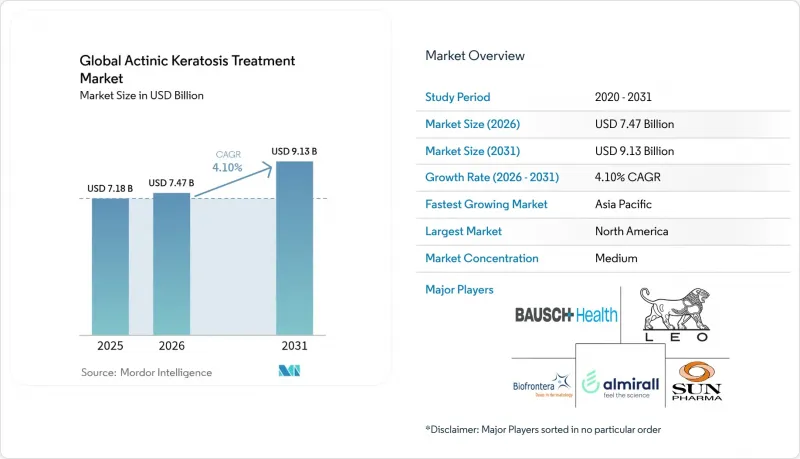
Mordor Intelligence에 의하면, 광선각화증 치료 시장 규모는 2025년 71억 8,000만 달러로 평가되었습니다. 2026년에는 74억 7,000만 달러로 확대되어 2026-2031년에 걸쳐 CAGR 4.10%로 성장을 지속하여, 2031년까지 91억 3,000만 달러에 이를 것으로 예측됩니다.
본 보고서는 치료법(외용약, 기타), 최종 사용자(병원·암 치료 센터, 기타), 유통 채널(병원 약국, 기타), 환자 연령대(60세 이상), 지역(북미, 유럽, 아시아태평양, 중동 및 아프리카, 남미)별로 세분화되어 있습니다. 시장 예측은 금액(달러) 기준으로 제시되어 있습니다.
세계의 광선각화증 치료 시장 동향 및 인사이트
고령화가 진행되고 있는 피부가 흰 인구층에서 광선각화증 유병률 증가
유병률은 북위도가 높은 지역에서 11%에서 25% 사이이며, 호주의 성인에서는 60%에 달하고, 환자층이 방대하고 증가 추세에 있음을 보여줍니다. 스페인의 진료 데이터에 따르면, 전체 유병률은 28.6%이며, 남성에게 불균형적으로 많이 나타나는 것으로 나타나 치료 수요를 형성하고 있습니다. 공공 검진 체계의 정비와 평균 수명의 연장으로 인해 더 많은 병변이 임상 현장에 유입되고 있습니다. 한편, 각 병변은 편평상피암의 위험 증가를 나타내며, 면역 기능이 정상인 환자의 악성화율은 8%로 추정됩니다. 보험사는 조기 치료가 비용 절감으로 이어진다고 보고 있으며, 외용약과 시술을 통한 치료 모두에 대한 보험 적용 범위 확대를 지지하고 있습니다. 이러한 요인들이 결합되어 모든 주요 지역에서 지속적인 수요를 창출하고 있습니다.
저침습적 피부과 시술에 대한 수요 증가
환자들의 선호도는 높은 치유율과 회복 기간 최소화를 실현하는 치료법으로 이동하고 있습니다. 광역학 요법은 1-2회의 시술로 85%-90%의 치유율을 달성하며, 미용적 결과 측면에서 냉동 요법을 능가합니다. 데이라이트 프로토콜을 통해 통증 점수가 낮아지고 클리닉의 가동률도 감소하므로, 통증을 꺼리는 환자들에게도 이 치료법은 수용하기 쉬워지고 있습니다. 듀얼 파장의 Fraxel FTX와 같은 프랙셔널 레이저 플랫폼은 표적화된 절제술과 신속한 회복을 실현하여 시술의 보급을 촉진하고 있습니다. 87%의 민감도를 달성하는 AI 선별 도구는 조기 진단을 가속화하여 의사가 더 빨리 최소 침습적 치료 옵션을 선택할 수 있도록 합니다. 이러한 발전들이 결합되어 시술 부문의 급속한 성장을 뒷받침하고 있습니다.
기존 외용제의 부작용 프로파일이 환자의 치료 순응도를 제한하고
홍반, 통증, 딱지 형성 등의 국소 반응으로 인해 많은 환자가 5-플루오로우라실 사용을 조기에 중단하여 종양 제거 성과를 저해하고 있습니다. 안전성에 대한 우려로 2020년에 시장에서 철수된 잉게놀 메부테이트는 새로운 분자에 대한 처방 의사의 신중함을 더욱 강화하는 결과를 가져왔습니다. 병변 부위를 표적으로 하는 치료법은 얼굴이나 두피의 넓은 부위를 덮어야 하는 경우가 많고, 눈에 띄는 염증이 발생하기 때문에 외모를 신경 쓰는 환자들을 멀어지게 합니다. 5-FU와 칼시포트리엔의 병용 요법을 검증하는 진행 중인 연구에서는 높은 유효성을 유지하면서 치료 기간을 4일로 단축하는 것을 목표로 하고 있습니다. 내약성이 개선될 때까지는 일부 환자들이 필요한 치료를 미루거나 거부할 것으로 예측됩니다.
부문별 분석
2025년, 광선각화증 치료 시장에서 외용제가 45.12%의 점유율을 차지했습니다. 이는 5-플루오로우라실, 이미키모드, 신약인 틸바니브린이 광범위 치료의 1차 선택 약물로 계속 사용되고 있기 때문입니다. 틸바니브린의 적응증 확대로 적용 면적이 100cm²까지 확대됨에 따라, 안면이나 두피에 더 광범위하게 도포할 수 있게 되어 외용제의 주도적 지위가 더욱 강화되었습니다. 그럼에도 불구하고, 시술 요법 부문은 연평균 성장률(CAGR) 5.12%로 성장을 지속하고 있으며, 광선각화증 치료 시장 규모에서 차지하는 점유율은 2031년까지 꾸준히 상승할 것으로 예측됩니다. 햇빛을 이용한 광역학 치료(PDT), 프랙셔널 CO₂ 레이저, 레이저 보조 약물 전달법이 치료법 선택의 폭을 넓혀 미용상의 이점과 치료 기간 단축을 가져오고 있습니다.
시술 보급률은 지역 및 보험 환급 제도에 따라 다르지만, 다발성 병변 영역에서는 임상적 근거가 여전히 반복적인 외용 요법보다 PDT를 지지하고 있습니다. 병원, 피부과 클리닉, 나아가 외래 진료 센터에서도 최근 FDA 승인을 받아 RhodoLED XL 및 유사한 플랫폼에 대한 투자가 진행되고 있습니다. 고립된 병변에 대해 여전히 널리 사용되고 있는 냉동 요법은 현재, 단 한 번의 내원만으로 광범위한 자외선 손상을 제거할 수 있는 레이저 리서페이싱과 경쟁하고 있습니다. 치료 프로토콜이 성숙해짐에 따라, 특히 보험사가 장기적인 개선 효과를 평가하는 시장에서 시술 기반 치료가 외용제의 우위를 더욱 약화시킬 것으로 예측됩니다.
2025년, 광선각화증 치료 시장 매출의 53.55%를 병원 및 암 치료 센터가 차지했으며, 이는 전문 지식의 집중과 장비를 많이 사용하는 시술이 반영된 결과입니다. 종합적인 보험 환급 지원과 학술적인 임상시험 활동을 통해, 진행성 또는 고위험 병변 관리에 있어 이러한 시설의 역할은 확고해졌습니다. 이러한 시설에서는 통합된 전자 건강 기록(EHR), 영상 진단, AI 기반 분류 시스템을 도입하여 치료 범위 매핑 및 후속 관리를 효율화하고 있습니다. 그러나 수용 능력의 제약과 높은 간접비로 인해 의료 제공업체들은 안정적인 사례를 외래 또는 재택치료 현장으로 분산시키도록 권장받고 있습니다.
간호사가 주도하는 광선 요법 프로그램과 자가 도포형 외용약에 기반한 재택치료는 연평균 성장률(CAGR) 4.73%로 가장 빠르게 성장하는 채널입니다. 파일럿 프로그램에서는 원격 모니터링 하에 좁은 파장대의 광선 요법이나 햇빛을 이용한 광역학 요법(PDT)의 안전한 자가 투여가 입증되어, 통원 및 대기 비용을 절감하고 있습니다. 원격 피부과를 통한 경과 관찰과 앱을 활용한 복약 순응도 알림 기능은 중요한 촉진요인으로 작용하고 있습니다. 보험사가 원격 모니터링에 대한 진료 보수를 인정함에 따라, 특히 전용 기기가 필요 없는 유지 요법이나 현장 요법 분야에서 재택치료의 보급이 가속화될 것으로 예측됩니다.
지역별 분석
북미는 2025년 광선각화증(AK) 치료 시장의 41.70%를 차지했습니다. 이는 여러 AK 치료법을 보험 적용 대상에 포함하는 제도, 첨단 연구 인프라, AI 진단 플랫폼의 급속한 보급에 힘입은 결과입니다. 미국의 학술 기관들은 레이저를 병용한 약물 전달 및 복합 외용제에 관한 임상시험을 주도하고 있어, 해당 지역의 기술적 리더십을 공고히 하고 있습니다. 캐나다에서는 의료 제도와 피부과 전문의 밀도가 높은 덕분에 유사한 추세가 관찰됩니다. 진행 중인 산업 재편으로 인해 구매력이 강화되고 기술 도입이 가속화될 가능성이 있습니다.
연평균 성장률(CAGR) 6.08%로 확대되고 있는 아시아태평양은 인구 고령화와 중산층의 의료비 지출 증가라는 혜택을 누리고 있으나, 신흥국에서는 전문의 부족 문제에 직면해 있습니다. 일본은 고령화로 인한 부담을 여실히 보여주고 있으며, 현재 피부암 환자의 74%가 70세 이상입니다. 호주는 특히 태양광 PDT 분야에서 시술 보급에 있어 벤치마크를 확립하고 있습니다. 중국과 인도에서는 원격 피부과 스타트업이 두 자릿수 성장을 보이고 있지만, 보험 환급 제도의 불균일성과 피부과 전문의 분포의 편중이 시장의 잠재력을 충분히 발휘하는 데 제약 요인으로 작용하고 있습니다. 지역 AI 알고리즘 개발자들은 서유럽의 훈련 데이터셋과는 다른, 피부색이 어두운 광형(phototype)에 맞추어 모델을 재조정하는 데 주력하고 있습니다.
유럽은 성숙해 가면서도 여전히 혁신적인 시장으로 남아 있습니다. 각국의 국민건강보험은 햇빛 아래 PDT를 권장하고 있으며, 독일과 북유럽 국가에서는 피부과 치료 과정에서의 비용 절감을 검증하기 위한 종합적 지불 제도의 시범 사업이 시행되고 있습니다. 유럽의약품청(EMA)에 의한 잉게놀 메부테이트의 결정적인 판매 중단은 엄격한 안전성 모니터링의 필요성을 부각시키고 있습니다. 의료 기관들은 처방 목록을 더 안전하고 근거에 기반한 약물로 조정하고, 다파장 레이저 워크스테이션에 대한 투자를 추진하고 있습니다. 자외선 지수가 높은 남유럽 국가들에서는 여름철 성수기에 시술 건수를 늘리기 위한 계절별 피부암 검진 캠페인에 공공 자금이 배정되고 있습니다.
기타 혜택
- 엑셀 형식 시장 예측(ME) 시트
- 3개월간의 애널리스트 지원
자주 묻는 질문
목차
제1장 서론
제2장 조사 방법
제3장 주요 요약
제4장 시장 구도
제5장 시장 규모 및 성장 예측
제6장 경쟁 구도
제7장 시장 기회 및 향후 전망
KTH 26.08.28According to Mordor Intelligence, the actinic keratosis treatment market size is expected to grow from USD 7.18 billion in 2025 to USD 7.47 billion in 2026 and is forecast to reach USD 9.13 billion by 2031 at 4.10% CAGR over 2026-2031.
This report is Segmented by Therapy (Topical Medications, and More), End User (Hospitals & Oncology Centers, and More), Distribution Channel (Hospital Pharmacies, and More), Patient Age Group (60 Years), and Geography (North America, Europe, Asia-Pacific, Middle East & Africa, South America). The Market Forecasts are Provided in Terms of Value (USD).
Global Actinic Keratosis Treatment Market Trends and Insights
Rising Prevalence of Actinic Keratosis Among Aging, Fair-Skinned Populations
Prevalence rates range from 11% to 25% in northern latitudes and reach 60% among Australian adults, underscoring a large and rising patient pool. Spain's clinic data show 28.6% overall prevalence, with men disproportionately affected, which shapes therapy demand. Improved public screening and longer life expectancy push more lesions into clinical settings, while each lesion signals elevated squamous cell carcinoma risk-with malignant transformation estimated at 8% in immunocompetent patients. Payers view early treatment as cost-avoiding, supporting broader coverage for both topical and procedural care. Collectively these dynamics create durable demand across every major geography.
Growing Demand for Minimally-Invasive Dermatologic Procedures
Patient preference is shifting toward approaches that offer high clearance and minimal downtime. Photodynamic therapy achieves 85%-90% clearance after one or two sessions and outperforms cryotherapy on cosmetic outcome. Daylight protocols lower pain scores and cut clinic occupancy, making the modality more acceptable to pain-averse patients. Fractional laser platforms such as the dual-wavelength Fraxel FTX deliver targeted ablation with faster recovery, driving procedural uptake. AI screening tools that hit 87% sensitivity accelerate early diagnosis, enabling doctors to select minimally invasive options sooner. Together these advances propel the procedural segment's rapid growth.
Adverse-Event Profile of Existing Topicals Limits Patient Compliance
Local reactions such as erythema, pain, and crusting cause many patients to discontinue 5-fluorouracil prematurely, hampering clearance outcomes. Ingenol mebutate's 2020 market exit after safety alarms magnified prescriber caution about newer molecules. Field-directed regimens often require covering large facial or scalp regions, creating visible inflammation that deters cosmetically sensitive patients. Ongoing studies exploring 5-FU-calcipotriene combinations aim to shorten treatment to four days while preserving high efficacy. Until tolerability improves, some patients will defer or refuse needed therapy.
Other drivers and restraints analyzed in the detailed report include:
- Expansion of Reimbursement Coverage for AK Therapies in OECD Markets
- Adoption of Daylight-PDT Protocols Reducing Chair-Time & Cost
- Regulatory Approvals of Novel Agents Boosting Physician Uptake
- AI-Enabled Dermoscopy Driving Earlier Diagnosis & Treatment Volumes
- High Out-of-Pocket Costs in Emerging Economies
For complete list of drivers and restraints, kindly check the Table Of Contents.
Segment Analysis
Topical medications held 45.12% of actinic keratosis treatment market share in 2025 as 5-fluorouracil, imiquimod, and newer tirbanibulin remain first-line for field therapy . Tirbanibulin's label expansion to 100 cm2 positions it for wider facial and scalp application, reinforcing topical leadership. Nonetheless, the procedural category is on a 5.12% CAGR trajectory, and its share of the actinic keratosis treatment market size is forecast to rise steadily toward 2031. Daylight-mediated PDT, fractional CO2 lasers, and laser-assisted drug delivery are broadening the armamentarium, offering cosmetic advantages and shorter healing windows.
Procedural uptake varies by geography and reimbursement, yet clinical evidence continues to favor PDT over repeat topical courses for multi-lesion fields. Hospitals, dermatology clinics, and even ambulatory centers are investing in RhodoLED XL and similar platforms following recent FDA clearance. Cryotherapy, still widely used for isolated lesions, now competes with laser resurfacing that can remove diffuse ultraviolet damage in a single visit. As protocols mature, procedural treatments are expected to further dilute topical dominance, especially in markets where payers reward long-term clearance.
Hospitals and oncology centers accounted for 53.55% of actinic keratosis treatment market revenue in 2025, reflecting concentrated expertise and equipment-intensive procedures. Comprehensive reimbursement support and academic trial activity solidify their role in managing advanced or high-risk lesions. These facilities deploy integrated EHR, imaging, and AI triage that streamline field treatment mapping and follow-up. Nevertheless, capacity constraints and high overhead spur providers to triage stable cases into outpatient and home settings.
Home-care settings, aided by nurse-led phototherapy programs and self-applied topicals, are the fastest-growing channel at a 4.73% CAGR. Pilot programs demonstrate safe self-administration of narrow-band phototherapy and daylight-based PDT under virtual supervision, trimming transport and waiting costs. Teledermatology follow-up and app-based adherence reminders are critical enablers. As payers reimburse remote monitoring codes, home-care uptake is expected to accelerate, especially for maintenance and field therapies that do not require specialized devices.
Complete Report Scope:
- By Therapy
- Topical Medications
- 5-Fluorouracil
- Imiquimod
- Tirbanibulin
- Diclofenac
- Ingenol Mebutate
- Other Topicals
- Procedural Treatments
- Cryotherapy
- Photodynamic Therapy
- Laser Resurfacing
- Chemical Peels
- Curettage & Electrodessication
- Other Procedures
- Combination / Sequential Therapy
- Topical Medications
- By End User
- Hospitals & Oncology Centers
- Dermatology Clinics
- Ambulatory Surgical Centers
- Home-care Settings
- By Distribution Channel
- Hospital Pharmacies
- Retail Pharmacies
- Online Pharmacies
- By Patient Age Group
- < 40 Years
- 40 - 60 Years
- > 60 Years
- By Geography
- North America
- United States
- Canada
- Mexico
- Europe
- Germany
- United Kingdom
- France
- Italy
- Spain
- Rest of Europe
- Asia-Pacific
- China
- Japan
- India
- Australia
- South Korea
- Rest of Asia-Pacific
- Middle East & Africa
- GCC
- South Africa
- Rest of Middle East & Africa
- South America
- Brazil
- Argentina
- Rest of South America
- North America
Geography Analysis
North America held 41.70% of the actinic keratosis treatment market in 2025, supported by insurance coverage that reimburses multiple AK therapies, advanced research infrastructure, and rapid uptake of AI diagnostic platforms. Academic centers in the United States spearhead trials for laser-assisted drug delivery and combination topicals, reinforcing regional technology leadership. Canada mirrors these trends through universal healthcare and robust dermatologist density. Ongoing consolidation may enhance purchasing power and accelerate technology roll-outs.
Asia-Pacific, expanding at 6.08% CAGR, benefits from demographic aging and growing middle-class health spending, yet faces specialist shortages in emerging economies. Japan illustrates the aging burden, with 74% of skin cancer patients now over 70 years. Australia sets procedural adoption benchmarks, especially for daylight-PDT. China and India witness double-digit growth in teledermatology startups, though uneven reimbursement and limited dermatologist distribution restrain full-market potential. Regional AI algorithm developers work to recalibrate models for darker skin phototypes, which differ from Western training datasets.
Europe remains a mature yet innovative arena. National health services endorse daylight-PDT, and bundled-payment pilots in Germany and the Nordics test cost-containment for dermatology episodes. The EMA's decisive removal of ingenol mebutate underscores stringent safety oversight. Providers adjust formularies toward safer, evidence-heavy agents and invest in multi-wavelength laser workstations. Southern European countries, with higher UV indexes, allocate public funding to seasonal skin-cancer screening campaigns that feed procedure volumes during peak summer months.
- Bausch Health
- Almirall S.A.
- Biofrontera
- Sun Pharmaceuticals Industries
- Galderma
- Alma Lasers
- Hill Dermaceuticals Inc.
- GlaxoSmithKline
- Cipher Pharmaceuticals
- Leo Pharma
- Novartis
- DUSA Pharmaceuticals Inc.
- Athenex Inc.
- Theralase Technologies
- Cutera
- Hologic
- ThermiGen
- Valeant Pharmaceuticals Int'l
- Regeneron Pharmaceuticals
- Sanofi
Additional Benefits:
- The market estimate (ME) sheet in Excel format
- 3 months of analyst support
TABLE OF CONTENTS
1 Introduction
- 1.1 Study Assumptions & Market Definition
- 1.2 Scope of the Study
2 Research Methodology
3 Executive Summary
4 Market Landscape
- 4.1 Market Overview
- 4.2 Market Drivers
- 4.2.1 Rising Prevalence Of Actinic Keratosis Among Aging, Fair-Skinned Populations
- 4.2.2 Growing Demand For Minimally-Invasive Dermatologic Procedures
- 4.2.3 Expansion Of Reimbursement Coverage For AK Therapies In OECD Markets
- 4.2.4 Adoption Of Daylight-Pdt Protocols Reducing Chair-Time & Cost
- 4.2.5 Regulatory Approvals Of Novel Agents Boosting Physician Uptake
- 4.2.6 AI-Enabled Dermoscopy Driving Earlier Diagnosis & Treatment Volumes
- 4.3 Market Restraints
- 4.3.1 Adverse-Event Profile Of Existing Topicals Limits Patient Compliance
- 4.3.2 High Out-Of-Pocket Costs In Emerging Economies
- 4.3.3 Withdrawal Of Ingenol Mebutate Eroding Clinician Confidence
- 4.3.4 Margin Pressure From European Bundled-Payment Pilots
- 4.4 Value / Supply-Chain Analysis
- 4.5 Regulatory Landscape
- 4.6 Technological Outlook
- 4.7 Porter's Five Forces
- 4.7.1 Threat of New Entrants
- 4.7.2 Bargaining Power of Buyers
- 4.7.3 Bargaining Power of Suppliers
- 4.7.4 Threat of Substitutes
- 4.7.5 Competitive Rivalry
5 Market Size & Growth Forecasts
- 5.1 By Therapy
- 5.1.1 Topical Medications
- 5.1.1.1 5-Fluorouracil
- 5.1.1.2 Imiquimod
- 5.1.1.3 Tirbanibulin
- 5.1.1.4 Diclofenac
- 5.1.1.5 Ingenol Mebutate
- 5.1.1.6 Other Topicals
- 5.1.2 Procedural Treatments
- 5.1.2.1 Cryotherapy
- 5.1.2.2 Photodynamic Therapy
- 5.1.2.3 Laser Resurfacing
- 5.1.2.4 Chemical Peels
- 5.1.2.5 Curettage & Electrodessication
- 5.1.2.6 Other Procedures
- 5.1.3 Combination / Sequential Therapy
- 5.1.1 Topical Medications
- 5.2 By End User
- 5.2.1 Hospitals & Oncology Centers
- 5.2.2 Dermatology Clinics
- 5.2.3 Ambulatory Surgical Centers
- 5.2.4 Home-care Settings
- 5.3 By Distribution Channel
- 5.3.1 Hospital Pharmacies
- 5.3.2 Retail Pharmacies
- 5.3.3 Online Pharmacies
- 5.4 By Patient Age Group
- 5.4.1 < 40 Years
- 5.4.2 40 - 60 Years
- 5.4.3 > 60 Years
- 5.5 By Geography
- 5.5.1 North America
- 5.5.1.1 United States
- 5.5.1.2 Canada
- 5.5.1.3 Mexico
- 5.5.2 Europe
- 5.5.2.1 Germany
- 5.5.2.2 United Kingdom
- 5.5.2.3 France
- 5.5.2.4 Italy
- 5.5.2.5 Spain
- 5.5.2.6 Rest of Europe
- 5.5.3 Asia-Pacific
- 5.5.3.1 China
- 5.5.3.2 Japan
- 5.5.3.3 India
- 5.5.3.4 Australia
- 5.5.3.5 South Korea
- 5.5.3.6 Rest of Asia-Pacific
- 5.5.4 Middle East & Africa
- 5.5.4.1 GCC
- 5.5.4.2 South Africa
- 5.5.4.3 Rest of Middle East & Africa
- 5.5.5 South America
- 5.5.5.1 Brazil
- 5.5.5.2 Argentina
- 5.5.5.3 Rest of South America
- 5.5.1 North America
6 Competitive Landscape
- 6.1 Market Concentration
- 6.2 Market Share Analysis
- 6.3 Company Profiles (includes Global level Overview, Market level overview, Core Segments, Financials as available, Strategic Information, Market Rank/Share, Products & Services, Recent Developments)
- 6.3.1 Bausch Health Companies Inc.
- 6.3.2 Almirall S.A.
- 6.3.3 Biofrontera AG
- 6.3.4 Sun Pharmaceutical Industries Ltd.
- 6.3.5 Galderma SA
- 6.3.6 Alma Lasers
- 6.3.7 Hill Dermaceuticals Inc.
- 6.3.8 GlaxoSmithKline plc
- 6.3.9 Cipher Pharmaceuticals Inc.
- 6.3.10 LEO Pharma A/S
- 6.3.11 Novartis AG
- 6.3.12 DUSA Pharmaceuticals Inc.
- 6.3.13 Athenex Inc.
- 6.3.14 Theralase Technologies Inc.
- 6.3.15 Cutera Inc.
- 6.3.16 Hologic Inc.
- 6.3.17 ThermiGen LLC
- 6.3.18 Valeant Pharmaceuticals Int'l
- 6.3.19 Regeneron Pharmaceuticals Inc.
- 6.3.20 Sanofi SA
7 Market Opportunities & Future Outlook
- 7.1 White-space & Unmet-Need Assessment