|
시장보고서
상품코드
2114759
염화아연 : 시장 점유율 분석, 업계 동향 및 통계, 성장 예측(2026-2031년)Zinc Chloride - Market Share Analysis, Industry Trends & Statistics, Growth Forecasts (2026 - 2031) |
||||||
 Mordor Intelligence
Mordor Intelligence에 의하면, 염화아연 시장 규모는 2026년에 190.33킬로톤으로 추정되고 예측 기간(2026-2031년) CAGR 3.81%로 성장을 지속하여, 2031년에는 229.46킬로톤에 이를 전망입니다.
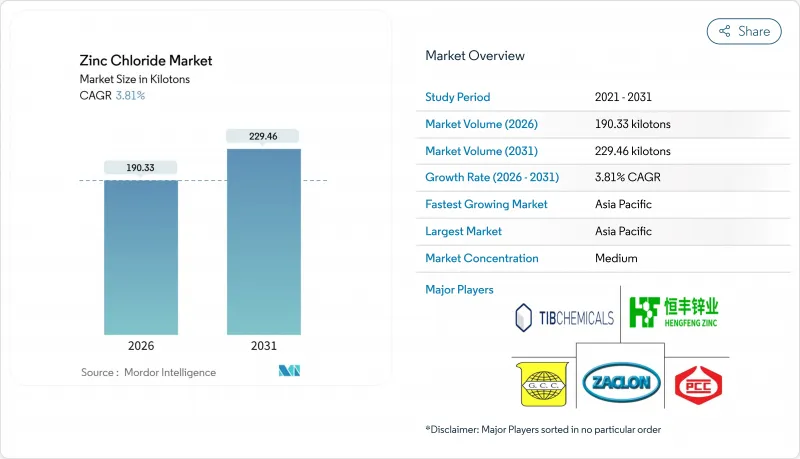
본 보고서는 등급별(산업용, 배터리용, 시약·고순도), 형태별(액체, 분말, 과립·펠릿), 용도별(수처리, 촉매, 기타), 최종 사용자 산업별(화학, 석유 및 가스,섬유, 야금, 기타), 지역별(아시아태평양, 북미, 유럽, 남미, 중동 및 아프리카)로 분류되어 있습니다. 시장 예측은 수량(톤) 기준으로 제시되어 있습니다.
세계의 염화아연 시장 동향 및 인사이트
물 부족으로 어려움을 겪는 지방자치단체의 급속한 증가가 ZnCl₂를 이용한 폐수 소독을 촉진
인도, 북아프리카, 중국 일부 지역의 심각한 물 부족으로 인해 상수도 유틸리티자들은 중금속 침전과 미생물 불활성화를 동시에 수행하기 위해 염화아연을 활용하는 3차 처리 단계로의 개조를 서둘러야 하는 상황에 처해 있습니다. 아연 이온은 인산염 및 황화물과 안정적인 착물을 형성하여 화학적 산소 요구량(COD)을 저감하는 동시에 광범위한 항균 작용을 발휘합니다. 구자라트주에서 실시된 현장 조사 결과, 섬유 산업의 폐수에 65% ZnCl2 용액을 첨가함으로써 생화학적 산소 요구량(BOD)을 30% 감소시켜, 산업 규모의 염색 공장 폐수 재활용을 가능하게 한 것으로 나타났습니다. 남아시아의 수직 통합형 공급업체들은 이러한 수요를 활용하여 LME 아연 지수에 연동된 가격으로 장기 인수 계약에 기초하여 대량 액상 ZnCl2를 공급하고 있습니다. 걸프협력회의(GCC) 국가들의 ‘폐수 무방류’ 의무화 규제 움직임에 따라 해수 담수화 플랜트에서 해당 화학물질의 도입이 가속화되고 있습니다. 전반적으로 담수 예산의 부족과 배출 비용의 급등이 2031년까지 이러한 구조적인 촉진요인을 뒷받침하고 있습니다.
리튬을 포함하지 않는 아연 이온 배터리의 시범 프로젝트를 통한 배터리용 ZnCl₂ 수요
수성 아연 이온 배터리의 실험실 수준 기술 발전은 중국과 한국의 수 메가와트 규모 시범 라인으로 확대되고 있습니다. 2M의 ZnCl2를 사용한 4전자 Zn-I? 배터리는 2만 회의 안정적인 사이클과 요오드 질량 기준 723Wh/kg의 에너지 밀도를 달성하여, 고정형 리튬 철 인산염 배터리와 동등한 성능을 실현했습니다. 전이 금속 불순물이 기생적인 수소 발생을 촉매하기 때문에 배터리 개발자들은 순도 99.995% 이상이고 총 중금속 함량이 50ppm 이하인 염화아연을 지정하고 있습니다. 아연 클로라이드 1톤당 1tCO2e 이하의 스코프 3 배출량을 입증할 수 있는 생산 업체들은 현재 장쑤성의 데이터센터용 백업 프로젝트 인증 공급업체 목록에 등록되기 시작했습니다. 산업 단체의 로드맵에 따르면, 2031년까지 배터리 등급 염화아연에 대한 전 세계 누적 수요가 5배 증가할 것으로 예측되지만, 생산 확대는 제련소 수준의 정제 능력에 의해 제약을 받을 전망입니다.
액체 ZnCl₂ 처리에 관한 EU의 엄격한 폐액·염수 규제
2024년 ‘폐기물 기본 지침’ 개정에 따라, 농도 10% 이상의 액체 염화아연은 ‘H410’ 만성 수생 독성 물질로 분류되어, 폐쇄형 처리 또는 배기가스 세정을 수반하는 고온 소각이 의무화되었습니다. 포르투갈의 섬유 가공업체들은 이 규정을 준수할 경우 폐수 처리 비용이 20% 증가할 것으로 추산하고 있으며, 액체 폐기물 기준치를 초과하지 않는 입상 염화아연으로의 전환을 강요받고 있습니다. REACH 등록 서류에는 현재 ‘제조 시작부터 공장 출하까지’의 금속 수지를 상세하게 기재하는 것이 의무화되어 있으며, 이로 인해 아연 도금 업체들은 용액을 대량으로 운송하는 대신 현장에서 결정화시킨 후 재용해하는 방식을 채택하도록 권장받고 있습니다. 이러한 조치들은 고체 처리 시스템의 규모가 확대될 때까지 유럽 내 액체 등급 제품에 대한 수요에 당분간 부정적인 영향을 미치고 있습니다.
부문별 분석
배터리용 등급은 연평균 성장률(CAGR) 5.63%를 나타낼 것으로 예측되며, 가장 빠르게 확대될 등급이 될 전망입니다. 아연-요오드 전지와 아연-공기 전지의 프로토타입 개발자들은 дендрит 형성 방지를 위해 니켈과 구리 함량이 ppm 이하인 염화물 염을 지정하고 있습니다. 중국의 주요 제조업체들은 수화 껍질을 줄이고 쿨롱 효율을 99.5% 이상으로 높이는 30M 염화아연 전해액의 유효성을 입증했습니다. 대조적으로, 염화아연 시장의 대부분은 여전히 산업용 등급이 차지하고 있으며, 2025년에는 시장 점유율의 60.51%를 차지할 것으로 예측됩니다. 이는 불순물에 대한 규제가 비교적 완만하고 가격 민감도가 높은 아연 도금용 플럭스 및 화학 합성 용도 때문입니다. 수명 주기 보증이 적용된 저탄소 배터리용 등급을 제공하는 제조업체들은 원자재 가격에 비해 20-25%의 프리미엄 가격을 책정하고 있습니다.
액체(수용액)는 투여가 용이하여 2025년에도 55.44%의 점유율을 차지한 주력 형태로 남았지만, 독일,스페인, 프랑스의 아연 도금 업체들이 암모니아 배출을 억제하기 위해 건조 플럭스 혼합 방식으로 전환하고 있어, 과립 및 펠릿 형태는 연평균 성장률(CAGR) 4.81%로 성장을 지속하고 있습니다. 또한, 과립 형태는 유출 사고에 대한 대응 비용을 절감할 수 있다는 장점이 있어, EU의 유해 폐기물 규제가 강화되는 가운데 이 장점이 특히 주목받고 있습니다. AGC의 태국 내 염소-알칼리 사업 확장이 2027년에 가동을 시작하면, 동남아시아의 생산량은 증가할 전망입니다. 이로 인해 해당 지역의 염소 비용이 낮아지고, 무수 염화아연 펠릿공급량이 증가하게 될 것입니다. 분말 형태는 습기 제거가 극히 중요한 의약품 합성 및 실험용 시약 부문에서 틈새 수요를 유지하고 있습니다.
지역별 분석
아시아태평양은 산둥성의 제련 거점과 인도의 생산 능력 확대에 힘입어 2025년에도 염화아연 시장 점유율 45.83%를 유지했습니다. 중국에서는 염소 통합 생산과 자체 발전 덕분에 단일 거점의 연간 5만 톤 규모 공장에서 톤당 1,000달러 미만의 액체 제품을 생산하고 있습니다. 인도에서는 힌두스탄 징크(Hindustan Zinc)사의 재생 가능 전력을 활용하여, 유럽의 탄소국경조정메커니즘(CBAM)에 대응한 저탄소 파생 제품의 수출을 추진하고 있습니다. 견조한 아연 도금 및 수처리 사업이 2031년까지 아시아태평양의 연평균 성장률(CAGR) 4.75%를 견인하고 있습니다.
북미는 유전용 유체의 견조한 수요 혜택을 받고 있는 반면, 유럽에서는 더욱 엄격해진 폐기물 처리 규제가 성장을 억제하는 한편, 펠릿 및 재생 ZnCl2로의 제품 구성 전환을 촉진하고 있습니다. 동남아시아에서는 태국의 염소-알칼리 사업 확대로 염소 공급이 안정화되면, 시멘트 첨가제용 펠릿을 현지에서 생산할 수 있게 되어 비용 면에서 우위를 점할 수 있습니다. 아프리카와 중동에서는 해수 담수화의 브라인 처리 및 도시 용수 재이용과 관련하여 꾸준한 수요 증가가 예상됩니다.
기타 혜택
- 엑셀 형식 시장 예측(ME) 시트
- 3개월간의 애널리스트 지원
자주 묻는 질문
목차
제1장 서론
제2장 조사 방법
제3장 주요 요약
제4장 시장 구도
제5장 시장 규모 및 성장 예측
제6장 경쟁 구도
제7장 시장 기회 및 향후 전망
KTH 26.08.28According to Mordor Intelligence, the zinc chloride market size is estimated at 190.33 kilotons in 2026, and is expected to reach 229.46 kilotons by 2031, at a CAGR of 3.81% during the forecast period (2026-2031).
This report is Segmented by Grade (Industrial, Battery, and Reagent/High-Purity), Form (Liquid, Powder, and Granules/Pellets), Application (Water Treatment, Catalyst, and More), End-User Industry (Chemical, Oil and Gas, Textile, Metallurgy, and More), and Geography (Asia-Pacific, North America, Europe, South America, and Middle-East and Africa). The Market Forecasts are Provided in Terms of Volume (Tons).
Global Zinc Chloride Market Trends and Insights
Rapid Expansion of Water-Scarce Municipalities Boosting ZnCl2 Wastewater Disinfection
Acute water stress across India, North Africa, and parts of China is impelling utilities to retrofit tertiary treatment stages that rely on zinc chloride for simultaneous heavy-metal precipitation and microbial inactivation. Zinc ions form stable complexes with phosphates and sulfides, trimming chemical oxygen demand while delivering broad-spectrum antimicrobial activity. Field trials in Gujarat showed that adding 65% ZnCl2 solution to textile effluents cut biological oxygen demand by 30% and enabled dye-house water recycling at industrial scale. Vertically integrated suppliers in South Asia are capitalizing on this pull by offering bulk liquid ZnCl2 under long-term offtake agreements priced against a zinc LME index. Regulatory drives that mandate zero-liquid discharge in the Gulf Cooperation Council countries are accelerating uptake of the same chemistry in desalination plants. Overall, tightening freshwater budgets and escalating discharge fees reinforce this structural driver through 2031.
Battery-Grade ZnCl2 Demand from Lithium-Free Zinc-Ion Pilot Projects
Laboratory breakthroughs in aqueous zinc-ion cells are translating into multimegawatt pilot lines in China and South Korea. A four-electron Zn-I2 cell using 2 M ZnCl2 delivered 20,000 stable cycles and 723 Wh/kg based on iodine mass, bringing parity with stationary lithium-iron-phosphate batteries. Because transition-metal impurities catalyze parasitic hydrogen evolution, battery developers specify >=99.995% purity zinc chloride with total heavy metals less than 50 ppm. Producers that document Scope-3 footprints below 1 tCO2e per tonne of ZnCl2 are now entering approved-vendor lists for data-center backup projects in Jiangsu province. Industry association roadmaps expect cumulative global demand for battery-grade zinc chloride to grow five-fold by 2031, although ramp-up will be gated by refinery-level purification capacity.
Stringent EU Waste-Brine Regulations on Liquid ZnCl2 Disposal
Revisions to the Waste Framework Directive in 2024 classified liquid zinc chloride at >=10% concentration as an H410 chronic aquatic toxin, obligating closed-loop or high-temperature incineration with flue-gas scrubbing. Textile processors in Portugal estimate compliance raises effluent treatment costs by 20%, nudging them toward granular zinc chloride that falls outside liquid-waste thresholds. REACH registration dossiers must now detail cradle-to-gate metal balances, encouraging galvanizers to crystallize and re-dissolve on-site rather than ship bulk solution. These measures exert immediate headwinds on European demand for liquid grades until solid handling systems scale up.
Other drivers and restraints analyzed in the detailed report include:
- Ammonium-Chloride Substitution by ZnCl2 in Galvanizing Fluxes
- Emergence of ZnCl2-Based Deep-Eutectic Solvents for Biomass Fractionation
- Zinc Metal Price Volatility Compressing Tier-2 Producer Margins
For complete list of drivers and restraints, kindly check the Table Of Contents.
Segment Analysis
Battery-grade is forecast to grow at a 5.63% CAGR, making it the fastest-expanding grade. Developers of zinc-iodine and zinc-air prototypes specify chloride salts with sub-ppm nickel and copper to avoid dendrite formation. A leading Chinese producer validated 30 M zinc chloride electrolyte that cuts hydration shells and raises Coulombic efficiency above 99.5%. In contrast, the bulk of the zinc chloride market size still resides in industrial grade with 60.51% market share in 2025 due to galvanizing fluxes and chemical synthesis, where impurity constraints are looser, and price sensitivity remains acute. Producers offering life-cycle-assured, low-carbon battery grade command premiums of 20-25% over commodity rates.
Liquid (aqueous solution) remains the workhorse format with 55.44% share in 2025 due to ease of dosing, yet granular and pellet forms are registering 4.81% CAGR as galvanizers in Germany, Spain, and France shift to dry flux blends that limit ammoniacal emissions. Granules also eliminate spill-response costs, an advantage that resonates under the EU's tightened hazardous-waste codes. Southeast Asian output is set to climb after AGC's chlor-alkali expansion in Thailand goes on-stream in 2027, lowering the regional chlorine cost base and enlarging supply for anhydrous zinc chloride pellets. Powdered forms retain niche demand in pharmaceutical synthesis and laboratory reagents where moisture exclusion is paramount.
Complete Report Scope:
- By Grade
- Industrial Grade
- Battery Grade
- Reagent/High-Purity Grade
- By Form
- Liquid (Aqueous Solution)
- Powder (Anhydrous)
- Granules and Pellets
- By Application
- Water Treatment
- Catalyst
- Other Applications
- By End-user Industry
- Chemical
- Oil and Gas
- Textile
- Metallurgy
- Other End-user Industries
- By Geography
- Asia-Pacific
- China
- India
- Japan
- South Korea
- ASEAN Countries
- Rest of Asia-Pacific
- North America
- United States
- Canada
- Mexico
- Europe
- Germany
- United Kingdom
- France
- Italy
- Spain
- NORDIC Countries
- Rest of Europe
- South America
- Brazil
- Argentina
- Rest of South America
- Middle-East and Africa
- Saudi Arabia
- South Africa
- Rest of Middle-East and Africa
- Asia-Pacific
Geography Analysis
Asia Pacific maintained 45.83% zinc chloride market share in 2025, supported by Shandong's smelting hub and India's capacity ramp-up. China's single-site 50,000 t/y plant delivers sub-USD 1,000/t liquid product thanks to chlorine integration and captive power. India leverages Hindustan Zinc's renewable electricity to position low-carbon derivatives for export into Europe's carbon-border adjustment mechanism. Robust galvanizing and water-treatment activity drives Asia Pacific's regional CAGR of 4.75% to 2031.
North America benefits from strong oilfield fluid offtake, whereas Europe's stricter disposal codes temper growth but spur product-mix upgrades toward pellets and reclaimed ZnCl2. Southeast Asia gains cost advantage once Thai chlor-alkali expansions stabilize chlorine supply, permitting local pellet manufacturing for cement additives. Africa and the Middle-East exhibit steady uptake tied to desalination brine processing and municipal water reuse.
- American Elements
- BALAJI CHEMICALS
- Eurocontal
- Flaurea Chemicals
- GFS Chemicals, Inc.
- Global Chemical Co., Ltd.
- Hunan Hecheng Pharmaceutical Chemical Co., Ltd.
- JINCHANG XINGTAI CHEMICAL CO.,LTD
- Pan-Continental Chemical Co., Ltd.
- S.A. Lipmes
- ShengLong Zinc
- TIB Chemicals AG
- Vijay Chemical Industries
- Weifang Dongfangsheng Chemical Co.,Ltd.
- Weifang Hengfeng Zinc Industry
- Zaclon LLC
Additional Benefits:
- The market estimate (ME) sheet in Excel format
- 3 months of analyst support
TABLE OF CONTENTS
1 Introduction
- 1.1 Study Assumptions and Market Definition
- 1.2 Scope of the Study
2 Research Methodology
3 Executive Summary
4 Market Landscape
- 4.1 Market Overview
- 4.2 Market Drivers
- 4.2.1 Rapid Expansion of Water-Scarce Municipalities Boosting Zncl2 Wastewater Disinfection
- 4.2.2 Battery-Grade Zncl2 Demand from Lithium-Free Zinc-Ion Pilot Projects
- 4.2.3 Ammonium-Chloride Substitution by Zncl2 In Galvanizing Fluxes
- 4.2.4 Emergence of Zncl2-based Deep-Eutectic Solvents for Biomass Fractionation
- 4.2.5 Quick-Setting Low-Carbon Cement Using Zncl2-Activated Alkali Binders
- 4.3 Market Restraints
- 4.3.1 Stringent EU Waste-Brine Regulations on Liquid Zncl2 Disposal
- 4.3.2 Zinc Metal Price Volatility Compressing Tier-2 Producer Margins
- 4.3.3 PFAS-Like Regulatory Scrutiny on Zinc-Salt Leachates
- 4.4 Value Chain Analysis
- 4.5 Porter's Five Forces
- 4.5.1 Threat of New Entrants
- 4.5.2 Bargaining Power of Buyers
- 4.5.3 Bargaining Power of Suppliers
- 4.5.4 Threat of Substitutes
- 4.5.5 Degree of Competition
5 Market Size and Growth Forecasts (Volume)
- 5.1 By Grade
- 5.1.1 Industrial Grade
- 5.1.2 Battery Grade
- 5.1.3 Reagent/High-Purity Grade
- 5.2 By Form
- 5.2.1 Liquid (Aqueous Solution)
- 5.2.2 Powder (Anhydrous)
- 5.2.3 Granules and Pellets
- 5.3 By Application
- 5.3.1 Water Treatment
- 5.3.2 Catalyst
- 5.3.3 Other Applications
- 5.4 By End-user Industry
- 5.4.1 Chemical
- 5.4.2 Oil and Gas
- 5.4.3 Textile
- 5.4.4 Metallurgy
- 5.4.5 Other End-user Industries
- 5.5 By Geography
- 5.5.1 Asia-Pacific
- 5.5.1.1 China
- 5.5.1.2 India
- 5.5.1.3 Japan
- 5.5.1.4 South Korea
- 5.5.1.5 ASEAN Countries
- 5.5.1.6 Rest of Asia-Pacific
- 5.5.2 North America
- 5.5.2.1 United States
- 5.5.2.2 Canada
- 5.5.2.3 Mexico
- 5.5.3 Europe
- 5.5.3.1 Germany
- 5.5.3.2 United Kingdom
- 5.5.3.3 France
- 5.5.3.4 Italy
- 5.5.3.5 Spain
- 5.5.3.6 NORDIC Countries
- 5.5.3.7 Rest of Europe
- 5.5.4 South America
- 5.5.4.1 Brazil
- 5.5.4.2 Argentina
- 5.5.4.3 Rest of South America
- 5.5.5 Middle-East and Africa
- 5.5.5.1 Saudi Arabia
- 5.5.5.2 South Africa
- 5.5.5.3 Rest of Middle-East and Africa
- 5.5.1 Asia-Pacific
6 Competitive Landscape
- 6.1 Market Concentration
- 6.2 Strategic Moves
- 6.3 Market Share(%)/Ranking Analysis
- 6.4 Company Profiles (includes Global-level Overview, Market-level Overview, Core Segments, Financials as available, Strategic Information, Products and Services, Recent Developments)
- 6.4.1 American Elements
- 6.4.2 BALAJI CHEMICALS
- 6.4.3 Eurocontal
- 6.4.4 Flaurea Chemicals
- 6.4.5 GFS Chemicals, Inc.
- 6.4.6 Global Chemical Co., Ltd.
- 6.4.7 Hunan Hecheng Pharmaceutical Chemical Co., Ltd.
- 6.4.8 JINCHANG XINGTAI CHEMICAL CO.,LTD
- 6.4.9 Pan-Continental Chemical Co., Ltd.
- 6.4.10 S.A. Lipmes
- 6.4.11 ShengLong Zinc
- 6.4.12 TIB Chemicals AG
- 6.4.13 Vijay Chemical Industries
- 6.4.14 Weifang Dongfangsheng Chemical Co.,Ltd.
- 6.4.15 Weifang Hengfeng Zinc Industry
- 6.4.16 Zaclon LLC
7 Market Opportunities and Future Outlook
- 7.1 White-Space and Unmet-Need Assessment
- 7.2 Innovations in New Production Routes