

|
시장보고서
상품코드
2114761
플루오로실리콘 시장 : 점유율 분석, 업계 동향과 통계, 성장 예측(2026-2031년)Fluorosilicone - Market Share Analysis, Industry Trends & Statistics, Growth Forecasts (2026 - 2031) |
||||||
 Mordor Intelligence
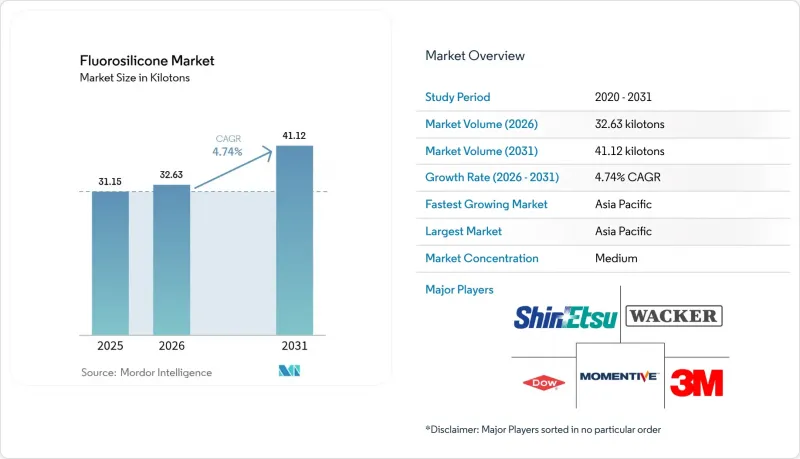
Mordor Intelligence에 의하면, 플루오로실리콘 시장 규모는 2025년 31.15 킬로톤에서 2026년에는 32.63 킬로톤으로 확대되어 2026년부터 2031년까지 CAGR 4.74%로 성장을 지속하여, 2031년에는 41.12 킬로톤에 이를 것으로 예측됩니다.
본 보고서에서는 업계를 제품 유형(엘라스토머, 접착제 및 실란트 등), 최종 사용자 산업(석유 및 가스, 자동차 등), 지역(아시아태평양, 북미 등)별로 분류하고 있습니다. 시장 예측은 수량(톤) 단위로 표시되어 있습니다.
세계 플루오로실리콘 시장 동향 및 인사이트
항공우주 및 방위 분야의 연료/유압 시스템 수요 증가
현대 항공기의 연료 회로는 177°C를 넘는 고온에서 작동하며, 합성 바이오 제트 연료 블렌드, 작동유 및 제빙 첨가제 사이를 순환합니다. 표준 실리콘은 파단되거나 팽창하지만, 플루오로실리콘에 포함된 트리플루오로프로틸 치환 사슬은 -73°C까지 탄성을 유지하므로 고고도에서 발생하는 취성 파단을 방지할 수 있습니다. 주요 씰 공급업체들은 현재 피로 현상 없이 급격한 압력 주기를 견딜 수 있도록 MIL-DTL-25988을 준수하는 플루오로실리콘 O-링 인증을 진행하고 있습니다. 경량화 추세가 강화됨에 따라 이러한 전환은 더욱 가속화되고 있습니다. 이는 더 얇은 씰의 경우, 수명 기간 동안 신뢰성을 유지하기 위해 뛰어난 내화학성이 요구되기 때문입니다.
해양 석유 및 가스전에서의 활용 확대
초심해 유정에서는 압력이 22,000 psi를 초과하고 온도는 450°F에 육박합니다. 컴플리트 스트링이나 FPSO의 유체 스위블은 사워 가스, 고농도 염수, 급격한 가스 감압에 노출됩니다. 플루오로실리콘은 HNBR이나 퍼플루오로엘라스토머가 균열이 생기거나 강도가 저하되는 상황에서도 탄성 계수와 부피 변화를 API 규격의 허용 범위 내로 유지합니다. 유지보수 주기가 길어짐에 따라 리프트 비용이 절감되므로, 운영사는 가혹한 가스 저류층용 패커, 분출 방지 장치(BOP) 씰 및 유정 내 센서에 플루오로실리콘을 지정하고 있습니다.
비용 경쟁력 있는 대체재의 등장
현재, 첨단 EPDM, HNBR 및 VMQ 컴파운드는 과거에는 플루오로실리콘에서만 볼 수 있었던 수준의 내연료성을 달성하여, 중온 용도에서 최대 70%의 재료비 절감을 실현하고 있습니다. 이러한 전환이 가장 빠르게 진행되고 있는 분야는 총 노출 온도가 180°C를 거의 넘지 않는 대중 시장용 자동차 및 가전제품의 씰 분야입니다. 그러나 부식성이 높은 방향족 화합물에 노출되고 큰 온도 변동이 동시에 발생하는 환경에서는 경쟁 엘라스토머의 성능이 여전히 미치지 못하는 것이 현실입니다.
부문 분석
2025년, 엘라스토머는 플루오로실리콘 시장에서 가장 큰 점유율을 차지하여 수량 기준으로 46.55%를 차지했습니다. 고점도 고무나 액상 실리콘 고무와 같은 형태가 호스, 개스킷, O-링 제조업체가 사용하는 프레스 성형, 압출 성형, 사출 성형 각 라인에 적합하기 때문에 엘라스토머가 시장을 독점하고 있습니다. 윤활제, 그리스 및 유전성 유체는 규모는 작지만 성장 속도가 빠른 분야에 속하며, 배터리식 전기차의 냉각 회로 확대에 따라 2031년까지 연평균 성장률(CAGR) 7.55%를 나타낼 것으로 예측됩니다. 양산에서는 액체 등급이 엄격한 공차를 유지하면서 사이클 시간을 단축하고, 2액형 실온 가황(RTV) 화학 조성물이 라인에서 개스킷 장착을 간소화합니다. 특수 코팅 및 소포제는 여전히 틈새 시장에 머물러 있지만 수익성이 높으며, 화학적으로 불활성이고 이취나 악취를 발생시키지 않는 제제를 필요로 하는 제약 및 식품 가공 업체에 판매되고 있습니다.
배합 범위가 넓어짐에 따라 공급업체는 각 고객의 사양에 맞추어 경도, 탄력성, 팽윤 한계를 조정할 수 있게 됩니다. 이러한 유연성 덕분에 산업 간 수요 변화가 있더라도 엘라스토머의 우위는 유지될 것입니다. 한편, 윤활제 하위 부문은 낮은 전기 전도성이 중요한 ‘직접 침지형 배터리 냉각’의 급증에 힘입어 성장하고 있습니다. 또한, 탄화수소의 역류를 허용할 수 없는 반도체용 진공 펌프에서도 채택이 확대되고 있습니다. 이러한 용도 전반에 걸쳐, 윤활제용 플루오로실리콘 시장 규모는 2030년까지 실험실 규모에서 상업적 규모의 톤 단위로 확대될 가능성이 있습니다.
지역별 분석
아시아태평양은 2025년에 전 세계 출하량의 38.55%를 차지하며, 2031년까지 연평균 성장률(CAGR) 6.55%를 기록할 전망입니다. 중국은 자동차용 터보차저의 대량 생산, 300mm 반도체 팹의 급속한 확대, 그리고 특수 화학제품의 국내 공급망 구축을 목표로 한 국가 프로그램 덕분에 여전히 핵심 거점으로 자리 잡고 있습니다. 현지 화학자들은 유수 분리를 위한 플루오로실리콘 폼을 시험하고 있으며, 이러한 노력은 이 지역의 혁신 깊이를 입증하고 있습니다. 일본은 정밀한 공정 노하우를 활용하여 우주·방위 장비용 초고순도 등급 제품을 생산하고 있는 반면, 한국에서는 KCC 코퍼레이션이 모멘티브(Momentive)사를 흡수 합병함으로써 재벌 구조가 혜택을 입어 사내 공급 안정성이 확고해졌습니다.
북미는 항공, 우주, 방위 분야는 물론, 고품질 소재를 선호하는 셰일 및 해양 사업자들의 지원에 힘입어 여전히 2위의 소비 지역을 유지하고 있습니다. 이 지역의 플루오로실리콘 시장 규모는 FAA 및 DoD의 인증에 의해 뒷받침되고 있으며, 이를 통해 긴 교체 주기가 보장되고 있습니다. 자동차 분야 수요는 비용 절감 목표의 영향으로 눈부시다기보다는 안정적이지만, 배터리식 전기 트럭으로의 전환에 따라 열 인터페이스 재료 및 유전체 유체 분야에서 새로운 기회가 창출되고 있습니다. 캐나다의 오일샌드에서는 사용 온도가 충분히 높기 때문에 FKM보다 플루오로실리콘의 사용이 정당화되며, 이 지역 수요가 에너지 분야로 확대되고 있습니다.
유럽은 가장 복잡한 규제 환경에 직면해 있습니다. REACH에 기반한 PFAS 규제안은 보고 및 대체 요건을 강화하고 있지만, 항공우주, 의료 및 중요 에너지 인프라에 대해서는 적용 예외가 마련되어 있습니다. 독일의 OEM 기업들은 바이오연료 대응 엔진에 계속해서 플루오로실리콘 호스를 채택하고 있으며, 프랑스의 원자력 시설에서는 내방사선 등급의 사용이 지속되고 있습니다. 북유럽 국가들에서는 폴리머 사슬을 재활용 가능한 단량체로 분해하는 재활용 실리콘 루프에 대한 연구가 진행되고 있으며, 이는 장기적인 공급을 안정화할 가능성이 있는 순환형 경제로 가는 길이 될 것입니다. 전반적으로 유럽의 소비량은 완만하게 증가하고 있으나, 지속 가능하고 불소 함량이 낮은 설계로 전환되고 있어, 이 틈새 시장에서 현지 생산자들이 강점을 발휘할 수 있는 위치에 있습니다.
기타 혜택:
- 엑셀 형식 시장 예측(ME) 시트
- 3개월간의 애널리스트 지원
자주 묻는 질문
목차
제1장 서론
제2장 조사 방법
제3장 주요 요약
제4장 시장 구도
제5장 시장 규모와 성장 예측
제6장 경쟁 구도
제7장 시장 기회와 향후 전망
JHS 26.08.26According to Mordor Intelligence, the fluorosilicone market size is expected to grow from 31.15 kilotons in 2025 to 32.63 kilotons in 2026 and is forecast to reach 41.12 kilotons by 2031 at 4.74% CAGR over 2026-2031.
This report Segments the Industry by Product Type (Elastomer, Adhesives and Sealants, and More), End-User Industry (Oil and Gas, Automotive, and More), and Geography (Asia-Pacific, North America, and More). The Market Forecasts are Provided in Terms of Volume (Tons).
Global Fluorosilicone Market Trends and Insights
Growing Demand from Aerospace & Defence Fuel/Hydraulic Systems
Modern aircraft fuel circuits run hotter than 177 °C and cycle between synthetic bio-jet blends, hydraulic fluids, and anti-icing additives. Standard silicones fracture or swell, but trifluoropropyl-substituted chains in fluorosilicone stay elastic down to -73 °C, avoiding brittle failure at altitude. Leading seal suppliers now qualify fluorosilicone O-rings under MIL-DTL-25988 to satisfy rapid pressure cycling without fatigue. Weight-saving trends intensify the switch because thinner seals rely on superior chemical tenacity to preserve lifetime reliability.
Rising Utilisation from Offshore Oil and Gas Fields
Ultra-deep wells exceed 22,000 psi and approach 450 °F. Completion strings and FPSO fluid swivels face sour gas, high brine salinity, and rapid gas decompression. Fluorosilicone keeps modulus and volume change within API-spec limits where HNBR and perfluoroelastomer grades either crack or lose strength. Longer mean time between intervention lowers lifting costs, so operators specify fluorosilicone on packers, blow-out preventer seals, and downhole sensors for harsh-gas reservoirs.
Availability of Cost-Competitive Alternatives
Advanced EPDM, HNBR, and VMQ compounds now reach fuel-resistance levels once exclusive to fluorosilicone, offering up to 70% material savings for moderate-temperature duties. The switch is fastest in mass-market automotive and appliance seals where total exposure temperatures seldom surpass 180 °C. However, in environments with simultaneous exposure to aggressive aromatics and large thermal swings, competing elastomers still fall short.
Other drivers and restraints analyzed in the detailed report include:
- Adoption in High-Temperature Automotive Turbo & Bio-Fuel Lines
- Emergence of Flexible Electronics and EV Battery Applications
- Fluoromonomer Price Volatility & Supply Bottlenecks
For complete list of drivers and restraints, kindly check the Table Of Contents.
Segment Analysis
Elastomers generated the largest slice of the fluorosilicone market in 2025, capturing 46.55% of volume. They dominate because high-consistency rubber and liquid silicone rubber formats suit press-molding, extrusion, and injection lines used by hose, gasket, and O-ring producers. Lubricants, greases, and dielectric fluids sit in a smaller but faster pool, expected to post a 7.55% CAGR through 2031 as battery-electric cooling circuits scale up. In mass production, liquid grades cut cycle times while holding tight tolerances, and two-part room-temperature-vulcanizing chemistries simplify on-line gasketing. Specialty coatings and antifoams stay niche yet profitable, sold to pharmaceutical and food processors that need chemically inert, non-tainting agents.
A wider formulation window allows suppliers to tailor hardness, resilience, and swelling limits to each customer specification. That flexibility preserves elastomer prominence even as volumes shift among industries. Meanwhile, the lubricant sub-segment rides the jump in direct-immersion battery cooling, where low electrical conductivity matters. Adoption also spreads in semiconductor vacuum pumps unable to tolerate hydrocarbon backstreaming. Across these uses the fluorosilicone market size for lubricants could move from lab scale to commercial tonnage by 2030.
Complete Report Scope:
- By Product Type
- Elastomer
- Adhesives and Sealants
- Antifoams
- Coating
- Other Product Types (Lubricants, etc.)
- By End-user Industry
- Oil and Gas
- Automotive
- Aerospace and Defence
- Other End-user Industries (Industrial OEM, etc.)
- By Geography
- Asia-Pacific
- China
- India
- Japan
- South Korea
- Rest of Asia-Pacific
- North America
- United States
- Canada
- Mexico
- Europe
- Germany
- United Kingdom
- France
- Italy
- Rest of Europe
- South America
- Brazil
- Argentina
- Rest of South America
- Middle East and Africa
- Saudi Arabia
- South Africa
- Rest of Middle East and Africa
- Asia-Pacific
Geography Analysis
Asia-Pacific controlled 38.55% of global shipments in 2025 and is poised to record a 6.55% CAGR to 2031. China remains the central node, thanks to high-volume automotive turbocharger production, rapid expansion in 300 mm semiconductor fabs, and state programs that target domestic supply chains for specialty chemicals. Indigenous chemists are trialling fluorosilicone foams for oil-water separation, a step that underlines the region's innovation depth. Japan leverages precision process know-how to turn out ultra-clean grades for space and defence instruments, while South Korea's chaebol structure benefited after KCC Corporation absorbed Momentive, cementing in-house supply security.
North America maintains the second-largest consumption bloc, supported by its aviation, space, and defence sectors, plus shale and offshore operators that prefer premium materials. The fluorosilicone market size in the region is anchored by FAA and DoD certifications, which lock in long replacement cycles. Automotive demand is stable rather than stellar, hampered by cost-down targets, yet the shift to battery-electric trucks creates new thermal-interface and dielectric-fluid opportunities. Canadian oil sands push service temperatures high enough to justify fluorosilicone over FKM, extending regional demand into energy.
Europe faces the most intricate regulatory climate. Draft PFAS restrictions under REACH tighten reporting and substitution requirements, but carve-out exemptions exist for aerospace, medical, and critical energy infrastructure. German OEMs continue to fit fluorosilicone hoses on bio-fuel-capable engines, and French nuclear facilities keep using radiation-hard grades. Nordic countries explore recycled silicone loops that break down polymer chains into reusable monomers, a pathway for circularity that could stabilise long-term supply. Overall, European consumption grows slowly yet shifts toward sustainable, low-fluoro content designs, a niche that local producers are well placed to serve.
- 3M
- Dow
- Eagle Elastomer Inc.
- DLR Elastomer Engineering Ltd
- Marco Rubber & Plastics
- Momentive Performance Materials (KCC Corporation)
- Parker Hannifin Corp
- Shandong Huaxia Shenzhou New Material Co., Ltd.
- Shin-Etsu Silicones of America, Inc.
- Trelleborg Group
- Wacker Chemie AG
- Zhejiang Huanxin Fluoro Material Co. Ltd.
Additional Benefits:
- The market estimate (ME) sheet in Excel format
- 3 months of analyst support
TABLE OF CONTENTS
1 Introduction
- 1.1 Study Assumptions
- 1.2 Scope of the Study
2 Research Methodology
3 Executive Summary
4 Market Landscape
- 4.1 Market Overview
- 4.2 Market Drivers
- 4.2.1 Growing demand from aerospace & defence fuel/ hydraulic systems
- 4.2.2 Rising utilisation from the oil and gas industry
- 4.2.3 Adoption in high-temperature automotive turbo & bio-fuel lines
- 4.2.4 Emergence of flexible electronics and electric vehicle battery applications
- 4.2.5 Commercialisation of bio-sourced fluorinated siloxane monomer
- 4.3 Market Restraints
- 4.3.1 Availability of cost-competitive alternatives
- 4.3.2 Fluoromonomer price volatility & supply bottlenecks
- 4.3.3 Environemntal concerns related to fluorine compounds
- 4.4 Value Chain Analysis
- 4.5 Porter's Five Forces
- 4.5.1 Bargaining Power of Suppliers
- 4.5.2 Bargaining Power of Buyers
- 4.5.3 Threat of New Entrants
- 4.5.4 Threat of Substitutes
- 4.5.5 Degree of Competition
5 Market Size & Growth Forecasts (Volume)
- 5.1 By Product Type
- 5.1.1 Elastomer
- 5.1.2 Adhesives and Sealants
- 5.1.3 Antifoams
- 5.1.4 Coating
- 5.1.5 Other Product Types (Lubricants, etc.)
- 5.2 By End-user Industry
- 5.2.1 Oil and Gas
- 5.2.2 Automotive
- 5.2.3 Aerospace and Defence
- 5.2.4 Other End-user Industries (Industrial OEM, etc.)
- 5.3 By Geography
- 5.3.1 Asia-Pacific
- 5.3.1.1 China
- 5.3.1.2 India
- 5.3.1.3 Japan
- 5.3.1.4 South Korea
- 5.3.1.5 Rest of Asia-Pacific
- 5.3.2 North America
- 5.3.2.1 United States
- 5.3.2.2 Canada
- 5.3.2.3 Mexico
- 5.3.3 Europe
- 5.3.3.1 Germany
- 5.3.3.2 United Kingdom
- 5.3.3.3 France
- 5.3.3.4 Italy
- 5.3.3.5 Rest of Europe
- 5.3.4 South America
- 5.3.4.1 Brazil
- 5.3.4.2 Argentina
- 5.3.4.3 Rest of South America
- 5.3.5 Middle East and Africa
- 5.3.5.1 Saudi Arabia
- 5.3.5.2 South Africa
- 5.3.5.3 Rest of Middle East and Africa
- 5.3.1 Asia-Pacific
6 Competitive Landscape
- 6.1 Market Concentration
- 6.2 Strategic Moves
- 6.3 Market Share(%)/Ranking Analysis
- 6.4 Company Profiles {(includes Global level Overview, Market level overview, Core Segments, Financials as available, Strategic Information, Market Rank/Share for key companies, Products & Services, and Recent Developments)}
- 6.4.1 3M
- 6.4.2 Dow
- 6.4.3 Eagle Elastomer Inc.
- 6.4.4 DLR Elastomer Engineering Ltd
- 6.4.5 Marco Rubber & Plastics
- 6.4.6 Momentive Performance Materials (KCC Corporation)
- 6.4.7 Parker Hannifin Corp
- 6.4.8 Shandong Huaxia Shenzhou New Material Co., Ltd.
- 6.4.9 Shin-Etsu Silicones of America, Inc.
- 6.4.10 Trelleborg Group
- 6.4.11 Wacker Chemie AG
- 6.4.12 Zhejiang Huanxin Fluoro Material Co. Ltd.
7 Market Opportunities & Future Outlook
- 7.1 White-space & Unmet-need Assessment


