

|
시장보고서
상품코드
2114763
인간 생식 기술 : 시장 점유율 분석, 업계 동향 및 통계, 성장 예측(2026-2031년)Human Reproductive Technologies - Market Share Analysis, Industry Trends & Statistics, Growth Forecasts (2026 - 2031) |
||||||
 Mordor Intelligence
Mordor Intelligence에 의하면, 2026년 인간 생식 기술 시장 규모는 334억 6,000만 달러로 추정되고 2025년 326억 4,000만 달러에서 확대해, 2031년 예측은 378억 7,000만 달러에 달하며, 2026-2031년에 걸쳐 CAGR 2.51%로 성장할 전망입니다.
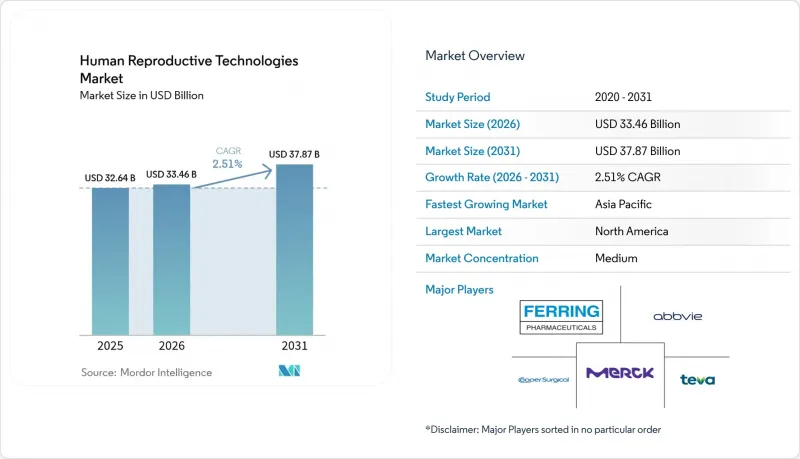
본 보고서는 생식 기술(불임 치료 및 피임법), 성별(남성 및 여성), 최종 사용자(불임 치료 클리닉, 병원·외과 센터, 기타), 제품 유형(의약품, 의료기기·설비), 지역별로 분류되어 있습니다. 시장 규모와 전망은 금액(달러)으로 표시되어 있습니다.
세계의 인간 생식 기술 시장 동향 및 인사이트
불임 유병률 증가
현재 성인 6명 중 1명이 인생의 어느 단계에서 불임을 경험하고 있으며, 이는 첨단 생식 의학에 대한 지속적인 수요를 촉진하는 공중 보건상의 과제임을 여실히 보여줍니다. 미국에서는 불임을 보고한 50세 미만의 기혼 여성 비율이 2010년대 초반 6.7%에서 2019년에는 8.7%로 상승했습니다. 아시아태평양의 일부 국가 및 지역은 더욱 심각한 압박에 직면해 있으며, 한국의 총특수출생률은 0.8까지 급락하여 세계 최저 수준을 기록하고 있습니다. 환경적 요인에의 노출, 생활 방식의 변화, 출산 연기 등이 생물학적 위험을 증가시켜 더 많은 부부가 보조생식기술(ART)을 찾게 되고 있습니다. 이러한 요인들이 복합적으로 작용하여, 전체 인간 생식 기술 시장 내에서 한 자릿수 중반의 성장률을 유지하는 부문을 뒷받침하고 있습니다.
지속적인 기술 발전 - ICSI, 착상 전 유전자 검사
AI를 활용한 배아 선별은 현재 임상 임신 예측 정확도에서 최대 75%를 달성하고 있으며, 기존의 형태학적 평가만을 통한 방법보다 정확도가 향상되었습니다. 로봇 제어에 의한 세포질 내 정자 주입법(ICSI)은 2,300마일이 넘는 원격 조작을 가능하게 하면서 더 높은 수정률을 실현하고 있습니다. 배양액 내 무세포 DNA를 분석하는 비침습적 착상 전 유전자 검사는 생검을 통한 방법과 동등한 일치율을 보여주고 있어, 배아 조작에 따른 위험을 줄이고 있습니다. 딥러닝과 결합된 타임랩스 영상 시스템을 통해 배아에 대한 조사 조건을 변경하지 않고도 지속적인 모니터링이 가능해져, 선정 프로토콜이 최적화되었습니다. 이러한 진보로 인해 치료 주기 수가 감소하고, 성공률이 향상되며, 환자의 비용 부담이 경감됨에 따라 인간 생식 기술 시장 전반에 걸쳐 도입이 촉진되고 있습니다.
ART에 대한 보험 적용 범위 제한
고용주에 의한 복리후생 확충이 진행되고 있음에도 불구하고, 미국에서는 여전히 많은 환자가 체외수정(IVF) 1주기당 1만 2,000-2만 5,000달러의 본인 부담금을 감당해야 하여, 중산층 가구의 이용이 제한되고 있습니다. 많은 저·중소득 국가에서는 ART 비용이 1인당 GDP의 200%를 초과하는 경우도 있어, 대다수의 사람들에게 이 서비스는 이용 불가능한 상황입니다. 보험 계약에서는 진단은 보장되는 반면 치료는 제외되는 경우가 많아, 이로 인해 치료 과정이 분절화되어 인간 생식 기술 시장의 잠재력을 저해하고 있습니다. 이러한 보상 격차는 특히 가격에 민감한 신흥 시장에서 치료 건수 증가를 둔화시키고 있습니다.
부문별 분석
2025년에는 피임 솔루션이 매출의 58.02%를 차지했으며, 이는 모든 인구층에서 오랫동안 확립된 수요가 있음을 보여줍니다. 경구 피임약이 여전히 주류를 이루고 있지만, 차세대 자궁 내 시스템에 서방형 메커니즘이 도입됨에 따라 장시간 작용형 가역적 피임법의 점유율이 확대되고 있습니다. 이와 동시에, 불임 치료는 전체 인간 생식 기술 시장의 성장률을 상회하며, 2031년까지 연평균 성장률(CAGR)은 3.02%로 예측됩니다. 공적 자금 확충, AI를 활용한 배아 분석, 시술의 복잡성 감소로 인해, 특히 아시아태평양의 클리닉에서 치료 주기 수가 증가하고 있습니다. 약물과 의료기기를 결합한 프로토콜을 통해 자극 투여량이 감소하고 주기 기간이 단축됨에 따라 환자들로부터의 지지가 확대되고 있습니다.
연구개발(R&D) 투자는 생식세포의 질 향상, 비침습적 유전자 검사, 로봇을 이용한 미세 조작과 같은 분야에 집중되고 있으며, 이러한 분야들은 1주기당 출생률이라는 현재 42%라는 상한선을 넘어 성공률의 기준을 높일 것으로 기대됩니다. 그 결과, 예방적 서비스와 치료적 서비스를 모두 제공하는 통합형 서비스 제공업체는 인간 생식 기술 시장에서 높아지는 부문 간 수요를 흡수할 준비를 갖추고 있습니다.
2025년에는 피임법 보급률과 확립된 불임 치료를 배경으로 여성용 부문이 매출의 85.05%를 차지했습니다. 그러나 획기적인 남성용 피임약 파이프라인이 시장 점유율 동향을 일변시킬 가능성을 내포하고 있습니다. 현재 3상 임상시험 단계에 있는 외용 호르몬 젤은 15주 이내에 86%의 정자 억제 효과를 발휘하여, 기존 주사제보다 빠른 효과를 보이고 있습니다. 선택적 레티노산 수용체 길항제나 하이드로겔 기반 정관 폐쇄형 임플란트와 같은 비호르몬계 대안은 초기 임상시험 단계에 접어들었으며, 호르몬으로 인한 부작용이 없는 가역적인 방법을 찾는 남성들에게 매력적인 선택지가 되고 있습니다.
남성 불임 진단 분야에서도 AI를 활용한 정자 품질 예측이 적용되어, 검사실의 업무 부담을 줄이면서 예측 정확도를 높이고 있습니다. 이러한 혁신 기술 덕분에 해당 부문은 연평균 성장률(CAGR) 3.28%라는 업계 최고 수준의 성장이 예상되며, 이는 인간 생식 기술 산업이 얼마나 성평등한 치료 포트폴리오를 확대하고 있는지를 보여줍니다.
지역별 분석
북미는 성숙한 헬스케어 자금 조달 체계, 고용주에 의한 광범위한 불임 치료 혜택, AI를 활용한 임상 프로토콜의 조기 도입의 혜택을 받아 2025년 매출의 44.78%를 차지했습니다. 또한, 이 지역에서는 지원적인 연방 정책도 시행되고 있으며, 그 예로 2025년에 발령된 군인 및 공무원 가족에 대한 체외수정(IVF) 급여를 확대하는 대통령령이 있습니다. 그러나 2030년까지 생식 내분비 전문의가 5,170명 부족할 것으로 예측되어, 이것이 성장을 부분적으로 제약하고 있습니다. 이러한 인력 부족으로 인해 임상 인력을 둘러싼 경쟁이 격화되는 한편, 공급 격차를 메우기 위한 원격의료 및 로봇 솔루션 도입이 촉진되고 있습니다.
아시아태평양은 2031년까지 연평균 성장률(CAGR)이 3.92%로 예측되어 가장 빠르게 성장하고 있는 지역입니다. 정책적 노력이 중심적인 역할을 하고 있으며, 중국이 전국적인 ART(생식보조의료) 보험 적용을 검토하고 있는 것은 연간 수백만 건에 달하는 치료 주기 증가로 이어질 가능성이 있습니다. 일본에서도 체외수정(IVF)과 현미수정(ICSI)에 관한 수술 코드가 개정되어, 마찬가지로 보험 적용 범위가 확대되고 있습니다. 한편, 싱가포르와 말레이시아에서는 저출산 대책의 일환으로 치료비의 최대 75%를 지원하고 있습니다. 지역 주요 도시로 향하는 ‘불임 치료 관광’은 시술 건수를 더욱 끌어올리고, 첨단 클리닉 건설을 촉진하고 있습니다.
유럽에서는 국민건강보험 제도가 환자의 막대한 본인 부담을 경감시켜 주고 있어, 안정적인 한 자릿수 중반대의 성장률을 유지하고 있습니다. 또한, 이 지역에는 ESHRE와 같은 주요 연구 네트워크가 있어 전 세계적으로 채택되고 있는 모범 사례 기준을 보급하고 있습니다. 배아 검사의 윤리나 국경을 넘는 대리모 출산을 둘러싼 규제 논쟁으로 인해 승인까지의 기간이 길어질 가능성은 있지만, 첨단 임상 기술과 높은 가처분 소득 덕분에 시술 수요는 유지되고 있습니다.
중동 및 아프리카, 남미의 신흥 경제국들은 여전히 인간 생식 기술 시장 규모에서 미미한 비중을 차지하고 있지만, 민간 클리닉에 대한 투자와 기술 이전 파트너십이 낮은 기저 수준에서 두 자릿수의 현지 성장률을 견인하고 있습니다.
기타 혜택
- 엑셀 형식 시장 예측(ME) 시트
- 3개월간의 애널리스트 지원
자주 묻는 질문
목차
제1장 서론
제2장 조사 방법
제3장 주요 요약
제4장 시장 구도
제5장 시장 규모 및 성장 예측
제6장 경쟁 구도
제7장 시장 기회 및 향후 전망
KTH 26.08.28According to Mordor Intelligence, human reproductive technologies market size in 2026 is estimated at USD 33.46 billion, growing from 2025 value of USD 32.64 billion with 2031 projections showing USD 37.87 billion, growing at 2.51% CAGR over 2026-2031.
This report is Segmented by Reproductive Technology (Infertility Treatment and Contraceptives), Gender (Male and Female), End User (Fertility Clinics, Hospitals & Surgical Centers, and More), Product Mode (Drugs, Devices and Equipment), and Geography. The Market Sizes and Forecasts are Provided in Terms of Value (USD).
Global Human Reproductive Technologies Market Trends and Insights
Rising Prevalence of Infertility
One in six adults now experiences infertility at some stage, underscoring a public-health challenge that drives sustained demand for advanced reproductive care. In the United States, the share of married women under 50 who reported infertility rose to 8.7% in 2019, up from 6.7% in the earlier half of the decade . Several Asia-Pacific economies face even sharper pressures, with South Korea's total fertility rate plummeting to 0.8, the lowest worldwide. Environmental exposure, lifestyle changes, and postponement of childbearing compound biologic risk, pushing more couples toward assisted reproductive technology (ART). These factors collectively sustain the mid-single-digit growth segments within the broader human reproductive technologies market.
Continuous Technological Progress-ICSI & Pre-implantation Genetic Testing
AI-enhanced embryo selection now achieves up to 75% clinical pregnancy-prediction accuracy, improving over traditional morphology-only assessment . Robot-controlled intracytoplasmic sperm injection (ICSI) has demonstrated higher fertilization rates while allowing remote operation over distances exceeding 2,300 miles. Non-invasive pre-implantation genetic testing that analyzes cell-free DNA in spent culture media matches the concordance of biopsy-based methods, reducing embryo manipulation risk. Time-lapse imaging systems combined with deep learning allow continuous embryo monitoring without exposure changes, optimizing selection protocols. Such advances cut cycle numbers, raise success rates, and compress patient costs, reinforcing adoption across the human reproductive technologies market.
Limited Insurance Coverage for ART
Even as employer benefits expand, many patients still face out-of-pocket costs of USD 12,000-25,000 per IVF cycle in the United States, limiting uptake among middle-income households. In numerous low- and middle-income countries, ART fees can exceed 200% of GDP per capita, rendering services inaccessible for the vast majority. Insurance policies often cover diagnostics while excluding treatment, creating fragmented pathways that suppress the potential of the human reproductive technologies market. These reimbursement gaps slow volume growth, especially in price-sensitive emerging markets.
Other drivers and restraints analyzed in the detailed report include:
- Delayed Family Planning & Higher Maternal Age
- Growing Government Support & Reimbursement
- Ethical & Religious Opposition
For complete list of drivers and restraints, kindly check the Table Of Contents.
Segment Analysis
Contraceptive solutions dominated revenue with a 58.02% stake in 2025, testifying to long-established demand across demographics. Oral pills remain the mainstay, yet long-acting reversible contraception gains share as next-generation intra-uterine systems introduce sustained-release mechanisms. In parallel, infertility treatments outpace overall human reproductive technologies market growth, registering a 3.02% CAGR projected through 2031. Broadening public funding, AI-guided embryo analytics, and reduced procedural complexity propel treatment cycles higher, especially in Asia-Pacific clinics. Combination drug-and-device protocols lower stimulation doses and shorten cycle lengths, broadening patient appeal.
R&D investment targets gamete quality enhancement, non-invasive genetic testing, and robotic micromanipulation-areas anticipated to lift success-rate benchmarks beyond today's 42% live-birth per cycle ceiling. As a result, integrated providers that offer both preventive and therapeutic services position themselves to capture rising cross-segment demand within the human reproductive technologies market.
The female segment commanded 85.05% of revenue in 2025, anchored by contraceptive prevalence and well-established fertility treatments. However, breakthrough male contraceptive pipelines promise to reshape share dynamics. A topical hormonal gel now in Phase III delivers 86% sperm suppression within 15 weeks, faster than historic injectables. Non-hormonal options such as selective retinoic acid receptor antagonists and hydrogel-based vas-occlusive implants advance through early trials, appealing to men seeking reversible methods without hormonal side effects.
Male infertility diagnostics also benefit from AI-assisted sperm-quality prediction, reducing laboratory workload while increasing predictive accuracy. These innovations explain the segment's forecast-leading 3.28% CAGR, illustrating how the human reproductive technology industry is broadening gender-inclusive care portfolios.
Complete Report Scope:
- By Reproductive Technology
- Infertility Treatment
- Drugs
- Follitropin Alfa
- Follitropin Beta
- Menotropins
- Others
- Devices
- Sperm Separation Devices
- Sperm Analyzer Systems
- Ovum Aspiration Pumps
- Micromanipulator Systems
- Others
- Drugs
- Contraceptive
- Drugs
- Oral Contraceptives
- Topical Contraceptives
- Contraceptive Injectables
- Devices
- Condoms
- IUD
- Cervical Caps
- Diaphragms
- Drugs
- Infertility Treatment
- By Gender
- Male
- Female
- By End User
- Fertility Clinics
- Hospitals & Surgical Centers
- Homecare & OTC
- Research Institutes
- By Product Mode
- Drugs
- Devices & Equipment
- By Geography
- North America
- United States
- Canada
- Mexico
- Europe
- Germany
- United Kingdom
- France
- Italy
- Spain
- Rest of Europe
- Asia-Pacific
- China
- Japan
- India
- Australia
- South Korea
- Rest of Asia-Pacific
- Middle East & Africa
- GCC
- South Africa
- Rest of Middle East & Africa
- South America
- Brazil
- Argentina
- Rest of South America
- North America
Geography Analysis
North America generated 44.78% of 2025 revenue, benefiting from mature healthcare financing, broad employer fertility benefits, and early adoption of AI-driven clinical protocols. The region also enacts supportive federal policy, exemplified by the 2025 executive order extending IVF benefits to military and civil-service families. Yet growth is partially constrained by a projected shortfall of 5,170 reproductive endocrinologists by 2030, which intensifies competition for clinical talent and incentivizes tele-medicine and robotic solutions to balance supply gaps.
Asia-Pacific represents the fastest-growing geography with a 3.92% CAGR expected through 2031. Policy levers play a central role: China's exploration of national ART reimbursement could unlock millions of incremental treatment cycles per year. Japan's updated surgical codes for IVF and ICSI similarly expand coverage, while Singapore and Malaysia subsidize up to 75% of treatment costs to combat declining birth rates. Fertility tourism into regional hubs further boosts procedure volumes and encourages high-tech clinic build-outs.
Europe maintains steady, mid-single-digit growth as universal health systems shield patients from high out-of-pocket spend. The region also hosts leading research networks such as ESHRE, which disseminate best-practice standards adopted worldwide. Regulatory debate over embryo-testing ethics and cross-border surrogacy can lengthen approval timelines, yet clinical sophistication and high disposable income sustain procedure uptake.
Emerging economies in the Middle East, Africa, and South America still account for a modest slice of human reproductive technologies market size, but investment in private clinics and technology transfer partnerships is catalyzing double-digit local growth rates from a low base.
- The Cooper Companies
- Teva Pharmaceutical Industries
- Abbvie
- Ferring Pharmaceuticals
- Merck
- Genea
- IVFtech ApS
- Bayer
- Pfizer
- Organon
- Vitrolife
- Cook Group
- Thermo Fisher Scientific
- Boston IVF
- Virtus Health Ltd.
- Progyny Inc.
- Reckitt Benckiser Group
- Okamoto Industries Inc.
- Perrigo Company
- Care Fertility Group
Additional Benefits:
- The market estimate (ME) sheet in Excel format
- 3 months of analyst support
TABLE OF CONTENTS
1 Introduction
- 1.1 Study Assumptions
- 1.2 Scope of the Study
2 Research Methodology
3 Executive Summary
4 Market Landscape
- 4.1 Market Overview
- 4.2 Market Drivers
- 4.2.1 Rising Prevalence Of Infertility
- 4.2.2 Continuous Technological Progress-Icsi, Pre-Implantation Genetic Testing
- 4.2.3 Delayed Family Planning & Higher Maternal Age
- 4.2.4 Growing Government Support & Reimbursement
- 4.2.5 Employer-Funded Fertility-Benefit Programs
- 4.2.6 Ai-Powered Embryo & Gamete Analytics
- 4.3 Market Restraints
- 4.3.1 Limited Insurance Coverage For Art
- 4.3.2 Ethical & Religious Opposition
- 4.3.3 Stringent Regulatory Pathways And Lengthy Approval Timelines
- 4.3.4 Shortage Of Reproductive Endocrinologists
- 4.4 Value / Supply-Chain Analysis
- 4.5 Regulatory Landscape
- 4.6 Technological Outlook
- 4.7 Porter's Five Forces Analysis
- 4.7.1 Threat of New Entrants
- 4.7.2 Bargaining Power of Buyers
- 4.7.3 Bargaining Power of Suppliers
- 4.7.4 Threat of Substitutes
- 4.7.5 Competitive Rivalry
5 Market Size & Growth Forecasts
- 5.1 By Reproductive Technology
- 5.1.1 Infertility Treatment
- 5.1.1.1 Drugs
- 5.1.1.1.1 Follitropin Alfa
- 5.1.1.1.2 Follitropin Beta
- 5.1.1.1.3 Menotropins
- 5.1.1.1.4 Others
- 5.1.1.2 Devices
- 5.1.1.2.1 Sperm Separation Devices
- 5.1.1.2.2 Sperm Analyzer Systems
- 5.1.1.2.3 Ovum Aspiration Pumps
- 5.1.1.2.4 Micromanipulator Systems
- 5.1.1.2.5 Others
- 5.1.1.1 Drugs
- 5.1.2 Contraceptive
- 5.1.2.1 Drugs
- 5.1.2.1.1 Oral Contraceptives
- 5.1.2.1.2 Topical Contraceptives
- 5.1.2.1.3 Contraceptive Injectables
- 5.1.2.2 Devices
- 5.1.2.2.1 Condoms
- 5.1.2.2.2 IUD
- 5.1.2.2.3 Cervical Caps
- 5.1.2.2.4 Diaphragms
- 5.1.2.1 Drugs
- 5.1.1 Infertility Treatment
- 5.2 By Gender
- 5.2.1 Male
- 5.2.2 Female
- 5.3 By End User
- 5.3.1 Fertility Clinics
- 5.3.2 Hospitals & Surgical Centers
- 5.3.3 Homecare & OTC
- 5.3.4 Research Institutes
- 5.4 By Product Mode
- 5.4.1 Drugs
- 5.4.2 Devices & Equipment
- 5.5 By Geography
- 5.5.1 North America
- 5.5.1.1 United States
- 5.5.1.2 Canada
- 5.5.1.3 Mexico
- 5.5.2 Europe
- 5.5.2.1 Germany
- 5.5.2.2 United Kingdom
- 5.5.2.3 France
- 5.5.2.4 Italy
- 5.5.2.5 Spain
- 5.5.2.6 Rest of Europe
- 5.5.3 Asia-Pacific
- 5.5.3.1 China
- 5.5.3.2 Japan
- 5.5.3.3 India
- 5.5.3.4 Australia
- 5.5.3.5 South Korea
- 5.5.3.6 Rest of Asia-Pacific
- 5.5.4 Middle East & Africa
- 5.5.4.1 GCC
- 5.5.4.2 South Africa
- 5.5.4.3 Rest of Middle East & Africa
- 5.5.5 South America
- 5.5.5.1 Brazil
- 5.5.5.2 Argentina
- 5.5.5.3 Rest of South America
- 5.5.1 North America
6 Competitive Landscape
- 6.1 Market Concentration
- 6.2 Market Share Analysis
- 6.3 Company Profiles (includes Global level Overview, Market level overview, Core Segments, Financials as available, Strategic Information, Market Rank/Share for key companies, Products & Services, and Recent Developments)
- 6.3.1 CooperSurgical Inc.
- 6.3.2 Teva Pharmaceutical Industries Ltd.
- 6.3.3 AbbVie Inc.
- 6.3.4 Ferring B.V.
- 6.3.5 Merck KGaA
- 6.3.6 Genea Limited
- 6.3.7 IVFtech ApS
- 6.3.8 Bayer AG
- 6.3.9 Pfizer Inc.
- 6.3.10 Organon & Co.
- 6.3.11 Vitrolife AB
- 6.3.12 Cook Medical LLC
- 6.3.13 Thermo Fisher Scientific Inc.
- 6.3.14 Boston IVF
- 6.3.15 Virtus Health Ltd.
- 6.3.16 Progyny Inc.
- 6.3.17 Reckitt Benckiser Group plc
- 6.3.18 Okamoto Industries Inc.
- 6.3.19 Perrigo Company plc
- 6.3.20 Care Fertility Group
7 Market Opportunities & Future Outlook
- 7.1 White-space & Unmet-need Assessment


