
|
시장보고서
상품코드
2114765
미국의 정밀농업 소프트웨어 시장 : 점유율 분석, 업계 동향과 통계, 성장 예측(2026-2031년)United States Precision Farming Software - Market Share Analysis, Industry Trends & Statistics, Growth Forecasts (2026 - 2031) |
||||||
 Mordor Intelligence
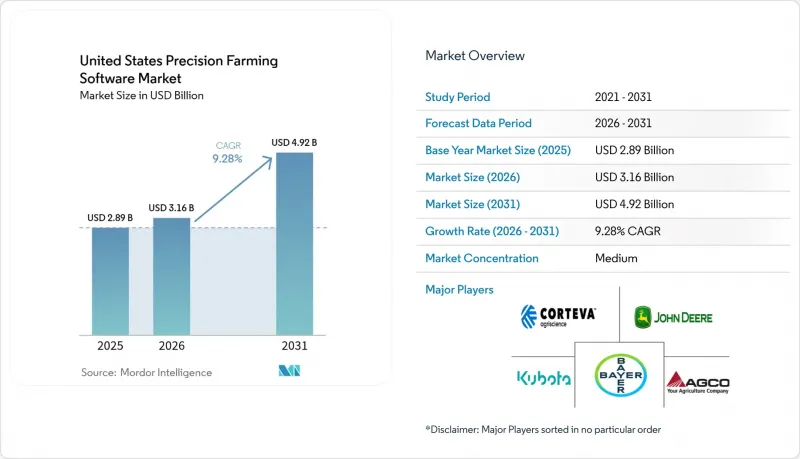
Mordor Intelligence에 의하면, 미국 정밀농업 소프트웨어 시장 규모는 2025년에 28억 9,000만 달러로 평가되었고 2026년 31억 6,000만 달러에서 2031년까지 49억 2,000만 달러에 이를 것으로 예측되며, 예측 기간(2026-2031년) CAGR은 9.28%를 나타낼 전망입니다.
본 보고서는 용도별(작물 관리, 재무 관리 등), 도입 형태별(로컬/웹 기반, 클라우드 기반), 농장 규모별(소규모, 중규모, 대규모), 최종 사용자별(작물 재배 농가 등)로 분류되어 있습니다. 시장 예측은 금액(달러)으로 표시되어 있습니다.
미국 정밀농업 소프트웨어 시장 동향 및 인사이트
농업 인력 부족과 평균 농장 규모의 확대
대규모 농장으로의 통합이 진행됨에 따라 이러한 압박은 더욱 심화되고 있습니다. 이는 더 광대한 경작 면적을 관리함에 따라 밭 작업, 인력 일정 관리, 재고 흐름을 연계하는 소프트웨어에 대한 수요가 증가하기 때문입니다. 중규모 농장은 대규모 농장의 효율성을 따라잡기 위해 노력하고 있어 가장 빠르게 반응하고 있으며, 12.2%의 연평균 성장률(CAGR)로 도입이 진행되고 있습니다. 그 결과, 미국 정밀농업 소프트웨어 시장에서는 장비의 가동 중지 시간을 줄이고, 투입 자재의 배분을 합리화하며, 부족한 인력을 대체하는 기능이 점점 더 중요시되고 있습니다. 이러한 동향에 따라 향후 두 번의 계획 주기 동안 워크플로우 자동화 및 차량군 조정 모듈이 업그레이드의 최우선 과제로 자리 잡고 있습니다.
디지털 도구에 대한 연방 정부의 비용 분담 프로그램
2024 회계연도에는 신청 건수가 15만 6,485건으로 급증하여 충족되지 않은 수요가 존재함을 시사하고 있으며, 이로 인해 프로그램의 적용 범위가 확대될 가능성이 높습니다. 이러한 인센티브는 규정 준수 보고에 필요한 상세한 농지 데이터를 수집하는 클라우드 기반 패키지로의 조기 업그레이드를 촉진하고 있습니다. 자금은 미충족 수요를 완전히 충당하지는 못하지만, 그 지속성은 대출 기관에 안도감을 주고 통합 플랫폼에 대한 장기적인 자금 조달을 촉진하고 있습니다. 그 결과, 미국의 정밀농업 소프트웨어 시장에서는 비용 분담 자금이 센서, 연결성, 구독 서비스에 대한 민간 투자를 촉진하는 선순환이 형성되고 있습니다.
높은 초기 비용과 불투명한 단기 투자 회수
아이오와주의 조사에 따르면, 생산자의 74%가 효율성 향상의 이점을 인정하면서도 정밀농업 기술을 ‘비싸다’고 평가하고 있으며, 확실한 수익을 기대할 수 없는 한 투자에 소극적임을 보여주고 있습니다. 하드웨어 생태계가 분절되어 있어, 조율이 제대로 이루어지지 않은 여러 번의 구매를 강요받게 되고, 투자 회수 기간이 길어지는 경우가 많습니다. 대규모 농장(2,000에이커 이상)은 이러한 비용을 더 쉽게 감당할 수 있어 현재 63%의 시장 점유율을 차지하고 있지만, 소규모 농장의 경우 보조금이 설비 투자 비용을 충당하지 않는 한 여전히 업그레이드를 미루고 있습니다.
부문 분석
2025년, 작물 재배 관리 솔루션은 미국 정밀농업 소프트웨어 시장 점유율의 45.35%를 차지하며, 파종, 비료 시비, 수확에 대한 의사 결정에서 핵심적인 역할을 하고 있음을 입증하고 있습니다. 작물 관리에 기인한 미국 정밀농업 소프트웨어 시장 규모는 첨단 이미지 처리, 센서 융합 및 가변 시비 기능의 발전에 따라 확대될 것으로 예측됩니다. 재무 및 규정 준수 모듈을 추가함으로써, 단일 솔루션이 다양한 농업 경영에 매력적인 종합적인 제품군으로 변모하고 있습니다.
연평균 성장률(CAGR) 11.35%로 성장하고 있는 기상 추적 용도는 고해상도 레이더와 머신러닝 모델을 활용하여 파종 적기에 영향을 미치는 미기후 변화를 예측했습니다. 이러한 성공은 오픈 API를 통해 전문적인 기능이 종합적인 플랫폼에 통합되는 마이크로서비스 아키텍처로의 전환을 여실히 보여주고 있습니다.
2025년, 미국의 정밀농업 소프트웨어 시장에서 클라우드 서비스는 60.25%를 차지했습니다. 이는 원격 액세스, 자동 업데이트, 초기 하드웨어 투자 절감 등의 이점 덕분입니다. 농촌 지역에 광섬유 회선이 구축되어 통신 사각지대가 해소됨에 따라, 클라우드 도입에 따른 미국의 정밀농업 소프트웨어 시장 규모는 연평균 성장률(CAGR) 11.02%로 성장할 전망입니다. 조기 도입자들은 농업 전문가, 기계 조작자, 회계 담당자가 단일 데이터 소스를 공유할 수 있는 원활한 멀티 디바이스 연동을 주요 이점으로 꼽고 있습니다.
전파가 잘 닿지 않는 지역에서는 오프라인 동기화 기능이 여전히 중요하기 때문에 클라우드 코어와 엣지 게이트웨이를 결합한 하이브리드 구성이 계속해서 인기를 끌고 있습니다. 각 공급업체는 사이버 보안 프로토콜을 통합하고, 계약 종료 시 데이터 이관성을 보장하는 계약 조항을 마련함으로써 차별화를 꾀하고, 벤더 종속성에 대한 우려를 완화하고 있습니다. 기기로부터 수집되는 텔레메트리 데이터의 양이 증가함에 따라, 사용량 기반 과금 방식의 스토리지 및 컴퓨팅 모델을 통해 비용이 자본 지출에서 운영비로 더욱 전환되면서, 미국 정밀농업 소프트웨어 시장에서 클라우드의 성장세가 지속될 전망입니다.
기타 혜택:
- 엑셀 형식 시장 예측(ME) 시트
- 3개월간의 애널리스트 지원
자주 묻는 질문
목차
제1장 서론
제2장 조사 방법
제3장 주요 요약
제4장 시장 구도
제5장 시장 규모와 성장 예측
제6장 경쟁 구도
제7장 시장 기회와 향후 전망
JHS 26.08.26According to Mordor Intelligence, the United States precision farming software market size was valued at USD 2.89 billion in 2025 and estimated to grow from USD 3.16 billion in 2026 to reach USD 4.92 billion by 2031, at a CAGR of 9.28% during the forecast period (2026-2031).
This report is Segmented by Application (Crop Management, Financial Management, and More), by Deployment Type (Local/Web-Based and Cloud-Based), by Farm Size (Small, Medium, and Large), and by End-User (Row-Crop Growers, and More). The Market Forecasts are Provided in Terms of Value (USD).
United States Precision Farming Software Market Trends and Insights
Farm-Labor Scarcity and Rising Average Farm Size
Consolidation into larger holdings amplifies these pressures because covering wider acreages intensifies demand for software that synchronizes field operations, labor scheduling, and inventory flows. Medium-scale farms are the most responsive, posting 12.2% CAGR adoption as they strive to match the efficiency of larger peers. Consequently, the United States precision farming software market increasingly targets features that reduce idle equipment time, streamline input allocation, and substitute scarce human labor. These dynamics position workflow automation and fleet coordination modules as core upgrade priorities over the next two planning cycles.
Federal Cost-Share Programs for Digital Tools
Application volume surged to 156,485 in fiscal 2024, signaling unmet demand that is likely to expand program breadth. These incentives stimulate early upgrades to cloud-based packages that capture granular field data needed for compliance reporting. Although funding does not fully cover backlog demand, its continuity reassures lenders and stimulates longer-term financing for integrated platforms. Consequently, the United States precision farming software market experiences a virtuous cycle wherein cost-share capital catalyzes private investment in sensors, connectivity, and subscription services.
High Upfront Cost and Unclear Short-Term Payback
Iowa surveys show 74% of growers label precision technologies expensive, even while acknowledging efficiency benefits, indicating hesitancy to invest absent guaranteed returns. Fragmented hardware ecosystems often force multiple, uncoordinated purchases that lengthen payback periods. Although large farms (>2,000 acres) shoulder these costs more easily and now hold 63% market share, smaller holdings still delay upgrades unless subsidies defray capital expense.
Other drivers and restraints analyzed in the detailed report include:
- Expanding Cloud Connectivity in Rural Broadband
- AI-Driven Agronomy Improving ROI Visibility
- Data Ownership and Privacy Concerns
For complete list of drivers and restraints, kindly check the Table Of Contents.
Segment Analysis
Crop management solutions controlled 45.35% of the United States precision farming software market share in 2025, underscoring their status as the operating hub for seeding, fertilization, and harvest decisions. The United States precision farming software market size attributed to crop management is projected to expand alongside advanced imaging, sensor fusion, and rate-variable application features. Adding financial and compliance modules converts point solutions into holistic suites that appeal to diversified operations.
Weather-tracking applications, rising at a 11.35% CAGR, exploit high-resolution radar and machine-learning models that predict micro-climate shifts affecting planting windows. Their success illustrates the shift to microservices architecture, where specialized functions bolt onto an overarching platform via open APIs.
Cloud offerings accounted for 60.25% of the United States precision farming software market in 2025 because of remote access, automatic updates, and lower upfront hardware outlays. The United States precision farming software market size for cloud deployments is primed for an 11.02% CAGR as rural fiber installations alleviate coverage gaps. Early adopters cite seamless multi-device collaboration, enabling agronomists, equipment operators, and accountants to share one data source as the principal advantage.
Offline-sync capabilities still matter in fringe signal zones, so hybrid configurations combining cloud cores with edge gateways remain popular. Providers differentiate by embedding cybersecurity protocols and contract clauses that guarantee data portability on termination, easing vendor-lock fears. As machine telemetry volumes escalate, pay-per-use storage and compute models will further shift costs from capital to operating expenditure, sustaining cloud momentum within the United States precision farming software market.
Complete Report Scope:
- By Application
- Crop Management
- Financial Management
- Farm Inventory Management
- Personnel Management
- Weather Tracking and Forecasting
- Other Applications
- By Deployment Type
- Local/Web-based
- Cloud-based
- By Farm Size
- Small (Less than 500 acres)
- Medium (500 to 2,000 acres)
- Large (More than 2,000 acres)
- By End-User
- Row-crop Growers
- Specialty-crop Growers
- Livestock and Mixed Operations
List of Companies Covered in this Report:
- Deere & Company
- Corteva Agriscience
- AGCO Corporation
- Topcon Corporation
- IBM Corporation
- Kubota Corporation
- Bayer AG
- Ag Leader Technology
- Farmers Edge Inc. (Fairfax Financial Holdings)
- Raven Industries, Inc.(CNH Industrial N.V)
- CropX Inc
- Iteris Inc. (Almaviva S.p.A.)
- Planet Labs PBC
- Farmers Business Network, Inc.
- Conservis Corp. (Rabobank and TELUS Agriculture)
Additional Benefits:
- The market estimate (ME) sheet in Excel format
- 3 months of analyst support
TABLE OF CONTENTS
1 Introduction
- 1.1 Study Assumptions and Market Definition
- 1.2 Scope of the Study
2 Research Methodology
3 Executive Summary
4 Market Landscape
- 4.1 Market Overview
- 4.2 Market Drivers
- 4.2.1 Farm-labor scarcity and rising average farm size
- 4.2.2 Federal cost-share programs for digital tools
- 4.2.3 Expanding cloud connectivity in rural broadband
- 4.2.4 AI-driven agronomy improving ROI visibility
- 4.2.5 Carbon-credit revenue models for data-rich farms
- 4.2.6 OEM-software vendor JV activity
- 4.3 Market Restraints
- 4.3.1 High upfront cost and unclear short-term payback
- 4.3.2 Data ownership and privacy concerns
- 4.3.3 Integration complexity across heterogeneous machinery
- 4.3.4 Digital-skills gap among ageing farm operators
- 4.4 Regulatory Landscape
- 4.5 Technological Outlook
- 4.6 Porter's Five Forces Analysis
- 4.6.1 Bargaining Power of Suppliers
- 4.6.2 Bargaining Power of Buyers
- 4.6.3 Threat of New Entrants
- 4.6.4 Threat of Substitutes
- 4.6.5 Intensity of Competitive Rivalry
5 Market Size and Growth Forecasts (Value)
- 5.1 By Application
- 5.1.1 Crop Management
- 5.1.2 Financial Management
- 5.1.3 Farm Inventory Management
- 5.1.4 Personnel Management
- 5.1.5 Weather Tracking and Forecasting
- 5.1.6 Other Applications
- 5.2 By Deployment Type
- 5.2.1 Local/Web-based
- 5.2.2 Cloud-based
- 5.3 By Farm Size
- 5.3.1 Small (Less than 500 acres)
- 5.3.2 Medium (500 to 2,000 acres)
- 5.3.3 Large (More than 2,000 acres)
- 5.4 By End-User
- 5.4.1 Row-crop Growers
- 5.4.2 Specialty-crop Growers
- 5.4.3 Livestock and Mixed Operations
6 Competitive Landscape
- 6.1 Market Concentration
- 6.2 Strategic Moves
- 6.3 Market Share Analysis
- 6.4 Company Profiles (Includes Global Level Overview, Market Level Overview, Core Segments, Financials as Available, Strategic Information, Market Rank/Share for Key Companies, Products and Services, and Recent Developments)
- 6.4.1 Deere & Company
- 6.4.2 Corteva Agriscience
- 6.4.3 AGCO Corporation
- 6.4.4 Topcon Corporation
- 6.4.5 IBM Corporation
- 6.4.6 Kubota Corporation
- 6.4.7 Bayer AG
- 6.4.8 Ag Leader Technology
- 6.4.9 Farmers Edge Inc. (Fairfax Financial Holdings)
- 6.4.10 Raven Industries, Inc.(CNH Industrial N.V)
- 6.4.11 CropX Inc
- 6.4.12 Iteris Inc. (Almaviva S.p.A.)
- 6.4.13 Planet Labs PBC
- 6.4.14 Farmers Business Network, Inc.
- 6.4.15 Conservis Corp. (Rabobank and TELUS Agriculture)