
|
시장보고서
상품코드
2114773
의료용 체온계 시장 : 점유율 분석, 업계 동향과 통계, 성장 예측(2026-2031년)Medical Thermometer - Market Share Analysis, Industry Trends & Statistics, Growth Forecasts (2026 - 2031) |
||||||
 Mordor Intelligence
Mordor Intelligence에 의하면, 의료용 체온계 시장 규모는 2025년 22억 9,000만 달러에서 2026년에는 24억 6,000만 달러로 확대되어 2026년부터 2031년까지 CAGR 7.57%로 성장을 지속하여, 2031년까지 35억 5,000만 달러에 이를 것으로 예측됩니다.
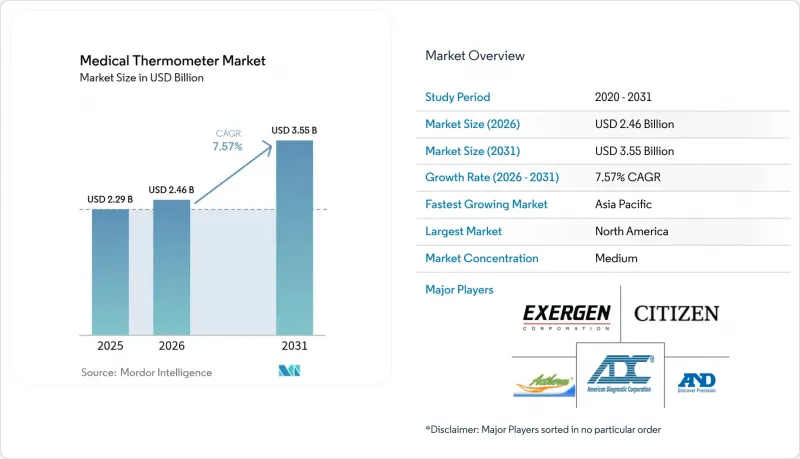
본 보고서는 제품 유형(수은식, 무수은식 (적외선(비접촉식), 디지털(접촉식), 스마트/커넥티드)), 측정 부위(이마, 구강/겨드랑이 등), 최종 사용자(병원, 진료소·의사 진료실 등), 환자 연령대(신생아, 소아, 성인), 지역(북미, 유럽, 아시아태평양 등)별로 분류되어 있습니다.
전 세계 의료용 체온계 시장 동향 및 인사이트
COVID-19 이후 가정용 디지털·스마트 체온계의 폭발적인 보급
원격의료의 보험 적용 범위가 메디케어로까지 확대되고, 임상의의 81%가 체온 추적을 RPM(원격 환자 모니터링) 프로토콜에 포함시키고 있는 만큼, 데이터를 원격의료 대시보드로 직접 전송하는 커넥티드 기기에 대한 소비자 수요가 높아지고 있습니다. 300만 대가 넘는 스마트 체온계의 도입으로 지역별 발열 급증 예측에 사용되는 익명화된 데이터 세트가 제공되고 있으며, 이는 의료용 체온계 시장이 공중 보건 분석과 점점 더 밀접하게 연결되고 있음을 보여줍니다. 가정 내 보급률은 여전히 북미가 가장 높지만, 모바일 헬스 생태계의 성숙과 가격대가 일반 시장 수준까지 하락함에 따라 아시아태평양의 성장이 가속화되고 있습니다. 데이터 기반 플랫폼은 펌웨어 및 알고리즘 업그레이드를 통해 기기의 수명을 연장함으로써 재구매를 촉진하고 있습니다. 기기 제조업체들은 현재 체온 프로브에 맥박 산소 측정기나 혈압 측정 모듈을 결합하여 환자 참여를 촉진하는 다중 매개변수 키트를 개발하고 있습니다.
비접촉식 기기를 권장하는 병원의 감염 관리 프로토콜
임상 워크플로우에서는 소독 시간 단축과 교차 감염 위험 감소를 위해 비접촉식 체온 측정이 우선시되고 있습니다. 캐나다와 호주의 국가 지침에서는 분류 및 노인 간호 현장에서 적외선식 또는 일회용 솔루션을 권장하고 있습니다. 조달 팀은 입찰 조건에 비접촉 요건을 포함시켜, 공급업체가 방사율 보정 알고리즘을 통해 센서의 정확도를 향상시키도록 독려하고 있습니다. 동료 심사를 거친 연구에서는 여전히 심부 체온과의 상관계수가 0.8 미만이라는 점이 지적되고 있지만, 공급업체 측은 듀얼 센서 어레이 통합 및 로트별 교정 증명서 첨부를 통해 이에 대응하고 있습니다. 또한, 공항이나 대규모 시설에 설치되어 있던 열화상 검사 게이트가 병원의 일반 출입구로 용도 변경된 것도 시장 성장을 뒷받침하고 있습니다.
저가 수입 제품의 정확도와 교정 편차
많은 저가형 적외선 측정 기기에서 클래스 내 상관계수가 0.8 미만에 그치는 것은 임상의의 신뢰를 떨어뜨릴 뿐만 아니라, 발열성 질환의 진단을 지연시킬 우려가 있습니다. 주요 의료 서비스 제공업체들은 현재 NIST(미국 국립표준기술연구소)에 추적 가능한 교정 보고서를 요구하고 있으며, 사내에 측정 실험실을 갖추지 않은 공급업체에게는 규정 준수 비용 증가로 이어지고 있습니다. ISO 13485:2016을 준수하는 FDA(미국 식품의약국)의 새로운 품질 경영 시스템 규정이 시행되면, 인증을 받지 않은 수입업체가 배제되어 경쟁 환경이 일변할 가능성이 있습니다.
부문 분석
무수은 체온계는 2025년 의료용 체온계 시장 규모 중 16억 5,000만 달러를 차지하고 있으며, EU 규정 2017/852에 따른 수은의 전면 사용 금지에 힘입어 연평균 성장률(CAGR) 8.29%로 계속 확대되고 있습니다. 디지털 스틱형 체온계는 측정 시간이 20초 미만이며 유해 물질을 포함하지 않는다는 점이 간병인들에게 중요하게 여겨져 판매량 측면에서 주류를 이루고 있습니다. 적외선 체온계와 첨단 귀용 프로브는 혼잡한 트리아지 구역에서의 감염 방지 전략을 강화하고 있습니다. 모바일 앱과 연동되는 스마트 무수은 체온계는 원시 데이터를 장기적인 건강 동향으로 변환해 주는 클라우드 대시보드의 도움도 받아 가장 빠르게 성장하는 틈새 시장이 되고 있습니다.
운송 규정에 따라 수은 사용 기기는 위험물로 분류되므로, 유통업체들은 무수은 제품으로 전환을 추진하며 기존 재고를 순차적으로 처분하고 있습니다. 마이크로라이프(Microlife)와 같은 선도 기업들은 연구 개발 규모를 활용하여 EU 의료기기 규정에 따른 제품 인증을 획득함으로써, 제네릭 브랜드에 비해 가격 프리미엄을 확보하고 있습니다. 반도체 부족은 장기적인 공급업체 계약을 맺지 않은 중소 제조업체에게는 과제가 되고 있지만, 수직 통합형 대기업은 우선적인 할당량을 확보하여 수요가 급증하는 시기에도 생산량을 유지하고 있습니다. 라틴아메리카와 아프리카 일부 지역에서 환경 및 건강 관련 규제가 강화되는 가운데, 의료용 체온계 시장은 수은 미사용 솔루션으로의 전환이라는 사실상 되돌릴 수 없는 흐름에 직면해 있습니다.
2025년, 구강 및 겨드랑이 측정 방식은 14억 4,000만 달러의 매출을 기록하고, 이는 의료용 체온계 시장의 62.90%를 차지하여 병동에서의 일상적인 프로토콜과 보험 환급 제도에 대한 익숙함을 반영하고 있습니다. 한편, 이마용 스캐너는 피부 접촉을 최소화하고 환자 분류를 신속하게 진행할 수 있다는 장점 덕분에 연평균 성장률(CAGR) 8.06%로 성장을 지속하고, 있습니다. 최근의 센서 융합 알고리즘은 방사율이나 주변 환경에 의한 변동을 보정하여, 대조 시험에서 제곱평균제곱근 오차를 0.2°C 미만으로 억제함으로써 구강용 프로브와의 격차를 좁히고 있습니다.
호주와 캐나다의 규제 당국은 현재 노인 요양 시설의 감염 관리 매뉴얼에 비접촉식 체온 측정을 권장하는 실천 사항으로 명시하고 있습니다. 임상 현장의 구매 담당자들은 프로브 커버 없이 1분당 수십 명의 환자 체온을 측정할 수 있다는 점을 높이 평가하고 있으며, 이를 통해 소모품 비용을 절감하고 있습니다. 한편, 고막식 체온계는 불편감이 최소화되고 외이도와 심부 체온 간의 상관관계가 안정적이기 때문에 소아과 분야에서 여전히 중요한 위치를 차지하고 있습니다. 37.5°C를 넘으면 색이 변하는 열변색 마스크와 같은 혁신적인 제품은 이마 중심 솔루션이 휴대용의 틀을 넘어 확산되고 있음을 보여줍니다. 속도, 위생, 정확성을 모두 갖춘 제조업체야말로 끊임없이 진화하는 의료용 체온계 시장에서 입찰을 따내기 위한 최상의 위치에 있습니다.
지역별 분석
북미는 2025년 의료용 체온계 시장에서 8억 3,800만 달러 규모 시장을 차지했으며, 견조한 RPM 회복, 병원의 디지털화, 규제 명확화를 배경으로 36.60%의 점유율을 유지했습니다. 이 지역의 의료 서비스 제공업체들은 사이버 보안 인증 의무화를 점점 더 강화하고 있으며, 이는 저비용 수입업체에게는 장벽이 되는 한편, 프리미엄 가격의 평균 판매 가격(ASP)을 지탱하는 요인이 되고 있습니다. 재택 만성기 치료 프로그램이 전국적으로 확대됨에 따라 성장률은 연평균 성장률(CAGR) 6.58%로 견조한 추세를 보이고 있습니다.
아시아태평양은 2025년에 6억 5,400만 달러 규모가 되고, 중국의 병원 디지털화 지원금 및 인도의 ‘아유슈만 바라트’ 보험 도입에 힘입어 2031년까지 연평균 성장률(CAGR) 9.11%라는 가장 높은 성장률을 기록하고 있습니다. 의료 기술에 대한 투자는 2021년 정점 대비 감소했으나, 업계 재편을 통해 유서 깊은 체온계 제조업체가 경영난에 빠진 센서 기업을 인수함으로써 현지 유통망을 확보할 수 있게 되었습니다. 일본에서는 급속한 고령화가 진행되고 있어, 지속적인 모니터링이 가능한 웨어러블 기기에 대한 수요가 증가하고 있습니다. 한편, 동남아시아의 진료소에서는 스마트폰 보급률이 높아 모바일 연동형 기기로 단숨에 전환되고 있습니다.
유럽은 의료기기 규정(MDR)에 따른 시판 후 감시가 강화되면서 소규모 브랜드들이 재인증을 피하기 위해 시장에서 철수하는 움직임이 보이는 가운데, 매출 점유율을 23.80%로 안정적으로 유지하고 있습니다. 수은 사용 금지 조치는 여전히 결정적인 호재로 작용하며, 의료용 체온계 시장을 지속가능성 요건에 부합하도록 만들고 있습니다. 중동 및 아프리카에서는 감염병 감시를 위한 보조금과 민간 병원 프로젝트의 지원에 힘입어 낮은 기저에서 두 자릿수 성장을 보이고 있지만, 물류상의 과제와 환율 변동이 단기적인 보급을 억제하고 있습니다. 라틴아메리카에서는 공공 부문 입찰에서 저가형 모델이 선호되지만, 민간 보험사의 연결형 기기 보험 적용 범위가 확대됨에 따라 제품 구성은 점차 고부가가치 스마트 체온계로 전환되고 있습니다.
기타 혜택:
- 엑셀 형식 시장 예측(ME) 시트
- 3개월간의 애널리스트 지원
자주 묻는 질문
목차
제1장 서론
제2장 조사 방법
제3장 주요 요약
제4장 시장 구도
제5장 시장 규모와 성장 예측
제6장 경쟁 구도
제7장 시장 기회와 향후 전망
JHS 26.08.26According to Mordor Intelligence, the medical thermometer market size is expected to grow from USD 2.29 billion in 2025 to USD 2.46 billion in 2026 and is forecast to reach USD 3.55 billion by 2031 at 7.57% CAGR over 2026-2031.
This report is Segmented by Product Type (Mercury-Based, Mercury-Free [Infrared (Contact-Less), Digital (Contact), Smart / Connected]), by Measurement Point (Forehead, Oral/Axillary, and More), by End User (Hospitals, Clinics and Physician Offices, and More), by Patient Age Group (Neonatal, Pediatric, Adult), by Geography (North America, Europe, Asia-Pacific, and More).
Global Medical Thermometer Market Trends and Insights
Explosion of home-use digital & smart thermometry post-COVID
Remote-care reimbursement now spans Medicare, and 81% of clinicians integrate temperature tracking into RPM protocols, lifting consumer demand for connected devices that feed data directly into telehealth dashboards. Smart-thermometer fleets exceeding 3 million units provide anonymized datasets used to forecast regional fever spikes, illustrating how the medical thermometer market increasingly overlaps with public-health analytics. Household adoption remains highest in North America, yet Asia-Pacific growth accelerates as mobile-health ecosystems mature and price points fall to mass-market levels. Data-driven platforms encourage repeat sales because firmware and algorithm upgrades extend device lifecycles. Device makers now bundle temperature probes with pulse-ox and blood-pressure modules, creating multi-parameter kits that anchor patient engagement.
Hospital infection-control protocols favoring contact-less devices
Clinical workflows prioritize non-contact thermometry to cut disinfection-time and cross-infection risks. National guidelines in Canada and Australia highlight infrared or single-use solutions in triage and aged-care settings. Procurement teams embed non-contact requirements in tenders, pushing vendors to refine sensor accuracy through emissivity-compensation algorithms. Although peer-reviewed studies still flag sub-0.8 correlation with core temperature, suppliers counter by integrating dual-sensor arrays and calibration certificates for each batch. Growth is further supported by thermal-screening gates deployed in airports and large venues that were repurposed for routine hospital entry points.
Accuracy & calibration variability across low-cost imports
Intra-class correlation coefficients below 0.8 for many budget infrared units undermine clinician trust and can delay febrile-illness diagnosis. Larger providers now demand NIST-traceable calibration reports, increasing compliance costs for suppliers without in-house metrology labs. The FDA's forthcoming Quality Management System Regulation, aligned with ISO 13485:2016, may exclude non-certified importers, reshaping the competitive field.
Other drivers and restraints analyzed in the detailed report include:
- Growing pediatric & geriatric populations needing frequent monitoring
- Integrated vital-sign platforms bundling temperature sensors
- Rising cybersecurity concerns around connected thermometers
For complete list of drivers and restraints, kindly check the Table Of Contents.
Segment Analysis
Mercury-free thermometers represented USD 1.65 billion of the 2025 medical thermometer market size and continue to expand at 8.29% CAGR, buoyed by sweeping prohibitions on mercury under EU Regulation 2017/852. Digital stick thermometers dominate volume sales because caregivers value their sub-20-second readouts and absence of hazardous materials. Infrared guns and advanced ear probes reinforce infection-control strategies in crowded triage zones. Smart mercury-free units that sync with mobile apps are the fastest-growing niche, aided by cloud dashboards that convert raw temperature into longitudinal health trends.
Since transportation rules classify mercury devices as hazardous goods, distributors increasingly purge legacy stock in favor of mercury-free portfolios. Early movers such as Microlife leveraged R&D scale to certify products under the EU Medical Device Regulation, gaining a price premium over generic brands. Semiconductor shortages challenge smaller players lacking long-term supplier contracts, yet vertically integrated giants secure priority allocations, protecting output during demand spikes. As environmental-health frameworks tighten in Latin America and parts of Africa, the medical thermometer market faces virtually irreversible migration toward mercury-free solutions.
Oral/axillary modalities delivered USD 1.44 billion revenue in 2025, or 62.90% of the medical thermometer market, reflecting routine ward protocols and reimbursement familiarity. However, forehead scanners notch an 8.06% CAGR because they minimize surface-contact and accelerate triage. Recent sensor-fusion algorithms adjust for emissivity and ambient drift, pulling root-mean-square error below 0.2 °C in controlled studies, narrowing the gap with oral probes.
Regulators in Australia and Canada now list non-contact screening as preferred practice in aged-care infection-control manuals. Clinical buyers appreciate the ability to read dozens of patients per minute without probe covers, cutting consumable expense. Meanwhile, tympanic devices retain relevance in pediatrics thanks to minimal discomfort and stable ear-canal core-temperature correlation. Innovations such as thermochromic masks that change color above 37.5 °C illustrate how forehead-centric solutions extend beyond handheld form factors. Manufacturers that reconcile speed, hygiene and accuracy are best placed to win tenders in the evolving medical thermometer market.
Complete Report Scope:
- By Product Type
- Mercury-Based
- Mercury-Free
- Infrared (Contact-less)
- Digital (Contact)
- Smart / Connected
- By Measurement Point
- Forehead
- Ear (Tympanic)
- Oral/Axillary
- Rectal
- By End User
- Hospitals
- Clinics and Physician Offices
- Home-care Settings
- Others
- By Patient Age Group
- Neonatal
- Pediatric
- Adult
- By Geography
- North America
- United States
- Canada
- Mexico
- Europe
- Germany
- United Kingdom
- France
- Italy
- Spain
- Rest of Europe
- Asia-Pacific
- China
- Japan
- India
- Australia
- South Korea
- Rest of Asia-Pacific
- Middle East and Africa
- GCC
- South Africa
- Rest of Middle East and Africa
- South America
- Brazil
- Argentina
- Rest of South America
- North America
Geography Analysis
North America delivered USD 838 million of the 2025 medical thermometer market, holding 36.60% share on the back of robust RPM reimbursement, hospital digitization and regulatory clarity. The region's providers increasingly mandate cybersecurity certifications, creating barriers for low-cost importers but supporting premium ASPs. Growth remains healthy at 6.58% CAGR as home-based chronic-care programs scale nationwide.
Asia-Pacific, valued at USD 654 million in 2025, records the fastest 9.11% CAGR to 2031, underpinned by China's hospital-digitization subsidies and India's Ayushman Bharat insurance rollout. Although medtech investment fell from 2021 peaks, consolidation allows established thermometer makers to buy distressed sensor firms and capture local distribution networks. Japan's rapidly aging population favors continuous monitoring wearables, while Southeast Asian clinics leapfrog straight to mobile-linked devices due to smartphone ubiquity.
Europe holds a steady 23.80% revenue slice as the Medical Device Regulation tightens post-market surveillance, prompting smaller brands to exit rather than re-certify. Mercury prohibitions remain a decisive tailwind and keep the medical thermometer market aligned with sustainability mandates. Middle East and Africa show double-digit expansion from a low base, propelled by infection-surveillance grants and private-hospital projects, yet logistical hurdles and currency volatility temper near-term uptake. Latin America's public-sector tenders favor budget models, but private insurers increasingly reimburse connected devices, gradually shifting the mix toward higher-value smart thermometers.
- A&D Company Ltd
- American Diagnostic Corp
- Actherm Medical Corp
- Exergen Corp
- Citizen Systems Japan Co Ltd
- Microlife Corp
- OMRON
- Cardinal Health
- Innovo Medical
- Welch Allyn Inc (Baxter International Inc.)
- Tecnimed Srl
- Terumo
- VivaLnk Inc
- iProven
- Kinsa Inc
- HuBDIC Co Ltd
- Hartmann Group
- BPL
Additional Benefits:
- The market estimate (ME) sheet in Excel format
- 3 months of analyst support
TABLE OF CONTENTS
1 Introduction
- 1.1 Study Assumptions & Market Definition
- 1.2 Scope of the Study
2 Research Methodology
3 Executive Summary
4 Market Landscape
- 4.1 Market Overview
- 4.2 Market Drivers
- 4.2.1 Explosion of home-use digital & smart thermometry post-COVID
- 4.2.2 Hospital infection-control protocols favouring contact-less devices
- 4.2.3 Growing paediatric & geriatric populations needing frequent monitoring
- 4.2.4 Integrated vital-sign platforms bundling temperature sensors
- 4.2.5 AI-powered fever-prediction algorithms embedded in wearables (under-reported)
- 4.2.6 Climate-change induced vector-borne disease surveillance programmes (under-reported)
- 4.3 Market Restraints
- 4.3.1 Regulatory moves to ban mercury thermometers in emerging markets
- 4.3.2 Accuracy & calibration variability across low-cost imports
- 4.3.3 Rising cybersecurity concerns around connected thermometers (under-reported)
- 4.3.4 Sensor-grade semiconductor shortages disrupting supply (under-reported)
- 4.4 Value / Supply-Chain Analysis
- 4.5 Regulatory Landscape
- 4.6 Technological Outlook
- 4.7 Porter's Five Forces Analysis
- 4.7.1 Threat of New Entrants
- 4.7.2 Bargaining Power of Buyers
- 4.7.3 Bargaining Power of Suppliers
- 4.7.4 Threat of Substitutes
- 4.7.5 Competitive Rivalry
5 Market Size & Growth Forecasts (Value)
- 5.1 By Product Type
- 5.1.1 Mercury-Based
- 5.1.2 Mercury-Free
- 5.1.2.1 Infrared (Contact-less)
- 5.1.2.2 Digital (Contact)
- 5.1.2.3 Smart / Connected
- 5.2 By Measurement Point
- 5.2.1 Forehead
- 5.2.2 Ear (Tympanic)
- 5.2.3 Oral/Axillary
- 5.2.4 Rectal
- 5.3 By End User
- 5.3.1 Hospitals
- 5.3.2 Clinics and Physician Offices
- 5.3.3 Home-care Settings
- 5.3.4 Others
- 5.4 By Patient Age Group
- 5.4.1 Neonatal
- 5.4.2 Pediatric
- 5.4.3 Adult
- 5.5 By Geography
- 5.5.1 North America
- 5.5.1.1 United States
- 5.5.1.2 Canada
- 5.5.1.3 Mexico
- 5.5.2 Europe
- 5.5.2.1 Germany
- 5.5.2.2 United Kingdom
- 5.5.2.3 France
- 5.5.2.4 Italy
- 5.5.2.5 Spain
- 5.5.2.6 Rest of Europe
- 5.5.3 Asia-Pacific
- 5.5.3.1 China
- 5.5.3.2 Japan
- 5.5.3.3 India
- 5.5.3.4 Australia
- 5.5.3.5 South Korea
- 5.5.3.6 Rest of Asia-Pacific
- 5.5.4 Middle East and Africa
- 5.5.4.1 GCC
- 5.5.4.2 South Africa
- 5.5.4.3 Rest of Middle East and Africa
- 5.5.5 South America
- 5.5.5.1 Brazil
- 5.5.5.2 Argentina
- 5.5.5.3 Rest of South America
- 5.5.1 North America
6 Competitive Landscape
- 6.1 Market Concentration
- 6.2 Market Share Analysis
- 6.3 Company Profiles (includes Global level Overview, Market level overview, Core Segments, Financials as available, Strategic Information, Market Rank/Share, Products & Services, Recent Developments)
- 6.3.1 A&D Company Ltd
- 6.3.2 American Diagnostic Corp
- 6.3.3 Actherm Medical Corp
- 6.3.4 Exergen Corp
- 6.3.5 Citizen Systems Japan Co Ltd
- 6.3.6 Microlife Corp
- 6.3.7 Omron Healthcare Inc
- 6.3.8 Cardinal Health
- 6.3.9 Innovo Medical
- 6.3.10 Welch Allyn Inc (Baxter International Inc.)
- 6.3.11 Tecnimed Srl
- 6.3.12 Terumo Corp
- 6.3.13 VivaLnk Inc
- 6.3.14 iProven
- 6.3.15 Kinsa Inc
- 6.3.16 HuBDIC Co Ltd
- 6.3.17 Paul Hartmann AG
- 6.3.18 BPL Medical Technologies
7 Market Opportunities & Future Outlook
- 7.1 White-space & Unmet-Need Assessment