|
시장보고서
상품코드
2114777
외과용 클립 : 시장 점유율 분석, 업계 동향 및 통계, 성장 예측(2026-2031년)Global Surgical Clips - Market Share Analysis, Industry Trends & Statistics, Growth Forecasts (2026 - 2031) |
||||||
 Mordor Intelligence
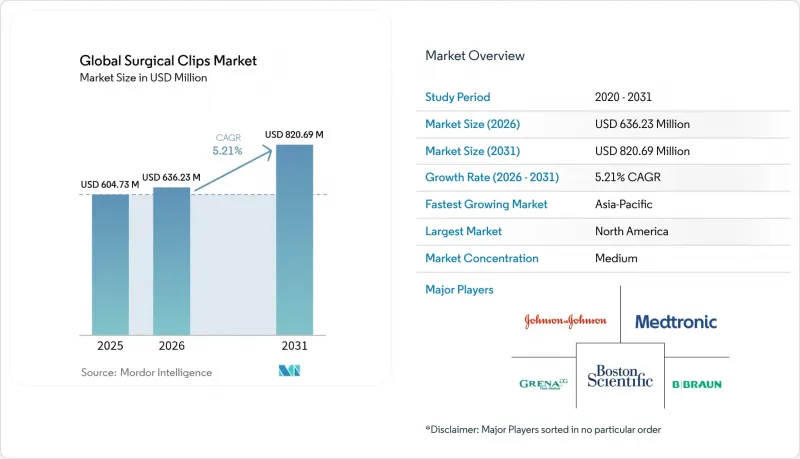
Mordor Intelligence에 의하면, 외과용 클립 시장 규모는 2025년 6억 473만 달러로 평가되었습니다. 2026년에는 6억 3,623만 달러로 확대되어 2026년부터 2031년에 걸쳐 CAGR 5.21%로 성장을 지속하여, 2031년에는 8억 2,069만 달러에 이를 것으로 예측됩니다.
본 보고서는 기기 유형(결찰 클립, 동맥류 클립, 기타), 소재(티타늄, 폴리머, 기타), 기술(자동 수술용 클립, 수동 수술용 클립), 최종 사용자(병원 등), 지역(북미, 유럽, 아시아태평양 등)별로 분류되어 있습니다. 시장 예측은 금액(달러) 기준으로 제시됩니다.
세계의 외과용 클립 시장 동향 및 인사이트
전 세계 수술 건수 증가
탈장, 정형외과, 비만 치료 분야의 수술 건수가 꾸준히 증가함에 따라 수술 건수가 늘어나고 있으며, 이는 외과용 클립 시장을 직접 견인하고 있습니다. 탈장 복구술만 해도 2050년까지 19.7% 증가하여 연간 172만 건의 신규 사례에 달할 것으로 예측됩니다. 외래 진료 현장에서는 신속하고 확실한 혈관 결찰이 필요한 고관절 및 무릎 관절 수술에서 두 자릿수 성장이 보고되고 있습니다. 로봇 수술의 도입이 수요를 뒷받침하고 있습니다. ‘다빈치 5(da Vinci 5)’ 플랫폼은 조직에 가해지는 부담을 43% 줄이고, 취약한 구조물에도 더 정밀한 클립 삽입을 가능하게 하기 때문입니다. BMI 상승 추세와 항혈전 요법의 보급으로 인해 모든 전문 분야에서 견고하면서도 조직에 부담을 덜 주는 기기의 필요성이 높아지고 있습니다. 이러한 시너지 효과로 인해 지속적인 판매량이 확보되고, 클립 제품 라인업 확충이 촉진되고 있습니다.
전 세계 고령 인구 급증
수술을 받는 환자의 연령 중앙값은 2008년 55.5세에서 2020년 58.5세로 상승했으며, 2030년까지 61.5세에 달할 전망입니다. 고령 환자는 당뇨병이나 혈관 취약성 등의 동반 질환을 앓고 있으며, 이러한 질환들이 출혈 위험을 높이기 때문에 확실한 클립 고정이 필수적입니다. 티타늄 클립이 여전히 주류를 이루고 있지만, 금속 알레르기를 피하고 수술 후 영상 진단 시 발생하는 아티팩트를 줄일 수 있어 폴리머 클립의 사용도 확대되고 있습니다. 또한, 의료 종사자들은 고령자에게 흔히 나타나는 석회화 조직이나 섬세한 조직에 적합한, 로우 프로파일 조를 갖춘 어플리케이터를 채택하고 있습니다. 보험사가 환급액을 합병증 발생률과 연계하고 있기 때문에 고령자 집단에서 클립의 신뢰성 높은 성능이 구매의 우선 순위가 되고 있으며, 이것이 외과용 클립 시장의 성장세를 유지하고 있습니다.
클립의 이동 및 담관·혈관 합병증
100건 이상의 보고 사례에서 담낭 절제술 후 클립의 지연성 이동이 수술 후 수십 년이 지난 후에 나타날 수도 있는 심각한 담도 사건과 관련이 있는 것으로 나타났습니다. 보고된 사례에는 Hem-o-lok의 폴리머 재질 제품과 기존의 금속 클립이 모두 포함되어 있어, 이는 설계와 무관한 위험임을 시사합니다. 평균적으로 수술 후 26개월 만에 이동이 발생하며, 고비용의 ERCP를 통한 클립 제거가 필요할 뿐만 아니라, 외과의사의 신중한 태도와 규제 당국의 감시를 강화하는 요인이 되고 있습니다. 이러한 인식의 확산으로 인해 임상의들은 클립 사용량을 제한하고, 대체 밀봉재를 고려하며, 더 정밀한 어플리케이터를 요구하게 되었으며, 이로 인해 수술용 클립 시장의 성장은 일시적으로 둔화되고 있습니다.
부문별 분석
2025년, 외과용 클립 시장에서 가장 큰 기여를 한 것은 결찰기였으며, 이는 일반 복강경 수술 및 개복 수술에서 64.33%의 점유율을 반영한 것입니다. 담낭 절제술, 대장·직장 수술, 그리고 신속한 혈관 폐쇄가 필요한 일반 복부 수술에서는 여전히 높은 수요가 유지되고 있습니다. 자원이 제한된 지역에서도 도입이 진행되고 있어, 안정적인 기본 수요량을 확보함과 동시에 시장의 회복력을 강화하고 있습니다.
동맥류용 클립은 현재 매출 규모는 작지만, 고령화에 따라 신경혈관 수술 건수가 증가하고 있어 연평균 성장률(CAGR) 5.88%로 가장 빠르게 성장하고 있습니다. 실리콘 질화물 및 지르코니아 세라믹은 조의 교차 없이도 뛰어난 폐쇄력을 발휘하여, 신경외과 의사들에게 복잡한 부위에서 MRI 촬영이 가능한 선택지를 제공합니다. 제조업체들은 이러한 클립을 좁은 수술 공간에 적합한 마이크로 어플리케이터와 세트로 판매하여, 더 광범위한 외과용 클립 시장 내에서 프리미엄 틈새 시장을 창출하고 있습니다. 조(jaw)의 형상 및 스프링의 금속 조직에 대한 지속적인 연구 개발로 인해 장기적인 개존성이 향상되어 더 광범위한 채택이 촉진되고 있습니다.
티타늄은 수십 년에 걸친 임상 실적과 외과의들의 익숙함 덕분에 2025년에는 부문 매출의 67.55%를 차지했습니다. 강도 대 중량비와 비활성 표면으로 인해 조직 반응이 억제되어 다양한 수술에서 신뢰할 수 있는 성능을 발휘합니다. 멸균 공정의 효율화와 대량 구매에 따른 가격 우대 조치로 인해 병원에서는 계속해서 대규모 구매가 이루어지고 있습니다.
임상의들이 MRI 영상의 선명도를 추구하고 금속 알레르기를 피하기 위해 노력하는 가운데, 폴리머 제품 라인은 2031년까지 연평균 성장률(CAGR) 5.54%로 성장을 지속하고 있습니다. 조사에 따르면, 합병증 발생률은 비슷한 수준을 유지하면서도 금속 클립에서 폴리머 클립으로 전환함으로써 1건당 75달러의 비용 절감이 가능함이 밝혀졌습니다. 생분해성 마그네슘·티타늄 하이브리드 소재가 연구 파이프라인에 등장하고 있으며, 치유 후 이물질을 완전히 제거할 수 있을 가능성이 있습니다. 영상 진단 프로토콜이 엄격해지고 환자 알레르기 검사가 증가함에 따라, 폴리머 및 하이브리드 제품의 점유율은 확대되고 외과용 클립 시장의 다각화가 진행될 것으로 전망됩니다.
지역별 분석
2025년, 북미는 외과용 클립 시장 점유율의 41.21%를 차지했으며, 이는 높은 수술 건수, 광범위한 보험 적용 범위, 그리고 MRI 호환 제품의 급속한 보급에 힘입은 것입니다. 2025년까지 외과 의료비는 GDP의 7.3%에 달할 전망이며, 이는 고품질 제품 조달을 뒷받침하여 해당 지역의 외과용 클립 시장의 호황을 유지할 것입니다. 2026년에 시행될 FDA의 품질 시스템 개혁은 제조업체들이 첨단 소재에 대한 투자를 더욱 촉진할 것입니다.
아시아태평양은 연평균 성장률(CAGR) 5.98%를 기록하며, 외과용 클립 시장에서 가장 빠르게 성장하고 있는 지역입니다. 중국, 인도, 동남아시아의 소득 증가와 건강보험 보급률 상승이 선택적 수술 건수 증가를 뒷받침하고 있습니다. 국내 제조업체들은 비용 경쟁력이 있는 티타늄 제품을 공급하는 한편, 대도시권에서는 폴리머 제품과 자동화 시스템이 수입되고 있습니다. 수술용 로봇 및 병원 인프라에 대한 정부 투자로 인해 예측 기간 동안 이 지역 수요는 강화될 전망입니다.
유럽은 고령화와 엄격한 의료기기 규제를 배경으로 연평균 성장률(CAGR) 4.91%로 성장을 지속하고 있습니다. 독일, 프랑스, 북유럽 국가의 병원에서는 추적 가능성과 영상 진단의 안전성이 중시되고 있어, 폴리머제 및 생분해성 제품의 보급이 확대되고 있습니다. 각국의 공동 조달 제도가 도입의 일관성을 촉진하는 한편, 현지 혁신 기업들은 엄격한 MRI 지침을 충족하는 세라믹제 동맥류 클립 개발을 추진하고 있습니다. 중동 및 아프리카는 걸프 국가들이 석유 수입을 활용해 고품질 폴리머 세트를 선호하는 최첨단 수술실에 투자하고 있어 5.73%의 성장이 예상됩니다. 신흥 사하라 이남 시장에서는 합리적인 가격의 수동식 티타늄 솔루션에 중점을 두고 있지만, 도시 지역 병원이 확대되고 있어 판매량은 여전히 증가 추세를 보이고 있습니다. 남미는 브라질과 아르헨티나의 민관 파트너십을 통해 최소 침습 수술(MIS)에 대한 접근성이 향상되고 있어 5.37%의 성장이 예상됩니다.
기타 혜택 :
- 엑셀 형식 시장 예측(ME) 시트
- 3개월간의 애널리스트 지원
자주 묻는 질문
목차
제1장 서론
제2장 조사 방법
제3장 주요 요약
제4장 시장 구도
제5장 시장 규모 및 성장 예측
제6장 경쟁 구도
제7장 시장 기회 및 향후 전망
KTH 26.08.28According to Mordor Intelligence, the surgical clips market size is expected to grow from USD 604.73 million in 2025 to USD 636.23 million in 2026 and is forecast to reach USD 820.69 million by 2031 at 5.21% CAGR over 2026-2031.
This report is Segmented by Device Type (Ligating Clips, Aneurysm Clips, and Other Types), Material (Titanium, Polymer, and Other Materials), Surgery Type (Automated Surgery Clips and Manual Surgery Clips), End-User (Hospitals and More), and Geography (North America, Europe, Asia-Pacific, and More). The Market Forecasts are Provided in Terms of Value (USD).
Global Surgical Clips Market Trends and Insights
Increase in surgical procedures worldwide
Steady growth in hernia, orthopedic, and bariatric interventions lifts procedural volume and directly drives the surgical clips market. Hernia repairs alone are expected to rise 19.7% by 2050 to 1.72 million new cases every year. Ambulatory settings report double-digit gains in hip and knee work that depend on quick, reliable vessel ligation. Robotics adoption reinforces demand as the da Vinci 5 platform applies 43% less tissue force, allowing finer clip placement for fragile structures. Growing BMI profiles and wider antithrombotic therapy amplify the need for sturdy yet atraumatic devices across specialties. The combined effect channels recurring unit sales and encourages broader clip portfolios.
Surge in global geriatric population
Median surgical age moved from 55.5 years in 2008 to 58.5 years in 2020 and is on track for 61.5 years by 2030. Older candidates present comorbid diabetes and vascular fragility that heighten bleeding risk, making secure clipping essential. Titanium remains a staple, yet polymer lines gain acceptance because they avoid metal allergies and reduce postoperative imaging artifacts. Providers also adopt applicators with low-profile jaws that suit calcified or delicate tissue common in older adults. As payers tie reimbursement to complication rates, dependable clip performance in geriatric cohorts becomes a purchasing priority and sustains momentum for the surgical clips market.
Clip migration and bile-duct or vascular complications
More than 100 documented cases link delayed cholecystectomy clip migration to serious biliary events that sometimes surface decades after surgery. Hem-o-lok polymer variants and legacy metals alike appear in reports, signaling a design-agnostic risk. Average migration occurs 26 months post-procedure, leading to costly ERCP retrievals and feeding both surgeon caution and regulatory vigilance. Awareness forces clinicians to limit clip counts, explore alternative sealants, and demand better applicator precision, temporarily tempering growth in the surgical clips market.
Other drivers and restraints analyzed in the detailed report include:
- Rising healthcare expenditure and access to MIS
- Shift toward MRI-compatible polymer or absorbable clips
- Adoption of robotic staplers and energy sealing devices
For complete list of drivers and restraints, kindly check the Table Of Contents.
Segment Analysis
Ligating devices generated the largest contribution to the surgical clips market in 2025, reflecting their 64.33% share in routine laparoscopic and open work. Unit demand remains high for cholecystectomy, colorectal, and general abdominal procedures that rely on quick vessel closure. Uptake persists in lower-resource settings, ensuring stable baseline volumes and reinforcing market resilience.
Aneurysm clips, although smaller in revenue today, grow fastest at 5.88% CAGR as neurovascular caseloads climb with an aging population. Silicon-nitride and zirconia ceramics demonstrate superior closing force without jaw crossing, giving neurosurgeons MRI-safe options for complex locations. Manufacturers bundle these clips with micro-applicators that fit narrow surgical windows, creating premium niches inside the wider surgical clips market. Continuous R&D into jaw geometry and spring metallurgy improves long-term patency and supports broader adoption.
Titanium held 67.55% of segment revenue in 2025 thanks to decades of clinical proof and surgeon familiarity. Its strength-to-weight ratio and inert surface limit tissue reaction, providing dependable performance for diverse procedures. Hospitals continue large-scale buying due to streamlined sterilization and bulk pricing arrangements.
Polymer lines register 5.54% CAGR through 2031 as clinicians pursue MRI clarity and avoid metal allergies. Studies record USD 75 savings per case when switching from metal to polymer clips while maintaining comparable complication profiles. Biodegradable magnesium-titanium hybrids emerge in research pipelines and could remove post-healing foreign bodies altogether. As imaging protocols tighten and patient allergy testing rises, polymer and hybrid shares will likely advance, diversifying the surgical clips market.
Complete Report Scope:
- By Device Type
- Ligating Clips
- Aneurysm Clips
- Other Types
- By Material
- Titanium
- Polymer
- Other Materials
- By Technology
- Automated Surgery Clips
- Manual Surgery Clips
- By End-User
- Hospitals
- Ambulatory Surgery Centers
- Other End-Users
- By Geography
- North America
- United States
- Canada
- Mexico
- Europe
- Germany
- United Kingdom
- France
- Italy
- Spain
- Rest of Europe
- Asia-Pacific
- China
- India
- Japan
- Australia
- South Korea
- Rest of Asia-Pacific
- Middle East and Africa
- GCC
- South Africa
- Rest of Middle East and Africa
- South America
- Brazil
- Argentina
- Rest of South America
- North America
Geography Analysis
North America accounted for 41.21% of the surgical clips market share in 2025, sustained by high procedure counts, broad insurance coverage, and rapid adoption of MRI-compatible lines. Surgical spending is set to hit 7.3% of GDP by 2025, supporting premium procurement and keeping the surgical clips market vibrant in the region. FDA quality-system reforms, effective in 2026, further encourage manufacturers to invest in advanced materials.
Asia-Pacific is the fastest-expanding region for the surgical clips market, with a 5.98% CAGR. Rising incomes and health-insurance penetration in China, India, and Southeast Asia push higher elective surgery counts. Domestic makers supply cost-advantaged titanium options, while high-tier urban centers import polymer and automated systems. Government investments in surgical robotics and hospital infrastructure strengthen regional demand through the forecast period.
Europe posts a 4.91% CAGR on the back of aging demographics and rigorous device oversight. Hospitals in Germany, France, and the Nordics value traceability and imaging safety, helping polymer and biodegradable lines gain traction. Group purchasing across national systems steers consistent adoption, while local innovators refine ceramic aneurysm clips that meet stringent MRI guidelines. The Middle East and Africa grow 5.73% as Gulf states channel oil revenue into state-of-the-art surgical suites that prefer premium polymer sets. Emerging sub-Saharan markets focus on affordable manual titanium solutions yet still post rising volumes thanks to expanding urban hospitals. South America advances 5.37% under Brazil and Argentina's public-private partnerships that enhance access to MIS.
- Ackermann Instrumente
- Applied Medical Resources
- B. Braun
- Boston Scientific
- Conmed
- Cook Group
- Edward Lifesciences
- Grena Limited
- Hangzhou Boer Medical
- Johnson & Johnson
- Kangji Medical
- LeMaitre Vascular
- Medtronic
- Meril Life Sciences
- Olympus
- Scanlan International
- Stapleline Medizintechnik
- Stryker
- Teleflex
- XNY Medical Technology
Additional Benefits:
- The market estimate (ME) sheet in Excel format
- 3 months of analyst support
TABLE OF CONTENTS
1 Introduction
- 1.1 Study Assumptions & Market Definition
- 1.2 Scope of the Study
2 Research Methodology
3 Executive Summary
4 Market Landscape
- 4.1 Market Overview
- 4.2 Market Drivers
- 4.2.1 Increase in surgical procedures worldwide
- 4.2.2 Surge in global geriatric population
- 4.2.3 Rising healthcare expenditure & access to MIS
- 4.2.4 Shift toward MRI-compatible polymer/absorbable clips
- 4.2.5 Regulatory push for single-use sterile ligation devices
- 4.2.6 Proliferation of hybrid operating rooms
- 4.3 Market Restraints
- 4.3.1 Clip migration & bile-duct/vascular complications
- 4.3.2 Adoption of robotic staplers & energy sealing devices
- 4.3.3 Titanium allergy & slippage safety alerts (ECRI)
- 4.3.4 Limited demand in under-developed countries
- 4.4 Supply Chain Analysis
- 4.5 Regulatory Landscape
- 4.6 Technological Outlook
- 4.7 Porter's Five Forces Analysis
- 4.7.1 Threat of New Entrants
- 4.7.2 Bargaining Power of Buyers
- 4.7.3 Bargaining Power of Suppliers
- 4.7.4 Threat of Substitutes
- 4.7.5 Intensity of Competitive Rivalry
5 Market Size & Growth Forecasts (Value)
- 5.1 By Device Type
- 5.1.1 Ligating Clips
- 5.1.2 Aneurysm Clips
- 5.1.3 Other Types
- 5.2 By Material
- 5.2.1 Titanium
- 5.2.2 Polymer
- 5.2.3 Other Materials
- 5.3 By Technology
- 5.3.1 Automated Surgery Clips
- 5.3.2 Manual Surgery Clips
- 5.4 By End-User
- 5.4.1 Hospitals
- 5.4.2 Ambulatory Surgery Centers
- 5.4.3 Other End-Users
- 5.5 By Geography
- 5.5.1 North America
- 5.5.1.1 United States
- 5.5.1.2 Canada
- 5.5.1.3 Mexico
- 5.5.2 Europe
- 5.5.2.1 Germany
- 5.5.2.2 United Kingdom
- 5.5.2.3 France
- 5.5.2.4 Italy
- 5.5.2.5 Spain
- 5.5.2.6 Rest of Europe
- 5.5.3 Asia-Pacific
- 5.5.3.1 China
- 5.5.3.2 India
- 5.5.3.3 Japan
- 5.5.3.4 Australia
- 5.5.3.5 South Korea
- 5.5.3.6 Rest of Asia-Pacific
- 5.5.4 Middle East and Africa
- 5.5.4.1 GCC
- 5.5.4.2 South Africa
- 5.5.4.3 Rest of Middle East and Africa
- 5.5.5 South America
- 5.5.5.1 Brazil
- 5.5.5.2 Argentina
- 5.5.5.3 Rest of South America
- 5.5.1 North America
6 Competitive Landscape
- 6.1 Market Concentration
- 6.2 Competitive Benchmarking
- 6.3 Market Share Analysis
- 6.4 Company Profiles (includes Global level Overview, Market level overview, Core Segments, Financials as available, Strategic Information, Market Rank/Share for key companies, Products & Services, and Recent Developments)
- 6.4.1 Ackermann Medical GmbH & Co.
- 6.4.2 Applied Medical Resources
- 6.4.3 B. Braun Melsungen AG
- 6.4.4 Boston Scientific Corporation
- 6.4.5 ConMed Corporation
- 6.4.6 Cook Medical
- 6.4.7 Edwards Lifesciences Corporation
- 6.4.8 Grena Limited
- 6.4.9 Hangzhou Boer Medical
- 6.4.10 Johnson & Johnson Services, Inc.
- 6.4.11 Kangji Medical
- 6.4.12 Lemaitre Vascular Inc.
- 6.4.13 Medtronic plc
- 6.4.14 Meril Life Sciences
- 6.4.15 Olympus Corporation
- 6.4.16 Scanlan International
- 6.4.17 Stapleline Medizintechnik GmbH
- 6.4.18 Stryker Corporation
- 6.4.19 Teleflex Incorporated
- 6.4.20 XNY Medical Technology
7 Market Opportunities & Future Outlook
- 7.1 White-space & Unmet-need Assessment