

|
시장보고서
상품코드
2114787
불임 치료제 : 시장 점유율 분석, 업계 동향 및 통계, 성장 예측(2026-2031년)Infertility Drugs - Market Share Analysis, Industry Trends & Statistics, Growth Forecasts (2026 - 2031) |
||||||
 Mordor Intelligence
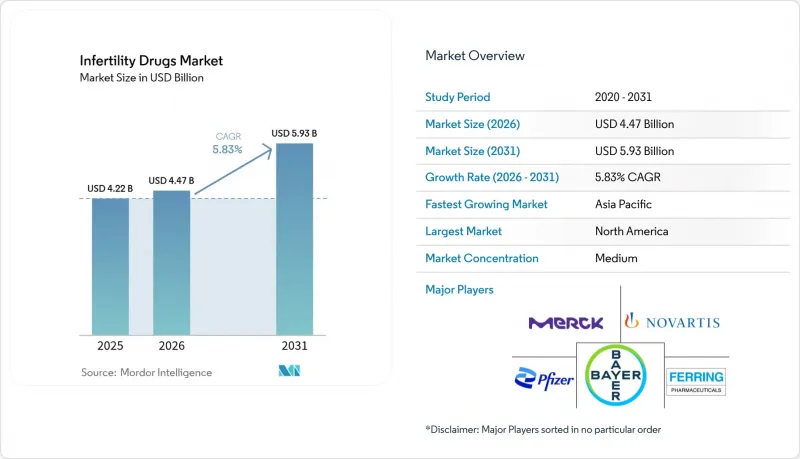
Mordor Intelligence에 의하면, 불임 치료제 시장 규모는 2025년에 42억 2,000만 달러로 평가되었습니다. 2026년 44억 7,000만 달러에서 2031년까지 59억 3,000만 달러에 이를 것으로 예상되며, 예측 기간(2026-2031년) CAGR은 5.83%를 나타낼 전망입니다.
본 보고서는 약물 분류별(고나도트로핀, 선택적 에스트로겐 수용체 조절제(SERM) 등), 환자 성별(여성 및 남성), 투여 경로(경구 등), 유통 채널(병원 약국 등), 지역(북미, 유럽, 아시아태평양, 중동 및 아프리카, 남미)별로 분류되어 있습니다. 시장 예측은 금액(달러) 기준으로 제시되어 있습니다.
세계의 불임 치료제 시장 동향 및 인사이트
전 세계 불임 유병률 증가
약 1억 8,600만 명이 불임으로 고통받고 있으며, 연령 조정 유병률은 현재 남성의 경우 10만 명당 1,354.76명, 여성의 경우 10만 명당 2,764.62명입니다. 이러한 추세는 출산 지연, 비만 및 생활 습관 요인과 관련이 있습니다. 아시아태평양에서는 가장 급격한 증가세가 나타나고 있으며, 이차성 불임이 1차성 불임을 앞지르고, 다낭성 난소 증후군(PCOS)이 수요의 주요 촉진요인으로 작용하고 있습니다. 저소득 시장에서는 보조생식기술(ART) 비용이 1인당 GDP의 200%를 초과하고 있어, 의료 자금 조달이 개선되면 미개척 수요가 표면화될 것으로 예측됩니다. 도시화와 경력 우선순위의 변화로 인해 가족 계획 시기가 늦어지는 경향이 있으며, 불임 치료는 주류 의료 경로로 자리 잡아가고 있습니다. 역학적 예측에 따르면 2036년까지 불임 발생률이 상승할 것으로 예상되며, 전 세계적으로 약물 치료에 대한 지속적인 수요가 확실시되고 있습니다.
정부 및 민간 차원의 보상 지원 확대
현재 EU 회원국 전부가 최소 1주기의 체외수정(IVF)에 대해 보조금을 지급하고 있으며, 5개국에서는 최대 6주기까지 보조하고 있습니다. 캘리포니아주 상원 법안 729호에 따라 2025년 7월부터는 대규모 단체 대상 보험사에 대해 불임 치료의 보험 적용이 의무화되며, 소규모 단체 대상 보험 플랜에 대해서도 적용 옵션을 제공해야 합니다. 기업 분야에서는 Cigna 헬스케어와 Progyny와 같은 제휴를 통해 불임 치료에 대한 종합적인 플랜이 제공되고 있으며, 본인 부담금이 1만 5,000-3만 달러에서 보다 합리적인 수준으로 낮아지고 있습니다. 미국 및 유럽에서의 보험 적용 범위 확대는 환자 수를 보험 적용 대상 경로로 유도하여, 불임 치료제 시장의 성장을 뒷받침하고 있습니다.
고액의 치료비와 제한적인 보험 적용
체외수정(IVF)용 약품 가격은 지난 10년간 84% 상승하여 1주기당 1,279달러에 달하며, 이는 IVF 총 비용의 35%를 차지합니다. 이러한 비용 부담으로 인해 많은 저소득 환자들이 치료를 받지 못하고 있습니다. 유럽에서 IVF 1주기당 평균 비용은 4,000-5,000유로(4,300-5,400달러)이지만, 일부 국가에서는 공적 의료 제도의 대기 기간이 1년에 달하기도 합니다. 저소득 지역에서는 보조생식기술(ART) 비용이 1인당 GDP의 200%를 초과하여 치료를 받기 어려운 상황입니다. 바이오시밀러와 보험사의 의무화로 인해 장벽은 점차 낮아지고 있지만, 합리적인 가격 실현은 불임 치료제 시장에 있어 여전히 중요한 단기적 제약 요인으로 남아 있습니다.
부문별 분석
2025년, 고나도트로핀은 확립된 체외수정(IVF) 프로토콜과 의사의 익숙함에 힘입어 불임 치료제 시장에서 43.78%의 점유율을 유지했습니다. 오르가논의 ‘폴리스팀 AQ’는 2024년 3분기에 6,300만 달러의 매출을 기록하며 전년 동기 대비 16% 증가해 견고한 기초 수요를 보여주었습니다. 그럼에도 불구하고 아로마타제 억제제의 성장세가 강해지고 있습니다. 레트로졸의 뛰어난 배란율 및 출생률은 2031년까지 연평균 성장률(CAGR)이 8.05%를 나타낼 것으로 예측되는 요인입니다. 무작위 대조 임상시험을 통한 증거에 따르면, 클로미펜에 비해 배란율이 13% 더 높은 것으로 나타났으며, 이로 인해 진료 지침의 개정이 가속화되고 있습니다.
제2군 약물도 여전히 중요한 위치를 차지하고 있습니다. 선택적 에스트로겐 수용체 조절제(SERM)는 의료 자원이 제한된 환경에서 계속해서 1차 치료의 기반이 되고 있습니다. 비구아나이드 계열 약물, 특히 메트포르민은 다낭성 난소 증후군(PCOS)의 대사 지표 개선을 목적으로 보조적으로 처방되고 있으나, 매출에서 차지하는 비중은 미미합니다. 카베르고린 등의 도파민 작용제는 난소 과자극 증후군을 예방합니다. 비교 시험에 따르면, 하이드록시클로로퀸과 동등한 유효성을 보이며 내약성이 우수함이 입증되었습니다. 용량에 대한 연구가 진행됨에 따라--2.5 mg의 레트로졸과 FSH를 순차적으로 투여하는 프로토콜에서는 누적 임신률이 72.7%를 달성한 반면, 5 mg 요법에서는 59.1%에 그쳤습니다.--불임 치료제 시장은 표적화된 저용량 옵션으로 더욱 전환될 것으로 예측됩니다.
확립된 임상 경로와 폭넓은 적응증 덕분에, 2025년 매출의 70.76%는 여성용 적응증이 차지했습니다. 선진국에서는 출산 연령의 고령화가 진행되고 있어 배란유도제에 대한 수요는 계속해서 견조합니다. 한편, 남성용 부문은 선별 검사 증가와 사회적 편견 해소 등을 배경으로 2031년까지 연평균 성장률(CAGR) 8.62%를 기록하며 추격세를 보이고 있습니다. 펠링 파마슈티컬스(Felling Pharmaceuticals)는 불임의 절반이 남성 요인에 기인한다는 점을 감안하여, 포스텔리티 헬스(Posteriority Health)와 제휴하여 ‘남성 불임 프로그램’을 전개했습니다.
치료법의 발전이 이러한 성장을 뒷받침하고 있습니다. 캐나다에서 실시된 코호트 파일럿 연구에 따르면, 저용량 레트로졸을 주 1회 투여한 결과, 성선 기능 저하증을 동반한 비만 남성 12명의 생식 능력이 회복되었습니다. 활성산소와 관련된 남성 불임의 20-30%에 항산화제가 사용되고 있는 만큼, 산화 스트레스 관리도 새로운 분야로 떠오르고 있습니다. 레스베라트롤이나 커큐민과 같은 생리활성 화합물은 암 치료로 인한 불임에 직면한 환자, 특히 정자 보존이 불가능한 사춘기 이전 남성을 대상으로 그 유효성이 검토되고 있습니다. 부부 동시 평가 프로토콜에 따라 처방 패턴이 두 파트너 모두를 포괄하는 방향으로 변화하고 있어, 불임 치료제 시장의 잠재 고객층이 확대되고 있습니다.
지역별 분석
2025년, 북미는 전 세계 매출의 35.12%를 차지했으며, 보험 적용 의무와 잘 갖춰진 시설을 갖춘 체외수정(IVF) 센터가 이를 뒷받침하고 있습니다. 캘리포니아주에서 시행될 예정인 보험 적용법에 따라 불임 치료 대상자층에 200만 명 이상의 피보험자가 추가될 것으로 예상되며, 수요의 성장세가 더욱 가속화될 것으로 전망됩니다. Cigna-Progyny의 번들 플랜으로 대표되는 기업 복리후생 패키지는 밀레니얼 세대와 Z세대 직원을 대상으로 고용주가 제공하는 혜택을 재구성하고 있습니다.
아시아태평양은 2031년까지 연평균 성장률(CAGR)이 7.18%로 가장 빠르게 성장하고 있는 지역입니다. 중국, 일본, 한국의 출산율 하락이 정부의 보조생식기술(ART) 지원을 뒷받침하는 한편, 태국이나 말레이시아 등의 국가들은 의료 관광객 유치 경쟁을 펼치고 있습니다. 중국 여성을 대상으로 한 1회 주사형 rhFSH-CTP 임상시험에서는 서유럽 프로토콜과 동등한 임상 효과가 나타나, 자국의 강력한 연구개발 역량을 입증했습니다. 가격 차이(싱가포르에서는 체외수정(IVF) 1주기당 1만 200달러인 반면, 인도에서는 2,700달러)가 국경을 넘는 환자 유입을 유발하여 아세안 전역에서 불임 치료제 시장을 확대시키고 있습니다.
유럽은 성숙 단계에 접어들었음에도 여전히 확장을 거듭하는 시장 상황에 있습니다. 현재 모든 EU 회원국이 최소 1주기의 체외수정(IVF) 비용을 공적 자금으로 부담하고 있지만, 최대 6주기까지 전액 지원해 주는 나라는 5개국에 불과하여, 긴 대기 시간을 피하기 위해 환자들이 민간 클리닉으로 몰리는 요인이 되고 있습니다. 중동 및 아프리카의 의약품 지출은 2024년에 326억 달러에 달했으나, 불임 치료는 여전히 초기 단계에 있습니다. MENA 지역의 인구통계학적 불임률은 22.6%에 달하며, 규제 및 자금 조달 체계가 개선된다면 향후 큰 성장이 예상됩니다(iqvia.com). 남미는 더 초기 단계에 있지만, 브라질, 아르헨티나, 칠레에서 공공 자금 지원이 확대됨에 따라 보조생식기술(ART)의 보급이 진행되고 있습니다.
기타 혜택 :
- 엑셀 형식 시장 예측(ME) 시트
- 3개월간 애널리스트 지원
자주 묻는 질문
목차
제1장 서론
제2장 조사 방법
제3장 주요 요약
제4장 시장 구도
제5장 시장 규모 및 성장 예측
제6장 경쟁 구도
제7장 시장 기회 및 향후 전망
KTH 26.08.28According to Mordor Intelligence, the infertility drugs market size was valued at USD 4.22 billion in 2025 and estimated to grow from USD 4.47 billion in 2026 to reach USD 5.93 billion by 2031, at a CAGR of 5.83% during the forecast period (2026-2031).
This report is Segmented by Drug Class (Gonadotropins, Selective Estrogen Receptor Modulators (SERMs), and More), Patient Gender (Female and Male), Route of Administration (Oral, and More), Distribution Channel (Hospital Pharmacies, and More), Geography (North America, Europe, Asia-Pacific, The Middle East and Africa, and South America). The Market Forecasts are Provided in Terms of Value (USD).
Global Infertility Drugs Market Trends and Insights
Rising Infertility Prevalence Worldwide
Roughly 186 million people live with infertility, and age-standardized prevalence now stands at 1,354.76 per 100,000 in males and 2,764.62 per 100,000 in females, trends linked to delayed childbearing, obesity and lifestyle factors. Asia-Pacific shows the sharpest rise, with secondary infertility surpassing primary infertility and polycystic ovary syndrome (PCOS) acting as a pivotal demand driver. In low-income markets, ART costs exceed 200% of GDP per capita, underscoring untapped demand once health financing improves. Urbanization and shifting career priorities lengthen the window for family planning, embedding infertility therapy in mainstream care pathways. Epidemiological projections anticipate higher infertility incidence through 2036, ensuring sustained need for pharmacologic interventions worldwide.
Increasing Government and Private Reimbursement Support
All EU member states now subsidize at least one IVF cycle, and five nations fund up to six cycles. California's Senate Bill 729 will compel large-group insurers to cover fertility treatments from July 2025, with small-group plans required to offer coverage options. In the corporate sector, partnerships such as Cigna Healthcare with Progyny offer bundled fertility journeys, reducing out-of-pocket costs from USD 15,000-30,000 to more affordable co-pay levels. Reimbursement expansion across the United States and Europe is steering patient volumes into covered channels and reinforcing the growth of the infertility drugs market.
High Treatment Costs and Limited Insurance Coverage
IVF medication prices rose 84% over the past decade, reaching USD 1,279 per cycle and accounting for 35% of total IVF costs, a burden that excludes many low-income patients. Average European IVF cycles cost EUR 4,000-5,000 (USD 4,300-5,400), while public wait lists can stretch to one year in several countries. In low-income regions, ART exceeds 200% of GDP per capita, rendering treatment out of reach. Although biosimilars and insurer mandates are lowering barriers, affordability remains a pivotal short-term restraint for the infertility drugs market.
Other drivers and restraints analyzed in the detailed report include:
- Advancements in Biosimilar and Novel Hormonal Formulations
- Expanding Access to Fertility Services in Emerging Markets
- Stringent and Divergent Regulatory Approval Pathways
For complete list of drivers and restraints, kindly check the Table Of Contents.
Segment Analysis
Gonadotropins retained 43.78% infertility drugs market share in 2025, supported by entrenched IVF protocols and physician familiarity. Organon's Follistim AQ recorded USD 63 million in Q3 2024, a 16% rise year-over-year, illustrating robust baseline demand. Nevertheless, aromatase inhibitors are gaining traction; letrozole's superior ovulation and live-birth rates have spurred an 8.05% CAGR forecast through 2031. Evidence from randomized trials showing a 13% higher ovulation rate versus clomiphene is accelerating guideline revisions.
Second-tier classes remain relevant. Selective estrogen receptor modulators continue to anchor first-line treatment in resource-constrained settings. Biguanides, particularly metformin, are prescribed adjunctively to improve metabolic parameters in PCOS, though they represent a small revenue slice. Dopamine agonists like cabergoline prevent ovarian hyperstimulation syndrome; comparative trials indicate equivalent efficacy to hydroxychloroquine with better tolerability. As dosing research evolves-sequential 2.5 mg letrozole/FSH protocols have achieved 72.7% cumulative pregnancy versus 59.1% for 5 mg regimens-the infertility drugs market is expected to tilt further toward targeted, lower-dose options.
Female indications generated 70.76% of 2025 revenue owing to established clinical pathways and broader drug labels. Demand remains solid for ovulation-induction agents as delayed motherhood becomes common in developed economies. The male segment, however, is catching up with an 8.62% CAGR to 2031, driven by increased screening and destigmatization. Ferring Pharmaceuticals teamed with Posterity Health to roll out a Male Fertility Program, acknowledging that male factors contribute to half of infertility cases.
Therapeutic advances bolster this growth. Weekly low-dose letrozole restored fertility in 12 obese men with hypogonadotropic hypogonadism in a Canadian cohort pilot. Oxidative stress management is another frontier, as antioxidants target the 20-30% of male infertility linked to reactive oxygen species. Bioactive compounds such as resveratrol and curcumin are being explored for patients facing cancer-therapy infertility, especially prepubertal males unable to bank sperm. Simultaneous couple evaluation protocols are shifting prescribing patterns to encompass both partners, expanding the addressable pool for the infertility drugs market.
Complete Report Scope:
- By Drug Class
- Gonadotropins
- Selective Estrogen Receptor Modulators (SERMs)
- Aromatase Inhibitors
- Biguanides (Metformin)
- Dopamine Agonists
- Other Drug Classes
- By Patient Gender
- Female
- Male
- By Route Of Administration
- Oral
- Injectable (SC / IM)
- Transdermal / Intranasal
- By Distribution Channel
- Hospital Pharmacies
- Retail Pharmacies
- Online & Specialty Pharmacies
- Geography
- North America
- United States
- Canada
- Mexico
- Europe
- Germany
- United Kingdom
- France
- Italy
- Spain
- Rest of Europe
- Asia-Pacific
- China
- Japan
- India
- Australia
- South Korea
- Rest of Asia-Pacific
- Middle East & Africa
- GCC
- South Africa
- Rest of Middle East & Africa
- South America
- Brazil
- Argentina
- Rest of South America
- North America
Geography Analysis
North America held 35.12% of global revenue in 2025, anchored by insurance mandates and well-resourced IVF centers. California's upcoming coverage law is expected to add more than 2 million insured lives to the fertility cohort, reinforcing demand momentum. Corporate benefit packages, typified by Cigna-Progyny bundles, are reshaping employer offerings for millennial and Gen-Z workforces.
The Asia-Pacific region is the fastest-growing geography at a 7.18% CAGR through 2031. Declining birth rates in China, Japan and South Korea spur government support for ART, while nations such as Thailand and Malaysia compete for medical tourists. Single-injection rhFSH-CTP trials in Chinese women show clinical parity to western protocols, demonstrating home-grown research strength. Price differentials-USD 10,200 per IVF cycle in Singapore versus USD 2,700 in India-are channeling cross-border patient flows, expanding the infertility drugs market across ASEAN.
Europe presents a mature but still expanding landscape. All EU states now fund at least one IVF cycle, yet only five provide up to six fully reimbursed cycles, driving patients into private clinics to avoid long wait times. Middle East & Africa's pharmaceutical spend rose to USD 32.6 billion in 2024, but infertility care remains nascent. Demographic infertility in MENA reaches 22.6%, signaling strong future upside if regulatory and financing frameworks improve iqvia.com. South America is at an earlier stage but is seeing rising ART uptake as Brazil, Argentina and Chile expand public financing.
- Merck
- Ferring Pharmaceuticals
- Pfizer
- Bayer
- Novartis
- Teva Pharmaceutical Industries
- Theramex
- Mankind Pharma
- Livzon Pharmaceutical
- Organon
- ASKA Pharmaceutical
- Zydus Lifesciences
- Gedeon Richter PLC
- Ipsen
- Sun Pharmaceuticals Industries
- Cipla
- Myovant Sciences
Additional Benefits:
- The market estimate (ME) sheet in Excel format
- 3 months of analyst support
TABLE OF CONTENTS
1 Introduction
- 1.1 Study Assumptions & Market Definition
- 1.2 Scope Of The Study
2 Research Methodology
3 Executive Summary
4 Market Landscape
- 4.1 Market Overview
- 4.2 Market Drivers
- 4.2.1 Rising Infertility Prevalence Worldwide
- 4.2.2 Growing Adoption of Assisted Reproductive Technologies
- 4.2.3 Increasing Government and Private Reimbursement Support
- 4.2.4 Advancements in Biosimilar and Novel Hormonal Formulations
- 4.2.5 Expanding Access to Fertility Services in Emerging Markets
- 4.3 Market Restraints
- 4.3.1 High Treatment Costs and Limited Insurance Coverage
- 4.3.2 Stringent and Divergent Regulatory Approval Pathways
- 4.3.3 Social, Ethical, and Cultural Barriers to Treatment Acceptance
- 4.3.4 Drug Safety Concerns Including Ovarian Hyperstimulation Risk
- 4.4 Value / Supply-Chain Analysis
- 4.5 Regulatory Landscape
- 4.6 Technological Outlook
- 4.7 Porter's Five Forces
- 4.7.1 Bargaining Power Of Suppliers
- 4.7.2 Bargaining Power Of Buyers
- 4.7.3 Threat Of New Entrants
- 4.7.4 Threat Of Substitute Products
- 4.7.5 Intensity Of Competitive Rivalry
5 Market Size & Growth Forecasts (Value, USD)
- 5.1 By Drug Class
- 5.1.1 Gonadotropins
- 5.1.2 Selective Estrogen Receptor Modulators (SERMs)
- 5.1.3 Aromatase Inhibitors
- 5.1.4 Biguanides (Metformin)
- 5.1.5 Dopamine Agonists
- 5.1.6 Other Drug Classes
- 5.2 By Patient Gender
- 5.2.1 Female
- 5.2.2 Male
- 5.3 By Route Of Administration
- 5.3.1 Oral
- 5.3.2 Injectable (SC / IM)
- 5.3.3 Transdermal / Intranasal
- 5.4 By Distribution Channel
- 5.4.1 Hospital Pharmacies
- 5.4.2 Retail Pharmacies
- 5.4.3 Online & Specialty Pharmacies
- 5.5 Geography
- 5.5.1 North America
- 5.5.1.1 United States
- 5.5.1.2 Canada
- 5.5.1.3 Mexico
- 5.5.2 Europe
- 5.5.2.1 Germany
- 5.5.2.2 United Kingdom
- 5.5.2.3 France
- 5.5.2.4 Italy
- 5.5.2.5 Spain
- 5.5.2.6 Rest of Europe
- 5.5.3 Asia-Pacific
- 5.5.3.1 China
- 5.5.3.2 Japan
- 5.5.3.3 India
- 5.5.3.4 Australia
- 5.5.3.5 South Korea
- 5.5.3.6 Rest of Asia-Pacific
- 5.5.4 Middle East & Africa
- 5.5.4.1 GCC
- 5.5.4.2 South Africa
- 5.5.4.3 Rest of Middle East & Africa
- 5.5.5 South America
- 5.5.5.1 Brazil
- 5.5.5.2 Argentina
- 5.5.5.3 Rest of South America
- 5.5.1 North America
6 Competitive Landscape
- 6.1 Market Concentration
- 6.2 Market Share Analysis
- 6.3 Company Profiles (includes Global level Overview, Market level overview, Core Business Segments, Financials, Headcount, Key Information, Market Rank, Market Share, Products and Services, and analysis of Recent Developments)
- 6.3.1 Merck KGaA
- 6.3.2 Ferring Pharmaceuticals Inc
- 6.3.3 Pfizer, Inc.
- 6.3.4 Bayer AG
- 6.3.5 Novartis AG
- 6.3.6 Teva Pharmaceuticals Industries
- 6.3.7 Theramex
- 6.3.8 Mankind Pharma
- 6.3.9 Livzon Pharmaceutical
- 6.3.10 Organon & Co.
- 6.3.11 ASKA Pharmaceutical
- 6.3.12 Zydus Lifesciences
- 6.3.13 Gedeon Richter PLC
- 6.3.14 Ipsen Pharma
- 6.3.15 Sun Pharma
- 6.3.16 Cipla Ltd.
- 6.3.17 Myovant Sciences
7 Market Opportunities & Future Outlook
- 7.1 White-Space & Unmet-Need Assessment


