

|
시장보고서
상품코드
2114788
척수성 근위축증 치료 시장 : 점유율 분석, 업계 동향과 통계, 성장 예측(2026-2031년)Spinal Muscular Atrophy Treatment - Market Share Analysis, Industry Trends & Statistics, Growth Forecasts (2026 - 2031) |
||||||
 Mordor Intelligence
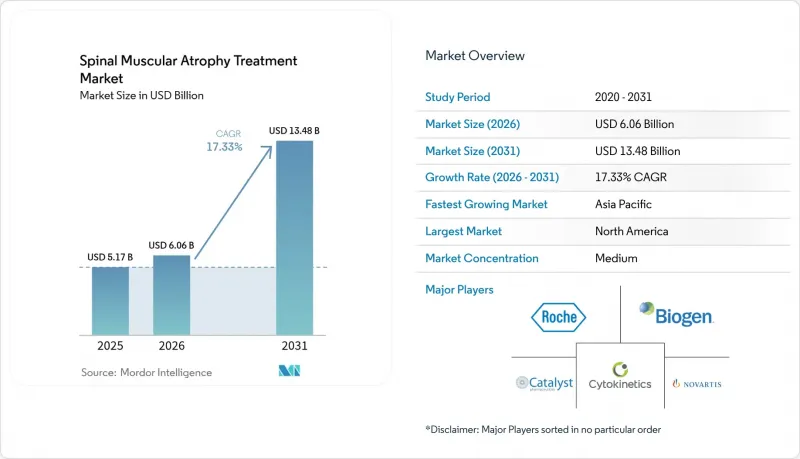
Mordor Intelligence에 의하면, 2026년 척수성 근위축증 치료 시장 규모는 60억 6,000만 달러로 추정되고 있어 2025년 51억 7,000만 달러에서 확대해, 2031년에는 134억 8,000만 달러에 이를 것으로 예측됩니다.
2026년부터 2031년까지의 연평균 성장률(CAGR)은 17.33%에 달할 전망입니다.
본 보고서는 유형(I형, II형, III형, IV형), 치료법(유전자 치환 요법 및 약물 요법), 투여 경로(경구 및 척수강 내 투여), 지역(북미, 유럽, 아시아태평양, 중동 및 아프리카, 남미)별로 세분화되어 있습니다. 본 보고서에서는 상기 각 부문 시장 규모(백만 달러)를 제시하고 있습니다.
전 세계 척수성 근위축증 치료 시장 동향 및 인사이트
신생아 선별검사의 의무화로 치료 가능한 환자층 확대
2024년 1월 이후 미국 전역에서 시행되고 있는 전국적인 선별 검사를 통해 SMA를 증상이 나타나기 전 단계에서 조기에 발견할 수 있게 되어, 효과적인 치료를 최적의 시기에 시행할 수 있게 되었습니다. 대만, 헝가리,세르비아에서도 유사한 제도가 도입되어, 총 65만 명 이상의 영아가 선별 검사를 받고 있으며, 다양한 의료 제도 내에서의 확장성이 부각되고 있습니다. 선별 검사 결과 신생아 약 1만 4,694명 중 1명의 비율로 SMA가 검출되어, 치료 수요를 유지할 수 있는 예측 가능한 연간 환자군이 형성되고 있습니다. 조기 발견을 통해 운동 기능의 예후가 현저히 개선됨에 따라, 고액 치료비에 대한 보험사의 보상 의지가 높아지고 있습니다. 또한, 이러한 노력은 정맥주사 센터나 전문 약국의 수용 능력 계획을 정교화하기 위해 필수적인 역학 데이터도 제공합니다.
고소득 시장에서 SMN을 표적으로 하는 유전자 치료의 급속한 확산
SMN을 표적으로 하는 치료법은 현재 안티센스 올리고뉴클레오티드, 유전자 치환 벡터, 저분자 스플라이싱 조절제로 확대되어, 임상의에게 SMN 단백질 수준을 회복시키기 위한 여러 가지 선택지를 제공합니다. 누시넬센의 용량 증량 시험에서는 혈장 내 뉴로필라멘트 경쇄가 94% 감소한 것으로 나타나, 더 높은 초기 투여량의 임상적 타당성이 입증되었습니다. 로슈가 2025년 2월에 정제 형태의 승인을 획득함에 따라, 약물 노출량을 저해하지 않으면서 치료 부담이 더욱 경감되었습니다. 노바티스는 척수강 내 투여용 오나셈노젠 아베팔보벡을 사용한 고령 소아 환자에서 HFMSE 점수를 2.39점 개선하여 유전자 치료의 적용 범위를 확대했습니다. 이러한 진전들이 합쳐져 척수성 근위축증 치료 시장의 도입 곡선이 단축되고 수익 기반이 확대되고 있습니다.
수백만 달러에 달하는 가격과 불투명한 장기 보험 환급
졸겐스마의 수백만 달러에 달하는 비용과 평생에 걸친 유효성 전망은 특히 중소득 국가에서 지불 주체의 예산에 부담을 주고 있습니다. 증분 비용 대비 효과 비율은 여전히 기존의 기준치를 상회하고 있어, 도입을 지연시키는 위험 분담 협정을 초래하고 있습니다. 보험 적용이 승인된 경우에도, 상환에는 종종 성과 기반의 마일스톤이 포함되어 있어, 이로 인해 관리상의 복잡성이 증가하고 제조업체에게는 수익의 지연으로 이어집니다. 이러한 제약으로 인해 설득력 있는 임상적 이점이 있음에도 불구하고 시장 침투 가능성이 제한되고 있습니다.
부문 분석
2025년, 척수성 근위축증(SMA) 치료 시장에서 1형 SMA는 48.05%의 점유율을 유지했습니다. 생명을 위협하는 특성상 즉각적인 치료 시작이 필요하며, 이로 인해 높은 가격 책정이 정당화되고 있습니다. 신생아 보편적 선별 검사의 도입으로 진단 시기가 증상 발현 전 단계로 앞당겨졌으며, 인공호흡기 비의존 생존율이 향상됨과 동시에 조기 유전자 치료 시행에 대한 임상적 합의가 강화되고 있습니다. 기존에 임상시험에서 제외되었던 0형은 규제 당국의 지침에 따라 적격 기준이 확대되었고, 적응증 외 사용의 선례를 통해 안전성이 확인됨에 따라 현재 18.02%의 연평균 성장률(CAGR)을 기록하고 있습니다. 2형 및 3형은 평생에 걸친 유지 투여가 표준 치료법이므로 안정적이고 지속적인 수익을 창출하고 있습니다. 4형의 성인 발병 사례는 현재로서는 틈새 시장에 머물러 있지만, 인지도가 높아짐에 따라 성장하고 있습니다.
무증상기 치료는 제1형 환자의 운동 발달 단계를 현저히 개선시킵니다. 이는 대만의 선별 및 치료 코호트에서 유전자 치료를 받은 환자의 100%가 스스로 앉을 수 있게 되었습니다는 사실로 입증됩니다. 발병이 늦은 그룹에서는 개선 속도가 완만하지만 지속적인 향상이 관찰되어, 만성적인 치료 지속을 뒷받침하는 결과를 보여주고 있습니다. 질환의 중증도 차이는 치료법 선택에 영향을 미칩니다. 제1형에서는 유전자 치환 요법이 선호되지만, 제2형부터 제4형에서는 투여량의 유연성과 관리의 용이성으로 인해 SMN2 스플라이싱 조절제나 안티센스 올리고뉴클레오티드가 주류를 이루고 있습니다.
2025년에는 SMN2 스플라이싱 조절제가 척수성 근위축증 치료 시장의 42.35%를 차지했습니다. 그 경쟁 우위로는 광범위한 표현형에 대한 적응성, 경구 또는 척수강내 투여 옵션, 그리고 우수한 안전성 실적 등이 꼽힙니다. 유전자 대체 요법은 제조 수율 향상과 척수강 내 제제의 등장으로 인해 나이가 많은 소아의 체중 제한이 해소됨에 따라 18.41%라는 가장 높은 연평균 성장률(CAGR)을 기록하고 있습니다. 안티센스 올리고뉴클레오티드는 용량 증량 프로토콜을 통해 안정적인 실적을 유지하고 있으며, 뉴로필라멘트 제거 지표를 개선하고 있습니다.
아피테그로맙 등의 근육 특이적 약제는 SMN을 회복시키는 기초 치료와 병용함으로써 시너지 효과가 기대됩니다. 보조 요법(인공호흡 지원, 영양 지원, 정형외과적 처치 등)은 여전히 다학제적 협력을 통한 치료의 일환으로 중요하지만, 질병 수식 약물에 의해 합병증 발생이 지연되거나 예방됨에 따라 매출 점유율은 축소되고 있습니다. RNA 편집 도구를 활용한 새로운 파이프라인은 향후 기존 치료법과 융합되어, 척수성 근위축증 치료 시장의 혁신적 깊이를 유지할 가능성이 있습니다.
지역별 분석
북미는 2025년에도 전 세계 매출의 42.30%를 차지했습니다. 이는 신생아 선별 검사의 종합적인 시행, 신경근 전문의의 긴밀한 네트워크, 그리고 6자리에서 7자리에 이르는 가격을 감당할 수 있는 성숙한 지불 체계에 힘입은 결과입니다. 미국 CMS(의료보험서비스센터)에 의한 영아 선별 검사의 의무화로 거의 모든 사례에 걸쳐 조기 발견이 보장되는 한편, 민간 보험사 및 메디케이드 프로그램은 폭넓은 접근성을 확보하기 위해 마일스톤 기반의 계약을 협상하고 있습니다. 캐나다의 단일 지불자 제도에서는 리스디플람과 누시넬센이 전국적으로 공적 자금으로 지원되고 있지만, 유전자 치료에 대한 보상은 여전히 주 단위로 제한되어 있어 서부 주에서 미국의 의료 센터로 국경을 넘어 치료를 받으러 가는 현상이 발생하고 있습니다. 유럽에서는 EMA(유럽의약품청)의 중앙 승인을 통해 적응증 조화가 촉진되어 꾸준한 점진적 증가가 나타나고 있지만, 각국의 협상 담당자에 따라 시장 진입 시기가 제각각입니다. 독일과 프랑스에서는 승인된 모든 SMA 치료법에 대해 건강보험을 통한 의무적 급여가 시행되고 있어 높은 치료 도입률이 유지되고 있습니다. 대조적으로, 이탈리아와 스페인에서는 유전자 치료에 대한 자금 지원에 연령 및 체중 상한선이 설정되어 있어, 연령이 높은 아동들에게는 대신 스플라이싱 조절제 치료가 권장되고 있습니다. 동유럽에서는 신생아 선별 검사의 도입이 가속화되고 있으며, 세르비아에서는 프로그램 시작 후 12개월 이내에 5만 4,000명의 영아가 선별 검사를 받았습니다.
아시아태평양은 건강 보험 보급률 상승, 분자진단 능력 확대, 그리고 수입 관세를 면제하는 정부의 희귀질환 목록 덕분에 2031년까지 연평균 성장률(CAGR)이 18.96%로 가장 높은 성장률을 기록하고 있습니다. 일본은 1인당 지출액에서 선두를 달리고 있으며, 2023년부터 모든 신생아를 대상으로 선별검사를 실시하고, SMN을 표적으로 하는 3가지 약물군 모두에 공적 자금을 지원하고 있습니다. 중국은 2024년에 누시넬센을 승인하고, 협상을 통해 할인된 가격을 적용하여 NRDL(국가 의약품 목록)에 포함시켰으며, 각 성에서의 도입을 가속화하고 있습니다. 인도의 연방 보건부는 케랄라주와 마하라슈트라주에서 국가 예산으로 선별 검사를 시범 운영하며, 더 광범위한 확대를 위한 기반을 마련하고 있습니다. 호주와 한국은 이 지역의 고소득 국가 그룹을 구성하고 있으며, 잘 갖춰진 유전체 분석 시설과 원격의료를 활용하여 지방 환자들의 접근성을 보장하고 있습니다. 이러한 일련의 확대로 인해 척수성 근위축증 치료 시장에는 매년 수만 명의 적격 환자가 새롭게 추가될 것입니다.
기타 혜택:
- 엑셀 형식 시장 예측(ME) 시트
- 3개월간의 애널리스트 지원
자주 묻는 질문
목차
제1장 서론
제2장 조사 방법
제3장 주요 요약
제4장 시장 구도
제5장 시장 규모와 성장 예측
제6장 경쟁 구도
제7장 시장 기회와 향후 전망
JHS 26.08.26According to Mordor Intelligence, spinal muscular atrophy treatment market size in 2026 is estimated at USD 6.06 billion, growing from 2025 value of USD 5.17 billion with 2031 projections showing USD 13.48 billion, growing at 17.33% CAGR over 2026-2031.
This report is Segmented by Type (Type I, Type II, Type III, and Type IV), Procedure (Gene Replacement Therapy and Drug Therapy), Route of Administration (Oral and Intrathecal), and Geography (North America, Europe, Asia-Pacific, Middle-East and Africa, and South America). The Report Offers the Value (in USD Million) for the Above Segments.
Global Spinal Muscular Atrophy Treatment Market Trends and Insights
Newborn Screening Mandates Expand Treatable Patient Pool
Nationwide screening now active across all US states since January 2024 identifies SMA at a presymptomatic stage, enabling optimal timing for high-impact therapies. Taiwan, Hungary, and Serbia followed similar rollouts and collectively screened more than 650,000 infants, highlighting scalability across varied health systems . Screening detects roughly 1 in 14,694 newborns, generating a predictable annual cohort that sustains therapy demand. Early detection translates into markedly improved motor outcomes, reinforcing payer willingness to reimburse expensive treatments. The practice also supplies essential epidemiological data that refine capacity planning for infusion centers and specialty pharmacies.
Rapid Uptake of SMN-Targeting Gene Therapies in High-Income Markets
SMN-targeting therapeutics now span antisense oligonucleotides, gene replacement vectors, and small-molecule splicing modifiers, offering clinicians multiple paths to restore SMN protein levels. Nusinersen dose-escalation showed a 94% reduction in plasma neurofilament light chain, supporting the clinical rationale for higher loading doses. Roche's February 2025 tablet approval further lowers treatment burden without compromising exposure. Novartis achieved a 2.39-point HFMSE gain in older children using intrathecal onasemnogene abeparvovec, broadening gene-therapy eligibility. Together, these advances shorten the adoption curve and amplify the revenue base of the spinal muscular atrophy treatment market.
Million-Dollar Price Tags and Uncertain Long-Term Reimbursement
Zolgensma's multi-million-dollar cost and a lifetime efficacy horizon strain payer budgets, especially in middle-income countries. Incremental cost-effectiveness ratios remain above traditional thresholds, prompting risk-sharing arrangements that delay uptake. Where coverage is approved, reimbursement often includes outcomes-based milestones, adding administrative complexity and revenue deferral for manufacturers. This drag limits penetration potential despite compelling clinical benefit.
Other drivers and restraints analyzed in the detailed report include:
- Global Payer Acceptance of High-Value Rare-Disease Drugs
- Rising Advocacy-Group Funding for Early-Stage Trials
- Intrathecal Delivery Complexities and Capacity Constraints at Infusion Centers
For complete list of drivers and restraints, kindly check the Table Of Contents.
Segment Analysis
Type 1 SMA retained 48.05% share of the spinal muscular atrophy treatment market in 2025. Its life-threatening nature prompts immediate therapy initiation and supports premium pricing. Universal newborn screening has shifted diagnoses into the presymptomatic stage, improving ventilatory-free survival and reinforcing clinical consensus for early gene therapy use. Type 0, historically excluded from trials, now logs an 18.02% CAGR as regulatory guidance broadens eligibility criteria and compassionate-use precedents confirm safety. Types 2 and 3 generate steady, recurring revenue because lifelong maintenance dosing remains standard practice. Type 4 adult-onset cases remain a niche today but grow as awareness climbs.
Presymptomatic treatment markedly improves motor milestones for Type 1 patients, evidenced by Taiwanese screen-and-treat cohorts achieving independent sitting in 100% of gene-therapy recipients. Later-onset groups experience slower but durable gains, supporting chronic therapy continuation. Variations in disease severity influence modality choice: gene replacement is favored in Type 1, while SMN2 splicing modifiers and antisense oligonucleotides dominate Types 2-4 due to flexible dosing and straightforward logistics.
SMN2 splicing modifiers commanded 42.35% of the spinal muscular atrophy treatment market share in 2025. Competitive advantages include pan-phenotype eligibility, oral or intrathecal options, and favorable safety records. Gene-replacement therapy shows the fastest 18.41% CAGR as manufacturing yields improve and intrathecal formulations remove weight caps for older children. Antisense oligonucleotides hold steady with dose-escalation protocols, boosting neurofilament clearance metrics.
Muscle-directed agents such as apitegromab promise synergistic benefits when layered onto SMN-restoring backbones. Supportive therapies-ventilation aids, nutritional support, orthopedics-still feature in multidisciplinary care but shrink in revenue share as disease-modifying agents delay or prevent complications. An emerging pipeline of RNA-editing tools could eventually converge with existing modalities, sustaining innovation depth for the spinal muscular atrophy treatment market.
Complete Report Scope:
- By Disease Type
- Type 0
- Type 1
- Type 2
- Type 3
- Type 4
- By Treatment Modality
- Gene Replacement Therapy
- SMN2 Splicing Modifiers
- Antisense-Oligonucleotide Therapy
- Muscle-Directed / Myostatin Inhibitors
- Supportive & Assistive Therapies
- By Route of Administration
- Oral
- Intrathecal
- Intravenous
- By Age Group
- Neonates (0-6 mo)
- Pediatrics (6 mo-12 y)
- Adolescents (12-18 y)
- Adults (>18 y)
- By Distribution Channel
- Hospital Pharmacies
- Specialty Clinics
- Online & Retail Pharmacies
- By Geography
- North America
- United States
- Canada
- Mexico
- Europe
- Germany
- United Kingdom
- France
- Italy
- Spain
- Rest of Europe
- Asia-Pacific
- China
- Japan
- India
- Australia
- South Korea
- Rest of Asia-Pacific
- Middle East & Africa
- GCC
- South Africa
- Rest of Middle East & Africa
- South America
- Brazil
- Argentina
- Rest of South America
- North America
Geography Analysis
North America retained 42.30% of global revenue in 2025, underpinned by exhaustive newborn screening coverage, dense neuromuscular-specialist networks, and mature payer mechanisms that accommodate six- to seven-figure price tags. The US CMS infant-screening mandate guarantees near-universal early detection, while private insurers and Medicaid programs negotiate milestone-based contracts that secure wide access. Canada's single-payer system funds risdiplam and nusinersen nationwide, yet gene-therapy reimbursement remains provincial in scope, leading to cross-border treatment outflow from western provinces to US centers. Europe shows steady incremental gains as EMA centralized approvals streamline label harmonization, but individual country negotiators stagger market entry times. Germany and France implement compulsory sickness-fund coverage for all approved SMA therapies, preserving high uptake. Conversely, Italy and Spain apply age or weight caps to gene-therapy funding, directing older children toward splicing modifiers instead. Eastern Europe accelerates newborn-screening adoption, with Serbia screening 54,000 infants within twelve months of program launch .
Asia-Pacific records the fastest 18.96% CAGR through 2031 thanks to rising health-insurance penetration, expanding molecular-diagnostics capacity, and government rare-disease lists that waive import tariffs. Japan leads on per-capita spend, screening every newborn since 2023 and funding all three SMN-targeted classes. China approved nusinersen in 2024 and included it in the NRDL formulary at a negotiated discount that accelerates provincial uptake. India's Union Health Ministry pilots state-funded screening in Kerala and Maharashtra, laying groundwork for broader scale. Australia and South Korea complete the region's high-income cluster, leveraging robust genomic labs and telehealth to reach rural patients. Collectively, these expansions add tens of thousands of eligible patients to the spinal muscular atrophy treatment market each year.
- Biogen
- Roche Holding AG (Genentech)
- Novartis
- Ionis Pharmaceuticals
- PTC Therapeutics
- Scholar Rock Inc.
- Cytokinetics
- Sarepta Therapeutics
- NMD Pharma A/S
- Astellas Pharma
- Pfizer
- Chugai Pharmaceutical
- Sanofi S.A. (Genzyme)
- Catalyst Pharmaceuticals
- Regenxbio Inc.
- Biohaven Pharmaceutical Holding Co.
- Audentes Therapeutics (Astellas Gene Therapies)
- BridgeBio Pharma Inc.
- Shionogi & Co., Ltd.
Additional Benefits:
- The market estimate (ME) sheet in Excel format
- 3 months of analyst support
TABLE OF CONTENTS
1 Introduction
- 1.1 Study Assumptions & Market Definition
- 1.2 Scope of the Study
2 Research Methodology
3 Executive Summary
4 Market Landscape
- 4.1 Market Overview
- 4.2 Market Drivers
- 4.2.1 Newborn-Screening Mandates Expand Treatable Patient Pool
- 4.2.2 Rapid Uptake Of Smn-Targeting Gene Therapies In High-Income Markets
- 4.2.3 Global Payer Acceptance Of High-Value Rare-Disease Drugs
- 4.2.4 Rising Advocacy-Group Funding For Early-Stage Trials
- 4.2.5 Pipeline Combination Regimens Targeting Smn & Myostatin
- 4.2.6 Home-Based Digital Adherence Platforms Boost Chronic Dosing
- 4.3 Market Restraints
- 4.3.1 Million-Dollar Price Tags And Uncertain Long-Term Reimbursement
- 4.3.2 Intrathecal Delivery Complexities & Capacity Constraints At Infusion Centers
- 4.3.3 Shortage Of Pediatric Neuromuscular Specialists In Emerging Economies
- 4.3.4 Viral-Vector Manufacturing Bottlenecks For Aav Supplies
- 4.4 Value / Supply-Chain Analysis
- 4.5 Regulatory Landscape
- 4.6 Technological Outlook
- 4.7 Porter's Five Forces Analysis
- 4.7.1 Threat of New Entrants
- 4.7.2 Bargaining Power of Buyers/Consumers
- 4.7.3 Bargaining Power of Suppliers
- 4.7.4 Threat of Substitute Products
- 4.7.5 Intensity of Competitive Rivalry
5 Market Size & Growth Forecasts (Value)
- 5.1 By Disease Type
- 5.1.1 Type 0
- 5.1.2 Type 1
- 5.1.3 Type 2
- 5.1.4 Type 3
- 5.1.5 Type 4
- 5.2 By Treatment Modality
- 5.2.1 Gene Replacement Therapy
- 5.2.2 SMN2 Splicing Modifiers
- 5.2.3 Antisense-Oligonucleotide Therapy
- 5.2.4 Muscle-Directed / Myostatin Inhibitors
- 5.2.5 Supportive & Assistive Therapies
- 5.3 By Route of Administration
- 5.3.1 Oral
- 5.3.2 Intrathecal
- 5.3.3 Intravenous
- 5.4 By Age Group
- 5.4.1 Neonates (0-6 mo)
- 5.4.2 Pediatrics (6 mo-12 y)
- 5.4.3 Adolescents (12-18 y)
- 5.4.4 Adults (>18 y)
- 5.5 By Distribution Channel
- 5.5.1 Hospital Pharmacies
- 5.5.2 Specialty Clinics
- 5.5.3 Online & Retail Pharmacies
- 5.6 By Geography
- 5.6.1 North America
- 5.6.1.1 United States
- 5.6.1.2 Canada
- 5.6.1.3 Mexico
- 5.6.2 Europe
- 5.6.2.1 Germany
- 5.6.2.2 United Kingdom
- 5.6.2.3 France
- 5.6.2.4 Italy
- 5.6.2.5 Spain
- 5.6.2.6 Rest of Europe
- 5.6.3 Asia-Pacific
- 5.6.3.1 China
- 5.6.3.2 Japan
- 5.6.3.3 India
- 5.6.3.4 Australia
- 5.6.3.5 South Korea
- 5.6.3.6 Rest of Asia-Pacific
- 5.6.4 Middle East & Africa
- 5.6.4.1 GCC
- 5.6.4.2 South Africa
- 5.6.4.3 Rest of Middle East & Africa
- 5.6.5 South America
- 5.6.5.1 Brazil
- 5.6.5.2 Argentina
- 5.6.5.3 Rest of South America
- 5.6.1 North America
6 Competitive Landscape
- 6.1 Market Concentration
- 6.2 Market Share Analysis
- 6.3 Company Profiles (includes Global level Overview, Market level overview, Core Segments, Financials as available, Strategic Information, Market Rank/Share for key companies, Products & Services, and Recent Developments)
- 6.3.1 Biogen Inc.
- 6.3.2 Roche Holding AG (Genentech)
- 6.3.3 Novartis International AG
- 6.3.4 Ionis Pharmaceuticals Inc.
- 6.3.5 PTC Therapeutics Inc.
- 6.3.6 Scholar Rock Inc.
- 6.3.7 Cytokinetics Inc.
- 6.3.8 Sarepta Therapeutics Inc.
- 6.3.9 NMD Pharma A/S
- 6.3.10 Astellas Pharma Inc.
- 6.3.11 Pfizer Inc.
- 6.3.12 Chugai Pharmaceutical Co., Ltd.
- 6.3.13 Sanofi S.A. (Genzyme)
- 6.3.14 Catalyst Pharmaceuticals
- 6.3.15 Regenxbio Inc.
- 6.3.16 Biohaven Pharmaceutical Holding Co.
- 6.3.17 Audentes Therapeutics (Astellas Gene Therapies)
- 6.3.18 BridgeBio Pharma Inc.
- 6.3.19 Shionogi & Co., Ltd.
7 Market Opportunities & Future Outlook
- 7.1 White-space & Unmet-Need Assessment


