
|
시장보고서
상품코드
2114794
라임병 진단 시장 : 점유율 분석, 업계 동향과 통계, 성장 예측(2026-2031년)Lyme Disease Diagnostic - Market Share Analysis, Industry Trends & Statistics, Growth Forecasts (2026 - 2031) |
||||||
 Mordor Intelligence
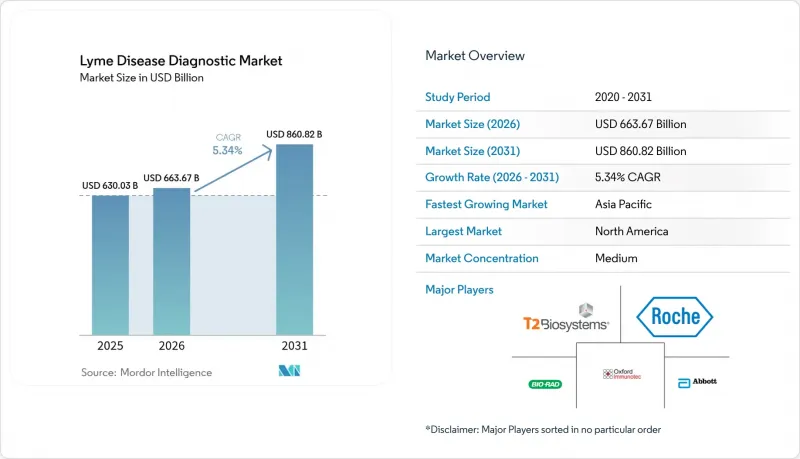
Mordor Intelligence에 의하면, 2026년 라임병 진단 시장 규모는 6억 6,367만 달러로 추정되고 있어 2025년 6억 3,003만 달러에서 확대해, 2031년에는 8억 6,082만 달러에 이를 것으로 예측됩니다.
2026년부터 2031년까지의 연평균 성장률(CAGR)은 5.34%를 나타낼 전망입니다.
본 보고서에서는 시장을 검사 유형(ELISA, 웨스턴 블롯 등),기술(혈청학(항체 기반), 분자진단 등), 검체 유형(혈액/혈청, 뇌척수액 등), 최종 사용자(병원 및 진료소, 진단 검사 기관 등), 지역(북미, 유럽 등)별로 분류하고 있습니다. 시장 예측은 금액(달러) 기준으로 제시되어 있습니다.
전 세계 라임병 진단 시장 동향 및 인사이트
기후 변화에 따른 진드기 서식지 확대
겨울의 온난화와 여름의 장기화로 인해 진드기의 활동 기간이 길어지고, 매개생물이 더 높은 위도 지역으로 이동하고 있습니다. 이로 인해 미국의 연간 진단 건수는 약 47만 6,000건에 달하며, 검사 건수는 멕시코 북부까지 증가하고 있습니다. 모델 예측에 따르면, 발트해 연안 지역에서는 서식지가 1.5배로 확대되는 반면, 우크라이나 일부 지역에서는 급격한 감소가 예상되고 있어, 의료 시스템은 보렐리아속 균의 유행 상황에 따라 검사 항목을 조정해야 할 필요에 직면해 있습니다. 지중해 및 북아프리카 국가들에서는 현재 보렐리아 유행이 증가하고 있는 것으로 보고되고 있으며, 공급업체들은 해당 지역의 균주에 맞춘 항원 패널의 현지화를 서둘러야 하는 상황에 직면해 있습니다. 경제 전망에 따르면, 기온이 3℃ 상승하면 미국의 의료비는 2억 3,600만 달러로 급증할 가능성이 있어, 정확한 조기 진단에 대한 지속적인 수요가 부각되고 있습니다.
수정형 2단계 알고리즘(MTTTA)의 채택 확대
임상 실험실에서는 웨스턴 블롯을 통한 확인 검사를, 더 조기에 항체 반응을 포착할 수 있는 2단계 ELISA로 대체하고 있으며, 일부 연구에서는 특이성을 저해하지 않으면서 검출 감도를 2배로 높이고 있습니다. 블루크로스 NC 등 미국의 보험 지급 기관들은 MTTTA 워크플로우에 대한 보험 적용을 시작했으며, 이로 인해 검사실의 예산 제약이 완화되어 도입이 가속화되고 있습니다. 유럽의 참조 센터가 지침을 업데이트함에 따라, EU의 기술 기준에 의존하는 아시아의 신생 검사 기관에도 파급 효과가 나타나고 있습니다. 1단계와 2단계 키트를 단일 규제 신청으로 통합할 수 있는 공급업체는 더 강력한 구매 협상력을 보유하고 있습니다.
기존 ELISA 프로토콜의 높은 위음성률
기존의 2단계 검사에서는 초기 감염의 최대 50%를 놓칠 가능성이 있어, 그 결과 임상의는 경험에 기반한 치료를 시행하거나 재검사를 지시하게 되어 비용 증가와 환자의 불안을 초래하고 있습니다. 프랑스의 SPPT 분류는 이러한 취약점에 대한 정책적 인식을 보여주고 있지만, 많은 보험사는 여전히 표준 워크플로우만을 보험 적용 대상으로 하고 있어 최신 기술 도입이 지연되고 있습니다. 또한, 위음성은 감시 데이터를 왜곡하여 전국 등록부에 기록된 실제 질병 부담을 은폐하게 됩니다.
부문 분석
ELISA는 확립된 보험 급여 제도와 임상 실험실 내 자동 분석기의 보급에 힘입어 2025년 매출의 45.98%를 차지했으나, 높은 위음성률로 인해 연평균 성장률(CAGR) 6.07%로 성장하고 있는 멀티플렉스 어레이로의 전환이 진행되고 있습니다. 웨스턴 블롯은 기존 알고리즘에서 여전히 필수적이지만, 개선된 2단계 ELISA 모델로 인해 블롯에 대한 수요는 점차 감소하고 있습니다. PCR 및 NAAT는 감염 초기라는 좁은 틈새 시장을 채우고 있지만, 라테럴 플로우 카드는 민감도가 낮아 현장 진료에 적합합니다. 병원들이 워크플로우 효율을 높이는 원런(One-Run) 동시 감염 패널을 채택함에 따라, 라임병 진단 시장에서 멀티플렉스 마이크로어레이 시장 규모는 현저히 확대될 것으로 예측됩니다. 그 보급 속도는 보험사의 승인 여부와 확장된 항원 시그니처를 해석하기 위한 직원 교육의 필요성에 따라 좌우될 것입니다.
임상 경험에 따르면, 최대 400종의 항원을 동시에 선별함으로써 단백질 마이크로어레이는 민감도를 63%에서 100%까지 향상시킬 수 있는 것으로 나타났습니다. 31개 밴드 프로파일을 갖춘 FDA 승인 ImmunoBlot 키트는 특이성을 유지하면서 검사 시간을 단축함으로써 웨스턴 블롯의 사용을 점차 줄이고 있습니다. 상환 코드가 따라잡히면 ELISA의 지배력은 약화되겠지만, 예산이 제한된 지방 검사실에서는 감가상각 주기가 끝날 때까지 기존 플랫폼을 계속 고수할 가능성이 있습니다.
2025년에는 혈청학 검사가 매출의 57.12%를 차지했지만, 디지털 및 AI를 활용한 플랫폼은 결과 판독을 자동화하고 해석 오류를 줄임으로써 연평균 성장률(CAGR) 6.62%라는 기세로 급성장하고 있습니다. 분자진단법은 감염 후 2주 이내에 병원체를 직접 검출할 수 있다는 점에서 매력적이지만, 비용이 높기 때문에 일상적인 사용에는 한계가 있습니다. 현재, 현장 진단용 카트리지에는 머신러닝을 통한 분석 기능이 내장되어 있어, 의사는 검체를 외부로 보내지 않고도 20분 이내에 95.5%의 정확도로 결과를 얻을 수 있습니다. 그 결과, 라임병 진단 시장에서는 공급업체들이 혈청 검사에 디지털 기능을 결합하거나 분자진단을 통한 확인 검사를 세트로 제공함으로써 기술의 경계가 모호해지고 있습니다.
예측 기간 동안, 전자 진료 기록과 연동되는 AI 탑재 측면 유동식 리더기는 응급 진료 클리닉에서 표준 장비로 자리 잡을 전망입니다. 클라우드 기반 교정 데이터를 통해 기기 간 민감도의 일관성이 확보되는 한편, 검사실에서는 스트립의 자동 판정으로의 전환이 진행되어 인건비가 절감됩니다. 소프트웨어가 클래스 II 의료기기 인증을 획득함에 따라, 기술 공급업체들은 단순한 시약 제공에서 통합형 ‘진단 서비스(Diagnostics-as-a-Service)’의 구독 모델로 사업을 전환해 나갈 것입니다.
지역별 분석
2025년에는 유행 지역이 서쪽과 북쪽으로 확대되는 가운데, 북미가 매출의 42.98%를 차지했습니다. 미국에서는 연간 약 47만 6,000건의 사례가 보고되었으며, 의료비는 10억 달러에 육박했습니다. 캐나다의 주 단위 보고 체계 강화와 멕시코의 진드기 감시 체계 구축이 이 지역의 성장을 뒷받침하고 있습니다. FDA의 실험실 개발 검사(LDT) 관련 규제 제정으로 인해 단기적으로는 규정 준수 비용이 발생하지만, 장기적으로는 검사의 품질에 대한 신뢰도가 높아질 것입니다.
아시아태평양은 중국, 인도, 일본에서의 인식 제고를 배경으로 2031년까지 연평균 성장률(CAGR) 7.18%를 기록하며 가장 빠르게 성장하는 지역입니다. 다양한 보렐리아 속 균은 수입된 검사 패널에 있어 과제가 되고 있으며, 공급업체들은 항원의 현지화 및 검증 시험 실시를 요구받고 있습니다. 한국과 호주의 공중보건 기관은 전문 지식 이전을 가속화하기 위해 유럽의 검사 기관과 합동 연수를 시작했습니다. 현장 진단(Point-of-Care) 방식에 대한 투자는 이 지역의 분산된 농촌 인구와 인프라 격차에 적합합니다.
유럽에서는 검사 지침의 통일과 임상의들의 높은 숙련도 덕분에 검사 건수가 견조한 추세를 보이고 있습니다. 독일과 프랑스가 조사 결과를 주도하는 한편, 이탈리아나 스페인 등 지중해 연안 국가들은 기후 온난화와 철새의 영향으로 발생률 상승에 직면해 있습니다. 남미 및 아프리카 일부 지역에서는 도입이 초기 단계에 있습니다. 아르헨티나에서는 인간 감염 사례가 보고되고 있으나, 시약의 확보 가능성 및 임상의의 지식이 제한적이어서 여전히 진단 미비 현상이 지속되고 있습니다.
기타 혜택:
- 엑셀 형식 시장 예측(ME) 시트
- 3개월간의 애널리스트 지원
자주 묻는 질문
목차
제1장 서론
제2장 조사 방법
제3장 주요 요약
제4장 시장 구도
제5장 시장 규모와 성장 예측
제6장 경쟁 구도
제7장 시장 기회와 향후 전망
JHS 26.08.26According to Mordor Intelligence, lyme disease diagnostics market size in 2026 is estimated at USD 663.67 million, growing from 2025 value of USD 630.03 million with 2031 projections showing USD 860.82 million, growing at 5.34% CAGR over 2026-2031.
This report Segments the Industry Into by Test Type (ELISA, Western Blot and More), by Technology (Serologic (Antibody-Based), Molecular Diagnostics and More), by Sample Type (Blood / Serum, Cerebrospinal Fluid and More), by End User (Hospitals & Clinics, Diagnostic Laboratories and More) and Geography (North America, Europe and More). The Market Forecasts are Provided in Terms of Value (USD).
Global Lyme Disease Diagnostic Market Trends and Insights
Climate-linked Tick Habitat Expansion
Warming winters and longer summers lengthen tick activity seasons and push vectors into higher latitudes, lifting U.S. diagnoses to roughly 476,000 annually and driving test volumes as far south as northern Mexico. Models suggest a 1.5-fold increase in Baltic habitats, alongside a sharp decline in parts of Ukraine, compelling health systems to tailor test menus according to Borrelia species prevalence. Mediterranean and North African nations now report a rise in Borrelia circulation, pressuring suppliers to localize antigen panels for regional strains. Economic projections indicate that a 3 °C temperature rise could swell U.S. healthcare costs to USD 236 million, underlining the persistent demand for accurate early-stage diagnostics.
Rising Adoption of Modified Two-Tier Algorithms (MTTTA)
Clinical laboratories are replacing Western blot confirmation with second-step ELISAs that capture earlier antibody responses, doubling detection sensitivity in some studies without losing specificity. U.S. payers such as Blue Cross NC have started to reimburse MTTTA workflows, easing budget constraints on labs and accelerating uptake. European reference centers are updating guidelines, creating a follow-on effect in emerging Asian laboratories that rely on EU technical standards. Vendors that can bundle first- and second-step kits within a single regulatory filing enjoy stronger purchasing leverage.
High False-Negative Rate of Legacy ELISA Protocols
Traditional two-tier testing can miss up to 50% of early infections, leading clinicians to treat empirically or order repeat tests, raising costs and patient anxiety. France's SPPT classification illustrates policy acknowledgement of these weaknesses, but many insurers still reimburse only the standard workflow, delaying modern upgrades. False negatives also skew surveillance data, masking actual disease burdens in national registries.
Other drivers and restraints analyzed in the detailed report include:
- FDA Approvals of High-Sensitivity ImmunoBlot & xVFA Rapid Tests
- Home-Collection Kits Boosting Access & Testing Volumes
- Reimbursement Gaps for Multiplex & Urine-Based Assays
For complete list of drivers and restraints, kindly check the Table Of Contents.
Segment Analysis
ELISA generated 45.98% of 2025 revenue, supported by entrenched reimbursement and automated analyzers across clinical labs, yet its high false-negative profile is sparking migration to multiplex arrays growing at a 6.07% CAGR. Western blot remains integral within legacy algorithms, though the Modified Two-Tier ELISA model is gradually curbing blot demand. PCR and NAAT fill a narrow early-infection niche, while lateral-flow cards suit field medicine despite lower sensitivity levels. The Lyme disease diagnostics market size for multiplex microarrays is anticipated to climb markedly as hospitals adopt one-run co-infection panels that improve workflow efficiency. Adoption is paced by payer acceptance and the need for staff training to interpret expanded antigen signatures.
Clinical experience shows protein microarrays lifting sensitivity from 63% to 100% when up to 400 antigens are screened simultaneously. FDA-cleared ImmunoBlot kits with 31-band profiles are eroding Western blot use by matching specificity while reducing laboratory time. As reimbursement codes catch up, ELISA's hold will loosen, yet budget-constrained regional labs may still cling to legacy platforms until depreciation cycles end.
Serology commanded 57.12% revenue in 2025, but digital and AI-augmented platforms are sprinting ahead with 6.62% CAGR by automating result reads and cutting interpretation errors. Molecular assays appeal for direct pathogen detection within the first two weeks of infection, though higher costs limit routine use. Point-of-care cartridges are now integrating machine-learning analytics, enabling physicians to obtain 95.5%-accurate results in under 20 minutes without shipping specimens off-site. The Lyme disease diagnostics market is therefore seeing technology lines blur as vendors hybridize serology with digital overlay or bundle molecular confirmatory tests.
Over the forecast, AI-enabled lateral-flow readers that link to electronic records will become standard in urgent-care clinics. Cloud-based calibration data will ensure consistent sensitivity across devices, while labs migrate to automated strip interpretation, reducing manpower costs. As software attains Class II medical-device status, technology suppliers will pivot from pure reagents to integrated diagnostics-as-a-service subscriptions.
Complete Report Scope:
- By Test Type
- ELISA
- Western Blot
- PCR / NAAT
- Lateral Flow Assay (Rapid)
- ImmunoBlot
- Multiplex Microarray & Others
- By Technology
- Serologic (Antibody-based)
- Molecular
- Point-of-Care Platforms
- Multiplex Diagnostic Platforms
- Digital & AI-augmented Diagnostics
- By Sample Type
- Blood / Serum
- Cerebrospinal Fluid
- Urine
- Skin Biopsy
- Synovial Fluid
- By End User
- Hospitals & Clinics
- Diagnostic Laboratories
- Research Institutes
- Homecare / Direct-to-Consumer
- By Geography
- North America
- United States
- Canada
- Mexico
- Europe
- Germany
- United Kingdom
- France
- Italy
- Spain
- Rest of Europe
- Asia-Pacific
- China
- India
- Japan
- South Korea
- Australia
- Rest of Asia-Pacific
- South America
- Brazil
- Argentina
- Rest of South America
- Middle East and Africa
- GCC
- South Africa
- Rest of Middle East and Africa
- North America
Geography Analysis
North America contributed 42.98% revenue in 2025 as endemic counties expanded westward and northward, with the United States logging about 476,000 annual cases and healthcare costs near USD 1 billion. Canada's provincial reporting upgrades and Mexico's emerging tick surveillance reinforce regional growth. FDA rulemaking around laboratory-developed tests introduces near-term compliance costs but longer-term confidence in assay quality.
Asia-Pacific is the fastest-growing region at 7.18% CAGR to 2031, driven by heightened awareness in China, India, and Japan. Diverse Borrelia species challenge imported assay panels, pushing suppliers to localize antigens and validation studies. Public-health agencies across South Korea and Australia have begun joint training with European laboratories to accelerate expertise transfer. Investment in point-of-care formats fits the region's dispersed rural populations and infrastructure gaps.
Europe maintains strong volumes thanks to harmonized testing guidelines and high clinician familiarity. Germany and France spearhead research output, while Mediterranean states such as Italy and Spain face rising incidence linked to warmer climates and migrating birds South America and parts of Africa sit in early-stage adoption: Argentina has documented human cases, yet under-diagnosis persists due to limited reagent availability and clinician knowledge.
- Abbott Laboratories
- Roche
- DiaSorin
- bioMerieux
- QIAGEN
- Thermo Fisher Scientific
- Bio-Rad Laboratories
- ZEUS Scientific
- Trinity Biotech
- Euroimmun (PerkinElmer)
- Quest Diagnostics
- LabCorp
- Igenex
- ArminLabs
Additional Benefits:
- The market estimate (ME) sheet in Excel format
- 3 months of analyst support
TABLE OF CONTENTS
1 Introduction
- 1.1 Study Assumptions & Market Definition
- 1.2 Scope of the Study
2 Research Methodology
3 Executive Summary
4 Market Landscape
- 4.1 Market Overview
- 4.2 Market Drivers
- 4.2.1 Climate-Linked Tick Habitat Expansion
- 4.2.2 Rising Adoption Of Modified Two-Tier Algorithms (MTTTA)
- 4.2.3 Fda Approvals Of High-Sensitivity Immunoblot & Xvfa Rapid Tests
- 4.2.4 Home-Collection Kits Boosting Access & Testing Volumes
- 4.2.5 Ai-Powered Digital Readers Reducing False Negatives
- 4.2.6 Growth In Point-Of-Care Diagnostics Investment In Endemic Regions
- 4.3 Market Restraints
- 4.3.1 High False-Negative Rate Of Legacy ELISA Protocols
- 4.3.2 Reimbursement Gaps For Multiplex & Urine-Based Assays
- 4.3.3 Supply-Chain Fragility For Recombinant Antigens
- 4.3.4 Physician Under-Recognition In Emerging Geographies
- 4.4 Supply-Chain Analysis
- 4.5 Regulatory Landscape
- 4.6 Technological Outlook
- 4.7 Porter's Five Forces Analysis
- 4.7.1 Threat of New Entrants
- 4.7.2 Threat of Substitutes
- 4.7.3 Bargaining Power of Buyers
- 4.7.4 Bargaining Power of Suppliers
- 4.7.5 Competitive Rivalry
5 Market Size & Growth Forecasts (Value)
- 5.1 By Test Type
- 5.1.1 ELISA
- 5.1.2 Western Blot
- 5.1.3 PCR / NAAT
- 5.1.4 Lateral Flow Assay (Rapid)
- 5.1.5 ImmunoBlot
- 5.1.6 Multiplex Microarray & Others
- 5.2 By Technology
- 5.2.1 Serologic (Antibody-based)
- 5.2.2 Molecular
- 5.2.3 Point-of-Care Platforms
- 5.2.4 Multiplex Diagnostic Platforms
- 5.2.5 Digital & AI-augmented Diagnostics
- 5.3 By Sample Type
- 5.3.1 Blood / Serum
- 5.3.2 Cerebrospinal Fluid
- 5.3.3 Urine
- 5.3.4 Skin Biopsy
- 5.3.5 Synovial Fluid
- 5.4 By End User
- 5.4.1 Hospitals & Clinics
- 5.4.2 Diagnostic Laboratories
- 5.4.3 Research Institutes
- 5.4.4 Homecare / Direct-to-Consumer
- 5.5 By Geography
- 5.5.1 North America
- 5.5.1.1 United States
- 5.5.1.2 Canada
- 5.5.1.3 Mexico
- 5.5.2 Europe
- 5.5.2.1 Germany
- 5.5.2.2 United Kingdom
- 5.5.2.3 France
- 5.5.2.4 Italy
- 5.5.2.5 Spain
- 5.5.2.6 Rest of Europe
- 5.5.3 Asia-Pacific
- 5.5.3.1 China
- 5.5.3.2 India
- 5.5.3.3 Japan
- 5.5.3.4 South Korea
- 5.5.3.5 Australia
- 5.5.3.6 Rest of Asia-Pacific
- 5.5.4 South America
- 5.5.4.1 Brazil
- 5.5.4.2 Argentina
- 5.5.4.3 Rest of South America
- 5.5.5 Middle East and Africa
- 5.5.5.1 GCC
- 5.5.5.2 South Africa
- 5.5.5.3 Rest of Middle East and Africa
- 5.5.1 North America
6 Competitive Landscape
- 6.1 Market Concentration
- 6.2 Market Share Analysis
- 6.3 Company Profiles (includes Global level Overview, Market level overview, Core Segments, Financials as available, Strategic Information, Market Rank/Share for key companies, Products & Services, and Recent Developments)
- 6.3.1 Abbott Laboratories
- 6.3.2 Roche Diagnostics
- 6.3.3 DiaSorin
- 6.3.4 bioMerieux
- 6.3.5 Qiagen
- 6.3.6 Thermo Fisher Scientific
- 6.3.7 Bio-Rad Laboratories
- 6.3.8 ZEUS Scientific
- 6.3.9 Trinity Biotech
- 6.3.10 Euroimmun (PerkinElmer)
- 6.3.11 Quest Diagnostics
- 6.3.12 LabCorp
- 6.3.13 Igenex
- 6.3.14 ArminLabs
7 Market Opportunities & Future Outlook
- 7.1 White-space & Unmet Need Assessment