|
시장보고서
상품코드
2114796
문합기 : 시장 점유율 분석, 업계 동향 및 통계, 성장 예측(2026-2031년)Anastomosis Devices - Market Share Analysis, Industry Trends & Statistics, Growth Forecasts (2026 - 2031) |
||||||
 Mordor Intelligence
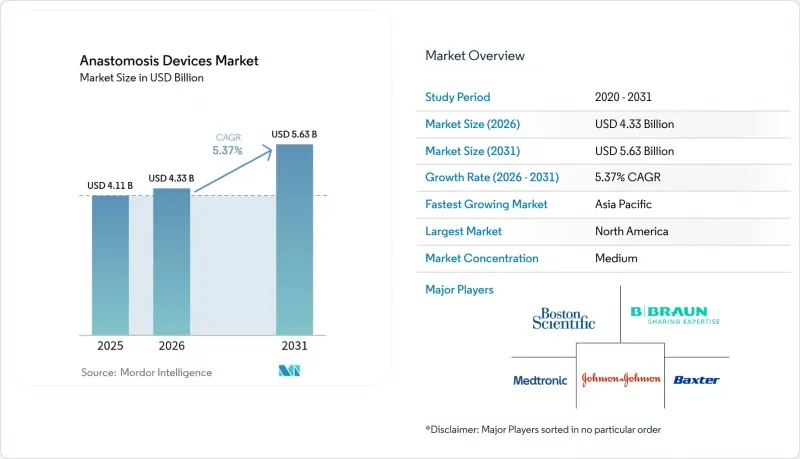
Mordor Intelligence에 의하면, 2026년 문합기 시장 규모는 43억 3,000만 달러로 추정되고 2025년 41억 1,000만 달러에서 확대해, 2031년에는 56억 3,000만 달러에 이를 것으로 예측됩니다.
2026-2031년 동안 연평균 성장률(CAGR) 5.37%로 성장할 것으로 전망됩니다.
본 보고서는 사용 방식(일회용 및 재사용 가능), 제품 유형(외과용 스테이플러, 외과용 봉합사, 기타), 기기 기술(수동, 전동, 기타),소재(금속계, 기타), 용도(심혈관 외과, 소화기 외과, 기타), 최종 사용자(병원, 외래수술센터(ASC), 기타), 지역별로 분류되어 있습니다. 시장 예측은 금액(달러)으로 표시되어 있습니다.
세계의 문합기 시장 동향 및 인사이트
수술 건수 증가 및 만성 질환 부담의 확대
인구 고령화가 진행되고, 비만, 당뇨병, 심혈관 질환이 선진국과 신흥 지역 모두에서 확산됨에 따라 외과 수술 건수는 증가 일로를 걷고 있습니다. CMS는 2025년 ASC(외래수술센터(ASC))에 대한 지급액을 74억 달러로 제안했습니다(2024년 대비 2억 200만 달러 증액), 이에 따라 ASC 적용 대상 목록에 20가지 수술이 추가되어 수술 건수 증가가 예상됩니다. SADI-S와 같은 단일 문합을 이용한 비만 수술 기술은 중국 코호트에서 당뇨병의 완전한 관해를 가져왔으며, 이는 이 수술의 유효성과 높은 수요를 입증하고 있습니다. 사례가 1건 증가할 때마다 여러 번의 조직 접합이 필요하기 때문에 문합 기기 시장의 제품당 소비량이 증가합니다. 이와 동시에, 로봇 플랫폼의 보급으로 인해 복잡한 소화관 재건술의 적용 범위가 확대되면서, 간접적으로 기기 판매량을 끌어올리고 있습니다. 이에 따라 병원 및 ASC(외래수술센터(ASC))는 사례 수 증가에 대응하기 위해 원형 스테이플러, 직선 커터, 자석 링의 재고를 보충하고 있습니다.
저침습 스테이플링 및 실란트 기술의 채택 확대
복강경 수술 및 로봇 수술의 워크플로는 조직에 가해지는 부담을 줄이고 회복 기간을 단축하기 위해, 외과의들 사이에서 전동 스테이플러, 스마트 실란트, 관절 가동식 리로드의 도입이 점점 더 확대되고 있습니다. ETHICON의 ‘ECHELON’ 전동 스테이플러는 수동식 제품에 비해 출혈로 인한 합병증을 73%, 누출을 85% 감소시켰습니다. Intuitive의 ‘SureForm’은 120°의 관절 가동 범위와 ‘SmartFire’ 조직 감지 기능을 갖추고 있어 균일한 클램프 압력과 스테이플 형성을 보장합니다. 이러한 성능 향상은 높은 가격 책정을 정당화하며, 문합기 시장이 중간 단일 자릿수 대의 성장을 유지하는 데 기여하고 있습니다. 렉싱턴 메디컬(Lexington Medical)이 35개국에 걸친 저침습 스테이플러 판매망 확장에 성장 자금을 조달한 것으로 보아, 투자자들의 신뢰가 뚜렷이 드러나고 있습니다. 로봇 기술과 지능형 고정 장치 기술의 융합은 후발 기업에게 기술적 진입 장벽을 높이는 한편, 임상 성과 향상으로도 이어집니다.
카테터 기반 대체 요법(예 : PCI)으로의 전환에 따른 관상동맥 우회술(CABG) 건수 감소
경피적 관상동맥 중재술(PCI) 및 경카테터 대동맥판막 교체술(TAVR) 덕분에, 과거에는 개흉 우회술이 필수적이었던 관상동맥 질환 및 판막증의 치료가 가능해지면서 수술 건수가 감소하고 있습니다. 보스턴 사이언티피크의 심혈관 부문 매출은 중재적 심장학 부문 수요를 배경으로 2025년 1분기에 26.2% 급증했습니다. 메드트로닉의 ‘Evolut FX+’는 관상동맥 접근이 용이하다는 점을 인정받아 FDA 승인을 획득했으며, 이로 인해 외과적 이식술을 받는 환자 수가 더욱 감소하고 있습니다. 그 결과, 성숙한 시장의 심혈관 외과의사들은 혈관용 스테이플러나 커플러를 예전만큼 필요로 하지 않게 되어, 문합기 시장의 고부가가치 부문 중 하나에 둔화 현상을 초래하고 있습니다. 반면, 신흥국에서는 카테터실 인프라가 제한적이어서 여전히 CABG에 의존하고 있으며, 이는 이러한 감소 추세를 부분적으로 상쇄하고 있습니다.
부문별 분석
2025년, 문합기 시장에서 일회용 제품은 67.92%의 점유율을 차지했습니다. 이는 재처리가 필요 없습니다는 편의성과 엄격한 감염 관리 프로토콜이 뒷받침한 결과입니다. 특히 수술 건수가 많아 중앙 멸균 부서에 부담이 가중되는 상황에서 병원 측은 예측 가능한 처리 시간과 간소화된 물류를 높이 평가했습니다. 많은 의료 기관에서는 일회용 스테이플러를 시술 팩에 포함시켜 준비 및 재고 관리의 효율화를 도모하고 있습니다. 그러나 환경에 대한 배려와 예산 관리의 엄격화가 진행되는 가운데, 조달 담당자들은 재사용형 로더나 강화형 리로드 카트리지로의 전환을 요구받고 있습니다. 재사용형 제품군은 연평균 성장률(CAGR) 7.24%로 확대되고 있으며, 이는 저온 멸균 기술의 성숙과 검증된 세척 워크플로우의 확립을 반영한 것입니다. 수술 건수가 특정 손익분기점을 초과할 경우, 수술 건수가 많은 외래수술센터(ASC)에서는 총 소유 비용(TCO)이 낮아질 것으로 추산되고 있어, 이 부문의 전망은 밝아지고 있습니다.
당초 외과의사들 사이에서는 재사용형 조(jaw)와 나이프 에지의 신뢰성에 대한 우려의 목소리가 있었으나, 설계를 거듭 개선한 결과 현재는 스테이플 라인의 품질을 저해하지 않으면서 50회 이상의 멸균 주기를 견딜 수 있게 되었습니다. VMI(공급업체 관리 재고)를 동반한 자본 구매 모델도 도입 장벽을 더욱 완화하고 있습니다. 예측 기간 동안 일회용 제품이 문합기 시장을 계속 독점할 전망이지만, 특히 환경 의식이 높은 유럽의 의료 기관에서는 일회용 리로드 카트리지와 재사용형 핸들을 결합한 듀얼 트랙 전략이 보편화되고 있습니다.
스테이플러는 2025년 매출의 40.78%를 차지했으며, 수십 년에 걸친 치료 성과 데이터와 외과의사들이 익숙하게 사용하는 사용감 덕분에 여전히 기본 선택지로 남아 있습니다. 최신 직선형 및 원형 스테이플러는 3열 스테이플, 높이 조절이 가능한 폐쇄형 앤빌 설계, 조직에 가해지는 저항을 최소화하는 정교한 커터 블레이드를 갖추고 있습니다. 경쟁사 벤치마킹에 따르면, ETHICON PROXIMATE 직선형 커터는 타사 브랜드에 비해 누출 압력 임계값이 34% 더 높은 것으로 나타났습니다. 지속적인 기능 강화로 인해 대장 외과, 비만 외과, 흉부 외과 부문에서 수요가 지속되고 있으며, 이는 기존 공급업체의 가치를 뒷받침하고 있습니다.
압축형 및 자기식 링 클립은 현재 매출 규모는 작지만, 2031년까지 연평균 성장률(CAGR) 7.55%로 다른 카테고리를 상회하는 성장이 예상됩니다. FDA의 ‘획기적 치료법(Breakthrough)’ 지정은 임상적 유망성을 보여주고 있으며, 초기 연구에서 염증 반응이 낮고 잔류하는 경질 금속 이물질이 제거된다는 사실이 밝혀졌습니다. 봉합이 필요 없는 압축 방식은 성장 적응과 임플란트로 인한 부담을 최소화하는 것을 우선시하는 소아외과 의사 및 이식외과 의사들에게 지지를 받고 있습니다. 동물 모델 및 초기 인체 임상시험에서의 성공 사례가 보다 광범위한 보험 적용 승인의 길을 열어주며, 문합기 시장에 새로운 활력을 불어넣고 있습니다.
지역별 분석
북미는 연구개발(R&D) 클러스터의 집중, 기술의 조기 도입, 견고한 보험 환급 채널에 힘입어 2025년에는 전 세계 매출의 38.12%를 차지했습니다. FDA의 ‘획기적 치료(Breakthrough)’ 및 510(k) 프로그램은 새로운 압축 기기 시장 출시 기간을 단축하고 있으며, 대규모 통합 의료 네트워크를 통해 여러 주에 걸친 신속한 확장이 가능해졌습니다. 가치 기반 구매(VBP)가 가격에 하방 압력을 가하고 있어, 공급업체들은 이익률을 유지하기 위해 재입원율 및 누출률 감소를 입증하는 근거를 강조할 수밖에 없게 되었습니다.
유럽은 이에 이어 각국의 조달 규정 및 의료기기 규정(MDR)에 따른 증거 요건의 강화로 인해 견조하면서도 다양한 수요가 나타나고 있습니다. 독일과 프랑스에서는 병원의 설비 투자 예산이 풍부하여 로봇 스테이플러 도입이 추진되고 있지만, 남유럽 국가들에서는 비용 대비 효과가 우선시되고 있습니다. 브렉시트 이후의 규제 차이로 인해 영국에서는 별도의 인증이 필요해져 시장 출시까지의 기간이 길어지는 한편, 문합기 시장의 단기적인 성장이 다소 억제되고 있습니다.
아시아태평양은 가처분 소득 증가, 인프라 확충, 정부의 의료 투자로 인해 2031년까지의 연평균 성장률(CAGR)이 8.55%로 가장 높은 성장세를 보이고 있습니다. 중국 모 의료 센터에서 실시된 827건의 로봇 보조 SADI-S 수술에 대한 후향적 분석 결과, 합병증 발생률이 위 우회 수술과 동등한 것으로 나타나 현지 기술 수준이 입증되었습니다. 일본에서는 초고령화 사회에 따라 누출 없는 혈관 및 소화관 문합이 요구되고 있는 반면, 한국의 의료 관광 클러스터에서는 해외 환자를 유치하기 위해 최첨단 스테이플러가 도입되고 있습니다. 인도에서는 2024년에 마케팅 행동 강령이 도입되어, 다국적 기업의 진입을 촉진하는 규제 감독 체제의 성숙도를 보여주고 있습니다. 다양한 소득 계층이 존재하기 때문에 고급 로봇용 리로드와 경제적인 수동식 스테이플러에 대한 수요가 동시에 발생하고 있으며, 문합기 시장 규모가 확대되고 있습니다.
기타 혜택
- 엑셀 형식 시장 예측(ME) 시트
- 3개월간의 애널리스트 지원
자주 묻는 질문
목차
제1장 서론
제2장 조사 방법
제3장 주요 요약
제4장 시장 구도
제5장 시장 규모 및 성장 예측
제6장 경쟁 구도
제7장 시장 기회 및 향후 전망
KTH 26.08.28According to Mordor Intelligence, the anastomosis devices market size in 2026 is estimated at USD 4.33 billion, growing from 2025 value of USD 4.11 billion with 2031 projections showing USD 5.63 billion, growing at 5.37% CAGR over 2026-2031.
This report is Segmented by Usage (Disposable and Reusable), Product Type (Surgical Staplers, Surgical Sutures, and More), Device Technology (Manual, Powered, and More), Material (Metallic, and More), Application (Cardiovascular Surgery, Gastrointestinal Surgery, and More), End User (Hospital, Ambulatory Surgical Centers, and More), and Geography. The Market Forecasts are Provided in Terms of Value (USD).
Global Anastomosis Devices Market Trends and Insights
Rising volume of surgeries and mounting chronic disease burden
Surgical procedures keep climbing as populations age and obesity, diabetes and cardiovascular disease spread across both developed and emerging regions. CMS proposed USD 7.4 billion in 2025 ASC payments-USD 202 million more than 2024-while adding 20 extra procedures to the ASC list, signaling higher case throughput.Single-anastomosis bariatric techniques such as SADI-S have delivered complete diabetes remission in Chinese cohorts, underlining procedure efficacy and demand. Each incremental case translates into multiple tissue connections, thereby raising unit consumption of anastomosis devices market products. In parallel, robotic platforms are broadening eligibility for complex gastrointestinal reconstructions, indirectly lifting device volumes. Hospitals and ASCs alike are therefore replenishing inventories of circular staplers, linear cutters and magnetic rings to keep pace with caseload growth.
Growing adoption of minimally-invasive stapling and sealant technologies
Laparoscopic and robotic workflows reduce trauma and shorten recovery, so surgeons increasingly favor powered staplers, smart sealants and articulating reloads. ETHICON's ECHELON Powered Stapler cut bleeding complications by 73% and leaks by 85% versus manual peers. Intuitive's SureForm features 120° articulation plus SmartFire tissue sensing, ensuring even clamp pressure and staple formation. These performance gains justify premium pricing, helping the anastomosis devices market sustain mid-single-digit growth. Investor confidence is evident, as Lexington Medical attracted growth capital to widen distribution of its minimally-invasive staplers across 35 nations. Convergence between robotics and intelligent fastening elevates technical barriers for late entrants but boosts clinical outcomes.
Shift to catheter-based alternatives reducing CABG volumes
Percutaneous coronary interventions and TAVR now treat coronary and valvular disease once reserved for open bypass, cutting surgical case volumes. Boston Scientific's cardiovascular revenue surged 26.2% in Q1 2025 on interventional cardiology demand. Medtronic's Evolut FX+ received FDA approval with easier coronary access, further diverting patients from surgical grafting. Cardiovascular surgeons in mature markets therefore require fewer vascular staplers and couplers, dampening one high-value segment of the anastomosis devices market. Emerging economies still rely on CABG due to limited cath-lab infrastructure, partially offsetting the decline.
Other drivers and restraints analyzed in the detailed report include:
- Technological advancement in surgical stapling and suturing devices
- Emergence of suture-less magnetic & nitinol compression devices
- High capital and single-use costs of advanced staplers/connectors
For complete list of drivers and restraints, kindly check the Table Of Contents.
Segment Analysis
Disposables secured 67.92% of the anastomosis devices market share in 2025, driven by zero-reprocessing convenience and strict infection-control protocols. Hospitals appreciate the predictable turnaround and simplified logistics, especially when high case volume stresses central-sterile departments. Many institutions embed single-use staplers into procedure packs, streamlining setup and inventory tracking. However, heightened environmental scrutiny and budget oversight are nudging procurement teams toward reusable loaders and reinforced reload cartridges. The reusable cohort is growing at 7.24% CAGR, reflecting maturation of low-temperature sterilization and validated cleaning workflows. High-volume ASCs now calculate lower total cost of ownership when cases surpass specific break-even counts, improving the segment's prospects.
Surgeons initially voiced reliability concerns about reusable jaws and knife edges, yet iterative engineering now delivers cycle counts exceeding 50 sterilizations without staple line compromise. Capital-purchase models with vendor-managed inventory further soften adoption hurdles. While disposables will continue dominating the anastomosis devices market for the forecast period, dual-track strategies that pair single-use reloads with reusable handles are becoming common, especially in Europe's eco-conscious facilities.
Staplers generated 40.78% of 2025 revenue and remain the default choice thanks to decades of outcome data and surgeon familiarity. Modern linear and circular variants boast triple-row staples, variable height closed-anvil designs, and refined knife blades that minimize tissue drag. Competitive benchmarking shows ETHICON PROXIMATE linear cutters achieve 34% higher leak-pressure thresholds versus alternate brands. Continuous enhancements ensure sustained demand across colorectal, bariatric and thoracic disciplines, anchoring value for incumbent suppliers.
Compression and magnetic rings & clips, although currently smaller in dollars, outpace other categories at 7.55% CAGR through 2031. FDA breakthrough designations signal clinical promise, and early studies reveal lower inflammatory profiles and elimination of retained hard-metal artifacts. Sutureless compression resonates with pediatric and transplant surgeons who prioritize growth accommodation and minimal implant burden. Success stories in animal models and initial human trials are setting the stage for broader reimbursement approval, fueling fresh momentum in the anastomosis devices market.
Complete Report Scope:
- By Usage
- Disposable
- Reusable
- By Product Type
- Surgical Staplers
- Surgical Sutures
- Surgical Sealants & Adhesives
- Compression / Magnetic Rings & Clips
- By Device Technology
- Manual
- Powered
- Robotic-assisted / Automated Connectors
- By Material
- Metallic (Stainless Steel, Titanium, Nitinol)
- Polymer (PP, ABS, PEEK)
- Bio-absorbable / Hydrogel
- By Application
- Cardiovascular Surgery
- Gastrointestinal Surgery
- Bariatric & Metabolic Surgery
- Organ Transplant & Dialysis Access
- Others (Thoracic, Neuro, Urology)
- By End User
- Hospitals
- Ambulatory Surgical Centers
- Specialty Clinics
- By Geography
- North America
- United States
- Canada
- Mexico
- Europe
- Germany
- United Kingdom
- France
- Italy
- Spain
- Rest of Europe
- Asia-Pacific
- China
- Japan
- India
- Australia
- South Korea
- Rest of Asia-Pacific
- Middle East and Africa
- GCC
- South Africa
- Rest of Middle East and Africa
- South America
- Brazil
- Argentina
- Rest of South America
- North America
Geography Analysis
North America controlled 38.12% of global revenue in 2025, underpinned by concentrated R&D clusters, early technology adoption and robust reimbursement pathways. FDA breakthrough and 510(k) programs accelerate time-to-market for novel compression devices, while large integrated health networks enable swift rollouts across multiple states. Nonetheless, value-based purchasing exerts downward pressure on price, compelling suppliers to emphasise evidence of reduced readmission and leak rates to sustain margin.
Europe follows with strong yet varied demand shaped by national procurement rules and the Medical Device Regulation's heightened evidence bar. Germany and France champion robotic stapling adoption due to high hospital capital budgets, whereas Southern European systems prioritise cost-effectiveness. Post-Brexit regulatory divergence necessitates separate UK certifications, elongating launch timelines and modestly restraining short-term growth in the anastomosis devices market.
Asia-Pacific registers the fastest CAGR at 8.55% through 2031, thanks to rising disposable incomes, infrastructure expansion and government healthcare investments. Retrospective analysis of 827 robotic SADI-S patients in a Chinese center showed complication rates comparable to gastric bypass, validating local skill levels. Japan's super-aged demographic demands leak-proof vascular and GI anastomoses, while South Korea's medical-tourism clusters adopt cutting-edge staplers to attract overseas patients. India implemented a marketing conduct code in 2024, signalling maturing regulatory oversight that encourages multinational entrants. Diverse income tiers generate parallel demand for premium robotic reloads and economical manual staplers, broadening the anastomosis devices market footprint.
- Medtronic
- Johnson & Johnson
- Baxter
- Boston Scientific
- B. Braun
- Getinge
- LivaNova plc
- Beckton Dickinson
- Intuitive Surgical
- Meril Life Sciences
- Teleflex
- Cook Group
- Smiths Group
- Stryker
- Terumo
- AtriCure
- W. L. Gore & Associates
- Peters Surgical
- Zimmer Biomet
- Conmed
- Purple Surgical
- Phraxis Inc.
Additional Benefits:
- The market estimate (ME) sheet in Excel format
- 3 months of analyst support
TABLE OF CONTENTS
1 Introduction
- 1.1 Study Assumptions and Market Definition
- 1.2 Scope of the Study
2 Research Methodology
3 Executive Summary
4 Market Landscape
- 4.1 Market Overview
- 4.2 Market Drivers
- 4.2.1 Rising Volume Of Surgeries Coupled With Increasing Burden Of Chronic Diseases
- 4.2.2 Growing Adoption Of Minimally-Invasive Stapling & Sealant Technologies
- 4.2.3 Technological Advancement In Surgical Stapling And Suturing Devices
- 4.2.4 Emergence Of Suture-Less Magnetic & Nitinol Compression Devices
- 4.2.5 Robotic Assistance Enabling Automated Vessel Anastomosis
- 4.2.6 Value-Based Care Focus On Post Surgical Complications
- 4.3 Market Restraints
- 4.3.1 Shift To Catheter-Based Alternatives (E.G., PCI) Reducing CABG Volumes
- 4.3.2 High Capital & Single-Use Costs Of Advanced Staplers/Connectors
- 4.3.3 Device Malfunctions & Recalls Affecting Surgeon Confidence
- 4.3.4 Limited Clinical Evidence Slowing Approvals Of Bioabsorbable Glues
- 4.4 Value / Supply-Chain Analysis
- 4.5 Regulatory Landscape
- 4.6 Technology Outlook
- 4.7 Porter's Five Forces Analysis
- 4.7.1 Bargaining Power of Suppliers
- 4.7.2 Bargaining Power of Buyers
- 4.7.3 Threat of New Entrants
- 4.7.4 Threat of Substitutes
- 4.7.5 Intensity of Competitive Rivalry
5 Market Size and Growth Forecasts (Value-USD)
- 5.1 By Usage
- 5.1.1 Disposable
- 5.1.2 Reusable
- 5.2 By Product Type
- 5.2.1 Surgical Staplers
- 5.2.2 Surgical Sutures
- 5.2.3 Surgical Sealants & Adhesives
- 5.2.4 Compression / Magnetic Rings & Clips
- 5.3 By Device Technology
- 5.3.1 Manual
- 5.3.2 Powered
- 5.3.3 Robotic-assisted / Automated Connectors
- 5.4 By Material
- 5.4.1 Metallic (Stainless Steel, Titanium, Nitinol)
- 5.4.2 Polymer (PP, ABS, PEEK)
- 5.4.3 Bio-absorbable / Hydrogel
- 5.5 By Application
- 5.5.1 Cardiovascular Surgery
- 5.5.2 Gastrointestinal Surgery
- 5.5.3 Bariatric & Metabolic Surgery
- 5.5.4 Organ Transplant & Dialysis Access
- 5.5.5 Others (Thoracic, Neuro, Urology)
- 5.6 By End User
- 5.6.1 Hospitals
- 5.6.2 Ambulatory Surgical Centers
- 5.6.3 Specialty Clinics
- 5.7 By Geography
- 5.7.1 North America
- 5.7.1.1 United States
- 5.7.1.2 Canada
- 5.7.1.3 Mexico
- 5.7.2 Europe
- 5.7.2.1 Germany
- 5.7.2.2 United Kingdom
- 5.7.2.3 France
- 5.7.2.4 Italy
- 5.7.2.5 Spain
- 5.7.2.6 Rest of Europe
- 5.7.3 Asia-Pacific
- 5.7.3.1 China
- 5.7.3.2 Japan
- 5.7.3.3 India
- 5.7.3.4 Australia
- 5.7.3.5 South Korea
- 5.7.3.6 Rest of Asia-Pacific
- 5.7.4 Middle East and Africa
- 5.7.4.1 GCC
- 5.7.4.2 South Africa
- 5.7.4.3 Rest of Middle East and Africa
- 5.7.5 South America
- 5.7.5.1 Brazil
- 5.7.5.2 Argentina
- 5.7.5.3 Rest of South America
- 5.7.1 North America
6 Competitive Landscape
- 6.1 Market Concentration
- 6.2 Market Share Analysis
- 6.3 Company profiles (includes Global level Overview, Market level overview, Core Segments, Financials as available, Strategic Information, Market Rank/Share for key companies, Products and Services, and Recent Developments)
- 6.3.1 Medtronic plc
- 6.3.2 Johnson & Johnson (Ethicon)
- 6.3.3 Baxter
- 6.3.4 Boston Scientific Corp.
- 6.3.5 B. Braun SE
- 6.3.6 Getinge AB
- 6.3.7 LivaNova plc
- 6.3.8 Becton, Dickinson & Company
- 6.3.9 Intuitive Surgical
- 6.3.10 Meril Life Sciences
- 6.3.11 Teleflex Inc.
- 6.3.12 Cook Medical
- 6.3.13 Smith & Nephew plc
- 6.3.14 Stryker Corporation
- 6.3.15 Terumo Corporation
- 6.3.16 AtriCure Inc.
- 6.3.17 W. L. Gore & Associates
- 6.3.18 Peters Surgical
- 6.3.19 Zimmer Biomet Holdings
- 6.3.20 Conmed Corporation
- 6.3.21 Purple Surgical
- 6.3.22 Phraxis Inc.
7 Market Opportunities and Future Outlook
- 7.1 White-Space and Unmet-Need Assessment