

|
시장보고서
상품코드
2114813
산화인듐주석(ITO) : 시장 점유율 분석, 업계 동향 및 통계, 성장 예측(2026-2031년)Indium Tin Oxide - Market Share Analysis, Industry Trends & Statistics, Growth Forecasts (2026 - 2031) |
||||||
 Mordor Intelligence
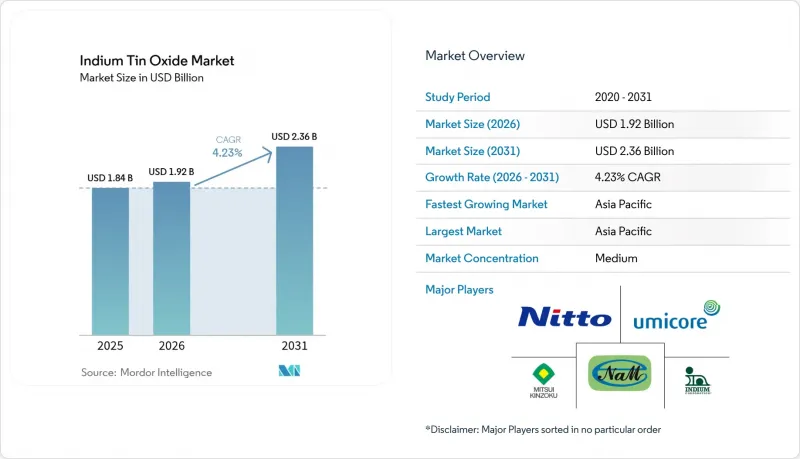
Mordor Intelligence에 의하면, 산화인듐주석(ITO) 시장 규모는 2025년에 18억 4,000만 달러로 평가되었습니다. 2026년 19억 2,000만 달러에서 2031년까지 23억 6,000만 달러에 이를 것으로 예상되며, 예측 기간(2026-2031년) CAGR은 4.23%를 나타낼 전망입니다.
본 보고서는 제조 공정(스퍼터링 증착, 전자빔 증착법, 기타 기술), 용도(광전자, 태양전지 셀, 기타),최종 사용자 산업(가전제품, 재생 에너지, 기타), 지역(아시아태평양, 북미, 유럽, 남미, 중동 및 아프리카)별로 분류되어 있습니다. 시장 전망은 금액(달러) 기준으로 제시되어 있습니다.
세계의 산화인듐주석(ITO) 시장 동향 및 인사이트
패널 생산 능력 확대에 따른 수요 증가
중국, 한국, 일본 각지에서 건설 중인 OLED 제조 공장은 산화인듐주석에 대한 장기 공급 계약을 체결하고 있습니다. BOE Technology와 TCL CSOT는 대형 기판용으로 설계된 8세대 생산 라인을 발표했으며, 이에 따라 높은 균일성의 스퍼터 증착이 요구되는 사양이 추진되고 있습니다. 2024년 말까지 플렉서블 스마트폰 디스플레이 출하량이 전체의 절반을 넘어설 것으로 예측되며, 근거리용 디바이스용 마이크로 OLED에 대한 투자가 가속화되고 있습니다. 각 장비 제조업체들은 미결 주문량이 증가했다고 보고하고 있으며, ITO 코팅 수요에 대한 향후 몇 년간의 전망이 밝아지고 있습니다. 잉크젯 인쇄를 이용한 전극 기술은 향상되고 있지만, 주류 생산에서는 기존 스퍼터링 방식의 경제성이 여전히 경쟁력을 유지하고 있습니다.
투명 전극이 필요한 태양광 발전 설비의 설치 증가
2024년 전 세계 태양광 발전 설비의 신규 도입량은 230GW를 넘어섰으며, 정부의 입찰 상황을 고려할 때 2025년에는 더욱 대규모로 도입되었습니다. 박막 CIGS 개발 기업들은 특히 탠덤형이나 실리콘 상의 페로브스카이트형 설계에서 투명성과 시트 저항의 균형을 맞추기 위해 산화인듐주석(ITO) 층에 의존하고 있습니다. 모듈공급 과잉으로 인해 가격은 하락 추세를 보이고 있지만, 와트당 설비 투자(CAPEX)의 감소가 분산형 발전에서의 채택을 뒷받침하고 있습니다. 연구팀은 전해법을 사용하여 폐기된 CIGS 모듈에서 52%의 인듐 회수에 성공했으며, 이는 1차 공급의 집중을 상쇄하기 위한 첫걸음이 될 것입니다. 장기적으로는 고효율 페로브스카이트에 내구성이 높고 결함이 적은 투명 전도체가 필요하게 되어, ITO의 기준 생산량을 뒷받침할 것으로 예측됩니다.
인듐 가격의 급격한 변동과 공급 리스크
중국이 일부 인듐 화합물에 대해 라이선싱 제도를 도입함에 따라, 2025년 초 인듐 가격은 13% 가까이 상승했습니다. 1차 인듐의 75-80%는 아연 제품 분리 과정에서 회수되기 때문에 현물 수요가 급증하더라도 광산은 생산량을 신속하게 늘릴 수 없어 정제업체들은 재고에 의존할 수밖에 없는 상황입니다. 미국은 정제 인듐 수입이 국가 안보를 위협하는지 여부를 판단하기 위해 제232조에 따른 조사를 개시했습니다. 이는 관세 부과나 비축 조치의 가능성을 시사하는 것입니다. 한국과 캐나다의 제련소에서는 회수율 향상에 사용된 잔사의 침출 처리를 검토하고 있는 반면, 브랜드 소유자들은 할당량을 확보하기 위해 장기 계약 협상을 진행하고 있습니다. 이러한 전략은 산화인듐-주석 산업 관계자들에게 비용의 불확실성을 억제해 주기는 하지만, 완전히 제거해 주지는 않습니다.
부문별 분석
2025년, 산화인듐주석(ITO) 시장에서 스퍼터링은 공정의 성숙도와 뛰어난 박막 균일성을 바탕으로 매출 점유율 74.62%를 차지하며 시장을 장악했습니다. 회전 음극의 개량을 통해 아크 발생이 억제되고, 장비 가동률이 향상되어 1제곱미터당 비용이 절감되었습니다. 일부 제조업체는 성능과 처리량의 균형을 맞추기 위해, 전도성을 높이기 위한 산소 함량이 낮은 시드 필름과 광학적 투명성을 확보하기 위한 산소 함량이 높은 캡 필름을 조합한 2층 스퍼터링 방식을 채택하고 있습니다. 스프레이 열분해 및 화학 기상 증착(CVD)을 포함한 기타 기술은 플렉서블 기판에서 저온 처리가 요구되기 때문에 2031년까지 연평균 성장률(CAGR) 5.12%를 나타낼 것으로 예측됩니다. 이러한 기법은 기판의 허용 온도가 200°C를 초과해서는 안 되는 폴더블 디스플레이를 제조하는 스타트업 기업들에게 매력적입니다.
전자빔 증착은 초고진공 순도가 요구되는 틈새 광학 부문에서 여전히 확고한 입지를 유지하고 있습니다. JX 어드밴스트 메탈즈의 애리조나주 메사 공장 확장은 지정학적 압박 속에서 OEM 업체들이 스퍼터링 관련 공급망을 현지화하려는 노력을 여실히 보여주고 있습니다. 폴리머 웹의 현장 플라즈마 세정에 관한 조사는 스퍼터링 방식과 대기압 스프레이 방식 간의 효율 격차를 더욱 좁힐 가능성이 있으며, 성막 방식의 다양화는 급격하게가 아니라 단계적으로 진행될 것임을 시사하고 있습니다.
지역별 분석
아시아태평양의 매출 점유율 55.68%는 수직 통합된 디스플레이 및 태양광 발전 생태계에 의해 뒷받침되고 있습니다. 2025년까지 중국이 단독으로 전 세계 OLED 생산 능력의 76%를 차지했으며, BOE 등의 제조업체는 유리 용융, 대상 접합, 재활용 설비를 동일한 부지 내에 집약한 제조 단지를 운영했습니다. 한국은 생산량 면에서는 뒤처져 있지만 공정 혁신에서는 선두를 달리고 있으며, 한편 일본은 고순도 스퍼터링 타겟과 마스크 세트를 공급하고 있습니다. 중국이 2025년에 라이선싱 제도를 도입함에도 불구하고, 지역 전체의 연평균 성장률(CAGR)은 4.82%로 예측됩니다. 이는 국내 재활용 및 동남아시아에서의 백엔드 조립이 해외 유출 위험을 완화하고 있기 때문입니다.
북미에서는 수요 증가와 중요 광물 안보 프로그램 간의 균형을 맞추고 있습니다. 애리조나주에 신설된 스퍼터링 대상 공장이나 온타리오주에서 계획 중인 인듐 재활용 허브는 반도체 및 자동차 산업 고객을 위한 공급 라인 단축을 목표로 하고 있습니다. 미국의 ‘인플레이션 억제법’에 따른 전기차(EV)에 대한 우대 조치는 국내 자동차 제조업체의 디스플레이 업그레이드를 통해 간접적으로 ITO 사용량을 증가시키고 있습니다. 유럽의 ‘중요 원자재법’은 2030년까지 전략적 금속의 국내 조달률을 10%로 높이는 것을 목표로 하고 있으며, 벨기에와 불가리아에서는 아연 제련소 잔재물로부터 인듐을 2차 추출하는 것에 대한 타당성 조사가 촉진되고 있습니다. 개정된 ‘건축물의 에너지 성능에 관한 지침’에 따른 스마트 유리 도입 의무화로 인해, 해당 지역의 소비량은 더욱 증가할 전망입니다.
남미나 중동과 같이 규모는 작지만 유망한 시장에서는 풍부한 태양광 자원이 활용되고 있습니다. 브라질의 분산형 태양광 발전 입찰에서는 지역 ITO 코팅 파트너에게 유리한 현지 조달 요건이 정해져 있는 반면, 사우디아라비아의 NEOM 프로젝트에서는 주요 구역 전체에 일렉트로크로믹 파사드 채택이 규정되어 있습니다. 현지 생산 능력은 제한적이기 때문에 여전히 아시아태평양으로부터의 수입이 필요하지만, 최종 사용자와 가까운 곳에서 스퍼터링 생산 능력을 확충하기 위해 일본 및 한국의 제조업체들과의 합작 사업 협상이 진행 중입니다.
기타 혜택
- 엑셀 형식 시장 예측(ME) 시트
- 3개월간의 애널리스트 지원
자주 묻는 질문
목차
제1장 서론
제2장 조사 방법
제3장 주요 요약
제4장 시장 구도
제5장 시장 규모 및 성장 예측
제6장 경쟁 구도
제7장 시장 기회 및 향후 전망
KTH 26.08.28According to Mordor Intelligence, the indium tin oxide market size was valued at USD 1.84 billion in 2025 and estimated to grow from USD 1.92 billion in 2026 to reach USD 2.36 billion by 2031, at a CAGR of 4.23% during the forecast period (2026-2031).
This report is Segmented by Technique (Sputtering Deposition, Electron-Beam Evaporation, Other Techniques), Application (Optoelectronics, Photovoltaic Cells, and More), End-User Industry (Consumer Electronics, Renewable Energy, and More), and Geography (Asia-Pacific, North America, Europe, South America, Middle East and Africa). The Market Forecasts are Provided in Terms of Value (USD).
Global Indium Tin Oxide Market Trends and Insights
Rising Demand from New Panel Capacity
OLED fabs under construction across China, Korea, and Japan are lifting long-term offtake agreements for indium tin oxide targets. BOE Technology and TCL CSOT have announced eighth-generation lines designed for large substrates, driving specifications that favor high-uniformity sputtered films. Flexible smartphone displays are projected to exceed half of shipments by late-2024, and micro-OLED spending is accelerating for near-to-eye devices. Equipment providers report backlog growth, reinforcing multi-year visibility for ITO coating demand. Although inkjet-printed electrodes are improving, incumbent sputtering economics remain competitive for mainstream production.
Rising Solar PV Installations Needing Transparent Electrodes
Global photovoltaic additions topped 230 GW in 2024, and government auctions point to larger 2025 build-outs. Thin-film CIGS developers rely on indium tin oxide layers to balance transparency and sheet resistance, especially in tandem and perovskite-on-silicon designs. Module oversupply is pushing prices down, yet lower capex per watt is spurring adoption in distributed generation. Research groups have achieved 52% indium recovery from end-of-life CIGS modules via electrolytic methods, a step toward offsetting primary supply concentration. Over the long term, higher-efficiency perovskites will require durable, low-defect transparent conductors, supporting baseline ITO volumes.
High Indium Price Volatility and Supply Risk
Indium prices rose nearly 13% in early-2025 after China introduced export licensing on several indium compounds. Because 75-80% of primary indium is recovered as a zinc by-product, mines cannot quickly boost output when spot demand spikes, leaving refiners dependent on inventories. The United States started a Section 232 study to determine whether imports of refined indium threaten national security, signaling possible tariffs or stockpiling measures. Smelters in Korea and Canada are examining residue leaching to lift recoveries, while brand-owners negotiate long-term contracts to lock in allocation. These strategies cap, but do not eliminate, cost unpredictability for indium tin oxide industry participants.
Other drivers and restraints analyzed in the detailed report include:
- Growth of Smart-Glass and Touch-Interface Devices
- EV Battery Tabs Using Ultra-Thin ITO Coatings
- Commercialization of Low-Cost Substitutes
For complete list of drivers and restraints, kindly check the Table Of Contents.
Segment Analysis
Sputtering dominated the indium tin oxide market in 2025 with a 74.62% revenue share, underpinned by process maturity and superior film homogeneity. Rotary cathode upgrades cut arcing events, enhancing target utilization and lowering cost per square meter. Some producers deploy bilayer sputtering-an oxygen-lean seed film for conductivity topped by an oxygen-rich cap for optical clarity-to balance performance and throughput. Other techniques, including spray pyrolysis and chemical vapor deposition, together are projected to clock a 5.12% CAGR to 2031 as flexible substrates demand lower-temperature processing. These routes appeal to start-ups manufacturing foldable displays where substrate heat budgets cannot exceed 200 °C.
Electron-beam evaporation keeps a foothold in niche optics requiring ultra-high vacuum purity. JX Advanced Metals' Mesa, Arizona plant expansion illustrates OEM efforts to localize sputtering target supply chains amid geopolitical pressures. Research on in-situ plasma cleaning of polymer webs may further bridge efficiency gaps between sputtering and atmospheric spray methods, suggesting a gradual, not abrupt, diversification of deposition choices.
Complete Report Scope:
- By Technique
- Sputtering Deposition
- Electron-Beam Evaporation
- Other Techniques (Spray Pyrolysis, Chemical Vapour Deposition (CVD))
- By Application
- Optoelectronics
- Photovoltaic Cells
- Battery Inhibitors
- Other Applications (Wearables and Flexible Electronics, etc.)
- By End-User Industry
- Consumer Electronics
- Renewable Energy
- Automotive and Transportation
- Building and Construction
- Aerospace and Defence
- By Geography
- Asia-Pacific
- China
- Japan
- India
- South Korea
- ASEAN Countries
- Rest of Asia-Pacific
- North America
- United States
- Canada
- Mexico
- Europe
- Germany
- United Kingdom
- France
- Italy
- Spain
- Russia
- NORDIC Countries
- Rest of Europe
- South America
- Brazil
- Argentina
- Rest of South America
- Middle East and Africa
- Saudi Arabia
- South Africa
- Rest of Middle East and Africa
- Asia-Pacific
Geography Analysis
Asia-Pacific's 55.68% revenue stake is anchored in its vertically integrated display and solar ecosystems. China alone is projected to control 76% of global OLED capacity by 2025, and producers such as BOE operate fabrication parks that co-locate glass melting, target bonding, and recycling units. Korea lags in volume but leads in process innovation, while Japan supplies high-purity sputtering targets and mask sets. Regional growth of 4.82% CAGR is forecast despite China's 2025 export licensing, as domestic recycling and Southeast Asian back-end assembly mitigate outward flow risks.
North America is balancing demand growth with critical-mineral security programs. New sputtering-target factories in Arizona and planned indium recycling hubs in Ontario aim to shorten supply lines for semiconductor and automotive customers. The U.S. Inflation Reduction Act's EV incentives indirectly lift ITO usage via domestic car-maker display upgrades. Europe's Critical Raw Materials Act targets 10% domestic sourcing of strategic metals by 2030, spurring feasibility studies for secondary indium extraction from zinc smelter residues in Belgium and Bulgaria. Smart-glass mandates in revised Energy Performance of Buildings Directive will further raise regional consumption.
Smaller yet promising markets in South America and the Middle East leverage abundant solar resources. Brazil's distributed solar auctions stipulate local content requirements that favor regional ITO coating partners, while Saudi Arabia's NEOM project specifies electrochromic facades across key zones. Limited local target manufacturing still necessitates Asia-Pacific imports, but joint ventures with Japanese and Korean producers are under negotiation to add sputtering capacity near end-users.
- American Elements
- Diamond Coatings Inc
- ENAM Optoelectronic Material
- Guangxi Crystal Union Photoelectric Materials Co., Ltd. (CUPM)
- Indium Corporation
- Knight Optical
- MITSUI MINING & SMELTING CO.,LTD.
- Nitto Denko Corporation.
- OPCO Laboratory, Inc.,
- Sumitomo Metal Mining Co., Ltd.
- Touch International, Inc.
- Umicore
- Vital Materials Co., Limited.
Additional Benefits:
- The market estimate (ME) sheet in Excel format
- 3 months of analyst support
TABLE OF CONTENTS
1 Introduction
- 1.1 Study Assumptions and Market Definition
- 1.2 Scope of the Study
2 Research Methodology
3 Executive Summary
4 Market Landscape
- 4.1 Market Overview
- 4.2 Market Drivers
- 4.2.1 Rising demand due to panel capacity additions
- 4.2.2 Rising solar-PV installations needing transparent electrodes
- 4.2.3 Growth of smart-glass and touch-interface devices
- 4.2.4 EV battery tabs adopting ultra-thin ITO coatings for heat sensing
- 4.2.5 Increase in demand from wearable and fkexible elctronics
- 4.3 Market Restraints
- 4.3.1 High indium price volatility and supply risk
- 4.3.2 Availability of low-cost substitutes
- 4.3.3 Increasing recycling mandates lowering virgin target demand
- 4.4 Value Chain Analysis
- 4.5 Porter's Five Forces
- 4.5.1 Bargaining Power of Suppliers
- 4.5.2 Bargaining Power of Buyers
- 4.5.3 Threat of New Entrants
- 4.5.4 Threat of Substitutes
- 4.5.5 Degree of Competition
5 Market Size and Growth Forecasts (Value)
- 5.1 By Technique
- 5.1.1 Sputtering Deposition
- 5.1.2 Electron-Beam Evaporation
- 5.1.3 Other Techniques (Spray Pyrolysis, Chemical Vapour Deposition (CVD))
- 5.2 By Application
- 5.2.1 Optoelectronics
- 5.2.2 Photovoltaic Cells
- 5.2.3 Battery Inhibitors
- 5.2.4 Other Applications (Wearables and Flexible Electronics, etc.)
- 5.3 By End-User Industry
- 5.3.1 Consumer Electronics
- 5.3.2 Renewable Energy
- 5.3.3 Automotive and Transportation
- 5.3.4 Building and Construction
- 5.3.5 Aerospace and Defence
- 5.4 By Geography
- 5.4.1 Asia-Pacific
- 5.4.1.1 China
- 5.4.1.2 Japan
- 5.4.1.3 India
- 5.4.1.4 South Korea
- 5.4.1.5 ASEAN Countries
- 5.4.1.6 Rest of Asia-Pacific
- 5.4.2 North America
- 5.4.2.1 United States
- 5.4.2.2 Canada
- 5.4.2.3 Mexico
- 5.4.3 Europe
- 5.4.3.1 Germany
- 5.4.3.2 United Kingdom
- 5.4.3.3 France
- 5.4.3.4 Italy
- 5.4.3.5 Spain
- 5.4.3.6 Russia
- 5.4.3.7 NORDIC Countries
- 5.4.3.8 Rest of Europe
- 5.4.4 South America
- 5.4.4.1 Brazil
- 5.4.4.2 Argentina
- 5.4.4.3 Rest of South America
- 5.4.5 Middle East and Africa
- 5.4.5.1 Saudi Arabia
- 5.4.5.2 South Africa
- 5.4.5.3 Rest of Middle East and Africa
- 5.4.1 Asia-Pacific
6 Competitive Landscape
- 6.1 Market Concentration
- 6.2 Strategic Moves
- 6.3 Market Share(%)/Ranking Analysis
- 6.4 Company Profiles (includes Global level Overview, Market level overview, Core Segments, Financials as available, Strategic Information, Market Rank/Share, Products and Services, Recent Developments)
- 6.4.1 American Elements
- 6.4.2 Diamond Coatings Inc
- 6.4.3 ENAM Optoelectronic Material
- 6.4.4 Guangxi Crystal Union Photoelectric Materials Co., Ltd. (CUPM)
- 6.4.5 Indium Corporation
- 6.4.6 Knight Optical
- 6.4.7 MITSUI MINING & SMELTING CO.,LTD.
- 6.4.8 Nitto Denko Corporation.
- 6.4.9 OPCO Laboratory, Inc.,
- 6.4.10 Sumitomo Metal Mining Co., Ltd.
- 6.4.11 Touch International, Inc.
- 6.4.12 Umicore
- 6.4.13 Vital Materials Co., Limited.
7 Market Opportunities and Future Outlook
- 7.1 White-space and Unmet-Need Assessment


