

|
시장보고서
상품코드
2114815
글루코스 시장 : 점유율 분석, 업계 동향과 통계, 성장 예측(2026-2031년)Glucose - Market Share Analysis, Industry Trends & Statistics, Growth Forecasts (2026 - 2031) |
||||||
 Mordor Intelligence
Mordor Intelligence에 의하면, 글루코스 시장 규모는 2025년 269억 1,000만 달러에서 2026년에는 278억 8,000만 달러로 확대되어 2026년부터 2031년까지 CAGR 3.6%로 성장을 지속하여, 2031년에는 332억 6,000만 달러에 이를 것으로 예측됩니다.
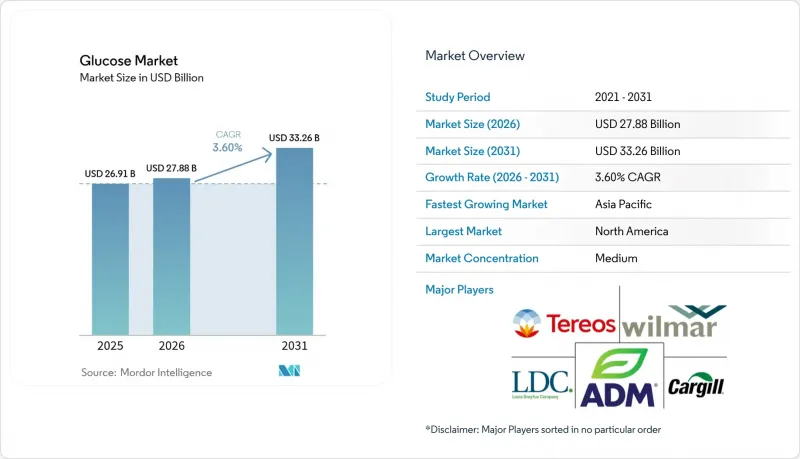
본 보고서는 원료별(밀, 옥수수 등), 형태별(시럽 및 고체), 등급별(식품 등급, 의약품 등급 등), 용도별(식품 및 음료, 의약품, 퍼스널케어 및 화장품, 동물사료, 기타 용도), 지역별(북미, 유럽,아시아태평양 등)으로 분류되어 있습니다. 시장 예측은 금액(달러) 기준으로 제시되어 있습니다.
세계 글루코스 시장 동향 및 인사이트
천연 식품 감미료에 대한 수요 증가
식품 가공업체들이 합성 첨가물 대신 FDA의 GRAS(일반적으로 안전하다고 인정되는) 기준을 준수하는 글루코스를 채택하는 경향이 강해짐에 따라, 글루코스 시장은 현저한 확장을 이루고 있습니다. 2024년에 발표된 국제식품정보협의회(IFIC)의 ‘식품·건강 조사’에 따르면, 미국 소비자의 약 43%가 천연 유래 감미료를 선호하는 것으로 나타났으며, 이는 시장의 견조한 성장과 천연 유래 대체품에 대한 소비자의 강한 선호도를 보여줍니다. 그린 플레인즈(Green Plains)사의 ‘클린 슈가 테크놀로지(Clean Sugar Technology)’는 저탄소 생산 방식을 가능하게 하며, 현대의 글루코스 제조 공정에서 지속가능성과 기능성을 동시에 달성할 수 있음을 입증하고 있습니다. 소매업체들이 공급망 전반에 걸쳐 더욱 엄격한 환경 인증 요건을 도입함에 따라, 생산 과정에서 재생에너지 사용을 입증할 수 있는 공급업체는 큰 경쟁 우위를 확보할 수 있습니다. 프리미엄 부문은 기존의 품질 지표의 틀을 넘어, 우수한 제품 품질과 입증된 환경 성과 모두를 중시하는 추세입니다. 이는 지속 가능한 관행을 향한 업계 전반의 변화를 반영한 것입니다.
편의식품 및 가공식품에 대한 수요 급증
아시아태평양의 도시형 라이프스타일로 전환됨에 따라 제빵, 음료, 즉석식사 제조 시설의 생산 능력은 높은 수준을 유지하고 있으며, 이러한 시설에서는 수분 유지 및 갈변 억제를 위해 액상 글루코스가 필수적입니다. 중국, 인도, 동남아시아 국가 등 주요 경제권에서의 급속한 도시화는 기존의 식품 소비 패턴을 변화시키고, 가공식품 및 편의식품에 대한 수요 증가를 주도하고 있습니다. 중국의 식품 가공업체들은 안정적인 공급 품질과 확립된 무역 관계 덕분에 미국에서 옥수수 유래 원료를 대량으로 수입하고 있습니다. 식품 제조업체들은 단일 원료로 감미, 발효 촉진, 식감 개선 등 여러 기능을 제공할 수 있는 글루코스를 선호하여, 이를 통해 조달 과정의 복잡성과 운영 비용을 절감하고 있습니다. 전자상거래 플랫폼의 성장에 따라 포장 식품 생산이 증가하고 있으며, 주요 온라인 소매업체들은 식품 배달 서비스와 디지털 식료품 부문을 확대되고 있습니다. 이러한 디지털 전환으로 인해 소비자들이 편의성과 긴 유통기한을 추구하며 포장 식품에 대한 의존도를 높임에 따라, 개인 소비가 감소하는 시기에도 꾸준한 수요 증가가 보장되고 있습니다.
원자재 가격 변동
옥수수와 밀 가격은 글루코스 생산 비용의 상당 부분에 큰 영향을 미치고 있습니다. 러시아·우크라이나 분쟁은 곡물 수출에 심각한 혼란을 초래하여 현물 시장 공급에 큰 제약을 야기했습니다. 세계은행은 2025년에 농산물 가격이 전반적으로 하락할 것으로 예측하고 있지만, 농산물 가격 변동은 앞으로도 계속될 것이라고 지적하고 있습니다. ADM의 재무 보고서에 따르면, 이 회사의 ‘탄수화물 솔루션’ 부문에서는 주로 세계 시장의 원자재 비용 변동에 기인한 상당한 이익률 압박이 나타나고 있습니다. 이러한 과제에 대응하기 위해 가공업체들은 선물 구매 계약 연장이나 밀, 카사바 등의 대체 원료 도입과 같은 전략적 조치를 취하고 있습니다. 이러한 대응은 시장의 불확실성에 대처하는 데 도움이 되지만, 업계 관계자들이 직면하고 있는 지속적인 가격 리스크를 완화하는 데는 부분적인 효과에 그칩니다.
부문 분석
옥수수 유래 글루코스는 2025년에 52.12%의 시장 점유율을 차지하고, 2031년까지 연평균 성장률(CAGR) 3.05%를 나타낼 것으로 전망됩니다. 미국에 위치한 통합형 습식 제분 시설은 철도 접근성 및 에탄올 제품별 세액 공제 등을 통해 가공업체에 구조적인 비용 이점을 제공합니다. ADM만 해도 연간 수백만 부셸을 분쇄하고 있어, 음료 및 제과 대기업이 중시하는 공급 신뢰성을 높이고 있습니다. 그러나 기후 변화로 인한 수확량 변동과 바이오연료 정책의 변동이 시장에 불안정성을 초래하고 있어, 이에 대응하기 위한 긴급 대책이 요구되고 있습니다.
밀 유래 글루코스는 유럽 및 아시아의 가공업체들이 옥수수 가격 리스크를 헤지하고 지역 곡물 잉여분을 활용함에 따라 연평균 성장률(CAGR) 4.98%로 성장하고 있습니다. EU의 전분 공장은 듀얼 피드(Dual Feed) 대응이 가능하도록 생산 라인을 재편하고 있어, 흑해 지역의 물류 상황이 다시 악화되더라도 공급의 지속성을 확보하고 있습니다. 감자와 카사바는 틈새 시장이지만 수익성이 높은 분야를 차지하고 있으며, 알레르기 유발 물질이 없습니다는 표시와 열대 지역 특유의 농법이 지역적 우위를 가져다주고 있습니다. 『Clean Sugar Technology』는 원료 선택이 탄소 감축 브랜딩과 어떻게 연계될 수 있는지를 부각시키며, 글루코스 생산자가 전 세계 소비재(CPG) 구매자들이 요구하는 스코프 3 감사에 대응할 수 있도록 자리매김하고 있습니다.
식품 등급 제품군은 2025년 매출의 60.54%를 차지하며, 다국간 라벨 승인을 확보하는 세계 GMP 및 코덱스(Codex) 준수에 힘입고 있습니다. 대중 시장을 겨냥한 음료, 통조림 과일, 냉동 디저트는 모두 계속해서 5자리 수 후반의 톤 규모 계약을 확보하고 있으며, 이것이 글루코스 시장의 기초적인 수요를 뒷받침하고 있습니다.
대조적으로, 의약품 등급의 취급량은 적지만 가격은 최대 60% 더 높습니다. 주사용 글루코스 시장 규모는 2026년 24억 3,000만 달러에서 연평균 성장률(CAGR) 5.48%를 기록하며 2031년까지 31억 7,000만 달러에 달할 것으로 예측됩니다. ICH-Q7 및 USP 프로토콜에 따른 인증은 생산 비용을 상승시키지만, 노보노르디스크의 노스캐롤라이나 공장 같은 투자를 통해 수년에 걸친 공급 계약이 확보되어 있습니다. 발효용 영양제 및 콘크리트 혼화제를 목적으로 하는 테크니컬 등급의 생산은 제품 포트폴리오를 강화하며, 각 공장이 이익률 추이에 따라 생산 라인을 전환할 수 있게 해줍니다.
지역별 분석
북미는 통합된 옥수수 벨트, 화학 가공에 대한 깊은 전문 지식, 그리고 견고한 제약 밸류체인을 배경으로 2025년에 37.68%의 시장 점유율을 차지했습니다. ADM, 카길, 잉그레디언 각사는 중서부 곡물 산지 근처에 전분 정제 자산을 집중시키고, 시럽을 철도를 통해 해안 지역의 병입 업체로 출하하고 있습니다. 또한, 이 지역에는 최대 규모의 GLP-1 제제 시설이 집적되어 있어, 스낵 식품의 배합 변경이 둔화되더라도 USP 등급 글루코스에 대한 안정적인 수요가 보장됩니다. FDA 및 USP 규제에 대한 이해도가 높기 때문에 규정 준수 관련 마찰이 줄어들어 라틴아메리카로의 수출 경쟁력이 유지되고 있습니다.
아시아태평양에서는 중국, 인도, 동남아시아의 도시화에 따라 2031년까지 4.98%라는 가장 높은 연평균 성장률(CAGR)을 나타낼 전망입니다. 콜드체인의 확충과 현대적인 소매업의 발전이 가공 식품의 보급을 뒷받침하는 한편, 국내 전분 가공업체들은 규모를 확대하며 수입품 대체를 추진하고 있습니다. 중국의 제분 공장에서는 원료 비용의 평준화를 도모하기 위해 옥수수, 밀, 카사바를 조합하고 있으며, 지방 자치 단체는 글루코스를 주원료로 하는 하류 과자류의 수출에 대해 보조금을 지급하고 있습니다. 또한, 만성 질환 발생률의 상승도 의약품 등급 제품의 확산을 뒷받침하고 있으며, 다국적 기업들은 공급 경로를 단축하기 위해 해당 지역 내에 충전 및 완제품 공장을 건설하고 있습니다.
유럽의 글루코스 시장은 성숙기에 접어들었지만, 프리미엄 틈새 시장에서는 여전히 풍부한 기회가 남아 있습니다. 인공 감미료에 대한 소비자의 기피 현상으로 인해 수요는 곡물 유래 시럽으로 이동하고 있습니다. 한편, 탈탄소화 정책으로 인해 글루코스를 원료로 하는 바이오플라스틱 사업에 대한 관심이 높아지고 있습니다. 중부 유럽의 공장에서는 옥수수와 밀을 모두 가공하고 있어, 이를 통해 흑해에서공급 리스크를 완화하는 동시에 단일 시장 내 관세 없는 접근을 유지하고 있습니다. 남미, 중동 및 아프리카는 여전히 신흥 시장이지만, 브라질, 이집트, 나이지리아의 제빵·음료 분야에 대한 투자는 거시경제적 역풍이 가라앉으면 기초 수요가 증가할 것임을 시사하고 있습니다.
기타 혜택:
- 엑셀 형식 시장 예측(ME) 시트
- 3개월간의 애널리스트 지원
자주 묻는 질문
목차
제1장 서론
제2장 조사 방법
제3장 주요 요약
제4장 시장 구도
제5장 시장 규모와 성장 예측
제6장 경쟁 구도
제7장 시장 기회와 향후 전망
JHS 26.08.26According to Mordor Intelligence, the glucose market size is expected to grow from USD 26.91 billion in 2025 to USD 27.88 billion in 2026 and is forecast to reach USD 33.26 billion by 2031 at 3.6% CAGR over 2026-2031.
This report is Segmented by Source (Wheat, Corn, and More), Form (Syrup and Solid), Grade (Food-Grade, Pharmaceutical-Grade, and Others), Application (Food and Beverages, Pharmaceutical, Personal Care and Cosmetics, Animal Feed and Other Applications), and Geography (North America, Europe, Asia-Pacific, and More). The Market Forecasts are Provided in Terms of Value (USD).
Global Glucose Market Trends and Insights
Growing Demand for Natural Food Sweeteners
The glucose market is experiencing significant expansion as food processors increasingly replace synthetic additives with glucose that complies with FDA GRAS (Generally Recognized as Safe) status . According to the International Food Information Council (IFIC) Food & Health Survey published in 2024, approximately 43% of American consumers prefer natural sources of sweetness. , indicating robust market growth and strong consumer preferences for natural alternatives. Green Plains' Clean Sugar Technology enables low-carbon production methods, demonstrating the compatibility between sustainability and functionality in modern glucose manufacturing processes. Suppliers who can verify renewable energy usage in production gain substantial competitive advantages as retailers implement stricter environmental certification requirements across their supply chains. The premium segment has evolved beyond traditional quality metrics, now emphasizing both superior product quality and verified environmental performance, reflecting a broader industry transformation toward sustainable practices.
Surging Demand for Convenience and Processed Foods
The shift toward urban lifestyles in the Asia-Pacific region maintains high production capacity in bakery, beverage, and ready-meal manufacturing facilities, where liquid glucose is essential for moisture retention and browning control. The rapid urbanization across major economies like China, India, and Southeast Asian countries has transformed traditional food consumption patterns, driving increased demand for processed and convenience foods. Chinese food processors import significant quantities of corn-based ingredients from the United States due to consistent supply quality and established trade relationships. Food manufacturers prefer glucose as it provides multiple functions - sweetness, fermentation support, and texture enhancement - through a single ingredient, reducing procurement complexity and operational costs. The growth of e-commerce platforms increases packaged food production, with major online retailers expanding their food delivery services and digital grocery segments. This digital transformation ensures steady demand growth even during periods of reduced consumer spending, as consumers increasingly rely on packaged food products for convenience and longer shelf life.
Raw Material Price Volatility
Corn and wheat prices significantly influence the majority of glucose production costs. The Russia-Ukraine conflict severely disrupted grain exports, leading to substantial constraints in spot market supplies. The World Bank anticipates a decrease in overall crop prices in 2025 but indicates persistent price volatility in agricultural commodities . ADM's financial reports demonstrate considerable margin pressures in its Carbohydrate Solutions segment, primarily attributed to fluctuating raw material costs in the global markets. In response to these challenges, processors are implementing strategic measures, including the extension of forward-purchase agreements and incorporation of alternative feedstocks such as wheat and cassava. While these adaptations help manage market uncertainties, they only partially mitigate the ongoing price risks faced by industry participants.
Other drivers and restraints analyzed in the detailed report include:
- Increasing Adoption of Glucose-Based Medical Solutions
- Expanding Use of Glucose in Fermentative Bioplastic Production
- Availability of Alternative Sweeteners
For complete list of drivers and restraints, kindly check the Table Of Contents.
Segment Analysis
Corn-based glucose represented a 52.12% market share in 2025 and projected a 3.05% CAGR to 2031. Integrated U.S. wet-milling complexes give processors structural cost benefits, including rail access and ethanol coproduct credits. ADM alone grinds millions of bushels annually, reinforcing supply reliability that beverage and confectionery majors value. Yet climate-driven yield variability and biofuel policy swings inject volatility, motivating contingency strategies.
Wheat-derived glucose grows at 4.98% CAGR as European and Asian processors hedge against corn price risk and leverage regional grain surpluses. EU starch plants re-tool lines for dual-feed capability, ensuring continuity if Black Sea logistics tighten again. Potato and cassava occupy niche but profitable corners where allergen-free labeling or tropical agronomy offer localized advantage. Clean Sugar Technology highlights how feedstock choice can dovetail with carbon-reduction branding, positioning glucose producers for scope-3 audits demanded by global CPG buyers.
Food-grade streams delivered 60.54% of 2025 sales, underpinned by global GMP and Codex compliance that secures multi-country label acceptance. Mass-market drinks, canned fruit, and frozen desserts all continue to draw high-five-figure-tonne contracts underpinning baseline glucose market demand.
In contrast, pharmaceutical-grade volumes are smaller but fetch prices up to 60% higher. The glucose market size for injectable-class material is projected to climb from USD 2.43 billion in 2026 to USD 3.17 billion by 2031 on a 5.48% CAGR. Certification under ICH-Q7 and USP protocols raises production costs, yet investments such as Novo Nordisk's North Carolina plant lock in multi-year off-take agreements. Technical-grade outputs aimed at fermentation nutrients or concrete admixtures round out portfolios, allowing plants to shift streams depending on margin signals.
Complete Report Scope:
- By Source
- Corn
- Wheat
- Potato
- Cassava
- Others
- By Form
- Syrup
- Solid
- By Grade
- Food-Grade
- Pharmaceutical-Grade
- Others
- By Application
- Food and Beverage
- Bakery and Confectionery
- Snacks and Cereals
- Beverages
- Dairy and Frozen Desserts
- Others Food and Beverages
- Pharmaceuticals
- Personal Care and Cosmetics
- Animal Feed
- Others
- Food and Beverage
- By Geography
- North America
- United States
- Canada
- Mexico
- Rest of North America
- Europe
- Germany
- United Kingdom
- Italy
- France
- Spain
- Netherlands
- Rest of Europe
- Asia-Pacific
- China
- India
- Japan
- Australia
- South Korea
- Rest of Asia-Pacific
- South America
- Brazil
- Argentina
- Rest of South America
- Middle East and Africa
- South Africa
- Saudi Arabia
- United Arab Emirates
- Rest of Middle East and Africa
- North America
Geography Analysis
North America held 37.68% market share in 2025 on the strength of an integrated corn belt, deep chemical processing expertise, and a robust pharmaceutical value chain. ADM, Cargill, and Ingredion concentrate starch-milling assets near Midwestern grain origination then ship syrups by rail to coastal bottlers. The region also hosts the largest cluster of GLP-1 drug facilities, guaranteeing steady draw for USP-grade glucose even when snack-food reformulation slows. Regulatory familiarity with FDA and USP codes lowers compliance friction, sustaining export competitiveness into Latin America.
Asia-Pacific records the fastest 4.98% CAGR to 2031 as China, India, and Southeast Asia urbanize. Expanded cold-chain and modern retail spur packaged-food penetration, while domestic starch processors scale to replace imports. Chinese mills integrate corn, wheat, and cassava to smooth feedstock costs, and local governments subsidize downstream candy exports that hinge on glucose inputs. Rising chronic disease incidence likewise fuels pharmaceutical-grade penetration, with multinationals building fill-finish sites inside the region to shorten supply lines.
Europe's glucose market matures yet remains opportunity-rich in premium niches. Consumer aversion to artificial sweeteners channels demand toward grain-sourced syrups, while decarbonization policy amplifies interest in glucose-to-bioplastic ventures. Central European plants process both corn and wheat, mitigating Black Sea supply risks and keeping duty-free access within the Single Market. South America and Middle East & Africa stay emergent, but bakery and beverage investments in Brazil, Egypt, and Nigeria signal rising baseline demand once macro headwinds stabilize.
- Archer Daniels Midland Company
- Cargill Incorporated
- Ingredion Incorporated
- Roquette Freres
- Tate and Lyle PLC
- Tereos SA
- Sudzucker AG (AGRANA Group)
- Wilmar International Ltd
- Louis Dreyfus Company B.V.
- Grain Processing Corporation
- Bunge Ltd
- Global Bio-Chem Technology Group
- Corn Products China Co.
- Zhucheng Dongxiao Biotechnology
- Matsutani Chemical Co.
- Gulshan Polyols Ltd
- Avebe U.A.
- Shandong Fuyang Biotechnology
- Royal Cosun
- SSP Co. for Sugar and Integrated Ind.
Additional Benefits:
- The market estimate (ME) sheet in Excel format
- 3 months of analyst support
TABLE OF CONTENTS
1 INTRODUCTION
- 1.1 Study Assumptions and Market Definition
- 1.2 Scope of the Study
2 RESEARCH METHODOLOGY
3 EXECUTIVE SUMMARY
4 MARKET LANDSCAPE
- 4.1 Market Overview
- 4.2 Market Drivers
- 4.2.1 Growing Demand for Natural Food Sweeteners
- 4.2.2 Surging Demand for Convenience and Processed Foods
- 4.2.3 Increasing Adoption of Glucose-Based Medical Solutions
- 4.2.4 Expanding Use of Glucose in Fermentative Bioplastic Production
- 4.2.5 Growth in Sports and Energy Nutrition Products
- 4.2.6 Rising Incorporation of Glucose in Infant and Pediatric Formulas
- 4.3 Market Restraints
- 4.3.1 Raw Material Price Volatility
- 4.3.2 Availability of Alternative Sweeteners
- 4.3.3 Growing Preference for Low-Glycemic Index (Low-GI) Foods
- 4.3.4 Rising Adoption of Low-Sugar Diets
- 4.4 Supply Chain Analysis
- 4.5 Regulatory Landscape
- 4.6 Technological Outlook
- 4.7 Porter's Five Forces
- 4.7.1 Threat of New Entrants
- 4.7.2 Bargaining Power of Buyers
- 4.7.3 Bargaining Power of Suppliers
- 4.7.4 Threat of Substitutes
- 4.7.5 Competitive Rivalry
5 MARKET SIZE AND GROWTH FORECASTS (VALUE)
- 5.1 By Source
- 5.1.1 Corn
- 5.1.2 Wheat
- 5.1.3 Potato
- 5.1.4 Cassava
- 5.1.5 Others
- 5.2 By Form
- 5.2.1 Syrup
- 5.2.2 Solid
- 5.3 By Grade
- 5.3.1 Food-Grade
- 5.3.2 Pharmaceutical-Grade
- 5.3.3 Others
- 5.4 By Application
- 5.4.1 Food and Beverage
- 5.4.1.1 Bakery and Confectionery
- 5.4.1.2 Snacks and Cereals
- 5.4.1.3 Beverages
- 5.4.1.4 Dairy and Frozen Desserts
- 5.4.1.5 Others Food and Beverages
- 5.4.2 Pharmaceuticals
- 5.4.3 Personal Care and Cosmetics
- 5.4.4 Animal Feed
- 5.4.5 Others
- 5.4.1 Food and Beverage
- 5.5 By Geography
- 5.5.1 North America
- 5.5.1.1 United States
- 5.5.1.2 Canada
- 5.5.1.3 Mexico
- 5.5.1.4 Rest of North America
- 5.5.2 Europe
- 5.5.2.1 Germany
- 5.5.2.2 United Kingdom
- 5.5.2.3 Italy
- 5.5.2.4 France
- 5.5.2.5 Spain
- 5.5.2.6 Netherlands
- 5.5.2.7 Rest of Europe
- 5.5.3 Asia-Pacific
- 5.5.3.1 China
- 5.5.3.2 India
- 5.5.3.3 Japan
- 5.5.3.4 Australia
- 5.5.3.5 South Korea
- 5.5.3.6 Rest of Asia-Pacific
- 5.5.4 South America
- 5.5.4.1 Brazil
- 5.5.4.2 Argentina
- 5.5.4.3 Rest of South America
- 5.5.5 Middle East and Africa
- 5.5.5.1 South Africa
- 5.5.5.2 Saudi Arabia
- 5.5.5.3 United Arab Emirates
- 5.5.5.4 Rest of Middle East and Africa
- 5.5.1 North America
6 COMPETITIVE LANDSCAPE
- 6.1 Market Concentration
- 6.2 Strategic Moves
- 6.3 Market Ranking Analysis
- 6.4 Company Profiles (includes Global-level overview, Market-level overview, Core segments, Financials, Strategic information, Market rank/share, Products and Services, Recent developments)
- 6.4.1 Archer Daniels Midland Company
- 6.4.2 Cargill Incorporated
- 6.4.3 Ingredion Incorporated
- 6.4.4 Roquette Freres
- 6.4.5 Tate and Lyle PLC
- 6.4.6 Tereos SA
- 6.4.7 Sudzucker AG (AGRANA Group)
- 6.4.8 Wilmar International Ltd
- 6.4.9 Louis Dreyfus Company B.V.
- 6.4.10 Grain Processing Corporation
- 6.4.11 Bunge Ltd
- 6.4.12 Global Bio-Chem Technology Group
- 6.4.13 Corn Products China Co.
- 6.4.14 Zhucheng Dongxiao Biotechnology
- 6.4.15 Matsutani Chemical Co.
- 6.4.16 Gulshan Polyols Ltd
- 6.4.17 Avebe U.A.
- 6.4.18 Shandong Fuyang Biotechnology
- 6.4.19 Royal Cosun
- 6.4.20 SSP Co. for Sugar and Integrated Ind.


