

|
시장보고서
상품코드
2114824
감시 레이더 : 시장 점유율 분석, 업계 동향 및 통계, 성장 예측(2026-2031년)Surveillance Radar - Market Share Analysis, Industry Trends & Statistics, Growth Forecasts (2026 - 2031) |
||||||
 Mordor Intelligence
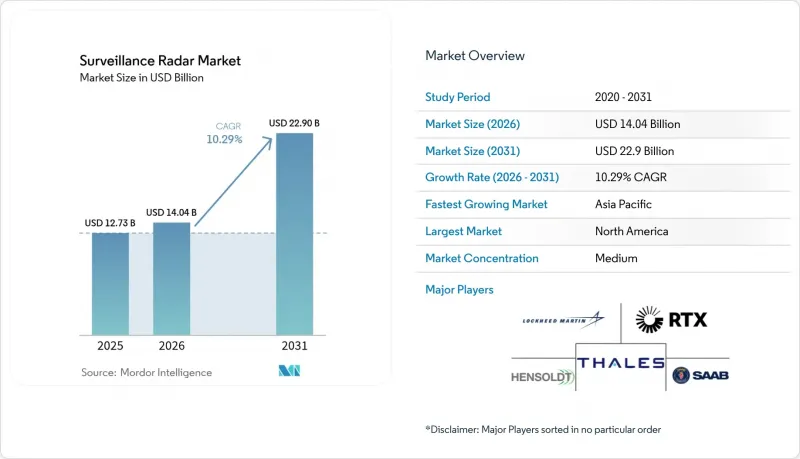
Mordor Intelligence에 의하면, 2026년 감시 레이더 시장 규모는 140억 4,000만 달러로 추정되고 2025년 127억 3,000만 달러에서 확대해, 2031년에는 229억 달러에 이를 것으로 예측됩니다.
2026년부터 2031년까지 연평균 성장률(CAGR) 10.29%로 성장할 것으로 전망됩니다.
본 보고서는 플랫폼(항공기 탑재형, 지상형, 해상형, 우주형), 구성 요소(안테나, 송신기, 듀플렉서, 기타), 용도(상업용 및 군용), 주파수 대역(VHF·UHF, L대역, 기타),감지 거리(단거리, 기타), 레이더 차원(2차원, 3차원, 4차원), 지역(북미, 유럽, 기타)별로 분류되어 있습니다. 시장 예측은 금액(달러) 기준으로 제시되어 있습니다.
세계의 감시 레이더 시장 동향 및 인사이트
국방 예산 확대 및 함대 현대화
NATO 회원국들은 2035년까지 국방비를 GDP의 5%까지 끌어올리겠다고 공약하고 있으며, 이는 2024년 지침인 2%에서 대폭 증가한 수치입니다. 이러한 지출 구조의 변화로 인해 수십억 달러 규모의 레이더 교체 프로그램이 실현될 것입니다. 그 예로, 2028년 운용 개시가 예정된 미국 공군의 4억 7,200만 달러 규모 TPY-4 시스템 19기 조달을 들 수 있습니다. 유럽의 1,000발 패트리어트 GEM-T 미사일 발주를 대표하는 공동 조달은 각국의 예산을 통합하는 동시에, 동맹 전체의 레이더 통합 요건을 조화시킵니다. 능력 기반 계획 모델을 통해 총군 구조 예산이 변동하더라도 레이더 관련 예산 항목은 영향을 받지 않고 유지됩니다. 멀티도메인 전략이 성숙해짐에 따라 지휘관들은 견고한 감지 아키텍처를 우선시하며, 차세대 레이더에 대한 안정적인 예산 배분을 확보하고 있습니다.
증가하는 국경 경비 및 감시 수요
영토 분쟁, 이민자 유입, 마약 밀수 등으로 인해 기존 군사 작전 지역 이외의 곳에서도 레이더 배치가 확대되고 있습니다. 캐나다가 4,840만 달러에 체결한 ‘폴라 오버 더 호라이즌 레이더(Polar Over-the-Horizon Radar)’ 계약은 북극권 진입로를 경계하는 동시에 NORAD(북미항공우주방위사령부)의 광범위한 현대화를 보완하는 것입니다. 네덜란드가 우크라이나에 드론 감지 레이더를 기증한 것은 민간 감시 기술이 실전 지역으로 급속히 침투하고 있음을 여실히 보여줍니다. 남중국해 암초에 설치된 중국의 대스텔스 시설은 레이더 자산이 어떻게 사실상 국경을 공고히 하고 있는지를 보여줍니다. 운용자들은 현재 저고도 경계, 무인기와의 통합, 저지 부대에 대한 신속한 유도를 요구하고 있으며, 이로 인해 단기적인 수요는 견조한 추세를 보이고 있습니다.
높은 조달 비용 및 수명 주기 비용
레이시온(Raytheon)사의 LTAMDS는 1기당 가격이 1억 3,000만 달러에 육박하며, 이 수준은 최상위권의 국방 예산이라 해도 부담이 되는 금액입니다. 25년의 수명 기간에 걸친 유지 관리, 훈련, 정기적인 기술 업데이트로 인해 초기 구입 비용의 3배에 달할 가능성이 있습니다. 소규모 국가들은 단독 자금 부담을 피하면서도 우수한 능력을 확보하기 위해 비용 분담 체계를 모색하고 있습니다. 유럽의 ‘패트리어트’ 공동 구매가 그 대표적인 예입니다. 시중에서 구할 수 있는 범용 부품(COTS)을 도입한 모듈형 개방형 시스템 아키텍처가 지지를 얻고 있지만, 여전히 명확하고 엄격한 군사 규격 준수가 요구되고 있어 단기적으로는 비용 대비 효과에 미치는 영향을 완화하는 요인이 되고 있습니다.
부문별 분석
우주 탑재 레이더는 가장 빠르게 성장하는 부문으로, ‘심우주 첨단 레이더 능력(Deep Space Advanced Radar Capability)’ 프로그램에 따른 2억 달러 규모의 3개국 공동 개발을 배경으로 연평균 성장률(CAGR) 9.47%를 유지하고 있습니다. 금액 기준으로 볼 때, 이 부문은 2031년까지 감시 레이더 시장에 20억 달러 이상을 추가할 것으로 전망됩니다. 항공기 탑재형 플랫폼은 2025년에 36.12%의 점유율을 차지하며 여전히 우위를 유지했습니다. 이는 제너럴 아토믹스(General Atomics)사의 ‘이글아이(EagleEye)’ 통합을 통해 그레이 이글(Gray Eagle)의 비행 시간을 2배로 연장하는 동시에 합성개구레이더(SAR)의 해상도를 향상시킨 것이 뒷받침되고 있습니다. 지상 이동식 레이더는 육군 기동 부대에 원정 시 유연성을 제공하며, 한편 해상 배치형 어레이는 전투 관리 시스템과 통합되어 무기의 교전 범위를 확대합니다.
플랫폼의 우선순위는 지역적 제약이나 상공 비행권에 방해받지 않는 지속적이고 전 세계적으로 이용 가능한 감시 체계로 전환되고 있습니다. 중국의 정지 궤도 SAR 위성은 지구 표면의 약 3분의 1을 지속적으로 커버하고 있으며, 이는 궤도 상 자산의 전략적 중요성을 여실히 보여줍니다. Iceye 및 Capella Space의 상용 위성 군은 새로운 능력을 제공하며, 공공 및 민간 고객에게 거의 실시간으로 임무 지시 정보를 제공합니다. 동시에 모듈식 레이더 포드가 항공기 전반에 도입됨에 따라 유인 및 무인 항공 자산의 역할이 융합되고 있습니다. 그 결과, 궤도, 항공기 탑재, 지상 센서 간의 상호 유도(inter-sensor coordination)가 일상화되는 다층적 센싱 아키텍처가 형성되어 임무 전반의 회복탄력성이 강화되고 있습니다.
디지털 신호 프로세서(DSP)는 연평균 성장률(CAGR) 8.22%로 가장 빠르게 성장하는 부품 분류이며, 이는 현대 센서 내에서 증가하는 AI 워크로드를 반영합니다. 안테나는 2025년에 24.08%의 점유율을 차지하며, 감시 레이더 시장에서 가장 큰 비용 요인이 되었습니다. 질화 갈륨(GaN) 프런트엔드 기술의 발전으로 인해, 기존 비소 갈륨(GaAs) 방식에 비해 전력 밀도가 5-10배 향상되어, 냉각에 필요한 질량을 줄이면서 감지 범위를 확대되고 있습니다. 송수신 모듈에는 현재 아날로그-디지털 변환 기능이 칩 상에 통합되어 있어 RF 채널을 단축하고 보정을 간소화하고 있습니다.
감시 레이더 시장은 소모 가능한 무인 시스템에 탑재할 수 있도록 하는 부품 소형화의 혜택을 받고 있습니다. MIT 링컨 연구소의 광대역 선택적 전파 프로젝트에서는 밀리파 레이더가 단일 기판 위에서 장거리 통신과 고정밀 감지를 수행하고 있음이 입증되었습니다. 전력 증폭기의 기술적 진보로 열 부하가 감소하여 플랫폼 수준에서의 통합이 용이해졌습니다. 공통의 어퍼처 내에 레이더, 전자 지원, 위성 통신 기능을 통합한 다목적 설계가 조달의 주요 선택지로 부상하고 있으며, 이는 DSP 및 RF 체인 공급업체에게 지속적인 수익원이 되고 있습니다.
지역별 분석
북미는 2025년 매출의 35.12%를 차지했으며, 이 지역의 NORAD(북미항공우주방위사령부) 종합적 현대화뿐만 아니라 1,750억 달러 규모의 ‘골든 돔(Golden Dome)’ 미사일 방어 로드맵을 통해 향후 수주의 상당 부분이 확보되어 있습니다. 캐나다가 병행하여 추진 중인 400억 달러 규모의 계획에서는 접근이 점점 더 용이해지고 있는 북극해 항로를 아우르는 지평선 너머 감시가 우선시되고 있습니다. 미국 의회의 예산 조치에 따라 다년간의 레이더 계약 승인이 지속되고 있어, 주요 기업들은 적어도 2030년까지 계획을 수립하기가 수월해졌습니다.
아시아태평양은 해역 내 긴장이 고조되는 가운데 각국의 투자가 촉진되어, 지역 최고 수준인 연평균 성장률(CAGR) 7.41%를 달성할 전망입니다. 중국의 광속에 가까운 속도의 레이더 연구는 수중 모니터링 분야의 패러다임 전환을 시사하는 한편, 일본의 필리핀에 대한 연안 레이더 공급은 동맹국의 억지력을 강화하고 있습니다. 인도는 연안 감시 체제 확충을 가속화하고, 지역 내 힘의 불균형을 시정하기 위해 이스라엘과 공동으로 AESA(능동 전자 주사식 위상배열) 개발에 착수하고 있습니다.
유럽의 기세는 NATO가 GDP의 5%를 국방비로 할당하자는 호소와 유럽 방위 기금(European Defence Fund) 등의 자금 조달 수단에 기인하고 있습니다. EISNET 컨소시엄에 23개 파트너가 참여하여 항공·미사일 방어 프로토콜의 표준화를 위해 추진한 노력은 그 전형적인 사례이며, 연구 개발 비용을 분산시키는 대량 발주를 촉진하고 있습니다. 발트 3국의 조달(에스토니아의 GM400a 및 라트비아의 IRIS-T 기반 솔루션)은 해당 지역이 상호 운용 가능한 시스템을 신속하게 도입하고 있음을 반영합니다. 한편, 아랍에미리트연합(UAE) 등 중동의 운용국들은 공급망을 확보하고 자국의 역량을 구축하기 위해 합작 투자(EDGE-Indra)를 통해 생산의 현지화를 추진하고 있습니다. 아프리카에서는 자원이 풍부한 국가들이 해상 시설을 경비하려는 선택적 수요가 나타나고 있으며, 그 자금은 대개 에너지 수입이나 외국으로부터의 군사 원조로 충당되고 있습니다.
기타 혜택
- 엑셀 형식 시장 예측(ME) 시트
- 3개월간의 애널리스트 지원
자주 묻는 질문
목차
제1장 서론
제2장 조사 방법
제3장 주요 요약
제4장 시장 구도
제5장 시장 규모 및 성장 예측
제6장 경쟁 구도
제7장 시장 기회 및 향후 전망
KTH 26.08.28According to Mordor Intelligence, surveillance radar market size in 2026 is estimated at USD 14.04 billion, growing from 2025 value of USD 12.73 billion with 2031 projections showing USD 22.9 billion, growing at 10.29% CAGR over 2026-2031.
This report is Segmented by Platform (Airborne, Land, Sea, and Space), Component (Antennas, Transmitters, Duplexers, and More), Application (Commercial, and Military), Frequency Band (VHF and UHF, L Band, and More), Range (Short-Range, and More), Radar Dimension (2-D, 3-D, 4-D) and Geography (North America, Europe, and More). The Market Forecasts are Provided in Terms of Value (USD).
Global Surveillance Radar Market Trends and Insights
Escalating Defense Budgets and Fleet Modernization
NATO allies have pledged to lift defense outlays toward 5% of GDP by 2035, a sizeable jump from the 2% guideline in 2024. This expenditure shift unlocks multi-billion-dollar radar recapitalization programs, such as the US Air Force's USD 472 million procurement of 19 TPY-4 systems scheduled for operational acceptance in 2028. Collective procurement-exemplified by Europe's order of 1,000 Patriot GEM-T missiles-pools national budgets while harmonizing radar-integration requirements across the alliance. Capability-based planning models keep radar line items insulated even when total force-structure budgets fluctuate. As multi-domain doctrine matures, commanders prioritize resilient sensing architecture, securing steady allocations for next-generation radar.
Heightened Border-Security Surveillance Needs
Territorial disputes, migration flows, and narco-trafficking spur radar deployments outside conventional military theaters. Canada's USD 48.4 million Polar Over-the-Horizon Radar contract safeguards Arctic approaches and complements broader NORAD modernization. The Netherlands' drone-detection radar donation to Ukraine underscores the fast crossover of civil surveillance technologies into active conflict zones. China's counter-stealth installations on South China Sea reefs demonstrate how radar assets cement de facto borders. Operators now demand low-altitude cover, unmanned integration, and rapid cueing for interdiction forces, keeping near-term demand buoyant.
High Acquisition and Lifecycle Costs
Raytheon's LTAMDS has a unit price approaching USD 130 million, a threshold that strains even top-tier defense budgets. Over a 25-year service life, support, training, and periodic tech refreshes can triple the original purchase outlay. Smaller states pursue cost-sharing frameworks-Europe's pooled Patriot buy being a prime example-to secure premium capability without a standalone capital burden. Modular open-systems architectures that insert commercial off-the-shelf components are gaining approval but must still have clear, stringent military qualifications, tempering the near-term impact on affordability.
Other drivers and restraints analyzed in the detailed report include:
- Rapid Adoption of AESA-Based Systems
- AI-Enabled Autonomous Target Recognition
- Spectrum Congestion and Regulatory Limits
For complete list of drivers and restraints, kindly check the Table Of Contents.
Segment Analysis
Space-based radars form the quickest-rising branch, sustaining a 9.47% CAGR on the back of the Deep Space Advanced Radar Capability program's USD 200 million trilateral buildout. In value terms, the segment will add more than USD 2 billion to the surveillance radar market by 2031. Airborne platforms retained dominance with a 36.12% share in 2025, supported by General Atomics' EagleEye integration, doubling Gray Eagle endurance while enhancing synthetic-aperture resolution. Land-based mobile radars deliver expeditionary flexibility for Army maneuver forces, whereas sea-based arrays integrate with combat-management suites to extend weapons engagement zones.
Platform priorities shift toward persistent, globally accessible surveillance unobstructed by geography or over-flight rights. China's geosynchronous SAR satellite covers almost one-third of Earth's surface continuously, exemplifying the strategic premium on orbital assets. Commercial constellations from Iceye and Capella Space inject fresh capacity, furnishing near-real-time tasking feeds for public and private customers. Concurrently, manned and unmanned airborne assets merge roles as modular radar pods migrate across airframes. The result is a multi-layered sensing architecture where cross-cueing between orbital, airborne, and ground sensors becomes routine, amplifying overall mission resilience.
Digital-signal processors (DSPs) constitute the fastest-growing component class with an 8.22% CAGR, mirroring the AI workload rising within modern sensors. Antennas, at 24.08% share in 2025, represent the single largest cost driver in the surveillance radar market. Advancements in gallium-nitride front-ends offer a 5- 10x power-density uplift over gallium-arsenide predecessors, trimming cooling mass while boosting detection range. Transmit-receive modules now integrate analog-to-digital conversion on-chip, shrinking the RF path and simplifying calibration.
The surveillance radar market benefits from component miniaturization that enables insertion into attritable unmanned systems. MIT Lincoln Laboratory's wideband selective-propagation project shows millimeter-wave radars executing long-range communication and precision sensing on one board. Power-amplifier breakthroughs cut thermal load, easing platform-level integration. Multi-mission designs that combine radar, electronic support, and satcom functions within a common aperture emerge as primary choices for procurement, bolstering recurring revenue for DSP and RF-chain suppliers.
Complete Report Scope:
- By Platform
- Airborne
- Land
- Sea
- Space
- By Component
- Antennas
- Transmitters
- Duplexers
- Digital Signal Processors
- Other Components
- By Application
- Commercial
- Military
- By Frequency Band
- VHF and UHF
- L Band
- S Band
- C Band
- X Band
- Ku/K Band
- Ka-Band and Above
- By Range
- Short-Range (Less than 50 km)
- Medium-Range (50-200 km)
- Long-Range (Greater than 200 km)
- By Radar Dimension
- 2-D
- 3-D
- 4-D
- By Geography
- North America
- United States
- Canada
- Europe
- United Kingdom
- Germany
- France
- Russia
- Rest of Europe
- Asia-Pacific
- China
- Japan
- India
- South Korea
- Rest of Asia-Pacific
- South America
- Brazil
- Rest of South America
- Middle East and Africa
- Middle East
- United Arab Emirates
- Saudi Arabia
- Rest of Middle East
- Africa
- Egypt
- Rest of Africa
- Middle East
- North America
Geography Analysis
North America controlled 35.12% of 2025 turnover, and the region's comprehensive NORAD modernization, plus the USD 175 billion Golden Dome missile-defense roadmap, preserves a sizable portion of future awards. Canada's parallel USD 40 billion plan prioritizes over-the-horizon surveillance extending across the increasingly accessible Arctic routes. US congressional appropriations continue authorizing multi-year radar contracts, giving primes planning visibility through at least 2030.
Asia-Pacific is on track for a region-leading 7.41% CAGR as maritime flashpoints catalyze sovereign investments. China's near-light-speed radar research hints at a paradigm shift in undersea monitoring, while Japan's supply of coastal radars to the Philippines amplifies allied deterrence. India accelerates coastal surveillance buildouts and collaborates with Israel on joint AESA development to offset regional power asymmetry.
European momentum stems from NATO's call for 5% GDP defense spending and funding vehicles such as the European Defence Fund. The EISNET consortium's 23-partner effort to standardize air-missile-defense protocols is typical, driving bulk orders that spread R&D costs. Baltic procurement-Estonia's GM400a and Latvia's IRIS-T-based solution-reflects the bloc's quick uptake of interoperable systems. Meanwhile, Middle East operators like the UAE localize production through joint ventures (EDGE-Indra) to secure supply chains and build indigenous capability. Africa shows selective demand where resource-rich states guard offshore installations, often financed via energy receipts or foreign military grants.
- Thales Group
- HENSOLDT AG
- Lockheed Martin Corporation
- RTX Corporation
- Saab AB
- BAE Systems plc
- Elbit Systems Ltd.
- ASELSAN A.S.
- Leonardo S.p.A.
- Israel Aerospace Industries Ltd.
- Airbus SE
- L3Harris Technologies, Inc.
- Northrop Grumman Corporation
- Bharat Electronics Ltd.
- Indra Sistemas, S.A.
- Terma A/S
- Reutech Radar Systems (Reutech Pty (Ltd)).
- NEC Corporation
Additional Benefits:
- The market estimate (ME) sheet in Excel format
- 3 months of analyst support
TABLE OF CONTENTS
1 INTRODUCTION
- 1.1 Study Assumptions
- 1.2 Scope of the Study
2 RESEARCH METHODOLOGY
3 EXECUTIVE SUMMARY
4 MARKET LANDSCAPE
- 4.1 Market Overview
- 4.2 Market Drivers
- 4.2.1 Escalating defense budgets and fleet modernization
- 4.2.2 Heightened border-security surveillance needs
- 4.2.3 Rapid adoption of AESA-based systems
- 4.2.4 AI-enabled autonomous target recognition
- 4.2.5 Proliferation of multi-static and passive radar networks
- 4.2.6 UTM-grade lightweight radars for commercial drones
- 4.3 Market Restraints
- 4.3.1 High acquisition and lifecycle costs
- 4.3.2 Spectrum congestion and regulatory limits
- 4.3.3 Cyber-EW vulnerability of networked radars
- 4.3.4 GaN semiconductor supply bottlenecks
- 4.4 Value Chain Analysis
- 4.5 Regulatory Landscape
- 4.6 Technological Outlook
- 4.7 Porter's Five Forces Analysis
- 4.7.1 Bargaining Power of Suppliers
- 4.7.2 Bargaining Power of Buyers/Consumers
- 4.7.3 Threat of New Entrants
- 4.7.4 Threat of Substitute Products
- 4.7.5 Intensity of Competitive Rivalry
5 MARKET SIZE AND GROWTH FORECASTS (VALUE)
- 5.1 By Platform
- 5.1.1 Airborne
- 5.1.2 Land
- 5.1.3 Sea
- 5.1.4 Space
- 5.2 By Component
- 5.2.1 Antennas
- 5.2.2 Transmitters
- 5.2.3 Duplexers
- 5.2.4 Digital Signal Processors
- 5.2.5 Other Components
- 5.3 By Application
- 5.3.1 Commercial
- 5.3.2 Military
- 5.4 By Frequency Band
- 5.4.1 VHF and UHF
- 5.4.2 L Band
- 5.4.3 S Band
- 5.4.4 C Band
- 5.4.5 X Band
- 5.4.6 Ku/K Band
- 5.4.7 Ka-Band and Above
- 5.5 By Range
- 5.5.1 Short-Range (Less than 50 km)
- 5.5.2 Medium-Range (50-200 km)
- 5.5.3 Long-Range (Greater than 200 km)
- 5.6 By Radar Dimension
- 5.6.1 2-D
- 5.6.2 3-D
- 5.6.3 4-D
- 5.7 By Geography
- 5.7.1 North America
- 5.7.1.1 United States
- 5.7.1.2 Canada
- 5.7.2 Europe
- 5.7.2.1 United Kingdom
- 5.7.2.2 Germany
- 5.7.2.3 France
- 5.7.2.4 Russia
- 5.7.2.5 Rest of Europe
- 5.7.3 Asia-Pacific
- 5.7.3.1 China
- 5.7.3.2 Japan
- 5.7.3.3 India
- 5.7.3.4 South Korea
- 5.7.3.5 Rest of Asia-Pacific
- 5.7.4 South America
- 5.7.4.1 Brazil
- 5.7.4.2 Rest of South America
- 5.7.5 Middle East and Africa
- 5.7.5.1 Middle East
- 5.7.5.1.1 United Arab Emirates
- 5.7.5.1.2 Saudi Arabia
- 5.7.5.1.3 Rest of Middle East
- 5.7.5.2 Africa
- 5.7.5.2.1 Egypt
- 5.7.5.2.2 Rest of Africa
- 5.7.5.1 Middle East
- 5.7.1 North America
6 COMPETITIVE LANDSCAPE
- 6.1 Market Concentration
- 6.2 Strategic Moves
- 6.3 Market Share Analysis
- 6.4 Company Profiles (includes Global-level Overview, Market-level Overview, Core Segments, Financials as available, Strategic Information, Market Rank/Share for key companies, Products and Services, and Recent Developments)
- 6.4.1 Thales Group
- 6.4.2 HENSOLDT AG
- 6.4.3 Lockheed Martin Corporation
- 6.4.4 RTX Corporation
- 6.4.5 Saab AB
- 6.4.6 BAE Systems plc
- 6.4.7 Elbit Systems Ltd.
- 6.4.8 ASELSAN A.S.
- 6.4.9 Leonardo S.p.A.
- 6.4.10 Israel Aerospace Industries Ltd.
- 6.4.11 Airbus SE
- 6.4.12 L3Harris Technologies, Inc.
- 6.4.13 Northrop Grumman Corporation
- 6.4.14 Bharat Electronics Ltd.
- 6.4.15 Indra Sistemas, S.A.
- 6.4.16 Terma A/S
- 6.4.17 Reutech Radar Systems (Reutech Pty (Ltd).)
- 6.4.18 NEC Corporation
7 MARKET OPPORTUNITIES AND FUTURE OUTLOOK
- 7.1 White-space and Unmet-Need Assessment


