

|
시장보고서
상품코드
2114839
인간 호흡기 세포융합 바이러스 치료 : 시장 점유율 분석, 업계 동향 및 통계, 성장 예측(2026-2031년)Human Respiratory Syncytial Virus Treatment - Market Share Analysis, Industry Trends & Statistics, Growth Forecasts (2026 - 2031) |
||||||
 Mordor Intelligence
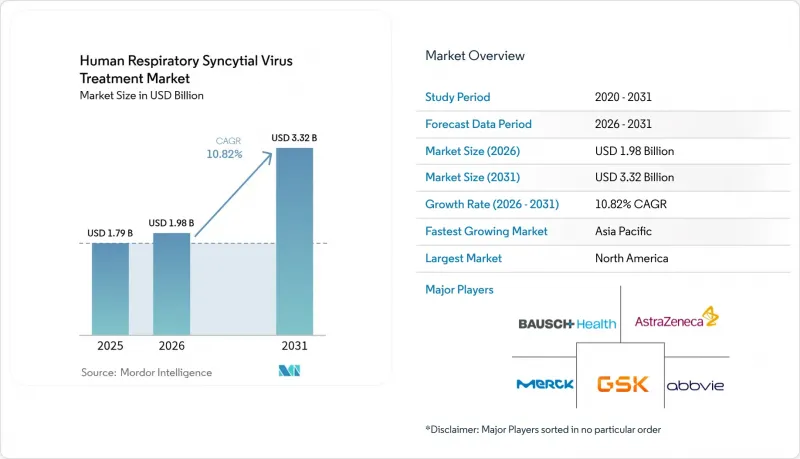
Mordor Intelligence에 의하면, 2026년 인간 호흡기 세포융합 바이러스 치료 시장 규모는 19억 8,000만 달러로 추정되고 2025년 17억 9,000만 달러에서 확대해, 2031년에는 33억 2,000만 달러에 이를 것으로 예측됩니다.
2026-2031년 동안의 연평균 성장률(CAGR)은 10.82%를 나타낼 전망입니다.
본 보고서는 중재 유형(예방적 중재-단일클론 항체를 이용한 예방 등, 치료적 중재-항바이러스제, 기타), 투여 경로(주사제, 기타), 환자 연령대(조산아(임신 37주 미만), 기타), 지역(북미, 기타)별로 분류되어 있습니다. 시장 전망은 금액(달러) 기준으로 제시되어 있습니다.
세계의 인간 호흡기 세포융합 바이러스 치료 시장 동향 및 인사이트
장시간 작용형 단일클론 항체를 이용한 예방 요법의 전 세계적 보급 급증
닐세비맙은 1회 주사로 시즌 전체에 걸친 예방 효과를 제공하며, 주요 임상시험에서 의료 기관을 방문한 RSV 감염증 환자에 대해 약 70-80%의 유효성을 보였습니다. 2024년에 승인된 공급 확대 계약에 따라 2024-2025년 시즌 동안 공급량 확대가 확보되어 지불 기관의 신뢰가 높아졌으며, 지침에 신속하게 반영되는 데 박차를 가했습니다. 미국과 유럽의 보험 환급 체계 덕분에 1회당 높은 비용이 완화되어, 병원 시스템은 예방 예산을 파리비즈마브에서 장기 작용형 플랫폼으로 전환할 수 있게 되었습니다. 시장 분석에 따르면, 대상 영아의 접종률이 10% 포인트 상승할 때마다 연간 약 1억 5,000만 달러의 매출 증가로 이어진다고 합니다. 이러한 명확한 임상적·경제적 가치로 인해, 인간 호흡기 세포융합 바이러스 치료 시장은 중기적으로 높은 가격대를 유지할 것으로 예측됩니다.
60세 이상 성인의 입원 증가가 백신의 급속한 보급을 뒷받침
CDC의 모니터링에 따르면, 미국 고령층에서 연간 6만-16만 건의 입원과 최대 1만 건의 사망이 확인되고 있으며, 이는 고위험 고령층을 대상으로 한 정기적인 RSV 백신 접종을 둘러싸고 보험사 간의 합의 형성을 촉진하고 있습니다. 현재 이 대상 집단을 위한 3종의 승인된 백신이 있으며, 모두 하기도 질환에 대해 67% 이상의 유효성을 보이고 있습니다. 첫 시즌의 실제 임상 데이터에서는 입원 예방 효과가 약 75%로 기록되어, 1회 접종 일정에 대한 보험 적용 결정을 뒷받침했습니다. 독일과 일본의 민관 조달 컨소시엄도 미국의 보험 적용 범위를 따르고 있어, 고령자 대상 인간 호흡기 세포융합 바이러스 치료 시장 규모를 더욱 확대시키고 있습니다. 따라서 백신 접종의 확산세는 2020년대 중반까지의 전체 연평균 성장률(CAGR) 전망에 약 2.8%의 추가 상승을 가져오고 있습니다.
리바비린을 둘러싼 항바이러스 내성 우려가 의료진의 신뢰를 훼손하고 있습니다.
리바비린 내성 RSV 균주의 출현은 임상의들이 해당 약물에 대한 신뢰를 떨어뜨리고, 결과적으로 항바이러스 요법이라는 더 넓은 부문에 불확실성을 초래하고 있습니다. 현재 리바비린의 사용은 주로 면역결핍 환자로 제한되어 있지만, 산발적인 내성 보고는 새로운 저분자 후보 약물에 대한 조합 전략에 영향을 미칠 가능성이 있습니다. 그 결과, 개발 기업은 임상 자료에서 견고한 내성 장벽 프로파일을 입증해야 하며, 이로 인해 도입 곡선이 다소 지연될 것입니다. 전체 성장에 미치는 이러한 억제 효과는 현재 0.8%로 추정되며, 인간 호흡기 세포융합 바이러스 치료 시장이 다양한 치료법으로 전환되는 가운데, 소폭이긴 하지만 주목할 만한 역풍이 되고 있습니다.
부문별 분석
단일클론 항체를 이용한 예방 요법은 2025년 매출의 43.98%를 차지하며, 예방으로의 결정적인 시장 전환을 뒷받침하는 동시에 인간 호흡기 세포융합 바이러스 치료 시장에서 가장 큰 매출 기준을 형성했습니다. 닐세비맙의 ‘1시즌에 1회’ 투여 일정은 소아 진료 지침에 빠르게 정착되고 있지만, 머크(Merck)사가 개발 중인 크레스로비맙이 2025년에 승인되면서 경쟁이 격화될 가능성이 있습니다. 성인용 백신은 비교적 새로운 부문이지만, 보험사가 인플루엔자와 유사한 조달 체계에 포함시키면서 가장 급격한 성장을 보이고 있습니다. 이 백신들의 총 연평균 성장률(CAGR)은 11.93%로 예측되며, 2031년까지 항체 제제와의 매출 격차를 좁힐 전망입니다. 이는 인간 호흡기 세포융합 바이러스 치료 시장이 기존 사업을 잠식하지 않으면서 제품 형태의 다양화를 추진하고 있음을 보여줍니다.
경구용 항바이러스제 등의 치료법은 여전히 시장 점유율이 작지만, 지속적인 벤처 캐피털 투자를 받고 있으며, 외래 진료를 목적으로 한 융합 효소 억제제 및 중합효소 억제제의 파이프라인이 형성되고 있습니다. 젤리카파비르는 위약에 비해 5일째에 1.4 로그의 바이러스 부하 감소를 보였으며, 이러한 약제가 백신으로는 충분한 효과를 얻을 수 없는 고위험 성인 집단에 대응할 수 있을 가능성을 시사합니다. 이러한 치료법이 후기 임상시험 단계로 넘어감에 따라, 지원적인 의료 기술 평가가 매우 중요해질 것으로 보입니다. 그 결과, 경쟁 우위는 종합적인 유효성을 내세우는 것보다 특정 집단에서의 유익성을 입증하는 데 달려 있게 될 것이며, 이는 인간 호흡기 세포융합 바이러스 치료 시장 전체의 향후 평가 기준을 형성하게 될 것으로 보입니다.
지역별 분석
북미는 견실한 보험 환급, 높은 질병 인지도, 백신 및 항체에 관한 지침의 신속한 제정에 힘입어 2025년 전 세계 매출의 39.12%를 차지했습니다. 미국에서만 2024-2025년 시즌에 400만 회분 이상의 단일클론 항체가 투여되었으나, 접종률은 여전히 불균형하여 2025년 3월 기준 대상 고령자 중 백신 접종을 받은 비율은 고작 22.2%에 그쳤습니다. 캐나다에서는 60세 이상 성인을 대상으로 한 전국적인 백신 접종 프로그램 검토가 진행 중이며, 이로 인해 해당 지역의 인간 호흡기 세포융합 바이러스 치료 시장에 연간 약 1억 2,000만 달러 규모 시장 기회가 추가될 가능성이 있습니다.
유럽은 두 번째로 큰 점유율을 차지하고 있지만, 회원국 간 도입 상황에는 큰 편차가 보입니다. 독일에서는 법정 보험 제도 하에서 60세 이상 인구에 대한 예방 접종이 권장되고 있어 조달이 가속화되고 있는 반면, 남유럽 국가들에서는 여전히 개별 의사의 판단에 맡겨져 있습니다. 유럽의약품청(EMA)의 여러 백신 및 항체 요법 승인으로 규제상의 통일된 기준이 확립되었으나, 의료 기술 평가의 차이가 지역에 따른 시장 접근을 좌우하고 있습니다. 유럽집행위원회가 주도하는 보험 급여 균등화 노력은 국경을 초월한 형평성을 향상시키고, 보급률이 낮은 시장에서 인간 호흡기 세포융합 바이러스 치료제 시장 점유율 확대로 이어질 가능성이 있습니다.
아시아태평양은 의료비 증가, 대규모 인구, RSV 예방제 임상시험에서의 선도적 입지를 배경으로 연평균 성장률(CAGR) 11.58%를 기록하며 가장 빠르게 성장하는 지역입니다. 일본에서는 고령자 백신 접종률이 첫 시즌에 40%를 넘어, 의사의 권고에 대한 소비자의 반응이 높음을 알 수 있습니다. 중국의 공중보건 기관은 국내 항체 및 백신 후보 물질을 평가하고 있으며, 국가 차원의 약가 협상이 마무리되면 수십억 달러 규모 시장이 확대될 가능성이 있습니다. 한편, 인도와 인도네시아는 Gavi의 지원을 받는 임산부 예방접종 체계를 우선시하고 있으며, 지불 주체의 다양화로 인해 인간 호흡기 세포융합 바이러스 치료 시장 규모가 더욱 확대될 것으로 예측됩니다.
남미와 중동 및 아프리카를 합쳐도 2025년 매출에서 차지하는 비중은 10% 이하였지만, 질병 부담의 관점에서는 잠재적인 수요가 시사되고 있습니다. 브라질은 2025년도 예산 주기에서 임산부 예방접종을 위한 연방 자금을 확보한 반면, 걸프협력회의(GCC) 회원국에서는 고령자 백신 접종을 위한 입찰 절차가 시작되었습니다. 콜드체인 인프라나 예산 제약과 같은 진입 장벽이 당분간 보급을 저해하고 있지만, WHO의 사전 승인 절차와 단계적 가격 책정 노력에 힘입어 이러한 신흥 인간 호흡기 세포융합 바이러스 치료 시장에서 전환점이 앞당겨질 가능성이 있습니다.
기타 혜택
- 엑셀 형식 시장 예측(ME) 시트
- 3개월간의 애널리스트 지원
자주 묻는 질문
목차
제1장 서론
제2장 조사 방법
제3장 주요 요약
제4장 시장 구도
제5장 시장 규모 및 성장 예측
제6장 경쟁 구도
제7장 시장 기회 및 향후 전망
KTH 26.08.28According to Mordor Intelligence, the human respiratory syncytial virus treatment market size in 2026 is estimated at USD 1.98 billion, growing from 2025 value of USD 1.79 billion with 2031 projections showing USD 3.32 billion, growing at 10.82% CAGR over 2026-2031.
This report is Segmented by Intervention Type (Preventive Interventions - Monoclonal Antibody Prophylaxis, and More; Therapeutic Interventions - Antiviral Drugs and More), Route of Administration (Injectable, and More), Patient Type (Pre-Term Infants (less Than 37 Wks), and More), and Geography (North America, and More). The Market Forecasts are Provided in Terms of Value (USD).
Global Human Respiratory Syncytial Virus Treatment Market Trends and Insights
Surge in Global Adoption of Long-Acting Monoclonal Antibody Prophylaxis
Nirsevimab is providing full-season protection with one injection and showed roughly 70-80% efficacy against medically attended RSV disease in pivotal trials. Supply expansion agreements approved in 2024 ensured wider availability for the 2024-2025 season, improving payer confidence and supporting faster guideline integration. Reimbursement frameworks in the United States and Europe are mitigating the high per-dose cost, enabling hospital systems to shift preventive budgets from palivizumab to longer-acting platforms. Market analytics indicate that each 10-percentage-point gain in eligible infant coverage translates to almost USD 150 million of incremental annual revenue. The clear clinical-economic value is expected to keep the Human Respiratory Syncytial Virus Treatment market in a premium pricing corridor over the medium term.
Rising Hospitalizations of Adults >= 60 Years Triggering Rapid Vaccine Uptake
CDC surveillance confirmed 60,000-160,000 hospitalizations and up to 10,000 deaths annually among U.S. seniors, catalyzing payer alignment behind routine RSV vaccination for higher-risk older adults. Three licensed vaccines now cover this cohort, each demonstrating more than 67% efficacy against lower respiratory tract disease. First-season real-world evidence recorded about 75% effectiveness in preventing hospitalization, reinforcing the decision to reimburse a one-dose schedule. Public-private procurement consortia in Germany and Japan are mirroring U.S. coverage, further widening the Human Respiratory Syncytial Virus Treatment market footprint among seniors. Uptake momentum is therefore adding roughly 2.8% to the overall CAGR forecast through mid-decade.
Antiviral Resistance Concerns Around Ribavirin Reducing Physician Confidence
Emerging ribavirin-resistant RSV strains erode clinician trust in the molecule and, by extension, cast uncertainty over the broader field of antiviral therapy. Although ribavirin is now restricted mainly to immunocompromised patients, sporadic resistance reports can influence prescribing attitudes toward new small-molecule candidates. Consequently, developers must demonstrate robust resistance-barrier profiles in clinical dossiers, slightly delaying adoption curves. The drag on overall growth is currently estimated at 0.8%, a modest but noteworthy headwind as the Human Respiratory Syncytial Virus Treatment market moves toward diversified treatment modalities.
Other drivers and restraints analyzed in the detailed report include:
- National Infant Immunization Programs in Emerging Economies
- Increasing Venture-Capital Flow into Oral Antiviral Therapeutics Boosting Pipeline Breadth
- Seasonal Demand Volatility Complicating Capacity Planning for Manufacturers
For complete list of drivers and restraints, kindly check the Table Of Contents.
Segment Analysis
Monoclonal antibody prophylaxis accounted for 43.98% of 2025 revenue, confirming a decisive market pivot toward prevention and providing the single largest revenue base within the Human Respiratory Syncytial Virus Treatment market. Nirsevimab's once-per-season schedule has been rapidly embedded in pediatric guidelines, while Merck's investigational clesrovimab could intensify rivalry if approved in 2025. Adult vaccines, although newer, are registering the steepest expansion as payers integrate them into influenza-style procurement frameworks. The vaccines' collective 11.93% CAGR is forecast to close the revenue gap with antibodies by 2031, demonstrating how the Human Respiratory Syncytial Virus Treatment market is diversifying product modalities without cannibalizing existing franchises.
Therapeutics such as oral antivirals remain a smaller slice but benefit from sustained venture capital, yielding a pipeline of fusion and polymerase inhibitors aimed at ambulatory care. Zelicapavir's Day-5 viral load drop of 1.4 log against placebo indicates that such agents could address high-risk adult populations in whom vaccines underperform. As these treatments transition to late-stage trials, supportive health-technology assessments will be pivotal. Consequently, competitive positioning now hinges on demonstrating population-specific benefit rather than promising blanket efficacy, shaping future valuation benchmarks across the Human Respiratory Syncytial Virus Treatment market.
Complete Report Scope:
- By Intervention Type
- Preventive Interventions
- Monoclonal Antibody Prophylaxis
- Vaccines
- Therapeutic Interventions
- Antiviral Drugs
- Immunomodulators
- Supportive Care
- Preventive Interventions
- By Route of Administration
- Injectable
- Oral
- Inhaled
- Intranasal
- By Patient Age
- Preterm Infants (<37 wks)
- Infants (0-12 mo)
- Children (1-5 yr)
- Adults (18-59 yr)
- Older Adults (>=60 yr)
- By Geography
- North America
- United States
- Canada
- Mexico
- Europe
- Germany
- United Kingdom
- France
- Italy
- Spain
- Rest of Europe
- Asia-Pacific
- China
- Japan
- India
- South Korea
- Australia
- Rest of Asia-Pacific
- Middle East and Africa
- GCC
- South Africa
- Rest of Middle East and Africa
- South America
- Brazil
- Argentina
- Rest of South America
- North America
Geography Analysis
North America contributed 39.12% of global revenue in 2025, supported by robust reimbursement, high disease awareness, and rapid codification of vaccine and antibody guidelines. The United States alone dispensed more than 4 million monoclonal antibody doses in the 2024-2025 season, yet coverage remains uneven, with just 22.2% of eligible seniors vaccinated by March 2025. Canada is evaluating a national vaccination program for adults >=60 years, which could add roughly USD 120 million annual opportunity to the regional Human Respiratory Syncytial Virus Treatment market.
Europe holds the second-largest share, but adoption varies widely between member states. Germany's endorsement of immunization for people >=60 years under the statutory insurance scheme is accelerating procurement, while southern European countries still rely on individual physician judgment. EMA approvals for multiple vaccine and antibody options create a harmonized regulatory baseline, yet divergent health-technology assessments shape localized market access. Reimbursement parity efforts spearheaded by the European Commission may improve cross-border equity and lift the Human Respiratory Syncytial Virus Treatment market share in underpenetrated markets.
Asia-Pacific is the fastest-growing region, posting an 11.58% CAGR on the back of rising healthcare expenditure, demographic heft, and trial leadership in RSV prophylactics. Japan's older-adult vaccine coverage exceeded 40% in its inaugural season, reflecting high consumer responsiveness to physician recommendation. China's public health agencies are assessing domestic antibody and vaccine candidates, which could unlock multi-billion-dollar volume once national drug reimbursement negotiations conclude. Meanwhile, India and Indonesia prioritize maternal immunization frameworks supported by Gavi, indicating that payer-mix expansion will further extend the Human Respiratory Syncytial Virus Treatment market footprint.
South America and the Middle East & Africa together represent less than 10% of 2025 revenue, but disease burden suggests latent demand. Brazil set aside federal funding for maternal immunization in the 2025 budget cycle, while Gulf Cooperation Council states have initiated tender processes for senior-adult vaccination. Access barriers, including cold-chain infrastructure and budget constraints, hamper immediate uptake, but the WHO pre-qualification pathway and tiered-pricing commitments could hasten inflection points across these emerging Human Respiratory Syncytial Virus Treatment market frontiers.
- AstraZeneca
- Sanofi
- Pfizer
- GlaxoSmithKline
- Moderna
- Merck
- Johnson & Johnson
- F. HoffmannLa Roche Ltd.
- Shionogi & Co., Ltd.
- Swedish Orphan Biovitrum
- Meissa Vaccines Inc.
- Enanta Pharmaceuticals Inc.
- Icosavax Inc.
- ReViral Ltd. (Pfizer)
- ADMA Biologics
- Shionogi & Co., Ltd.
- Inhalon Biopharma
- Vir Biotechnology Inc.
- Synairgen plc
Additional Benefits:
- The market estimate (ME) sheet in Excel format
- 3 months of analyst support
TABLE OF CONTENTS
1 Introduction
- 1.1 Study Assumptions & Market Definition * Scope of the Study
2 Research Methodology
3 Executive Summary
4 Market Landscape
- 4.1 Market Overview
- 4.2 Market Drivers
- 4.2.1 Surge in Global Adoption of LongActing Monoclonal Antibody Prophylaxis
- 4.2.2 Rising Hospitalizations of Adults >=60 Years Triggering Rapid Vaccine Uptake
- 4.2.3 National Infant Immunization Programs in Emerging Economies
- 4.2.4 Increasing VentureCapital Flow into Oral Antiviral Therapeutics Boosting Pipeline Breadth
- 4.2.5 WHO Prequalification Pathway for Maternal RSV Vaccines
- 4.3 Market Restraints
- 4.3.1 Antiviral Resistance Concerns Around Ribavirin Reducing Physician Confidence
- 4.3.2 Seasonal Demand Volatility Complicating Capacity Planning for Manufacturers
- 4.4 SupplyChain Analysis
- 4.5 Regulatory Outlook
- 4.6 Technological Outlook
- 4.7 Porter's Five Forces
- 4.7.1 Threat of New Entrants
- 4.7.2 Bargaining Power of Suppliers
- 4.7.3 Bargaining Power of Buyers
- 4.7.4 Threat of Substitutes
- 4.7.5 Competitive Rivalry
5 Market Size & Growth Forecasts (Value)
- 5.1 By Intervention Type
- 5.1.1 Preventive Interventions
- 5.1.1.1 Monoclonal Antibody Prophylaxis
- 5.1.1.2 Vaccines
- 5.1.2 Therapeutic Interventions
- 5.1.2.1 Antiviral Drugs
- 5.1.2.2 Immunomodulators
- 5.1.2.3 Supportive Care
- 5.1.1 Preventive Interventions
- 5.2 By Route of Administration
- 5.2.1 Injectable
- 5.2.2 Oral
- 5.2.3 Inhaled
- 5.2.4 Intranasal
- 5.3 By Patient Age
- 5.3.1 Preterm Infants (<37 wks)
- 5.3.2 Infants (0-12 mo)
- 5.3.3 Children (1-5 yr)
- 5.3.4 Adults (18-59 yr)
- 5.3.5 Older Adults (>=60 yr)
- 5.4 By Geography
- 5.4.1 North America
- 5.4.1.1 United States
- 5.4.1.2 Canada
- 5.4.1.3 Mexico
- 5.4.2 Europe
- 5.4.2.1 Germany
- 5.4.2.2 United Kingdom
- 5.4.2.3 France
- 5.4.2.4 Italy
- 5.4.2.5 Spain
- 5.4.2.6 Rest of Europe
- 5.4.3 Asia-Pacific
- 5.4.3.1 China
- 5.4.3.2 Japan
- 5.4.3.3 India
- 5.4.3.4 South Korea
- 5.4.3.5 Australia
- 5.4.3.6 Rest of Asia-Pacific
- 5.4.4 Middle East and Africa
- 5.4.4.1 GCC
- 5.4.4.2 South Africa
- 5.4.4.3 Rest of Middle East and Africa
- 5.4.5 South America
- 5.4.5.1 Brazil
- 5.4.5.2 Argentina
- 5.4.5.3 Rest of South America
- 5.4.1 North America
6 Competitive Landscape
- 6.1 Market Concentration
- 6.2 Market Share Analysis
- 6.3 Company Profiles (includes Global level Overview, Market level overview, Core Segments, Financials, Strategic Information, Market Rank/Share, Products & Services, Recent Developments)
- 6.3.1 AstraZeneca PLC
- 6.3.2 Sanofi S.A.
- 6.3.3 Pfizer Inc.
- 6.3.4 GlaxoSmithKline plc
- 6.3.5 Moderna Inc.
- 6.3.6 Merck & Co., Inc.
- 6.3.7 Johnson & Johnson (Janssen)
- 6.3.8 F. HoffmannLa Roche Ltd.
- 6.3.9 Shionogi & Co., Ltd.
- 6.3.10 Swedish Orphan Biovitrum AB (Sobi)
- 6.3.11 Meissa Vaccines Inc.
- 6.3.12 Enanta Pharmaceuticals Inc.
- 6.3.13 Icosavax Inc.
- 6.3.14 ReViral Ltd. (Pfizer)
- 6.3.15 ADMA Biologics Inc.
- 6.3.16 Shionogi & Co., Ltd.
- 6.3.17 Inhalon Biopharma
- 6.3.18 Vir Biotechnology Inc.
- 6.3.19 Synairgen plc
7 Market Opportunities & Future Outlook
- 7.1 Whitespace & UnmetNeed Assessment
- 7.1.1 NextGeneration Combination Vaccines (e.g., RSV/Influenza)
- 7.1.2 Maternal Immunization Programs in LMICs
- 7.1.3 Accessible LowCost Biosimilar mAbs
- 7.1.4 Oral OutPatient Antivirals for Rapid Symptom Relief
- 7.1.5 AIDriven HostDirected Therapies


