

|
시장보고서
상품코드
2114843
실험용 원심분리기 : 시장 점유율 분석, 업계 동향 및 통계, 성장 예측(2026-2031년)Global Laboratory Centrifuge - Market Share Analysis, Industry Trends & Statistics, Growth Forecasts (2026 - 2031) |
||||||
 Mordor Intelligence
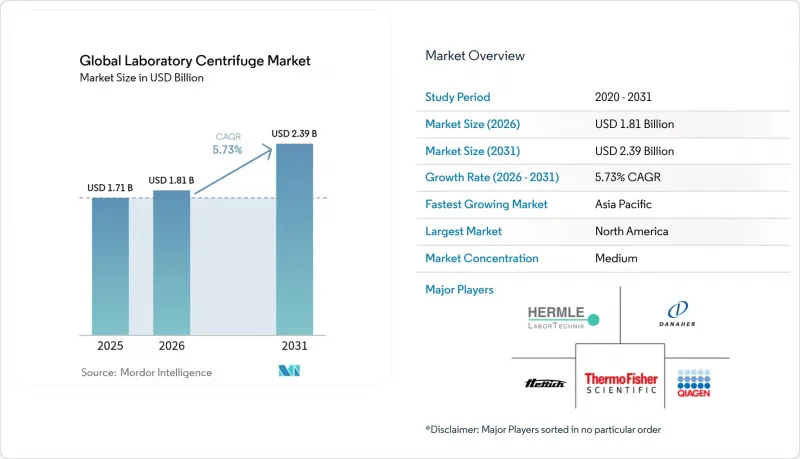
Mordor Intelligence에 의하면, 실험용 원심분리기 시장 규모는 2025년에 17억 1,000만 달러로 평가되었습니다. 2026년 18억 1,000만 달러에서 2031년까지 23억 9,000만 달러에 이를 것으로 예상되며, 예측 기간(2026-2031년) CAGR은 5.73%를 나타낼 전망입니다.
본 보고서는 제품 유형별(기기 (마이크로 원심분리기, 초원심분리기 등), 액세서리별 (튜브·병 등)), 모델 유형별(탁상형, 바닥 설치형),용도별(미생물학, 셀오믹스 등), 최종 사용자별(병원 및 진단실험실 등), 자동화 수준별(수동/기존 등), 지역별(북미, 유럽, 아시아태평양 등)로 분류되어 있습니다.
세계의 실험용 원심분리기 시장 동향 및 인사이트
만성 질환 및 감염증의 높은 유병률
진단실험실에서는 당뇨병, 심혈관 질환, 암 관리에 도움이 되는 바이오마커를 특정하기 위해 원심분리를 이용하여 혈장을 분리하고 병원체를 분리하고 있습니다. 현재, 안전 버킷의 설계는 에어로졸 위험을 줄이기 위해 밀폐된 조작을 요구하는 WHO의 결핵 프로토콜을 준수하고 있습니다. 미국과 서유럽의 고령화로 인해 검체량은 높은 수준을 유지하고 있는 반면, 새로운 감염병의 유행으로 인해 의료 시스템에서는 일선 진료소에 휴대용 원심분리기를 도입하는 움직임이 가속화되고 있습니다. 이러한 상황이 맞물려 실험용 원심분리기 시장 전체에서 일정한 수요가 유지되고 있습니다.
바이오의약품 및 생명과학 분야의 연구개발비 증가
신약 개발 프로그램에서는 단백질 정제, 세포외 소포 분리 및 바이러스 벡터 생산을 위해 고도의 분리 워크플로가 채택되고 있습니다. EVics 시스템은 탠덤식 접선 유동 여과 기술을 통해 생체 분자의 완전성을 유지하면서 최대 1L를 처리함으로써, 기존 초원심분리기의 병목 현상을 극복하는 방법을 제시하고 있습니다. 위탁 연구 기관(CRO)은 후원 기업의 프로젝트를 수행하기 위해 새로운 자동화 플랫폼을 도입하고 있으며, 이로 인해 실험용 원심분리기 시장은 더욱 확대되고 있습니다.
첨단 시스템의 높은 초기 투자 비용
완비된 초원심분리기는 10만 달러를 초과하는 경우가 많아 소규모 연구소의 도입을 저해하고 있습니다. 현재 20억 미 달러 규모의 전 세계 중고 장비 시장에서는 공급업체 보증이 적용된 재생 제품이 공급되고 있어, 합리적인 가격으로 도입이 가능해졌습니다. 리스나 렌탈 플랜을 통해 지출을 분산시킬 수도 있지만, 특히 라틴아메리카와 동남아시아의 일부 지역에서는 여전히 예산 제약이 남아 있습니다.
부문별 분석
2025년 매출액 중 장비가 76.12%를 차지하여, 실험용 원심분리기 시장에서 사용자들이 플랫폼 조달을 최우선으로 하고 있음이 확인되었습니다. 초원심분리기는 10만rpm을 초과하는 회전 속도를 달성하여, 생물제제 연구에서 단백질 및 바이러스의 분리를 지원합니다. 마이크로 원심분리기는 일상적인 분석에 여전히 널리 사용되고 있지만, 다목적형 장비는 로터의 유연성이 필요한 기관의 요구를 충족시키고 있습니다. 실험용 원심분리기 시장의 부속품 시장 규모는 작지만, 연구소에서 반복적인 멸균 주기 후 튜브, 병,로터 씰을 교체해야 하기 때문에 더 빠른 성장세를 보이고 있습니다. 경량이면서도 내식성이 뛰어난 탄소섬유 로터는 현재 부하 균형 조정 및 피로 검사를 보장하는 유지보수 계약의 대상이 되고 있습니다.
소모품은 하드웨어보다 더 자주 교체되기 때문에 액세서리 분야는 연평균 성장률(CAGR) 7.04%로 성장하고 있습니다. 애프터마켓 수요의 대부분은 고정각형 및 스윙 버킷형이 차지하고 있으며, 이는 로터 업그레이드와 교정 서비스를 세트로 제공하는 공급업체의 프로그램에 힘입은 것입니다. 고속 처리량 스크리닝이 확대됨에 따라, 연구소에서는 교차 오염을 방지하기 위해 일회용 튜브를 대량으로 구매하고 있습니다. 이에 따라 각 제조업체는 초기 하드웨어 이익률을 보완할 지속적인 매출을 기대하고 있으며, 이는 실험용 원심분리기 시장의 회복력을 강화하고 있습니다.
2025년에는 벤치탑형이 매출의 61.30%를 차지했으며, 500mL 미만의 처리량을 필요로 하는 일상적인 진단 및 학술적 프로토콜에서 선호되고 있습니다. 이 제품의 컴팩트한 설치 면적은 공간이 제한된 실험대에 적합하며, 최근 펌웨어 업데이트를 통해 터치스크린 조작 및 QR 코드를 통한 유지보수 로그 기능이 추가되었습니다. 대조적으로, 플로어 스탠드형은 업스트림 바이오프로세스에서 수확에 필요한 백이나 병을 처리할 수 있어 연평균 성장률(CAGR) 6.49%를 달성하고 있습니다. 프로그래밍 가능한 가속·감속 제어 및 진동 댐퍼는 GMP 검증 규정을 준수하여, 이에 따라 수탁 제조업체들의 관심이 높아지고 있습니다.
실험용 원심분리기 시장은 각 기관이 ‘긴급 검사에는 탁상형, 배치 정제에는 플로어 스탠드형’과 같은 혼합 구성을 도입하고 있는 데서 혜택을 보고 있습니다. 로봇 암과의 통합을 통해 무인 로딩이 가능해지면서, 기존의 플로어 스탠드형 시스템이 자동화된 워크셀로 변모하고 있습니다. 각 벤더사는 현재 두 모델 라인 전반에 걸쳐 로터의 가동 주기를 원격으로 추적하는 하이브리드 서비스 플랜을 제공하고 있으며, 이를 통해 운영자가 익숙한 조작성을 유지하면서 가동 중지 시간을 최소화하고 있습니다.
지역별 분석
북미는 2025년 매출의 36.10%를 차지했으며, 그 기반이 되는 것은 미국 내 제약 기업 본사가 밀집해 있다는 점, 국립보건원(NIH)의 보조금, 그리고 견고한 수탁 제조거점입니다. 캐나다는 공중보건연구소와 급성장하는 생물제제 생태계로 이를 보완하고 있는 반면, 멕시코는 의료기기 조립 분야의 니어쇼어링 혜택을 누리고 있습니다. 첨단 제조에 대한 연방 정부의 우대 조치는 현지 세포 치료 공장에 공급되는 GMP 준수 원심분리기의 수주를 더욱 촉진하고 있습니다. 또한, 각 연구소는 OSHA(미국 직업안전보건청) 및 CDC(미국 질병통제예방센터)의 안전 지침을 준수하고 있으며, 에어로졸 차단형 뚜껑 및 방음 대책에 대한 업그레이드가 진행되고 있어 실험용 원심분리기 시장은 견조한 추세를 보이고 있습니다.
아시아태평양은 7.68%라는 가장 높은 연평균 성장률(CAGR)을 기록하고 있습니다. 중국의 의료기기 부문은 2024년에 1790억 달러에 달하며, 13만 8,000건의 의료기기 특허를 보유하고 있고, 국가 정책은 국내 조달을 장려하고 있습니다. 인도의 ‘국가 의료기기 정책’은 2030년까지 500억 달러의 매출을 목표로 하고 있으며, 규제 절차를 간소화함으로써 다국적 기업과 현지 기업이 원심분리기 조립 라인에 투자하도록 장려하고 있습니다. 일본, 한국, 호주에서는 높은 처리량의 원심분리가 필요한 임상시험 네트워크가 확대되고 있으며, 이로 인해 해당 지역 전체의 실험용 원심분리기 시장이 강화되고 있습니다.
유럽에서는 독일의 수출 지향형 의료기기 제조업체, 영국의 생명공학 클러스터, 프랑스의 병원 현대화 프로그램이 주도적인 역할을 하며 꾸준한 성장이 나타나고 있습니다. 에코디자인 및 의료기기 규제에 관한 EU 지침은 에너지 효율이 높은 로터의 채택과 종합적인 검증 기록 작성을 촉진하고 있습니다. 지속가능성을 중시하는 병원들은 전력 소비가 70% 낮은 모델을 선호하여, 조달 활동을 친환경 공공 조달 정책과 연계하고 있습니다. 이러한 노력들이 결합되어 유럽 수요는 안정적인 수준을 유지하는 한편, 원심분리기군의 수명 주기를 연장하는 순환 경제 기반의 재생 서비스에 새로운 시장 기회를 창출하고 있습니다.
기타 혜택 :
- 엑셀 형식 시장 예측(ME) 시트
- 3개월간의 애널리스트 지원
자주 묻는 질문
목차
제1장 서론
제2장 조사 방법
제3장 주요 요약
제4장 시장 구도
제5장 시장 규모 및 성장 예측
제6장 경쟁 구도
제7장 시장 기회 및 향후 전망
KTH 26.08.28According to Mordor Intelligence, the laboratory centrifuge market size was valued at USD 1.71 billion in 2025 and estimated to grow from USD 1.81 billion in 2026 to reach USD 2.39 billion by 2031, at a CAGR of 5.73% during the forecast period (2026-2031).
This report is Segmented by Product Type (Equipment [Microcentrifuges, Ultracentrifuges, and More], Accessories [Tubes & Bottles, and More]), by Model Type (Benchtop, Floor-Standing), by Application (Microbiology, Cellomics, and More), by End-User (Hospitals & Diagnostic Labs, and More), by Automation Level (Manual / Conventional, and More), by Geography (North America, Europe, Asia-Pacific, and More).
Global Laboratory Centrifuge Market Trends and Insights
High Prevalence of Chronic & Infectious Diseases
Diagnostic laboratories rely on centrifugation to separate plasma and isolate pathogens for biomarkers that guide diabetes, cardiovascular, and cancer management. Safety-bucket designs now meet WHO tuberculosis protocols that call for sealed operation to reduce aerosol risk. Aging populations in the United States and Western Europe keep specimen volumes high, while novel infection outbreaks spur health systems to deploy portable centrifuges in frontline clinics. These conditions collectively maintain baseline demand across the laboratory centrifuge market.
Rising R&D Spending in Biopharma & Life Sciences
Drug-discovery programs adopt advanced separation workflows for protein purification, extracellular-vesicle isolation, and viral-vector production. The EVics system shows how tandem tangential-flow filtration overcomes legacy ultracentrifuge bottlenecks by processing up to 1 L while preserving biomolecule integrity. Contract research organizations equip new automated platforms to keep pace with sponsor projects, further expanding the laboratory centrifuge market.
High Upfront Capital Cost of Advanced Systems
Fully-equipped ultracentrifuges often exceed USD 100,000, restricting adoption by small laboratories. A USD 2 billion global secondary-equipment channel now supplies refurbished units with vendor warranties, offering affordable entry points. Leasing and rental plans further spread out expenditure, yet budget constraints persist, especially in Latin America and parts of Southeast Asia.
Other drivers and restraints analyzed in the detailed report include:
- Technological Advances in High-Throughput & Refrigerated Systems
- Viral-Vector Demand for Cell & Gene Therapy Manufacturing
- Tightening Biosafety & Noise-Emission Regulations
For complete list of drivers and restraints, kindly check the Table Of Contents.
Segment Analysis
Equipment represented 76.12% of 2025 revenue, confirming users' primary focus on platform procurement within the laboratory centrifuge market. Ultracentrifuges reach speeds above 100,000 rpm, supporting protein and virus separation for biologics research. Microcentrifuges remain staples of routine assays, while multipurpose units cater to institutions needing rotor flexibility. The laboratory centrifuge market size for accessories is smaller but displays faster momentum as laboratories replace tubes, bottles, and rotor seals after repeated sterilization cycles. Carbon-fiber rotors, lighter yet corrosion-resistant, now enter service contracts that guarantee load balancing and fatigue inspection.
The accessories segment grows at 7.04% CAGR because consumables are replaced more frequently than hardware. Fixed-angle and swinging-bucket formats account for most aftermarket demand, backed by vendor programs that bundle rotor upgrades with calibration services. As high-throughput screens expand, laboratories secure bulk lots of single-use tubes to avoid cross-contamination. Manufacturers thus bank on recurring sales that complement initial hardware margins, reinforcing the resilience of the laboratory centrifuge market.
Benchtop units held 61.30% revenue in 2025, favored for daily diagnostic and academic protocols that handle volumes under 500 mL. Their compact footprint aligns with space-limited benches, and recent firmware updates add touch-screen controls plus QR-code maintenance logs. In contrast, floor-standing models realise a 6.49% CAGR by accommodating bags and bottles needed for upstream bioprocess harvests. Programmable ramps and vibration dampers meet GMP validation rules, which lifts their appeal for contract manufacturers.
The laboratory centrifuge market benefits as institutions deploy mixed fleets: benchtops for stat tests, floor units for batch purification. Integration with robotic arms enables unmanned loading, turning traditional floor systems into automated work cells. Vendors now offer hybrid service plans that remotely track rotor cycles across both model lines, minimising downtime while retaining operator familiarity.
Complete Report Scope:
- By Product Type
- Equipment
- Microcentrifuges
- Ultracentrifuges
- Multipurpose/General-purpose
- Accessories
- Tubes & Bottles
- Rotors (fixed-angle, swinging-bucket)
- Buckets/Plates/Consumables
- Equipment
- By Model Type
- Benchtop
- Floor-standing
- By Intended Use
- Clinical
- Pre-clinical/Research
- General Purpose
- By Application
- Microbiology
- Cellomics
- Proteomics
- Genomics
- Diagnostics
- By End-user
- Hospitals & Diagnostic Labs
- Academic & Research Institutes
- Biotech & Pharma Companies
- Contract Testing / CROs
- By Automation Level
- Manual / Conventional
- Semi-automated
- Fully-automated / Robotic
- By Geography
- North America
- United States
- Canada
- Mexico
- Europe
- Germany
- United Kingdom
- France
- Italy
- Spain
- Rest of Europe
- Asia-Pacific
- China
- Japan
- India
- Australia
- South Korea
- Rest of Asia-Pacific
- Middle East and Africa
- GCC
- South Africa
- Rest of Middle East and Africa
- South America
- Brazil
- Argentina
- Rest of South America
- North America
Geography Analysis
North America retained 36.10% of 2025 revenue, anchored by the United States' dense cluster of pharmaceutical headquarters, National Institutes of Health grants, and a robust contract manufacturing base. Canada complements with public health labs and a growing biologics ecosystem, while Mexico benefits from near-shoring of medical-device assembly. Federal incentives for advanced manufacturing further stimulate orders for GMP-graded centrifuges that feed into local cell-therapy plants. Laboratories also respond to OSHA and CDC safety directives, prompting upgrades to aerosol-tight lids and acoustic dampening, which sustains the laboratory centrifuge market.
Asia-Pacific posts the fastest 7.68% CAGR. China's medical-equipment sector reached USD 179 billion in 2024, featuring 138,000 device patents, and state policy favours domestic sourcing.India's National Medical Devices Policy targets USD 50 billion turnover by 2030 and simplifies regulatory pathways, encouraging multinational and local firms to invest in centrifuge assembly lines. Japan, South Korea, and Australia expand clinical-trial networks that demand high-throughput centrifugation, reinforcing the laboratory centrifuge market across the region.
Europe shows steady growth paced by Germany's export-oriented device makers, the United Kingdom's biotech clusters, and France's hospital modernisation programs. EU directives on eco-design and medical-device regulation encourage adoption of energy-efficient rotors and comprehensive validation records. Sustainability-focused hospitals favor models with 70% lower power draw, aligning procurement with green public-purchasing policies. Collectively, these initiatives keep European demand consistent while opening niches for circular-economy refurbishment services that extend the lifecycle of centrifuge fleets.
- Thermo Fisher Scientific
- Danaher Corp. (Beckman Coulter)
- Eppendorf
- Andreas Hettich
- Sigma Laborzentrifugen
- HERMLE Labortechnik
- Kubota Corp.
- NuAire Inc.
- Sartorius
- QIAGEN
- Labnics Equipment
- Esco Life Sciences
- KeraJet / Khera Instruments (Pvt Ltd)
- BT Lab Systems
- LabMedica (Scheuermann)
- Centrisys/CNP LLC
- Alfa Laval AB
- Becton, Dickinson & Co. (BD)
Additional Benefits:
- The market estimate (ME) sheet in Excel format
- 3 months of analyst support
TABLE OF CONTENTS
1 Introduction
- 1.1 Study Assumptions & Market Definition
- 1.2 Scope of the Study
2 Research Methodology
3 Executive Summary
4 Market Landscape
- 4.1 Market Overview
- 4.2 Market Drivers
- 4.2.1 High prevalence of chronic & infectious diseases
- 4.2.2 Rising R&D spending in biopharma & life sciences
- 4.2.3 Technological advances in high-throughput & refrigerated systems
- 4.2.4 Expansion of decentralised/near-patient diagnostic labs
- 4.2.5 Viral-vector demand for cell & gene therapy manufacturing
- 4.2.6 Rotor-refurbishment & circular-economy revenue streams
- 4.3 Market Restraints
- 4.3.1 High upfront capital cost of advanced systems
- 4.3.2 Long equipment lifespans slowing replacement sales
- 4.3.3 Growth of outsourced centrifugation services
- 4.3.4 Tightening biosafety & noise-emission regulations
- 4.4 Value / Supply-Chain Analysis
- 4.5 Regulatory Landscape
- 4.6 Technological Outlook
- 4.7 Porter's Five Forces Analysis
- 4.7.1 Threat of New Entrants
- 4.7.2 Bargaining Power of Buyers
- 4.7.3 Bargaining Power of Suppliers
- 4.7.4 Threat of Substitutes
- 4.7.5 Competitive Rivalry
5 Market Size & Growth Forecasts (Value)
- 5.1 By Product Type
- 5.1.1 Equipment
- 5.1.1.1 Microcentrifuges
- 5.1.1.2 Ultracentrifuges
- 5.1.1.3 Multipurpose/General-purpose
- 5.1.2 Accessories
- 5.1.2.1 Tubes & Bottles
- 5.1.2.2 Rotors (fixed-angle, swinging-bucket)
- 5.1.2.3 Buckets/Plates/Consumables
- 5.1.1 Equipment
- 5.2 By Model Type
- 5.2.1 Benchtop
- 5.2.2 Floor-standing
- 5.3 By Intended Use
- 5.3.1 Clinical
- 5.3.2 Pre-clinical/Research
- 5.3.3 General Purpose
- 5.4 By Application
- 5.4.1 Microbiology
- 5.4.2 Cellomics
- 5.4.3 Proteomics
- 5.4.4 Genomics
- 5.4.5 Diagnostics
- 5.5 By End-user
- 5.5.1 Hospitals & Diagnostic Labs
- 5.5.2 Academic & Research Institutes
- 5.5.3 Biotech & Pharma Companies
- 5.5.4 Contract Testing / CROs
- 5.6 By Automation Level
- 5.6.1 Manual / Conventional
- 5.6.2 Semi-automated
- 5.6.3 Fully-automated / Robotic
- 5.7 By Geography
- 5.7.1 North America
- 5.7.1.1 United States
- 5.7.1.2 Canada
- 5.7.1.3 Mexico
- 5.7.2 Europe
- 5.7.2.1 Germany
- 5.7.2.2 United Kingdom
- 5.7.2.3 France
- 5.7.2.4 Italy
- 5.7.2.5 Spain
- 5.7.2.6 Rest of Europe
- 5.7.3 Asia-Pacific
- 5.7.3.1 China
- 5.7.3.2 Japan
- 5.7.3.3 India
- 5.7.3.4 Australia
- 5.7.3.5 South Korea
- 5.7.3.6 Rest of Asia-Pacific
- 5.7.4 Middle East and Africa
- 5.7.4.1 GCC
- 5.7.4.2 South Africa
- 5.7.4.3 Rest of Middle East and Africa
- 5.7.5 South America
- 5.7.5.1 Brazil
- 5.7.5.2 Argentina
- 5.7.5.3 Rest of South America
- 5.7.1 North America
6 Competitive Landscape
- 6.1 Market Concentration
- 6.2 Market Share Analysis
- 6.3 Company Profiles (includes Global level Overview, Market level overview, Core Segments, Financials as available, Strategic Information, Market Rank/Share, Products & Services, Recent Developments)
- 6.3.1 Thermo Fisher Scientific Inc.
- 6.3.2 Danaher Corp. (Beckman Coulter)
- 6.3.3 Eppendorf AG
- 6.3.4 Andreas Hettich GmbH & Co. KG
- 6.3.5 Sigma Laborzentrifugen GmbH
- 6.3.6 HERMLE Labortechnik GmbH
- 6.3.7 Kubota Corp.
- 6.3.8 NuAire Inc.
- 6.3.9 Sartorius AG
- 6.3.10 Qiagen NV
- 6.3.11 Labnics Equipment
- 6.3.12 Esco Life Sciences
- 6.3.13 KeraJet / Khera Instruments (Pvt Ltd)
- 6.3.14 BT Lab Systems
- 6.3.15 LabMedica (Scheuermann)
- 6.3.16 Centrisys/CNP LLC
- 6.3.17 Alfa Laval AB
- 6.3.18 Becton, Dickinson & Co. (BD)
7 Market Opportunities & Future Outlook
- 7.1 White-space & Unmet-need Assessment


