

|
시장보고서
상품코드
2114853
구조생물학 및 분자 모델링 기술 : 시장 점유율 분석, 업계 동향 및 통계, 성장 예측(2026-2031년)Structural Biology And Molecular Modeling Techniques - Market Share Analysis, Industry Trends & Statistics, Growth Forecasts (2026 - 2031) |
||||||
 Mordor Intelligence
Mordor Intelligence에 의하면, 구조생물학 및 분자 모델링 기술 시장 규모는 2025년 103억 1,000만 달러로 평가되었습니다. 2026년에는 119억 달러로 확대되어 2026-2031년에 걸쳐 CAGR 15.38%로 성장을 지속하여, 2031년에는 243억 달러에 이를 것으로 예측됩니다.
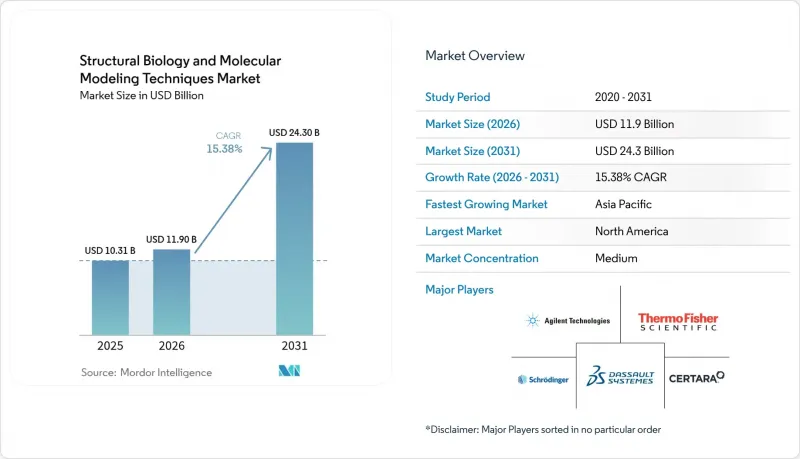
본 보고서는 도구별(SaaS(Software-as-a-Service)·독립형 플랫폼, 시각화·분석 제품군, 기타 도구), 용도별(신약 개발, 의약품 개발, 단백질 공학, 기타 용도), 최종 사용자별(제약·바이오기술 기업, 위탁 연구 기관, 기타),지역별(북미, 유럽, 기타)로 분류되어 있습니다. 시장 예측은 금액(달러) 기준으로 제시되어 있습니다.
세계의 구조생물학 및 분자 모델링 기술 시장 동향과 인사이트
AI를 활용한 신약 개발 플랫폼의 급속한 확산
일라이 릴리(Eli Lilly)가 양자화학 스타트업에 10억 달러를 투자한 사례는 대형 제약사가 신약 개발 파이프라인 전체를 머신러닝 앙상블에 맡기고 있는 실태를 여실히 보여줍니다. AlphaFold 3, Boltz-2 및 이와 유사한 도구의 광범위한 도입으로, 과거에는 수년이 걸리던 콘포메이션 상황의 병렬 탐색이 가능해졌습니다. FDA의 신뢰성 프레임워크에서는 현재 가상 스크리닝을 의사 결정에 충분한 증거로 인정하고 있으며, 이로 인해 전임상 단계의 탈락률이 30-40% 감소했습니다. 각 벤더사는 분자 역학, 도킹, 그래프 신경망을 통합된 작업 공간 내에 통합하여, 화학자가 실시간으로 설계를 반복할 수 있게 되었습니다. 경쟁 우위는 단일 독자 엔진에 의존하기보다는 여러 AI 모델의 출력을 통합적으로 활용하는 데 달려 있다는 경향이 점점 더 강해지고 있습니다.
만성 질환 유병률 증가
신경퇴행성 질환, 종양학, 대사성 질환 분야에서는 구조 정보를 활용한 모델링을 통해서만 지원할 수 있는 다제 병용 요법 접근법이 요구되고 있습니다. 2024년에 발표된 FDA의 종양학 관련 투여량 지침은 인간을 대상으로 한 첫 번째 임상시험에 앞서 노출-반응 관계에 대한 예측 시뮬레이션을 수행할 필요성을 강조하고 있습니다. 다중 표적 알고리즘은 오프-타겟 위험을 모니터링하면서 상호 관련된 채널 전반에 걸친 결합 친화도를 최적화합니다. 세포 환경 전반에 걸쳐 알로스테릭 변화와 단백질 간 상호작용을 추적하는 플랫폼에 대한 수요가 증가하고 있습니다. 만성 질환의 복잡성이 증가함에 따라 시뮬레이션의 ‘속도’뿐만 아니라 ‘깊이’도 중요해지면서, 고정밀 하이브리드 양자역학 기법의 추가적인 보급을 촉진하고 있습니다.
첨단 계측 장비의 높은 비용
첨단 극저온 전자 현미경 시스템이나 고성능 컴퓨팅 클러스터에는 1,000만 달러가 넘는 설비 투자가 필요하며, 이는 소규모 연구 기관이나 신흥 시장의 기관에게는 큰 장벽이 되고 있습니다. 운영 비용은 초기 장비 구입에 그치지 않고 전용 시설 요건, 유지보수 계약, 지속적인 소프트웨어 라이선스 비용 등으로 이어지며, 이는 연간 연구 예산의 40-50%를 소모할 가능성이 있습니다. 클라우드 기반 대안은 이러한 과제를 부분적으로 해결해 주지만, 데이터 전송 비용 및 지연 문제로 인해 실시간 공동 연구에서의 효과는 제한적입니다. 자금력이 있는 기관에 첨단 계측 장비가 집중되어 있는 것은 연구 격차를 초래하고 있으며, 최첨단 기술에 접근할 수 있는 소수의 엘리트 기관에서 획기적인 발견이 점점 더 많이 나오는 상황이 되고 있습니다. 이러한 추세는 연구 접근 방식의 다양성을 제한하고, 신약 개발 혁신에 적극적으로 참여하는 주체의 수를 감소시킴으로써 시장 전체의 성장을 둔화시킬 가능성이 있습니다.
부문별 분석
2025년에는 SaaS 및 독립형 플랫폼이 시장 규모의 41.02%를 차지하며, 신규 시장 진출기업의 자본 장벽을 완화하는 구독 경제의 중요성이 부각되었습니다. 이 범주 내에서 고성능 분자 역학 엔진이 일일 이용 지표를 주도하는 한편, 양자 역학 솔버는 sub-kcal/mol 수준의 정확도가 요구되는 특정 프로그램에서 보급이 확대되고 있습니다. 시각화 제품군은 16.24%의 연평균 성장률(CAGR)로 다른 모든 도구 유형을 앞지르고 있으며, 이는 의약품 화학자, 구조 생물학자, 데이터 사이언스자가 코딩 경험 없이도 공동으로 콘포메이션 앙상블을 탐색할 수 있는 직관적인 GUI에 힘입은 결과입니다. VTX나 OpenMMDL과 같은 오픈소스 신생 기업들은 접근성을 확대하며 독점 시장의 지배력을 서서히 잠식하고 있습니다. GPU 렌더링 비용이 낮아지고 클라우드 제공이 정착됨에 따라, 구조 생물학 및 분자 모델링 기술 시장 내 시각화 제품군 시장 규모는 꾸준히 확대될 것으로 예측됩니다.
벤더들의 전략은 통합된 인증 및 과금 시스템 하에서 도킹, 자유 에너지 계산, AI 기반 물성 예측을 통합하는 생태계를 중심으로 정리되고 있습니다. 인수를 통해 틈새 알고리즘이 더 대규모 스택으로 집약되면서, 시장이 세분화되는 것을 방지하는 전환 비용이 발생하고 있습니다. 구조 생물학 및 분자 모델링 기술 시장에서는 데이터 전송을 최소화하는 플랫폼이 지속적으로 높이 평가되고 있으며, 이러한 추세는 2030년까지도 산업 재편의 물결을 계속해서 뒷받침할 것으로 보입니다.
지역별 분석
북미는 2025년 전 세계 매출의 40.41%를 차지했으며, NIH(미국 국립보건원)의 예산 증액과 AI를 통해 생성된 증거를 명시적으로 수용하는 규제 문화에 힘입고 있습니다. 보스턴, 샌디에이고, 토론토의 고밀도 클러스터는 스타트업에 비옥한 토양을 제공하고 있지만, 클라우드 비용의 급등과 임금 인플레이션이 시드 단계 벤처 기업의 지속가능성에 한계를 시험하고 있습니다. 이 지역의 산학 협력은 특히 경쟁 전 단계의 도구 개발 보조금 분야에서 향후 상업적 차별화 요인으로 성숙해 갑니다는 점에서 여전히 강력한 성장 동력으로 작용하고 있습니다. 연방 기관은 심사 절차를 간소화하고 신청 주기를 단축하는 한편, 성공적인 자산의 상업적 회수를 가속화하고 있습니다.
유럽에서는 민관 협력을 통한 공동 노력과, 회원국 간의 AI 거버넌스를 통일하는 2024년 9월 EMA(유럽의약품청)의 검토 문서를 통해 꾸준한 모멘텀이 유지되고 있습니다. 데이터 주권에 관한 지침으로 인해 여러 지역에 걸친 데이터 레이크 구축은 복잡해지고 있지만, 국내에서 호스팅되는 클라우드 서비스를 통해 규정 준수상의 격차는 완화되고 있습니다. 국경을 초월한 ‘호라이즌(Horizon)’ 프로젝트가 대규모 극저온 전자현미경(cryo-EM) 네트워크와 양자 연구 회랑에 보조금을 지원하고 있어, 유럽 컨소시엄 내 구조생물학 및 분자 모델링 기술 시장 규모가 확대되고 있습니다. 아시아태평양은 연평균 성장률(CAGR) 16.21%라는 가장 빠른 성장 궤적을 기록하고 있습니다. 중국의 양자 컴퓨팅 연구소는 지수적으로 거대한 힐베르트 공간을 풀어낼 수 있는 신약 개발 알고리즘에 대해 국가 차원의 인센티브를 집중적으로 투입하고 있습니다. 크라이오 전자 현미경(cryo-EM) 인프라 분야에서 일본의 리더십은 세계 최고 수준의 슈퍼컴퓨터와 결합되어, 이 지역의 AI 이니셔티브를 뒷받침하는 고정밀 구조 데이터 세트를 생성하고 있습니다. 인도는 ‘클라우드 퍼스트’ 방식의 생명공학 인큐베이터를 확대하며, 소프트웨어 엔지니어링 분야의 탁월성을 비용 대비 효과가 높은 시뮬레이션 서비스로 전환하고 있습니다. 한국과 호주는 각각 바이오센서나 중개 유전체학(translational genomics)과 같은 틈새 강점에 초점을 맞추고, 그 성과를 더 광범위한 지역 생태계에 통합하고 있습니다. 이러한 노력들이 결합되어 구조 생물학 및 분자 모델링 기술 시장에서의 경쟁 균형을 재편하고 있습니다. 중동 및 아프리카 및 남미에서는 아직 초기 단계이긴 하지만, 유망한 도입 곡선을 기록하고 있습니다. 걸프 지역 국가들의 정부 주도의 기술·자유무역지대는 세제 혜택 조치를 통해 유럽과 미국의 소프트웨어 파트너를 유치하고 있는 반면, 브라질은 공립 대학 네트워크를 활용하여 농업 생물다양성 모델링을 수행하고 있습니다. 절대적인 지출 규모는 여전히 소규모이지만, 이러한 협력 체제는 구조생물학 및 분자 모델링 기술 산업에 대한 장기적인 참여를 위한 기반을 마련하고 있습니다.
기타 혜택
- 엑셀 형식 시장 예측(ME) 시트
- 3개월간의 애널리스트 지원
자주 묻는 질문
목차
제1장 서론
제2장 조사 방법
제3장 주요 요약
제4장 시장 구도
제5장 시장 규모 및 성장 예측
제6장 경쟁 구도
제7장 시장 기회 및 향후 전망
KTH 26.08.28According to Mordor Intelligence, the structural biology and Molecular Modeling Techniques market size is expected to grow from USD 10.31 billion in 2025 to USD 11.9 billion in 2026 and is forecast to reach USD 24.3 billion by 2031 at 15.38% CAGR over 2026-2031.
This report is Segmented by Tool (SaaS & Stand-Alone Platforms, Visualization & Analysis Suites, Other Tools), Application (Drug Discovery, Drug Development, Protein Engineering, Other Applications), End-User (Pharmaceutical & Biotech Companies, Cros, and More), and Geography (North America, Europe, and More). The Market Forecasts are Provided in Terms of Value (USD).
Global Structural Biology And Molecular Modeling Techniques Market Trends and Insights
Rapid Adoption of AI-Driven Drug-Discovery Platforms
Eli Lilly's USD 1 billion commitment to a quantum chemistry start-up exemplifies how top pharma dedicates full discovery pipelines to machine-learning ensembles. Widespread deployment of AlphaFold 3, Boltz-2, and similar tools drives parallel explorations of conformational landscapes that once took years. FDA credibility frameworks now accept virtual screens as decision-quality evidence, lowering preclinical attrition by 30-40%. Vendors integrate molecular dynamics, docking, and graph neural networks within unified workspaces so that chemists iterate designs in real time. Competitive advantage increasingly hinges on orchestrating outputs from multiple AI models rather than depending on a single proprietary engine.
Rising Prevalence of Chronic Diseases
Neurodegeneration, oncology, and metabolic disorders require poly-pharmacology approaches that only structure-enabled modeling can support. FDA oncology dosage guidance released in 2024 underlines the need for predictive exposure-response simulations before first-in-human trials. Multi-target algorithms optimize binding affinities across interconnected pathways while monitoring off-target risks. Demand rises for platforms that trace allosteric shifts and protein-protein interactions through entire cellular contexts. As chronic disease complexity grows, simulation depth-not just speed-becomes critical, fueling further uptake of high-precision hybrid quantum-mechanical methods.
High Cost of Sophisticated Instrumentation
Advanced cryo-electron microscopy systems and high-performance computing clusters require capital investments exceeding USD 10 million, creating significant barriers for smaller research organizations and emerging market institutions. The operational costs extend beyond initial equipment purchases to include specialized facility requirements, maintenance contracts, and continuous software licensing fees that can consume 40-50% of annual research budgets. Cloud-based alternatives partially address these challenges, but data transfer costs and latency issues limit their effectiveness for real-time collaborative research. The concentration of sophisticated instrumentation in well-funded institutions creates research inequality, where breakthrough discoveries increasingly emerge from a small number of elite organizations with access to cutting-edge technology. This dynamic potentially slows overall market growth by limiting the diversity of research approaches and reducing the number of active participants in drug discovery innovation.
Other drivers and restraints analyzed in the detailed report include:
- Advances in Cryo-EM & High-Resolution Imaging
- Growth in Cloud-Native Collaborative Research Environments
- Shortage of Cross-Disciplinary Skilled Personnel
For complete list of drivers and restraints, kindly check the Table Of Contents.
Segment Analysis
SaaS and stand-alone platforms captured 41.02% value in 2025, underscoring subscription economics that ease capital barriers for newcomers. Within this bracket, high-throughput molecular dynamics engines lead daily usage metrics, while quantum-mechanical solvers find traction in select programs demanding sub-kcal/mol accuracy. Visualization suites outpace all other tool types with a 16.24% CAGR, propelled by intuitive GUIs that let medicinal chemists, structural biologists, and data scientists co-explore conformational ensembles without coding experience. Open-source entrants such as VTX and OpenMMDL broaden access and chip away at proprietary market dominance. The structural biology and molecular modeling techniques market size for visualization suites is projected to expand steadily as GPU rendering costs decline and cloud delivery normalizes.
Vendor strategies coalesce around integrated ecosystems that knit together docking, free-energy calculations, and AI-guided property prediction under unified authentication and billing. Acquisitions concentrate niche algorithms into larger stacks, creating switching costs that discourage fragmentation. The structural biology and molecular modeling techniques market repeatedly rewards platforms that minimize data handoffs, and this mindset continues to drive consolidation waves through 2030.
Complete Report Scope:
- By Tool
- Software-as-a-Service (SaaS) & Stand-alone Platforms
- Homology Modeling
- Threading / Fold Recognition
- Molecular Dynamics Simulation
- Quantum-mechanical / Hybrid Methods
- Visualization & Analysis Suites
- Other Tools
- Software-as-a-Service (SaaS) & Stand-alone Platforms
- By Application
- Drug Discovery
- Drug Development / Lead Optimization
- Protein Engineering & Synthetic Biology
- Other Applications
- By End-User
- Pharmaceutical & Biotech Companies
- Contract Research Organizations
- Academic & Government Institutes
- Software Vendors & Platform Providers
- By Geography
- North America
- United States
- Canada
- Mexico
- Europe
- Germany
- United Kingdom
- France
- Italy
- Spain
- Rest of Europe
- Asia-Pacific
- China
- Japan
- India
- Australia
- South Korea
- Rest of Asia-Pacific
- Middle East and Africa
- GCC
- South Africa
- Rest of Middle East and Africa
- South America
- Brazil
- Argentina
- Rest of South America
- North America
Geography Analysis
North America held 40.41% of global revenue in 2025, buoyed by NIH budget upticks and a regulatory culture that explicitly embraces AI-generated evidence. High-density clusters in Boston, San Diego, and Toronto provide fertile ground for start-ups, yet escalating cloud costs and wage inflation test sustainability margins for seed-stage ventures. The region's academic-industry symbiosis remains a powerful growth engine, particularly for pre-competitive tool development grants that later mature into commercial differentiators. Federal agencies streamline review pathways, trimming submission cycles and accelerating commercial payback for successful assets.
Europe preserves steady momentum through coordinated public-private initiatives and the September 2024 EMA reflection paper that harmonizes AI governance across member states. Data-sovereignty directives complicate multi-regional data lakes, but domestically hosted clouds mitigate compliance gaps. The structural biology and molecular modeling techniques market size for European consortia rises as cross-border Horizon projects subsidize large-scale cryo-EM networks and quantum research corridors. Asia-Pacific commands the fastest growth trajectory at 16.21% CAGR. Chinese quantum computing labs funnel state incentives toward drug-discovery algorithms capable of teasing apart exponentially large Hilbert spaces. Japan's leadership in cryo-EM infrastructure complements its world-class supercomputers, producing high-fidelity structure sets that feed regional AI efforts. India scales cloud-first biotech incubators, translating its software engineering prowess into cost-effective simulation services. South Korea and Australia focus on niche strengths-biosensors and translational genomics respectively-integrating outputs into the wider regional ecosystem. Collectively these initiatives reshape competitive parity in the structural biology and molecular modeling techniques market. The Middle East, Africa, and South America record nascent yet promising adoption curves. Government technology free zones in the Gulf invite Western software partners through tax incentives, while Brazil leverages public university networks to perform agro-biodiversity modeling. Although absolute spend remains modest, collaborative frameworks lay groundwork for long-term participation in the structural biology and molecular modeling techniques industry.
- Schrodinger Inc.
- Dassault Systemes (BIOVIA)
- Thermo Fisher Scientific
- Agilent Technologies
- Illumina
- Bruker
- Chemical Computing Group
- PerkinElmer Informatics
- Certara
- OpenEye Scientific
- Acellera
- Biomax Informatics
- Charles River
- HORIBA
- CD BioSciences
- Agile Molecule
- BioSolveIT
- Simulations Plus
- Genedata
- Q-Chem Inc.
Additional Benefits:
- The market estimate (ME) sheet in Excel format
- 3 months of analyst support
TABLE OF CONTENTS
1 Introduction
- 1.1 Study Assumptions & Market Definition
- 1.2 Scope of the Study
2 Research Methodology
3 Executive Summary
4 Market Landscape
- 4.1 Market Overview
- 4.2 Market Drivers
- 4.2.1 Rapid Adoption of AI-Driven Drug-Discovery Platforms
- 4.2.2 Rising Prevalence of Chronic Diseases
- 4.2.3 Advances in Cryo-EM & High-Resolution Imaging
- 4.2.4 Growth in Cloud-Native Collaborative Research Environments
- 4.2.5 Increasing Use of Digital-Twin Proteins for In-Silico Toxicity Screening
- 4.2.6 Open-Access Structural Databases Enabling Decentralized Innovation
- 4.3 Market Restraints
- 4.3.1 High Cost of Sophisticated Instrumentation
- 4.3.2 Shortage of Cross-Disciplinary Skilled Personnel
- 4.3.3 Data-Sovereignty Limits on Cross-Border Collaboration
- 4.3.4 Algorithmic Bias in AI-Based Molecular Modeling
- 4.4 Regulatory Landscape
- 4.5 Technological Outlook
- 4.6 Porter's Five Forces Analysis
- 4.6.1 Threat of New Entrants
- 4.6.2 Bargaining Power of Buyers
- 4.6.3 Bargaining Power of Suppliers
- 4.6.4 Threat of Substitutes
- 4.6.5 Intensity of Rivalry
5 Market Size & Growth Forecasts (Value)
- 5.1 By Tool
- 5.1.1 Software-as-a-Service (SaaS) & Stand-alone Platforms
- 5.1.1.1 Homology Modeling
- 5.1.1.2 Threading / Fold Recognition
- 5.1.1.3 Molecular Dynamics Simulation
- 5.1.1.4 Quantum-mechanical / Hybrid Methods
- 5.1.2 Visualization & Analysis Suites
- 5.1.3 Other Tools
- 5.1.1 Software-as-a-Service (SaaS) & Stand-alone Platforms
- 5.2 By Application
- 5.2.1 Drug Discovery
- 5.2.2 Drug Development / Lead Optimization
- 5.2.3 Protein Engineering & Synthetic Biology
- 5.2.4 Other Applications
- 5.3 By End-User
- 5.3.1 Pharmaceutical & Biotech Companies
- 5.3.2 Contract Research Organizations
- 5.3.3 Academic & Government Institutes
- 5.3.4 Software Vendors & Platform Providers
- 5.4 By Geography
- 5.4.1 North America
- 5.4.1.1 United States
- 5.4.1.2 Canada
- 5.4.1.3 Mexico
- 5.4.2 Europe
- 5.4.2.1 Germany
- 5.4.2.2 United Kingdom
- 5.4.2.3 France
- 5.4.2.4 Italy
- 5.4.2.5 Spain
- 5.4.2.6 Rest of Europe
- 5.4.3 Asia-Pacific
- 5.4.3.1 China
- 5.4.3.2 Japan
- 5.4.3.3 India
- 5.4.3.4 Australia
- 5.4.3.5 South Korea
- 5.4.3.6 Rest of Asia-Pacific
- 5.4.4 Middle East and Africa
- 5.4.4.1 GCC
- 5.4.4.2 South Africa
- 5.4.4.3 Rest of Middle East and Africa
- 5.4.5 South America
- 5.4.5.1 Brazil
- 5.4.5.2 Argentina
- 5.4.5.3 Rest of South America
- 5.4.1 North America
6 Competitive Landscape
- 6.1 Market Concentration
- 6.2 Market Share Analysis
- 6.3 Company Profiles (includes Global level Overview, Market level overview, Core Segments, Financials as available, Strategic Information, Market Rank/Share for key companies, Products & Services, and Recent Developments)
- 6.3.1 Schrodinger Inc.
- 6.3.2 Dassault Systemes (BIOVIA)
- 6.3.3 Thermo Fisher Scientific Inc.
- 6.3.4 Agilent Technologies, Inc.
- 6.3.5 Illumina Inc.
- 6.3.6 Bruker Corporation
- 6.3.7 Chemical Computing Group
- 6.3.8 PerkinElmer Informatics
- 6.3.9 Certara
- 6.3.10 OpenEye Scientific
- 6.3.11 Acellera Ltd.
- 6.3.12 Biomax Informatics AG
- 6.3.13 Charles River Laboratories
- 6.3.14 Horiba Ltd.
- 6.3.15 CD BioSciences
- 6.3.16 Agile Molecule
- 6.3.17 BioSolveIT GmbH
- 6.3.18 Simulations Plus
- 6.3.19 Genedata AG
- 6.3.20 Q-Chem Inc.
7 Market Opportunities & Future Outlook
- 7.1 White-space & Unmet-need Assessment


