

|
시장보고서
상품코드
2114856
세포 계수 시장 : 점유율 분석, 업계 동향과 통계, 성장 예측(2026-2031년)Cell Counting - Market Share Analysis, Industry Trends & Statistics, Growth Forecasts (2026 - 2031) |
||||||
 Mordor Intelligence
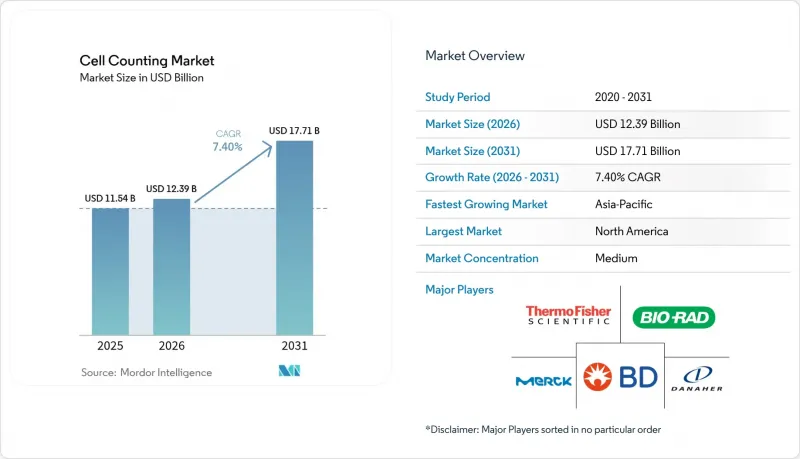
Mordor Intelligence에 의하면, 세포 계수 시장 규모는 2025년에 115억 4,000만 달러로 평가되었고 2026년에는 123억 9,000만 달러에서 2031년까지 177억 1,000만 달러에 이를 것으로 예측되며, 예측 기간(2026-2031년) CAGR은 7.40%를 나타낼 전망입니다.
본 보고서는 제품 유형(장비(분광광도계, 유세포분석기 등) 및 소모품), 용도(연구(암 연구 등), 임상·진단 등),최종 사용자(병원·임상검사실, 학술 기관 등), 기술(유세포분석법 등), 지역(북미, 유럽 등)별로 분류되어 있습니다. 시장 전망은 금액(달러) 기준으로 제시되어 있습니다.
전 세계 세포 계수 시장 동향 및 인사이트
고속 유세포 분석 및 자동 혈액 분석기 활용 확대
베크만 콜터(Beckman Coulter)사의 ‘CytoFLEX mosaic’와 같은 새로운 스펙트럼 유세포 분석기는 88개의 검출 채널과 최대 80 nm까지의 나노 입자 검출 감도를 갖추고 있어, 기존의 10색 패널의 한계를 뛰어넘는 상세한 면역 표현형 분석을 가능하게 합니다. 스펙트럼 언믹싱 알고리즘을 통해 복잡한 보정 절차가 불필요해지며, 운영자의 교육 요건도 완화됩니다. 한편, 시스멕스(Sysmex) 및 지멘스 헬스인어스(Siemens Healthineers)의 자동 혈액 검사 시스템은 응고 및 면역학 모듈을 통합하여 통합된 검사 워크플로우를 효율화하고 있습니다. 이러한 플랫폼을 결합함으로써 검체 이송이 줄어들고 오류율이 감소하며, 검사실은 단일 소프트웨어 기반 위에서 일상적인 계수 검사 및 전문적인 분석을 확장할 수 있게 됩니다.
재생의료 분야에서의 AI 탑재 영상식 세포 계수기 도입 확대
머신러닝을 활용한 영상 분석을 통해, 조작자의 숙련도에 차이가 있더라도 일관된 계수가 가능해집니다. 싱가포르-MIT 연구 기술 연합(S-MIT)은 UV 흡광 분광법과 AI를 결합하여, 무균 배양 시험에 소요되는 14일 대신 단 30분 만에 미생물 오염을 검출할 수 있음을 입증했습니다. NanoEntek사의 형광식 카운터는 극소량의 검체에서 살아있는 CAR T 세포와 죽은 CAR T 세포를 구별하여 시약 비용을 절감하는 동시에 정확한 투여량을 지원합니다. 다양한 기증자 샘플을 기반으로 구축된 딥러닝 라이브러리는 다양한 배양 조건에 적응하여 응집이나 잔해로 인해 발생하던 기존의 과제를 해결합니다.
고급 세포 계수 시스템 및 그 유지 관리 비용의 고비용
스펙트럼 유세포 분석기의 가격은 50만 달러를 초과하는 경우가 있으며, 연간 유지보수 계약에는 구매 가격의 10-15%가 추가되는 경우가 많습니다. 핵심 연구시설에 대한 조사에 따르면, 유지비가 새로운 분석법 개발에 필요한 자금 조달과 경쟁하고 있어, 연구실은 업그레이드를 단계적으로 진행하거나 장비를 공유할 수밖에 없는 상황에 처해 있습니다. 신흥 경제국의 소규모 진료소에서는 제조업체의 서비스 거점이 주요 도시에 집중되어 있어 더욱 큰 장벽에 직면해 있습니다.
부문 분석
소모품은 2025년 세포 계수 시장 점유율의 54.85%를 차지하며, 2031년까지 연평균 성장률(CAGR) 7.14%로 성장을 지속할 것으로 예상되고 있습니다. 시약, 분석 키트, 혈청 및 일회용 센서는 구매가 간헐적인 장비와 달리 지속적으로 재주문됩니다. 일회용 바이오리액터로의 전환은 이러한 추세를 더욱 강화하고 있습니다. 새로운 배치마다 멸균된 백, 튜브, 배지 첨가제의 새로운 세트가 필요하기 때문입니다. 소모품 중에서도 줄기세포 증식을 위해 특별히 조정된 배양 배지는 엄격한 순도 요건으로 인해 높은 가격이 책정되어 있습니다. 한편, 형광 측정용 염색제와 세포사멸 마커를 결합한 생존율 분석 키트는 트리판 블루법을 점차 대체하고 있습니다. 장비는 수익 규모는 작지만, 다운스트림 소모품 수요를 견인하는 도입 기반을 형성하고 있습니다. 분광광도계는 신속한 세포 밀도 확인을 위해 학계에서는 여전히 널리 보급되어 있지만, 형태, 생존율, 표현형을 병행하여 추적해야 하는 치료제 제조 시설에서는 다중 매개변수 유세포분석기나 이미지 기반 계수기가 필수적이 되어가고 있습니다.
자동 세포 계수 장치의 도입 대수는 두 가지 혁신의 궤도로 나뉘고 있습니다. 이미지 기반 모델은 고해상도 CMOS 센서와 클라우드 분석을 활용하여 30초 이내에 세포 밀집도, 생존율, 형태에 대한 측정 결과를 제공합니다. 한편, 임피던스 기반 장치는 최소한의 조작이 필수적인 조혈모세포 이식에 최적화된, 라벨이 필요 없는 계수 기능을 제공합니다. 또한, 마이크로플루이딕스 칩 방식의 계수 장치는 시약 사용량을 획기적으로 줄일 수 있을 것으로 기대되어, 대량의 시료를 할당할 수 없는 고비용 세포 치료 배치에서 매력적인 선택지가 되고 있습니다. 벤더들이 종량제 클라우드 라이선스를 채택함에 따라, 예산에 제약이 있는 연구소에서도 막대한 설비 투자 없이 도입할 수 있게 되었지만, 장기적인 총 소유 비용은 여전히 시약 카트리지에 포함된 소모품의 구독 모델에 의존하고 있습니다.
종양학, 면역학, 백신 프로그램에서 고처리량 플랫폼의 채택이 확대됨에 따라, 연구 활동은 2025년 매출의 40.10%를 계속 차지할 것으로 전망됩니다. 종양 오가노이드 스크리닝에서는 약물 투여 전에 정확한 접종 밀도와 생존율을 확인해야 하는 반면, CRISPR 스크리닝에서는 편집 효율을 정규화하기 위해 정확한 계수에 의존합니다. 임상 진단 분야는 절대값으로는 작지만, 병원이 혈액 검사 라인을 자동화하고 손가락 끝 채혈 후 5분 이내에 백혈구 분획을 제공할 수 있는 현장 진단(POC) 분석 장치를 도입함에 따라 연평균 성장률(CAGR) 7.55%로 성장하여 조사 분야를 능가할 전망입니다. 디지털 도말 검사 분석을 통해 병리학자의 심사 시간이 단축되고, 혈액 검사 수요가 계절적으로 급증하는 시기의 진단 처리 능력이 향상됩니다.
산업 및 바이오프로세스 분야에서는 피드배치 및 연속 관류 모드 모두에서 실시간 생세포 밀도 측정이 필수화됨에 따라 발전이 이루어지고 있습니다. 라만 센서와 정전용량 센서는 폐쇄 루프 제어 장치에 데이터를 공급하여 포도당 및 젖산공급량을 조절함으로써 대사 프로파일을 안정화하고 배치 간 편차를 줄입니다. 환경 검사는 틈새 시장으로 부상하고 있으며, 양조장 및 수처리 시설에서는 플레이트 계수보다 신속하게 미생물 오염을 감지하기 위해 고속 마이크로플루이딕스 계수기가 채택되고 있습니다. 이러한 동향들이 결합되어 수요의 다양화가 보장되고 있으며, 세포 계수 시장에서 특정 용도가 지배적인 위치를 차지하지는 않습니다.
지역별 분석
북미는 성숙한 바이오의약품 제조거점, 연방 정부의 막대한 연구 자금, 그리고 임상 경로에 차세대 세포 계수법의 신속한 통합을 배경으로 2025년에는 매출 점유율 39.20%로 세포 계수 시장을 주도했습니다. 미국에서는 자동 혈액 검사 기기 및 가정용 분획 계수 기기에 대한 FDA의 의료기기 승인 추세가 호재로 작용하여, 병원 및 재택 간호 제공업체들이 첨단 플랫폼을 도입하도록 촉진하고 있습니다. 캐나다 공중보건연구소에서는 혈액 악성 종양 감시를 위해 영상 기반 시스템이 도입되고 있는 반면, 멕시코에서는 의료기기 수입 우대 조치가 확대됨에 따라 중저가 분석 기기에 대한 접근성이 높아지고 있습니다. 이 지역 전체에서 통합된 서비스 네트워크를 통해 가동 중단 시간이 최소화되고 있으며, 기존 공급업체에 대한 고객의 충성도가 높아지고 있습니다.
아시아태평양은 가장 두드러진 성장을 보이는 지역으로, 연평균 성장률(CAGR) 7.66%가 예상됩니다. 이는 중국의 세포 치료 공급망 현지화 추진과 일본의 재생의료 제품에 대한 규제 심사 신속화에 힘입은 결과입니다. 정부 보조금을 통해 GMP 시설 구축이 진행되고 있으며, 각 시설에는 공정 일관성을 보장하는 고처리량 계수 장치가 핵심 장비로 도입되고 있습니다. 한국은 바이오시밀러 분야의 리더십을 바탕으로, 배양 실패를 방지하는 연속 관류 플랜트에 실시간 정전용량 프로브를 도입하는 데 투자하고 있습니다. 인도의 백신 생산 거점은 저비용 마이크로플루이딕스 장비를 채택하고 디지털 대시보드와 결합함으로써 엄격한 배치 릴리스 문서화 요건을 충족하고 있습니다. 호주의 중개 연구소는 외딴 지역 사회에서의 현장 진료(point-of-care) 도입을 중시하고 있어, 견고한 현장용 분석 장비에 대한 수요를 촉진하고 있습니다.
기타 혜택:
- 엑셀 형식 시장 예측(ME) 시트
- 3개월간의 애널리스트 지원
자주 묻는 질문
목차
제1장 서론
제2장 조사 방법
제3장 주요 요약
제4장 시장 구도
제5장 시장 규모와 성장 예측
제6장 경쟁 구도
제7장 시장 기회와 향후 전망
JHS 26.08.26According to Mordor Intelligence, the cell counting market size was valued at USD 11.54 billion in 2025 and estimated to grow from USD 12.39 billion in 2026 to reach USD 17.71 billion by 2031, at a CAGR of 7.40% during the forecast period (2026-2031).
This report is Segmented by Product Type (Instruments [Spectrophotometers, Flow Cytometers, and More] and Consumables), Application (Research [Cancer Research, and More], Clinical & Diagnostic, and More), End User (Hospitals & Clinical Labs, Academic Institutes, and More), Technology (Flow Cytometry, and More) and Geography (North America, Europe, and More). The Market Forecasts are Provided in Terms of Value (USD).
Global Cell Counting Market Trends and Insights
Growing Use of High-throughput Flow Cytometry & Automated Hematology Analyzers
New spectral flow cytometers such as Beckman Coulter's CytoFLEX mosaic offer 88 detection channels and nanoparticle sensitivity down to 80 nm, enabling deep immunophenotyping that exceeds the limits of traditional 10-color panels. Spectral unmixing algorithms remove complex compensation steps and shrink operator training requirements, while automated hematology systems from Sysmex and Siemens Healthineers integrate coagulation and immunology modules to streamline consolidated testing workflows. Combined, these platforms reduce sample hand-offs, lower error rates, and allow labs to scale routine counts and specialized assays on a single software spine.
Rising Adoption of AI-powered Image-based Cell Counters for Regenerative Medicine
Machine learning-enabled image analysis drives consistent enumeration even when operators vary in skill. The Singapore-MIT Alliance for Research and Technology showed that UV absorbance spectroscopy paired with AI detects microbial contamination in 30 minutes versus 14 days for sterility culture tests. NanoEntek's fluorescence-based counters differentiate live and dead CAR T cells from tiny sample volumes, trimming reagent costs and supporting precise dosing. Deep learning libraries built on diverse donor samples adapt to different culture conditions, solving historical challenges caused by clumping and debris.
High Cost of Advanced Cell Counting Systems & Maintenance
Spectral flow cytometers can exceed USD 500,000, and annual service contracts often add 10-15% of purchase price. Core facility surveys confirm that upkeep competes with funding for new assays, pressing labs to stagger upgrades or share instruments. Smaller clinics in emerging economies face steeper barriers because manufacturer service hubs cluster around major urban centers.
Other drivers and restraints analyzed in the detailed report include:
- Integration of Microfluidic Lab-on-a-chip Cell Counting in Point-of-care Testing
- Expansion of Single-use Bioprocessing Driving Demand for Real-time Viable Cell Density Monitoring
- Shortage of Skilled Technicians in Low-income Regions
For complete list of drivers and restraints, kindly check the Table Of Contents.
Segment Analysis
Consumables captured 54.85% of cell counting market share in 2025 and are tracking a 7.14% CAGR toward 2031. Reagents, assay kits, sera, and single-use sensors are reordered continuously, unlike instruments whose purchases are episodic. The shift to disposable bioreactors reinforces this dynamic because every new batch requires a fresh set of sterile bags, tubing, and media supplements. Within consumables, specialized growth media tailored for stem-cell expansion command premium pricing due to stringent purity requirements, while viability assay kits that combine fluorometric stains with apoptotic markers are displacing trypan-blue methods. Instruments, although a smaller revenue pool, set the installed-base foundation that fuels downstream consumables. Spectrophotometers remain ubiquitous in academia for quick density checks, yet multiparametric flow cytometers and image-based counters are becoming indispensable in therapy production suites where morphology, viability, and phenotype must be tracked in parallel.
The installed fleet of automated cell counters is splitting along two innovation tracks. Image-based models leverage high-resolution CMOS sensors and cloud analytics to return confluence, viability, and morphology readouts in under 30 seconds, while impedance-based devices offer label-free counts ideal for hematopoietic stem cell transplants where minimal manipulation is vital. Microfluidic chip counters further promise to reduce reagent volumes by orders of magnitude, making them attractive for high-cost cell therapy batches that cannot spare large sample volumes. As instrument vendors adopt pay-per-use cloud licenses, laboratories in budget-constrained settings gain entry without large capital outlays, yet long-term cost of ownership remains tied to consumables subscription models embedded in reagent cartridges.
Research activities maintained 40.10% of 2025 revenue as oncology, immunology, and vaccine programs continue to absorb high-throughput platforms. Tumor organoid screening requires precise seeding densities and viability confirmation before drug dosing, while CRISPR screens depend on accurate counts to normalize editing efficiencies. Clinical diagnostics, though smaller in absolute terms, will outpace research by growing at 7.55% CAGR as hospitals automate hematology lines and deploy point-of-care analyzers capable of providing differential counts within five minutes of finger-stick collection. Digital smear analysis cuts pathologist review time, enhancing diagnostic throughput during seasonal surges of hematologic testing.
Industrial and bioprocess segments are advancing as real-time viable cell density becomes mandatory for both fed-batch and continuous perfusion modes. Raman and capacitance sensors feed closed-loop controllers that adjust glucose or lactate feeds to stabilize metabolic profiles, mitigating batch-to-batch variability. Environmental testing has emerged as a niche, with breweries and water-treatment plants adopting rapid microfluidic counters to detect microbial contamination faster than plate counts. Combined, these trends ensure diversified demand so that no single application dominates the cell counting market.
Complete Report Scope:
- By Product Type
- Instruments
- Spectrophotometers
- Flow Cytometers
- Hematology Analyzers
- Automated Cell Counters
- Image-based Cell Counters
- Impedance Cell Counters
- Microfluidic Chip Counters
- Consumables
- Media, Sera & Reagents
- Assay Kits
- Others
- Instruments
- By Application
- Research
- Cancer Research
- Stem-Cell & Regenerative Medicine
- Immunology & Infectious-Disease
- Drug Discovery & Toxicology
- Clinical & Diagnostic
- Hematology Diagnostics
- Point-of-Care Testing
- Industrial & Bioprocess
- Biopharmaceutical Manufacturing
- Food & Beverage Quality-Control
- Environmental Monitoring
- Research
- By End User
- Hospitals & Clinical Labs
- Research & Academic Institutes
- Pharmaceutical & Biotech Companies
- CROs & CMOs
- Other Industrial Labs
- By Technology
- Flow Cytometry
- Image-Based Cytometry
- Spectrophotometry
- Impedance (Coulter Principle)
- Microfluidics & Lab-on-Chip
- Geography
- North America
- United States
- Canada
- Mexico
- Europe
- Germany
- United Kingdom
- France
- Italy
- Spain
- Rest of Europe
- Asia-Pacific
- China
- Japan
- India
- South Korea
- Australia
- Rest of Asia-Pacific
- Middle East and Africa
- GCC
- South Africa
- Rest of Middle East and Africa
- South America
- Brazil
- Argentina
- Rest of South America
- North America
Geography Analysis
North America led the cell counting market with 39.20% revenue share in 2025 on the back of a mature biopharmaceutical manufacturing base, heavy federal research funding, and quick integration of next-generation cytometry in clinical pathways. The United States benefits from FDA device-clearance momentum for automated hematology and home-use differential counters, encouraging hospitals and at-home care providers to adopt advanced platforms. Canada's public health labs deploy image-based systems for hematologic malignancy surveillance, while Mexico's growing medical-device import incentives widen access to mid-range analyzers. Across the region, integrated service networks ensure downtime is minimal, strengthening customer loyalty to incumbent vendors.
Asia-Pacific is the fastest-growing territory, projected at 7.66% CAGR, underpinned by China's push to localize cell therapy supply chains and Japan's expedited regulatory routes for regenerative-medicine products. Government grants fund the build-out of GMP suites, each anchored by high-throughput counters that guarantee process consistency. South Korea, leveraging its biosimilar leadership, invests in continuous perfusion plants where real-time capacitance probes guard against culture crashes. India's vaccine hubs adopt low-cost microfluidic instruments, pairing them with digital dashboards to satisfy stringent batch-release documentation. Australia's translational institutes emphasize point-of-care deployment in remote communities, fostering demand for rugged field analyzers.
- Danaher
- Thermo Fisher Scientific
- Becton Dickinson & Co.
- Sysmex Corp.
- Merck KGaA (MilliporeSigma)
- Agilent Technologies (Nexcelom)
- Bio-Rad Laboratories
- Siemens Healthineers
- Roche
- PerkinElmer
- GE Healthcare
- Tecan Group
- DeNovix
- Chemometec A/S
- Logos Biosystems
- Countstar (Shanghai Ruiyu)
- Orflo Technologies
- Luminex (DiaSorin)
- Abbott Laboratories
- HORIBA Medical
- Mindray Bio-medical
Additional Benefits:
- The market estimate (ME) sheet in Excel format
- 3 months of analyst support
TABLE OF CONTENTS
1 Introduction
- 1.1 Study Assumptions & Market Definition
- 1.2 Scope of the Study
2 Research Methodology
3 Executive Summary
4 Market Landscape
- 4.1 Market Overview
- 4.2 Market Drivers
- 4.2.1 Growing Incidence of Target Diseases & Blood Disorders
- 4.2.2 Growing Use of High-throughput Flow Cytometry & Automated Hematology Analyzers
- 4.2.3 Rising Adoption of AI-powered Image-based Cell Counters for Regenerative Medicine
- 4.2.4 Integration of Microfluidic Lab-on-a-chip Cell Counting in Point-of-care Testing
- 4.2.5 Expansion of Single-use Bioprocessing Driving Demand for Real-time Viable Cell Density Monitoring
- 4.2.6 Emergence of Label-free Impedance-based Cytometry for Rapid QC in Cell Therapy Manufacturing
- 4.3 Market Restraints
- 4.3.1 High Cost of Advanced Cell Counting Systems & Maintenance
- 4.3.2 Shortage of Skilled Technicians in Low-income Regions
- 4.3.3 Standardization Gaps in Digital Cell-imaging Analytics Hindering Cross-lab Reproducibility
- 4.3.4 Data-integrity Compliance Burdens Slowing Cloud-connected Device Rollout
- 4.4 Value / Supply-Chain Analysis
- 4.5 Regulatory Landscape
- 4.6 Technological Outlook
- 4.7 Porter's Five Forces Analysis
- 4.7.1 Threat of New Entrants
- 4.7.2 Bargaining Power of Buyers/Consumers
- 4.7.3 Bargaining Power of Suppliers
- 4.7.4 Threat of Substitute Products
- 4.7.5 Intensity of Competitive Rivalry
5 Market Size & Growth Forecasts (Value)
- 5.1 By Product Type
- 5.1.1 Instruments
- 5.1.1.1 Spectrophotometers
- 5.1.1.2 Flow Cytometers
- 5.1.1.3 Hematology Analyzers
- 5.1.1.4 Automated Cell Counters
- 5.1.1.4.1 Image-based Cell Counters
- 5.1.1.4.2 Impedance Cell Counters
- 5.1.1.5 Microfluidic Chip Counters
- 5.1.2 Consumables
- 5.1.2.1 Media, Sera & Reagents
- 5.1.2.2 Assay Kits
- 5.1.2.3 Others
- 5.1.1 Instruments
- 5.2 By Application
- 5.2.1 Research
- 5.2.1.1 Cancer Research
- 5.2.1.2 Stem-Cell & Regenerative Medicine
- 5.2.1.3 Immunology & Infectious-Disease
- 5.2.1.4 Drug Discovery & Toxicology
- 5.2.2 Clinical & Diagnostic
- 5.2.2.1 Hematology Diagnostics
- 5.2.2.2 Point-of-Care Testing
- 5.2.3 Industrial & Bioprocess
- 5.2.3.1 Biopharmaceutical Manufacturing
- 5.2.3.2 Food & Beverage Quality-Control
- 5.2.3.3 Environmental Monitoring
- 5.2.1 Research
- 5.3 By End User
- 5.3.1 Hospitals & Clinical Labs
- 5.3.2 Research & Academic Institutes
- 5.3.3 Pharmaceutical & Biotech Companies
- 5.3.4 CROs & CMOs
- 5.3.5 Other Industrial Labs
- 5.4 By Technology
- 5.4.1 Flow Cytometry
- 5.4.2 Image-Based Cytometry
- 5.4.3 Spectrophotometry
- 5.4.4 Impedance (Coulter Principle)
- 5.4.5 Microfluidics & Lab-on-Chip
- 5.5 Geography
- 5.5.1 North America
- 5.5.1.1 United States
- 5.5.1.2 Canada
- 5.5.1.3 Mexico
- 5.5.2 Europe
- 5.5.2.1 Germany
- 5.5.2.2 United Kingdom
- 5.5.2.3 France
- 5.5.2.4 Italy
- 5.5.2.5 Spain
- 5.5.2.6 Rest of Europe
- 5.5.3 Asia-Pacific
- 5.5.3.1 China
- 5.5.3.2 Japan
- 5.5.3.3 India
- 5.5.3.4 South Korea
- 5.5.3.5 Australia
- 5.5.3.6 Rest of Asia-Pacific
- 5.5.4 Middle East and Africa
- 5.5.4.1 GCC
- 5.5.4.2 South Africa
- 5.5.4.3 Rest of Middle East and Africa
- 5.5.5 South America
- 5.5.5.1 Brazil
- 5.5.5.2 Argentina
- 5.5.5.3 Rest of South America
- 5.5.1 North America
6 Competitive Landscape
- 6.1 Market Concentration
- 6.2 Market Share Analysis
- 6.3 Company Profiles
- 6.3.1 Danaher (Beckman Coulter)
- 6.3.2 Thermo Fisher Scientific, Inc.
- 6.3.3 Becton Dickinson & Co.
- 6.3.4 Sysmex Corp.
- 6.3.5 Merck KGaA (MilliporeSigma)
- 6.3.6 Agilent Technologies (Nexcelom)
- 6.3.7 Bio-Rad Laboratories
- 6.3.8 Siemens Healthineers
- 6.3.9 F. Hoffmann-La Roche
- 6.3.10 PerkinElmer
- 6.3.11 GE HealthCare
- 6.3.12 Tecan Group
- 6.3.13 DeNovix
- 6.3.14 Chemometec A/S
- 6.3.15 Logos Biosystems
- 6.3.16 Countstar (Shanghai Ruiyu)
- 6.3.17 Orflo Technologies
- 6.3.18 Luminex (DiaSorin)
- 6.3.19 Abbott Diagnostics
- 6.3.20 HORIBA Medical
- 6.3.21 Mindray Bio-medical
7 Market Opportunities & Future Outlook
- 7.1 White-Space & Unmet-Need Assessment


