
|
시장보고서
상품코드
2114864
기업 제조 인텔리전스 : 시장 점유율 분석, 업계 동향 및 통계, 성장 예측(2026-2031년)Enterprise Manufacturing Intelligence - Market Share Analysis, Industry Trends & Statistics, Growth Forecasts (2026 - 2031) |
||||||
 Mordor Intelligence
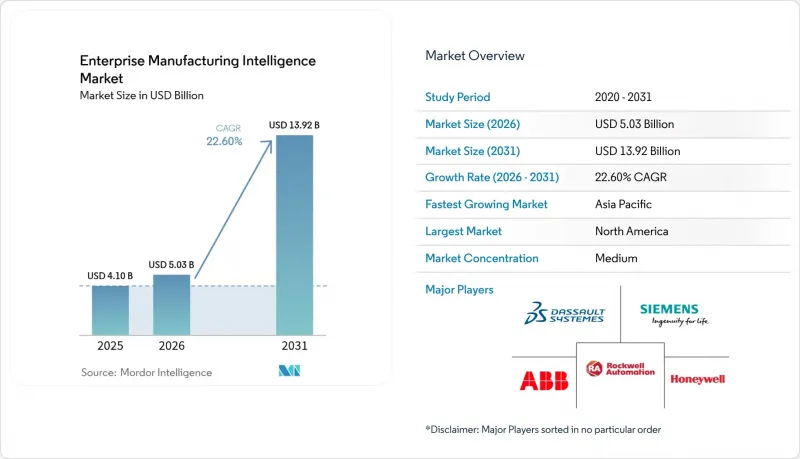
Mordor Intelligence에 의하면, 기업 제조 인텔리전스 시장 규모는 2025년에 41억 달러로 평가되었습니다. 2026년 50억 3,000만 달러에서 2031년까지 139억 2,000만 달러에 이를 것으로 예상되며, 예측 기간(2026-2031년) CAGR은 22.6%를 나타낼 전망입니다.
본 보고서는 용도별(데이터 통합, 애널리틱스·분석, 기타), 최종 사용자 산업별(자동차, 항공우주 및 방위, 기타), 배포 방식별(On-Premise, 하이브리드(엣지+클라우드), 클라우드 네이티브), 구성 요소별, 지역별로 분류되어 있습니다. 시장 예측은 금액(달러)으로 표시되어 있습니다.
세계의 기업 제조 인텔리전스 시장 동향 및 인사이트
시프트 레프트 분석을 통한 실시간 ‘품질 설계(QbD)’ 구현
제조 공정에 통합된 실시간 분석을 통해 발생 원천에서 편차를 감지하고, 삼성바이오로직스 등의 시설에서는 전산유체역학(CFD) 모델을 인라인으로 실행하여 바이오의약품의 매개변수를 즉시 조정함으로써 스크랩을 최대 30%까지 줄였습니다. 현재 머신러닝 알고리즘은 업스트림 신호로부터 품질 결과를 예측하여 설계 의도와 실제 제조 상황 간의 격차를 해소하고 있습니다. 규제 산업에서는 결함을 조기에 감지함으로써 리콜이나 규제 당국의 제재를 사전에 방지할 수 있어 부가가치를 창출합니다. 실행 플랫폼과 통합된 AI 기반 제어 루프는 처리량을 극대화하면서 공정을 사양 범위 내에 유지합니다. 이러한 성과로 인해 여러 거점으로 구성된 네트워크 전반에 걸친 대규모 도입에 대한 경영진의 지지가 강화되고 있습니다.
스마트 팩토리에서의 디지털 스레드 요구 사항
엔드투엔드 디지털 스레드는 설계, 생산, 서비스 데이터를 연결하여 제조업체가 문제를 특정 공정 설정이나 자재 로트까지 거슬러 올라가 추적할 수 있도록 합니다. 항공우주 공급업체인 Safran Aero Boosters는 PTC ThingWorx를 활용하여 엔지니어링 모델과 현장 운영을 연계함으로써 예측 유지보수와 지속적인 개선을 실현하고 있습니다. 이 개념은 감사 대응을 위한 데이터 무결성을 보장하는 블록체인 기반 추적성을 통해 공급업체로 확대되고 있습니다. 또한, 원활한 연결성을 통해 전 세계 공장에서 모범 사례를 실시간으로 도입할 수 있게 되어, 제품 시장 출시를 가속화하고 변경 관리 주기를 단축합니다.
기존 설비 개조에 따른 투자 회수 주저
기존 공장에서는 생산을 중단시키고 투자 회수 기간을 장기화시키는 센서 개조나 통합 작업의 정당성을 설명하는 데 어려움을 겪고 있습니다. 경영진은 즉각적인 비용 절감이 기대되는 프로젝트를 우선시하기 때문에 종합적인 인텔리전스 도입이 지연되고 있습니다. 수명 주기가 긴 자산에 차질을 빚을 위험에 더해, 경기 변동에 민감한 산업에서의 설비 투자 동결까지 겹치면서, 많은 기업은 전사적인 확대를 단행하기보다는 제한된 범위 내의 시범 도입을 선택하고 있습니다.
부문별 분석
‘분석 및 인텔리전스’ 부문은 2025년 매출의 40.62%를 차지하며, 인사이트 창출이 기업 제조 인텔리전스 시장의 모든 도입을 뒷받침하고 있음이 확인되었습니다. ‘워크플로우 및 KPI 관리’ 부문은 연평균 성장률(CAGR) 27.09%를 나타낼 것으로 예측되며, 이는 정적인 보고서에서 실시간 폐쇄 루프형 성과 관리로의 전환을 반영합니다. 시각화 도구와 데이터 통합 계층이 전형적인 스택을 구성하고 있지만, 투자는 알고리즘이 측정 가능한 처리량 향상을 가져오는 부문에 집중되고 있습니다.
현재 기업들은 작업자의 워크플로우를 의사 결정 과정을 이끄는 머신러닝의 출력 결과와 연계하여, 자가 조정형 생산 라인을 구축하고 있습니다. 허니웰(Honeywell)의 ‘설명 가능한 AI’ 모듈은 상황에 맞는 지침이 가동 중단 시간이나 교육에 드는 오버헤드를 어떻게 줄여주는지를 보여주는 좋은 예입니다. 생성형 인터페이스가 성숙해짐에 따라, 음성 쿼리를 지원하는 대시보드를 통해 현장 직원이 플랜트의 실시간 지표를 조회할 수 있게 되어, 해당 분야 전문가와 현장 데이터 간의 장벽이 낮아지고 있습니다.
자동차 제조업체는 차체 공장의 로봇 공학 및 최종 조립 시퀀싱 관리에 광범위한 플랫폼을 도입함으로써 2025년에는 매출의 23.52%를 차지했습니다. 제약 및 생명공학 산업은 규제 당국의 지속적인 공정 검증 및 디지털 트윈 의무화에 따라 25.54%라는 가장 높은 연평균 성장률(CAGR)을 보일 것으로 예측됩니다. 제약 제조업체용 기업 제조 인텔리전스 시장 규모는 배치 이력 및 무균 상태 유지를 위해 타임스탬프가 포함된 세밀한 데이터 세트가 요구됨에 따라 가장 빠르게 확대될 것으로 예측됩니다.
GlaxoSmithKline사의 디지털 트윈 백신 프로젝트에서는 제조 레시피 변경을 가상으로 검증한 결과, 실질적인 수율 향상이 보고되었습니다. 항공우주 및 방위 기업들은 수출 관리 감사에 대응하기 위해 디지털 스레드를 통한 추적성에 주력하고 있는 반면, 반도체 팹에서는 서브미크론 수준의 결함 감지를 위해 인라인 분석을 활용하고 있습니다. 식품 가공업체들도 엄격한 안전 프로토콜로 인해 도입률이 상승하고 있습니다.
지역별 분석
북미는 2025년 전 세계 매출의 37.71%를 차지했습니다. 이는 Procter & Gamble(P&G)과 같은 초기 도입 기업들이 100개 이상의 공장을 통합하는 하이브리드 클라우드 실행 시스템을 도입했기 때문입니다. 연방 정부의 리쇼어링(국내 복귀) 장려책과 하이퍼스케일러와의 제휴는 OEE(종합 설비 효율) 향상을 입증하는 모델 사이트에 대한 자금 지원을 통해 이러한 추세를 뒷받침하고 있습니다. 시스템 통합사업자에 의한 광범위한 생태계가 인재 파이프라인을 공급하여 중견 제조업체의 도입 위험을 완화하고 있습니다.
아시아태평양은 2031년까지 연평균 성장률(CAGR) 26.41%로 가장 높은 성장률을 기록할 전망입니다. 중국, 일본, 한국에서는 인더스트리 4.0 시범 사업에 국가 보조금이 투입되고 있는 반면, 싱가포르의 전국적인 디지털 팩토리 로드맵에서는 연결성에 대한 기본 기준이 규정되어 있습니다. 전자기기 및 배터리 제조업체들은 인력 부족을 보완하고 수출 품질 기준을 충족하기 위해 도입을 주도하고 있습니다. 지역 클라우드 제공업체들은 현재 데이터 거주지 규정을 충족하기 위해 현지 가용성 구역을 운영하고 있으며, Tier 2 공급업체에 대한 접근성을 확대되고 있습니다. 유럽에서는 ‘청정 산업 협약(Clean Industrial Deal)’과 같은 규제 조치를 활용하여 OEE(종합 설비 효율)뿐만 아니라 배출량을 기록하는 플랫폼으로 자본을 유도하고 있습니다. 독일의 자동차 산업 클러스터에서는 재활용 강철을 인증하기 위한 블록체인 기반 추적성 검사가 운영되고 있으며, 이탈리아의 식품 가공 라인에서는 에너지 소비를 줄이기 위해 AI가 도입되고 있습니다. 브렉시트로 인한 공급망 혼란으로 인해 미들랜드 지역의 항공우주 공장에서부터 중국 본토의 Tier 1 공급업체에 이르기까지 재고 가시화에 대한 수요가 높아지고 있으며, 회복탄력성 전략으로서 ‘기업 제조 인텔리전스’ 도입이 정착되고 있습니다.
기타 혜택
- 엑셀 형식 시장 예측(ME) 시트
- 3개월간의 애널리스트 지원
자주 묻는 질문
목차
제1장 서론
제2장 조사 방법
제3장 주요 요약
제4장 시장 구도
제5장 시장 규모 및 성장 예측
제6장 경쟁 구도
제7장 시장 기회 및 향후 전망
KTH 26.08.28According to Mordor Intelligence, the enterprise manufacturing intelligence market size was valued at USD 4.1 billion in 2025 and estimated to grow from USD 5.03 billion in 2026 to reach USD 13.92 billion by 2031, at a CAGR of 22.6% during the forecast period (2026-2031).
This report is Segmented by Application (Data Integration, Analytics & Analysis and More), End-User Industry (Automotive, Aerospace & Defense and More), Deployment Mode (On-Premise, Hybrid (Edge + Cloud) and Cloud-Native), Component and Geography. The Market Forecasts are Provided in Terms of Value (USD).
Global Enterprise Manufacturing Intelligence Market Trends and Insights
Shift-left Analytics Enables Real-time Quality-by-design
Real-time analytics embedded into production detect deviations at origin and have lowered scrap by as much as 30% at facilities such as Samsung Biologics, where computational fluid-dynamics models run inline to adjust biopharma parameters instantly. Machine-learning algorithms now forecast quality outcomes from upstream signals, closing the gap between design intent and manufacturing reality. Regulated industries gain added value because early defect detection prevents recalls and regulatory penalties. When integrated with execution platforms, AI-powered control loops keep processes within specification while maximizing throughput. These outcomes strengthen executive support for scaled deployments across multi-site networks.
Digital Thread Requirements in Smart Factories
End-to-end digital threads connect design, production, and service data, letting manufacturers trace issues back to specific process settings and material lots. Aerospace supplier Safran Aero Boosters uses PTC ThingWorx to link engineering models with shop-floor execution, enabling predictive maintenance and continuous improvement. The concept is expanding to suppliers through blockchain-backed traceability that ensures data integrity for audit readiness. Seamless connectivity also lets global plants adopt best practices in real time, accelerating product launches and shortening change-management cycles.
Pay-back Hesitation in Brown-field Retrofits
Legacy plants struggle to justify sensor retrofits and integration work that interrupt production and stretch pay-back periods. Managers favour projects with immediate savings, delaying holistic intelligence rollouts. The risk of disrupting long-lifecycle assets, alongside capex freezes in cyclical sectors, pushes many firms to pilot limited scopes rather than commit to enterprise-wide deployments.
Other drivers and restraints analyzed in the detailed report include:
- Integration of Industrial 5G and Edge AI
- Economies' Green-deal Subsidies Linked to OEE KPIs
- Persistent Data Ownership Uncertainty in Multi-tier Supply Chains
For complete list of drivers and restraints, kindly check the Table Of Contents.
Segment Analysis
Analytics and Analysis held a 40.62% slice of 2025 revenue, confirming that insight generation underpins every deployment of the Enterprise Manufacturing Intelligence market. Workflow and KPI Management, forecast at a 27.09% CAGR, reflects the pivot from static reports to real-time, closed-loop performance control. Visualization tools and data-integration layers round out typical stacks but spend concentrates where algorithms deliver measurable throughput gains.
Enterprises now tie operator workflows to machine learning outputs that guide decision steps, creating self-adjusting lines. Honeywell's explainable-AI modules exemplify how contextual guidance slashes downtime and training overhead. As generative interfaces mature, query-by-voice dashboards let frontline staff interrogate live plant metrics, shrinking the barrier between domain experts and shop-floor data.
Automotive producers accounted for 23.52% revenue in 2025 through extensive platform rollouts for body-shop robotics and final-assembly sequencing. Pharmaceuticals and biotechnology will post the fastest 25.54% CAGR as regulators mandate continuous process verification and digital twins. The Enterprise Manufacturing Intelligence market size for drug makers is forecast to expand fastest because batch genealogy and sterile conditions require granular, time-stamped datasets.
GlaxoSmithKline's digital twin vaccines project reports tangible yield increases after virtual validation of recipe changes. Aerospace and defense firms concentrate on digital-thread traceability to meet export-control audits, while semiconductor fabs exploit inline analytics for sub-micron defect detection. Food processors also climb the adoption curve due to stringent safety protocols.
Complete Report Scope:
- By Application
- Data Integration
- Analytics & Analysis
- Visualization / Dashboards
- Workflow & KPI management
- By End-user Industry
- Automotive
- Aerospace & Defense
- Electronics & Semiconductors
- Food & Beverage
- Chemicals & Materials
- Pharmaceuticals & Biotech
- By Deployment Mode
- On-premise
- Hybrid (Edge + Cloud)
- Cloud-native
- By Component
- Platforms / Software
- Services
- Embedded Analytics Hardware
- By Geography
- North America
- United States
- Canada
- Mexico
- South America
- Brazil
- Argentina
- Europe
- Italy
- France
- United Kingdom
- Germany
- Asia-Pacific
- China
- India
- Japan
- South Korea
- Middle East
- United Arab Emirates
- Saudi Arabia
- Turkey
- Africa
- Nigeria
- South Africa
- Kenya
- North America
Geography Analysis
North America controlled 37.71% of 2025 global revenue as early adopters such as Procter and Gamble embedded hybrid cloud execution systems that unify more than 100 plants. Federal reshoring incentives and partnerships with hyperscalers reinforce momentum by funding lighthouse sites that showcase OEE boosts. An extensive ecosystem of system integrators supplies talent pipelines that de-risk rollouts for mid-sized manufacturers.
Asia-Pacific will post the fastest 26.41% CAGR through 2031. China, Japan, and South Korea funnel state grants into Industry 4.0 pilots, while Singapore's nation-wide digital-factory roadmap prescribes baseline connectivity standards. Electronics and battery producers lead adoption to offset tight labour markets and meet export quality thresholds. Regional cloud providers now operate local availability zones to satisfy data-residency regulations, widening access for tier-2 suppliers. Europe leverages regulatory levers such as the Clean Industrial Deal, steering capital towards platforms that document emissions alongside OEE. German automotive clusters pilot blockchain provenance to certify recycled steel, and Italian food-processing lines deploy AI to cut energy use. Brexit-triggered supply-chain shocks elevate the need for inventory visibility from Midlands aerospace plants to mainland tier-1 suppliers, cementing Enterprise Manufacturing Intelligence adoption as a resilience strategy.
- ABB Ltd.
- Aspen Technology Inc.
- AVEVA Group plc
- Dassault Systmes SE
- Emerson Electric Co.
- General Electric Co.
- Hexagon AB
- Honeywell International Inc.
- Mitsubishi Electric Corp.
- Rockwell Automation Inc.
- SAP SE
- Schneider Electric SE
- Siemens AG
- Yokogawa Electric Corp.
Additional Benefits:
- The market estimate (ME) sheet in Excel format
- 3 months of analyst support
TABLE OF CONTENTS
1 INTRODUCTION
- 1.1 Study Assumptions & Market Definition
- 1.2 Scope of the Study
2 RESEARCH METHODOLOGY
3 EXECUTIVE SUMMARY
4 MARKET LANDSCAPE
- 4.1 Market Overview
- 4.2 Market Drivers
- 4.2.1 Shift-left analytics enables real-time quality-by-design
- 4.2.2 Digital thread requirements in smart factories
- 4.2.3 Integration of industrial 5G & edge AI
- 4.2.4 Economies green-deal subsidies linked to OEE KPIs
- 4.2.5 Rising use of low-code composable apps by operators
- 4.3 Market Restraints
- 4.3.1 Pay-back hesitation in brown-field retrofits
- 4.3.2 Persistent data ownership uncertainty in multi-tier supply chains
- 4.3.3 Talent shortage in IT-OT data engineering
- 4.4 Value / Supply-Chain Analysis
- 4.5 Regulatory Landscape
- 4.6 Technological Outlook
- 4.7 Porter's Five Forces Analysis
- 4.7.1 Threat of New Entrants
- 4.7.2 Bargaining Power of Buyers
- 4.7.3 Bargaining Power of Suppliers
- 4.7.4 Threat of Substitutes
- 4.7.5 Intensity of Competitive Rivalry
5 MARKET SIZE AND GROWTH FORECASTS (VALUE)
- 5.1 By Application
- 5.1.1 Data Integration
- 5.1.2 Analytics & Analysis
- 5.1.3 Visualization / Dashboards
- 5.1.4 Workflow & KPI management
- 5.2 By End-user Industry
- 5.2.1 Automotive
- 5.2.2 Aerospace & Defense
- 5.2.3 Electronics & Semiconductors
- 5.2.4 Food & Beverage
- 5.2.5 Chemicals & Materials
- 5.2.6 Pharmaceuticals & Biotech
- 5.3 By Deployment Mode
- 5.3.1 On-premise
- 5.3.2 Hybrid (Edge + Cloud)
- 5.3.3 Cloud-native
- 5.4 By Component
- 5.4.1 Platforms / Software
- 5.4.2 Services
- 5.4.3 Embedded Analytics Hardware
- 5.5 By Geography
- 5.5.1 North America
- 5.5.1.1 United States
- 5.5.1.2 Canada
- 5.5.1.3 Mexico
- 5.5.2 South America
- 5.5.2.1 Brazil
- 5.5.2.2 Argentina
- 5.5.3 Europe
- 5.5.3.1 Italy
- 5.5.3.2 France
- 5.5.3.3 United Kingdom
- 5.5.3.4 Germany
- 5.5.4 Asia-Pacific
- 5.5.4.1 China
- 5.5.4.2 India
- 5.5.4.3 Japan
- 5.5.4.4 South Korea
- 5.5.5 Middle East
- 5.5.5.1 United Arab Emirates
- 5.5.5.2 Saudi Arabia
- 5.5.5.3 Turkey
- 5.5.6 Africa
- 5.5.6.1 Nigeria
- 5.5.6.2 South Africa
- 5.5.6.3 Kenya
- 5.5.1 North America
6 COMPETITIVE LANDSCAPE
- 6.1 Market Concentration
- 6.2 Strategic Moves
- 6.3 Market Share Analysis
- 6.4 Company Profiles (includes Global level Overview, Market level overview, Core Segments, Financials as available, Strategic Information, Market Rank/Share, Products & Services, Recent Developments)
- 6.4.1 ABB Ltd.
- 6.4.2 Aspen Technology Inc.
- 6.4.3 AVEVA Group plc
- 6.4.4 Dassault Systmes SE
- 6.4.5 Emerson Electric Co.
- 6.4.6 General Electric Co.
- 6.4.7 Hexagon AB
- 6.4.8 Honeywell International Inc.
- 6.4.9 Mitsubishi Electric Corp.
- 6.4.10 Rockwell Automation Inc.
- 6.4.11 SAP SE
- 6.4.12 Schneider Electric SE
- 6.4.13 Siemens AG
- 6.4.14 Yokogawa Electric Corp.
- 6.5 Investment Analysis
7 MARKET OPPORTUNITIES AND FUTURE OUTLOOK
- 7.1 White-space & Unmet-need assessment