|
시장보고서
상품코드
2114875
보안용지 시장 : 시장 점유율 분석, 업계 동향 및 통계, 성장 예측(2026-2031년)Security Paper - Market Share Analysis, Industry Trends & Statistics, Growth Forecasts (2026 - 2031) |
||||||
 Mordor Intelligence
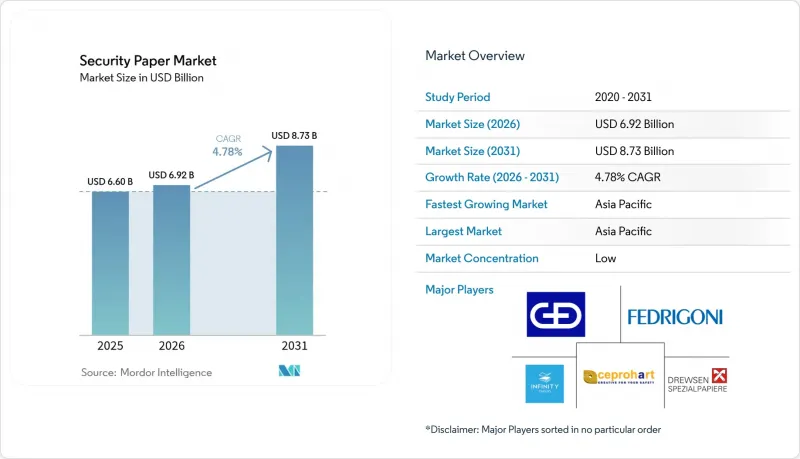
Mordor Intelligence에 의하면, 보안용지 시장 규모는 2025년 66억 달러로 평가되었고, 2026년에는 69억 2,000만 달러로 추정되고, 2026-2031년 CAGR 4.78%로 성장을 지속할 전망이며, 2031년에는 87억 3,000만 달러에 이를 것으로 예측됩니다.
본 보고서는 용도별(통화·지폐, 결제 카드·수표, 기타), 기재 유형별(면섬유지, 폴리머 기재, 기타), 보안 기능 통합별(워터마크, 보안 실, 기타), 최종 사용자별(중앙은행·조폐국, 정부 문서 기관, 보안 인쇄 업체, 기타), 지역별로 분류되어 있습니다. 시장 예측은 금액(달러) 기준으로 제시되어 있습니다.
세계의 보안용지 시장 동향 및 인사이트
사기·위조 사건 증가
사기 범죄의 급증은 보안용지 시장의 구조적 성장의 주축이 되고 있습니다. 2025년 인도에서 압수된, 거의 완벽한 위조 500루피(5.58달러) 지폐 사례는 철자상의 미세한 오류가 현재로서는 드문 육안 감지 단서 중 하나임을 보여줍니다. 미국 국토안보부는 생성형 AI로 인해 문서 위조 수법이 더욱 정교해짐에 따라, 발행 기관이 촉각적, 광학적, 디지털적 요소를 결합한 다층 기재를 채택할 수밖에 없을 것이라고 경고하고 있습니다. 이에 대응해 각국 중앙은행은 디자인 개편 주기를 단축하고 있으며, 그 결과 보안용지 시장은 끊임없는 업그레이드의 국면에 접어들었습니다. 아시아태평양 전체에서 폴리머 소재 검사 결과에 따르면, 투명 창이나 미세 천공을 도입함으로써 위조 지폐 차단율이 두 자릿수 수준으로 개선되어 기판 전환에 대한 신뢰가 높아지고 있습니다. 제조업체에게 있어 이러한 ‘군비 경쟁’은 꾸준한 연구개발비 지출로 이어지며, 범용 섬유 가격이 인플레이션으로 급등하더라도 이익률을 보호할 수 있는 프리미엄 가격대의 형성을 가져오고 있습니다.
보안 대책이 적용된 문서 프로그램의 확대(전자 여권, 신분증)
각국 정부는 신분증 인프라의 현대화를 추진하고 있으며, 물리적 신분증과 디지털 인증 시스템을 연계하고 있습니다. 토판이 2024년에 HID Citizen Identity Solutions를 인수함에 따라, 기존 보안 인쇄와 생체 인증 등록 플랫폼이 융합되어 정부 기관에 일원화된 조달 경로가 제공되게 되었습니다. 블록체인을 기반으로 한 ID 솔루션 관련 특허 출원 건수는 6,000건을 넘어섰으며, 이는 개인정보를 보호하고 사용자 중심의 ID 아키텍처를 위한 업계의 노력을 보여줍니다. 필리핀의 아바카 섬유를 배합한 폴리머 여권 등의 국가 프로젝트는 지역 섬유를 세계 수준의 기판에 접목하는 현지화 전략을 보여줍니다. 그 결과, 수요는 암호화된 칩을 내장하면서도 눈에 보이는 워터마크를 표시할 수 있는 하이브리드 용지로 이동하고 있으며, 이는 보안용지 시장에서 다각적인 수익원을 공고히 하고 있습니다.
‘죄의 세금’ 대상 품목에 대한 인지세 의무화
각국 정부는 담배, 주류 및 기타 고세율 품목에 대한 물품세 관리를 강화하고 있으며, 미국 법전 제26편에서는 특수 보안용지로만 충족할 수 있는 명확한 인지 기준이 규정되어 있습니다. 마찬가지로 유럽연합(EU) 지침에서도 홀로그램이나 UV 마킹이 적용된 인지 사용이 의무화되어 있어, 보안 인쇄 업체들에게 틈새 시장이지만 지속적인 수주 기회를 창출하고 있습니다. 이러한 의무화 조치에는 세수 확보와 불법 거래 억제라는 이중의 목적이 있으며, 이로 인해 더 광범위한 인쇄 시장이 위축되더라도 인장지 수요량은 견조하게 유지되고 있습니다. 눈에 보이는 홀로그램과 보이지 않는 RFID 칩을 융합할 수 있는 공급업체는 경쟁 우위를 확보하게 되며, 보안용지 시장은 의약품 및 음료용 추적·추적 가능성 솔루션 부문에서 인접한 성장 기회를 포착하게 될 것입니다.
부문 분석
2025년, 화폐와 지폐는 보안용지 시장에서 47.78%라는 압도적인 점유율을 유지했습니다. 이는 일본의 3D 홀로그램 지폐 도입과 아시아태평양 전반에 걸친 빈번한 디자인 개편에 힘입은 결과입니다. 디지털 지갑 사용이 증가하고 있음에도 불구하고, 은행 계좌가 없는 사람들에게는 현금이 여전히 필수적이며, 이는 보안용지 시장에 견고한 기초 수요를 제공합니다. 수표와 결제 카드는 특히 은행 이용률이 상승하고 있는 지역에서 부차적인 이용 사례로 자리 잡고 있습니다. 신분증 및 여행 서류는 유럽과 북미에서 전자 여권 발급 주기가 가속화됨에 따라 확대되는 중간 영역을 차지하고 있습니다. 보안 포장 및 라벨은 현재 점유율이 한 자릿수 중반에 그치고 있지만, 의약품 일련번호 부여에 관한 법규의 적용 범위가 확대됨에 따라 2031년까지 연평균 성장률(CAGR) 8.22%로 증가할 것으로 예측됩니다. 이러한 추세는 보안용지 시장이 순수한 화폐에 대한 의존에서 점차 균형을 재조정하고 있음을 보여줍니다.
부문 구성은 리스크 관리 전략도 반영하고 있습니다. 중앙은행은 고액권에는 폴리머를 선호하는 반면, 저액권에는 여전히 면을 지정하여 조달 리스크를 분산시키고 있습니다. 대조적으로, 포장용 가공업체들은 보안성과 지속가능성을 모두 충족하는 합성 섬유나 재생 섬유를 선호하여 채택하고 있습니다. 티켓 및 증명서 용도는 학술 부문과 이벤트 부문에서 틈새 수요를 유지하고 있어, 롱테일 수익원이 되고 있습니다. 이러한 동향을 종합적으로 살펴보면, 보안용지 시장에서 사업을 전개하는 기업에게 용도의 다각화가야말로 현금 수요의 구조적 감소에 대한 최선의 헤지 수단인 이유가 명확히 드러납니다.
2025년, 면 섬유 시트는 보안용지 시장 점유율의 56.10%를 차지했습니다. 이는 수 세기에 걸친 제조 생태계와 사용자가 익숙해져 온 사용감에 의해 구축된 입지입니다. 그러나 텍사스주의 연속된 가뭄과 인도의 생산량 10% 감소로 인해 수입량이 2배로 증가하면서 원자재 비용이 상승했을 뿐만 아니라, 공급 측면의 취약성이 드러났습니다. 폴리머 기판은 현재 내구성과 사용 비용 측면에서 뚜렷한 우위를 점하고 있으며, 리비아, 루마니아, 필리핀의 중앙은행이 주요 액면가의 지폐를 폴리머 기판으로 전환하는 데 박차를 가하고 있습니다. 하이브리드 지폐는 면의 촉감과 폴리머 필름의 강도를 융합하여 현금 사용자의 심리적 저항을 완화하고, 기기의 단계적 교체를 가능하게 하고 있습니다.
재생 섬유를 사용한 제품은 규제 당국 및 기업의 지속가능성 담당자들로부터 환경 성과 평가에 대한 압박에 힘입어, 해당 부문에서 가장 빠른 연평균 성장률(CAGR) 9.05%로 성장을 지속하고 있습니다. 아바카와 린넨은 지역 특유의 기회를 제공하며, 발행 기관에게 공급의 현지화 및 운송에 따른 배출량 감축으로 이어질 가능성이 있습니다. 앞으로 수명 주기 평가(LCA)는 위조 방지 성능과 마찬가지로 기재 선정에 영향을 미치는 요인이 될 것이며, 보안용지 산업에서 자사 내 섬유 연구개발의 전략적 가치를 높여갈 것으로 보입니다.
지역별 분석
아시아태평양은 2025년 매출의 32.10%를 차지했으며, 폴리머 채택 확대 및 국민 신분증 프로젝트의 규모 확대에 따라 해당 지역의 보안용지 시장 규모는 연평균 성장률(CAGR) 6.74%로 확대될 것으로 예측됩니다. 2024년 7월 일본에서 도입된 새 지폐는 3D 홀로그램 초상의 상업적 실현 가능성을 입증했으며, 지폐 디자인 개편을 계획 중인 인근 국가들에게 새로운 벤치마크가 될 가능성이 높습니다. 필리핀은 2025년 1월 최초의 폴리머 지폐 시리즈를 도입하여 통화 현대화 프로그램의 기반을 다졌습니다. 인도에서는 위조 위협과 면화 공급에 대한 우려라는 두 가지 요인이 맞물리면서, 수입 면화에 대한 의존도를 낮추는 혼합 기판에 대한 관심이 높아지고 있습니다.
북미와 유럽은 성숙 단계에 있지만, 발행 기관이 ISO 및 ICAO 여권 규정을 충족하는 다층적 보안을 요구하고 있어 여전히 높은 평균 판매 가격(ASP)을 유지하고 있습니다. 유럽중앙은행(ECB)의 디지털 유로 검토는 전략적 불확실성을 야기하고 있지만, 루마니아가 2024년에 발행한 폴리머 기념지폐는 유로존 시장이 당분간 고도의 보안 기능을 갖춘 현금 사용에 계속 주력하고 있음을 뒷받침합니다.
중동 및 아프리카에서는 비약적인 성장 가능성이 전망됩니다. 리비아가 2025년에 예정하고 있는 폴리머 소재로의 전환은 주변 국가들에게 선행 지표가 될 것입니다. 아랍에미리트(UAE) 등 걸프 지역 국가들의 발행 기관들은 혹독한 기후에 대응하기 위해 내구성이 뛰어난 폴리머 기재를 채택하고 있습니다. 브라질과 아르헨티나를 필두로 한 남미에서는 불법 주류 유통을 막기 위해 세금 인장 개편이 우선시될 것으로 예상되며, 이를 통해 보안용지 시장에는 소비세 용도로 새로운 수익원이 창출될 것입니다.
기타 혜택
- 엑셀 형식 시장 예측(ME) 시트
- 3개월간 애널리스트 지원
자주 묻는 질문
목차
제1장 서론
제2장 조사 방법
제3장 주요 요약
제4장 시장 구도
제5장 시장 규모 및 성장 예측
제6장 경쟁 구도
제7장 시장 기회 및 향후 전망
AJY 26.08.28According to Mordor Intelligence, the security paper market size is expected to grow from USD 6.60 billion in 2025 to USD 6.92 billion in 2026 and is forecast to reach USD 8.73 billion by 2031 at 4.78% CAGR over 2026-2031.
This report is Segmented by Application (Currency / Banknotes, Payment Cards and Cheques, and More), Substrate Type (Cotton-Fibre Paper, Polymer Substrate, and More), Security Feature Integration (Watermarks, Security Threads, and More), End User (Central Banks and Mints, Government Document Agencies, Secure Printing Houses, and More), by Geography. The Market Forecasts are Provided in Terms of Value (USD).
Global Security Paper Market Trends and Insights
Rising Fraud and Counterfeiting Incidents
Escalating fraud has become a structural growth pillar for the security paper market. India's 2025 seizure of near-perfect counterfeit INR 500(USD 5.58) notes illustrates how spelling micro-errors are now among the few visible detection clues. The U.S. Department of Homeland Security warns that generative AI will heighten document forgery sophistication, forcing issuers to adopt multi-layer substrates that combine tactile, optical and digital elements. Central banks respond by shortening redesign cycles, which keeps the security paper market in a perpetual upgrade mode. Across Asia-Pacific, polymer trials show counterfeit rejection rates improving by double digits once transparent windows and micro-perforations are introduced, reinforcing confidence in substrate migration. For producers, the arms race translates into steady R&D spend and a premium pricing corridor that buffers margins even when commodity fibres face inflationary spikes.
Expansion of Secure-Document Programmes
Governments are modernising identity infrastructures, intertwining physical credentials with digital verification rails. TOPPAN's 2024 acquisition of HID Citizen Identity Solutions fused traditional security printing with biometric enrolment platforms, offering agencies a single procurement lane. Patent filings exceed 6,000 for blockchain-anchored identity solutions, signalling industry commitment to privacy-preserving, user-centric ID architectures. National projects such as the Philippines' abaca-infused polymer passports demonstrate localisation strategies that embed regional fibres into global-grade substrates. Demand therefore tilts toward hybrid papers that can store encrypted chips while still displaying visible watermarks, cementing a multi-dimensional revenue stream for the security paper market.
Excise-Stamp Mandates for Sin-Tax Goods
Governments are tightening excise controls on tobacco, alcohol and other high-levy items, with U.S. Code Title 26 prescribing explicit stamp standards that only specialised security papers can meet. European Union directives similarly require holographic or UV-tagged stamps, generating niche but recurring orders for security printers. Mandates serve dual objectives-securing tax receipts and curbing illicit trade-which together ensure that stamp volumes remain resilient even when broader print markets decline. Suppliers that can blend overt holograms with covert RFID chips gain competitive advantage, positioning the security paper market for adjacent growth in track-and-trace solutions for pharmaceuticals and beverages.
Other drivers and restraints analyzed in the detailed report include:
- Polymer and Hybrid Substrate Migration
- Digital-Payment Substitution
- High Cost of Advanced Security Features
For complete list of drivers and restraints, kindly check the Table Of Contents.
Segment Analysis
Currency and banknotes retained a commanding 47.78% slice of the security paper market in 2025, underpinned by Japan's roll-out of 3D-hologram notes and frequent redesigns across Asia-Pacific. Despite an uptick in digital wallets, cash remains crucial for unbanked populations, giving the security paper market resilient base volumes. Cheques and payment cards hang on as secondary use cases, especially in regions where bank penetration is climbing. Identity and travel documents occupy a growing middle ground because e-passport issuance cycles are accelerating in Europe and North America. Secure packaging and labels, although only a mid-single-digit share today, are projected to rise at an 8.22% CAGR to 2031 as pharmaceutical serialisation laws widen coverage. That trajectory signals a gradual re-balancing of the security paper market away from pure currency dependency.
The segment mix also reflects risk-management strategies. Central banks favour polymer for high-denomination notes yet still specify cotton for lower tiers, spreading sourcing risk. Packaging converters, by contrast, gravitate towards synthetic and recycled fibres that pair security with sustainability. Ticketing and certificate applications retain niche demand in academic and events sectors, providing long-tail revenue. Collectively, these dynamics underline why application diversification is the foremost hedge against structural cash decline for companies active in the security paper market.
Cotton-fibre sheets secured 56.10% of the security paper market share in 2025, a position earned through centuries-old manufacturing ecosystems and user familiarity. Yet consecutive droughts in Texas and a 10% output dip in India forced imports to double, inflating input costs and exposing supply vulnerability. Polymer substrates now enjoy clear durability and cost-in-use advantages, encouraging central banks in Libya, Romania and the Philippines to transition core denominations. Hybrid papers marry cotton's tactile feel with polymer film strength, easing psychological barriers among cash users and enabling gradual equipment retrofits.
Recycled-fibre variants register a 9.05% CAGR, the fastest pace in the segment, driven by environmental scorecard pressures from both regulators and corporate sustainability officers. Abaca and linen offer region-specific opportunities, giving issuers a chance to localise supply and cut transport emissions. Looking ahead, lifecycle assessments will dictate substrate selection as much as counterfeit resistance, elevating the strategic value of in-house fibre R&D within the security paper industry.
Complete Report Scope:
- By Application
- Currency / Banknotes
- Payment Cards and Cheques
- ID and Travel Documents
- Certificates and Ticketing
- Secure Packaging and Labels
- Other Application
- By Substrate Type
- Cotton-fibre Paper
- Polymer Substrate
- Hybrid Cotton-Polymer
- Synthetic Fibres (Abaca, Linen)
- Recycled-fibre Paper
- By Security Feature Integration
- Watermarks
- Security Threads
- Holograms and OVD
- UV/IR Fibres and Dyes
- RFID/NFC Embedded
- Micro-printing and Nanotext
- Colour-shifting Inks
- By End User
- Central Banks and Mints
- Government Document Agencies
- Secure Printing Houses
- Commercial Banks
- Brand-Protection and Packaging Firms
- By Geography
- North America
- United States
- Canada
- Mexico
- Europe
- Germany
- United Kingdom
- France
- Italy
- Russia
- Rest of Europe
- Asia-Pacific
- China
- India
- Japan
- South Korea
- Rest of Asia-Pacific
- Middle East and Africa
- Middle East
- Saudi Arabia
- United Arab Emirates
- Turkey
- Rest of Middle East
- Africa
- South Africa
- Nigeria
- Rest of Africa
- Middle East
- South America
- Brazil
- Argentina
- Rest of South America
- North America
Geography Analysis
Asia-Pacific held 32.10% of 2025 revenue, and the region's security paper market size is forecast to expand at 6.74% CAGR as polymer adoption widens and national ID projects scale. Japan's July 2024 banknote launch proved the commercial viability of 3D hologram portraits, likely setting a new benchmark for neighbours planning redesigns. The Philippines rolled out its first polymer series in January 2025, anchoring its monetary modernisation programme. India's twin dynamics of counterfeit threats and cotton-supply worries are spurring interest in blended substrates that reduce dependence on imported lint.
North America and Europe sit in maturity phase yet still command premium ASPs because issuers demand layered security that meets ISO and ICAO passport stipulations. The European Central Bank's exploration of a digital euro introduces strategic uncertainty, but Romania's 2024 polymer commemorative note confirms that Euro-linked markets remain committed to high-security physical cash for the foreseeable future.
The Middle East and Africa show leap-frog potential; Libya's 2025 polymer switch is a bellwether for neighbouring states. Gulf issuers such as the UAE embrace durable polymer substrates to cope with harsh climates. South America, led by Brazil and Argentina, is expected to prioritise tax-stamp revamps to stem illicit alcohol flows, giving the security paper market a fresh revenue pipeline in excise applications.
- Giesecke+Devrient Currency Technology GmbH
- De La Rue plc
- Fedrigoni Group
- Crane Currency
- Oberthur Fiduciaire SAS
- Papierfabrik Louisenthal GmbH
- Drewsen Spezialpapiere GmbH & Co. KG
- Domtar Corporation
- Thomas Greg & Sons Ltd
- Infinity Security Papers Ltd
- Simpson Security Papers
- Ceprohart SA
- Ciotola SRL
- A1 Security Print Ltd
- HUECK FOLIEN GmbH
- Security Papers Ltd (Pakistan)
- Portals Paper Ltd
- Sequana (Arjowiggins Security assets)
- Security Fibres Ltd
- Euro-Banknote Production GmbH
Additional Benefits:
- The market estimate (ME) sheet in Excel format
- 3 months of analyst support
TABLE OF CONTENTS
1 INTRODUCTION
- 1.1 Study Assumptions and Market Definition
- 1.2 Scope of the Study
2 RESEARCH METHODOLOGY
3 EXECUTIVE SUMMARY
4 MARKET LANDSCAPE
- 4.1 Market Overview
- 4.2 Market Drivers
- 4.2.1 Rising fraud and counterfeiting incidents
- 4.2.2 Expansion of secure-document programmes (e-passports, ID)
- 4.2.3 Polymer and hybrid substrate migration
- 4.2.4 Excise-stamp mandates for sin-tax goods
- 4.2.5 RFID/NFC-integrated "smart paper" adoption
- 4.2.6 Tamper-evident packaging for high-value goods
- 4.3 Market Restraints
- 4.3.1 Digital-payment substitution
- 4.3.2 High cost of advanced security features
- 4.3.3 Sustainability pressure on cotton fibre sourcing
- 4.3.4 Climate-driven fibre supply disruptions
- 4.4 Supply-Chain Analysis
- 4.5 Regulatory Landscape
- 4.6 Technological Outlook
- 4.7 Porter's Five Forces Analysis
- 4.7.1 Threat of New Entrants
- 4.7.2 Bargaining Power of Buyers
- 4.7.3 Bargaining Power of Suppliers
- 4.7.4 Threat of Substitutes
- 4.7.5 Intensity of Competitive Rivalry
5 MARKET SIZE AND GROWTH FORECASTS (VALUE)
- 5.1 By Application
- 5.1.1 Currency / Banknotes
- 5.1.2 Payment Cards and Cheques
- 5.1.3 ID and Travel Documents
- 5.1.4 Certificates and Ticketing
- 5.1.5 Secure Packaging and Labels
- 5.1.6 Other Application
- 5.2 By Substrate Type
- 5.2.1 Cotton-fibre Paper
- 5.2.2 Polymer Substrate
- 5.2.3 Hybrid Cotton-Polymer
- 5.2.4 Synthetic Fibres (Abaca, Linen)
- 5.2.5 Recycled-fibre Paper
- 5.3 By Security Feature Integration
- 5.3.1 Watermarks
- 5.3.2 Security Threads
- 5.3.3 Holograms and OVD
- 5.3.4 UV/IR Fibres and Dyes
- 5.3.5 RFID/NFC Embedded
- 5.3.6 Micro-printing and Nanotext
- 5.3.7 Colour-shifting Inks
- 5.4 By End User
- 5.4.1 Central Banks and Mints
- 5.4.2 Government Document Agencies
- 5.4.3 Secure Printing Houses
- 5.4.4 Commercial Banks
- 5.4.5 Brand-Protection and Packaging Firms
- 5.5 By Geography
- 5.5.1 North America
- 5.5.1.1 United States
- 5.5.1.2 Canada
- 5.5.1.3 Mexico
- 5.5.2 Europe
- 5.5.2.1 Germany
- 5.5.2.2 United Kingdom
- 5.5.2.3 France
- 5.5.2.4 Italy
- 5.5.2.5 Russia
- 5.5.2.6 Rest of Europe
- 5.5.3 Asia-Pacific
- 5.5.3.1 China
- 5.5.3.2 India
- 5.5.3.3 Japan
- 5.5.3.4 South Korea
- 5.5.3.5 Rest of Asia-Pacific
- 5.5.4 Middle East and Africa
- 5.5.4.1 Middle East
- 5.5.4.1.1 Saudi Arabia
- 5.5.4.1.2 United Arab Emirates
- 5.5.4.1.3 Turkey
- 5.5.4.1.4 Rest of Middle East
- 5.5.4.2 Africa
- 5.5.4.2.1 South Africa
- 5.5.4.2.2 Nigeria
- 5.5.4.2.3 Rest of Africa
- 5.5.4.1 Middle East
- 5.5.5 South America
- 5.5.5.1 Brazil
- 5.5.5.2 Argentina
- 5.5.5.3 Rest of South America
- 5.5.1 North America
6 COMPETITIVE LANDSCAPE
- 6.1 Market Concentration
- 6.2 Strategic Moves
- 6.3 Market Share Analysis
- 6.4 Company Profiles (includes Global level Overview, Market level overview, Core Segments, Financials as available, Strategic Information, Market Rank/Share for key companies, Products and Services, and Recent Developments)
- 6.4.1 Giesecke+Devrient Currency Technology GmbH
- 6.4.2 De La Rue plc
- 6.4.3 Fedrigoni Group
- 6.4.4 Crane Currency
- 6.4.5 Oberthur Fiduciaire SAS
- 6.4.6 Papierfabrik Louisenthal GmbH
- 6.4.7 Drewsen Spezialpapiere GmbH & Co. KG
- 6.4.8 Domtar Corporation
- 6.4.9 Thomas Greg & Sons Ltd
- 6.4.10 Infinity Security Papers Ltd
- 6.4.11 Simpson Security Papers
- 6.4.12 Ceprohart SA
- 6.4.13 Ciotola SRL
- 6.4.14 A1 Security Print Ltd
- 6.4.15 HUECK FOLIEN GmbH
- 6.4.16 Security Papers Ltd (Pakistan)
- 6.4.17 Portals Paper Ltd
- 6.4.18 Sequana (Arjowiggins Security assets)
- 6.4.19 Security Fibres Ltd
- 6.4.20 Euro-Banknote Production GmbH
7 MARKET OPPORTUNITIES AND FUTURE OUTLOOK
- 7.1 White-space and Unmet-Need Assessment