

|
시장보고서
상품코드
2114880
고무 결합 연마재 시장 : 점유율 분석, 업계 동향과 통계, 성장 예측(2026-2031년)Rubber Bonded Abrasive - Market Share Analysis, Industry Trends & Statistics, Growth Forecasts (2026 - 2031) |
||||||
 Mordor Intelligence
Mordor Intelligence에 의하면, 고무 결합 연마재 시장 규모는 2025년 12억 9,000만 달러에서 2026년에는 13억 3,000만 달러로 확대되어 2026년부터 2031년까지 CAGR 3.05%로 성장을 지속하여, 2031년까지 15억 4,000만 달러에 이를 것으로 예측됩니다.
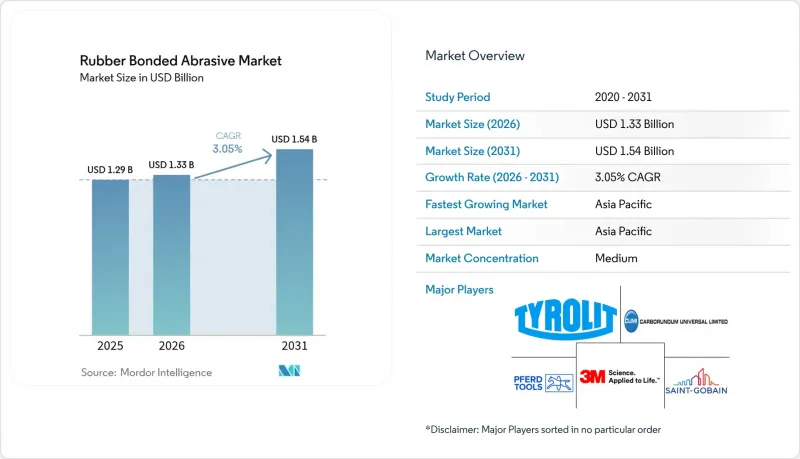
본 보고서는 제품 유형(휠, 포인트 및 스틱 등), 고무 유형(천연고무 등), 용도(기어, 베어링, 터빈 등), 최종 사용자 산업(산업기계, 자동차, 의료 등), 지역(아시아태평양, 북미, 유럽, 남미, 중동 및 아프리카)별로 분류되어 있습니다. 시장 예측은 금액(달러) 기준으로 제시되어 있습니다.
세계 고무 결합 연마재 시장 동향 및 인사이트
금속 및 철강 가공에 대한 수요 증가
인프라 및 조선용 강재 생산 능력 확대에 따라, 열 변형을 방지하기 위한 규격에 부합하는 연삭 공구에 대한 수요가 증가하고 있습니다. 고무 결합 휠은 유리질 휠이 파손될 수 있는 판재 연삭의 고압을 견딜 수 있습니다. 현재, 합성수지 강화 컴파운드를 통해 휠의 수명이 연장되어 생산성과 비용 관리의 균형이 잘 잡혀 있습니다. 북미와 유럽에서의 제조 현지화로 인해 구매자들이 수입 연마재의 대체품을 찾는 가운데, 새로운 수요 거점이 생겨나고 있습니다. 자동 연삭 라인에서는 마모를 예측하기 쉽고 무인 운전 가동 시간을 늘릴 수 있기 때문에 고무 결합 설계가 선호되고 있습니다.
자동차 OEM의 생산 능력 확대
세계 자동차 제조업체들은 파워트레인이나 배터리 하우징의 정밀한 마감이 필요한 전기차(EV) 프로그램에 대응하기 위해 생산 시설 확장을 추진하고 있습니다. 미세 입자 고무 결합 휠은 강철이나 알루미늄 부품에서 표면 아래 손상을 주지 않으면서 거울 같은 마감을 실현합니다. 유럽과 미국에서의 투자 발표는 연마 인프라의 장기적인 업그레이드를 시사합니다. 이 분야에서 경량 소재로의 전환 추세는 고무 결합 휠 수요를 뒷받침하고 있습니다. 이는 미세한 매개변수 변경만으로도 동일한 휠을 사용하여 강재에서 복합 소재로 가공 대상을 전환할 수 있기 때문입니다.
고무 및 VOC 배출에 관한 환경 규제
미국에서 제안된 ‘최대 달성 가능 제어 기술(MACT)’ 기준과 유럽의 ‘화학물질의 등록, 평가, 허가 및 제한(REACH)’ 규정의 강화로 인해 고무 컴파운더의 규정 준수 비용이 증가하고 있습니다. 각 제조업체는 저VOC 가황제를 사용한 배합 재검토를 진행하는 한편, 유해 대기 오염 물질을 포집하기 위한 열산화 장치에 투자하고 있습니다. 소규모 생산 업체에게는 자본 부담이 크게 가중되어 업계 재편이 가속화될 가능성이 있습니다. 현재 연구 개발의 우선순위는 배출량을 줄이면서도 탄력성을 유지하는 바이오 대체 소재에 맞추어져 있으며, 이를 조기에 도입한 기업들은 미래 성장을 위한 유리한 입지를 구축하고 있습니다.
부문 분석
2025년, 휠은 고무 결합 연마재 시장 규모의 47.72%를 차지하며, 대량 생산이 수반되는 중량 작업의 연마에 있어 필수적인 존재임을 보여주고 있습니다. 넓은 접촉면 덕분에 크랭크샤프트나 강판에서 신속한 절삭이 가능합니다. 포인트와 스틱은 생산량은 적지만, 전자기기 및 의료기기 제조 현장에서 정교한 부품의 마감에 핀포인트 수준의 정밀도가 요구되기 때문에 연평균 성장률(CAGR) 3.92%로 성장하고 있습니다. 블록과 부문은 형상의 유연성이 극히 중요한 터빈 블레이드의 뿌리 연마 등 틈새 용도로 사용되고 있습니다.
CNC 도입이 진행됨에 따라, 장기간에 걸친 사이클에서도 공차를 유지할 수 있는 형상 안정성이 높은 포인트에 대한 수요가 증가하고 있습니다. 휠 본체에 부문의 적응성을 통합한 하이브리드 휠 설계가 등장하여, 공구 교환 없이도 휠의 생산성과 포인트의 정교함을 동시에 실현할 수 있게 되었습니다.
지역별 분석
아시아태평양은 2025년 전 세계 고무 결합 연마재 시장 점유율의 39.25%를 차지하고 있으며, 2031년까지 연평균 성장률(CAGR) 4.02%를 나타낼 것으로 전망됩니다. 중국의 거대한 자동차, 전자기기, 기계 부문이 수요의 기반이 되고 있으며, 고품질 제조를 장려하는 국가 프로그램에 따라 정밀 연마 기준이 높아지고 있습니다. 일본의 선진 전자 산업에서는 고순도 연마석이 요구되고 있으며, 한국의 반도체 산업의 급속한 성장으로 인해 초정밀 포인트의 소비량이 증가하고 있습니다.
북미에서는 리쇼어링과 방위 분야 투자가 첨단 합금 가공이 가능한 특수 연마석의 채택을 뒷받침하고 있어 시장이 회복세를 보이고 있습니다. 특히 미국에서는 고무 결합 연마석의 성능 데이터를 공장 전체의 디지털 트윈에 통합하는 스마트 연삭 솔루션의 도입이 활발히 이루어지고 있습니다. 유럽에서는 수요가 견조한 추세를 보이고 있을 뿐만 아니라, 엄격한 환경 규제를 준수하기 위한 저VOC 배합 분야에서 선도적인 입지가 두드러지고 있습니다.
남미, 중동 및 아프리카는 생산량 면에서는 뒤처져 있지만, 성장 잠재력을 지니고 있습니다. 브라질 자동차 산업의 재건과 걸프 연안 국가들의 대규모 인프라 프로젝트가 헤비듀티용 연마재 조달을 뒷받침하고 있습니다. 세계 공급업체로부터의 기술 이전과 외국인 직접 투자가 맞물려 현지 마감 가공 역량의 기반이 구축되고 있으며, 이들 지역에서는 고무 결합 제품의 채택이 점차 확대될 전망입니다.
기타 혜택:
- 엑셀 형식 시장 예측(ME) 시트
- 3개월간의 애널리스트 지원
자주 묻는 질문
목차
제1장 서론
제2장 조사 방법
제3장 주요 요약
제4장 시장 구도
제5장 시장 규모와 성장 예측
제6장 경쟁 구도
제7장 시장 기회와 향후 전망
JHS 26.08.26According to Mordor Intelligence, the rubber bonded abrasive market size is expected to grow from USD 1.29 Billion in 2025 to USD 1.33 Billion in 2026 and is forecast to reach USD 1.54 Billion by 2031 at 3.05% CAGR over 2026-2031.
This report is Segmented by Product Type (Wheels, Points and Sticks, and More), Rubber Type (Natural Rubber and More), Application (Gears, Bearings, Turbines, and More), End-User Industry (Industrial Machinery, Automotive, Healthcare, and More), and Geography (Asia-Pacific, North America, Europe, South America, and Middle East and Africa). The Market Forecasts are Provided in Terms of Value (USD).
Global Rubber Bonded Abrasive Market Trends and Insights
Rising Demand for Metal and Steel Fabrication
Steel capacity additions for infrastructure and shipbuilding amplify the need for compliant grinding tools to prevent thermal distortion. Rubber bonded wheels withstand the high pressures of plate grinding, where vitrified alternatives can fracture. Synthetic-enhanced compounds now extend wheel life, balancing productivity with cost control. Localization of fabrication in North America and Europe opens new demand pockets as buyers seek alternatives to imported grains. Automated grinding lines favor rubber bonded designs because their predictable wear supports longer unattended runs .
Expanding Automotive OEM Production Capacities
Global automakers are enlarging facilities to serve electric vehicle programs that call for precise finishing of powertrain and battery housings. Fine-grit rubber bonded wheels deliver mirror finishes without subsurface damage on steel and aluminum components. Investment announcements in Europe and the United States point to long-term grinding infrastructure upgrades. The segment's tilt toward lightweight materials enhances rubber bonded traction because the same wheel can shift from steel to composites with minor parameter changes.
Environmental Regulations on Rubber and VOC Emissions
Proposed United States Maximum Achievable Control Technology (MACT) standards and tighter European Registration, Evaluation, Authorization and Restriction of Chemicals (REACH) rules are elevating compliance costs for rubber compounders. Manufacturers are reformulating with low-VOC curatives and investing in thermal oxidizers to capture hazardous air pollutants. Small producers may struggle with the capital burden, accelerating consolidation. R&D pipelines now prioritize bio-based alternatives that maintain elasticity while reducing emissions, positioning early adopters for future growth .
Other drivers and restraints analyzed in the detailed report include:
- Process-automation and CNC Integration Boosting Productivity
- Rapid Uptake in 3D-Printed Metal Finishing
- Raw-material Price Volatility
For complete list of drivers and restraints, kindly check the Table Of Contents.
Segment Analysis
Wheels represented 47.72% of the Rubber Bonded Abrasive market size in 2025, reflecting their indispensability in high-volume heavy-duty grinding. Their broad contact surface supports rapid stock removal on crankshafts and steel plates. Points and sticks, although smaller in volume, are climbing at 3.92% CAGR as electronics and medical plants require pinpoint accuracy for finishing delicate parts. Blocks and segments serve niche applications such as turbine blade root grinding where geometry flexibility is paramount.
CNC adoption is reinforcing demand for shape-stable points that uphold tolerances across extended cycles. Hybrid wheel designs that integrate segment adaptability within a wheel body are emerging, offering shops the productivity of wheels and the finesse of points without tool changeovers.
Complete Report Scope:
- By Product Type
- Wheels
- Points and Sticks
- Blocks and Segments
- Others
- By Rubber Type
- Natural Rubber
- Nitrile (NBR)
- Neoprene
- Other Rubber Types (Silicone, etc.)
- By Application
- Powertrain
- Gears
- Bearings
- Turbines
- Other Applications (Cutting and Forming Tools, etc.)
- By End-user Industry
- Industrial Machinery
- Automotive
- Electrical and Electronics
- Healthcare
- Other End-user Industries (Aerospace, etc.)
- By Geography
- Asia-Pacific
- China
- Japan
- India
- South Korea
- ASEAN Countries
- Rest of Asia-Pacific
- North America
- United States
- Canada
- Mexico
- Europe
- Germany
- United Kingdom
- France
- Italy
- Spain
- Russia
- NORDIC Countries
- Rest of Europe
- South America
- Brazil
- Argentina
- Rest of South America
- Middle East and Africa
- Saudi Arabia
- South Africa
- Rest of Middle East and Africa
- Asia-Pacific
Geography Analysis
Asia-Pacific accounted for 39.25% of the Global Rubber Bonded Abrasive market share in 2025 and is on course for 4.02% CAGR to 2031. China's vast automotive, electronics, and machinery sectors anchor demand, while national programs encouraging high-quality manufacturing are elevating precision grinding standards. Japan's advanced electronics industry requires high-purity wheels, and South Korea's semiconductor surge is lifting ultra-precision point consumption.
North America is witnessing a rebound as reshoring and defense investments spur the adoption of specialty wheels capable of processing advanced alloys. The United States is particularly active in integrating smart grinding solutions that tie rubber bonded wheel performance data into plant-wide digital twins. Europe shows steady demand but stands out for its leadership in low-VOC formulations to comply with stringent environmental frameworks.
South America and the Middle East and Africa trail in volume yet present upside potential. Brazil's automotive rebuild and Gulf infrastructure megaprojects are spurring procurement of heavy-duty wheels. Technology transfer from global suppliers, coupled with foreign direct investment, is laying the foundation for local finishing capacity, positioning these regions for incremental uptake of rubber bonded products.
- 3M
- ABRASIVOS MANHATTAN S.A.
- Atto Abrasive Ltd.
- Buehler
- Buffalo Abrasives, Inc.
- CUMI.
- KINIK COMPANY
- Klingspor Abrasives, Inc.
- Marrose Abrasives
- Osborn
- Pacer Industries Inc.
- PFERD INC.
- Saint-Gobain
- Schwarzhaupt GmbH & Co. KG
- Tyrolit - Schleifmittelwerke Swarovski AG & Co KG
Additional Benefits:
- The market estimate (ME) sheet in Excel format
- 3 months of analyst support
TABLE OF CONTENTS
1 Introduction
- 1.1 Study Assumptions and Market Definition
- 1.2 Scope of the Study
2 Research Methodology
3 Executive Summary
4 Market Landscape
- 4.1 Market Overview
- 4.2 Market Drivers
- 4.2.1 Rising Demand for Metal and Steel Fabrication
- 4.2.2 Expanding Automotive OEM Production Capacities
- 4.2.3 Process-automation and CNC Integration Boosting Productivity
- 4.2.4 Rapid Uptake in 3D-printed Metal Finishing
- 4.2.5 Increase in Electronics and Semiconductors Manufacturing
- 4.3 Market Restraints
- 4.3.1 Environmental Regulations on Rubber and VOC Emissions
- 4.3.2 Raw-material Price Volatility
- 4.3.3 Shift Toward Super-abrasives in Precision Grinding
- 4.4 Value Chain Analysis
- 4.5 Porter's Five Forces
- 4.5.1 Threat of New Entrants
- 4.5.2 Bargaining Power of Buyers
- 4.5.3 Bargaining Power of Suppliers
- 4.5.4 Threat of Substitute Products
- 4.5.5 Degree of Competition
5 Market Size and Growth Forecasts (Value)
- 5.1 By Product Type
- 5.1.1 Wheels
- 5.1.2 Points and Sticks
- 5.1.3 Blocks and Segments
- 5.1.4 Others
- 5.2 By Rubber Type
- 5.2.1 Natural Rubber
- 5.2.2 Nitrile (NBR)
- 5.2.3 Neoprene
- 5.2.4 Other Rubber Types (Silicone, etc.)
- 5.3 By Application
- 5.3.1 Powertrain
- 5.3.2 Gears
- 5.3.3 Bearings
- 5.3.4 Turbines
- 5.3.5 Other Applications (Cutting and Forming Tools, etc.)
- 5.4 By End-user Industry
- 5.4.1 Industrial Machinery
- 5.4.2 Automotive
- 5.4.3 Electrical and Electronics
- 5.4.4 Healthcare
- 5.4.5 Other End-user Industries (Aerospace, etc.)
- 5.5 By Geography
- 5.5.1 Asia-Pacific
- 5.5.1.1 China
- 5.5.1.2 Japan
- 5.5.1.3 India
- 5.5.1.4 South Korea
- 5.5.1.5 ASEAN Countries
- 5.5.1.6 Rest of Asia-Pacific
- 5.5.2 North America
- 5.5.2.1 United States
- 5.5.2.2 Canada
- 5.5.2.3 Mexico
- 5.5.3 Europe
- 5.5.3.1 Germany
- 5.5.3.2 United Kingdom
- 5.5.3.3 France
- 5.5.3.4 Italy
- 5.5.3.5 Spain
- 5.5.3.6 Russia
- 5.5.3.7 NORDIC Countries
- 5.5.3.8 Rest of Europe
- 5.5.4 South America
- 5.5.4.1 Brazil
- 5.5.4.2 Argentina
- 5.5.4.3 Rest of South America
- 5.5.5 Middle East and Africa
- 5.5.5.1 Saudi Arabia
- 5.5.5.2 South Africa
- 5.5.5.3 Rest of Middle East and Africa
- 5.5.1 Asia-Pacific
6 Competitive Landscape
- 6.1 Market Concentration
- 6.2 Strategic Moves
- 6.3 Market Share(%)/Ranking Analysis
- 6.4 Company Profiles (includes Global level Overview, Market level overview, Core Segments, Financials, Strategic Information, Market Rank/Share, Products and Services, Recent Developments)
- 6.4.1 3M
- 6.4.2 ABRASIVOS MANHATTAN S.A.
- 6.4.3 Atto Abrasive Ltd.
- 6.4.4 Buehler
- 6.4.5 Buffalo Abrasives, Inc.
- 6.4.6 CUMI.
- 6.4.7 KINIK COMPANY
- 6.4.8 Klingspor Abrasives, Inc.
- 6.4.9 Marrose Abrasives
- 6.4.10 Osborn
- 6.4.11 Pacer Industries Inc.
- 6.4.12 PFERD INC.
- 6.4.13 Saint-Gobain
- 6.4.14 Schwarzhaupt GmbH & Co. KG
- 6.4.15 Tyrolit - Schleifmittelwerke Swarovski AG & Co KG
7 Market Opportunities and Future Outlook
- 7.1 White-space and Unmet-need Assessment
- 7.2 Biodegradable and Recyclable Rubber Materials


