

|
시장보고서
상품코드
2114881
세라믹 기판 시장 : 점유율 분석, 업계 동향과 통계, 성장 예측(2026-2031년)Ceramic Substrate - Market Share Analysis, Industry Trends & Statistics, Growth Forecasts (2026 - 2031) |
||||||
 Mordor Intelligence
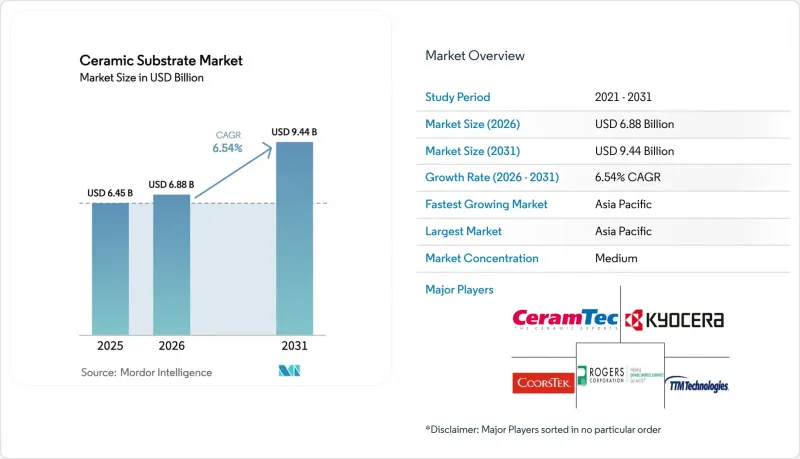
Mordor Intelligence에 의하면, 세라믹 기판 시장 규모는 2025년 64억 5,000만 달러, 2026년 68억 8,000만 달러에서 2031년까지 94억 4,000만 달러로 확대되어 2026년부터 2031년까지 CAGR 6.54%를 나타낼 것으로 예측됩니다.
본 보고서는 유형(알루미나, 질화알루미늄, 질화규소, 산화베릴륨 등), 제조 공정(HTCC, LTCC, DBC, AMB), 최종 사용자 산업(소비자 가전, 자동차, 반도체, 통신 등),및 지역(아시아태평양, 북미, 유럽, 남미, 중동 및 아프리카)별로 분류되어 있습니다. 시장 전망은 금액(달러) 기준으로 제시되어 있습니다.
세계 세라믹 기판 시장 동향 및 인사이트
고출력 전자기기를 구현하는 우수한 열전도율
설계자들은 현재 열전도율을 부차적인 사양이 아닌 주요 제약 조건으로 다루고 있습니다. 실리콘 카바이드(SiC) MOSFET 및 질화 갈륨(GaN) HEMT는 최대 225°C의 접합 온도에서 작동하며, 300 W/cm²를 초과하는 국부적인 열유속을 발생시킵니다. 이는 에폭시 수지계 적층 기판의 안전 한계를 훨씬 초과하는 수치입니다. 170-250 W/m*K의 열전도율을 자랑하는 질화알루미늄 기판은 방열판의 부피를 35% 줄이고, 액체 냉각제의 유량을 감소시킴으로써 시스템 전체의 효율을 2-3% 향상시킵니다. 직접 본딩 구리(DBC) 방식에서는 접착층이 필요 없기 때문에 열저항을 0.1 K*cm²/W 낮추고, 자동차용 트랙션 인버터에서 200 A/cm²의 전류 밀도를 실현합니다. 또한, SiC 웨이퍼의 직경을 150 mm에서 200 mm로 확대하기 위한 여러 기업의 투자로 인해 세라믹 기판 시장은 더욱 확대될 전망입니다.
EV용 인버터 및 차량용 충전기의 급속한 보급으로 인해 사용량이 증가하고 있습니다.
배터리식 전기자동차(BEV)는 800V 아키텍처가 표준화되고 있으며, 이에 따라 1,200V를 초과하는 과도 전압과 -40°C에서 150°C의 온도 범위에서 20만 사이클에 달하는 열 사이클이 부과됩니다. 이러한 조건에 대응하기 위해 자동차 제조업체들은 FR-4 기판을 파손시킬 수 있는 부하나 밀리초 단위의 회생 제동 극성 반전에도 견딜 수 있는 DBC 기판을 채택하고 있습니다. 질화 알루미늄 기판 위의 실리콘 카바이드 다이오드를 통해 차량용 충전기의 효율이 98%로 향상되고, 냉각 시스템의 무게를 20% 줄임으로써 차량의 주행 거리가 연장됩니다. 교세라가 나가사키에 4억 5,400만 달러를 투자하여 추진하는 확장 계획에 따라, 2026년 말까지 자동차용 기판의 생산 능력은 2배로 늘어날 것입니다. 모듈 비용의 하락에 따라 프리미엄 부문에서의 보급률은 이미 80%를 넘어섰고, 주류 시장에서의 채택도 비용 하락 곡선에 따라 진행되고 있어 세라믹 기판 시장에 대한 수요는 확고해졌습니다.
금속 및 유기 기판에 비해 높은 가격 프리미엄
단가는 1제곱인치당 2-10달러 범위인 반면, FR-4는 0.10-0.50달러로 5-20배의 가격 차이가 있어 많은 민간용 기기에의 채택이 저해되고 있습니다. 비용의 60%를 알루미나 분말과 메탈라이제이션이 차지하고, 수율 저하가 추가로 15%를 차지하고 있어 공정 혁신 없이는 가격 인하 여지가 거의 없습니다. 2024년부터 2025년까지 일시적인 공급 부족으로 인해 가격이 최대 20% 상승했고, 일부 휴대폰 제조업체들은 금속 코어 PCB로 되돌아갈 수밖에 없었습니다. 고열유속 부품 아래에만 세라믹을 배치하는 하이브리드 조립 방식에서는 열적 이점의 대부분을 유지하면서 기판 비용을 30% 절감할 수 있습니다.
부문 분석
2025년에는 비용 효율을 중시하는 소비자용 전자기기 및 산업용 드라이브를 주축으로, 알루미나(alumina)가 세라믹 기판 시장 점유율의 44.18%를 차지했습니다. 한편, 실리콘 카바이드 기판은 열팽창 계수의 불일치를 0.5 ppm/K 미만으로 억제해야 하는 항공우주용 레이더 및 차세대 EV 인버터에 힘입어 2031년까지 연평균 성장률(CAGR) 7.80%로 성장할 전망입니다. 열전도율 170-250 W/m*K를 가진 질화알루미늄은 작동 접합부 온도가 175°C를 초과하는 800V급 EV 플랫폼에서 채택이 확대되고 있습니다.
평균 판매 가격이 알루미나 제품 대비 3-5배 높은 수준을 유지하고 있어, 매출 성장에 있어 고급 소재에 유리하게 작용하고 있습니다. Coherent, DENSO, 미쓰비시 전기가 200mm SiC 웨이퍼 생산 라인에 10억 달러를 투자하는 가운데, 호환 가능한 기판에 대한 하류 수요가 가속화되어 세라믹 기판 시장 규모 구성을 완전히 바꿀 것으로 보입니다. 알루미나(Alumina)는 2031년까지 LED 및 스마트폰의 전원 관리 IC 분야에서 수량 면에서의 우위를 유지할 전망이지만, 통신 및 데이터센터 설계자들이 유전 손실 감소를 목적으로 AlN으로 전환함에 따라 매출 점유율은 하락할 것입니다.
지역별 분석
아시아태평양은 2025년에 매출의 46.61%를 차지하며, 2024년 중국의 전기차 생산 대수가 900만 대를 돌파한 것과, 2027년도까지 반투명 알루미나 웨이퍼 생산 능력을 3배로 확대하겠다는 일본의 노력에 힘입어, 2031년까지 연평균 성장률(CAGR) 7.09%를 나타낼 것으로 예측됩니다. 2026년 말 완공을 예정하고 있는 교세라의 나가사키 복합 시설에서는 SiC 기판과 첨단 패키징 생산 라인을 동일한 거점에 집약함으로써 리드 타임을 30% 단축하고, 지역의 자급자족을 강화할 예정입니다.
2025년 북미 시장 점유율 확대는 -55-125°C 범위에서 작동하는 위상 배열 레이더용 AlN 기판을 지정하는 방위·우주 프로그램이 주도했습니다. ‘인플레이션 억제법’에 따른 청정 에너지 우대 조치가 국내 인버터 조립을 뒷받침하고 있어, 아시아에 비해 전기차 보급 속도가 둔화되고 있는 영향을 완화하고 있습니다.
유럽에서는 에너지 가격 급등으로 인해 알루미나 소결 비용이 아시아태평양에 비해 25% 상승했으나, EU의 탄소국경조정메커니즘(CBAM)에 따라 CO2 1톤당 90달러 상당의 관세가 단계적으로 도입됨에 따라, 각 OEM 기업들은 하이드로(Hydro)사의 ‘HalZero’와 같은 저탄소 알루미나로의 전환을 강요받고 있으며, 재활용 가능한 기판에 대한 지역 수요가 증가하고 있습니다. 남미 및 중동 및 아프리카의 기여도는 여전히 10% 미만에 그치고 있습니다. 브라질의 ‘솔라 벨트’와 사우디아라비아의 스마트 시티 ‘NEOM’에서 진행 중인 프로젝트가 틈새 수요를 지탱하고 있지만, 수입 의존도가 높아 운송 비용이 최대 25% 상승하면서 해당 지역의 세라믹 기판 시장 확대를 제한하고 있습니다.
기타 혜택:
- 엑셀 형식 시장 예측(ME) 시트
- 3개월간의 애널리스트 지원
자주 묻는 질문
목차
제1장 서론
제2장 조사 방법
제3장 주요 요약
제4장 시장 구도
제5장 시장 규모와 성장 예측
제6장 경쟁 구도
제7장 시장 기회와 향후 전망
JHS 26.08.26According to Mordor Intelligence, the ceramic substrate market size is projected to expand from USD 6.45 billion in 2025 and USD 6.88 billion in 2026 to USD 9.44 billion by 2031, registering a CAGR of 6.54% between 2026 to 2031.
This report is Segmented by Type (Alumina, Aluminum Nitride, Silicon Nitride, Beryllium Oxide, and More), Manufacturing Process (HTCC, LTCC, DBC, and AMB), End-User Industry (Consumer Electronics, Automotive, Semiconductor, Telecommunications, and More), and Geography (Asia-Pacific, North America, Europe, South America, and Middle East and Africa). Market Forecasts are Provided in Terms of Value (USD).
Global Ceramic Substrate Market Trends and Insights
Superior Thermal Conductivity Enabling High-Power Electronics
Designers now treat thermal conductivity as a primary constraint rather than a secondary specification. Silicon-carbide MOSFETs and gallium-nitride HEMTs run at junction temperatures up to 225°C, generating local heat fluxes that top 300 W/cm2, well beyond the safe envelope for epoxy-based laminates. Aluminum-nitride substrates, offering 170-250 W/m*K, cut heat-sink volume by 35% and trim liquid-coolant flow rates, improving full-system efficiency by 2-3%. Direct-bonded-copper (DBC) variants eliminate adhesive layers, slicing thermal resistance by 0.1 K*cm2/W and allowing current densities of 200 A/cm2 in automotive traction inverters. Multi-company investments that will lift global SiC wafer output from 150-mm to 200-mm diameters further expand the ceramic substrate market.
Rapid EV Inverter and On-Board-Charger Build-Out Increasing Usage
Battery-electric vehicles are standardizing on 800-V architectures, which impose voltage transients above 1,200 V and thermal cycling from -40°C to 150°C over 200,000 cycles. To meet these conditions, automakers integrate DBC substrates that handle regenerative-braking reversals within milliseconds, loads that fracture FR-4 boards. Silicon-carbide diodes on aluminum-nitride bases lift on-board-charger efficiency to 98% and shave cooling-system mass by 20%, extending vehicle range. Kyocera's USD 454 million Nagasaki build-out will double automotive-grade substrate capacity by late 2026. As module costs fall, premium-segment penetration already exceeds 80%, and mainstream adoption is tracking downward cost curves, cementing demand for the ceramic substrate market.
High Price Premium Over Metal/Organic Boards
Unit prices range from USD 2 to USD 10 per square inch versus USD 0.10-0.50 for FR-4, a 5-to-20-fold spread that shuts entry into many consumer devices. Raw alumina powder and metallization account for 60% of the cost, while yield loss contributes another 15%, leaving scant room for markdowns without process innovation. Temporary shortages in 2024-2025 inflated prices by up to 20%, compelling some handset makers to revert to metal-core PCBs. Hybrid assemblies that place ceramic only under high-heat-flux components cut substrate spend by 30% while retaining most thermal benefit.
Other drivers and restraints analyzed in the detailed report include:
- 5G Base-Station and RF Module Densification
- SiC/GaN Migration Requiring AlN and DBC Substrates
- Fragility and Yield Losses During Assembly
For complete list of drivers and restraints, kindly check the Table Of Contents.
Segment Analysis
Alumina delivered 44.18% of the ceramic substrate market share in 2025, anchored by cost-sensitive consumer electronics and industrial drives. At the same time, silicon carbide substrates expanded 7.80% CAGR through 2031, propelled by aerospace radars and next-generation EV inverters that require coefficient-of-thermal-expansion mismatches below 0.5 ppm/K. Aluminum nitride, with 170-250 W/m*K conductivity, is gaining traction in 800-V EV platforms where operating junctions exceed 175°C.
Revenue momentum favors premium materials because average selling prices remain three to five times higher than alumina equivalents. As Coherent, DENSO, and Mitsubishi Electric pour USD 1 billion into 200-mm SiC wafer lines, downstream demand for compatible substrates will accelerate, reshaping the ceramic substrate market size profile. Alumina will keep its volume edge through 2031 in LEDs and smartphone power-management ICs, yet its revenue share will slip as telecom and data-center designers upgrade to AlN for lower dielectric loss.
Complete Report Scope:
- By Type
- Alumina
- Aluminum Nitride
- Silicon Nitride
- Beryllium Oxide
- Other Types (Cordierite andSilicon Carbide)
- By Manufacturing Process
- High-Temperature Co-Fired Ceramic (HTCC)
- Low-Temperature Co-Fired Ceramic (LTCC)
- Direct Bonded Copper (DBC)
- Active Metal Brazed (AMB)
- By End-User Industry
- Consumer Electronics
- Automotive
- Aerospace & Defense
- Semiconductor
- Telecommunications
- Other End-user Industries (Industrial Power & Renewable Energy, and Medical Devices)
- By Geography
- Asia-Pacific
- China
- India
- Japan
- South Korea
- Vietnam
- Malaysia
- Indonesia
- Thailand
- Rest of Asia-Pacific
- North America
- United States
- Canada
- Mexico
- Europe
- Germany
- United Kingdom
- France
- Italy
- Russia
- Turkey
- Spain
- NORDIC Countries
- Rest of Europe
- South America
- Brazil
- Argentina
- Colombia
- Rest of South America
- Middle East and Africa
- Saudi Arabia
- South Africa
- Qatar
- Nigeria
- United Arab Emirates
- Rest of Middle East and Africa
- Asia-Pacific
Geography Analysis
Asia-Pacific contributed 46.61% of revenue in 2025 and is expected to post a 7.09% CAGR through 2031, buoyed by Chinese EV output topping 9 million units in 2024 and Japanese initiatives to triple translucent-alumina wafer capacity by fiscal 2027. Kyocera's Nagasaki complex, slated for late 2026 completion, will co-locate SiC substrate and advanced packaging lines, cutting lead times by 30% and reinforcing regional self-sufficiency.
North America's 2025 share was driven by defense and space programs that specify AlN substrates for phased-array radars operating across -55°C to 125°C. The Inflation Reduction Act's clean-energy incentives underpin domestic inverter assembly, cushioning slower EV penetration relative to Asia.
In Europe, high energy prices inflate alumina sintering costs by 25% versus Asia-Pacific, but the EU Carbon Border Adjustment Mechanism, phasing in USD 90-equivalent tariffs per ton of CO2, nudges OEMs toward low-carbon alumina such as Hydro's HalZero, lifting regional demand for recyclable substrates. South America and the Middle East & Africa remain sub-10% contributors; projects in Brazil's solar belt and Saudi Arabia's NEOM smart-city keep niche demand alive, yet import reliance raises landed cost by up to 25%, limiting the ceramic substrate market's expansion there.
- CeramTec GmbH
- CoorsTek Inc.
- Corning Incorporated
- Denka Company Limited
- Heraeus Electronics
- KOA Speer Electronic, Inc.
- KYOCERA Corporation
- LEATEC
- MARUWA Co., Ltd.
- NEOTech
- NIPPON CARBIDE INDUSTRIES CO., INC.
- Niterra Materials Co., Ltd.
- Ortech, Inc.
- Rogers Corporation
- TTM Technologies Inc.
- Yokowo Co., Ltd.
Additional Benefits:
- The market estimate (ME) sheet in Excel format
- 3 months of analyst support
TABLE OF CONTENTS
1 Introduction
- 1.1 Study Assumptions & Market Definition
- 1.2 Scope of the Study
2 Research Methodology
3 Executive Summary
4 Market Landscape
- 4.1 Market Overview
- 4.2 Market Drivers
- 4.2.1 Superior thermal conductivity driving the demand for ceramic substrates in high-power electronics
- 4.2.2 Rapid EV inverter & on-board-charger build-out increasing ceramic substarte usage
- 4.2.3 5G base-station and RF module densification
- 4.2.4 SiC/GaN migration requiring AlN & DBC substrates
- 4.2.5 Aerospace CubeSat miniaturisation needs LTCC
- 4.3 Market Restraints
- 4.3.1 High price premium over metal/organic boards
- 4.3.2 Fragility & yield losses during assembly
- 4.3.3 Toxic-exposure limits on BeO
- 4.4 Value Chain Analysis
- 4.5 Porter's Five Forces
- 4.5.1 Threat of New Entrants
- 4.5.2 Bargaining Power of Suppliers
- 4.5.3 Bargaining Power of Buyers
- 4.5.4 Threat of Substitutes
- 4.5.5 Degree of Competition
5 Market Size & Growth Forecasts (Value)
- 5.1 By Type
- 5.1.1 Alumina
- 5.1.2 Aluminum Nitride
- 5.1.3 Silicon Nitride
- 5.1.4 Beryllium Oxide
- 5.1.5 Other Types (Cordierite andSilicon Carbide)
- 5.2 By Manufacturing Process
- 5.2.1 High-Temperature Co-Fired Ceramic (HTCC)
- 5.2.2 Low-Temperature Co-Fired Ceramic (LTCC)
- 5.2.3 Direct Bonded Copper (DBC)
- 5.2.4 Active Metal Brazed (AMB)
- 5.3 By End-User Industry
- 5.3.1 Consumer Electronics
- 5.3.2 Automotive
- 5.3.3 Aerospace & Defense
- 5.3.4 Semiconductor
- 5.3.5 Telecommunications
- 5.3.6 Other End-user Industries (Industrial Power & Renewable Energy, and Medical Devices)
- 5.4 By Geography
- 5.4.1 Asia-Pacific
- 5.4.1.1 China
- 5.4.1.2 India
- 5.4.1.3 Japan
- 5.4.1.4 South Korea
- 5.4.1.5 Vietnam
- 5.4.1.6 Malaysia
- 5.4.1.7 Indonesia
- 5.4.1.8 Thailand
- 5.4.1.9 Rest of Asia-Pacific
- 5.4.2 North America
- 5.4.2.1 United States
- 5.4.2.2 Canada
- 5.4.2.3 Mexico
- 5.4.3 Europe
- 5.4.3.1 Germany
- 5.4.3.2 United Kingdom
- 5.4.3.3 France
- 5.4.3.4 Italy
- 5.4.3.5 Russia
- 5.4.3.6 Turkey
- 5.4.3.7 Spain
- 5.4.3.8 NORDIC Countries
- 5.4.3.9 Rest of Europe
- 5.4.4 South America
- 5.4.4.1 Brazil
- 5.4.4.2 Argentina
- 5.4.4.3 Colombia
- 5.4.4.4 Rest of South America
- 5.4.5 Middle East and Africa
- 5.4.5.1 Saudi Arabia
- 5.4.5.2 South Africa
- 5.4.5.3 Qatar
- 5.4.5.4 Nigeria
- 5.4.5.5 United Arab Emirates
- 5.4.5.6 Rest of Middle East and Africa
- 5.4.1 Asia-Pacific
6 Competitive Landscape
- 6.1 Market Concentration
- 6.2 Strategic Moves
- 6.3 Market Share(%)/Ranking Analysis
- 6.4 Company Profiles (includes Global level Overview, Market level overview, Core Segments, Financials as available, Strategic Information, Market Rank/Share for key companies, Products & Services, and Recent Developments)
- 6.4.1 CeramTec GmbH
- 6.4.2 CoorsTek Inc.
- 6.4.3 Corning Incorporated
- 6.4.4 Denka Company Limited
- 6.4.5 Heraeus Electronics
- 6.4.6 KOA Speer Electronic, Inc.
- 6.4.7 KYOCERA Corporation
- 6.4.8 LEATEC
- 6.4.9 MARUWA Co., Ltd.
- 6.4.10 NEOTech
- 6.4.11 NIPPON CARBIDE INDUSTRIES CO., INC.
- 6.4.12 Niterra Materials Co., Ltd.
- 6.4.13 Ortech, Inc.
- 6.4.14 Rogers Corporation
- 6.4.15 TTM Technologies Inc.
- 6.4.16 Yokowo Co., Ltd.
7 Market Opportunities & Future Outlook
- 7.1 White-space & Unmet-Need Assessment
- 7.2 CBAM pushes EU OEMs to recyclable alumina


