

|
시장보고서
상품코드
2114883
저온 유동성 향상제 시장 : 시장 점유율 분석, 업계 동향 및 통계, 성장 예측(2026-2031년)Cold Flow Improver - Market Share Analysis, Industry Trends & Statistics, Growth Forecasts (2026 - 2031) |
||||||
 Mordor Intelligence
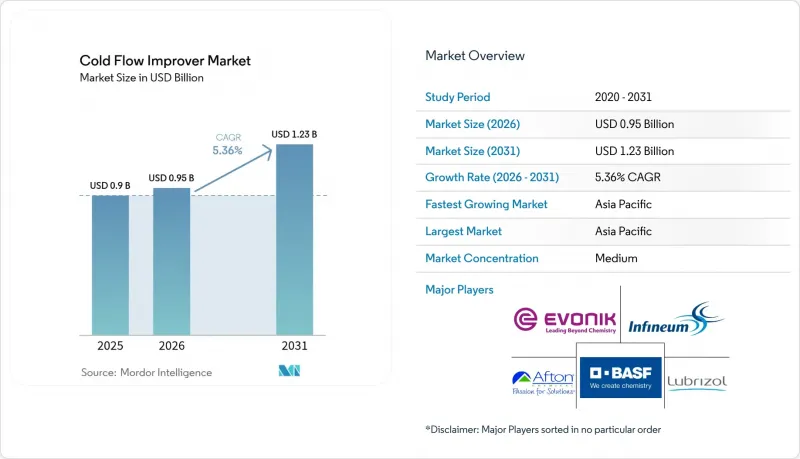
Mordor Intelligence에 의하면, 2026년 저온 유동성 향상제 시장 규모는 9억 5,000만 달러로 추정되고, 2025년 9억 달러에서 확대해, 2031년에는 12억 3,000만 달러에 이를 것으로 예측됩니다.
2026-2031년 연평균 성장률(CAGR)은 5.36%를 나타낼 전망입니다.
본 보고서는 유형별(폴리아릴메타크릴레이트, 에틸렌-비닐아세테이트, 폴리알파올레핀, 기타), 최종 사용자 산업별(자동차, 항공우주 및 방위, 기타), 연료 및 용도별(디젤, 바이오디젤, 항공유, 윤활유, 기타), 지역별(아시아태평양, 북미, 유럽, 남미, 중동 및 아프리카)로 분류되어 있습니다. 시장 예측은 금액(달러)으로 표시되어 있습니다.
세계의 저온 유동성 향상제 시장 동향 및 인사이트
초저황 디젤 및 동계용 연료에 대한 수요 증가
미국에서는 15ppm, 중국에서는 10mg/kg인 초저유황 디젤 연료의 경우, 유황계 천연 윤활제가 제거되기 때문에 저온에서 왁스 결정화가 진행되기 쉽습니다. 따라서 겨울용 디젤 연료에서는 폴리머계 유동점 저하제를 사용하여 혼탁점(클라우드 포인트)을 지역 규격 이하로 유지해야 합니다. 알래스카 농촌 지역에서 실시된 현장 조사에 따르면, 초저유황 디젤(ULSD)로의 전환에 따라 가구당 연간 연료비가 209달러 증가했으며, 이는 효과적인 저온 유동성 향상제 도입이 가져다주는 경제적 가치를 여실히 보여주고 있습니다. 북극위원회의 2024년 저유황 연료 이니셔티브는 향후 물류 계약에서 첨가제가 혼합된 연료 사용이 지정될 것임을 더욱 시사하고 있습니다.
바이오연료의 급속한 보급에 따른 고도화된 탄소 농업 이니셔티브(CFI)에 대한 요구
바이오디젤에 포함된 포화지방산으로 인해 혼탁점이 향상됨에 따라, 정제 업체들은 저온 유동성 향상제의 화학 조성을 조정할 수밖에 없게 되었습니다. 실험실 연구에 따르면, 폴리메틸아크릴레이트는 원료에 따라 결과는 다르지만, 바이오디젤의 유동점을 8°C, 저온 필터 막힘점을 6°C 낮출 수 있는 것으로 나타났습니다. 토탈에너지와 중국석유화공(SINOPEC)이 공동으로 추진하는 연간 23만 톤 규모의 지속가능 항공연료(SAF) 사업은 첨가제가 포함된 바이오연료의 유통 규모가 확대되고 있음을 보여주는 좋은 예입니다. 캘리포니아주의 저탄소 연료 기준(LCFS) 2024년 개정에 따라, 연료 공급업체는 겨울철 성능을 유지하면서 바이오 혼합 비율을 높여야 할 의무가 부과됨에 따라, 특수한 탄소 농업 이니셔티브(CFI)의 필요성이 더욱 커지고 있습니다.
전기차·수소연료전지차의 인기 급증
전기자동차의 보급은 저온 유동성 향상제 수요에 있어 가장 중대한 장기적 위협이 되고 있습니다. 국제에너지기구(IEA)는 2027년까지 승용 전기차(EV) 등록 대수가 3,000만 대에 육박할 것으로 예측하고 있으며, 이로 인해 도시 지역 차량 함대에서의 디젤 연료 수요가 감소할 전망입니다. 대형 차량 부문은 뒤처져 있지만 여전히 전동화의 길을 걷고 있으며, 2030년까지 전 세계 트럭 판매 대수의 18%에 달할 가능성이 있습니다. 한랭 지역에서는 도입이 늦어지겠지만, 내연기관 차량에서 전기 차량으로의 전환이 1% 진행될 때마다 저온 유동성 향상제 시장의 장기적인 판매 기반은 축소될 것입니다.
부문 분석
에틸렌 비닐 아세테이트(EVA)는 석유 디젤 및 바이오디젤 혼합 연료 모두와 호환성이 입증되었기 때문에 2025년 저온 유동성 향상제 시장에서 31.12%의 점유율을 유지했습니다. 그러나 폴리아릴 메타크릴레이트(PAMA)는 바이오디젤의 유동점(pour point)을 최대 8°C 낮출 수 있다는 사실이 연구를 통해 확인됨에 따라 연평균 성장률(CAGR) 5.63%로 점유율을 급속히 확대하고 있으며, 이러한 장점 덕분에 재생 가능 연료 시장에서의 침투가 진행되고 있습니다. 폴리알파올레핀 및 신흥 나노 복합재료 첨가제는 항공 연료나 북극권산 원유 스트림 등 유동점 목표가(-40)°C 미만인 틈새 시장에서 중요한 역할을 하고 있습니다. 바이오디젤 및 지속 가능한 항공 연료의 혼합 비율이 증가함에 따라, 2030년 이후 EVA의 우위를 위협할 수 있는 지속적인 대체 가능성이 확실시되고 있습니다.
PAMA 공급업체들은 혼합 원료 유래의 지방산 메틸 에스테르(FAME)에서 발생하는 결정화를 미세하게 조절하기 위해 모듈식 고분자 사슬 개발을 추진하고 있는 반면, EVA 제조업체들은 저온 효율을 회복하기 위해 공중합체 구조에 주력하고 있습니다. 현재 경쟁사와의 차별화는 다중 연료 시스템에서의 성능, 장기 저장 후 여과성 유지, 윤활성 향상제와 첨가제 간의 시너지 효과에 달려 있습니다.
지역별 분석
아시아태평양의 저온 유동성 향상제 시장은 2025년에 35.33%라는 최대 점유율을 차지했습니다. 이는 중국 북부의 겨울철 디젤 수요와 인도, 한국, 일본의 산업 확장에 힘입은 결과입니다. 지역별 기준에 따라 황 함량이 감소하고 바이오 혼합 상한선이 상향 조정됨에 따라 정유사들은 더 높은 처리율을 지정하고 있습니다. BASF와 루브리졸의 투자는 현지 배합 개발 및 연료 판매업체를 위한 리드타임 단축을 뒷받침하고 있습니다.
북미는 기온이 -40°C 아래로 떨어지는 캐나다 프레리 지역에서 알래스카의 노스슬로프 유전에 이르기까지, 겨울철 가동성과 관련된 과제의 전형적인 사례로 남아 있습니다. 개정된 캐나다의 바이오디젤 지침은 상황을 더욱 복잡하게 만들고 있는 반면, 미국의 북극권 과학 관측소에서는 제트 연료의 응고점을(-60)°C 부근으로 지정하고 있습니다. 이러한 극한 환경이 고부하형 응고점 강하제의 안정적인 프리미엄 부문을 뒷받침하고 있습니다.
유럽에서는 10% FAME 디젤의 도입과 재생 가능 연료에 대한 정책적 중점이 디젤 총 소비량이 정체된 상황에서도 첨가제 시장의 성장을 뒷받침하고 있습니다. 북유럽 국가들은 기술의 한계에 직면하여, 군용 및 민간 차량의 운행을 유지하기 위한 유동점 개선 솔루션을 모색하고 있습니다. 남유럽의 온화한 기후에서는 계절적 수요 증가가 제한적이지만, 공급망 측면에서는 여전히 대륙 전체에 걸쳐 동계용 디젤이 표준화되어 있어 첨가제의 기본 수요가 확보되고 있습니다.
기타 혜택
- 엑셀 형식 시장 예측(ME) 시트
- 3개월간의 애널리스트 지원
자주 묻는 질문
목차
제1장 서론
제2장 조사 방법
제3장 주요 요약
제4장 시장 구도
제5장 시장 규모 및 성장 예측
제6장 경쟁 구도
제7장 시장 기회 및 향후 전망
AJY 26.08.28According to Mordor Intelligence, cold flow improver market size in 2026 is estimated at USD 0.95 billion, growing from 2025 value of USD 0.9 billion with 2031 projections showing USD 1.23 billion, growing at 5.36% CAGR over 2026-2031.
This report is Segmented by Type (Polyalkyl Methacrylate, Ethylene Vinyl Acetate, Polyalpha Olefin, and More), End-User Industry (Automotive, Aerospace and Defense, and More), Fuel/Application (Diesel, Biodiesel, Aviation Fuel, Lubricating Oil, and More), and Geography (Asia-Pacific, North America, Europe, South America, and Middle East and Africa). The Market Forecasts are Provided in Terms of Value (USD).
Global Cold Flow Improver Market Trends and Insights
Increasing Demand for Ultra-low-sulfur Diesel & Winter-grade Fuels
Ultra-low-sulfur diesel at 15 parts per million (ppm) in the United States and 10 mg/kg in China removes sulfur-based natural lubricants, worsening wax crystallization at low temperatures. Winter-grade diesel therefore relies on polymeric pour-point depressants to hold cloud points below regional specifications. Field research in rural Alaska shows annual household fuel costs rising by USD 209 following the Ultra-Low Sulfur Diesel (ULSD) shift, underlining the economic value of effective cold flow improver adoption . The Arctic Council's 2024 low-sulfur fuel initiative further signals that future logistics contracts will specify additive-enhanced fuel blends.
Rapid Adoption of Biofuels Requiring Advanced Carbon Farming Initiatives (CFIs)
Higher cloud points from saturated fatty acids in biodiesel force refiners to tailor cold flow improver chemistry. Laboratory work demonstrates that polymethyl acrylate can drop biodiesel pour points by 8°C and cold-filter-plugging points by 6°C, though results vary by feedstock. China's 230,000 t/y sustainable aviation fuel venture by TotalEnergies and SINOPEC exemplifies the growing scale at which additive-ready biofuels will circulate. The California Low Carbon Fuel Standard's 2024 amendments oblige fuel suppliers to preserve winter performance while lifting bio-blend ratios, intensifying the need for specialty Carbon Farming Initiatives (CFIs).
Surge in Popularity of Electric & Fuel-cell Vehicles
Electric vehicle adoption represents the most significant long-term threat to cold flow improver demand. The International Energy Agency projects passenger electric vehicle (EV) registrations nearing 30 million units by 2027, eroding diesel demand in urban fleets . Heavy-duty sectors lag but remain on an electrification path that could reach 18% of global truck sales by 2030. While cold climates delay adoption, every percent shift away from internal combustion vehicles trims the long-run volume base for the cold flow improver market.
Other drivers and restraints analyzed in the detailed report include:
- Stricter Global Cold-flow Fuel Standards (EN 590, ASTM D975)
- Rising Investment in Arctic & Sub-arctic Oil Logistics
- Volatility in Crude Oil and Additive Raw-material Prices
For complete list of drivers and restraints, kindly check the Table Of Contents.
Segment Analysis
Ethylene Vinyl Acetate (EVA) retained 31.12% of the Cold Flow Improver market share in 2025, owing to proven compatibility with both petroleum diesel and biodiesel blends. However, Polyalkyl Methacrylate (PAMA) is accelerating at a 5.63% CAGR as research confirms up to 8°C reductions in biodiesel pour points, an advantage that lifts its penetration in renewable fuel markets. Polyalpha olefin and emerging nanocomposite additives occupy niche roles where pour-point targets drop below (-40)°C, including aviation and Arctic crude streams. Rising blend ratios of biodiesel and sustainable aviation fuel ensure ongoing substitution potential that could erode EVA's lead beyond 2030.
PAMA suppliers are developing modular polymer chains to fine-tune crystallization inhibition across mixed-feedstock Fatty Acid Methyl Ester (FAME), while EVA producers focus on copolymer architecture to regain low-temperature efficiency. Competitive differentiation now hinges on performance in multi-fuel systems, filterability retention after long storage, and additive-additive synergy with lubricity improvers.
Complete Report Scope:
- By Type
- Polyalkyl Methacrylate (PAMA)
- Ethylene Vinyl Acetate (EVA)
- Polyalpha Olefin (PAO)
- Others
- By End-user Industry
- Automotive
- Aerospace and Defense
- Other End-user Industry
- By Fuel / Application
- Diesel
- Biodiesel
- Aviation Fuel
- Lubricating Oil
- Crude Oil
- Others
- Geography
- Asia-Pacific
- China
- India
- Japan
- South Korea
- Rest of Asia-Pacific
- North America
- United States
- Canada
- Mexico
- Europe
- Germany
- United Kingdom
- France
- Italy
- Russia
- Rest of Europe
- South America
- Brazil
- Argentina
- Rest of South America
- Middle East and Africa
- Saudi Arabia
- South Africa
- Rest of Middle East and Africa
- Asia-Pacific
Geography Analysis
The Cold Flow Improver market in Asia-Pacific commands the largest share at 35.33% in 2025, driven by cold-season diesel demand in Northern China and industrial expansion across India, South Korea, and Japan. Regional standards cut sulfur and extend bio-blend ceilings, prompting refiners to specify higher treat rates. Investments by BASF and Lubrizol support local formulation and faster lead times for fuel marketers.
North America remains the archetype of winter operability challenges, from Canadian prairie provinces to Alaskan North Slope fields where temperatures fall below (-40)°C. Revised Canadian biodiesel guidelines add complexity, while the United States' Arctic science stations specify jet fuel freeze-points near (-60)°C. These extremes underpin a stable premium segment for high-load pour-point depressants.
Europe's adoption of 10% FAME diesel and policy focus on renewable fuels sustains additive growth even as total diesel consumption plateaus. NORDIC countries push the technological envelope, demanding pour-point solutions that keep military and civil fleets mobile. Southern Europe's milder climate offers limited seasonal uplift, but supply chains still standardize winter-grade diesel across the continent, ensuring baseline additive volumes.
- Afton Chemical
- Baker Hughes Company
- BASF
- Bell Performance
- Chevron Corporation
- Clariant
- Dorf Ketal
- Evonik Industries AG
- Infineum International Limited
- Innospec
- Lanxess
- Nouryon
- The Lubrizol Corporation
- TotalEnergies
Additional Benefits:
- The market estimate (ME) sheet in Excel format
- 3 months of analyst support
TABLE OF CONTENTS
1 Introduction
- 1.1 Study Assumptions & Market Definition
- 1.2 Scope of the Study
2 Research Methodology
3 Executive Summary
4 Market Landscape
- 4.1 Market Overview
- 4.2 Market Drivers
- 4.2.1 Increasing Demand for Ultra-low-sulfur Diesel & Winter-grade Fuels
- 4.2.2 Rapid Adoption of Biofuels Requiring Advanced CFIs
- 4.2.3 Stricter Global Cold-flow Fuel Standards (EN 590, ASTM D975)
- 4.2.4 Rising Investment in Arctic & Sub-arctic Oil Logistics
- 4.2.5 Growth of Remote Data-center Backup Gensets in Cold Regions
- 4.3 Market Restraints
- 4.3.1 Surge in Popularity of Electric & Fuel-cell Vehicles
- 4.3.2 Volatility in Crude Oil & Additive Raw-material Prices
- 4.3.3 Emerging Solid-state Battery Backup Systems for Telecom & Data Centers
- 4.4 Value Chain Analysis
- 4.5 Porter's Five Forces
- 4.5.1 Threat of New Entrants
- 4.5.2 Bargaining Power of Buyers
- 4.5.3 Bargaining Power of Suppliers
- 4.5.4 Threat of Substitute Products
- 4.5.5 Degree of Competition
5 Market Size & Growth Forecasts (Value)
- 5.1 By Type
- 5.1.1 Polyalkyl Methacrylate (PAMA)
- 5.1.2 Ethylene Vinyl Acetate (EVA)
- 5.1.3 Polyalpha Olefin (PAO)
- 5.1.4 Others
- 5.2 By End-user Industry
- 5.2.1 Automotive
- 5.2.2 Aerospace and Defense
- 5.2.3 Other End-user Industry
- 5.3 By Fuel / Application
- 5.3.1 Diesel
- 5.3.2 Biodiesel
- 5.3.3 Aviation Fuel
- 5.3.4 Lubricating Oil
- 5.3.5 Crude Oil
- 5.3.6 Others
- 5.4 Geography
- 5.4.1 Asia-Pacific
- 5.4.1.1 China
- 5.4.1.2 India
- 5.4.1.3 Japan
- 5.4.1.4 South Korea
- 5.4.1.5 Rest of Asia-Pacific
- 5.4.2 North America
- 5.4.2.1 United States
- 5.4.2.2 Canada
- 5.4.2.3 Mexico
- 5.4.3 Europe
- 5.4.3.1 Germany
- 5.4.3.2 United Kingdom
- 5.4.3.3 France
- 5.4.3.4 Italy
- 5.4.3.5 Russia
- 5.4.3.6 Rest of Europe
- 5.4.4 South America
- 5.4.4.1 Brazil
- 5.4.4.2 Argentina
- 5.4.4.3 Rest of South America
- 5.4.5 Middle East and Africa
- 5.4.5.1 Saudi Arabia
- 5.4.5.2 South Africa
- 5.4.5.3 Rest of Middle East and Africa
- 5.4.1 Asia-Pacific
6 Competitive Landscape
- 6.1 Market Concentration
- 6.2 Strategic Moves
- 6.3 Market Share Analysis
- 6.4 Company Profiles (includes Global level Overview, Market level overview, Core Segments, Financials as available, Strategic Information, Market Rank/Share for key companies, Products & Services, and Recent Developments)
- 6.4.1 Afton Chemical
- 6.4.2 Baker Hughes Company
- 6.4.3 BASF
- 6.4.4 Bell Performance
- 6.4.5 Chevron Corporation
- 6.4.6 Clariant
- 6.4.7 Dorf Ketal
- 6.4.8 Evonik Industries AG
- 6.4.9 Infineum International Limited
- 6.4.10 Innospec
- 6.4.11 Lanxess
- 6.4.12 Nouryon
- 6.4.13 The Lubrizol Corporation
- 6.4.14 TotalEnergies
7 Market Opportunities & Future Outlook
- 7.1 White-space & Unmet-need Assessment
- 7.2 Montmorillonite Nanocomposite as Cold Flow Improver


