|
시장보고서
상품코드
2114888
포장용 수지 시장 : 시장 점유율 분석, 업계 동향 및 통계, 성장 예측(2026-2031년)Packaging Resins - Market Share Analysis, Industry Trends & Statistics, Growth Forecasts (2026 - 2031) |
||||||
 Mordor Intelligence
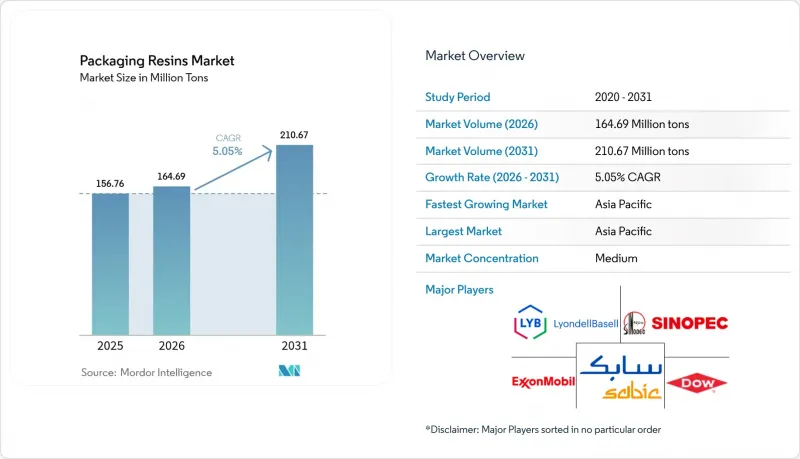
Mordor Intelligence에 의하면, 2026년 포장용 수지 시장 규모는 1억 6,469만 톤으로 추정되고, 2025년 1억 5,676만 톤으로부터 확대해, 2031년에는 2억 1,067만 톤에 이를 것으로 예측됩니다.
2026-2031년 연평균 성장률(CAGR) 5.05%로 성장할 것으로 전망됩니다.
본 보고서는 수지 유형별(고밀도 폴리에틸렌, 저밀도 폴리에틸렌, 폴리에틸렌 테레프탈레이트, 폴리프로필렌, 폴리스티렌, 기타), 용도별(식음료, 소비재, 화장품 및 퍼스널케어, 헬스케어, 기타), 지역별(아시아태평양, 북미, 유럽, 남미, 중동 및 아프리카)로 분류되어 있습니다. 시장 예측은 수량(톤) 기준으로 제시되어 있습니다.
세계의 포장용 수지 시장 동향 및 인사이트
비용 효율성 및 유통 기한 연장
포장용 수지는 산소 차단성과 내습성을 겸비함으로써 제품의 신선도를 오래 유지하고, 폐기물을 줄이며, 물류상의 손실을 감소시킵니다. 최근의 스마트 포장 프로토타입에는 폴리아닐린이나 탄소 나노닷 센서가 내장되어 있어, 부패 과정에서 발생하는 에탄올이나 메탄올을 감지하고 신선 식품의 상태에 대해 실시간으로 경보를 발령합니다. 산업계에서는 온도에 민감한 의약품 및 기능성 식품 부문에서 이러한 수지의 활용을 확대되고 있습니다. AI를 활용한 압출 성형 계획을 통해 층의 두께를 mm 단위의 공차로 조정할 수 있게 되어, 원료의 과다 사용을 억제하고 단위 비용을 절감하고 있습니다. 고부가가치 유효 성분이 증가하는 가운데, 가공업체들은 수지 선택을 단순한 범용 원료가 아닌 위험 경감 수단으로 재인식하고 있습니다. 그 결과 얻어지는 총 소유 비용(TCO)의 우위 덕분에, 원료 가격 변동이 이익률을 압박하는 경우에도 프리미엄 가격에 대한 수용이 유지되고 있습니다.
급증하는 전자상거래 주문 처리량
온라인 소매 취급량 증가에 따라, 더 가볍고 보호 성능이 뛰어난 포장으로의 구조적 전환이 진행되고 있습니다. 부피 중량에 따른 배송료 체계는 얇은 파우치의 채택을 촉진하는 한편, 자동화의 필요성은 예측 가능한 신축 저항성을 갖춘 필름을 요구하고 있습니다. 수지 배합 제조업체들은 컨베이어에서 떨어지더라도 견딜 수 있는 고강도 LLDPE 혼합물이나 내충격성이 개선된 폴리올레핀으로 이에 대응하고 있습니다. 종이 메일러 증가는 대체 위험을 초래하지만, 배리어 코팅이 적용된 폴리올레핀이나 EVOH 등급 덕분에 섬유계 소재 제품 내에서도 플라스틱 사용이 유지되고 있습니다. 소비자들이 편의성을 추구함에 따라 1회용 크기의 포장이 보급되고 있으며, 재밀봉 가능한 캡과 박리 가능한 씰에 대한 수요가 증가하고 있습니다. 그 결과, 세분화된 용도의 조합이 더욱 확대되고 있으며, 각각이 특정 용융 지수나 인성 프로파일을 필요로 하기 때문에 다양한 수지 계열 전반에 걸쳐 수요의 모멘텀이 유지되고 있습니다.
플라스틱 폐기물 관련 규제 강화
EU가 2026년 8월부터 식품 포장재 내 개별 PFAS에 대해 25ppb의 상한선을 설정함에 따라, 소재의 신속한 재조성이 시급해졌습니다. 캘리포니아주와 뉴멕시코주에서 병행하여 시행되고 있는 주 차원의 금지 조치는 다국적 기업공급망에 추가적인 복잡성을 더하고 있습니다. 한편, 인도의 재생 PET(r-PET) 30% 사용 의무는 제한된 r-PET 공급으로 어려움을 겪고 있는 음료 충전 업체에 30%의 비용 상승을 초래하고 있습니다. 2025년에 도입될 확대 생산자 책임(EPR) 법에 따라, 사용 후 제품 회수 수수료가 가속화될 것입니다. 규정 준수를 위한 지출은 장기적인 혁신을 촉진하는 한편, 확장 프로젝트에 대한 자금을 압박하여 단기적인 이익률을 압박하게 될 것입니다.
부문 분석
2025년, 고밀도 폴리에틸렌(HDPE)은 포장용 수지 시장에서 27.30%라는 최대 점유율을 유지했습니다. 그 수요는 블로우 성형된 식품 용기, 제리캔, 의약품용 병에 의해 뒷받침되고 있습니다. 재활용 원료 공급이 개선되고, 기업의 재활용 원료 사용률에 대한 공약과 부합함에 따라 성장은 지속되고 있습니다. ‘기타 유형’은 6.32%라는 가장 높은 연평균 성장률(CAGR)을 기록하고 있으며, 이는 높은 차단성, 레토르트 처리 가능, 밀봉이 용이한 형태에 특화된 폴리이미드, 이오노머, 고리형 올레핀 공중합체(COP) 제품 라인업의 확대를 반영합니다. 폴리프로필렌은 캡 및 의료기기 부문에서 시장 점유율을 확대하고 있는 반면, PET는 재활용 인프라의 혜택을 받는 한편, 공급을 전용하는 ‘병에서 병으로(bottle-to-bottle)’ 규제로 인해 제약을 받는 등 호불호가 엇갈리고 있습니다. 폴리염화비닐(PVC)은 염소와 관련된 폐기 처리 문제로 인해 비식품용 블리스터 팩 부문에서는 여전히 틈새 시장에 머물러 있습니다. 브라스켐(Bruskem)사가 30% 증산하여 26만 톤에 도달한 바이오 PE 생산 능력은 상업적 규모에서 재생 가능 원료로의 길이 확립되었음을 입증하고 있습니다. 엑슨모빌(ExxonMobil)의 베이트운(Baytown) 공장과 같은 첨단 재활용 플랜트는 2027년까지 연간 10억 파운드를 목표로 하고 있으며, 새로운 순환형 원료의 흐름을 가져올 것으로 기대됩니다.
HDPE 기반 경질 포장용 수지 시장은 고부가가치 용도 수요 증가에 힘입어 꾸준한 성장 가능성을 보이고 있습니다. 제품 개발자들은 다층 구조의 두께를 얇게 만들고 상용화제를 결합함으로써 단일 소재로의 회수를 가능하게 하고 있습니다. 이러한 접근 방식은 사용 후 제품의 재활용률을 향상시켜 2030년 재활용 가능성 관련 공약을 확실히 이행할 수 있게 합니다. 설비 개조를 통해 생산량의 유연성이 향상되고, 전동식 사출 성형기로의 전환으로 에너지 사용량이 감소함에 따라 HDPE의 비용 경쟁력이 더욱 강화되고 있습니다. 특수 등급은 수량 감소를 상쇄하는 프리미엄 가격을 실현하고 있으며, 방취 필름이나 방사선 저항 필름과 같은 틈새 시장에서의 기회가 혁신적인 기업의 매출 총이익률을 끌어올리고 있습니다.
지역별 분석
아시아태평양은 2025년에 세계 수요의 53.10%를 차지했으며, 2031년까지 연평균 성장률(CAGR) 5.95%로 성장세가 가속화될 전망입니다. 이러한 이중적 우위는 비용 효율적인 제조와 확대되는 국내 소비에 기인합니다. 2022년 중국의 버진 수지 생산량은 3억 6,200만 톤에 달했고, 세계 공급 측면에서의 영향력을 공고히 했으나, 수익성은 하락하여 일부 크래커가 가동을 중단하거나 확장을 연기하는 사태가 발생하고 있습니다. 인도에서는 도시화와 소득 증가를 배경으로 식음료 및 퍼스널케어 부문용 경질 포장재가 급성장하고 있지만, 생산자 책임 확대(EPR) 규제로 인해 브랜드 소유주들은 재활용 가능한 라미네이트 소재로의 전환을 강요받고 있습니다. 동남아시아 제조업체들은 마진 축소로 어려움을 겪고 있지만, 성장 시장과의 근접성 덕분에 장기적인 기초 여건은 여전히 견고합니다.
북미에서는 완만한 성장이 나타나고 있지만, 혁신의 밀도가 높은 것이 특징입니다. 애널리스트들은 생산 능력 과잉과 원자재의 불확실성을 이유로, 2026년까지 폴리에틸렌과 폴리프로필렌 시장에는 역풍이 계속될 것으로 예측했습니다. 엑슨모빌(ExxonMobil)의 고도 재활용 사업 확대나 리오넬 바셀(Lionel Basell)의 40만 톤 규모 프로파일렌 플랜트 건설과 같은 투자는 양을 중시하기보다는 차별화에 초점을 맞춘 전략적 도박을 반영하고 있습니다. 캐나다와 멕시코는 관세로 인한 혼란이 발생할 가능성에 직면해 있으며, 이는 북미 대륙의 무역 흐름을 재조정하게 될 것으로 보입니다.
유럽에서는 엄격한 규제와 기술적 리더십이 균형을 이루고 있습니다. ‘포장 및 포장 폐기물 규정’이 단일 소재 채택을 촉진하는 한편, 덴마크와 오스트리아의 높은 재활용률은 세척된 플레이크에 대한 하류 수요를 뒷받침하고 있습니다. SABIC의 2024년 135건의 신제품 출시와 화학 재활용 시범 사업은 기존 기업들이 자사의 포트폴리오를 순환 경제 정책에 부합하도록 조정하고 있음을 보여줍니다. 네덜란드는 2050년까지 화석 연료를 사용하지 않는 포장을 실현하는 것을 목표로 하고 있으며, 바이오 폴리머 연구 개발을 강화하고 있습니다. 남미, 중동 및 아프리카에서는 도시화와 전자상거래의 확산으로 인해 이들 지역 전반에 걸쳐 수요가 증가하고 있습니다. 브라질이 해당 지역의 도입을 주도하고 있으며, 사우디아라비아는 원료의 우위를 활용하여 수출 지향적인 PE와 PP를 생산하고 있습니다.
기타 혜택
- 엑셀 형식 시장 예측(ME) 시트
- 3개월간의 애널리스트 지원
자주 묻는 질문
목차
제1장 서론
제2장 조사 방법
제3장 주요 요약
제4장 시장 구도
제5장 시장 규모 및 성장 예측
제6장 경쟁 구도
제7장 시장 기회 및 향후 전망
AJY 26.08.28According to Mordor Intelligence, packaging resins market size in 2026 is estimated at 164.69 Million tons, growing from 2025 value of 156.76 Million tons with 2031 projections showing 210.67 Million tons, growing at 5.05% CAGR over 2026-2031.
This report is Segmented by Resin Type (High-Density Polyethylene, Low-Density Polyethylene, Polyethylene Terephthalate, Polypropylene, Polystyrene, and More), Application (Food and Beverage, Consumer Goods, Cosmetics and Personal Care, Healthcare, and More), and Geography (Asia-Pacific, North America, Europe, South America, Middle East and Africa). The Market Forecasts are Provided in Terms of Volume (tons).
Global Packaging Resins Market Trends and Insights
Cost-effectiveness & Longer Shelf-life
Packaging resins extend product freshness, cut waste, and reduce logistics losses by combining oxygen barriers with moisture resistance. Recent smart-packaging prototypes embed polyaniline and carbon nanodot sensors that detect ethanol and methanol generated during spoilage, delivering real-time condition alerts for perishable goods. Industrials are scaling these resins for temperature-sensitive pharmaceuticals and functional food channels. AI-guided extrusion planning now tunes layer thickness to millimeter tolerances, curbing raw-material overuse and trimming unit cost. As high-value active ingredients increase, converters recast resin choice as a risk-mitigation lever rather than a commodity input. The resulting cost-of-ownership advantage sustains premium acceptance even when feedstock swings pressure margins.
Booming E-commerce Fulfillment Volumes
Online retail volumes drive structural shifts toward lighter, more protective packaging. Dimensional-weight shipping fees incentivize thin-wall pouches, while automation demands predictably stretch-resistant films. Resin formulators answer with higher-strength LLDPE blends and impact-modified polyolefins able to survive conveyor drops. Growth of paper mailers creates substitution risk, yet barrier-coating grades of polyolefin and EVOH preserve plastic usage even inside fiber-based formats. Single-serve portion packs flourish as consumers seek convenience, intensifying demand for resealable closures and peelable seals. The net impact is a broader mix of micro-applications, each requiring specific melt index and toughness profiles, sustaining volume momentum across diverse resin families.
Tightening Regulations on Plastic Waste
The EU's August 2026 cap of 25 ppb for individual PFAS in food packaging compels rapid material reformulation. Parallel state-level bans in California and New Mexico layer complexity on multinational supply chains, while India's 30% recycled-PET mandate triggers 30% cost inflation for beverage fillers who struggle with limited r-PET supply. Extended producer responsibility statutes rolling out across the United States in 2025 will accelerate post-consumer take-back fees. Compliance spending diverts cash from expansion projects and narrows short-term margins, even as it catalyzes long-run innovation.
Other drivers and restraints analyzed in the detailed report include:
- Increasing Demand from Food & Beverage Industry
- Rise in Pharmaceutical & Healthcare Packaging Demand
- Feed-stock (Naphtha/Ethylene) Price Volatility
For complete list of drivers and restraints, kindly check the Table Of Contents.
Segment Analysis
High-density polyethylene sustained the largest 27.30% packaging resins market share in 2025, with demand anchored in blow-molded food containers, jerrycans, and pharma bottles. Growth persists as recyclate availability improves, aligning with corporate recycled-content pledges. "Other Types" register the fastest 6.32% CAGR, reflecting scaling of polyimide, ionomer, and cyclic-olefin copolymer lines tailored to high-barrier, retortable, and easy-seal formats. Polypropylene extends penetration in caps and medical devices, while PET faces mixed fortunes-benefiting from recycling infrastructure yet constrained by bottle-to-bottle mandates that divert supply. Polyvinyl chloride remains niche in non-food blister packs due to chlorine-related disposal issues. Bio-PE capacity, expanded 30% by Braskem to 260,000 tons, affirms commercial-scale renewable feedstock pathways. Advanced recycling plants such as ExxonMobil's Baytown unit, targeting 1 billion lb/year by 2027, promise new circular feedstreams.
The packaging resins market for HDPE-based rigid packs demonstrates steady growth potential, supported by increasing demand across high-value applications. Product developers couple multi-layer downgauging with compatibilizers that enable mono-material recovery, an approach boosting post-consumer recycling rates and ensuring compliance with 2030 recyclability pledges. Equipment retrofits unlock run-rate flexibility, and the migration to all-electric injection presses cuts energy use, strengthening HDPE cost leadership. Specialty grades command premium pricing that offsets lower volumes; niche opportunities in odor-barrier and radiation-resistant films lift gross margins for innovators.
Complete Report Scope:
- By Resin Type
- High-density Polyethylene (HDPE)
- Low-density Polyethylene (LDPE/LLDPE)
- Polyethylene Terephthalate (PET and rPET)
- Polypropylene (PP)
- Polystyrene (PS and HIPS)
- Polyvinyl Chloride (PVC)
- Other Resin Types (Polyimide, Surlyn, etc.)
- By Application
- Food and Beverage
- Consumer Goods
- Cosmetics and Personal Care
- Healthcare
- Industrial
- Other Applications (E-commerce Mailers and Protective Wrap, etc.)
- By Geography
- Asia-Pacific
- China
- Japan
- India
- South Korea
- ASEAN Countries
- Rest of Asia-Pacific
- North America
- United States
- Canada
- Mexico
- Europe
- Germany
- United Kingdom
- France
- Italy
- Spain
- Russia
- NORDIC Countries
- Rest of Europe
- South America
- Brazil
- Argentina
- Rest of South America
- Middle East and Africa
- Saudi Arabia
- South Africa
- Rest of Middle East and Africa
- Asia-Pacific
Geography Analysis
Asia-Pacific controlled 53.10% of global demand in 2025 and will accelerate at 5.95% CAGR through 2031, a dual dominance rooted in cost-effective manufacturing and swelling domestic consumption. China's 362 million-ton virgin resin output in 2022 cemented its global supply influence, yet profitability has thinned, prompting several crackers to idle or defer expansion. India's rigid-pack boom-serving food, beverage and personal care-is propelled by urbanization and rising income, though extended-producer-responsibility rules push brand owners toward recyclable laminates. Southeast Asian makers grapple with negative spreads, but long-term fundamentals remain intact due to proximity to growth markets.
North America shows moderate growth but high innovation density. Analysts forecast headwinds for polyethylene and polypropylene until 2026 because of capacity overhang and feedstock uncertainty. Investments such as ExxonMobil's advanced-recycling expansion and LyondellBasell's 400,000-t propylene unit reflect strategic bets on differentiation rather than volume plays. Canada and Mexico face potential tariff disruptions that would recalibrate continental trade flows.
Europe balances tight regulation with technology leadership. The Packaging and Packaging Waste Regulation drives mono-material adoption, while high recycling rates in Denmark and Austria reinforce downstream demand for washed flakes. SABIC's 135 product launches in 2024 and pilot chemical-recycling ventures show incumbents aligning portfolios with circular-economy policy. The Netherlands targets fossil-free packaging by 2050, intensifying R&D in bio-polymers. South America and Middle East & Africa collectively record rising demand from urbanization and e-commerce penetration; Brazil leads regional uptake, and Saudi Arabia leverages feedstock advantage for export-oriented PE and PP.
- Borealis GmbH
- Braskem
- Chevron Phillips Chemical Company LLC.
- China Petrochemical Corporation. (Sinopec)
- Dow
- Exxon Mobil Corporation
- Far Eastern Group
- Formosa Plastics Corporation
- Indorama Ventures
- INEOS
- LG Chem
- LyondellBasell Industries Holdings B.V.
- NOVA Chemicals Corporate.
- PetroChina Company Limited
- PTT Global Chemical Public Company Limited.
- Reliance Industries Limited.
- SABIC
- TotalEnergies
- Westlake Corporation
Additional Benefits:
- The market estimate (ME) sheet in Excel format
- 3 months of analyst support
TABLE OF CONTENTS
1 Introduction
- 1.1 Study Assumptions and Market Definition
- 1.2 Scope of the Study
2 Research Methodology
3 Executive Summary
4 Market Landscape
- 4.1 Market Overview
- 4.2 Market Drivers
- 4.2.1 Cost-effectiveness and longer shelf-life
- 4.2.2 Booming e-commerce fulfilment volumes
- 4.2.3 Increasing demand from food and beverage industry
- 4.2.4 Rise in phramaeuctical and healthcare packaging demand
- 4.2.5 Shift to mono-material packs for recyclability
- 4.3 Market Restraints
- 4.3.1 Tightening regulations on plastic waste
- 4.3.2 Feed-stock (naphtha/ethylene) price volatility
- 4.3.3 PFAS scrutiny on fluorinated HDPE containers
- 4.4 Value Chain Analysis
- 4.5 Porter's Five Forces
- 4.5.1 Bargaining Power of Suppliers
- 4.5.2 Bargaining Power of Buyers
- 4.5.3 Threat of New Entrants
- 4.5.4 Threat of Substitutes
- 4.5.5 Intensity of Competitive Rivalry
5 Market Size and Growth Forecasts (Volume)
- 5.1 By Resin Type
- 5.1.1 High-density Polyethylene (HDPE)
- 5.1.2 Low-density Polyethylene (LDPE/LLDPE)
- 5.1.3 Polyethylene Terephthalate (PET and rPET)
- 5.1.4 Polypropylene (PP)
- 5.1.5 Polystyrene (PS and HIPS)
- 5.1.6 Polyvinyl Chloride (PVC)
- 5.1.7 Other Resin Types (Polyimide, Surlyn, etc.)
- 5.2 By Application
- 5.2.1 Food and Beverage
- 5.2.2 Consumer Goods
- 5.2.3 Cosmetics and Personal Care
- 5.2.4 Healthcare
- 5.2.5 Industrial
- 5.2.6 Other Applications (E-commerce Mailers and Protective Wrap, etc.)
- 5.3 By Geography
- 5.3.1 Asia-Pacific
- 5.3.1.1 China
- 5.3.1.2 Japan
- 5.3.1.3 India
- 5.3.1.4 South Korea
- 5.3.1.5 ASEAN Countries
- 5.3.1.6 Rest of Asia-Pacific
- 5.3.2 North America
- 5.3.2.1 United States
- 5.3.2.2 Canada
- 5.3.2.3 Mexico
- 5.3.3 Europe
- 5.3.3.1 Germany
- 5.3.3.2 United Kingdom
- 5.3.3.3 France
- 5.3.3.4 Italy
- 5.3.3.5 Spain
- 5.3.3.6 Russia
- 5.3.3.7 NORDIC Countries
- 5.3.3.8 Rest of Europe
- 5.3.4 South America
- 5.3.4.1 Brazil
- 5.3.4.2 Argentina
- 5.3.4.3 Rest of South America
- 5.3.5 Middle East and Africa
- 5.3.5.1 Saudi Arabia
- 5.3.5.2 South Africa
- 5.3.5.3 Rest of Middle East and Africa
- 5.3.1 Asia-Pacific
6 Competitive Landscape
- 6.1 Market Concentration
- 6.2 Strategic Moves
- 6.3 Market Share(%)/Ranking Analysis
- 6.4 Company Profiles {(includes Global level Overview, Market level overview, Core Segments, Financials as available, Strategic Information, Market Rank/Share, Products and Services, Recent Developments)}
- 6.4.1 Borealis GmbH
- 6.4.2 Braskem
- 6.4.3 Chevron Phillips Chemical Company LLC.
- 6.4.4 China Petrochemical Corporation. (Sinopec)
- 6.4.5 Dow
- 6.4.6 Exxon Mobil Corporation
- 6.4.7 Far Eastern Group
- 6.4.8 Formosa Plastics Corporation
- 6.4.9 Indorama Ventures
- 6.4.10 INEOS
- 6.4.11 LG Chem
- 6.4.12 LyondellBasell Industries Holdings B.V.
- 6.4.13 NOVA Chemicals Corporate.
- 6.4.14 PetroChina Company Limited
- 6.4.15 PTT Global Chemical Public Company Limited.
- 6.4.16 Reliance Industries Limited.
- 6.4.17 SABIC
- 6.4.18 TotalEnergies
- 6.4.19 Westlake Corporation
7 Market Opportunities and Future Outlook
- 7.1 White-space and unmet-need assessment
- 7.2 Innovation of Modern Packaging Technologies
- 7.3 Growing Demand for Sustainable Packaging Solutions