

|
시장보고서
상품코드
2114892
지표 투과 레이더 시장 : 시장 점유율 분석, 업계 동향 및 통계, 성장 예측(2026-2031년)Ground Penetrating Radar - Market Share Analysis, Industry Trends & Statistics, Growth Forecasts (2026 - 2031) |
||||||
 Mordor Intelligence
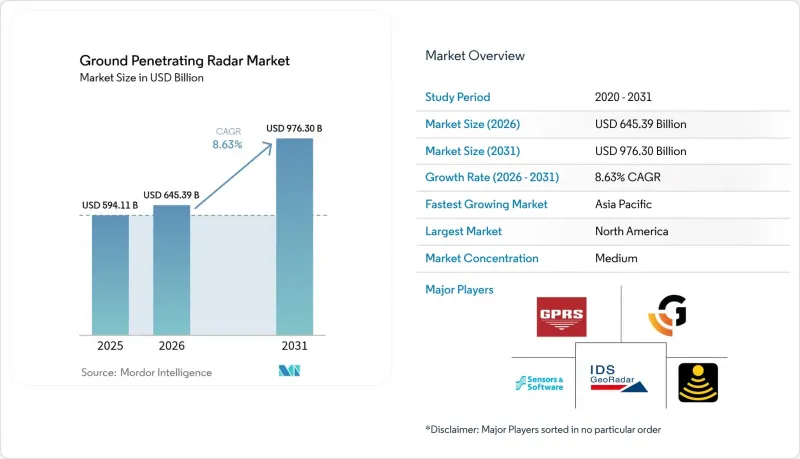
Mordor Intelligence에 의하면, 2026년 지표 투과 레이더(GPR) 시장 규모는 6,453억 9,000만 달러로 추정되고, 2025년 5,941억 1,000만 달러에서 확대해, 2031년에는 9,763억 달러에 이를 것으로 예측됩니다.
2026-2031년 연평균 성장률(CAGR)은 8.63%를 나타낼 전망입니다.
본 보고서는 제공 품목별(장비, 소프트웨어, 서비스), 제품 유형별(휴대용 GPR, 카트형 GPR, 기타), 구성 요소별(제어 장치, 안테나, 전원 공급 장치), 주파수 대역별(500MHz 미만, 기타), 용도별(유틸리티 감지, 기타), 최종 사용자 산업별(건설 및 인프라, 기타), 지역별로 분류되어 있습니다. 시장 전망은 금액(달러) 기준으로 제시되어 있습니다.
세계의 지표 투과 레이더 시장 동향 및 인사이트
아시아의 도시 지하 교통 회랑의 급속한 확대
베이징에서 자카르타에 이르는 아시아의 지하철망 확충은 실시간 레이더 영상과 BIM 대시보드를 연동하는 네트워크 지원 GPR 카트의 지속적인 구매를 촉진하고 있습니다. 건설업체들은 연속 스캔을 활용하여 터널 굴삭기를 유도하고, 고밀도로 집중된 유틸리티 군을 회피함으로써 충돌 위험과 공사 기간 지연을 줄이고 있습니다. ESA의 Truewave GPR 검사 운영에서는 GNSS와 IMU 텔레메트리가 통합되어 측량 속도가 50% 향상되었습니다. 기후 변화에 강한 인프라 구축을 위한 정부의 경기 부양책은 향후 몇 년간 장비 수요를 더욱 뒷받침하고 있습니다.
북미와 유럽의 지하 매설물 매핑 기준 의무화
Common Ground Alliance의 모범 사례 규범에 따라 굴착 시마다 전자기파를 이용한 검증이 의무화됨에 따라, 위치 파악 업체 및 토목 도급업체의 장비 갱신이 착실히 진행되고 있습니다. EU의 초광대역(UWB) 규격 통합으로 인해 통일된 주파수 대역이 확보되어, 국경을 넘는 장비 물류가 간소화되고 인증 비용이 절감되고 있습니다.
신흥 경제국에서의 높은 설비 투자 비용과 제한된 임대 환경
AI 프로세서를 탑재한 산업용 등급 시스템은 소매 가격이 10만 달러를 훨씬 상회하여, 소규모 도급업체에게는 진입 장벽이 되고 있습니다. 아프리카 및 라틴아메리카 일부 지역에서는 임대 장비 공급이 부족하여, 프로젝트 단위의 도입이 제한되고 있습니다.
부문 분석
2025년, 지하 레이더 시장의 50.68%를 차지한 것은 장비 부문이었으며, 이는 조사 워크플로우에서 송수신 하드웨어가 자본 집약적인 역할을 하고 있음을 여실히 보여주었습니다. 도입 기업들은 심도 분해능을 희생하지 않으면서 탐사 속도를 향상시키는 멀티채널 어레이로의 업그레이드를 추진하고 있습니다. 연평균 성장률(CAGR) 9.05%로 확대되고 있는 서비스 부문은 운영 비용(OPEX) 모델이나 턴키 방식의 데이터 분석을 원하는 프로젝트 소유주들을 끌어들이고 있습니다. AI 모듈이 제어 장치 내의 엣지 프로세서로 이전됨에 따라, 각 벤더는 하드웨어에 분석 서비스 구독을 묶어 지속적인 수익원을 구축하고 있습니다.
서비스의 성장은 기술 격차의 확대를 반영하기도 합니다. 복잡한 레이더 시그니처 분석에는 현재 지구물리학과 데이터 사이언스의 융합이 요구되고 있습니다. 후처리를 전문으로 하는 플릿 사업자는 사내에 전문 지식이 없는 인프라 소유자에게 신속한 스캔 서비스를 제공합니다. 소프트웨어 전문 제공업체들은 이러한 변화를 활용하여, 분류된 추적 데이터를 클라우드에서 호스팅되는 신경망에 입력함으로써 몇 분 이내에 자동화된 지층 식별 및 객체 태깅을 실현하고 있습니다.
카트형 플랫폼은 완벽한 지하 연동 기능과 인체공학적 조작성을 결합하여 2025년에는 매출의 41.35%를 차지했습니다. 이는 공공시설의 위치 파악 및 포장 도로 조사에 최적의 조합입니다. 분석 대시보드는 실시간 추적 데이터를 현장에서 확인할 수 있는 색상 구분된 깊이 슬라이스로 변환합니다. UAV(무인 항공기) 페이로드는 크기는 작지만 연평균 성장률(CAGR) 10.9%로 가장 빠르게 성장하고 있습니다. 광산 기업들은 회전익 드론에 레이더를 탑재해 광미 댐의 침투 채널을 매핑하고 있으며, 국방팀은 고정익 드론을 이용해 국경 터널 내부를 수색하고 있습니다. 안테나가 경량이기 때문에 카트에 비해 침투 깊이는 제한적이지만, 지상 접근이 제한되거나 위험한 장소에서는 수요가 증가하고 있습니다.
하이브리드 개념도 등장하고 있습니다. 드론 하네스에 장착하여 운반하다가 현장에 도착하면 바퀴를 이용한 스캔 모드로 전환되는 탈부착식 모듈입니다. 이러한 모듈성 덕분에 비행 지속 시간이 연장되고 깊이 측정 능력도 유지되므로, 향후에는 공중형과 지상형 설계가 융합될 것으로 예측됩니다.
지역별 분석
2025년에는 지하 검증을 의무화하는 엄격한 커먼 그라운드 얼라이언스(CGA) 규정과 기체 운영 사업자의 꾸준한 업데이트 주기로 인해 북미가 매출의 33.45%를 차지하며 1위를 차지했습니다. 광대역, 전기차(EV) 공장, 송전망 업그레이드를 지원하는 정부 지원 인프라 보조금 덕분에 스캔 프로젝트의 풍부한 파이프라인이 확보되었습니다. 이 지역공급업체들은 레이더와 AI 소프트웨어를 결합하여 전 세계에 턴키 솔루션을 제공합니다.
아시아태평양은 8.7%로 지역별 가장 높은 연평균 성장률(CAGR)을 기록하고 있습니다. 중국, 인도, 동남아시아의 대도시권 철도 건설에서는 굴착 작업 중 연중무휴 24시간 레이더 모니터링이 요구되고 있습니다. 스마트 시티 프로그램에서는 레이더 출력을 지하 유틸리티 회랑의 디지털 트윈에 통합하여 유지보수 작업자를 선제적으로 안내하고 있습니다. 일본과 한국은 산사태가 발생하기 쉬운 산악 노선을 위해 드론 기반 안테나 어레이를 추진하고 있으며, 경량 안테나 기술의 조기 도입을 주도하고 있습니다.
유럽에서는 인증 절차를 원활하게 하는 통일된 UWB 규제에 따라 견조한 수요가 유지되고 있습니다. 이탈리아와 그리스의 문화재 관리자들은 코어 샘플링 없이 대성당의 기초를 검사하기 위해 고주파 장비를 도입하고 있습니다. 2025년에는 지역적 긴장이 고조되고 대응 조치 예산이 증가함에 따라 방위용 센서 수주가 급증하여, 레이더 고도계 및 전자전용 페이로드 공급업체들이 혜택을 보았습니다.
라틴아메리카, 중동 및 아프리카에서는 보급률이 여전히 낮은 편이지만, 큰 기회가 잠재되어 있습니다. 예를 들어, 브라질의 전력망 확장이나 사우디아라비아의 기가 프로젝트에는 지하 매설물 매핑에 막대한 예산이 배정되어 있습니다. 과제로는 여전히 장비 가격과 분석 담당자 확보가 꼽히지만, 이로 인해 ‘스캔당 과금’이라는 서비스 모델에 대한 관심이 높아지고 있습니다.
기타 혜택
- 엑셀 형식 시장 예측(ME) 시트
- 3개월간의 애널리스트 지원
자주 묻는 질문
목차
제1장 서론
제2장 조사 방법
제3장 주요 요약
제4장 시장 구도
제5장 시장 규모 및 성장 예측
제6장 경쟁 구도
제7장 시장 기회 및 향후 전망
AJY 26.08.28According to Mordor Intelligence, ground penetrating radar market size in 2026 is estimated at USD 645.39 billion, growing from 2025 value of USD 594.11 billion with 2031 projections showing USD 976.3 billion, growing at 8.63% CAGR over 2026-2031.
This report is Segmented by Offering (Equipment, Software, Services), Product Type (Handheld GPR, Cart-Based GPR, and More), Component (Control Unit, Antenna, Power Supply), Frequency Range (<500 MHz, and More), Application (Utility Detection, and More), End-User Industry (Construction and Infrastructure, and More), and Geography. The Market Forecasts are Provided in Terms of Value (USD).
Global Ground Penetrating Radar Market Trends and Insights
Rapid Expansion of Urban Underground Transportation Corridors in Asia
Asia's metro build-out from Beijing to Jakarta is fueling sustained purchases of network-ready GPR carts that couple live radar feeds with BIM dashboards. Contractors use continuous scans to guide tunnel-boring machines and avoid high-density utility clusters, reducing strike risk and schedule overruns. ESA's TruewaveGPR trials logged 50% faster surveys once GNSS and IMU telemetry were embedded. Government stimulus for climate-resilient infrastructure further underpins multi-year equipment demand.
Mandated Underground Utility Mapping Standards in North America and Europe
The Common Ground Alliance best-practice code now obliges electromagnetic verification before every dig, driving steady fleet renewals among locators and civil contractors. EU ultra-wideband harmonization delivers uniform frequency windows that simplify cross-border equipment logistics and reduce certification costs.
High Capital Cost and Limited Rental Ecosystem in Emerging Economies
Industrial-grade systems with AI processors retail well above USD 100,000, a hurdle for small contractors. Sparse rental fleets in Africa and parts of Latin America curb project-based adoption.
Other drivers and restraints analyzed in the detailed report include:
- Rising Adoption of High-Frequency Antenna Arrays for Concrete Imaging
- Integration of GPR with AI-Enabled Data Analytics Platforms
- Signal Attenuation in High-Conductivity Soils Limiting Depth Accuracy
For complete list of drivers and restraints, kindly check the Table Of Contents.
Segment Analysis
The equipment segment controlled 50.68% of the ground penetrating radar market in 2025, underscoring the capital-intensive role of transmit-receive hardware in survey workflows. Adopters upgrade to multichannel arrays that boost coverage speed without sacrificing depth resolution. Services, expanding at 9.05% CAGR, attract project owners seeking OPEX models and turnkey data interpretation. As AI modules migrate to edge processors inside control units, vendors bundle analytics subscriptions with hardware to build annuity revenue.
Services growth also reflects a widening skills gap; interpreting complex radar signatures now blends geophysics with data science. Fleet operators specializing in post-processing sell rapid-response scans to infrastructure owners that lack in-house expertise. Software-only providers exploit this shift, feeding classified traces into cloud-hosted neural networks that deliver automated layer picks and object tags within minutes.
Cart platforms held 41.35% revenue in 2025 by combining full ground coupling with ergonomic handling, a formula ideal for utility-locating and pavement surveys. Analytic dashboards turn live traces into color-coded depth slices viewable on-site. UAV payloads, although smaller, are scaling fastest at 10.9% CAGR. Mining firms fly radar beneath rotary-wing drones to map tailings-dam seepage paths, while defense teams use fixed-wing variants for border-tunnel sweeps. Despite lighter antennas limiting penetration versus carts, demand rises where ground access is restricted or hazardous.
Hybrid concepts are emerging: detachable sleds that clip to a drone harness for transit then pivot to wheel-based scanning once on site. This modularity lengthens flight endurance and maintains depth capability, hinting at future convergence of airborne and terrestrial designs.
Complete Report Scope:
- By Offering
- Equipment
- Software
- Services
- By Product Type
- Handheld GPR
- Cart-Based GPR
- Vehicle-Mounted GPR
- UAV/Drone-Mounted GPR
- By Component
- Control Unit
- Antenna
- Power Supply
- By Frequency Range
- <500 MHz
- 500 - 1000 MHz
- > 1000 MHz
- By Application
- Utility Detection
- Concrete Investigation
- Municipal Inspection
- Forensics and Archaeology
- Transportation Infrastructure
- Geotechnical and Environment
- Disaster Inspection
- Law Enforcement and Military
- By End-User Industry
- Construction and Infrastructure
- Oil and Gas / Mining
- Environmental and Agriculture
- Defense and Security
- Academic and Research
- By Geography
- North America
- United States
- Canada
- Mexico
- South America
- Brazil
- Argentina
- Rest of South America
- Europe
- Germany
- United Kingdom
- France
- Italy
- Spain
- Rest of Europe
- Asia-Pacific
- China
- Japan
- India
- South Korea
- Southeast Asia
- Rest of Asia-Pacific
- Middle East and Africa
- South Africa
- Saudi Arabia
- Nigeria
- United Arab Emirates
- Rest of Middle East and Africa
- North America
Geography Analysis
North America led with 33.45% revenue in 2025 thanks to stringent Common Ground Alliance rules that mandate subsurface verification and to steady replacement cycles among fleet operators. State-backed infrastructure grants covering broadband, EV plants, and grid upgrades ensure a deep pipeline of scanning projects. Regional vendors couple radar with AI software to export turnkey offerings globally.
Asia-Pacific posts the highest regional CAGR at 8.7%. Mega-metro rail lines in China, India, and Southeast Asia require 24/7 radar monitoring during excavation. Smart-city programs layer radar outputs into digital twins of underground utility corridors, steering maintenance crews proactively. Japan and South Korea champion drone-based arrays for landslide-prone mountain routes, driving early adoption of lightweight antenna tech.
Europe retains healthy demand under harmonized UWB regulations that smooth certification workflows. Heritage-site managers in Italy and Greece deploy high-frequency rigs to audit cathedral foundations without drilling cores. Defense sensor contracts surged in 2025 as regional tensions prompted larger counter-measure budgets, benefitting suppliers of radar altimeters and electronic-warfare payloads.
Latin America, the Middle East, and Africa remain under-penetrated yet opportunity-rich. Brazil's power-grid expansion and Saudi Arabia's giga-projects, for example, include sizable allocations for underground-utility mapping. The constraint remains equipment affordability and interpreter availability, spurring interest in pay-per-scan service models.
- IDS GeoRadar
- Sensors and Software Inc.
- Guideline Geo AB
- Chemring Group PLC
- GSSI (Geophysical Survey Systems Inc.)
- Ground Penetrating Radar Systems LLC
- Geoscanners AB
- Pipehawk PLC
- Utsi Electronics Ltd.
- Hilti Corporation
- Hexagon AB
- US Radar Inc.
- Radiodetection Ltd.
- Penetradar Corporation
- MALA GPR
- Leica Geosystems AG
- Trimble Inc.
- ImpulseRadar Sweden AB
- 4M Analytics Ltd.
- TransTech Systems Inc.
Additional Benefits:
- The market estimate (ME) sheet in Excel format
- 3 months of analyst support
TABLE OF CONTENTS
1 INTRODUCTION
- 1.1 Study Assumptions and Market Definition
- 1.2 Scope of the Study
2 RESEARCH METHODOLOGY
3 EXECUTIVE SUMMARY
4 MARKET LANDSCAPE
- 4.1 Market Overview
- 4.2 Market Drivers
- 4.2.1 Rapid Expansion of Urban Underground Transportation Corridors in Asia
- 4.2.2 Mandated Underground Utility Mapping Standards in North America and Europe
- 4.2.3 Rising Adoption of High-Frequency Antenna Arrays for Concrete Imaging
- 4.2.4 Integration of GPR with AI-Enabled Data Analytics Platforms
- 4.2.5 Growing Demand for Non-Invasive Sub-surface Mapping in Renewable Energy Projects
- 4.2.6 Increasing Deployment of UAV-Mounted GPR for Remote and Hazardous Terrains
- 4.3 Market Restraints
- 4.3.1 High Capital Cost and Limited Rental Ecosystem in Emerging Economies
- 4.3.2 Signal Attenuation in High-Conductivity Soils Limiting Depth Accuracy
- 4.3.3 Scarcity of Skilled GPR Data Interpreters Globally
- 4.3.4 Regulatory Restrictions on Electromagnetic Emissions in EU and Japan
- 4.4 Value / Supply-Chain Analysis
- 4.5 Regulatory and Technological Outlook
- 4.5.1 Technology Snapshot
- 4.6 Porter's Five Forces Analysis
- 4.6.1 Threat of New Entrants
- 4.6.2 Bargaining Power of Buyers/Consumers
- 4.6.3 Bargaining Power of Suppliers
- 4.6.4 Threat of Substitute Products
- 4.6.5 Intensity of Competitive Rivalry
- 4.7 Investment Analysis
5 MARKET SIZE AND GROWTH FORECASTS (VALUE)
- 5.1 By Offering
- 5.1.1 Equipment
- 5.1.2 Software
- 5.1.3 Services
- 5.2 By Product Type
- 5.2.1 Handheld GPR
- 5.2.2 Cart-Based GPR
- 5.2.3 Vehicle-Mounted GPR
- 5.2.4 UAV/Drone-Mounted GPR
- 5.3 By Component
- 5.3.1 Control Unit
- 5.3.2 Antenna
- 5.3.3 Power Supply
- 5.4 By Frequency Range
- 5.4.1 < 500 MHz
- 5.4.2 500 - 1000 MHz
- 5.4.3 > 1000 MHz
- 5.5 By Application
- 5.5.1 Utility Detection
- 5.5.2 Concrete Investigation
- 5.5.3 Municipal Inspection
- 5.5.4 Forensics and Archaeology
- 5.5.5 Transportation Infrastructure
- 5.5.6 Geotechnical and Environment
- 5.5.7 Disaster Inspection
- 5.5.8 Law Enforcement and Military
- 5.6 By End-User Industry
- 5.6.1 Construction and Infrastructure
- 5.6.2 Oil and Gas / Mining
- 5.6.3 Environmental and Agriculture
- 5.6.4 Defense and Security
- 5.6.5 Academic and Research
- 5.7 By Geography
- 5.7.1 North America
- 5.7.1.1 United States
- 5.7.1.2 Canada
- 5.7.1.3 Mexico
- 5.7.2 South America
- 5.7.2.1 Brazil
- 5.7.2.2 Argentina
- 5.7.2.3 Rest of South America
- 5.7.3 Europe
- 5.7.3.1 Germany
- 5.7.3.2 United Kingdom
- 5.7.3.3 France
- 5.7.3.4 Italy
- 5.7.3.5 Spain
- 5.7.3.6 Rest of Europe
- 5.7.4 Asia-Pacific
- 5.7.4.1 China
- 5.7.4.2 Japan
- 5.7.4.3 India
- 5.7.4.4 South Korea
- 5.7.4.5 Southeast Asia
- 5.7.4.6 Rest of Asia-Pacific
- 5.7.5 Middle East and Africa
- 5.7.5.1 South Africa
- 5.7.5.2 Saudi Arabia
- 5.7.5.3 Nigeria
- 5.7.5.4 United Arab Emirates
- 5.7.5.5 Rest of Middle East and Africa
- 5.7.1 North America
6 COMPETITIVE LANDSCAPE
- 6.1 Market Concentration
- 6.2 Strategic Moves
- 6.3 Market Share Analysis
- 6.4 Company Profiles (includes Global level Overview, Market level overview, Core Segments, Financials as available, Strategic Information, Market Rank/Share for key companies, Products & Services, and Recent Developments)
- 6.4.1 IDS GeoRadar
- 6.4.2 Sensors and Software Inc.
- 6.4.3 Guideline Geo AB
- 6.4.4 Chemring Group PLC
- 6.4.5 GSSI (Geophysical Survey Systems Inc.)
- 6.4.6 Ground Penetrating Radar Systems LLC
- 6.4.7 Geoscanners AB
- 6.4.8 Pipehawk PLC
- 6.4.9 Utsi Electronics Ltd.
- 6.4.10 Hilti Corporation
- 6.4.11 Hexagon AB
- 6.4.12 US Radar Inc.
- 6.4.13 Radiodetection Ltd.
- 6.4.14 Penetradar Corporation
- 6.4.15 MALA GPR
- 6.4.16 Leica Geosystems AG
- 6.4.17 Trimble Inc.
- 6.4.18 ImpulseRadar Sweden AB
- 6.4.19 4M Analytics Ltd.
- 6.4.20 TransTech Systems Inc.
7 MARKET OPPORTUNITIES AND FUTURE OUTLOOK
- 7.1 White-Space and Unmet-Need Assessment


