
|
시장보고서
상품코드
2114895
전도성 섬유 시장 : 점유율 분석, 업계 동향과 통계, 성장 예측(2026-2031년)Conductive Textiles - Market Share Analysis, Industry Trends & Statistics, Growth Forecasts (2026 - 2031) |
||||||
 Mordor Intelligence
Mordor Intelligence에 의하면, 전도성 섬유 시장 규모는 2025년에 38억 2,000만 달러로 평가되었고 2026년 39억 8,000만 달러에서 2031년까지 48억 6,000만 달러에 이를 것으로 예측되며, 예측 기간(2026-2031년) CAGR은 4.09%를 나타낼 전망입니다.
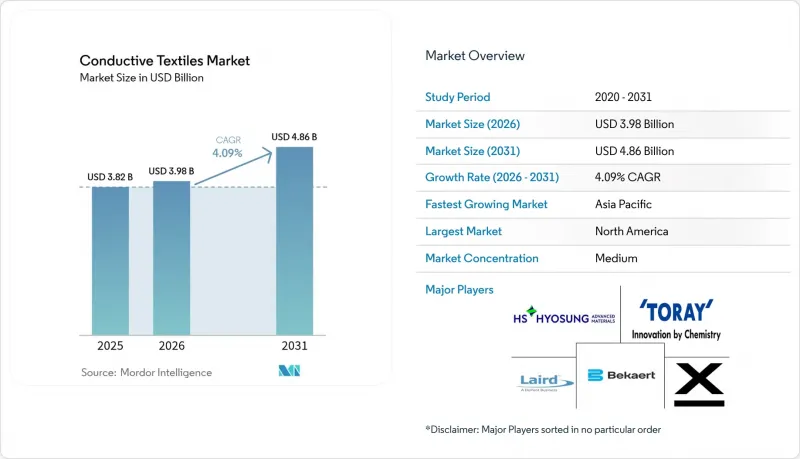
본 보고서는 원단 유형(면, 나일론 등), 전도성 소재(금속 피복 섬유, 전도성 폴리머 등), 기술(직물, 부직포, 편물), 최종 사용자 산업(방위 및 군사, 의료 등),용도(가열, 정전기 방지 및 EMI 차폐 등), 지역(아시아태평양, 북미, 유럽, 남미, 중동 및 아프리카)별로 분류되어 있습니다.
전 세계 전도성 섬유 시장 동향 및 인사이트
스마트 패브릭 및 웨어러블 전자 기기에서의 채택 확대
현재 소형화된 칩이 실 속에 내장되어 셔츠, 양말, 병원 가운 등이 딱딱한 모듈 없이도 움직임, 체온, 심박수를 측정하는 커넥티드 기기로 변모하고 있습니다. 병원 그룹들은 피부에 부착할 때의 불편함을 줄이고 간호사들이 유선 센서에서 해방될 수 있도록 세탁 가능한 모니터링 의류를 조달하고 있으며, 이는 상업적 주문을 가속화하고 있습니다. 통합된 에너지 수확 층 덕분에 부피가 큰 배터리가 필요 없어지고 착용 시간이 연장되며, 소비자의 수용도도 높아지고 있습니다. 각 스포츠 브랜드는 생체 데이터를 모바일 대시보드로 전송하는 고성능 웨어러블 의류를 판매하고 있으며, 보험사들도 검증된 활동 기록을 바탕으로 한 보험료 할인 제도를 검토하고 있습니다. 이러한 실시간 인사이트의 확산으로 인해 전도성 섬유는 차세대 디지털 헬스 생태계의 핵심 구성 요소로서의 입지를 확고히 하고 있습니다.
방위 및 군사 분야의 지능형 장비에 대한 수요 증가
군는 전력 분배, 무선 링크, 적응형 위장 기능을 하나의 원단 패널에 통합한 더 가벼운 제복을 원하고 있습니다. 직조된 전도성 그리드가 케이블을 대체하여 병사의 휴대 중량을 줄여줄 뿐만 아니라, 좁은 차량 내부에서 걸려 넘어질 위험을 줄여주고 있습니다. 미국 해군의 연구 자금 지원을 통해 현장에서 가열 및 냉각이 가능하고, 화학적 위협을 감지할 수 있는 저비용 시그니처 관리용 직물이 개발되고 있습니다. 실전 시험 결과, 전자 기기가 의복에 미리 배선된 상태로 제공되므로, 스트레스 상황에서의 커넥터 연결 작업에 드는 수고가 줄어들어 임무 준비 시간이 20% 단축되는 것으로 나타났습니다. 조달 주기가 장기간에 걸쳐 진행되기 때문에 승인된 공급업체는 다년 계약을 확보하고 있으며, 이는 상업 시장의 변동이 있더라도 수요를 지탱하는 기반이 되고 있습니다.
높은 제조 비용과 가격 프리미엄
전도성 섬유의 제조에는 진공 스퍼터링이나 폴리머 메탈라이제이션 공정이 필요하며, 이로 인해 공정 시간이 몇 분 연장되고 재료 폐기량이 증가하므로 기존 원단에 비해 단가가 최대 40% 높아집니다. 생산량이 적기 때문에 특히 틈새 시장인 의료용 패치의 경우 규모의 경제를 발휘하기 어렵습니다. 가격에 민감한 대량 생산 패션 분야의 바이어들은 비용 곡선이 하락세로 돌아설 때까지 도입을 미루고 있습니다. 설비 상각비는 소규모 직물 공장을 더욱 압박하여 지리적 확장을 제한하는 한편, 자본력이 있는 지역으로공급 집중을 강화하고 있습니다. 학습 곡선은 개선되는 추세이지만, 가격 프리미엄은 여전히 급속한 상품화의 걸림돌이 되고 있습니다.
부문 분석
나일론은 2025년 매출의 42.10%를 차지하고 있으며, 2031년까지 연평균 성장률(CAGR) 4.88%를 나타낼 것으로 예측됩니다. 이는 견고한 방위 장비부터 몸에 밀착되는 스포츠웨어에 이르기까지 그 다용도성을 입증하는 것입니다. 이 소재의 인장 강도는 전장의 마모를 견딜 수 있으며, 화학적 내성 덕분에 섬유의 현저한 열화를 초래하지 않고 은 구리 또는 탄소 코팅을 적용할 수 있습니다. 전도성 섬유 시장은 자동차 제조업체들이 헤드라이너의 차폐재로 나일론 메쉬를 지정함에 따라 혜택을 보고 있으며, 이로 인해 방적 공장에 대한 수요가 증가하고 있습니다.
탄성 회복력 덕분에 동작 중에도 센서가 피부에 밀착된 상태를 유지하여 의료용 의류의 신호 품질을 보장합니다. 쾌적성을 최우선으로 하는 병원용 리넨에서는 면이 시장 점유율을 유지하고 있지만, 내구성과 신축성이 가장 중요시되는 분야에서는 나일론이 새로운 수주를 확보하고 있습니다. 조사 결과, 은 코팅이 적용된 나일론이 세탁 시험에서 96 S/cm의 전도성을 달성하고 통기성 목표치도 충족함에 따라, 고급 기능성 의류 시장에서의 진출 여지가 확대되고 있습니다.
금속 피복 섬유는 항공우주 및 자동차 조립 분야에서 EMI 차폐 성능이 입증됨에 따라 2025년 매출의 34.72%를 차지했습니다. 이 섬유의 낮은 시트 저항은 항공기 항공전자 장비에 대한 엄격한 규격을 충족합니다. 그러나 규제 당국이 중금속 사용을 자제하는 방향으로 나아가고 있어, 2031년까지의 연평균 성장률(CAGR)은 탄소계 섬유가 5.07%로 가장 높은 성장세를 보이고 있습니다. 그래핀 직물은 반복적으로 구부려도 강인한 탄력성과 전도성을 유지하기 때문에 소비자용 전자기기의 보호 케이스에 적합합니다. 탄소나노튜브 잉크의 비용 곡선은 하락 추세를 보이고 있으며, 기존 가격 차이는 줄어들고 있습니다. 전도성과 지속가능성 목표 간의 균형을 맞추기 위해, 탄소 코어와 얇은 금속 피막을 결합한 하이브리드 실이 등장하고 있습니다.
지역별 분석
북미는 방위 조달 계약과 커넥티드 헬스케어 의류의 조기 도입에 힘입어 2025년 매출의 40.55%를 차지했습니다. 섬유 공장과 칩 설계자 간의 고도화된 공급망 협력을 통해 시제품 개발 주기가 단축되어 신속한 시장 진입이 가능해졌습니다. 연구 기관들은 연방 정부의 보조금을 활용하여 세탁에 강한 코팅 기술을 개선하고 있으며, 이 지역의 노하우는 전 세계 경쟁사들을 계속해서 앞서가고 있습니다. 반도체 생산의 국내 복귀를 촉진하는 주 정부의 인센티브 덕분에 지역 밸류체인은 더욱 강화되었으며, 지정학적 화물 운송 혼란으로부터 리드 타임이 보호되고 있습니다.
아시아태평양은 2031년까지 4.69%라는 가장 높은 연평균 성장률(CAGR)을 보일 것으로 전망됩니다. 이는 중국이 섬유 산업의 규모를 활용해 세계 시세보다 낮은 가격을 유지하면서도 기술적 수준을 높여가고 있기 때문입니다. 일본의 자동차 제조업체들은 전 세계로 수출되는 전기 세단에 차폐 원단을 적용하여 기초적인 수요를 확보하고 있습니다. 한국의 디스플레이 제조업체들은 원단에 통합된 터치 센서에 투자하여 의류 이외 시장 개척을 추진하고 있습니다. ‘인더스트리 4.0’ 관련 설비에 대한 정부의 보조금 덕분에 현지 방적 공장은 전도성 섬유 생산 라인으로의 개조를 추진하며, 생산량 확대와 단위 비용 절감을 가속화하고 있습니다.
유럽에서는 견조한 시장 점유율을 유지하면서, 재활용이 가능하고 금속을 포함하지 않는 대체 소재를 중시하는 지속가능성 관점과의 균형을 모색하고 있습니다. 독일의 1차 공급업체는 사용 후 제품의 재활용 규정을 충족하기 위해 차세대 자동차 내장재용 탄소계 직물에 대한 인증을 획득했습니다. 북유럽 브랜드는 순환 경제 목표에 따라 고성능 아우터웨어에 바이오 유래 전도성 섬유를 시범적으로 채택하고 있습니다. EU의 의료기기 규제는 섬유 전극에 대한 명확한 방향을 제시하며, 국경을 초월한 병원 내 도입을 촉진하고 있습니다.
기타 혜택:
- 엑셀 형식 시장 예측(ME) 시트
- 3개월간의 애널리스트 지원
자주 묻는 질문
목차
제1장 서론
제2장 조사 방법
제3장 주요 요약
제4장 시장 구도
제5장 시장 규모와 성장 예측
제6장 경쟁 구도
제7장 시장 기회와 향후 전망
JHS 26.08.26According to Mordor Intelligence, the conductive textiles market size was valued at USD 3.82 billion in 2025 and estimated to grow from USD 3.98 billion in 2026 to reach USD 4.86 billion by 2031, at a CAGR of 4.09% during the forecast period (2026-2031).
This report is Segmented by Fabric Type (Cotton, Nylon, and More), Conductive Material (Metal-Coated Fibers, Conductive Polymers, and More), Technology (Woven, Non-Woven, and Knitted), End-User Industry (Defense and Military, Healthcare, and More), Application (Heating, Antistatic and EMI Shielding, and More), and Geography (Asia-Pacific, North America, Europe, South America, and Middle-East and Africa).
Global Conductive Textiles Market Trends and Insights
Increasing Adoption in Smart Fabrics and Wearable Electronics
Miniaturized chips now slip inside yarns, turning shirts, socks, and hospital gowns into connected devices that read motion, temperature, and heart rates without rigid modules. Hospital groups are procuring washable monitoring garments to cut skin-adhesive discomfort and to free nurses from wired sensors, accelerating commercial orders. Integrated energy-harvesting layers remove bulky batteries, extending wear time and widening consumer acceptance. Athletic brands market performance outfits that stream biometric data to mobile dashboards, and insurers explore policy discounts tied to verified activity logs. The spread of these real-time insights cements conductive fabrics as a core building block of next-generation digital health ecosystems.
Growing Demand from Defense and Military Intelligent Gear
Armed forces seek lighter uniforms that combine power distribution, radio links, and adaptive camouflage in one fabric panel. Woven conductive grids replace cables, cutting soldier carry weight and reducing snag hazards in confined vehicles. U.S. naval research funds low-cost signature-management cloth that can heat, cool, and sense chemical threats in the field. Field trials indicate 20% faster mission setup times because electronics arrive pre-wired in garments, lowering the fumbling of connectors under stress. With long procurement cycles, approved suppliers secure multi-year contracts that anchor demand even when commercial markets fluctuate.
High Production Cost and Price Premium
Conductive yarns demand vacuum sputtering or polymer metallization steps that add process minutes and material waste, lifting unit prices by up to 40% versus conventional fabrics. Low volumes hinder scale economies, especially for niche medical patches. Buyers in price-sensitive mass fashion stall adoption until cost curves bend. Equipment amortization further squeezes smaller mills, limiting geographic spread and reinforcing supply concentration in capital-rich regions. Although learning rates are improving, the premium remains a brake on rapid commoditization.
Other drivers and restraints analyzed in the detailed report include:
- Expansion of Physiological-Monitoring Healthcare Wearables
- Rising Need for EMI Shielding in Autonomous-Vehicle Interiors
- Durability and Wash-Wash Cycle Degradation
For complete list of drivers and restraints, kindly check the Table Of Contents.
Segment Analysis
Nylon represented 42.10% of 2025 sales and is projected to grow at a 4.88% CAGR through 2031, underscoring its versatility across rugged defense gear and form-fitting sportswear. Its tensile strength withstands battlefield abrasion, while its chemical resilience accepts silver, copper, or carbon coatings without significant fiber degradation. The conductive textiles market benefits as automakers specify nylon mesh for headliner shielding, pushing mill demand upward.
Elastic recovery keeps sensors seated against skin during motion, sustaining signal quality for medical garments. Cotton retains share in comfort-first hospital linens, but nylon captures new contracts where durability and stretch matter most. On the research front, silver-coated nylon achieved conductivity of 96 S/cm in washability trials and still met breathability targets, expanding its runway in premium functional apparel.
Metal-coated fibers owned 34.72% of 2025 revenue thanks to proven EMI shielding in aerospace and automotive assemblies. Their low sheet resistance meets stringent aircraft avionics protocols. However, carbon-based textiles post the briskest 5.07% CAGR to 2031 as regulators steer away from heavy metals. Graphene weaves provide robust elasticity and maintain conductivity despite repeated bending, suiting consumer electronics sleeves. Cost curves for carbon nanotube inks are falling, narrowing the historical price gap. Hybrid yarns that combine carbon cores with thin metallic skins are emerging to balance conductivity with sustainability goals.
Complete Report Scope:
- By Fabric Type
- Cotton
- Nylon
- Polymer
- Other Fabric Types (Wool, etc.)
- By Conductive Material
- Metal-coated Fibers
- Conductive Polymers
- Carbon-based Textiles
- Hybrid Composites
- By Technology
- Woven
- Non-woven
- Knitted
- By End-user Industry
- Defense and Military
- Healthcare
- Sports and Fitness
- Other End-user Industries (Consumer Electronics, etc.)
- By Application
- Sensing
- Heating
- Antistatic and EMI Shielding
- Energy Harvesting and Storage
- By Geography
- Asia-Pacific
- China
- Japan
- India
- South Korea
- ASEAN Countries
- Rest of Asia-Pacific
- North America
- United States
- Canada
- Mexico
- Europe
- Germany
- United Kingdom
- France
- Italy
- Spain
- Russia
- NORDIC Countries
- Rest of Europe
- South America
- Brazil
- Argentina
- Rest of South America
- Middle-East and Africa
- Saudi Arabia
- South Africa
- Rest of Middle-East and Africa
- Asia-Pacific
Geography Analysis
North America held 40.55% of 2025 revenue, powered by defense procurement contracts and early adoption of connected healthcare garments. Advanced supply links between textile mills and chip designers shorten prototype cycles, allowing rapid market entry. Research institutes secure federal grants to refine wash-resilient coatings, keeping regional know-how ahead of global peers. State incentives for semiconductor reshoring further tighten local value chains, insulating lead times from geopolitical freight disruptions.
Asia-Pacific delivers the highest 4.69% CAGR to 2031 as China leverages its textile scale to undercut global prices while climbing the technology ladder. Japanese automakers embed shielding cloth in electric sedans slated for global export, locking in baseline demand. South Korean display makers invest in fabric-integrated touch sensors, broadening market avenues beyond clothing. Government subsidies for Industry 4.0 equipment help local mills retrofit lines for conductive yarns, accelerating volume and squeezing unit costs.
Europe balances solid market share with a sustainability lens that favors recyclable and metal-free alternatives. German tier-1 suppliers qualify carbon-based cloth for next-generation vehicle interiors to meet end-of-life recycling rules. Nordic brands trial bio-based conductive threads in performance outerwear, aligning with circular-economy targets. The EU's medical-device regulation offers a clear pathway for textile electrodes, easing cross-border hospital adoption.
- Arrow Technical Textiles Pvt. Ltd.
- Arville
- Bally Ribbon Mills
- Bekaert
- DuPont
- Eeonyx
- Forster Group Inter-Spitzen AG
- GrapheneUP
- Herculite
- HS HYOSUNG ADVANCED MATERIALS
- Laird Performance Materials
- Noble Biomaterials, Inc.
- Parker Hannifin Corp
- SEIREN CO., LTD.
- Shieldex
- Statex Produktions- und Vertriebs GmbH
- Swicofil AG
- TORAY INDUSTRIES, INC.
- UBE Corporation
Additional Benefits:
- The market estimate (ME) sheet in Excel format
- 3 months of analyst support
TABLE OF CONTENTS
1 Introduction
- 1.1 Study Assumptions and Market Definition
- 1.2 Scope of the Study
2 Research Methodology
3 Executive Summary
4 Market Landscape
- 4.1 Market Overview
- 4.2 Market Drivers
- 4.2.1 Increasing Adoption in Smart Fabrics and Wearable Electronics
- 4.2.2 Growing Demand from Defense and Military Intelligent Gear
- 4.2.3 Expansion of Physiological-Monitoring Healthcare Wearables
- 4.2.4 Rising Need for EMI Shielding in Autonomous-Vehicle Interiors
- 4.2.5 Growth of Haptic-Feedback E-Sports Apparel
- 4.3 Market Restraints
- 4.3.1 High Production Cost and Price Premium
- 4.3.2 Durability and Wash-Wash Cycle Degradation
- 4.3.3 Absence of Global Testing and Quality Standards
- 4.4 Value Chain Analysis
- 4.5 Porter's Five Forces Analysis
- 4.5.1 Threat of New Entrants
- 4.5.2 Bargaining Power of Buyers
- 4.5.3 Bargaining Power of Suppliers
- 4.5.4 Threat of Substitute Products
- 4.5.5 Degree of Competition
5 Market Size and Growth Forecasts (Value)
- 5.1 By Fabric Type
- 5.1.1 Cotton
- 5.1.2 Nylon
- 5.1.3 Polymer
- 5.1.4 Other Fabric Types (Wool, etc.)
- 5.2 By Conductive Material
- 5.2.1 Metal-coated Fibers
- 5.2.2 Conductive Polymers
- 5.2.3 Carbon-based Textiles
- 5.2.4 Hybrid Composites
- 5.3 By Technology
- 5.3.1 Woven
- 5.3.2 Non-woven
- 5.3.3 Knitted
- 5.4 By End-user Industry
- 5.4.1 Defense and Military
- 5.4.2 Healthcare
- 5.4.3 Sports and Fitness
- 5.4.4 Other End-user Industries (Consumer Electronics, etc.)
- 5.5 By Application
- 5.5.1 Sensing
- 5.5.2 Heating
- 5.5.3 Antistatic and EMI Shielding
- 5.5.4 Energy Harvesting and Storage
- 5.6 By Geography
- 5.6.1 Asia-Pacific
- 5.6.1.1 China
- 5.6.1.2 Japan
- 5.6.1.3 India
- 5.6.1.4 South Korea
- 5.6.1.5 ASEAN Countries
- 5.6.1.6 Rest of Asia-Pacific
- 5.6.2 North America
- 5.6.2.1 United States
- 5.6.2.2 Canada
- 5.6.2.3 Mexico
- 5.6.3 Europe
- 5.6.3.1 Germany
- 5.6.3.2 United Kingdom
- 5.6.3.3 France
- 5.6.3.4 Italy
- 5.6.3.5 Spain
- 5.6.3.6 Russia
- 5.6.3.7 NORDIC Countries
- 5.6.3.8 Rest of Europe
- 5.6.4 South America
- 5.6.4.1 Brazil
- 5.6.4.2 Argentina
- 5.6.4.3 Rest of South America
- 5.6.5 Middle-East and Africa
- 5.6.5.1 Saudi Arabia
- 5.6.5.2 South Africa
- 5.6.5.3 Rest of Middle-East and Africa
- 5.6.1 Asia-Pacific
6 Competitive Landscape
- 6.1 Market Concentration
- 6.2 Strategic Moves
- 6.3 Market Share(%)/Ranking Analysis
- 6.4 Company Profiles (includes Global level Overview, Market level overview, Core Segments, Financials as available, Strategic Information, Market Rank/Share for key companies, Products and Services, and Recent Developments)
- 6.4.1 Arrow Technical Textiles Pvt. Ltd.
- 6.4.2 Arville
- 6.4.3 Bally Ribbon Mills
- 6.4.4 Bekaert
- 6.4.5 DuPont
- 6.4.6 Eeonyx
- 6.4.7 Forster Group Inter-Spitzen AG
- 6.4.8 GrapheneUP
- 6.4.9 Herculite
- 6.4.10 HS HYOSUNG ADVANCED MATERIALS
- 6.4.11 Laird Performance Materials
- 6.4.12 Noble Biomaterials, Inc.
- 6.4.13 Parker Hannifin Corp
- 6.4.14 SEIREN CO., LTD.
- 6.4.15 Shieldex
- 6.4.16 Statex Produktions- und Vertriebs GmbH
- 6.4.17 Swicofil AG
- 6.4.18 TORAY INDUSTRIES, INC.
- 6.4.19 UBE Corporation
7 Market Opportunities and Future Outlook
- 7.1 White-space and Unmet-need Assessment