|
시장보고서
상품코드
2114898
수술용 레이저 시장 : 점유율 분석, 업계 동향과 통계, 성장 예측(2026-2031년)Global Surgical Lasers - Market Share Analysis, Industry Trends & Statistics, Growth Forecasts (2026 - 2031) |
||||||
 Mordor Intelligence
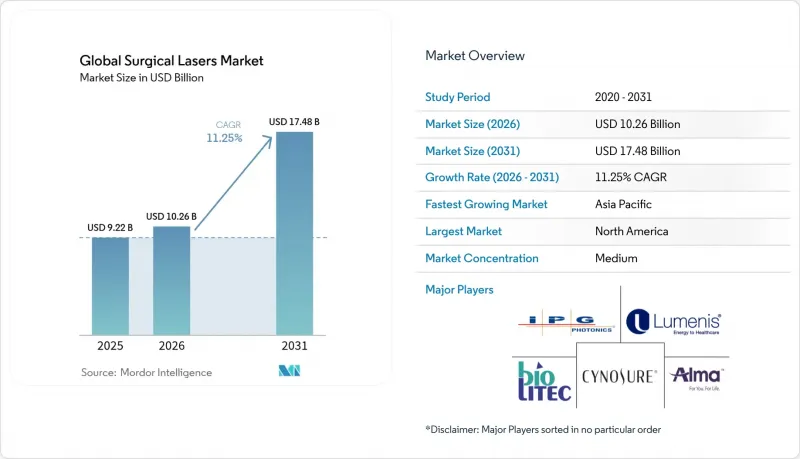
Mordor Intelligence에 의하면, 수술용 레이저 시장 규모는 2025년 92억 2,000만 달러에서 2026년에는 102억 6,000만 달러로 확대되어 2026년부터 2031년까지 CAGR 11.25%로 성장을 지속하여, 2031년에는 174억 8,000만 달러에 이를 것으로 예측됩니다.
본 보고서에서는 업계를 레이저 유형(이산화탄소(CO2) 레이저, Nd:YAG 레이저 등), 수술 방법(개복 수술, 복강경 수술 등), 용도(피부과, 안과, 비뇨기과 등), 최종 사용자(병원, 외래수술센터(ASC) 등) 및 지역별로 분류하고 있습니다. 시장 규모 및 전망은 금액(달러) 기준으로 제시되어 있습니다.
세계 수술용 레이저 시장 동향 및 인사이트
빔 성형 광학 시스템의 기술적 진보
현재, 액체 렌즈 모듈은 플렉서블 파이버 내부의 초점 편차를 보정하여 700µm을 초과하는 깊이에서 안정적인 절삭을 가능하게 하며, 이는 기존 한계의 3배 이상에 달할 전망입니다. MIT에서 개발된 파이버 셰이퍼는 빔 패턴을 최적화하여 산란을 절반으로 줄이고, 수술 중 영상 진단에 필수적인 생체 조직의 본래 구조를 유지합니다. 광간섭 단층 촬영(OCT)과 결합함으로써, 외과의는 서브mm 단위의 절제를 안내하는 실시간 단면 이미지를 얻을 수 있습니다. 효율 향상으로 평균 펄스 에너지도 감소되어 열 손상의 허용 범위가 축소됩니다. 이러한 발전이 결합되어 환자 안전성이 향상되고 수술 시간이 단축되므로, 수술용 레이저 시장에는 측정 가능한 품질상의 우위가 생겨나며, 병원은 사례 회전율 향상을 통해 수익 창출을 도모할 수 있습니다.
최소 침습 수술 및 당일 수술로의 전환
2025년 CMS 규정에 따라 ASC(외래수술센터)에 대한 지급액이 2.6% 인상된 것이 뒷받침되어, 현재 백내장 및 담낭 수술의 대부분이 국소 마취 하에 외래 시설에서 이루어지고 있습니다. 환자는 당일 퇴원 및 대기 목록 20% 단축이라는 혜택을 누리는 한편, 보험사는 시설 이용료를 최대 45% 절감할 수 있어 수술용 레이저 시장으로의 수술 건수 이동이 더욱 가속화되고 있습니다. 연기 포집 기능과 퀵 스왑 방식의 파이버 핸드피스를 갖춘 레이저 플랫폼은 ASC의 워크플로우에 적합하며, 수술실 회전 시간을 최소화합니다. 외래 센터들이 내시경과 레이저 절단을 결합한 로봇 카트에 투자함에 따라, 비용 효율성을 저해하지 않으면서 수술의 복잡성은 점차 높아지고 있습니다.
높은 설비 투자 및 시술 비용
최첨단 펨토초 워크스테이션의 가격은 50만 달러를 초과하기도 하여, 진료 보수가 시술 기법에 관계없이 책정되는 소규모 클리닉에게는 장벽이 되고 있습니다. 비용 대비 효과 연구에 따르면, 시력 개선 효과가 확인된 경우라도 사례 수가 적은 환경에서는 투자 회수 기간이 5년을 초과한다고 지적되고 있습니다. 레이저 안전 책임자 교육 및 환기 설비 업그레이드가 의무화되어 있는 점도 간접비 증가로 이어지고 있습니다. 인도주의적 백내장 치료 프로젝트에서는 한쪽 눈당 276달러로 시술이 이루어지는 반면, 막대한 설비 투자 비용은 도입 격차를 여실히 드러내고 있습니다. 신흥국 시장의 가격 민감도가 판매 대수를 억제하며, 전 세계 수술용 레이저 시장의 성장세를 둔화시키고 있습니다.
부문 분석
이산화탄소(CO2) 레이저 시스템은 이비인후과 및 산부인과 분야에서 높은 신뢰도를 바탕으로 2025년 매출의 34.18%를 차지했습니다. 102억 6,000만 달러 규모의 수술용 레이저 시장은 출혈을 최소화하면서 정밀한 증발을 수행한다는 점에서 여전히 CO2에 의존하고 있습니다. 그러나 연평균 성장률(CAGR) 12.18%를 나타낼 것으로 예측되는 다이오드 방식 장치는 445 nm의 파장을 통해 연조직을 효율적으로 절제하면서도 전력 소비를 줄임으로써, 보급형 CO2 장치 시장 점유율을 잠식하고 있습니다. 각 제조업체는 외래수술센터(ASC)의 예산에 맞추어 휴대용 케이스 및 소모품 비용 절감을 중시하고 있습니다. 포토닉 크리스탈 파이버 기술이 성숙해짐에 따라 다이오드의 빔 품질이 향상되어, 이비인후과 외과의들은 주변 부위에 미치는 열적 영향을 최소화하면서 1mm의 절개 깊이를 실현할 수 있게 되었습니다. 이러한 추세는 점진적이긴 하지만 지속적인 다각화를 시사하며, 유리관식 CO2 레이저의 생산 능력을 위협하는 헬륨 부족으로부터 공급망을 보호하고 있습니다.
이산화탄소 레이저 공급업체들은 중적외선 모듈을 통합한 하이브리드 시스템으로 대응하며, 피부과 및 종양학 분야의 이용 사례를 확대되고 있습니다. 엑시머 레이저 플랫폼은 각막 성형술에서 여전히 필수적이며, 현재는 미세 사카드를 교정하는 능동형 시선 추적 기능을 통합하여 치료 결과의 예측 가능성을 높이고 있습니다. 파이버 레이저 및 Er:YAG 레이저 설계는 척추 감압술에서 로봇과 결합되어 있으며, 하드웨어를 수술 방식에 특화된 소프트웨어와 연계함으로써 수술용 레이저 시장을 확대하려는 전략을 반영하고 있습니다.
기존의 수술 프로토콜과 외과의사의 관행이 뿌리 깊게 자리 잡고 있어, 2025년 수술 건수의 32.30%는 여전히 개복 수술이 차지하고 있습니다. 그럼에도 불구하고 로봇 보조 수술 건수는 연평균 성장률(CAGR) 12.36%로 증가하고 있으며, 이미 미국 주요 의료기관에서 시행되는 전립선 전적출술의 4분의 1을 차지하고 있습니다. 레이저 엔드 이펙터에 내장된 힘 피드백 센서 덕분에 조직 손상이 43% 감소하여 외과의사의 자신감을 뒷받침하고 있습니다. 소프트웨어 업데이트가 원격으로 배포됨에 따라, 이미 도입된 로봇은 하드웨어를 교체하지 않고도 새로운 레이저 모드를 활용할 수 있게 되어, 수술용 레이저 시장을 서비스 기반의 수익 모델로 이끌고 있습니다.
고해상도 영상 기술과 시인성을 유지하는 플룸 흡입 필터의 지원에 힘입어, 복강경 레이저 수술의 도입은 꾸준히 확대되고 있습니다. 경피적 결석 분쇄술에서는 툴륨 파이버의 효율성 덕분에 수술 시간 단축과 마취 노출 감소가 실현되고 있습니다. 이러한 변화들이 결합되어 레이저, 로봇, 영상 진단 플랫폼이 단일 디지털 생태계로 기능하는 수술실이 형성되고 있으며, 신규 시장 진출기업에 대한 진입 장벽이 높아지고 있습니다.
지역별 분석
북미는 기술의 조기 도입, 유리한 보험사 정책, 그리고 고밀도의 ASC(외래수술센터) 네트워크를 배경으로 2025년 매출의 44.72%를 차지했습니다. ‘da Vinci 5’ 로봇 및 ‘TENEO’ 엑시머 레이저의 FDA 승인은 임상적 선례를 확립하고, 장비 교체 주기를 뒷받침하고 있습니다. 주요 의료기기 제조업체들은 병원들이 ‘레이저 통지 제56호’를 준수하기 위해 장비를 업데이트함에 따라 미국에서 두 자릿수 매출 성장을 기록하고 있습니다. 그러나 헬륨 가격의 급등이 지속됨에 따라 의료 서비스 제공업체들은 광섬유 기반 대체 제품으로 전환하고 있으며, 이는 전 세계 공급 전략에 영향을 미치는 지역적 변화를 나타냅니다.
아시아태평양은 2031년까지 연평균 성장률(CAGR) 12.89%를 나타낼 것으로 전망됩니다. 중국의 공적 보험 확대는 로봇 및 레이저 수술의 두 자릿수 성장을 뒷받침하고 있으며, 일본 외래 유리체 망막 수술의 97.3% 성공률은 외래에서 진행되는 복잡한 수술의 유효성을 입증하고 있습니다. 인도의 도시 지역 병원 체인은 다학제적 레이저 장비에 대한 투자를 추진하고 있지만, 한편으로는 보험 환급 지연이 지방으로의 보급을 저해하고 있습니다. 한국과 싱가포르의 정부 자금 지원 암 센터에서는 듀얼 파장 대응 레이저 수술실이 도입되어 있으며, 이는 수술용 레이저 시장에서 지속적인 투자 추세를 보여줍니다.
유럽에서는 균형 잡힌 발전이 이루어지고 있습니다. IEC 규격과의 조화를 통해 국경을 넘는 거래가 간소화되었으며, 에너지 효율이 뛰어난 파이버 레이저는 기존 CO2 레이저 모델의 약 3분의 1에 해당하는 전력만 소비하므로, 해당 지역의 지속가능성 관련 규정에도 부합합니다. 동유럽 국가들은 EU의 구조 기금을 활용하여 수술실 현대화를 추진하고 있지만, 보험 환급 한도로 인해 고급 장비 도입은 제한되고 있습니다. 중동과 남미는 신흥 시장으로, 의료 관광 및 민간 병원 그룹이 고성능 장비 구매를 주도하고 있으나, 환율 변동과 헬륨 현물 시장 공급 부족이 운영상의 장벽으로 작용하고 있습니다.
기타 혜택:
- 엑셀 형식 시장 예측(ME) 시트
- 3개월간의 애널리스트 지원
자주 묻는 질문
목차
제1장 서론
제2장 조사 방법
제3장 주요 요약
제4장 시장 구도
제5장 시장 규모와 성장 예측
제6장 경쟁 구도
제7장 시장 기회와 향후 전망
JHS 26.08.26According to Mordor Intelligence, the surgical laser market size is expected to grow from USD 9.22 billion in 2025 to USD 10.26 billion in 2026 and is forecast to reach USD 17.48 billion by 2031 at 11.25% CAGR over 2026-2031.
This report Segments the Industry Into Laser Type (Carbon Dioxide (CO2) Lasers, Nd:yag Lasers, and More), Procedure (Open Surgery, Laparoscopic Surgery, and More), Application (Dermatology, Ophthalmology, Urology, and More), End User (Hospitals, Ambulatory Surgical Centres, and More), and Geography. The Market Sizes and Forecasts are Provided in Terms of Value (USD).
Global Surgical Lasers Market Trends and Insights
Technological Advancements in Beam-Shaping Optics
Liquid-lens modules now correct focal drift inside flexible fibers, enabling steady ablation at depths past 700 µm-more than triple previous limits . Fiber shapers developed at MIT tailor beam patterns that cut scattering by half and preserve native tissue architecture, which is crucial for intra-operative imaging. When paired with optical coherence tomography, surgeons receive real-time cross-sections that guide submillimeter resections. Efficiency gains also reduce average pulse energy, lowering thermal damage margins. Collectively, these advances enhance patient safety and shrink operative time, giving the surgical laser market a measurable quality edge that hospitals can monetize through faster case turnover.
Preference for Minimally-Invasive & Day-Care Surgeries
Ambulatory facilities now perform a majority of cataract and gall-bladder cases under local anesthesia, encouraged by a 2025 CMS rule that raises ASC payments by 2.6%. Patients benefit from same-day discharge and 20% shorter wait lists, while payers save up to 45% on facility fees, reinforcing a volume shift into the surgical laser market. Laser platforms with plume-capture and quick-swap fiber handpieces fit ASC workflows and minimize room turnaround time. As outpatient centers invest in robotic carts that combine endoscopy and laser cutting, procedure complexity gradually rises without eroding cost efficiency.
High Capital & Procedural Costs
State-of-the-art femtosecond workstations can exceed USD 500,000, a hurdle for smaller clinics whose reimbursements remain technique-agnostic. Cost-utility studies confirm visual gains but note payback periods beyond five years in low-volume settings. Mandatory laser safety officer training and ventilation upgrades add overhead. Where humanitarian cataract missions operate at USD 276 per eye, capital intensity underscores adoption gaps . Price sensitivity in emerging economies dampens unit sales and tempers the global surgical laser market trajectory.
Other drivers and restraints analyzed in the detailed report include:
- Rising Incidence of Ophthalmic & Urologic Disorders
- Regulatory Approvals Expanding Clinical Indications
- Reimbursement Gaps in Emerging Economies
For complete list of drivers and restraints, kindly check the Table Of Contents.
Segment Analysis
Carbon dioxide systems held 34.18% of 2025 revenue, owing to their reliability in ENT and gynecology. At USD 10.26 billion, the surgical laser market size continues to rely on CO2 for precise vaporization with minimal bleeding. Yet diode units, projected to expand at 12.18% CAGR, are eroding entry-level CO2 share as 445 nm wavelengths cut soft tissue efficiently while consuming less power. Manufacturers emphasize portable chassis and lower consumable costs, aligning with ASC budgets. As photonic-crystal fibers mature, diode beam quality improves, allowing ENT surgeons to achieve 1 mm cut depths with limited collateral heat. The trend suggests incremental but persistent diversification, safeguarding supply chains from helium scarcity that threatens glass-tube CO2 capacity.
Carbon dioxide suppliers counter with hybrid systems that embed mid-infrared modules to expand dermatology and oncology use cases. Excimer platforms remain irreplaceable for corneal reshaping and now incorporate active-eye tracking to compensate for micro-saccades, boosting outcome predictability. Fiber and Er:YAG designs pair with robots for spine decompression, reflecting a strategy to widen the surgical laser market by tying hardware to procedure-specific software.
Open surgery retained 32.30% of 2025 procedures as legacy protocols and surgeon familiarity persist. Nonetheless, robot-assisted cases are climbing at 12.36% CAGR and already represent a quarter of prostatectomies in leading U.S. centers. Force-feedback sensors integrated into laser end-effectors trim tissue damage by 43%, supporting surgeon confidence. As software updates roll out remotely, installed robots gain new laser modalities without hardware swaps, pushing the surgical laser market toward service-based revenue.
Laparoscopic laser adoption grows steadily, bolstered by high-resolution imaging and plume suction filters that preserve visibility. Percutaneous lithotripsy benefits from thulium-fiber efficiency, shortening operative times and lowering anesthesia exposure. Together, these shifts point to a surgical suite where lasers, robots and imaging platforms operate as a single digital ecosystem, raising entry barriers for newcomers.
Complete Report Scope:
- By Laser Type
- Carbon Dioxide (CO2) Lasers
- Nd:YAG Lasers
- Diode Lasers
- Holmium:YAG Lasers
- Fiber & Er:YAG Lasers
- Excimer Lasers
- Other Lasers
- By Procedure
- Open Surgery
- Laparoscopic Surgery
- Percutaneous Surgery
- Robot-assisted Surgery
- By Application
- Dermatology
- Ophthalmology
- Urology
- Dentistry
- Gynecology
- Cardiology
- Gastroenterology
- Oncology
- Other Applications
- By End User
- Hospitals
- Ambulatory Surgical Centres
- Specialty & Aesthetic Clinics
- Other End Users
- By Geography
- North America
- United States
- Canada
- Mexico
- Europe
- Germany
- United Kingdom
- France
- Italy
- Spain
- Rest of Europe
- Asia-Pacific
- China
- Japan
- India
- South Korea
- Australia
- Rest of Asia-Pacific
- Middle East
- GCC
- South Africa
- Rest of Middle East
- South America
- Brazil
- Argentina
- Rest of South America
- North America
Geography Analysis
North America generated 44.72% of 2025 revenue on the back of early technology adoption, favorable payer policies and a dense ASC network. FDA approvals of the da Vinci 5 robot and TENEO excimer laser set clinical precedents and underpin replacement cycles. Large device firms report double-digit U.S. revenue gains as hospitals refresh fleets to comply with Laser Notice No. 56. Persistent helium cost inflation, however, nudges providers toward fiber-based alternatives, illustrating a regional pivot that influences global supply strategies.
Asia-Pacific is poised for 12.89% CAGR through 2031. Public insurance expansion in China has spurred double-digit growth in robotic-laser procedures, and Japan's 97.3% success rate in office-based vitreoretinal work validates outpatient complex surgery. India's urban hospital chains invest in multi-specialty lasers even as reimbursement lag restrains rural penetration. Government-funded cancer centers in South Korea and Singapore are installing dual-wavelength suites, signaling sustained investment momentum within the surgical laser market.
Europe shows balanced progress. Harmonization with IEC standards simplifies cross-border trade, and energy-efficient fiber lasers align with the region's sustainability regulations, consuming roughly one-third of the electricity of legacy CO2 models. Eastern European nations leverage EU structural funds to modernize ORs, though reimbursement ceilings temper high-end adoption. The Middle East and South America represent emerging corridors, where medical tourism and private hospital groups drive premium equipment purchases, yet currency volatility and spot helium shortages present operational hurdles.
- Lumenis
- Boston Scientific
- IPG Photonics
- Cynosure
- Alma Lasers
- Biolitec
- Fotona
- Candela Medical
- Cutera
- BIOLASE
- Alcon
- Abbott Laboratories
- Iridex
- BISON Medical
- Spectranetics (Philips)
- El.En. SpA
- Quanta System
- Gigaalaser
- OmniGuide
- Asclepion Laser Technologies
Additional Benefits:
- The market estimate (ME) sheet in Excel format
- 3 months of analyst support
TABLE OF CONTENTS
1 Introduction
- 1.1 Study Assumptions & Market Definition
- 1.2 Scope of the Study
2 Research Methodology
3 Executive Summary
4 Market Landscape
- 4.1 Market Overview
- 4.2 Market Drivers
- 4.2.1 Technological advancements in beam-shaping optics
- 4.2.2 Preference for minimally-invasive & day-care surgeries
- 4.2.3 Rising incidence of ophthalmic & urologic disorders
- 4.2.4 Regulatory approvals expanding clinical indications
- 4.2.5 Rapid adoption of outpatient laser suites (ASC model)
- 4.2.6 AI-driven real-time laser dosimetry & workflow gains
- 4.3 Market Restraints
- 4.3.1 High capital & procedural costs
- 4.3.2 Reimbursement gaps in emerging economies
- 4.3.3 Global helium shortage disrupting CO2-tube supply
- 4.3.4 Tighter plume-safety rules inflating compliance spend
- 4.4 Value / Supply-Chain Analysis
- 4.5 Regulatory Landscape
- 4.6 Technological Outlook
- 4.7 Porter's Five Forces Analysis
- 4.7.1 Threat of New Entrants
- 4.7.2 Bargaining Power of Buyers
- 4.7.3 Bargaining Power of Suppliers
- 4.7.4 Threat of Substitutes
- 4.7.5 Intensity of Competitive Rivalry
5 Market Size & Growth Forecasts (Value)
- 5.1 By Laser Type
- 5.1.1 Carbon Dioxide (CO2) Lasers
- 5.1.2 Nd:YAG Lasers
- 5.1.3 Diode Lasers
- 5.1.4 Holmium:YAG Lasers
- 5.1.5 Fiber & Er:YAG Lasers
- 5.1.6 Excimer Lasers
- 5.1.7 Other Lasers
- 5.2 By Procedure
- 5.2.1 Open Surgery
- 5.2.2 Laparoscopic Surgery
- 5.2.3 Percutaneous Surgery
- 5.2.4 Robot-assisted Surgery
- 5.3 By Application
- 5.3.1 Dermatology
- 5.3.2 Ophthalmology
- 5.3.3 Urology
- 5.3.4 Dentistry
- 5.3.5 Gynecology
- 5.3.6 Cardiology
- 5.3.7 Gastroenterology
- 5.3.8 Oncology
- 5.3.9 Other Applications
- 5.4 By End User
- 5.4.1 Hospitals
- 5.4.2 Ambulatory Surgical Centres
- 5.4.3 Specialty & Aesthetic Clinics
- 5.4.4 Other End Users
- 5.5 By Geography
- 5.5.1 North America
- 5.5.1.1 United States
- 5.5.1.2 Canada
- 5.5.1.3 Mexico
- 5.5.2 Europe
- 5.5.2.1 Germany
- 5.5.2.2 United Kingdom
- 5.5.2.3 France
- 5.5.2.4 Italy
- 5.5.2.5 Spain
- 5.5.2.6 Rest of Europe
- 5.5.3 Asia-Pacific
- 5.5.3.1 China
- 5.5.3.2 Japan
- 5.5.3.3 India
- 5.5.3.4 South Korea
- 5.5.3.5 Australia
- 5.5.3.6 Rest of Asia-Pacific
- 5.5.4 Middle East
- 5.5.4.1 GCC
- 5.5.4.2 South Africa
- 5.5.4.3 Rest of Middle East
- 5.5.5 South America
- 5.5.5.1 Brazil
- 5.5.5.2 Argentina
- 5.5.5.3 Rest of South America
- 5.5.1 North America
6 Competitive Landscape
- 6.1 Market Concentration
- 6.2 Market Share Analysis
- 6.3 Company Profiles (includes Global level Overview, Market level overview, Core Segments, Financials as available, Strategic Information, Market Rank/Share for key companies, Products & Services, and Recent Developments)
- 6.3.1 Lumenis
- 6.3.2 Boston Scientific
- 6.3.3 IPG Photonics
- 6.3.4 Cynosure
- 6.3.5 Alma Lasers
- 6.3.6 biolitec AG
- 6.3.7 Fotona
- 6.3.8 Candela Medical
- 6.3.9 Cutera
- 6.3.10 Biolase
- 6.3.11 Alcon
- 6.3.12 Abbott Laboratories
- 6.3.13 IRIDEX Corp.
- 6.3.14 BISON Medical
- 6.3.15 Spectranetics (Philips)
- 6.3.16 El.En. SpA
- 6.3.17 Quanta System
- 6.3.18 Gigaalaser
- 6.3.19 OmniGuide
- 6.3.20 Asclepion Laser Technologies
7 Market Opportunities & Future Outlook
- 7.1 White-space & Unmet-need Assessment