
|
시장보고서
상품코드
2114899
안과용 점탄성 물질 시장 : 시장 점유율 분석, 업계 동향 및 통계, 성장 예측(2026-2031년)Ophthalmic Viscosurgical Devices - Market Share Analysis, Industry Trends & Statistics, Growth Forecasts (2026 - 2031) |
||||||
 Mordor Intelligence
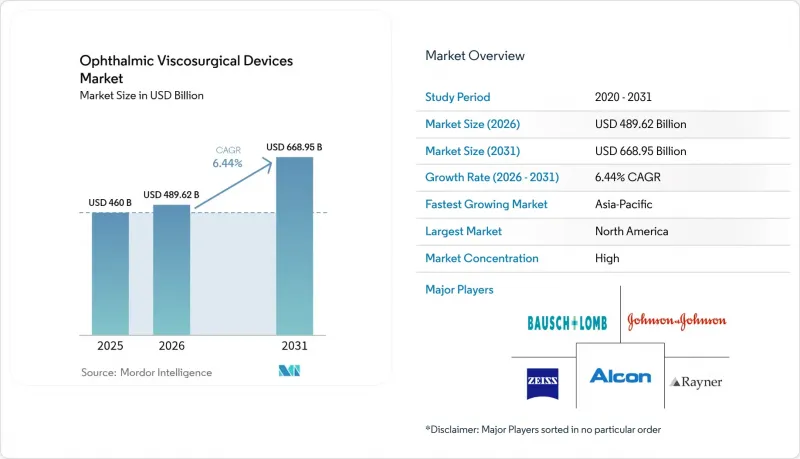
Mordor Intelligence에 의하면, 안과용 점탄성 물질 시장 규모는 2025년 4억 6,000만 달러로 평가되었고, 2026년에는 4억 8,962만 달러로 추정되고, 2026-2031년 CAGR 6.44%로 성장을 지속할 전망이며, 2031년에는 6억 6,895만 달러에 이를 것으로 예측됩니다.
본 보고서는 유형별(응집형, 분산형, 점탄성 적응형), 원료별(생물 유래(세균 유래 HA), 기타), 용도별(백내장 수술, 기타), 최종 사용자별(병원, 안과 전문 클리닉, 기타), 지역별(북미, 유럽, 아시아태평양, 중동 및 아프리카, 남미)로 분류되어 있습니다. 시장 예측은 금액(달러) 기준으로 제시되어 있습니다.
세계의 안과용 점탄성 물질 시장 동향 및 인사이트
백내장 발병 위험이 높은 고령층 증가
백내장으로 인한 장애 조정 생명년(DALY) 손실은 2019년 668만에서 2021년 710만으로 증가했으며, 발생률 추세가 유지되어 2025년까지 750만을 넘어섰습니다. 2024년 메타분석에 따르면, 2020년에는 1,700만 명이 백내장으로 실명했으며, 8,350만 명이 중등도에서 중증의 시력 장애를 겪고 있는 것으로 보고되었습니다. 고소득 국가의 병원에서는 현재 백내장 수술 대기 기간이 중앙값 기준으로 6주에 달하고 있으며, 이는 점탄성 물질 주사기의 기준 사용량을 직접적으로 끌어올리고 있습니다. 평균 수명이 1년 늘어날 때마다 수술 대상자 수가 증가함에 따라, 안과용 점탄성 물질 시장은 전체 안과용 소모품 시장을 상회하는 성장세를 지속하고 있습니다. 2025년 초에 발표된 선주문 현황은 충족되지 않은 수요를 여실히 드러내고 있으며, 시술당 투여량이 일정하더라도 기기 판매 견인력이 더욱 강해질 것임을 시사합니다.
당뇨병과 관련된 안과 합병증 발생률 증가
당뇨병을 앓고 있는 성인은 당뇨병이 없는 동년배에 비해 백내장 발병이 빠르고 진행 속도도 빠르기 때문에 첫 수술 연령이 앞당겨지고 평생에 걸친 점탄성 물질 사용 기간이 길어집니다. 정기적인 조기 검진을 통해 치료율이 상승하고 있으며, 그 효과는 녹내장 및 유리체 절제술 적응증 분야로도 파급되고 있습니다. 각 제조업체는 현재 수술 후 안압의 급격한 상승을 억제하는 배합을 중시하고 있으며, 이러한 특성을 임상적 차별화 요인으로 삼고 있습니다. 젊은 연령대의 당뇨병 환자를 치료하는 안과 의사들은 내피의 무결성을 유지하는 비스코어어댑티브 제제를 선호하여, 이에 따라 프리미엄급 수요가 뒷받침되고 있습니다. 따라서 안과용 점탄성 물질 시장은 환자층 확대와 고부가가치 제품 구성이라는 이중의 호재를 누리고 있습니다.
프리미엄 OVD 등급의 가격 민감도와 보상 상한선
ASC(외래수술센터(ASC))에 대한 결제는 병원의 외래 진료 요금표와 연동되어 있으며, 점탄성 물질의 비용은 보다 광범위한 백내장 치료의 보험 환급 패키지에 포함됩니다. 지급 상한으로 인해 이익률이 압박을 받으면, 조달 팀은 중저가 제제로 전환하거나 대량 구매를 통한 할인을 협상하게 됩니다. 금액 기준 예산으로 운영되는 유럽의 병원들은 고가 제품으로의 전환을 승인하기 전에, 동료 심사를 거친 내피 세포 손실 데이터를 요구하며, 탄탄한 임상 지원 프로그램에 자금을 지원하는 기업을 우선시하고 있습니다. 이러한 보험 지급액의 축소로 인해 안과용 점탄성 물질 시장에서 프리미엄 제품의 비중 확대는 완만해지겠지만, 전체적인 수량 증가를 저해하지는 않을 것입니다.
부문 분석
2025년, 안과용 점탄성 물질 시장 규모에서 분산형 약제가 37.33%라는 최대 점유율을 차지했습니다. 이는 수정체 핵 분해 과정에서 섬세한 조직을 코팅할 수 있다는 장점이 높이 평가되었기 때문입니다. 외과의사는 가성 박리, 얕은 전방, 라식(LASIK) 수술 후 사례와 같은 복잡한 백내장 사례에 대해, 단일 수술 내에서 분산형과 응집형 OVD를 번갈아 사용함으로써 대응하고 있으며, 이로 인해 사례당 사용량이 증가하고 있습니다. 현재 혁신적인 제조업체들은 분산형 제제에 항산화 첨가제를 배합하고 있어, 비용을 중시하는 입찰에서도 가격 수준을 유지하고 있습니다.
점탄성 적응형 혼합은 우수한 내피 보호가 요구되는 프리미엄 인공수정체(IOL) 사례에 힘입어 2031년까지 연평균 성장률(CAGR) 7.59%라는 가장 빠른 속도로 확대되고 있습니다. 이러한 약제는 저전단 조건에서는 응집성을, 고유량 조건에서는 분산성을 나타내므로, 파코유화술이나 펨토초 레이저를 이용한 파쇄 과정 중에도 방수의 안정성을 유지합니다. 각 제조업체는 점탄성 적응형 주사기를 주입 시스템과 결합함으로써 외과의사의 지지를 확보하고, 안과용 점탄성 물질 시장으로의 침투를 더욱 심화시키고 있습니다.
세균 유래 히알루론산은 2025년에 안과용 점탄성 물질 시장 점유율의 39.02%를 차지한 것으로 평가되었으며, 일관된 사슬 길이와 낮은 면역원성으로 높은 평가를 받고 있습니다. 병원에서는 동물 유래 성분을 사용하지 않는 조달을 중시하는 지속가능성 평가 기준에 이러한 제품들을 부합시키고 있습니다. 공급의 신뢰성 또한 이 부문의 리더십을 더욱 공고히 하고 있습니다.
반합성/발효 등급은 2031년까지 연평균 성장률(CAGR) 8.74%를 기록할 전망입니다. 발효 기술을 통해 신속한 생산 규모 확대와 분자량의 정밀한 제어가 가능해져, 백내장과 녹내장의 합병증 사례에 맞춘 맞춤형 배합이 실현됩니다. 조달 담당자들은 가축 질병으로 인한 공급 충격의 영향을 받지 않는다는 점을 높이 평가하고 있으며, 안과용 점탄성 물질 시장에서 발효 경로의 전략적 매력이 높아지고 있습니다. 동물 유래 원료는 가격 면에서 여전히 일정한 입지를 유지하고 있으나, 규제 당국이 동물성 단백질 감축을 권장함에 따라 그 점유율은 점차 축소되고 있습니다.
지역별 분석
2025년, 북미는 전 세계 안과용 점탄성 물질 시장 규모의 37.58%를 차지했습니다. 이는 견실한 보험 환급 제도와 안과 의사의 밀집된 분포에 힘입은 결과입니다. 메디케어에 따르면, 백내장 적출술은 외래수술센터(ASC)에서 시행되는 수술 건수의 약 19%를 차지하며 가장 많이 시행되는 수술입니다. 71세 이상의 미국 성인 중 약 27.8%가 시각 장애를 보고하고 있으며, 이는 수술 건수 증가를 뒷받침하고 있습니다. 점탄성 물질과 파코칩, 인공수정체(IOL) 주입기를 결합한 일괄 구매 계약이 확산되고 있으며, 공급업체에 대한 락인 현상이 정착되고 있습니다.
아시아태평양은 2031년까지 연평균 성장률(CAGR) 7.68%로 가장 높은 성장세를 보이고 있습니다. 중국과 인도에서 건강보험이 확대되면서 백내장 수술이 보편화되고 있는 반면, 지방 의료기관에서는 펨토초 레이저 플랫폼으로의 전환이 진행되고 있어 고성능 점탄성 물질이 필요로 되고 있습니다. 중국 남서부 지역의 조사에 따르면, 과거에 굴절 교정 수술을 받은 경험이 있거나 고도 근시인 백내장 환자의 비율이 증가하고 있는 것으로 나타났습니다. 보험 환급에서 프리미엄 IOL이 인정되기 시작함과 동시에, 듀얼 액션형 점탄성 물질이 외과의사들의 지지를 얻으며 해당 지역의 제품 구성을 개선하고, 안과용 점탄성 물질 시장에 증분 수익을 가져오고 있습니다.
유럽은 여전히 대규모 시장 기반을 유지하고 있지만, 가치 중심의 조달 기준이 엄격해지고 있습니다. 병원 측은 프리미엄 제품으로의 업그레이드를 승인하기 전에 내피세포 손실에 대한 직접 비교 데이터를 요구하고 있어, 임상 증거에 대한 투자 예산이 충실한 기업이 유리한 입장에 있습니다. 지역 학회는 인공수정체 포장으로 인한 배출량을 67% 감축하는 것을 목표로 전자판 사용 설명서 채택을 제안하고 있습니다. 친환경 인증 포장에 대한 조기 대응은 입찰 평가 점수 향상으로 이어져, 안과용 점탄성 물질 시장에서의 점유율 유지에 기여할 가능성이 있습니다.
기타 혜택
- 엑셀 형식 시장 예측(ME) 시트
- 3개월간의 애널리스트 지원
자주 묻는 질문
목차
제1장 서론
제2장 조사 방법
제3장 주요 요약
제4장 시장 구도
제5장 시장 규모 및 성장 예측
제6장 경쟁 구도
제7장 시장 기회 및 향후 전망
AJY 26.08.28According to Mordor Intelligence, the ophthalmic viscosurgical devices market size is expected to grow from USD 460 million in 2025 to USD 489.62 million in 2026 and is forecast to reach USD 668.95 million by 2031 at 6.44% CAGR over 2026-2031.
This report is Segmented by Type (Cohesive, Dispersive, and Viscoadaptive), Source (Biological (Bacteria-Derived HA), and More), Application (Cataract Surgery, and More), End User (Hospitals, Specialty Ophthalmic Clinics, and More), and Geography (North America, Europe, Asia-Pacific, The Middle East and Africa, and South America). The Market Forecasts are Provided in Terms of Value (USD).
Global Ophthalmic Viscosurgical Devices Market Trends and Insights
Demographic Expansion of the Cataract-Prone Elderly Cohort
Disability-adjusted life years lost to cataract rose from 6.68 million in 2019 to 7.1 million in 2021 and could exceed 7.5 million by 2025 if incidence trends hold. A 2024 meta-analysis logged 17 million people blind and 83.5 million experiencing moderate-to-severe visual impairment from cataract in 2020. Hospitals in high-income countries now face six-week median waitlists for extraction slots, directly inflating baseline use of viscoelastic syringes. Every additional year of life expectancy raises the surgical funnel, ensuring that the ophthalmic viscosurgical devices market keeps outpacing the broader ophthalmology consumables sector. Forward bookings released in early 2025 underscore unmet demand, implying stronger device pull-through even when per-procedure dosing remains constant.
Escalating Incidence of Diabetes-Linked Ocular Complications
Adults with diabetes develop cataract earlier and more aggressively than non-diabetic peers, pulling forward first-surgery age and lengthening lifetime exposure to viscoelastics. Routine early screening raises intervention rates that spill over into glaucoma and vitrectomy indications. Manufacturers now emphasize formulas that temper postoperative intraocular pressure spikes, positioning such attributes as clinical differentiators. Surgeons treating younger diabetic cohorts favor viscoadaptives that preserve endothelial integrity, reinforcing premium-tier demand. The ophthalmic viscosurgical devices market therefore benefits from a double-lift of larger patient cohorts and higher-value product mix.
Price Sensitivity and Reimbursement Caps on Premium OVD Grades
ASC payments are tethered to the hospital outpatient schedule, bundling viscoelastic costs into wider cataract reimbursement packages. When payment ceilings squeeze margins, procurement teams pivot toward mid-tier formulations or negotiate bulk discounts. European hospitals operating under value-based budgets demand peer-reviewed endothelial cell-loss data before approving costlier upgrades, favoring companies that fund robust clinical-support programs. This reimbursement compression moderates premium-mix expansion within the ophthalmic viscosurgical devices market without derailing overall volume growth.
Other drivers and restraints analyzed in the detailed report include:
- Technological Evolution in Phaco, Femto and MIGS Platforms
- Growing Surgical Capacity via ASCs and National Blindness-Prevention Programs
- Availability of Low-OVD or OVD-Free Surgical Techniques
For complete list of drivers and restraints, kindly check the Table Of Contents.
Segment Analysis
Dispersive agents accounted for the largest 37.33% share of the ophthalmic viscosurgical devices market size in 2025, benefiting from their ability to coat delicate tissue during nucleus disassembly. Surgeons manage complex cataract presentations-pseudoexfoliation, shallow chambers, post-LASIK cases-by alternating dispersive and cohesive OVDs within a single procedure, lifting per-case volume. Innovators now embed anti-oxidant additives into dispersive formulations, defending price points even in cost-sensitive tenders.
Viscoadaptive blends are expanding fastest at a 7.59%CAGR to 2031, propelled by premium intraocular lens (IOL) cases that demand superior endothelial protection. These agents behave cohesively under low shear and disperse under high flow, maintaining chamber stability during phacoemulsification or femtosecond fragmentation. Manufacturers tie viscoadaptive syringes to injector systems, locking in surgeon loyalty and deepening penetration of the ophthalmic viscosurgical devices market.
Bacteria-derived hyaluronic acid secured a 39.02% slice of the ophthalmic viscosurgical devices market share in 2025, prized for consistent chain length and low immunogenicity. Hospitals align these products with sustainability scorecards that favor animal-free sourcing. Supply reliability further cements the segment's leadership.
Semi-synthetic/fermentation grades are slated for an 8.74%CAGR through 2031. Fermentation allows rapid scale-up and precise molecular-weight control, enabling custom blends for combined cataract-glaucoma cases. Procurement teams appreciate insulation from livestock disease shocks, increasing the strategic appeal of fermentation routes within the ophthalmic viscosurgical devices market. Animal-derived sources retain a foothold on price but are ceding ground as regulators endorse animal-protein reduction.
Complete Report Scope:
- By Type
- Cohesive
- Dispersive
- Viscoadaptive
- By Source
- Biological (Bacteria-Derived HA)
- Animal (Rooster Comb, Porcine, Bovine)
- Semi-Synthetic / Fermentation-Based
- By Application
- Cataract Surgery
- Corneal Grafting / Keratoplasty
- Other Applications
- By End User
- Hospitals
- Specialty Ophthalmic Clinics
- Ambulatory Surgery Centers (ASCs)
- Other End-users
- Geography
- North America
- United States
- Canada
- Mexico
- Europe
- Germany
- United Kingdom
- France
- Italy
- Spain
- Rest of Europe
- Asia Pacific
- China
- Japan
- India
- Australia
- South Korea
- Rest of Asia Pacific
- Middle East & Africa
- GCC
- South Africa
- Rest of Middle East & Africa
- South America
- Brazil
- Argentina
- Rest of South America
- North America
Geography Analysis
North America represented 37.58% of the global ophthalmic viscosurgical devices market size in 2025, underpinned by robust reimbursement and dense ophthalmologist distribution. Medicare confirms cataract extraction as the top surgical episode in ASCs at roughly 19% of volume. Nearly 27.8% of U.S. adults aged 71+ report visual impairment, reinforcing surgical load. Bundled purchase agreements that link viscoelastic with phaco tips and IOL injectors are gaining traction, cementing supplier lock-in.
Asia-Pacific posts the highest 7.68%CAGR to 2031. Expanding health insurance in China and India drives cataract penetration, while provincial facilities transition to femtosecond platforms needing advanced viscoelastics. Surveys from Southwest China reveal a rising share of cataract patients with prior refractive surgery or high myopia. As reimbursement begins to acknowledge premium IOLs, dual-action viscoadaptives capture surgeon preference, lifting regional mix and directing incremental revenue into the ophthalmic viscosurgical devices market.
Europe sustains a sizable base yet faces tighter value-based procurement. Hospitals demand head-to-head endothelial cell-loss data before approving premium upgrades, favoring firms with strong clinical-evidence budgets. Regional societies advocate electronic instructions for use, aiming to cut intraocular lens packaging emissions by 67%. Early compliance with eco-qualified packaging may enhance tender scores and preserve share in the ophthalmic viscosurgical devices market.
- Alcon
- Johnson & Johnson
- Bausch + Lomb Inc.
- Carl Zeiss
- Beckton Dickinson
- Rayner Intraocular Lenses Ltd.
- Bohus Biotech
- Truviz Ophthalmic Pvt. Ltd.
- Amring Pharmaceutical
- Advin Health Care
- MicroSurgical Technology (MST)
- Lifecore Biomedical
- Contamac Ltd.
Additional Benefits:
- The market estimate (ME) sheet in Excel format
- 3 months of analyst support
TABLE OF CONTENTS
1 Introduction
- 1.1 Study Assumptions & Market Definition
- 1.2 Scope of the Study
2 Research Methodology
3 Executive Summary
4 Market Landscape
- 4.1 Market Overview
- 4.2 Market Drivers
- 4.2.1 Demographic Expansion of Cataract-Prone Elderly Cohort
- 4.2.2 Escalating Incidence of Diabetes-Linked Ocular Complications
- 4.2.3 Technological Evolution in Phaco, Femto & MIGS Platforms Elevating OVD Need
- 4.2.4 Growing Surgical Capacity via ASCs & National Blindness-Prevention Programs
- 4.2.5 Rising Healthcare Expenditure & Reimbursement for Cataract Procedures
- 4.2.6 Precision-Fermentation of High-Molecular-Weight HA Enabling Next-Gen Premium OVD Formulations
- 4.3 Market Restraints
- 4.3.1 Price Sensitivity & Reimbursement Caps on Premium OVD Grades
- 4.3.2 Availability of Low-OVD or OVD-Free Surgical Techniques
- 4.3.3 Stringent Regulatory Scrutiny Extending Approval Timelines
- 4.3.4 Environmental Waste-Management Costs for Single-Use Syringes
- 4.4 Regulatory or Technological Outlook
- 4.5 Porter's Five Forces Analysis
- 4.5.1 Threat of New Entrants
- 4.5.2 Bargaining Power of Buyers
- 4.5.3 Bargaining Power of Suppliers
- 4.5.4 Threat of Substitutes
- 4.5.5 Intensity of Competitive Rivalry
5 Market Size & Growth Forecasts (Value, USD)
- 5.1 By Type
- 5.1.1 Cohesive
- 5.1.2 Dispersive
- 5.1.3 Viscoadaptive
- 5.2 By Source
- 5.2.1 Biological (Bacteria-Derived HA)
- 5.2.2 Animal (Rooster Comb, Porcine, Bovine)
- 5.2.3 Semi-Synthetic / Fermentation-Based
- 5.3 By Application
- 5.3.1 Cataract Surgery
- 5.3.2 Corneal Grafting / Keratoplasty
- 5.3.3 Other Applications
- 5.4 By End User
- 5.4.1 Hospitals
- 5.4.2 Specialty Ophthalmic Clinics
- 5.4.3 Ambulatory Surgery Centers (ASCs)
- 5.4.4 Other End-users
- 5.5 Geography
- 5.5.1 North America
- 5.5.1.1 United States
- 5.5.1.2 Canada
- 5.5.1.3 Mexico
- 5.5.2 Europe
- 5.5.2.1 Germany
- 5.5.2.2 United Kingdom
- 5.5.2.3 France
- 5.5.2.4 Italy
- 5.5.2.5 Spain
- 5.5.2.6 Rest of Europe
- 5.5.3 Asia Pacific
- 5.5.3.1 China
- 5.5.3.2 Japan
- 5.5.3.3 India
- 5.5.3.4 Australia
- 5.5.3.5 South Korea
- 5.5.3.6 Rest of Asia Pacific
- 5.5.4 Middle East & Africa
- 5.5.4.1 GCC
- 5.5.4.2 South Africa
- 5.5.4.3 Rest of Middle East & Africa
- 5.5.5 South America
- 5.5.5.1 Brazil
- 5.5.5.2 Argentina
- 5.5.5.3 Rest of South America
- 5.5.1 North America
6 Competitive Landscape
- 6.1 Strategic Moves
- 6.2 Company Profiles (includes Global level Overview, Market level overview, Core Business Segments, Financials, Headcount, Key Information, Market Rank, Market Share, Products and Services, and analysis of Recent Developments)
- 6.2.1 Alcon AG
- 6.2.2 Johnson & Johnson
- 6.2.3 Bausch + Lomb Inc.
- 6.2.4 Carl Zeiss Meditec AG
- 6.2.5 Beaver-Visitec International Inc.
- 6.2.6 Rayner Intraocular Lenses Ltd.
- 6.2.7 Bohus Biotech AB
- 6.2.8 Truviz Ophthalmic Pvt. Ltd.
- 6.2.9 Amring Pharmaceutical Inc.
- 6.2.10 Advin Health Care
- 6.2.11 MicroSurgical Technology (MST)
- 6.2.12 Lifecore Biomedical LLC
- 6.2.13 Contamac Ltd.
7 Market Opportunities & Future Outlook
- 7.1 White-Space & Unmet-Need