

|
시장보고서
상품코드
2114902
업스트림 바이오프로세싱 시장 : 시장 점유율 분석, 업계 동향 및 통계, 성장 예측(2026-2031년)Upstream Bioprocessing - Market Share Analysis, Industry Trends & Statistics, Growth Forecasts (2026 - 2031) |
||||||
 Mordor Intelligence
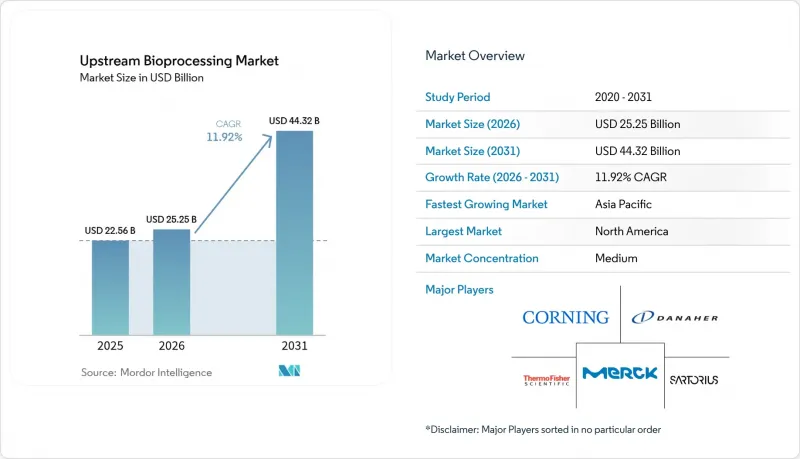
Mordor Intelligence에 의하면, 2026년 업스트림 바이오프로세싱 시장 규모는 252억 5,000만 달러로 추정되고, 2025년 225억 6,000만 달러에서 확대해, 2031년에는 443억 2,000만 달러에 이를 것으로 예측됩니다.
2026-2031년 연평균 성장률(CAGR)은 11.92%를 나타낼 전망입니다.
본 보고서는 제품별(세포 배양용 제품, 바이오리액터·발효조, 필터, 바이오리액터용 부속품, 기타 제품), 사용 형태별(일회용, 다회용), 모드별(사내, 외부 위탁), 최종 사용자별(바이오의약품 기업, 수탁 제조 기업(CMO/CDMO), 학술 연구 기관, 기타), 지역별(북미, 기타)로 분류되어 있습니다. 시장 예측은 금액(달러) 기준으로 제시되어 있습니다.
세계의 업스트림 바이오프로세싱 시장 동향 및 인사이트
일회용 업스트림 바이오프로세싱 채택 확대
일회용 기술은 스테인리스 스틸 시스템에 수반되는 세척 및 검증 부담을 해소하고, 가동 중지 시간을 최소화하면서 시설이 분자 유형 간 전환을 가능하게 합니다. 생산 유연성으로 인해 설비 가동률은 향상되지만, 2024년 수지 부족으로 인해 공급 병목 현상이 드러나면서 일회용 자산과 재사용 자산을 결합한 하이브리드형 시설의 도입이 진행되었습니다. 벤더의 수직 통합 및 폴리머 다각화 프로그램을 통해 압박은 완화될 전망이지만, 18-24개월에 달하는 리드타임은 공급이 여전히 핍박하고 있음을 시사하며, 전략적인 재고 포지션을 확보한 공급업체에게는 유리하게 작용할 것으로 보입니다.
바이오의약품의 상업적 성공과 수요 증가
신규 생물학적 제제의 신속 승인 및 ‘획기적 치료법(Breakthrough Therapy)’ 지정에 따라 임상 단계에서 시판까지의 기간이 단축되면서, 업스트림 공정의 생산 능력에 대한 수요가 증가하고 있습니다. 시장에서의 성공 여부가 불확실한 분자의 경우, 전용 플랜트 건설에 드는 설비 투자 부담을 정당화하기 어렵기 때문에 신흥 바이오테크 기업들은 CDMO에 대한 아웃소싱을 점점 더 늘리고 있습니다. 생산량의 양극화가 나타나고 있습니다. 블록버스터급 단일클론 항체에는 규모의 경제가 요구되는 반면, 틈새 시장의 첨단 치료법에는 맞춤형 소량 생산 환경이 필요합니다.
전단 응력 및 확장성을 포함한 운영상의 과제
규모 확대에 따라 유체역학적 조건이 변화하는 경우가 많으며, 이는 전단에 민감한 세포주에 악영향을 미쳐 생존율 저하 및 당사슬 프로파일의 변화를 초래합니다. 고도 임펠러 형태나 전산 유체 역학(CFD) 모델링을 통해 난류를 줄일 수는 있지만, 이는 설비 투자 비용을 증가시키고 적합성 평가 기간을 연장하게 됩니다. 관류 방식은 규모에 대한 제약을 어느 정도 완화하지만, 그 대신 추가적인 여과 공정과 제어의 복잡성을 수반합니다.
부문 분석
2025년, 세포 배양 배지, 혈청, 성장 인자는 업스트림 바이오프로세싱 시장 점유율의 39.01%를 차지했으며, 생산성 최적화에서 이들이 수행하는 중요한 역할을 반영하고 있습니다. 화학적으로 정의된 배지(chemically defined feeds)와 같은 배지 조성의 발전으로 인해 대사 산물이 안정화되고, 로트 간 편차가 억제되고 있습니다. CHO 균주나 HEK 균주에 맞추어 조정된 보충제는 고가대로 거래되고 있어, 이 부문의 견실한 이익률을 뒷받침하고 있습니다. 바이오리액터 및 발효조 하위 부문은 일회용 형태나 퍼퓨전 설계를 통해 더 작은 설치 면적에서 더 높은 효능을 얻을 수 있게 됨에 따라 연평균 성장률(CAGR) 12.52%로 확대되고 있습니다. 모듈식 제어 소프트웨어의 도입으로 사업자는 교반, 가스 이송, 온도 프로파일을 미세 조정할 수 있어 재현성이 향상됩니다. 공정의 고도화에 따라 오염을 방지하기 위해 밀폐형 유로와 고해상도 모니터링이 필수적이므로, 필터, 프로브, 부속품에 대한 수요도 마찬가지로 증가하고 있습니다.
스테인리스 스틸 용기는 감가상각이 수십 년에 걸친 자산 사용 연한에 분산되는 대량 생산 단일클론 항체 부문에서는 여전히 주류를 이루고 있지만, 신규 건설에서는 기술 이전 주기를 단축하고 가동 중지 시간을 최소화할 수 있는 일회용 또는 하이브리드 방식이 선호되고 있습니다. 기업들이 시설 집약화 목표를 추구한 결과, 2024-2025년 퍼퓨전 유닛 도입은 두 자릿수 성장을 기록했습니다. 통합형 심층 여과 스키드는 일회용 유로 내에서 수확액의 정화를 효율화하여 품질 설계(QbD) 목표를 충족하는 동시에 전환 작업에 소요되는 공수를 줄여줍니다.
일회용 어셈블리는 교차 오염의 위험을 제거하고 캠페인 전환을 신속하게 할 수 있기 때문에 2025년에는 업스트림 바이오프로세싱 시장에서 62.55%의 점유율을 차지했습니다. 일회용 유로(flow path)는 배치 규모가 작고 일정이 촉박한 다제품 대응 CDMO 시설이나 초기 단계의 프로그램에 적합합니다. 대용량 바이오의약품의 경우, 경제적 이유로 재사용형 인프라가 유지되고 있기 때문에 제조업체들이 기존 플랜트에 첨단 센싱 기술과 자동화를 도입함에 따라 재사용형 부문은 2031년까지 연평균 성장률(CAGR) 12.66%를 나타낼 것으로 예측됩니다. 강철 바이오리액터와 일회용 시드 트레인을 결합한 하이브리드 시설은 유연성과 운영 비용 제약 간의 균형을 맞추고 있습니다.
환경 지속가능성을 둘러싼 논의가 설비 전략에 영향을 미치고 있습니다. 고처리량 단일클론 항체 생산 라인을 도입하는 사용자는 폴리머 폐기물 발생을 줄이는 다회용 스키드 기술을 채택하는 반면, 바이러스 벡터 제조업체는 바이러스 간 교차 오염을 방지하기 위해 일회용 격리 시스템을 선호합니다. 현재 공급업체들의 혁신은 무균성이나 용출물 프로파일을 손상시키지 않으면서 환경 문제를 완화하기 위해 재활용 노력과 경량 필름 개발에 주력하고 있습니다.
지역별 분석
북미는 2025년 업스트림 바이오프로세싱 시장에서 40.78%의 점유율을 차지했습니다. 이는 바이오의약품 클러스터의 밀집, 벤처 캐피탈 확보, FDA 규제의 명확화가 기술의 급속한 보급을 촉진하고 있기 때문입니다. 총 20억 달러 규모의 연방 정부 투자를 통해 새로운 충전 및 마무리 시설, 일회용 백 제조, 지역 밀착형 공급망이 지원되고 있습니다. 캐나다의 팬데믹 대응 보조금은 모듈식 백신 제조 시설에 자금을 지원하고 있는 반면, 멕시코는 미국 시장과의 근접성을 희생하지 않으면서도 더 낮은 운영 비용을 추구하는 니어쇼어링형 바이오의약품 프로젝트를 유치하고 있습니다. FDA의 연속 처리 관련 지침은 엔드투엔드(end-to-end) 생산 라인의 도입을 가속화하여 국내 생산 거점에 효율성 우위를 가져다주고 있습니다.
2031년까지 아시아태평양의 연평균 성장률(CAGR)은 12.8%로 성장이 전망되며, 지역별 가장 높은 성장세를 보이고 있습니다. 중국은 해외 의존도를 낮추기 위해 국내 퍼퓨전형 바이오리액터 개발 및 업스트림 공정용 소모품 제조 공장에 보조금을 지급하고 있습니다. 인도는 바이오시밀러 부문에서의 리더십을 활용하여, 그램당 비용 최적화에 중점을 둔 다국적 기업의 기술 이전 프로젝트를 확보하고 있습니다. 일본과 한국은 정밀한 제어가 필요한 소용량 바이오리액터가 요구되는 바이러스 벡터 및 iPS 세포 치료 플랫폼에 연구개발 자금을 투자하고 있습니다. 지역별 공급망 다각화 프로그램은 현지에서의 수지 생산을 촉진하여 해외 운송 지연 및 관세 위험 노출을 완화하고 있습니다.
유럽은 독일, 영국, 스위스를 중심으로 완만한 성장을 유지하고 있습니다. EU의 지속가능성 목표에 따라 연속 운전 및 저에너지 시설 설계 도입이 촉진되고 있으며, 유럽의약품청(EMA)은 첨단 치료 의약품(ATMP)에 관한 통일된 지침을 제공합니다. 프랑스, 이탈리아, 스페인에는 틈새 시장인 생물학적 제제 부문을 담당하는 전문 수탁 제조업체(CMO)가 거점을 두고 있습니다. 유럽공급업체들은 디지털 전환 분야의 파트너로서 입지를 확고히 하고 있으며, PAT 센서 및 AI 분석을 일회용 하드웨어와 통합함으로써 생산성을 점진적으로 향상시키고 있습니다.
기타 혜택
- 엑셀 형식 시장 예측(ME) 시트
- 3개월간의 애널리스트 지원
자주 묻는 질문
목차
제1장 서론
제2장 조사 방법
제3장 주요 요약
제4장 시장 구도
제5장 시장 규모 및 성장 예측
제6장 경쟁 구도
제7장 시장 기회 및 향후 전망
AJY 26.08.28According to Mordor Intelligence, the upstream bioprocessing market size in 2026 is estimated at USD 25.25 billion, growing from 2025 value of USD 22.56 billion with 2031 projections showing USD 44.32 billion, growing at 11.92% CAGR over 2026-2031.
This report is Segmented by Product (Cell Culture Products, Bioreactors and Fermenters, Filters, Bioreactor Accessories, Other Products), Usage Type (Single-Use, Multi-Use), Mode (In-House, Outsourced), End User (Biopharmaceutical Companies, CMOs/CDMOs, Academic & Research Institutes, Others), and Geography (North America, and More). The Market Forecasts are Provided in Terms of Value (USD).
Global Upstream Bioprocessing Market Trends and Insights
Rising Adoption of Single-Use Upstream Bioprocessing
Single-use technologies remove the cleaning validation burden linked to stainless-steel systems and let facilities pivot between molecule classes with minimal downtime. Production flexibility improves asset utilisation, yet 2024 resin shortages exposed supply bottlenecks that prompted hybrid facilities combining disposable and reusable assets. Vendor vertical integration and polymer diversification programs will ease pressure, but lead times of 18-24 months suggest continued tightness that rewards suppliers holding strategic inventory positions.
Commercial Success & Rising Demand for Biotherapeutics
Accelerated approvals for novel biologics and breakthrough designations shorten clinical-to-commercial transition windows, amplifying upstream capacity requirements. Emerging biotechs increasingly outsource to CDMOs because the capex burden of purpose-built plants is hard to justify for molecules with unproven market trajectories. Volume bifurcation is visible: blockbuster monoclonal antibodies demand scale efficiencies while niche advanced therapies need bespoke small-batch environments.
Operational Challenges Including Shear Stress and Scalability
Scale-up often alters hydrodynamic conditions that harm shear-sensitive cell lines, reducing viability and changing glycosylation profiles. Advanced impeller geometries and computational fluid dynamics modelling reduce turbulence, but they raise capital costs and extend qualification timelines. Perfusion configurations partly alleviate scale limitations, although they introduce extra filtration and control complexity.
Other drivers and restraints analyzed in the detailed report include:
- Emergence of High-Intensity Perfusion Bioreactors
- Government Push for Domestic Biomanufacturing Capacity
- Supply-Chain Volatility for Single-Use Plastics
For complete list of drivers and restraints, kindly check the Table Of Contents.
Segment Analysis
Cell culture media, sera and growth factors held 39.01% upstream bioprocessing market share in 2025, reflecting their pivotal role in productivity optimisation. Media formulation advances, such as chemically defined feeds, stabilise metabolites and curb lot variability. Supplements tailored to CHO or HEK lines command premium pricing, supporting solid segment margins. The bioreactors and fermenters sub-segment expands at 12.52% CAGR as single-use formats and perfusion designs enable higher titres in smaller footprints. Adoption of modular control software lets operators refine agitation, gas-transfer and temperature profiles, enhancing reproducibility. Filters, probes and ancillary accessories rise in tandem because intensified processes mandate closed fluid paths and high-resolution monitoring to avoid contamination.
Stainless-steel vessels still dominate high-volume monoclonal antibody production where depreciation is spread across multi-decade asset lives, but new builds favour single-use or hybrid operations that shorten tech-transfer cycles and minimise downtime . Perfusion units recorded double-digit adoption growth during 2024-2025 as firms chased facility densification goals. Integrated depth-filtration skids streamline harvest clarification inside disposable flow-paths, aligning with quality-by-design objectives and cutting change-over labor hours.
Single-use assemblies secured 62.55% upstream bioprocessing market share in 2025 due to their ability to eliminate cross-contamination risk and accelerate campaign changeovers. Disposable flow-paths suit multi-product CDMO suites and early-stage programs where batch sizes are small and timelines compressed. Large-volume biologics retain multi-use infrastructure for economic reasons, so the multi-use category grows at 12.66% CAGR through 2031 as manufacturers retrofit existing plants with advanced sensing and automation. Hybrid facilities that mix steel bioreactors with single-use seed trains balance flexibility and operating cost constraints.
Environmental sustainability debates influence equipment strategy. Users deploying high-throughput monoclonal antibody lines adopt multi-use skid technologies that lower polymer waste generation, whereas viral-vector producers prefer disposable containment to prevent cross-viral contamination. Vendor innovation now targets recycling initiatives and lower-weight films to mitigate ecological concerns without compromising sterility or leachables profiles.
Complete Report Scope:
- By Product
- Cell Culture Products
- Media
- Sera & Reagents
- Supplements & Growth Factors
- Bioreactors and Fermenters
- Stainless-steel Bioreactors
- Single-use Bioreactors
- Perfusion Bioreactors
- Filters
- Bioreactor Accessories
- Other Products
- Cell Culture Products
- By Usage Type
- Single-use
- Multi-use
- By Mode
- In-house
- Outsourced
- By End User
- Biopharmaceutical Companies
- Contract Manufacturing Organisations (CMOs/CDMOs)
- Academic & Research Institutes
- Others
- By Geography
- North America
- United States
- Canada
- Mexico
- Europe
- Germany
- United Kingdom
- France
- Italy
- Spain
- Rest of Europe
- Asia-Pacific
- China
- Japan
- India
- Australia
- South Korea
- Rest of Asia-Pacific
- Middle East and Africa
- GCC
- South Africa
- Rest of Middle East and Africa
- South America
- Brazil
- Argentina
- Rest of South America
- North America
Geography Analysis
North America held 40.78% upstream bioprocessing market share in 2025 as dense biopharma clusters, venture capital availability and FDA regulatory clarity foster rapid technology uptake. Federal investments totaling USD 2 billion support new fill-finish suites, single-use bag manufacturing and localised supply chains. Canada's pandemic-preparedness grants fund modular vaccine facilities, while Mexico attracts near-shoring biologics projects seeking lower operating costs without sacrificing US market proximity. Continuous-processing guidance from the FDA accelerates adoption of end-to-end manufacturing trains, giving domestic sites an efficiency edge.
Asia-Pacific's 12.8% CAGR through 2031 marks the highest regional pace. China subsidises domestic perfusion bioreactor development and upstream consumable plants to lessen foreign reliance. India leverages its biosimilar leadership to win multi-national tech-transfer mandates, focusing on cost-per-gram optimisation. Japan and South Korea channel R&D funds into viral-vector and iPSC therapy platforms that need highly controlled small-volume bioreactors. Regional supply-chain diversification programs encourage local resin production, reducing exposure to overseas shipping delays and tariff risks.
Europe maintains moderate growth anchored by Germany, the United Kingdom and Switzerland. EU sustainability goals motivate adoption of continuous operations and low-energy facility designs, and the European Medicines Agency provides harmonised guidance for advanced therapy medicinal products. France, Italy and Spain house specialised contract manufacturers serving niche biologic segments. European suppliers position themselves as partners in digital transformation, integrating PAT sensors and AI analytics with disposable hardware to deliver incremental productivity gains.
- Thermo Fisher Scientific
- Danaher Corp. (Cytiva & Pall)
- Sartorius
- Merck
- Eppendorf
- Corning
- Getinge AB (Applikon)
- Entegris Inc.
- Avantor Inc.
- Boehringer Ingelheim
- Cellexus International Ltd.
- Cesco Bioengineering Co., Ltd.
- PBS Biotech Inc.
- Kuhner Shaker AG
- Solaris Biotech
- Hitachi Koki Co.
- Wuxi Biologics
- Lonza Group
Additional Benefits:
- The market estimate (ME) sheet in Excel format
- 3 months of analyst support
TABLE OF CONTENTS
1 Introduction
- 1.1 Study Assumptions & Market Definition
- 1.2 Scope of the Study
2 Research Methodology
3 Executive Summary
4 Market Landscape
- 4.1 Market Overview
- 4.2 Market Drivers
- 4.2.1 Rising adoption of single-use upstream bioprocessing
- 4.2.2 Commercial success & rising demand for biotherapeutics
- 4.2.3 Emergence of high-intensity perfusion bioreactors
- 4.2.4 Government push for domestic biomanufacturing capacity
- 4.2.5 Integration of continuous manufacturing workflows
- 4.2.6 AI-driven optimisation of cell-culture parameters
- 4.3 Market Restraints
- 4.3.1 Operational challenges including shear stress and scalability
- 4.3.2 Supply-chain volatility for single-use plastics
- 4.3.3 Skilled labour shortages in bioprocess engineering
- 4.3.4 Quality variability in novel cell lines
- 4.4 Regulatory Landscape
- 4.5 Technological Outlook
- 4.6 Porter's Five Forces Analysis
- 4.6.1 Threat of New Entrants
- 4.6.2 Bargaining Power of Buyers/Consumers
- 4.6.3 Bargaining Power of Suppliers
- 4.6.4 Threat of Substitute Products
- 4.6.5 Intensity of Competitive Rivalry
5 Market Size & Growth Forecasts (Value, USD)
- 5.1 By Product
- 5.1.1 Cell Culture Products
- 5.1.1.1 Media
- 5.1.1.2 Sera & Reagents
- 5.1.1.3 Supplements & Growth Factors
- 5.1.2 Bioreactors and Fermenters
- 5.1.2.1 Stainless-steel Bioreactors
- 5.1.2.2 Single-use Bioreactors
- 5.1.2.3 Perfusion Bioreactors
- 5.1.3 Filters
- 5.1.4 Bioreactor Accessories
- 5.1.5 Other Products
- 5.1.1 Cell Culture Products
- 5.2 By Usage Type
- 5.2.1 Single-use
- 5.2.2 Multi-use
- 5.3 By Mode
- 5.3.1 In-house
- 5.3.2 Outsourced
- 5.4 By End User
- 5.4.1 Biopharmaceutical Companies
- 5.4.2 Contract Manufacturing Organisations (CMOs/CDMOs)
- 5.4.3 Academic & Research Institutes
- 5.4.4 Others
- 5.5 By Geography
- 5.5.1 North America
- 5.5.1.1 United States
- 5.5.1.2 Canada
- 5.5.1.3 Mexico
- 5.5.2 Europe
- 5.5.2.1 Germany
- 5.5.2.2 United Kingdom
- 5.5.2.3 France
- 5.5.2.4 Italy
- 5.5.2.5 Spain
- 5.5.2.6 Rest of Europe
- 5.5.3 Asia-Pacific
- 5.5.3.1 China
- 5.5.3.2 Japan
- 5.5.3.3 India
- 5.5.3.4 Australia
- 5.5.3.5 South Korea
- 5.5.3.6 Rest of Asia-Pacific
- 5.5.4 Middle East and Africa
- 5.5.4.1 GCC
- 5.5.4.2 South Africa
- 5.5.4.3 Rest of Middle East and Africa
- 5.5.5 South America
- 5.5.5.1 Brazil
- 5.5.5.2 Argentina
- 5.5.5.3 Rest of South America
- 5.5.1 North America
6 Competitive Landscape
- 6.1 Market Concentration
- 6.2 Market Share Analysis
- 6.3 Company Profiles (includes Global level Overview, Market level overview, Core Segments, Financials as available, Strategic Information, Market Rank/Share for key companies, Products & Services, and Recent Developments)
- 6.3.1 Thermo Fisher Scientific Inc.
- 6.3.2 Danaher Corp. (Cytiva & Pall)
- 6.3.3 Sartorius AG
- 6.3.4 Merck KGaA
- 6.3.5 Eppendorf AG
- 6.3.6 Corning Inc.
- 6.3.7 Getinge AB (Applikon)
- 6.3.8 Entegris Inc.
- 6.3.9 Avantor Inc.
- 6.3.10 Boehringer Ingelheim GmbH
- 6.3.11 Cellexus International Ltd.
- 6.3.12 Cesco Bioengineering Co., Ltd.
- 6.3.13 PBS Biotech Inc.
- 6.3.14 Kuhner Shaker AG
- 6.3.15 Solaris Biotech
- 6.3.16 Hitachi Koki Co.
- 6.3.17 Wuxi Biologics
- 6.3.18 Lonza Group AG
7 Market Opportunities & Future Outlook
- 7.1 White-space & Unmet-need Assessment


