|
시장보고서
상품코드
2114904
스텔스 기술 시장 : 시장 점유율 분석, 업계 동향 및 통계, 성장 예측(2026-2031년)Stealth Technologies - Market Share Analysis, Industry Trends & Statistics, Growth Forecasts (2026 - 2031) |
||||||
 Mordor Intelligence
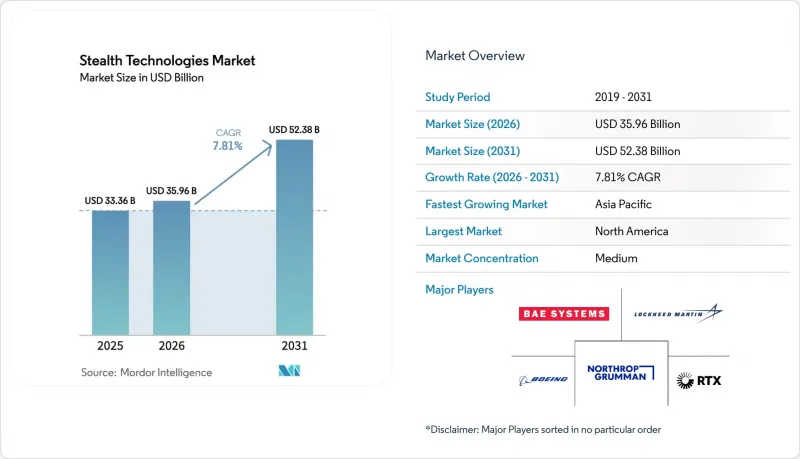
Mordor Intelligence에 의하면, 스텔스 기술 시장 규모는 2025년 333억 6,000만 달러로 평가되었고 2026년에는 359억 6,000만 달러로 추정되고, 2026-2031년 CAGR 7.81%로 성장을 지속할 전망이며, 2031년에는 523억 8,000만 달러에 이를 것으로 예측됩니다.
본 보고서는 플랫폼별(항공, 해상, 지상, 우주), 기술 유형별(레이더 흡수재(RAM), 성형·기하학적 설계, 적외선 시그니처 저감, 기타), 용도별(유인 항공기, 무인 항공기(UAV), 수상함, 잠수함, 기타), 지역별(북미, 남미, 유럽, 기타)로 분류되어 있습니다. 시장 예측은 금액(달러) 기준으로 제시되어 있습니다.
세계의 스텔스 기술 시장 동향 및 인사이트
멀티스태틱 저주파 레이더의 보급에 따른 RAM 업그레이드 촉진
현재, 멀티스태틱 VHF 및 UHF 레이더 네트워크는 발트해 지역과 남중국해를 포괄하고 있으며, 형상이 최적화된 기체를 200km가 넘는 거리에서 감지할 수 있게 하고 있습니다. 이에 따라 운영자는 30MHz에서 18GHz까지의 에너지를 흡수하는 광대역 코팅에 투자할 수밖에 없습니다. 중국의 YLC-8E 시스템은 2024년에 저 RCS 표적의 실전 추적에 성공했으며, 이로 인해 협대역 대체품에 비해 재료비가 3배나 비싸음에도 불구하고, 미국이 희토류를 풍부하게 함유한 광대역 RAM의 조달을 가속화하고 있습니다. 미국의 2025 회계연도 국방 예산에서는 F-35의 레이더 반사 면적(RCS) 유지 대책에 3억 4,000만 달러가 배정되었으며, 이는 2024 회계연도 수준보다 28% 증가한 것으로, 업그레이드의 시급성을 여실히 보여주고 있습니다. 동유럽의 소규모 공군에서는 정비 공장에서 정비 시 4세대 전투기에 모듈식 부착 패널을 사후 장착하는 개조를 진행하고 있으며, 이로 인해 틈새 애프터마켓이 형성되고 있습니다. 그 결과 발생하는 수요는 대스텔스 센서의 보급에도 불구하고 스텔스 기술 시장을 뒷받침하고 있습니다.
6세대 전투기의 스텔스·전자전(EW) 복합 아키텍처로의 전환
보잉(Boeing)사의 F-47 NGAD는 표면 임피던스를 실시간으로 변조하는 인지형 전자전(EW) 프로세서를 통합하여, 기체 외피를 수동적인 흡수체가 아닌 재구성 가능한 안테나로 변모시킵니다. 이 계약에서는 개방형 임무 시스템 인터페이스가 의무화되어 있어, 타사 제작 페이로드가 물리적 재도장 주기가 아닌 소프트웨어 업데이트를 통해 시그니처 프로파일을 업데이트할 수 있게 되었습니다. GCAP의 ‘템페스트’ 프로젝트에서 진행 중인 병행 설계 선택에서는 현장에서 재프로그래밍이 가능한 능동형 주파수 선택 표면이 요구되고 있으며, 이는 F-35 시대의 수동형 코팅으로는 실현할 수 없는 기능입니다. 중국의 J-20 블록 3은 주익 가장자리를 따라 분산형 RF 개구부를 통합하여, 저관측 모드와 전자 공격 모드를 전환할 수 있습니다. 고정 코팅을 기반으로 한 록히드 마틴의 F-35 시리즈는 적응성이 낮다고 판단되었습니다. 이는 스텔스 기술 시장에서의 경쟁 우위를 재정의하는 패러다임 전환을 여실히 보여주고 있습니다.
트라이밴드 수동형 레이더의 보급에 따른 운용상의 우위 감소
나토(NATO) 동부 전선에 배치된 ERA의 VERA-NG 네트워크는 VHF, UHF, L-밴드 일루미네이터를 융합하여 스텔스 모의기를 400km에 걸쳐 추적하는 데 성공했으며, 감지되지 않고 공중에 머무를 수 있는 시간을 20분 이하로 단축했습니다. 대만 해협 연안에 배치된 중국의 DWL-002 기지는 2025년까지 12곳으로 확대된 것으로 평가되었으며, 표적이 될 수 있는 에너지를 방출하지 않고 조기 경보를 제공함으로써 제압 임무를 복잡하게 만들 것입니다. RAND의 분석에 따르면, 패시브 레이더에 대한 투자 비용은 능동형 AESA 어레이의 10분의 1 수준이며, 이로 인해 대스텔스 기술의 보급이 확대되면서 저가시성 플랫폼의 가치 프리미엄이 하락하고 있습니다. 미국 공군의 교리 개정에서는 현재 신속한 진입 및 이탈과 스탠드오프형 무기가 중시되고 있으며, 이러한 전환으로 인해 플랫폼의 체공 시간이 단축되어 고도 스텔스성을 갖춘 플랫폼에 대한 투자의 정당성이 부분적으로 훼손되고 있습니다. 운영자들이 축소되는 전술적 기회와 전략의 비용 대비 효과를 저울질하는 가운데, 시장 성장은 완만한 속도이긴 하지만 계속되고 있습니다.
부문 분석
지상 차량은 2026-2031년 연평균 성장률(CAGR) 9.18%를 나타낼 것으로 예측되며, 이는 플랫폼 그룹 중 가장 높은 성장률입니다. 이는 드론 및 회전익 탄약 센서의 보급에 대응하기 위해 각국 육군이 주력 전차와 보병 전투차에 사후 장착형 RAM을 탑재하고 있기 때문입니다. 이스라엘 항공우주산업(IAI)의 ‘카멜’ 시연기는 기존 차체에 비해 레이더 단면적을 60% 감소시키는 데 성공했으며, 정비 공장에서의 정밀 점검 시 장착 가능한 모듈식 키트의 유효성을 입증했습니다. 항공 부문은 6세대 전투기 및 CCA(전투기 콘셉트) 프로토타입 개발에 힘입어 2025년에는 스텔스 기술 시장에서 44.54%의 점유율을 차지했습니다. 그러나 고성능 유인 항공기의 높은 단가로 인해 양산형 무인기 군으로의 전환이 진행되면서 조달 예산 배분이 재편되고 있습니다. 해상 플랫폼의 경우, 미 해군의 DDG(X)에서 볼 수 있듯이 텀블홈 선체와 능동 소음 상쇄 어레이가 통합되어 있으며, 잠수함의 무향 타일은 음향 스텔스 성능을 향상시키고 있습니다. 우주 및 미사일 부문은 여전히 틈새 시장이지만, 저지구 궤도 운영 사업자가 플라즈마 시스를 검사하고, 스탠드오프 미사일이 저가시성 외피를 채택함에 따라 연구 개발의 주목을 받고 있습니다. 전반적으로, 분야를 초월한 수요가 스텔스 기술의 전략적 중요성을 더욱 높이고 있습니다.
항공 부문에서는 적층 가공 기술을 통해 혼합 날개-동체형 무인항공기(UAV)의 반복 주기가 단축되어 신속한 개념 증명이 가능해졌습니다. 지상에서는 3D 프린팅된 메타물질 타일을 통해 기갑 여단이 몇 시간 이내에 도시 지역이나 개방된 지형에서의 작전에 맞추어 시그니처를 조정할 수 있게 되었습니다. 해군 설계자들은 적외선 및 음향 프로파일을 훼손하지 않기 위해, 순수한 레이더 반사율 감소보다 전자기 시그니처의 균형을 우선시하는 경향이 강해지고 있습니다. 이러한 환경에서의 재료 과학 융합은 스텔스 기술 시장이 계속해서 플랫폼에 구애받지 않는 형태를 유지할 것이며, 각 공급업체가 표준 화학 조성 및 설계 툴체인을 여러 분야를 통합하는 기업에 판매해 나갈 것임을 시사합니다. 이러한 동향은 개별 플랫폼 프로그램이 변동하는 상황에서도 건전한 공급업체 생태계를 뒷받침할 것입니다.
지역별 분석
2025년, B-21 레이더가 비행 시험 단계에 진입하고 NGAD(차세대 공격기)에 대한 자금이 다년간의 연구비를 통해 확보됨에 따라, 북미는 전 세계 매출의 34.89%를 차지했습니다. 또한, 미국은 초음속 기술 개발 경쟁에서도 주도적인 입지를 차지하고 있으며, UHTC(초음속 기술) 공급망에 대한 투자와 1,000대 이상의 CCA(전투기) 발주를 진행하고 있어, 예산 심사가 진행되고 있음에도 불구하고 이 모든 것이 국내 수요의 기반이 되고 있습니다. 캐나다 국방부는 CF-18의 후속 기종에 광대역 코팅을 탑재하기 위한 개량에 자금을 배정하고 있는데, 이는 미국공급망을 둘러싼 동맹국들과의 협력을 반영한 것입니다.
아시아태평양은 중국이 J-20의 연간 생산량을 60대로 늘려 증산하고, J-35의 항공모함 탑재형을 시험 중이기 때문에 2031년까지 9.93%라는 최고 수준의 연평균 성장률(CAGR)을 나타낼 전망입니다. 한국의 KF-21 블록 2에 대한 자금 지원으로 스텔스 성능 향상이 확보되는 한편, 일본의 GCAP 참여는 영국, 이탈리아, 스웨덴과의 협력을 통해 6세대 아키텍처에 대한 접근을 가능하게 하고 있습니다. 인도의 AMCA는 2029년까지 첫 비행을 목표로 하고 있으며, 기술적 격차가 있음에도 불구하고 수입 의존도를 낮추기 위한 전략적인 동향으로 평가됩니다. 호주는 MQ-28 고스트배트 계획을 통해 군전술을 추진하고 있으며, 동남아시아 국가들은 지역 내 힘의 불균형을 시정하기 위해 저가시성 미사일정 도입을 추진하고 있습니다.
유럽은 GCAP과 프랑스·독일·스페인이 주도하는 경쟁 프로그램인 ‘퓨처 컴뱃 에어 시스템(FCAS)’에 대해 계속해서 견실한 자금 지원을 하고 있지만, 대서양을 사이에 둔 ITAR(국제무기거래규정)을 둘러싼 마찰로 인해 부품 공급이 복잡해지고 있습니다. 동유럽 국가들은 5세대 전투기 구매 대신 수동형 멀티밴드 레이더를 조달하고, 구형 전투기에 후장식 RAM(근접방어미사일)을 장착하는 개조를 진행하고 있는데, 이는 예산 제약과 잠재적 분쟁 지역과의 근접성에 대한 현실적인 대응이라고 할 수 있습니다. 중동에서는 미사일 위협을 상쇄하기 위해 저가시성 항공기 및 해군 자산이 도입되고 있습니다. 아랍에미리트의 F-35에 대한 관심과 사우디아라비아의 ‘템페스트’ 참여는 이 지역의 현대화를 상징하는 것입니다. 남미에서는 여전히 틈새 시장 수준의 도입에 그치고 있습니다. 브라질의 KC-390 수송기에는 제한적인 스텔스 기능이 탑재되어 있지만, 전용 저가시성 전투기 개발 계획은 없습니다.
기타 혜택
- 엑셀 형식 시장 예측(ME) 시트
- 3개월간의 애널리스트 지원
자주 묻는 질문
목차
제1장 서론
제2장 조사 방법
제3장 주요 요약
제4장 시장 구도
제5장 시장 규모 및 성장 예측
제6장 경쟁 구도
제7장 시장 기회 및 향후 전망
AJY 26.08.28According to Mordor Intelligence, the stealth technologies market size is expected to grow from USD 33.36 billion in 2025 to USD 35.96 billion in 2026 and is forecasted to reach USD 52.38 billion by 2031 at a 7.81% CAGR over 2026-2031.
This report is Segmented by Platform (Aerial, Marine, Terrestrial, and Space-Based), Technology Type (Radar-Absorbent Materials, Shaping & Geometric Design, Infrared Signature Reduction, and More), Application (Manned Aircraft, Uavs, Surface Ships, Submarines, and More), and Geography (North America, South America, Europe, and More). Market Forecasts are Provided in Terms of Value (USD).
Global Stealth Technologies Market Trends and Insights
Ubiquity of Multi-Static Low-Frequency Radars Driving RAM Upgrades
Multi-static VHF and UHF radar networks now cover the Baltic region and the South China Sea, exposing shape-optimized airframes at ranges exceeding 200 km and forcing operators to invest in broadband coatings that absorb energy from 30 MHz to 18 GHz. China's YLC-8E system achieved live tracking of low-RCS targets in 2024, accelerating US procurement of rare-earth-rich broadband RAM despite triple material costs relative to a narrowband alternative. The US FY-2025 defense budget allocates USD 340 million for F-35 radar cross-section sustainment, 28% above the 2024 levels, underscoring the urgency of upgrades. Smaller Eastern European air forces are retrofitting fourth-generation fighters with modular applique panels during depot maintenance, spawning a niche aftermarket. The resulting demand boosts the stealth technologies market, despite the proliferation of counter-stealth sensors.
Shift Toward Combined Stealth-EW Architectures for Sixth-Generation Fighters
Boeing's F-47 NGAD integrates cognitive EW processors that modulate surface impedance in real time, transforming the airframe skin into a reconfigurable antenna rather than a passive absorber. The contract mandates open-mission-systems interfaces, allowing third-party payloads to update signature profiles via software updates instead of physical respray cycles. Parallel design choices in GCAP's Tempest require active frequency-selective surfaces that are reprogrammable in the field, a capability that passive F-35-era coatings cannot match. China's J-20 Block 3 embeds distributed RF apertures along wing edges to alternate between low-observable and electronic-attack modes. Lockheed Martin's F-35 lineage, rooted in fixed coatings, was judged less adaptable, underscoring a paradigm shift that rewrites competitive advantage in the stealth technologies market.
Tri-Band Passive Radar Proliferation Reducing Operational Advantage
ERA's VERA-NG network, deployed across NATO's eastern flank, achieved 400 km tracking of stealth surrogates by fusing VHF, UHF, and L-band illuminators, compressing undetected loiter windows to under 20 minutes. China's DWL-002 sites, arrayed along the Taiwan Strait, are expected to expand to 12 installations by 2025, providing early warning without emitting energy that can be targeted, thereby complicating suppression missions. RAND analysis shows passive radar investments cost one-tenth of active AESA arrays, democratizing counter-stealth and eroding the value premium of low-observable platforms. US Air Force doctrine updates now emphasize rapid ingress and egress, as well as standoff munitions, a shift that reduces platform loiter time and undermines some investment cases for highly stealthy platforms. Market growth persists, albeit at a moderated pace, as operators weigh the cost-effectiveness of their strategies against shrinking tactical windows.
Other drivers and restraints analyzed in the detailed report include:
- Mass Production of Low-Observable UAV Swarms for ISR and Decoy Missions
- Hypersonic-Related Aero-Heating Challenges Increasing Demand for Advanced CMC RAM
- Regulatory Barriers on ITAR-Controlled Advanced Composites
For complete list of drivers and restraints, kindly check the Table Of Contents.
Segment Analysis
Terrestrial vehicles are forecast to post a 9.18% CAGR from 2026 to 2031, the fastest among platform groups, as armies retrofit main battle tanks and infantry fighting vehicles with applique RAM to counter the proliferation of drone and loitering-munition sensors. Israel Aerospace Industries' Carmel demonstrator achieved a 60% reduction in radar cross-section relative to legacy hulls, validating modular kits that can be fitted during depot overhauls. The aerial segment held a 44.54% market share in stealth technologies in 2025, driven by the development of sixth-generation fighters and CCA prototyping. Yet unit costs for exquisite manned aircraft drive a shift toward mass-produced unmanned swarms, redistributing procurement budgets. Maritime platforms integrate tumblehome hulls and active-cancellation arrays as seen on the US Navy's DDG(X), while submarine anechoic tiles advance acoustic stealth. Space and missile segments remain niche but draw R&D as low-Earth-orbit operators test plasma sheaths and as standoff missiles adopt low-observable skins. Collectively, cross-domain demand reinforces the strategic importance of stealth technologies.
In the aerial domain, additive manufacturing is shortening iteration cycles for blended-wing-body UAVs, enabling rapid concept verification. On land, 3D-printed metamaterial tiles allow armored brigades to tailor signatures for urban or open-terrain operations within hours. Naval designers increasingly prioritize electromagnetic signature balance over pure radar reduction to avoid compromising infrared and acoustic profiles. The convergence of materials science across these environments indicates that the stealth technologies market will remain platform-agnostic, with providers selling standard chemistries and design toolchains to multiple domain integrators. This dynamic supports a healthy supplier ecosystem even as individual platform programs fluctuate.
Complete Report Scope:
- By Platform
- Aerial
- Marine
- Terrestrial
- Space-Based
- By Technology Type
- Radar-Absorbent Materials (RAM)
- Shaping and Geometric Design
- Infrared Signature Reduction
- Active Cancellation (Electronic Stealth)
- Plasma/EM Cloaking
- By Application
- Manned Aircraft
- Unmanned Aerial Vehicles (UAVs)
- Surface Ships
- Submarines
- Ground Combat Vehicles
- Missiles and Precision-Guided Munitions
- By Geography
- North America
- United States
- Canada
- Mexico
- South America
- Brazil
- Rest of South America
- Europe
- United Kingdom
- Germany
- France
- Russia
- Rest of Europe
- Asia-Pacific
- China
- India
- Japan
- South Korea
- Rest of Asia-Pacific
- Middle East and Africa
- Middle East
- United Arab Emirates
- Saudi Arabia
- Rest of Middle East
- Africa
- South Africa
- Rest of Africa
- Middle East
- North America
Geography Analysis
North America generated 34.89% of global revenue in 2025, as the B-21 Raider entered flight testing and NGAD funding was secured through multi-year research outlays. The United States also leads the hypersonic race, investing in UHTC supply chains and ordering 1,000-plus CCAs, which collectively anchor domestic demand despite budget scrutiny. Canada's Department of National Defence is allocating funds to retrofit CF-18 replacements with broadband coatings, reflecting an alignment with allied nations around US supply chains.
Asia Pacific is forecast to register the highest a 9.93% CAGR through 2031 as China raises annual J-20 production toward 60 airframes and tests J-35 carrier variants. South Korea's KF-21 Block 2 funding secures stealth upgrades, while Japan's GCAP participation grants access to sixth-generation architectures in cooperation with the UK, Italy, and Sweden. India's AMCA aims for first flight by 2029, marking a strategic move to reduce import dependence despite technology gaps. Australia champions swarming concepts through the MQ-28 Ghost Bat program, and Southeast Asian nations are pursuing low-observable missile boats to counterbalance regional power asymmetries.
Europe maintains robust funding for the GCAP and France-Germany-Spain's rival, the Future Combat Air System, though trans-Atlantic ITAR frictions complicate component flows. Eastern European states procure passive multiband radars and retrofit legacy fighters with applique RAM instead of buying fifth-generation jets, a pragmatic response to budget limits and proximity to potential conflict zones. The Middle East is acquiring low-observable aircraft and naval assets to offset missile threats; the UAE's interest in the F-35 and Saudi participation in Tempest exemplify regional modernization. South America remains a niche adopter; Brazil's KC-390 transport includes limited stealth features but no dedicated low-observable combat aircraft pipeline.
- Lockheed Martin Corporation
- Northrop Grumman Corporation
- BAE Systems plc
- The Boeing Company
- Saab AB
- Thales Group
- RTX Corporation
- Leonardo S.p.A.
- United Aircraft Corporation
- Hindustan Aeronautics Limited
- Israel Aerospace Industries Ltd.
- Dassault Aviation
- Mitsubishi Heavy Industries, Ltd. (MHI)
- Airbus SE
- Elbit Systems Ltd.
- Kratos Defense & Security Solutions, Inc.
- QinetiQ Group plc
Additional Benefits:
- The market estimate (ME) sheet in Excel format
- 3 months of analyst support
TABLE OF CONTENTS
1 INTRODUCTION
- 1.1 Study Assumptions and Market Definition
- 1.2 Scope of the Study
2 RESEARCH METHODOLOGY
3 EXECUTIVE SUMMARY
4 MARKET LANDSCAPE
- 4.1 Market Overview
- 4.2 Market Drivers
- 4.2.1 Ubiquity of multi-static low-frequency radars driving RAM upgrades
- 4.2.2 Shift toward combined stealth-EW architectures for sixth-generation fighters
- 4.2.3 Mass production of low-observable UAV swarms for ISR and decoy missions
- 4.2.4 Hypersonic-related aero-heating challenges increasing demand for advanced CMC RAM
- 4.2.5 Growing interest in plasma-magnetic signature suppression for LEO satellites
- 4.2.6 Additive manufacturing of graded-density metamaterials reducing program costs
- 4.3 Market Restraints
- 4.3.1 Tri-band passive radar proliferation reducing operational advantage
- 4.3.2 Regulatory barriers on ITAR-controlled advanced composites
- 4.3.3 High O&M costs of radar-absorbent coatings in humid littoral climates
- 4.3.4 Thermal-acoustic signature trades limiting platform endurance
- 4.4 Value Chain Analysis
- 4.5 Regulatory Outlook
- 4.6 Technological Outlook
- 4.7 Porter's Five Forces Analysis
- 4.7.1 Bargaining Power of Suppliers
- 4.7.2 Bargaining Power of Buyers/Consumers
- 4.7.3 Threat of New Entrants
- 4.7.4 Threat of Substitute Products
- 4.7.5 Intensity of Competitive Rivalry
5 MARKET SIZE AND GROWTH FORECASTS (VALUE)
- 5.1 By Platform
- 5.1.1 Aerial
- 5.1.2 Marine
- 5.1.3 Terrestrial
- 5.1.4 Space-Based
- 5.2 By Technology Type
- 5.2.1 Radar-Absorbent Materials (RAM)
- 5.2.2 Shaping and Geometric Design
- 5.2.3 Infrared Signature Reduction
- 5.2.4 Active Cancellation (Electronic Stealth)
- 5.2.5 Plasma/EM Cloaking
- 5.3 By Application
- 5.3.1 Manned Aircraft
- 5.3.2 Unmanned Aerial Vehicles (UAVs)
- 5.3.3 Surface Ships
- 5.3.4 Submarines
- 5.3.5 Ground Combat Vehicles
- 5.3.6 Missiles and Precision-Guided Munitions
- 5.4 By Geography
- 5.4.1 North America
- 5.4.1.1 United States
- 5.4.1.2 Canada
- 5.4.1.3 Mexico
- 5.4.2 South America
- 5.4.2.1 Brazil
- 5.4.2.2 Rest of South America
- 5.4.3 Europe
- 5.4.3.1 United Kingdom
- 5.4.3.2 Germany
- 5.4.3.3 France
- 5.4.3.4 Russia
- 5.4.3.5 Rest of Europe
- 5.4.4 Asia-Pacific
- 5.4.4.1 China
- 5.4.4.2 India
- 5.4.4.3 Japan
- 5.4.4.4 South Korea
- 5.4.4.5 Rest of Asia-Pacific
- 5.4.5 Middle East and Africa
- 5.4.5.1 Middle East
- 5.4.5.1.1 United Arab Emirates
- 5.4.5.1.2 Saudi Arabia
- 5.4.5.1.3 Rest of Middle East
- 5.4.5.2 Africa
- 5.4.5.2.1 South Africa
- 5.4.5.2.2 Rest of Africa
- 5.4.5.1 Middle East
- 5.4.1 North America
6 COMPETITIVE LANDSCAPE
- 6.1 Market Concentration
- 6.2 Strategic Moves
- 6.3 Market Share Analysis
- 6.4 Company Profiles {(includes Global level Overview, Market level overview, Core Segments, Financials as available, Strategic Information, Market Rank/Share for key companies, Products and Services, and Recent Developments)}
- 6.4.1 Lockheed Martin Corporation
- 6.4.2 Northrop Grumman Corporation
- 6.4.3 BAE Systems plc
- 6.4.4 The Boeing Company
- 6.4.5 Saab AB
- 6.4.6 Thales Group
- 6.4.7 RTX Corporation
- 6.4.8 Leonardo S.p.A.
- 6.4.9 United Aircraft Corporation
- 6.4.10 Hindustan Aeronautics Limited
- 6.4.11 Israel Aerospace Industries Ltd.
- 6.4.12 Dassault Aviation
- 6.4.13 Mitsubishi Heavy Industries, Ltd. (MHI)
- 6.4.14 Airbus SE
- 6.4.15 Elbit Systems Ltd.
- 6.4.16 Kratos Defense & Security Solutions, Inc.
- 6.4.17 QinetiQ Group plc
7 MARKET OPPORTUNITIES AND FUTURE OUTLOOK
- 7.1 White-space and Unmet-need Assessment