
|
시장보고서
상품코드
2114908
유선 인터페이스 시장 : 점유율 분석, 업계 동향과 통계, 성장 예측(2026-2031년)Wired Interface - Market Share Analysis, Industry Trends & Statistics, Growth Forecasts (2026 - 2031) |
||||||
 Mordor Intelligence
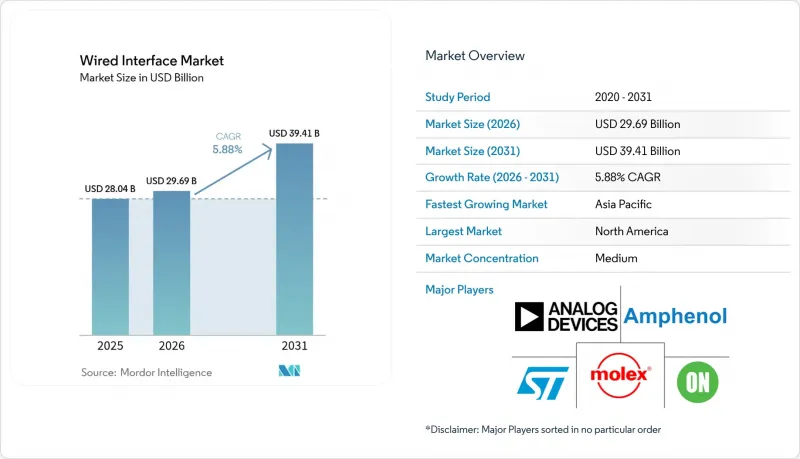
Mordor Intelligence에 의하면, 유선 인터페이스 시장 규모는 2025년에 280억 4,000만 달러로 평가되었고 2026년 296억 9,000만 달러에서 2031년까지 394억 1,000만 달러에 이를 것으로 예측되며, 예측 기간(2026-2031년) CAGR은 5.88%를 나타낼 전망입니다.
본 보고서는 구성 요소 유형(USB, HDMI, DisplayPort, Thunderbolt, 기타), 데이터 전송 속도 등급(5Gbps 미만, 5-20 Gbps, 20-40 Gbps, 기타), 용도(스마트폰·태블릿,PC·게임기, TV·디지털 사이니지, 기타), 최종 사용자 산업(소비자 가전, 자동차, 산업용, 기타), 지역별로 분류되어 있습니다. 시장 예측은 금액(달러) 기준으로 제시되어 있습니다.
전 세계 유선 인터페이스 시장 동향 및 인사이트
각종 기기에서 USB-C/USB4 채택 확대
USB-C가 프리미엄 커넥터에서 표준 포트로 진화함에 따라 OEM 제조업체의 부품 원가가 절감되고 재고 관리가 효율화되고 있습니다. 2024년 12월에 발효되는 유럽연합(EU)의 ‘공통 충전기 지침’에 따라 휴대전화, 노트북, 나아가 배터리 충전기의 재설계가 의무화되면서, 제조업체들이 지역별 SKU의 복잡화를 피하려 하는 가운데 전 세계적으로 규정 준수 대응의 물결이 가속화되고 있습니다. 로고 표시 의무화는 소비자의 신뢰를 더욱 높여주며, USB-C 허브 및 전원 공급 케이블의 보급률을 가속화하고 있습니다. 각 컨트롤러 공급업체들은 이미 수주 증가를 보고하고 있으며, ASMedia는 AMD의 데스크톱 플랫폼과 관련된 USB 4.0 매출의 급증에 주목하고 있습니다. 인도나 캘리포니아주에서도 유사한 규제안이 마련되고 있는 만큼, 이러한 규제의 도미노 효과가 소비자용 및 산업용 엔드포인트에서의 USB-C 보급을 뒷받침하고 있습니다.
8K/16K 게이밍 및 동영상 대역폭 수요의 급증
높은 주사율을 자랑하는 8K 게이밍에는 HDMI 2.1의 48 Gbps 상한선을 훨씬 뛰어넘는 총 처리량이 요구되므로, 디스플레이 제조업체들은 80 Gbps를 초과하는 새로운 물리 계층을 개발해야 하는 상황에 직면해 있습니다. VESA에 의해 표준화된 DisplayPort 2.x는 VR 헤드셋 및 컨텐츠 제작용 모니터를 위한 어댑티브 싱크 기능의 강화를 통해 이에 대응하고 있습니다. 게임 업계에서 AI 기반 슈퍼 샘플링이 급속히 보급됨에 따라 GPU와 패널 간의 데이터 버스트가 두 배로 증가하고 있으며, 40Gbps를 초과하는 신호 무결성을 보장하는 프리미엄 케이블 어셈블리의 필요성이 입증되고 있습니다. 중국이 국내에서 지원하는 GPMI 사양은 192 Gbps 기능을 도입하고 있으며, 지역 주권과 관련된 과제가 병행되는 인터페이스 생태계를 만들어낼 가능성을 시사하고 있습니다.
PC 및 태블릿 출하량 감소로 인해 레거시 포트에 대한 수요가 줄어들고 있습니다.
특히 가격에 민감한 아시아태평양의 판매 채널에서 주류 PC 판매량이 부진하여 VGA 및 USB 2.0 커넥터에 대한 수요가 감소하고 있습니다. IDC의 기록에 따르면, 2024년에는 출하 대수가 1.3% 회복되었지만, 현재는 섀시당 물리적 포트 수가 적은 AI 중심 노트북으로의 전환이 진행되고 있습니다. 기업에서는 Windows 11로의 전환 및 AI 추론 워크로드에 맞추어 선택적인 리프레시 주기를 실시하고 있어, 레거시 포트의 중요성은 특정 이용 사례로 제한된 채 지속되고 있습니다.
부문 분석
USB는 2025년 매출의 32.40%를 계속 차지하며, 소비자용 및 기업용 기기에서 사실상 범용 인터페이스로서의 역할을 강조하고 있습니다. USB 커넥터 및 컨트롤러 유선 인터페이스 시장 규모는 플래그십 노트북에 USB4 V2가 도입됨에 따라 확대될 전망입니다. 썬더볼트는 시장 규모는 작지만, 컨텐츠 크리에이터와 워크스테이션 게이머들이 80Gbps의 처리량과 데이지 체인 연결의 유연성을 채택함에 따라 2031년까지 연평균 성장률(CAGR) 7.05%를 나타낼 것으로 예측됩니다. HDMI는 TV 패널에서의 견고한 도입 기반 덕분에 한 자릿수 중반대의 성장률을 유지하고 있지만, 높은 대역폭을 요구하는 애호가층은 어댑티브 싱크 성능을 위해 DisplayPort 2.x로 전환할 가능성이 있습니다.
표준의 융합 추세는 분명합니다. 인텔의 ‘Maple Ridge’ 리타이머는 USB4와 썬더볼트(Thunderbolt)의 터널링 기능을 모두 통합하고 있는 반면, 애플의 최신 맥북 프로(MacBook Pro)는 USB4와 ‘썬더볼트 4(Thunderbolt 4)’라는 브랜드명을 결합함으로써 카테고리 간의 경계를 모호하게 만들고 있습니다. 이와 동시에, MIPI A-PHY와 같은 틈새 규격은 주류 PC 인터페이스로는 충족할 수 없는 자동차 안전 요구 사항을 충족하고 있습니다. 공급업체의 경우, 고객이 단일 공급처에서 다중 프로토콜 연결을 요구함에 따라 구리선, 광학, 능동형 케이블 제품에 걸친 폭넓은 포트폴리오가 매우 중요해지고 있습니다.
주류 노트북, 도크, 임베디드용 마더보드에서는 여전히 5-20 Gbps 레인이 주류를 이루고 있으며, 이것이 2025년에 이 등급이 39.05%의 점유율을 차지하게 될 이유입니다. 그럼에도 불구하고 AI 서버, 엣지 가속기, 8K 방송용 카메라는 40 Gbps 이상으로 전환되고 있으며, 이는 연평균 성장률(CAGR) 7.62%로 가장 빠르게 성장하는 부문입니다. PCIe Gen5 스위치 및 이더넷 800G 플러그형 제품의 채택 확대에 따라, 42GHz를 초과하는 정격의 저손실 케이블 어셈블리에 대한 수요가 증가하고 있습니다.
이러한 변화를 주도하고 있는 것은 재료 과학의 혁신입니다. TOPPAN사가 입증한 코어리스 유기 인터포저는 스텁 및 비아의 기생 성분을 최소화하여, 112 Gbps PAM4 SerDes에서 더 짧은 트레이스 길이와 더 깨끗한 신호를 실현합니다. Ayar Labs사의 광·전기 코패키지 모듈은 16 Tbps의 양방향 대역폭을 실현하여, 현재 구리선 기술의 한계를 뛰어넘는 미래의 클래스를 예고하고 있습니다. 광학 기술이 성숙기에 도달할 때까지는 액티브 구리선 및 트윈 액스(Twin-Ax) 솔루션이 비용과 전력 소비 목표 간의 균형을 맞추려는 하이퍼스케일 사업자들에게 그 공백을 메우는 역할을 할 것입니다.
지역별 분석
북미는 하이퍼스케일 데이터센터의 갱신과 소비자용 데스크톱 PC의 기록적인 GPU 탑재율에 힘입어 2025년 매출의 35.15%를 차지했습니다. 미국 기업들은 관세 정책 변경에 앞서 Windows 11로의 전환을 가속화하여 2025년 1분기 PC 출하량을 1,600만 대로 끌어올렸습니다. 반도체 공급업체들도 이러한 수요를 반영하여, 텍사스 기기는 2025년 1분기 매출이 40억 7,000만 달러를 기록했으며, 아날로그 인터페이스 IC는 13% 증가했습니다. 캐나다의 FTTP(Fiber-to-the-Premise) 구축과 멕시코의 OEM 조립 클러스터가 이 지역의 커넥터 수요를 안정적으로 유지하고 있습니다. 캘리포니아주, 워싱턴주, 텍사스주에 본사를 둔 게이밍 주변기기 브랜드들은 8K 및 VR 용도에 적합한 프리미엄 USB-C-to-DisplayPort 케이블을 주도하며, 포트당 가치 지표를 강화하고 있습니다.
유럽의 유선 인터페이스 시장은 정책을 중심으로 전개되고 있습니다. 유럽에서 USB-C의 의무화로 인해 스마트폰, 노트북, 그리고 독립형 충전기에 걸친 규정 준수 중심의 교체 주기가 활성화되고 있습니다. 독일은 ‘인더스트리 4.0’ 개편을 위한 견고한 인터페이스에 대한 수요를 지속적으로 주도하고 있는 반면, 프랑스와 네덜란드는 차폐 기능이 있는 대전류 커플러에 의존하는 전기차(EV) 충전 회랑에 대한 투자를 추진하고 있습니다. 자동차 업계의 도메인 컨트롤러로의 전환은 MIPI A-PHY 및 800Mbps 이더넷 링크의 채택을 촉진하고, EMC에 최적화된 커넥터 변형에 대한 수요를 창출하고 있습니다. 지속가능성 프레임워크는 모듈식 쉘과 재활용 가능한 합금을 특징으로 하는 순환 경제에 부합하는 커넥터에 대한 관심을 높이고 있습니다.
연평균 성장률(CAGR) 6.78%로 예측되는 아시아태평양은 PCB, 케이블, 칩셋 생산의 수직 통합의 혜택을 받고 있습니다. 주요 디스플레이 기업들의 지원을 받는 중국의 국내 GPMI 이니셔티브는 192 Gbps 인터페이스를 도입하고 있으며, 이는 세계 표준의 양극화를 초래할 가능성이 있습니다. 동시에 일본의 OEM 기업들은 교육 및 현장 서비스 분야에서 크롬북 도입을 추진하고 있으며, 2025년 1분기 출하 대수는 15.6% 증가했습니다. 인도의 생산 연계형 인센티브 제도 덕분에 커넥터 프레스 가공 및 케이블 조립 라인이 내륙 지역에 집적되어, 전 세계 노트북 브랜드의 물류 리드타임이 단축되고 있습니다. 한국의 메모리 공장 및 파운드리 업체들은 국산 컨트롤러 설계를 촉진하여 현지 공급 경쟁을 심화시키고 있습니다. 한편, 호주의 광업 자동화 프로젝트에서는 가혹한 환경에서도 사용 가능한 구리·광섬유 하이브리드 케이블이 요구되고 있습니다.
기타 혜택:
- 엑셀 형식 시장 예측(ME) 시트
- 3개월간의 애널리스트 지원
자주 묻는 질문
목차
제1장 서론
제2장 조사 방법
제3장 주요 요약
제4장 시장 구도
제5장 시장 규모와 성장 예측
제6장 경쟁 구도
제7장 시장 기회와 향후 전망
JHS 26.08.26According to Mordor Intelligence, the wired interface market size was valued at USD 28.04 billion in 2025 and estimated to grow from USD 29.69 billion in 2026 to reach USD 39.41 billion by 2031, at a CAGR of 5.88% during the forecast period (2026-2031).
This report is Segmented by Component Type (USB, HDMI, Displayport, Thunderbolt, and Others), Data-Rate Class (Below 5 Gbps, 5-20 Gbps, 20-40 Gbps, and More), Application (Smartphones and Tablets, Pcs and Gaming Consoles, Tvs and Digital Signage, and More), End-User Industry (Consumer Electronics, Automotive, Industrial, and More), and Geography. The Market Forecasts are Provided in Terms of Value (USD).
Global Wired Interface Market Trends and Insights
Growing adoption of USB-C / USB4 across devices
USB-C's evolution from premium connector to default port is compressing bill-of-materials costs and streamlining inventory for OEMs. The European Union's common-charger directive, effective December 2024, forces handset, laptop, and even battery-charger redesigns, catalyzing a global compliance ripple as manufacturers avoid regional SKU complexity. Mandatory logo labeling further promotes consumer confidence, accelerating attach rates for USB-C hubs and power-delivery cables. Controller suppliers already note order upticks; ASMedia highlighted a USB 4.0 revenue surge linked to AMD desktop platforms. With India and California drafting aligned regulations, the regulatory domino effect supports USB-C ubiquity across consumer and industrial endpoints.
Surge in 8K / 16K gaming and video bandwidth needs
High-refresh 8K gaming demands aggregate throughputs far exceeding HDMI 2.1's 48 Gbps ceiling, pushing display makers toward emergent >80 Gbps physical layers. DisplayPort 2.x, standardized by VESA, responds with adaptive-sync enhancements for VR headsets and content-creation monitors. The gaming sector's aggressive AI-based supersampling multiplies data bursts between GPUs and panels, validating premium cable assemblies that guarantee signal integrity above 40 Gbps. China's locally backed GPMI specification introduces 192 Gbps capability, illustrating how regional sovereignty agendas can spawn parallel interface ecosystems.
Shrinking PC and tablet shipments cut legacy-port volumes
Mainstream PC volume softness, especially in cost-sensitive Asia-Pacific channels, is eroding demand for VGA and USB 2.0 connectors. IDC recorded a 1.3% unit rebound in 2024, but the mix now tilts to AI-centric laptops with fewer physical ports per chassis. Enterprises engage in selective refresh cycles aligned with Windows 11 migration and AI inference workloads, prolonging legacy port relevance only for specific use cases.
Other drivers and restraints analyzed in the detailed report include:
- Automotive centralized infotainment and ADAS data links
- EU charger mandate accelerates USB-C deployments
- Preference for wireless display / charging
For complete list of drivers and restraints, kindly check the Table Of Contents.
Segment Analysis
USB maintained 32.40% of 2025 revenue, underlining its role as the de facto general-purpose link across consumer and enterprise gear. The wired interface market size for USB connectors and controllers is slated to rise alongside USB4 V2 rollouts in flagship laptops. Thunderbolt, though representing a smaller base, is forecast at a 7.05% CAGR through 2031 as content creators and workstation gamers adopt its 80 Gbps throughput and daisy-chain flexibility. HDMI's strong installed base in television panels preserves mid-single-digit growth, yet high-bandwidth enthusiasts may pivot to DisplayPort 2.x for adaptive-sync performance.
Convergence trends are evident. Intel's Maple Ridge re-timers integrate both USB4 and Thunderbolt tunnelling, while Apple's latest MacBook Pro combines USB4 with "Thunderbolt 4" branding, blurring category boundaries. In parallel, niche standards such as MIPI A-PHY address automotive safety requirements that mainstream PC interfaces cannot meet. For suppliers, portfolio breadth across copper, optical, and active-cable products becomes crucial as customers demand a single source for multi-protocol connectivity.
Mainstream notebooks, docks, and embedded motherboards continue to favour 5-20 Gbps lanes, explaining the 39.05% share held by this class in 2025. Nevertheless, AI servers, edge accelerators, and 8K broadcast cameras are migrating above 40 Gbps, the fastest-growing slice at an 7.62% CAGR. Rising adoption of PCIe Gen5 switches and Ethernet 800G pluggables amplifies demand for low-loss cable assemblies rated beyond 42 GHz.
Materials science innovations drive the shift. Coreless organic interposers demonstrated by TOPPAN minimize stubs and via parasitics, enabling shorter trace lengths and cleaner signals for SerDes at 112 Gbps PAM4. Optical-electrical co-packaged modules from Ayar Labs showcase 16 Tbps bidirectional bandwidth, foreshadowing a future class that could eclipse today's copper ceilings. Until optical matures, active copper and twin-ax solutions will bridge the gap for hyperscale operators balancing cost and power targets.
Complete Report Scope:
- By Component Type
- USB
- HDMI
- DisplayPort
- Thunderbolt
- Others
- By Data-Rate Class
- Below 5 Gbps
- 5-20 Gbps
- 20-40 Gbps
- Above 40 Gbps
- By Application
- Smartphones and Tablets
- PCs and Gaming Consoles
- TVs and Digital Signage
- VR/AR and Wearables
- Other Applications
- By End-User Industry
- Consumer Electronics
- Automotive
- Industrial
- Healthcare
- IT and Telecom
- Other End-User Industries
- By Geography
- North America
- United States
- Canada
- Mexico
- Europe
- Germany
- United Kingdom
- France
- Italy
- Spain
- Rest of Europe
- Asia-Pacific
- China
- Japan
- India
- South Korea
- Australia
- Rest of Asia-Pacific
- South America
- Brazil
- Argentina
- Rest of South America
- Middle East and Africa
- Middle East
- Saudi Arabia
- United Arab Emirates
- Turkey
- Rest of Middle East
- Africa
- South Africa
- Egypt
- Nigeria
- Rest of Africa
- Middle East
- North America
Geography Analysis
North America held a 35.15% slice of 2025 revenue, buoyed by hyperscale datacenter refreshes and record GPU attach rates in consumer desktops. United States enterprises accelerated Windows 11 migrations ahead of potential tariff shifts, pushing Q1 2025 PC volumes to 16 million units. Semiconductor vendors mirrored demand; Texas Instruments posted USD 4.07 billion Q1 2025 revenue with analog interface ICs up 13%. Canada's fiber-to-the-premise rollouts and Mexico's OEM assembly clusters stabilize regional connector demand. Gaming peripheral brands headquartered in California, Washington, and Texas champion premium USB-C-to-DisplayPort cables suited for 8K and VR usage, reinforcing value per port metrics.
Europe's wired interface story pivots on policy. The continent's USB-C mandate energizes a compliance-driven refresh cycle spanning smartphones, laptops, and standalone chargers. Germany continues to anchor ruggedized interface demand for Industrie 4.0 retrofits, while France and the Netherlands invest in EV charging corridors that rely on shielded high-current couplers. The automotive belt's shift to domain controllers drives adoption of MIPI A-PHY and Ethernet 800Mbps links, creating volume for EMC-optimized connector variants. Sustainability frameworks catalyze interest in circular-economy rated connectors featuring modular shells and recyclable alloys.
Asia-Pacific, projected at a 6.78% CAGR, benefits from the vertical integration of PCB, cable, and chipset production. China's domestic GPMI initiative, backed by display majors, introduces a 192 Gbps interface that could bifurcate global standards. Simultaneously, Japanese OEMs embrace Chromebook deployment in education and field-service sectors, recording 15.6% shipment growth in Q1 2025. India's production-linked incentive scheme draws connector stamping and cable assembly lines inland, compressing logistics lead times for global notebook brands. South Korea's memory fabs and foundries foster home-grown controller designs, intensifying local supply competition, while Australia's mining automation projects demand harsh-environment copper-fiber hybrids.
- TE Connectivity
- Molex
- Amphenol
- Japan Aviation Electronics
- Luxshare Precision
- Foxconn Interconnect Technology
- Texas Instruments
- STMicroelectronics
- ON Semiconductor
- Analog Devices
- Microchip Technology
- Infineon Technologies
- NXP Semiconductors
- Renesas Electronics
- ASMedia Technology
- Parade Technologies
- Analogix Semiconductor
- Lattice Semiconductor
- ROHM
- Samtec
- Hirose Electric
Additional Benefits:
- The market estimate (ME) sheet in Excel format
- 3 months of analyst support
TABLE OF CONTENTS
1 INTRODUCTION
- 1.1 Study Assumptions and Market Definition
- 1.2 Scope of the Study
2 RESEARCH METHODOLOGY
3 EXECUTIVE SUMMARY
4 MARKET LANDSCAPE
- 4.1 Market Overview
- 4.2 Market Drivers
- 4.2.1 Growing adoption of USB-C / USB4 across devices
- 4.2.2 Surge in 8K/16K gaming and video bandwidth needs
- 4.2.3 Automotive centralized infotainment and ADAS data links
- 4.2.4 EU charger mandate accelerates USB-C deployments
- 4.2.5 China's GPMI standard drives regional refresh
- 4.2.6 Active long-reach cable tech opens medical and industrial use
- 4.3 Market Restraints
- 4.3.1 Shrinking PC and tablet shipments cut legacy-port volumes
- 4.3.2 Preference for wireless display / charging
- 4.3.3 Slow ecosystem readiness for DP 2.1 and HDMI 2.2
- 4.3.4 Interoperability risks from proliferating specs
- 4.4 Value Chain Analysis
- 4.5 Regulatory Landscape
- 4.6 Technological Outlook
- 4.7 Porter's Five Forces Analysis
- 4.7.1 Bargaining Power of Suppliers
- 4.7.2 Bargaining Power of Buyers
- 4.7.3 Threat of New Entrants
- 4.7.4 Threat of Substitutes
- 4.7.5 Intensity of Competitive Rivalry
- 4.8 Assessment of the Impact of Macroeconomic Trends on the Market
5 MARKET SIZE AND GROWTH FORECASTS (VALUE)
- 5.1 By Component Type
- 5.1.1 USB
- 5.1.2 HDMI
- 5.1.3 DisplayPort
- 5.1.4 Thunderbolt
- 5.1.5 Others
- 5.2 By Data-Rate Class
- 5.2.1 Below 5 Gbps
- 5.2.2 5-20 Gbps
- 5.2.3 20-40 Gbps
- 5.2.4 Above 40 Gbps
- 5.3 By Application
- 5.3.1 Smartphones and Tablets
- 5.3.2 PCs and Gaming Consoles
- 5.3.3 TVs and Digital Signage
- 5.3.4 VR/AR and Wearables
- 5.3.5 Other Applications
- 5.4 By End-User Industry
- 5.4.1 Consumer Electronics
- 5.4.2 Automotive
- 5.4.3 Industrial
- 5.4.4 Healthcare
- 5.4.5 IT and Telecom
- 5.4.6 Other End-User Industries
- 5.5 By Geography
- 5.5.1 North America
- 5.5.1.1 United States
- 5.5.1.2 Canada
- 5.5.1.3 Mexico
- 5.5.2 Europe
- 5.5.2.1 Germany
- 5.5.2.2 United Kingdom
- 5.5.2.3 France
- 5.5.2.4 Italy
- 5.5.2.5 Spain
- 5.5.2.6 Rest of Europe
- 5.5.3 Asia-Pacific
- 5.5.3.1 China
- 5.5.3.2 Japan
- 5.5.3.3 India
- 5.5.3.4 South Korea
- 5.5.3.5 Australia
- 5.5.3.6 Rest of Asia-Pacific
- 5.5.4 South America
- 5.5.4.1 Brazil
- 5.5.4.2 Argentina
- 5.5.4.3 Rest of South America
- 5.5.5 Middle East and Africa
- 5.5.5.1 Middle East
- 5.5.5.1.1 Saudi Arabia
- 5.5.5.1.2 United Arab Emirates
- 5.5.5.1.3 Turkey
- 5.5.5.1.4 Rest of Middle East
- 5.5.5.2 Africa
- 5.5.5.2.1 South Africa
- 5.5.5.2.2 Egypt
- 5.5.5.2.3 Nigeria
- 5.5.5.2.4 Rest of Africa
- 5.5.5.1 Middle East
- 5.5.1 North America
6 COMPETITIVE LANDSCAPE
- 6.1 Market Concentration
- 6.2 Strategic Moves
- 6.3 Market Share Analysis
- 6.4 Company Profiles (includes Global level Overview, Market level overview, Core Segments, Financials as available, Strategic Information, Market Rank/Share for key companies, Products and Services, and Recent Developments)
- 6.4.1 TE Connectivity
- 6.4.2 Molex
- 6.4.3 Amphenol
- 6.4.4 Japan Aviation Electronics
- 6.4.5 Luxshare Precision
- 6.4.6 Foxconn Interconnect Technology
- 6.4.7 Texas Instruments
- 6.4.8 STMicroelectronics
- 6.4.9 ON Semiconductor
- 6.4.10 Analog Devices
- 6.4.11 Microchip Technology
- 6.4.12 Infineon Technologies
- 6.4.13 NXP Semiconductors
- 6.4.14 Renesas Electronics
- 6.4.15 ASMedia Technology
- 6.4.16 Parade Technologies
- 6.4.17 Analogix Semiconductor
- 6.4.18 Lattice Semiconductor
- 6.4.19 ROHM
- 6.4.20 Samtec
- 6.4.21 Hirose Electric
7 MARKET OPPORTUNITIES AND FUTURE OUTLOOK
- 7.1 White-space and Unmet-Need Assessment