|
시장보고서
상품코드
2114910
빙정석 시장 : 점유율 분석, 업계 동향과 통계, 성장 예측(2026-2031년)Cryolite - Market Share Analysis, Industry Trends & Statistics, Growth Forecasts (2026 - 2031) |
||||||
 Mordor Intelligence
Mordor Intelligence에 의하면, 빙정석 시장 규모는 2025년 3억 1,461만 달러에서 2026년에는 3억 2,760만 달러로 확대되어 2026년부터 2031년까지 CAGR 4.13%로 성장을 지속하여, 2031년에는 4억 108만 달러에 이를 것으로 예측됩니다.
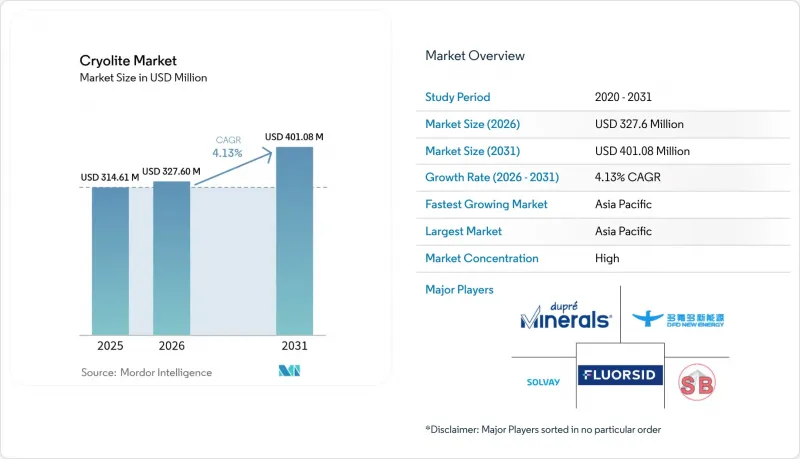
본 보고서는 등급(천연, 합성, 재생), 형태(분말, 과립),용도(알루미늄 제련, 연마재 제조, 금속 표면 처리, 에나멜 및 유리 프릿, 용접 플럭스, 기타 용도), 지역(아시아태평양, 북미, 유럽, 남미, 중동 및 아프리카)별로 분류되어 있습니다. 시장 전망은 금액(달러) 기준으로 제시되어 있습니다.
전 세계 빙정석 시장 동향 및 인사이트
1차 알루미늄 생산량 증가
전기차 및 재생 에너지 관련 기기를 위한 견조한 알루미늄 소비가 제련소의 생산 능력 확충을 꾸준히 뒷받침하며, 빙정석의 기본 수요를 끌어올리고 있습니다. 국제알루미늄협회(IAI)는 전 세계 사용량이 2020년 8,620만 톤에서 2030년까지 1억 1,950만 톤으로 증가할 것으로 예측했습니다. 중국에서는 에너지 공급 제한에도 불구하고 2023년 생산량이 4,159만 톤에 달하며, 이 지역의 빙정석 공급에 대한 수요가 더욱 강해지고 있습니다. 제련소가 재생에너지를 활용한 전력 사용을 통해 탄소 발자국을 줄이려는 가운데, 불활성 양극으로의 개조가 상용화되기 전까지는 빙정석가 비용 효율이 뛰어난 전해질로 남을 것입니다. 컨설팅 회사의 조사에 따르면, 2030년까지 최대 1,600만 톤의 알루미늄 공급 부족이 발생할 가능성이 지적되고 있으며, 이로 인해 600억-900억 달러 규모의 새로운 전지 건설이 촉진되고, 그에 비례한 용융욕 수요도 예상됩니다. 그 결과, 중기적으로는 수요 회복이 예상되지만, 장기적인 기술 대체 위험으로 인해 그 기세는 다소 억제될 것입니다.
결합형 및 피복형 연마재 산업의 확대
인더스트리 4.0에 따른 기계 가공의 발전으로 인해 제조업체들은 발열이 적고 수명이 긴 고정밀 연삭 휠을 채택해야 하는 상황에 직면해 있습니다. 빙정석는 페놀 수지계 연마재에서 성능 향상제로 기능하여 절삭 효율과 내마모성을 높입니다. 이는 과거 특허에도 기재되어 있으며, 최근 미국 지질조사국(USGS)의 제조 통계에 의해서도 뒷받침되고 있습니다. 항공우주 및 자동차 OEM 기업들은 현재 더 엄격한 표면 마감 공차를 지정하고 있으며, 이로 인해 더 높은 이익률을 가져다주는 고급 등급 연삭 도구 수요가 촉진되고 있습니다. 북미 및 서유럽의 지역적 생산 회귀(리쇼어링)로 인해 수요가 아시아의 허브에서 분산되어 공급망의 안정성이 향상되고 있습니다. 장기적으로는 자동화된 연삭 셀로 인해 처리 능력이 향상되고 연삭 휠 교체 빈도가 증가함에 따라, 연삭 휠 1개당 사용량이 소량에 그치더라도 빙정석 수요량은 점차 증가할 것입니다.
직업적 및 환경적 불소 화합물의 독성
규제 당국은 불소 화합물의 노출 한도치를 더욱 엄격하게 적용하고 있습니다. 미국 환경보호청(EPA)의 재등록 결정에 따라 잔류 허용 기준치가 낮아진 반면, EU의 REACH 규정에서는 종합적인 위험 평가가 요구되고 있습니다. 규제를 준수하기 위해서는 배기가스 세정, 근로자 모니터링 및 폐수 처리에 대한 투자가 필요하며, 이는 소규모 생산자에게는 비용 증가로 이어집니다. 현대 제련소의 산업위생 감사에서는 기존 공장에 비해 현저한 진전이 확인되고 있지만, 여전히 대중의 인식으로 인해 최종 사용자는 불소 함량이 적거나 불소를 포함하지 않는 대체품의 도입을 검토해야 하는 상황에 놓여 있습니다. 감시가 강화됨에 따라, 주로 선진국 시장에서 신규 생산 라인의 허가 취득이 지연되거나 서류 작성 부담이 증가할 가능성이 있습니다. 그 결과, 성장 가능성은 고도의 환경 관리 시스템과 투명성이 높은 보고 체제를 갖춘 공급업체로 이동하고 있습니다.
부문 분석
2025년에는 합성 소재가 빙정석 시장의 77.68%를 차지하며 시장을 장악했습니다. 이는 그린란드의 이비그투트 광산 폐쇄와 형석을 원료로 하는 생산으로의 전면적인 전환을 반영한 것입니다. 합성 등급 빙정석 시장 규모는 2025년에 2억 4,440만 달러에 달하고, 알루미늄 제련소가 예측 가능한 화학 성분을 중시하고 있기 때문에 앞으로도 한 자릿수 중반대의 꾸준한 성장을 기록할 것으로 전망됩니다. 천연 등급은 연평균 성장률(CAGR) 5.39%로 꾸준히 성장하고 있으며, 미량 금속의 허용치가 엄격하게 규정된 고급 프릿, 연마재 및 연구 분야의 틈새 시장에 공급되고 있습니다. 사용 후 포트 라이닝에서 회수되는 재활용 등급은 여전히 규모는 작지만, 폐기물 관리 규제가 순환형 경로를 촉진하고 있어 낮은 기준에서 두 자릿수 성장을 달성했습니다.
합성 등급 생산자들은 확립된 배치 반응기 네트워크와 통합된 형석 공급 계약의 혜택을 받고 있으며, 이를 통해 주요 알루미늄 제조업체들과 안정적인 가격 책정 및 공급량 보장을 확보하고 있습니다. 천연 등급 공급업체는 희소성이라는 가치를 활용하여, 불순물의 급격한 증가가 허용되지 않는 특수 유리 및 연마재 분야에서 가격 프리미엄을 확보하고 있습니다. 재활용 등급의 혁신은 막 분리 및 나노 여과 기술의 발전에 힘입어, 셀 폐기물에서 87-90%의 유용한 빙정석을 회수함으로써 처리 비용을 절감하는 동시에 탄소 발자국을 줄이고 있습니다. 이러한 기술이 성숙해짐에 따라 재활용되는 물량은 신규 생산량의 상당 부분을 보완할 가능성이 있으며, 향후 10년 동안 투입 비용의 변동을 완화할 것으로 전망됩니다.
지역별 분석
아시아태평양은 중국의 거대한 제련 기반에 힘입고 인도의 생산 능력 증대에 힘입어 2025년에는 매출 점유율 43.12%로 빙정석 시장을 선도했습니다. 인도의 나빈 플루오라인(Navin Fluorine)사가 원자재 공급 리스크를 줄이기 위해 업스트림 단계의 불화수소 공장에 140억 루피를 투자함에 따라, 이 지역 수요는 더욱 확대되었습니다. 일본과 한국에서는 정밀 연마재 및 전자용 유리에 대한 안정적인 소비량이 나타난 반면, 아세안(ASEAN) 국가들의 알루미늄 압연 및 주조 분야에 대한 투자가 점진적인 수요 증가를 뒷받침했습니다. 이 지역의 예상 연평균 성장률(CAGR)은 5.18%로 여전히 세계 최고 수준을 유지하고 있으며, 이는 전기차 공급망과 재생에너지 송전망에 대한 정부의 경기 부양책에 힘입은 것입니다.
북미는 성숙한 시장이지만, 혁신이 중심이 되는 영역입니다. 미국은 2024년 4분기에 3,850톤의 빙정석를 수입했는데, 그 대부분은 멕시코의 형석 광산에서 공급된 것으로, 산성 등급 수입량의 74%를 차지했습니다. 케모어스와 에너지 퓨얼스의 제휴와 같은 전략적 제휴는 국내 불소 밸류체인의 재구축과 지정학적 위험 감소를 목표로 하고 있습니다. 캐나다의 수력발전을 이용한 제련소는 탈탄소화 노력을 추진하고 있으며, 그중에서도 리오 틴토(Rio Tinto)가 알비다 콤플렉스(Alvida Complex)에서 진행 중인 ELYSIS 파일럿 프로젝트는 2027년에 첫 상업 생산을 시작할 예정입니다. 이러한 프로젝트들로 인해 장기적으로는 수요가 고순도, 경우에 따라 소량 생산되는 전해액 시스템으로 이동할 가능성이 있습니다.
유럽에서는 규제 준수 및 자원 효율성에 중점을 두고 있습니다. 솔베이(Solvay)사의 2024년 매출액 46억 8,600만 유로는 해당 지역의 화학 산업이 확고한 입지를 다지고 있음에도 불구하고 경쟁이 치열함을 여실히 보여줍니다. EU의 REACH 규정은 폐쇄형 회수 체계의 도입을 장려하고 있으며, 매사추세츠 공과대학(MIT)의 구상을 바탕으로 한 나노 여과 플랜트 도입을 위한 토대를 마련하고 있습니다. 이 플랜트는 사용 후 전해액에서 99.1%의 효율로 알루미늄을 분리·회수합니다. 독일, 프랑스 및 스칸디나비아 국가에서는 항공우주 프로그램 및 포장용 알루미늄을 위해 고순도의 빙정석이 요구되고 있습니다. 장기적인 소비량 증가세는 완만하지만, 특수 용도가 제품 구성에서 비중을 높여감에 따라 톤당 가치는 상승하고 있으며, 또한 탄소 국경 조정(CBA) 메커니즘에 따라 내재된 배출량이 높은 수입품에는 벌금이 부과되기 때문입니다.
기타 혜택:
- 엑셀 형식 시장 예측(ME) 시트
- 3개월간의 애널리스트 지원
자주 묻는 질문
목차
제1장 서론
제2장 조사 방법
제3장 주요 요약
제4장 시장 구도
제5장 시장 규모와 성장 예측
제6장 경쟁 구도
제7장 시장 기회와 향후 전망
JHS 26.08.26According to Mordor Intelligence, the cryolite market size is expected to grow from USD 314.61 million in 2025 to USD 327.6 million in 2026 and is forecast to reach USD 401.08 million by 2031 at 4.13% CAGR over 2026-2031.
This report is Segmented by Grade (Natural, Synthetic, Recycled), Form (Powder, Granular), Application (Aluminium Smelting, Abrasive Production, Metal Surface Treatment, Enamel and Glass Frits, Welding Flux, Other Applications), and Geography (Asia-Pacific, North America, Europe, South America, Middle East and Africa). The Market Forecasts are Provided in Terms of Value (USD).
Global Cryolite Market Trends and Insights
Growth in Primary Aluminum Output
Robust aluminum consumption for electric vehicles and renewable-energy hardware underpins steady growth in smelter capacity additions, lifting baseline cryolite demand. The International Aluminium Institute projects global usage climbing from 86.2 million t in 2020 to 119.5 million t by 2030. China's 2023 production hit 41.59 million t despite energy caps, reinforcing the region's pull on cryolite supply. As smelters seek lighter carbon footprints with renewable electricity, cryolite remains a cost-effective electrolyte until inert-anode retrofits become commercial. Consulting studies flag a potential 16 million t aluminum supply gap by 2030, spurring USD 60-90 billion in new cell construction that would require proportional molten-bath volumes. The net effect is a positive mid-term demand signal, tempered only by longer-range technology substitution risk.
Expansion of Bonded and Coated Abrasives Industry
Industry 4.0 machining pushes manufacturers toward high-precision grinding wheels that run cooler and last longer. Cryolite acts as a performance filler in phenolic-resin abrasives, boosting cutting efficiency and wear resistance, as documented in legacy patents and corroborated by recent USGS manufacturing statistics. Aerospace and automotive OEMs now specify tighter surface-finish tolerances, encouraging premium wheel grades that command higher margins. Regional reshoring in North America and Western Europe diversifies demand away from Asian hubs, adding stability to supply chains. Over the long term, automated grinding cells amplify throughput and increase abrasive-wheel change-out frequency, sustaining incremental cryolite volumes even when per-wheel dosage remains small.
Occupational and Environmental Fluoride Toxicity
Regulators are tightening exposure limits for fluoride compounds. The US EPA's reregistration decisions set lower residue thresholds, while EU REACH frameworks demand comprehensive risk assessments. Compliance requires investments in exhaust scrubbing, worker monitoring, and waste-water treatment, adding cost for smaller producers. Occupational-health audits in modern smelters confirm significant progress versus legacy plants, yet public perception still pressures end users to explore lower-fluoride or fluoride-free alternatives. Heightened scrutiny can slow permitting for new production lines and increases documentation burdens, mainly in developed markets. Consequently, growth potential shifts toward suppliers with advanced environmental-management systems and transparent reporting.
Other drivers and restraints analyzed in the detailed report include:
- Rising Demand for Fluxes in Welding Electrodes
- Increasing Glass and Enamel Frits Production
- Shift Toward Fluoride-Free Inert-Anode Smelting
For complete list of drivers and restraints, kindly check the Table Of Contents.
Segment Analysis
Synthetic material dominated with 77.68% cryolite market share in 2025, reflecting the closure of Greenland's Ivigtut mine and the comprehensive shift to fluorspar-based production. The cryolite market size for synthetic grades reached USD 244.4 million in 2025 and is projected to register steady mid-single-digit growth as aluminum smelters favor predictable chemical compositions. Natural grade edges forward at a 5.39% CAGR, serving premium frits, abrasives, and research niches where trace-metal thresholds are exacting. Recycled grade, reclaimed from spent pot-lining, remains small but achieved double-digit growth from a low base because waste-management regulations encourage circular routes.
Synthetic producers benefit from established batch-reactor networks and integrated fluorspar supply contracts, ensuring stable pricing and volume commitments with aluminum majors. Natural suppliers capitalize on scarcity value, commanding price premiums in specialist glass and abrasive segments that cannot tolerate impurity spikes. Recycled-grade innovation leans on membrane separation and nanofiltration advances that recover 87-90% usable cryolite from cell waste, trimming disposal fees while shrinking carbon footprints. As these technologies mature, recycled tonnage could offset a notable share of new production, moderating input-cost volatility over the next decade.
Complete Report Scope:
- By Grade
- Natural
- Synthetic
- Recycled (from spent pot-lining)
- By Form
- Powder
- Granular
- By Application
- Aluminium Smelting
- Abrasive Production
- Metal Surface Treatment
- Enamel and Glass Frits
- Welding Flux
- Other Applications (Sodium Ion Battery Additive, etc.)
- By Geography
- Asia-Pacific
- China
- Japan
- India
- South Korea
- ASEAN Countries
- Rest of Asia-Pacific
- North America
- United States
- Canada
- Mexico
- Europe
- Germany
- United Kingdom
- France
- Italy
- Spain
- Russia
- NORDIC Countries
- Rest of Europe
- South America
- Brazil
- Argentina
- Rest of South America
- Middle East and Africa
- Saudi Arabia
- South Africa
- Rest of Middle East and Africa
- Asia-Pacific
Geography Analysis
Asia-Pacific led the cryolite market with a 43.12% revenue share in 2025, driven by China's mammoth smelting base and reinforced by Indian capacity additions. Regional demand expanded further after India's Navin Fluorine committed INR 14 billion to upstream hydrogen-fluoride plants that de-risk raw-material supply. Japan and South Korea consumed steady tonnage for precision abrasives and electronic-grade glass, while ASEAN investments in aluminum rolling and casting supported incremental gains. The region's forecast 5.18% CAGR remains the highest globally, underpinned by government stimulus for electric-vehicle supply chains and renewable-energy grids.
North America represents a mature but innovation-centric arena. The United States imported 3,850 t of cryolite in Q4 2024, most of it routed from Mexican fluorspar mines that delivered 74% of acid-grade imports. Strategic alliances such as the Chemours-Energy Fuels partnership aim to rebuild domestic fluorine value chains and reduce geopolitical exposure. Canada's hydro-powered smelters advance decarbonization initiatives, most notably Rio Tinto's ELYSIS pilot at the Arvida complex scheduled for first commercial output in 2027. These projects could shift demand profiles toward higher-purity and possibly lower-volume electrolyte systems over the long term.
Europe focuses on regulatory compliance and resource efficiency. Solvay's EUR 4.686 billion sales in 2024 underscore the region's entrenched yet competitive chemical sector. EU REACH mandates incentivize the adoption of closed-loop recovery schemes, setting the stage for MIT-inspired nanofiltration plants that strip aluminum from spent electrolytes at 99.1% efficiency. Germany, France, and the Scandinavian countries demand high-purity cryolite for aerospace programs and packaging-grade aluminum. Long-term consumption growth is modest, yet value per ton climbs as specialty applications climb the product mix and carbon-border-adjustment mechanisms penalize imports with higher embedded emissions.
- DO-FLUORIDE NEW ENERGY TECHNOLOGY CO.LTD
- Dupre Minerals Limited
- Eclipse Metals Ltd.
- Fluorsid
- Harshil Industries
- HENAN JINHE INDUSTRY CO.,LTD
- JINZHOU SATA FUSED FLUXES AND NEW MATERIALS FACTORY
- Navin Fluorine International Limited
- S.B. Chemicals
- Sanyo Corporation of America
- Skyline Chemical Corporation
- Solvay
Additional Benefits:
- The market estimate (ME) sheet in Excel format
- 3 months of analyst support
TABLE OF CONTENTS
1 Introduction
- 1.1 Study Assumptions and Market Definition
- 1.2 Scope of the Study
2 Research Methodology
3 Executive Summary
4 Market Landscape
- 4.1 Market Overview
- 4.2 Market Drivers
- 4.2.1 Growth in primary aluminium output
- 4.2.2 Expansion of bonded and coated abrasives industry
- 4.2.3 Rising demand for fluxes in welding electrodes
- 4.2.4 Increasing glass and enamel frits production
- 4.2.5 Sodium-ion battery cathode additive adoption
- 4.3 Market Restraints
- 4.3.1 Occupational and environmental fluoride toxicity
- 4.3.2 Limited natural ore deposits and supply risk
- 4.3.3 Shift toward fluoride-free inert-anode smelting
- 4.4 Value Chain Analysis
- 4.5 Porter's Five Forces
- 4.5.1 Bargaining Power of Suppliers
- 4.5.2 Bargaining Power of Buyers
- 4.5.3 Threat of New Entrants
- 4.5.4 Threat of Substitute Products
- 4.5.5 Degree of Competition
5 Market Size and Growth Forecasts (Value)
- 5.1 By Grade
- 5.1.1 Natural
- 5.1.2 Synthetic
- 5.1.3 Recycled (from spent pot-lining)
- 5.2 By Form
- 5.2.1 Powder
- 5.2.2 Granular
- 5.3 By Application
- 5.3.1 Aluminium Smelting
- 5.3.2 Abrasive Production
- 5.3.3 Metal Surface Treatment
- 5.3.4 Enamel and Glass Frits
- 5.3.5 Welding Flux
- 5.3.6 Other Applications (Sodium Ion Battery Additive, etc.)
- 5.4 By Geography
- 5.4.1 Asia-Pacific
- 5.4.1.1 China
- 5.4.1.2 Japan
- 5.4.1.3 India
- 5.4.1.4 South Korea
- 5.4.1.5 ASEAN Countries
- 5.4.1.6 Rest of Asia-Pacific
- 5.4.2 North America
- 5.4.2.1 United States
- 5.4.2.2 Canada
- 5.4.2.3 Mexico
- 5.4.3 Europe
- 5.4.3.1 Germany
- 5.4.3.2 United Kingdom
- 5.4.3.3 France
- 5.4.3.4 Italy
- 5.4.3.5 Spain
- 5.4.3.6 Russia
- 5.4.3.7 NORDIC Countries
- 5.4.3.8 Rest of Europe
- 5.4.4 South America
- 5.4.4.1 Brazil
- 5.4.4.2 Argentina
- 5.4.4.3 Rest of South America
- 5.4.5 Middle East and Africa
- 5.4.5.1 Saudi Arabia
- 5.4.5.2 South Africa
- 5.4.5.3 Rest of Middle East and Africa
- 5.4.1 Asia-Pacific
6 Competitive Landscape
- 6.1 Market Concentration
- 6.2 Strategic Moves
- 6.3 Market Share(%)/Ranking Analysis
- 6.4 Company Profiles (includes Global level Overview, Market level overview, Core Segments, Financials as available, Strategic Information, Market Rank/Share for key companies, Products and Services, and Recent Developments)
- 6.4.1 DO-FLUORIDE NEW ENERGY TECHNOLOGY CO.LTD
- 6.4.2 Dupre Minerals Limited
- 6.4.3 Eclipse Metals Ltd.
- 6.4.4 Fluorsid
- 6.4.5 Harshil Industries
- 6.4.6 HENAN JINHE INDUSTRY CO.,LTD
- 6.4.7 JINZHOU SATA FUSED FLUXES AND NEW MATERIALS FACTORY
- 6.4.8 Navin Fluorine International Limited
- 6.4.9 S.B. Chemicals
- 6.4.10 Sanyo Corporation of America
- 6.4.11 Skyline Chemical Corporation
- 6.4.12 Solvay
7 Market Opportunities and Future Outlook
- 7.1 White-space and Unmet-need Assessment


