
|
시장보고서
상품코드
2114911
코팅 전처리 시장 : 점유율 분석, 업계 동향과 통계, 성장 예측(2026-2031년)Coating Pretreatment - Market Share Analysis, Industry Trends & Statistics, Growth Forecasts (2026 - 2031) |
||||||
 Mordor Intelligence
Mordor Intelligence에 의하면, 코팅 전처리 시장 규모는 2025년에 48억 1,000만 달러로 평가되었고 2026년 50억 1,000만 달러에서 2031년까지 61억 5,000만 달러에 이를 것으로 예측되며, 예측 기간(2026-2031년) CAGR은 4.17%를 나타낼 전망입니다.
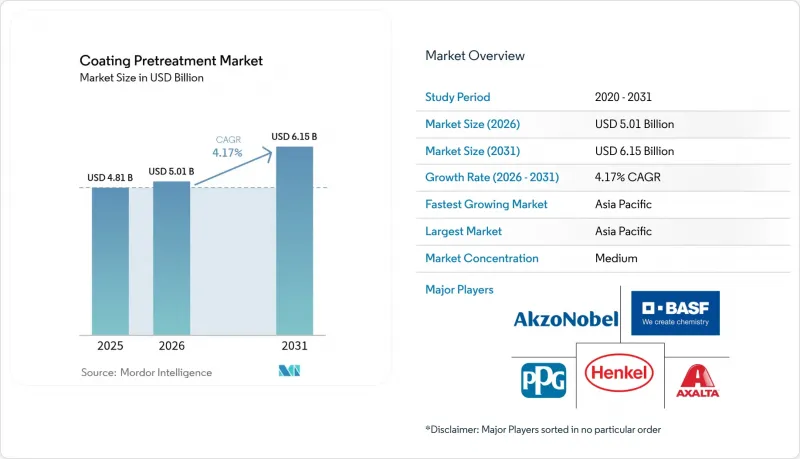
본 보고서는 유형(인산염, 크로메이트, 크로메이트 프리, 블라스팅 세정), 금속 기판(강철, 알루미늄), 최종 사용자 산업(자동차, 항공우주, 소비자 가전, 건축 및 건설, 기타 최종 사용자 산업), 지역(아시아태평양, 북미, 유럽, 남미, 중동 및 아프리카)별로 분류되어 있습니다. 시장 예측은 금액(미화) 기준으로 제시되어 있습니다.
전 세계 코팅 전처리 시장 동향 및 인사이트
인산염계 멀티메탈 시스템에 대한 OEM 수요 급증
세계 자동차 제조업체들은 혼합 금속으로 제작된 화이트 바디 어셈블리에 대해 신뢰할 수 있는 부식 방지 성능을 발휘하는 첨단 인산아연 욕을 계속해서 선호하고 있습니다. PPG사의 ‘Versabond’ 배합은 빠른 반응 속도와 균일한 결정 형성을 가능하게 하여, 품질을 저하시키지 않으면서 라인 속도를 향상시킵니다. 배터리식 전기차의 부상으로 인해, 강철 프레임과 알루미늄 배터리 하우징 간의 갈바닉 부식 억제에 대한 수요가 높아지고 있습니다. 도요타가 켄튀르키예주의 코팅 공장에 9억 2,200만 달러를 투자해 진행한 설비 현대화는 높은 처리량과 다중 금속 대응 공정을 추구하는 각 OEM 업체들의 태도를 여실히 보여주고 있습니다. 아시아의 철강 제조업체들도 이러한 추세를 따르고 있으며, 안강 광저우는 확대되는 자동차 생산에 대응하기 위해 연간 40만 톤의 생산 능력을 갖춘 아연 도금 라인을 새로 가동했습니다.
친환경 지르코늄 및 실란계 나노 코팅으로의 급속한 전환
유럽의 REACH 규정 개정과 영국의 2024년 크로메이트 사용 금지 조치가 슬러지가 적은 지르코늄 및 실란계 화학 약품의 채택을 뒷받침하고 있습니다. BASF사의 ‘Oxsilan’과 PPG사의 ‘ZircoBond’는 기존의 인산염 처리에 비해 코팅 중량을 절반으로 줄이면서도 동등한 부식 방지 효과를 발휘하며, 슬러지를 최대 80%까지 감소시킵니다. 실란 나노층은 실온에서 중합되므로, 60-70°C의 인산염 욕과 비교하여 에너지 사용량을 약 30% 절감할 수 있습니다. 각 OEM 업체들이 Scope 3 배출 감축을 추구하는 가운데, 이러한 저에너지 화학 기술은 공장의 탈탄소화 로드맵에 필수적인 요소가 되고 있습니다.
크로메이트 규제 강화와 처리 비용
2024년 9월 영국에서 시행될 6가 크롬을 이용한 전처리 금지 조치는 정책적 조치가 급속히 진행되고 있음을 여실히 보여주며, 기존에 크롬을 사용해 온 기업들은 갑작스럽게 경쟁상의 위험에 노출될 것입니다. 캘리포니아주 대기자원국은 2030년까지 6가 크롬을 사용한 장식 도금을 완전히 폐지하도록 의무화하고 있으며, 1,000만 달러의 보조금을 제공하고 있지만, 많은 중소 도금 업체들은 고액의 설비 개조 비용에 직면해 있습니다. 허가된 처리 용량이 한계에 다다르면서 유해 폐기물 처리 비용은 계속 상승하고 있으며, 제조업체들은 3가 크롬 또는 비크롬계 공정에 대한 연구 개발을 가속화할 수밖에 없는 상황입니다.
부문 분석
인산염욕은 OEM의 확고한 승인 및 광범위한 기판과의 호환성 덕분에 2025년 코팅 전처리 시장에서 45.42%의 점유율을 차지했습니다. 자동차 언더바디 등 대량 생산이 이루어지고 내식성이 극히 중요한 용도에서는 여전히 표준적인 선택지로 자리 잡고 있습니다. 그러나 실란계 화학 약품은 슬러지 발생량이 적고 에너지 소비를 최소화하는 상온 처리가 가능하기 때문에 연평균 성장률(CAGR) 5.57%로 시장을 확대되고 있습니다. 지속가능성에 대한 요구가 높아지는 가운데, 실란계 플랫폼의 코팅 전처리 시장 규모는 2031년까지 두 배로 증가할 전망인 반면, 크로메이트계는 법적 규제의 압박으로 인해 시장 점유율이 급락하고 있습니다. 각 공급업체는 나노층의 균일성과 더 짧은 경화 시간을 겸비한 하이브리드형 지르코늄-실란 배합을 통해 차별화를 꾀하고 있으며, 이를 통해 라인 운영자는 생산성 저하를 피할 수 있게 되었습니다.
실란 공급업체들은 폐수 관리의 용이성 측면에서도 혜택을 보고 있습니다. 전 세계적으로 배출 기준이 엄격해지는 가운데, 나노 코팅은 일반적으로 금속 함량이 적다는 특징을 가지고 있습니다. 또한, 공정의 간편함은 복잡한 형상에서 정밀한 두께 제어가 필요한 전자기기 표면 처리 업체들에게 더욱 큰 매력으로 작용하고 있습니다. 각 OEM 업체들이 전 세계 공장에서 승인 사양을 통일함에 따라, 아시아의 신규 공장에서 실란의 도입은 가속화될 전망이며, 인산염이 기존에 가졌던 비용 측면의 우위는 점차 줄어들고 있습니다.
지역별 분석
아시아태평양은 2025년에 전 세계 매출의 44.78%를 차지하고, 2031년까지 연평균 5.12%의 성장률을 보일 것으로 전망되어, 가장 크고 가장 빠르게 성장하는 지역 허브로서의 입지를 공고히할 것으로 보입니다. 중국의 전기차 급증은 다금속 전처리 능력에 대한 대규모 투자를 견인하고 있으며, 그 예로 선전에서 설계되어 수출용으로 설치된 120대 이상의 Durr 로봇을 갖춘 BYD의 유럽 신공장을 들 수 있습니다. 일본의 1차 공급업체들은 기업의 탄소 중립 공약에 부응하기 위해 저슬러지 나노 코팅에 주력하고 있는 반면, 베트남의 전자 산업 붐을 계기로 PPG는 현지에서 수성 코팅 생산량을 두 배로 늘렸습니다.
북미에서는 항공우주 산업 및 소형 트럭 생산 기반을 활용하여 스마트 팩토리로의 전환이 진행됨에 따라 디지털화의 확산이 가속화되고 있습니다. 유럽에서는 규제가 강화되어 다른 지역보다 앞서 생산 라인을 크롬 프리 화학 약품으로 전환해야 하는 압박을 받고 있습니다. 남미 및 중동 및 아프리카는 규모는 작지만, 자동차 조립의 변화와 내식성 강재 가공이 필요한 인프라 확장에 따른 성장 여지가 있습니다. 이러한 신흥 지역의 코팅 전처리 시장 규모는 현재로서는 아직 작지만, 서비스 역량의 현지화를 목표로 하는 다국적 공급업체들의 관심을 끌고 있습니다.
기타 혜택:
- 엑셀 형식 시장 예측(ME) 시트
- 3개월간의 애널리스트 지원
자주 묻는 질문
목차
제1장 서론
제2장 조사 방법
제3장 주요 요약
제4장 시장 구도
제5장 시장 규모와 성장 예측
제6장 경쟁 구도
제7장 시장 기회와 향후 전망
JHS 26.08.26According to Mordor Intelligence, the coating pretreatment market size was valued at USD 4.81 billion in 2025 and estimated to grow from USD 5.01 billion in 2026 to reach USD 6.15 billion by 2031, at a CAGR of 4.17% during the forecast period (2026-2031).
This report is Segmented by Type (Phosphate, Chromate, Chromate-Free, Blast Clean), Metal Substrate (Steel, Aluminum), End-User Industry (Automotive, Aerospace, Consumer Electronics, Building and Construction, Other End-User Industries), and Geography (Asia-Pacific, North America, Europe, South America, Middle East and Africa). The Market Forecasts are Provided in Terms of Value (USD).
Global Coating Pretreatment Market Trends and Insights
Surging OEM Demand for Phosphate-Based Multi-Metal Systems
Global automakers continue to favor advanced zinc phosphate baths that deliver reliable corrosion protection on mixed-metal body-in-white assemblies. PPG's Versabond formulation enables fast kinetics and consistent crystal formation, allowing line speeds to rise without compromising quality. The rise of battery-electric vehicles intensifies the need for galvanic-corrosion mitigation between steel frames and aluminum battery housings. Toyota's USD 922 million Kentucky paint-shop upgrade exemplifies OEM commitment to high-throughput, multi-metal capable processes. Asian steelmakers echo this trend: Angang Guangzhou commissioned an additional 400,000 tpa galvanizing line to feed expanded vehicle output.
Rapid Switch to Eco-Friendly Zirconium and Silane Nano-Coats
European REACH updates and the UK's 2024 chromate ban catalyze adoption of low-sludge zirconium and silane chemistries. BASF's Oxsilan and PPG's ZircoBond deliver equivalent corrosion protection at half the coating weight of conventional phosphates while cutting sludge up to 80%. Silane nano-layers polymerize at room temperature, lowering energy use by around 30% compared with 60-70 °C phosphate baths. As OEMs pursue Scope 3 emission cuts, these low-energy chemistries become integral to plant decarbonization roadmaps.
Tightening Chromate Regulations and Disposal Costs
The UK's September 2024 prohibition on hexavalent chromium pretreatments underscores fast-moving policy action, exposing legacy chrome users to sudden competitive risks. California's Air Resources Board mandates full phase-out of hex-chrome decorative plating by 2030, offering USD 10 million in grants but leaving many small platers facing steep retrofit bills. Hazardous-waste disposal fees continue to climb as permitted treatment capacity tightens, compelling manufacturers to accelerate R&D on trivalent or non-chromium routes.
Other drivers and restraints analyzed in the detailed report include:
- Smart-Factory Retrofits Boosting Inline Pretreatment Adoption
- Aerospace Composites Requiring Novel Adhesion Promoters
- Energy-Intensive High-Temperature Phosphate Lines
For complete list of drivers and restraints, kindly check the Table Of Contents.
Segment Analysis
Phosphate baths held 45.42% of the coating pretreatment market in 2025 thanks to entrenched OEM approvals and broad substrate compatibility. They remain the default for high-volume, corrosion-critical applications such as automotive underbodies. However, silane chemistries are expanding at a 5.57% CAGR because of lower sludge generation and ambient-temperature processing that minimizes energy spend. The coating pretreatment market size for silane platforms is on track to double by 2031 as sustainability mandates intensify, while chromate share collapses under legislative pressure. Suppliers differentiate through hybrid zirconium-silane formulations that combine nano-layer uniformity with faster cure windows, helping line operators avoid throughput penalties.
Silane suppliers also benefit from easier waste-water management; discharge limits tighten worldwide, and nano-coats typically exhibit lower metals load. Process simplicity further appeals to electronics finishers that require tight film-build control on intricate geometries. As OEMs harmonize approval specifications across global plants, silane adoption is poised to accelerate in Asia's greenfield factories, narrowing phosphate's historical cost advantage.
Complete Report Scope:
- By Type
- Phosphate
- Chromate
- Chromate-Free
- Blast Clean
- By Metal Substrate
- Steel
- Aluminum
- By End-User Industry
- Automotive
- Aerospace
- Consumer Electronics
- Building and Construction
- Other End-user Industries (Industrial Machinery and Appliances, etc.)
- By Geography
- Asia-Pacific
- China
- Japan
- India
- South Korea
- ASEAN Countries
- Rest of Asia-Pacific
- North America
- United States
- Canada
- Mexico
- Europe
- Germany
- United Kingdom
- France
- Italy
- Spain
- Russia
- NORDIC Countries
- Rest of Europe
- South America
- Brazil
- Argentina
- Rest of South America
- Middle East and Africa
- Saudi Arabia
- South Africa
- Rest of Middle East and Africa
- Asia-Pacific
Geography Analysis
Asia-Pacific held 44.78% of global revenue in 2025 and is forecast to expand 5.12% annually to 2031, cementing its position as both the largest and fastest-growing regional hub. China's electric-vehicle surge drives extensive investments in multi-metal pretreatment capacity, illustrated by BYD's new European plant equipped with over 120 Durr robots designed in Shenzhen for export installations. Japanese Tier-1 suppliers focus on low-sludge nano-coats to align with corporate carbon-neutral pledges, while Vietnam's electronics boom spurred PPG to double its local waterborne-coating output.
North America leverages deep aerospace and light-truck production, with smart-factory retrofits leading to faster digital uptake. Europe tightens regulatory screws, forcing line conversions to chrome-free chemistries ahead of other regions. South America and the Middle East & Africa, although smaller, represent upside tied to vehicle assembly shifts and infrastructure expansion requiring corrosion-resistant steel fabrication. The coating pretreatment market size in these emerging regions remains modest today but attracts multinational suppliers keen to localize service capability.
- 3M
- Akzo Nobel N.V.
- Atotech
- Axalta Coating Systems, LLC
- BASF
- Bulk Chemicals, Inc.
- Henkel AG and Co. KGaA
- Hubbard-Hall
- IFS Coatings
- Nihon Parkerizing Co., Ltd.
- Nippon Paint Holdings Co., Ltd.
- PPG Industries, Inc.
- The Sherwin-Williams Company
- Troy Chemical Industries
- Westchem Technologies Inc
Additional Benefits:
- The market estimate (ME) sheet in Excel format
- 3 months of analyst support
TABLE OF CONTENTS
1 Introduction
- 1.1 Study Assumptions and Market Definition
- 1.2 Scope of the Study
2 Research Methodology
3 Executive Summary
4 Market Landscape
- 4.1 Market Overview
- 4.2 Market Drivers
- 4.2.1 Surging OEM demand for phosphate-based multi-metal systems
- 4.2.2 Rapid switch to eco-friendly zirconium and silane nano-coats
- 4.2.3 Smart-factory retrofits boosting inline pretreatment adoption
- 4.2.4 Aerospace composites requiring novel adhesion promoters
- 4.2.5 OEM warranty extensions driving corrosion-resistance specs
- 4.3 Market Restraints
- 4.3.1 Tightening chromate regulations and disposal costs
- 4.3.2 Energy-intensive high-temperature phosphate lines
- 4.3.3 Rising CAPEX for multi-metal flexible lines
- 4.4 Value Chain Analysis
- 4.5 Porter's Five Forces
- 4.5.1 Bargaining Power of Suppliers
- 4.5.2 Bargaining Power of Buyers
- 4.5.3 Threat of New Entrants
- 4.5.4 Threat of Substitutes
- 4.5.5 Competitive Rivalry
5 Market Size and Growth Forecasts (Value)
- 5.1 By Type
- 5.1.1 Phosphate
- 5.1.2 Chromate
- 5.1.3 Chromate-Free
- 5.1.4 Blast Clean
- 5.2 By Metal Substrate
- 5.2.1 Steel
- 5.2.2 Aluminum
- 5.3 By End-User Industry
- 5.3.1 Automotive
- 5.3.2 Aerospace
- 5.3.3 Consumer Electronics
- 5.3.4 Building and Construction
- 5.3.5 Other End-user Industries (Industrial Machinery and Appliances, etc.)
- 5.4 By Geography
- 5.4.1 Asia-Pacific
- 5.4.1.1 China
- 5.4.1.2 Japan
- 5.4.1.3 India
- 5.4.1.4 South Korea
- 5.4.1.5 ASEAN Countries
- 5.4.1.6 Rest of Asia-Pacific
- 5.4.2 North America
- 5.4.2.1 United States
- 5.4.2.2 Canada
- 5.4.2.3 Mexico
- 5.4.3 Europe
- 5.4.3.1 Germany
- 5.4.3.2 United Kingdom
- 5.4.3.3 France
- 5.4.3.4 Italy
- 5.4.3.5 Spain
- 5.4.3.6 Russia
- 5.4.3.7 NORDIC Countries
- 5.4.3.8 Rest of Europe
- 5.4.4 South America
- 5.4.4.1 Brazil
- 5.4.4.2 Argentina
- 5.4.4.3 Rest of South America
- 5.4.5 Middle East and Africa
- 5.4.5.1 Saudi Arabia
- 5.4.5.2 South Africa
- 5.4.5.3 Rest of Middle East and Africa
- 5.4.1 Asia-Pacific
6 Competitive Landscape
- 6.1 Market Concentration
- 6.2 Strategic Moves
- 6.3 Market Share(%)/Ranking Analysis
- 6.4 Company Profiles (includes Global level Overview, Market level overview, Core Segments, Financials as available, Strategic Information, Market Rank/Share for key companies, Products and Services, and Recent Developments)
- 6.4.1 3M
- 6.4.2 Akzo Nobel N.V.
- 6.4.3 Atotech
- 6.4.4 Axalta Coating Systems, LLC
- 6.4.5 BASF
- 6.4.6 Bulk Chemicals, Inc.
- 6.4.7 Henkel AG and Co. KGaA
- 6.4.8 Hubbard-Hall
- 6.4.9 IFS Coatings
- 6.4.10 Nihon Parkerizing Co., Ltd.
- 6.4.11 Nippon Paint Holdings Co., Ltd.
- 6.4.12 PPG Industries, Inc.
- 6.4.13 The Sherwin-Williams Company
- 6.4.14 Troy Chemical Industries
- 6.4.15 Westchem Technologies Inc
7 Market Opportunities and Future Outlook
- 7.1 White-space and Unmet-Need Assessment