|
시장보고서
상품코드
2114913
탄소섬유 테이프 시장 : 시장 점유율 분석, 업계 동향 및 통계, 성장 예측(2026-2031년)Carbon Fiber Tape - Market Share Analysis, Industry Trends & Statistics, Growth Forecasts (2026 - 2031) |
||||||
 Mordor Intelligence
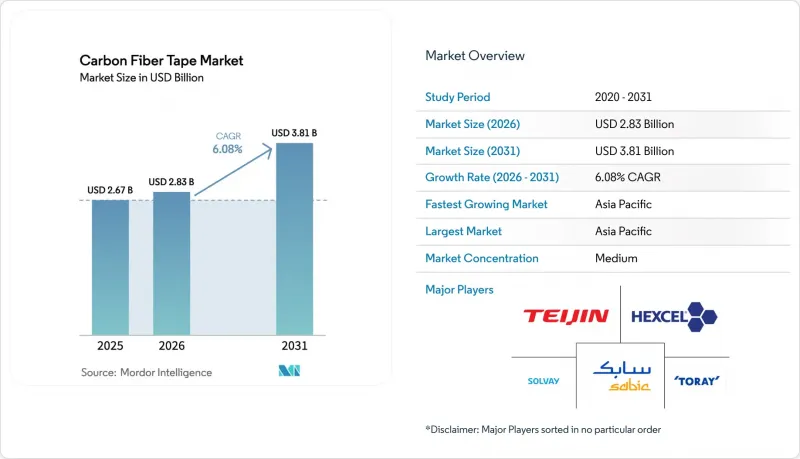
Mordor Intelligence에 의하면, 탄소섬유 테이프 시장 규모는 2025년 26억 7,000만 달러로 평가되었고, 2026년에는 28억 3,000만 달러로 추정되고, 2026-2031년 CAGR 6.08%로 성장을 지속할 전망이며, 2031년에는 38억 1,000만 달러에 이를 것으로 예측됩니다.
본 보고서는 유형별(프리프레그 테이프, 드라이 테이프), 수지 유형별(에폭시, 폴리아미드, 기타), 제조 공정별(핫멜트 프리프레그, 용제 침지, 기타), 최종 사용자 산업별(항공우주 및 방위, 자동차, 기타), 지역별(아시아태평양, 북미, 유럽, 남미, 중동 및 아프리카)로 분류되어 있습니다. 시장 예측은 금액(달러) 기준으로 제시되어 있습니다.
세계의 탄소섬유 테이프 시장 동향 및 인사이트
경량 1차 구조재에 대한 항공우주 산업 수요 급증
민간 및 방위 부문의 항공기 제조업체들은 금속으로 된 주익 스퍼, 동체 외판, 바닥 보를 내구성을 유지하면서 20%의 경량화를 실현하는 탄소섬유 테이프 적층재로 대체하고 있습니다. 이러한 경량화 효과는 보잉 787과 에어버스 A350 프로그램을 통해 입증되었습니다. 자동 섬유 배열 셀은 결함 없는 높은 적층 속도를 달성하기 위해 균일한 테이프 폭과 일관된 접착력을 필요로 하기 때문에 수요를 더욱 확대시키고 있습니다. Toray Industries Inc.의 탄소섬유와 급속 경화형 프리프레그를 결합한 NASA의 HiCAM 이니셔티브는 민관 공동 연구를 통해 와이드바디기와 단일 통로기의 구조물 사이클 타임이 단축되고 있음을 보여주는 좋은 예입니다. 인증 데이터 세트가 풍부해짐에 따라, 더 많은 주요 구조물이 테이프 기반 설계로 전환되고 있어 인증 공급업체에게 장기적인 성장이 보장되고 있습니다.
차세대 단일 통로형 항공기 생산 확대
에어버스와 보잉은 A320neo와 737 MAX 시리즈에 대해 월간 생산 대수를 두 자릿수 증가시킬 것을 약속하고 있습니다. 이러한 협폭기 프로그램에서는 2차 구조 부품과 내장용 복합재 부품이 대량으로 소비되지만, 이러한 부품은 섬유의 배향이 예측 가능하고 재료 손실을 최소화할 수 있다는 이유로 테이프를 이용한 제조가 점점 더 보편화되고 있습니다. 설비 공급업체인 MTorres는 제조업체가 사내에서 수지를 함침할 수 있는 드라이 파이버 테이프 형태를 도입했습니다. 이를 통해 기계적 성능을 유지하면서 원자재 비용을 최대 50%까지 절감할 수 있게 되었습니다. 민간 항공우주 부문의 탄소섬유 총 소비량은 2021년 1만 6,500톤에서 2026년까지 2만 9,100톤으로 증가할 것으로 예측되며, 테이프는 Tier 1 및 Tier 2 공급업체공급망을 뒷받침하는 주요 중간 형태로 자리매김하고 있습니다.
높은 전구체 및 가공 비용
폴리아크릴로니트릴은 완제품 섬유 가격의 절반에서 4분의 3을 차지하며, 다단계 산화·탄화 공정은 전력 소비량이 많기 때문에 생산자는 에너지 가격 급등의 영향을 받기 쉽습니다. 시장 가격은 산업용 등급의 경우 평균 15달러/kg, 항공우주용 등급의 경우 8만 5,000달러/t를 초과하고 있으며, 이러한 수준이 표준 승용차 등 비용에 민감한 부문으로의 보급을 저해하고 있습니다. 림릭 대학의 연구에 따르면, 에너지 사용량을 70% 절감할 수 있는 마이크로파 탄화법이 입증되었으나, 실용화까지는 아직 시간이 걸릴 것으로 보입니다. 리그닌계 및 기타 저비용 전구체가 양산화될 때까지, 테이프 제조업체들은 이익률 압박에 대처하기 위해 공정 수율을 점진적으로 향상시키고 수직 통합을 추구해야 합니다.
부문 분석
2025년 기준으로, 프리프레그의 각종 제품은 탄소섬유 테이프 시장 점유율의 63.45%를 차지했습니다. 이는 항공우주 산업의 주요 제조업체들이 주요 구조물에 요구하는 균일한 수지 함량, 안정적인 접착력, 예측 가능한 경화 프로파일을 제공할 수 있기 때문입니다. 대조적으로, 드라이 테이프는 6.72%라는 업계 최고 수준의 연평균 성장률(CAGR)을 기록하고 있으며, 자동 섬유 배치 시스템의 성숙과 1차 공급업체들이 상온 보관의 물류적 이점을 높이 평가함에 따라 그 채택이 확대되고 있습니다. 대량 생산 프로그램에서 인라인 수지 주입이 활용됨에 따라 비용 차이는 확대되고 있으며, 드라이 테이프는 2차 부품용 경제적인 대체재로서의 입지를 확립해 가고 있습니다.
프리프레그의 입지는 아웃타임 연장 및 두꺼운 적층체에서 손상 허용도를 높이는 강인한 수지 화학 조성 등의 개선을 통해 지켜지고 있습니다. 그러나 드라이 테이프 공급업체들은 수지의 웻아웃성을 높이는 독자적인 사이징제나 최대 3mm 폭의 슬릿 테이프를 채택하여 좁은 반경에서의 정밀한 성형을 가능하게 하는 등 이에 대응하고 있습니다. 수주 구성에 따라 프리프레그와 드라이 테이프를 전환할 수 있는 테이프 생산 라인은 항공우주 및 풍력 발전 양 분야의 고객에게 제품을 공급하는 수직 통합형 제조업체가 요구하는 공급 유연성을 제공합니다.
2025년에는 에폭시계 수지가 전 세계 출하량의 48.75%를 차지했습니다. 이는 수십 년에 걸친 인증 데이터와 최고 120°C의 사용 온도에서 입증된 성능을 반영한 것입니다. 이러한 우위는 Tier 1 및 Tier 2 항공우주 부품 제조업체에 대한 적시 납품을 뒷받침하는 잘 정비된 공급망도 반영하고 있습니다. PEEK 및 PPS와 같은 열가소성 수지군을 포함하는 ‘기타 수지’ 부문은 자동차 및 수소 탱크 용도에서 신속한 가공 및 재활용성이 요구됨에 따라 연평균 성장률(CAGR) 6.85%로 확대되고 있습니다.
에폭시 수지 공급업체들은 오토클레이브 외부에서 가공이 가능하고 파단 인성이 향상된 등급 및 스냅 경화 배합을 지속적으로 개발하고 있습니다. 한편, 열가소성 수지 분야의 혁신 기업들은 400°C 이하에서 성형이 가능한 저용융점도 매트릭스나, 하이브리드 구조에 대한 오버몰딩에 적합한 탄소섬유 강화 단방향 테이프로 이에 대응하고 있습니다. 폴리아미드와 비닐 에스테르는 선박이나 화학 물질 봉쇄와 같은 틈새 용도를 차지하고 있지만, 바이오 대안은 여전히 상용화 전 단계에 있음에도 불구하고, 사용 후 재활용성을 추구하는 자동차 OEM 업체들의 파일럿 프로젝트에서 주목을 받고 있습니다.
지역별 분석
아시아태평양은 중국의 대규모 섬유 생산, 견조한 풍력 터빈 건설 확대, 국내 항공우주 프로그램의 확대가 맞물려 2025년에는 탄소섬유 테이프 시장 규모의 36.40%를 차지했습니다. 이 지역의 연평균 성장률(CAGR) 6.57%는 재생에너지 발전 용량에 대한 정부의 인센티브와 COMAC의 C919 등 복합 소재를 많이 사용하는 국가가 지원하는 항공기 개발을 반영하고 있습니다. 일본의 Toray Industries Inc.와 미쓰비시는 고성능 섬유 생산을 주도하고 있는 반면, 한국과 인도의 기업들은 지역의 모빌리티 및 에너지 수요에 부응하기 위해 중급 등급의 생산 능력을 확대되고 있습니다.
북미는 이에 이어 견조한 추세를 보이고 있으며, 보잉(Boeing)사의 조립 라인, 견실한 국방 예산, 수소 동력 비행 실증기에 대한 연방 정부의 자금 지원이 이를 뒷받침하고 있습니다. 또한, 미국에는 자동 섬유 배열 기술 공급업체가 다수 존재하기 때문에 해당 지역의 컨버터는 차세대 적층 헤드를 조기에 도입할 수 있습니다. 캐나다는 2차 항공우주용 섬유 가공 제조업체 클러스터를 활용하고 있으며, 멕시코는 미국 OEM에 공급되는 자동차용 복합재 부품 분야에서 비용 경쟁력을 갖춘 거점으로 부상하고 있습니다. 유럽에서는 항공우주, 고급 자동차, 풍력 발전 각 부문에서 균형 잡힌 수요가 나타나고 있습니다. 제한안이 보류된 후에도 재확인된 탄소섬유 복합재에 대한 EU의 지원적 태도는 자동차 및 항공 양 부문에서의 채택을 뒷받침하고 있습니다. 독일의 각 OEM 업체들이 차량 통합 프로젝트를 주도하고 있으며, 영국과 프랑스는 와이드바디 기체에 대한 전문 지식의 거점이 되고 있고, 스페인의 연안 지역은 대규모 해상 풍력 발전의 확산으로 혜택을 보고 있습니다. 북유럽 국가들은 점점 더 대형화되는 블레이드를 의무화하는 적극적인 재생 에너지 목표를 통해 추진력을 제공하고 있는 반면, 동유럽은 복합재 부품 조립 분야에서 경쟁력 있는 노동력을 제공합니다.
기타 혜택
- 엑셀 형식 시장 예측(ME) 시트
- 3개월간의 애널리스트 지원
자주 묻는 질문
목차
제1장 서론
제2장 조사 방법
제3장 주요 요약
제4장 시장 구도
제5장 시장 규모 및 성장 예측
제6장 경쟁 구도
제7장 시장 기회 및 향후 전망
AJYAccording to Mordor Intelligence, the carbon fiber tape market size is expected to grow from USD 2.67 billion in 2025 to USD 2.83 billion in 2026 and is forecast to reach USD 3.81 billion by 2031 at 6.08% CAGR over 2026-2031.
This report is Segmented by Type (Prepreg Tape, Dry Tape), Resin Type (Epoxy, Polyamide, and More), Manufacturing Process (Hot-Melt Prepreg, Solvent Dip, and More), End-User Industry (Aerospace and Defense, Automotive, and More), and Geography (Asia-Pacific, North America, Europe, South America, Middle East and Africa). The Market Forecasts are Provided in Terms of Value (USD).
Global Carbon Fiber Tape Market Trends and Insights
Surging Aerospace Demand for Lightweight Primary Structures
Commercial and defense airframers are replacing metallic wing spars, fuselage skins, and floor beams with carbon fiber tape lay-ups that deliver durability alongside 20% weight savings, a metric validated by the Boeing 787 and Airbus A350 programs. Automated fiber placement cells amplify demand because they require uniform tape widths and consistent tack to achieve high deposition rates without defects. NASA's HiCAM initiative, which pairs Toray's carbon fiber with rapid-cure prepregs, exemplifies how public-private research is compressing cycle times for wide-body and single-aisle structures. As qualification datasets mature, more primary structures migrate to tape-based designs, securing long-run growth for certified suppliers.
Ramp-up of Next-Gen Single-Aisle Aircraft Production
Airbus and Boeing have committed to double-digit monthly build-rates for the A320neo and 737 MAX families. These narrow-body programs consume large volumes of secondary and interior composite parts that are increasingly manufactured from tape because of its predictable fiber orientation and minimal material wastage. Equipment provider MTorres has introduced dry-fiber tape formats that enable producers to infuse resin in-house, cutting raw material costs by up to 50% while safeguarding mechanical performance. With total carbon fiber consumption in commercial aerospace projected to climb from 16,500 t in 2021 to 29,100 t by 2026, tape is positioned as the dominant intermediate form feeding the supply chains of tier-1 and tier-2 suppliers.
High Precursor and Processing Costs
Polyacrylonitrile accounts for half to three-quarters of finished fiber price, and the multi-stage oxidation/carbonization route is power intensive, leaving producers exposed to energy spikes. Market prices average USD 15 kg for industrial grades and exceed USD 85,000 t for aerospace classes, levels that restrain penetration into cost-sensitive sectors such as standard-range passenger cars. Research at the University of Limerick demonstrated microwave carbonization that could cut energy use by 70%, but commercialization remains distant. Until lignin-based or other low-cost precursors reach scale, tape producers must pursue incremental process yields and vertical integration to manage margin compression.
Other drivers and restraints analyzed in the detailed report include:
- Automotive Shift to Carbon Fiber Reinforced Plastics for EV Range Extension
- Wind-Turbine Blade Lengthening Needs High-Modulus Tapes
- Feedstock Price and Energy-Cost Volatility
For complete list of drivers and restraints, kindly check the Table Of Contents.
Segment Analysis
Prepreg variants held 63.45% carbon fiber tape market share in 2025 because they deliver uniform resin content, stable tack, and predictable cure profiles that aerospace primes specify for primary structures. Dry tape, in contrast, posted a leading 6.72% CAGR and is gaining acceptance as automated fiber placement systems mature and as tier-1 suppliers appreciate the logistics benefits of ambient storage. The cost differential widens as high-volume programs exploit in-line resin infusion, positioning dry tape as the economical alternative for secondary parts.
Prepreg's foothold is defended by refinements such as extended out-time and tougher resin chemistries that raise damage tolerance in thicker laminates. However, dry tape vendors answer with proprietary sizing agents that enhance resin wet-out and with slit-tape formats down to 3 mm that allow precise steering around tight radii. Tape lines that can switch between prepreg and dry, depending on order mix, provide supply flexibility coveted by vertically integrated producers serving both aerospace and wind customers.
Epoxy systems constituted 48.75% of global volume in 2025, reflecting decades of certification data and proven performance at service temperatures up to 120 °C. Their dominance also mirrors well-developed supply networks that support just-in-time deliveries to both tier-1 and tier-2 aerospace fabricators. The "other resins" basket, which includes thermoplastic families such as PEEK and PPS, is expanding at 6.85% CAGR as automotive and hydrogen tank applications require fast processing and recyclability.
Epoxy suppliers continue to engineer fracture-toughened grades and snap-cure formulations that can be out-of-autoclave processed. Thermoplastic innovators respond with lower-melt-viscosity matrices that facilitate consolidation at sub-400 °C and with carbon-fiber-reinforced unidirectional tapes suitable for over-molding into hybrid structures. Polyamide and vinyl ester occupy niche marine and chemical containment roles, while bio-based options remain pre-commercial but are attracting automotive OEM pilots that seek end-of-life circularity.
Complete Report Scope:
- By Type
- Prepreg Tape
- Dry Tape
- By Resin Type
- Epoxy
- Polyamide
- Vinyl Ester
- Polyurethane
- Other Resin Types (Thermoplastic (PEEK, PPS), etc.)
- By Manufacturing Process
- Hot-Melt Prepreg
- Solvent Dip
- Automated Fiber Placement (AFP)
- Resin Transfer Infusion
- By End-user Industry
- Aerospace and Defense
- Automotive
- Building and Construction
- Marine
- Energy
- Other End-User Industries (Sporting Goods, etc.)
- By Geography
- Asia-Pacific
- China
- Japan
- India
- South Korea
- ASEAN Countries
- Rest of Asia-Pacific
- North America
- United States
- Canada
- Mexico
- Europe
- Germany
- United Kingdom
- France
- Italy
- Spain
- Russia
- NORDIC Countries
- Rest of Europe
- South America
- Brazil
- Argentina
- Rest of South America
- Middle East and Africa
- Saudi Arabia
- South Africa
- Rest of Middle East and Africa
- Asia-Pacific
Geography Analysis
Asia-Pacific held 36.40% carbon fiber tape market size in 2025 thanks to the intersection of large-scale fiber production in China, robust wind-turbine build-out, and growing domestic aerospace programs. The region's 6.57% CAGR reflects government incentives for renewable capacity and state-sponsored aircraft such as COMAC's C919, which adopt significant composite content. Japanese players Toray and Mitsubishi anchor high-performance fiber output, while South Korean and Indian firms scale mid-grade capacities to service regional mobility and energy demand.
North America follows closely, underpinned by Boeing's assembly lines, a resilient defense budget, and federal funding into hydrogen-powered flight demonstrators. The United States also hosts many automated fiber placement technology suppliers, giving regional converters first access to next-generation deposition heads. Canada leverages a cluster of tier-2 aerospace fabricators, and Mexico emerges as a cost-competitive site for automotive composite parts shipped into U.S. OEMs. Europe commands balanced demand across aerospace, premium automotive, and wind energy. The EU's supportive stance on carbon composites, reaffirmed after the shelved restriction proposal, sustains adoption in both road and aviation segments. Germany's OEMs lead vehicle integration projects; the United Kingdom and France anchor wide-body airframe expertise; and Spain's coastal corridor benefits from large offshore wind deployments. Nordic nations inject momentum through aggressive renewable targets that mandate ever-larger blades, while Eastern Europe offers competitive labor for composite component assembly.
- Axiom Materials
- Cevotec
- Chomarat
- Evonik Industries AG
- Gurit Services AG, Zurich
- Hexcel Corporation
- ITECMA
- McLAREN
- MITSUBISHI GAS CHEMICAL COMPANY, INC.
- NTPT (North Thin Ply Technology)
- Owens Corning
- Porsche
- SABIC
- SGL Carbon
- Solvay
- TCR Composites, Inc.
- Teijin Limited
- TORAY INDUSTRIES, INC.
- Victrex plc
Additional Benefits:
- The market estimate (ME) sheet in Excel format
- 3 months of analyst support
TABLE OF CONTENTS
1 Introduction
- 1.1 Study Assumptions and Market Definition
- 1.2 Scope of the Study
2 Research Methodology
3 Executive Summary
4 Market Landscape
- 4.1 Market Overview
- 4.2 Market Drivers
- 4.2.1 Surging aerospace demand for lightweight primary structures
- 4.2.2 Ramp-up of next-gen single-aisle aircraft production
- 4.2.3 Automotive shift to carbon fiber reinforced plastics (CFRP) for EV range extension
- 4.2.4 Wind-turbine blade lengthening needs high-modulus tapes
- 4.2.5 Cryogenic hydrogen tank winding for zero-carbon aviation
- 4.3 Market Restraints
- 4.3.1 High precursor and processing costs
- 4.3.2 Feedstock price and energy-cost volatility
- 4.3.3 Regulatory qualification bottlenecks for thick laminates
- 4.4 Value Chain Analysis
- 4.5 Porter's Five Forces
- 4.5.1 Bargaining Power of Suppliers
- 4.5.2 Bargaining Power of Buyers
- 4.5.3 Threat of New Entrants
- 4.5.4 Threat of Substitutes
- 4.5.5 Degree of Competition
5 Market Size and Growth Forecasts (Value)
- 5.1 By Type
- 5.1.1 Prepreg Tape
- 5.1.2 Dry Tape
- 5.2 By Resin Type
- 5.2.1 Epoxy
- 5.2.2 Polyamide
- 5.2.3 Vinyl Ester
- 5.2.4 Polyurethane
- 5.2.5 Other Resin Types (Thermoplastic (PEEK, PPS), etc.)
- 5.3 By Manufacturing Process
- 5.3.1 Hot-Melt Prepreg
- 5.3.2 Solvent Dip
- 5.3.3 Automated Fiber Placement (AFP)
- 5.3.4 Resin Transfer Infusion
- 5.4 By End-user Industry
- 5.4.1 Aerospace and Defense
- 5.4.2 Automotive
- 5.4.3 Building and Construction
- 5.4.4 Marine
- 5.4.5 Energy
- 5.4.6 Other End-User Industries (Sporting Goods, etc.)
- 5.5 By Geography
- 5.5.1 Asia-Pacific
- 5.5.1.1 China
- 5.5.1.2 Japan
- 5.5.1.3 India
- 5.5.1.4 South Korea
- 5.5.1.5 ASEAN Countries
- 5.5.1.6 Rest of Asia-Pacific
- 5.5.2 North America
- 5.5.2.1 United States
- 5.5.2.2 Canada
- 5.5.2.3 Mexico
- 5.5.3 Europe
- 5.5.3.1 Germany
- 5.5.3.2 United Kingdom
- 5.5.3.3 France
- 5.5.3.4 Italy
- 5.5.3.5 Spain
- 5.5.3.6 Russia
- 5.5.3.7 NORDIC Countries
- 5.5.3.8 Rest of Europe
- 5.5.4 South America
- 5.5.4.1 Brazil
- 5.5.4.2 Argentina
- 5.5.4.3 Rest of South America
- 5.5.5 Middle East and Africa
- 5.5.5.1 Saudi Arabia
- 5.5.5.2 South Africa
- 5.5.5.3 Rest of Middle East and Africa
- 5.5.1 Asia-Pacific
6 Competitive Landscape
- 6.1 Market Concentration
- 6.2 Strategic Moves
- 6.3 Market Share(%)/Ranking Analysis
- 6.4 Company Profiles (includes Global level Overview, Market level overview, Core Segments, Financials as available, Strategic Information, Market Rank/Share, Products and Services, Recent Developments)
- 6.4.1 Axiom Materials
- 6.4.2 Cevotec
- 6.4.3 Chomarat
- 6.4.4 Evonik Industries AG
- 6.4.5 Gurit Services AG, Zurich
- 6.4.6 Hexcel Corporation
- 6.4.7 ITECMA
- 6.4.8 McLAREN
- 6.4.9 MITSUBISHI GAS CHEMICAL COMPANY, INC.
- 6.4.10 NTPT (North Thin Ply Technology)
- 6.4.11 Owens Corning
- 6.4.12 Porsche
- 6.4.13 SABIC
- 6.4.14 SGL Carbon
- 6.4.15 Solvay
- 6.4.16 TCR Composites, Inc.
- 6.4.17 Teijin Limited
- 6.4.18 TORAY INDUSTRIES, INC.
- 6.4.19 Victrex plc
7 Market Opportunities and Future Outlook
- 7.1 White-space & Unmet-need Assessment