

|
시장보고서
상품코드
2114916
트리아세틴 시장 : 점유율 분석, 업계 동향과 통계, 성장 예측(2026-2031년)Triacetin - Market Share Analysis, Industry Trends & Statistics, Growth Forecasts (2026 - 2031) |
||||||
 Mordor Intelligence
에 의하면, 트리아세틴 시장 규모는 2026년에 162.28 킬로톤과 추정되고 있어 예측 기간(2026-2031년)에서 CAGR 4.16%로 성장을 지속하여, 2031년에는 198.96 킬로톤에 이른다고 전망되고 있습니다.
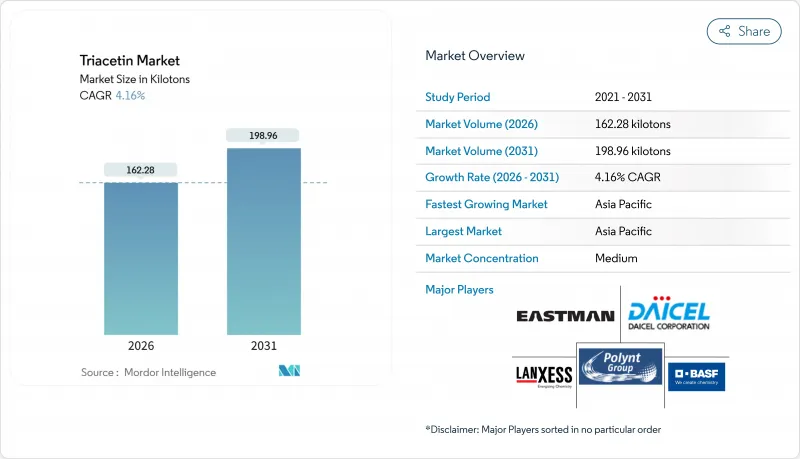
본 보고서는 등급(담배용, 식품용, 공업용), 제품 유형(가소제, 용제 등),원료(식물성 글리세린 유래 및 합성 글리세린 유래), 최종 이용 산업(담배, 식품 및 음료, 의약품 등), 그리고 지역(아시아태평양, 북미, 유럽 등)별로 세분화되어 있습니다. 시장 예측은 수량(톤) 기준으로 제시되어 있습니다.
세계 트리아세틴 시장 동향 및 인사이트
아시아 담배 필터에서 트리아세틴 가소화 아세트산 셀룰로오스 토의 채택 확대
중국에서는 400-800 m/min으로 가동되는 필터 로드 생산 라인에서 섬유 밀도를 1.28-1.32 g/cm³로 제어하기 위한 안정적인 가소제가 요구되고 있습니다. 트리아세틴은 필요한 이송 프로파일을 실현하여 담배 사양에 부합시킬 수 있습니다. 다이셀의 2밴드 특허에서는 트리아세틴의 표준 첨가량을 6-8 중량%로 규정하고 있으며, 이는 로드 1개가 성형될 때마다 반복적으로 구매되어야 함을 의미합니다. 이스트먼의 파이버스 사업부는 2024년에 13억 1,800만 달러의 매출을 기록했는데, 그 중 60%는 10대 주요 담배 제조업체에서 나온 것으로, 판매량의 확실성을 뒷받침하는 한편 집중 위험도 부각시키고 있습니다. 인도 및 인도네시아에서는 흡연자들이 필터가 부착된 담배로 계속 전환하고 있으며, 타르 함량을 줄이기 위해 로드의 길이가 연장됨에 따라 개당 트리아세틴 수요가 증가하고 있습니다. FDA 및 EU 담배 제품 지침에 따른 규제상 추적성 요건은 저비용 공급업체 시장 진입 장벽을 높여 기존 기업의 우위를 강화하고 있습니다.
뉴트라슈티컬 분야에서의 소프트젤 캡슐 수요 급증
소프트젤 캡슐은 고속 캡슐화 시 껍질의 취성을 줄이기 위해 가소제에 의존합니다. 트리아세틴은 친수성과 친유성 모두에 대한 혼합성을 갖추고 있어, 젤라틴계 및 카라기난계 모두에서 방출 프로파일을 최적화합니다. BASF사의 ‘Kollisolv GTA’는 트리아세틴을 유럽 약전(Ph.Eur.) 및 미국 약전(USP/NF) 규격에 부합하는 성막성 첨가제로 규정하여, 수탁 제조업체에 규제 측면에서의 신뢰성을 제공합니다. 바레인과 인도에서 채식주의자용 소프트젤 생산 능력을 확충함에 따라 의약품 등급에 대한 수요가 증가하고 있습니다. FDA의 GRAS(일반적으로 안전하다고 인정됨) 인증 및 여러 유형 IV 의약품 마스터 파일의 존재는 법적 책임을 우려하는 영양 보조제 분야에서 이 성분의 채택을 뒷받침하고 있습니다. 다당류 캡슐에 관한 비교 데이터가 제한적이어서 연구 개발상의 과제는 남아 있지만, 초기 연구 결과에 따르면 카라기난 제제에서 트리아세틴의 친수성이 유리함이 밝혀졌습니다.
메탄올 공급 제약으로 인한 무수 아세트산 가격 변동
무수 아세트에 의존하는 트리아세틴 생산자들은 천연가스 및 석탄 시장에 연동된 원료 가격 변동에 직면해 있습니다. 2024년 재생 에너지 시뮬레이션에서는 최근 가격 수준 하에서 루트 2(무수 아세트)의 경제성이 경쟁력이 부족하다고 지적되었습니다. 이스트만사는 원자재 리스크의 75%를 헤지하고 있지만, 그럼에도 운영 비용의 45%를 원료비로 지출하고 있어 이 분야의 구조적 취약성이 부각되고 있습니다. 중국의 석탄 가스화 메탄올 생산 거점은 전력 배급 제한이나 안전 점검 실시 시 가격 변동을 더욱 증폭시킵니다. 헤지 및 듀얼 피드 전략을 통해 그 영향은 부분적으로 완화되지만, 지역 간 비용 격차는 여전히 남아 있습니다.
부문별 분석
담배용 등급은 2025년 생산량의 55.45%를 차지하고 있으며, 중국의 연간 4,000억 개비에 달하는 담배 생산량에 따른 정착된 필터 사양의 혜택을 받고 있습니다. 담배용 등급의 트리아세틴 시장 규모는 금연 추진 움직임으로 인해 제약을 받고 있지만, 한 자릿수 초반의 성장률로 완만하게 확대될 것으로 예측됩니다. 대조적으로, 식품 등급은 연평균 성장률(CAGR) 5.56%로 확대되고 있으며, 제과 및 유제품에서 향료 용매로서의 역할이 이를 견인하고 있습니다. 이러한 분야에서는 GRAS(일반적으로 안전하다고 인정되는) 인증으로 인해 배합이 용이해졌습니다. USP/NF(미국 약전/국가 약전)의 문서화 및 로트 추적성을 요구하는 식품 및 제약 채널에서는 가격 결정력이 여전히 높은 수준을 유지하고 있습니다. 이러한 변화는 담배 분야공급량 변동을 완화하는 규제 대상인 고순도 틈새 시장으로의 점진적인 전환을 부각시키고 있습니다.
기존 아세틸 화학 물질의 통합을 통해 기존 기업들은 범용 담배 분야에서 비용 면에서의 우위를 확보하고 있지만, 식품 등급에서의 규정 준수 프리미엄으로 인해 취급량은 적더라도 매출 총이익률은 확대되고 있습니다. 이스트먼,BASF, 폴린트와 같이 두 가지 역량을 모두 갖춘 공급업체는 등급 간 차익 거래를 통해 필터 수요가 둔화되는 상황에서도 생산을 전환할 수 있습니다. 식품 등급 시장에 진입하는 스타트업 기업은 높은 분석 비용을 흡수하고 브랜드 신뢰를 구축해야 하므로, 손익분기점에 도달하기까지의 기간이 길어질 것입니다.
가소제는 필터 봉, 소프트젤 캡슐, PVC 블렌드를 배경으로 2025년 수요의 45.32%를 차지했습니다. 그러나 연포장 인쇄 업체들이 고고형분 잉크로 전환하고, 제약 기업의 제제 개발자들이 이중 혼합성을 활용함에 따라 용제 부문은 연평균 성장률(CAGR) 6.61%로 성장하여 가소제를 능가할 것으로 예측됩니다. 주요 인쇄 거점에서 VOC 규제가 강화됨에 따라, 용제 부문에서 트리아세틴 시장 점유율은 확대될 전망입니다.
식품 및 외용 의약품 분야의 보습제 용도는 틈새 시장이지만 안정적인 점유율을 유지하고 있는 반면, 안전 및 환경 감사의 진전에 따라 폭발물 및 주조 용도는 축소되는 추세입니다. 공정 집약형 생산 능력 덕분에 공급의 유연성이 유지되고 있으며, 생산자는 대규모 플랜트 개조를 하지 않고도 용제 구매자를 위해 생산량을 전환할 수 있습니다. 식품 포장용 잉크에 대한 고순도 수요는 식품 등급 요건과 규제 측면에서 시너지 효과를 창출하고 있습니다.
지역별 분석
아시아태평양은 2025년 출하량의 55.71%를 차지하며, 전 세계 담배 생산량의 35%를 차지하는 중국이 기초 수요를 뒷받침하고 있습니다. 아시아태평양의 트리아세틴 시장 규모는 아세트산 섬유의 통합 공급망과 인도의 계약 캡슐 생산량 증가에 힘입어 2031년까지 연평균 성장률(CAGR) 5.22%로 성장할 전망입니다. 이스트먼(Eastman)은 킹스포트에서 중국의 합작 기업에 100% 아세트산 플레이크를 공급하고 있으며, 이는 태평양을 가로지르는 원료 의존 관계를 보여줍니다.
북미는 이스트만의 섬유 매출에서 큰 비중을 차지하고 있습니다. 석탄에서 아세틸로의 수직 통합을 통해 비용 안정성이 확보되고 있지만, 흡연 동향의 성숙화로 인해 판매량 증가세는 억제되고 있습니다. 그럼에도 불구하고, 의약품 등급 수요와 바이오 제트 연료 유래 글리세롤 제품 부문이 완만한 성장을 뒷받침하고 있습니다. 유럽, 중동 및 아프리카에서는 가장 엄격한 가소제 규제가 적용되고 있어, 중소규모 사업자들은 생산 능력 업그레이드나 시장 철수 결정을 서둘러야 하는 상황에 처해 있습니다.
남미에서는 브라질과 아르헨티나에서 바이오디젤 유래 글리세린공급 과잉이 호재로 작용하여, 현지 트리아세틴 프로젝트에 원료 측면에서의 우위를 제공합니다. 중동에서는 사우디아라비아의 하류 사업 확대에 따라 아세틸 제품의 다각화가 주목받고 있으나, 수자원 부족과 글리세롤의 입수 가능성으로 인해 단기적인 규모 확대가 억제되고 있습니다. 전반적으로 지리적 다각화는 정책 리스크나 상품 가격 리스크를 헤지하는 수단이지만, 아시아가 여전히 중심적인 위치를 차지하고 있습니다.
기타 혜택:
- 엑셀 형식 시장 전망(ME) 시트
- 3개월간의 애널리스트 지원
자주 묻는 질문
목차
제1장 서론
제2장 조사 방법
제3장 주요 요약
제4장 시장 구도
제5장 시장 규모와 성장 예측
제6장 경쟁 구도
제7장 시장 기회와 향후 전망
JHS 26.08.26According to Mordor Intelligence, the triacetin market size is estimated at 162.28 kilotons in 2026 and is expected to reach 198.96 kilotons by 2031, at a CAGR of 4.16% during the forecast period (2026-2031).
This report is Segmented by Grade (Tobacco Grade, Food Grade, Industrial Grade), Product Type (Plasticizer, Solvent, and More), Source (Vegetable-Glycerin-Based and Synthetic-Glycerin-Based), End-Use Industry (Tobacco, Food and Beverage, Pharmaceuticals, and More), and Geography (Asia-Pacific, North America, Europe, and More). The Market Forecasts are Provided in Terms of Volume (Tons).
Global Triacetin Market Trends and Insights
Growing Implementation of Triacetin-Plasticized Cellulose-Acetate Tow in Asian Cigarette Filters
China's filter-rod lines operating at 400-800 m/min require a stable plasticizer to control tow density at 1.28-1.32 g/cm3; triacetin delivers the needed migration profile, locking it into cigarette specifications. Daicel's two-band patent quantifies typical triacetin dosing at 6-8 wt%, translating into repeat purchases with every rod formed. Eastman's Fibers unit logged USD 1,318 million sales in 2024, 60% of which came from the ten largest cigarette manufacturers, underscoring volume certainty but also concentration risk. India and Indonesia continue to shift smokers toward filtered formats, lengthening rods to cut tar yields and pushing per-stick triacetin demand upward. Regulatory traceability requirements from the FDA and the EU's Tobacco Products Directive elevate the barriers for low-cost suppliers, reinforcing incumbent dominance.
Surging Demand for Gel-Caps in Nutraceuticals
Soft-gel capsules rely on plasticizers to curb shell brittleness during high-speed encapsulation; triacetin's dual hydrophilic and lipophilic miscibility tailors release profiles in both gelatin and carrageenan systems. BASF's Kollisolv GTA positions triacetin as a film-forming excipient compliant with Ph.Eur. and USP/NF monographs, lending regulatory confidence to contract manufacturers. Vegetarian soft-gel capacity additions in Bahrain and India intensify pharmaceutical-grade pull. FDA GRAS affirmation and the presence of multiple Type IV Drug Master Files bolster adoption in liability-sensitive nutraceuticals. Limited comparative data on polysaccharide shells present a research and development gap, yet early evidence favors triacetin's hydrophilicity for carrageenan formulations.
Volatility in Acetic-Anhydride Prices Linked to Methanol Supply Constraints
Triacetin producers dependent on acetic anhydride endure feedstock swings tied to natural-gas and coal markets; a 2024 Renewable Energy simulation flagged route-2 economics (acetic anhydride) as uncompetitive under recent price decks. Eastman hedges 75% of raw-material exposure yet still devotes 45% of operations cost to feedstocks, illustrating systemic sensitivity. Coal-gasified methanol hubs in China amplify volatility during power rationing or safety inspections. Hedging and dual-feed strategies partially mitigate, but regional cost gaps persist.
Other drivers and restraints analyzed in the detailed report include:
- Shift Toward Bio-Based Plasticizers Under Europe's Paints and Coatings Regulations
- Emergence of Triacetin as Carrier Solvent in High-Solid Ink-Jet Inks for Flexible Packaging
- Regulatory Scrutiny on Plasticizers in Europe
For complete list of drivers and restraints, kindly check the Table Of Contents.
Segment Analysis
Tobacco grade anchored 55.45% of 2025 volume, benefiting from entrenched filter specifications in China's 400-billion-stick output. The triacetin market size for tobacco grade is projected to inch forward at low single-digit rates, constrained by anti-smoking drives. By contrast, food grade is expanding at 5.56% CAGR, propelled by flavor-solvent roles in confectionery and dairy, where GRAS status eases formulation. Pricing power remains higher in food and pharma channels that demand USP/NF documentation and lot traceability. The shift underscores a gradual pivot toward regulated, high-purity niches that cushion volatility in tobacco volumes.
Legacy acetyl-chemical integration grants incumbents a cost edge in commodity tobacco streams, yet the compliance premium in food-grade widens gross margins despite lower tonnage. Suppliers with dual capabilities-Eastman, BASF, Polynt-can arbitrage between grades, redirecting output as filter demand moderates. Start-ups chasing food-grade must absorb high analytical overheads and build brand trust, elongating break-even timelines.
Plasticizers accounted for 45.32% of 2025 demand on the back of filter rods, soft-gel shells, and PVC blends. However, the solvent segment is forecast to grow 6.61% CAGR, outpacing plasticizers as flexible-packaging printers shift to high-solid inks and pharma formulators exploit dual miscibility. The triacetin market share for solvents is set to widen as VOC caps tighten in major print hubs.
Humectant roles in food and topical pharma hold niche but steady slices, while explosive and foundry uses retreat amid safety and environmental audits. Process-intensified capacity keeps supply agile, allowing producers to pivot volumes toward solvent buyers without major plant revamps. High-purity needs in inks intended for food wrappers weave regulatory synergy with food-grade requirements.
Complete Report Scope:
- By Grade
- Tobacco Grade
- Food Grade
- Industrial Grade
- By Product Type
- Plasticizer
- Solvent
- Humectant
- Other Product Types
- By Source
- Vegetable-Glycerin-Based
- Synthetic-Glycerin-Based
- By End-Use Industry
- Tobacco
- Food and Beverage
- Pharmaceuticals
- Cosmetics
- Paints and Coatings
- Adhesives and Sealants
- Other End-user Industries
- By Geography
- Asia-Pacific
- China
- India
- Japan
- South Korea
- Rest of Asia-Pacific
- North America
- United States
- Canada
- Mexico
- Europe
- Germany
- United Kingdom
- Italy
- France
- Rest of Europe
- South America
- Brazil
- Argentina
- Rest of South America
- Middle East and Africa
- Saudi Arabia
- South Africa
- Rest of Middle East and Africa
- Asia-Pacific
Geography Analysis
Asia-Pacific commanded 55.71% of 2025 shipments, with China's 35% share of global cigarette production anchoring basal demand. The triacetin market size in Asia-Pacific will expand at a 5.22% CAGR through 2031, buoyed by integrated acetate-tow supply chains and rising contract capsule output in India. Eastman supplies 100% acetate flake to its Chinese venture from Kingsport, illustrating trans-Pacific feedstock dependency.
North America contributes a significant share of Eastman's fiber sales; vertical coal-to-acetyl integration ensures cost resilience, while mature smoking trends curb volume upside. Nevertheless, pharmaceutical-grade pull and bio-jet-fuel glycerol streams support modest growth. Europe, Middle East, and Africa face the most stringent plasticizer rules, forcing capacity upgrades or exit decisions among smaller players.
South America benefits from biodiesel-derived glycerin surpluses in Brazil and Argentina, offering feedstock leverage for local triacetin projects. The Middle East eye acetyl diversification in Saudi Arabia's downstream push, though water scarcity and glycerol availability temper near-term scale. Overall, geographic diversification hedges policy and commodity risk, yet Asia remains the gravitational center.
- BASF
- Daicel Corporation
- Eastman Chemical Company
- Innova Global (India)
- Jiangsu Licheng Chemical Co., Ltd.
- Jiangsu Ruijia Food Ingredient Co., Ltd.
- Kanoria Chemicals & Industries Ltd. (KCI)
- LANXESS
- Polynt S.p.A
- Sisco Research Laboratories Pvt. Ltd.
- Spectrum Chemical
- WUXI KAILAI BIOTECHNOLOGY CO.,LTD.
- Zhonglan Industry Co.,Ltd.
Additional Benefits:
- The market estimate (ME) sheet in Excel format
- 3 months of analyst support
TABLE OF CONTENTS
1 Introduction
- 1.1 Study Assumptions and Market Definition
- 1.2 Scope of the Study
2 Research Methodology
3 Executive Summary
4 Market Landscape
- 4.1 Market Overview
- 4.2 Market Drivers
- 4.2.1 Growing implementation of triacetin-plasticized cellulose-acetate tow in Asian cigarette filters
- 4.2.2 Surging demand for gel-caps in nutraceuticals
- 4.2.3 Shift toward bio-based plasticizers under Europe's paints and coatings regulations
- 4.2.4 Emergence of triacetin as carrier solvent in high-solid ink-jet inks for flexible packaging
- 4.2.5 Adoption of continuous reactive-distillation units lowering production cost and carbon footprint
- 4.3 Market Restraints
- 4.3.1 Volatility in acetic-anhydride prices linked to methanol supply constraints
- 4.3.2 Regulatory scrutiny on plasticizers in Europe
- 4.3.3 Anti-smoking policies targeting single-use cellulose filters
- 4.4 Value Chain Analysis
- 4.5 Porter's Five Forces
- 4.5.1 Bargaining Power of Suppliers
- 4.5.2 Bargaining Power of Buyers
- 4.5.3 Threat of New Entrants
- 4.5.4 Threat of Substitutes
- 4.5.5 Competitive Rivalry
5 Market Size and Growth Forecasts (Volume)
- 5.1 By Grade
- 5.1.1 Tobacco Grade
- 5.1.2 Food Grade
- 5.1.3 Industrial Grade
- 5.2 By Product Type
- 5.2.1 Plasticizer
- 5.2.2 Solvent
- 5.2.3 Humectant
- 5.2.4 Other Product Types
- 5.3 By Source
- 5.3.1 Vegetable-Glycerin-Based
- 5.3.2 Synthetic-Glycerin-Based
- 5.4 By End-Use Industry
- 5.4.1 Tobacco
- 5.4.2 Food and Beverage
- 5.4.3 Pharmaceuticals
- 5.4.4 Cosmetics
- 5.4.5 Paints and Coatings
- 5.4.6 Adhesives and Sealants
- 5.4.7 Other End-user Industries
- 5.5 By Geography
- 5.5.1 Asia-Pacific
- 5.5.1.1 China
- 5.5.1.2 India
- 5.5.1.3 Japan
- 5.5.1.4 South Korea
- 5.5.1.5 Rest of Asia-Pacific
- 5.5.2 North America
- 5.5.2.1 United States
- 5.5.2.2 Canada
- 5.5.2.3 Mexico
- 5.5.3 Europe
- 5.5.3.1 Germany
- 5.5.3.2 United Kingdom
- 5.5.3.3 Italy
- 5.5.3.4 France
- 5.5.3.5 Rest of Europe
- 5.5.4 South America
- 5.5.4.1 Brazil
- 5.5.4.2 Argentina
- 5.5.4.3 Rest of South America
- 5.5.5 Middle East and Africa
- 5.5.5.1 Saudi Arabia
- 5.5.5.2 South Africa
- 5.5.5.3 Rest of Middle East and Africa
- 5.5.1 Asia-Pacific
6 Competitive Landscape
- 6.1 Market Concentration
- 6.2 Strategic Moves
- 6.3 Market Share(%)/Ranking Analysis
- 6.4 Company Profiles (includes Global-level Overview, Market-level Overview, Core Segments, Financials as available, Strategic Information, Products and Services, Recent Developments)
- 6.4.1 BASF
- 6.4.2 Daicel Corporation
- 6.4.3 Eastman Chemical Company
- 6.4.4 Innova Global (India)
- 6.4.5 Jiangsu Licheng Chemical Co., Ltd.
- 6.4.6 Jiangsu Ruijia Food Ingredient Co., Ltd.
- 6.4.7 Kanoria Chemicals & Industries Ltd. (KCI)
- 6.4.8 LANXESS
- 6.4.9 Polynt S.p.A
- 6.4.10 Sisco Research Laboratories Pvt. Ltd.
- 6.4.11 Spectrum Chemical
- 6.4.12 WUXI KAILAI BIOTECHNOLOGY CO.,LTD.
- 6.4.13 Zhonglan Industry Co.,Ltd.
7 Market Opportunities and Future Outlook
- 7.1 White-Space and Unmet-Need Assessment
- 7.2 Growing Demand for E-Cigarettes


