

|
시장보고서
상품코드
2114918
중공 콘크리트 블록 시장 : 점유율 분석, 업계 동향과 통계, 성장 예측(2026-2031년)Hollow Concrete Block - Market Share Analysis, Industry Trends & Statistics, Growth Forecasts (2026 - 2031) |
||||||
 Mordor Intelligence
Mordor Intelligence에 의하면, 중공 콘크리트 블록 시장 규모는 2025년에 2,786억 5,000만 달러로 평가되었고 2026년 2,926억 9,000만 달러에서 2031년까지 3,743억 6,000만 달러에 이를 것으로 예측되며, 예측 기간(2026-2031년) CAGR은 5.04%를 나타낼 전망입니다.
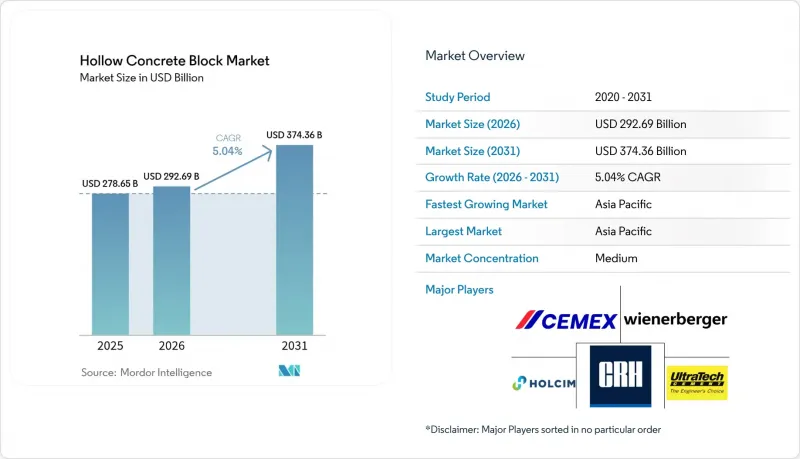
본 보고서는 제품 유형(절단면 블록, 평면 블록), 최종 사용자 산업(주택, 상업, 산업, 기타 최종 사용자 산업) 및 지역(아시아태평양, 북미, 유럽, 남미, 중동 및 아프리카)별로 분류되어 있습니다. 시장 예측은 금액(미 달러) 기준으로 제시되어 있습니다.
세계 중공 콘크리트 블록 시장 동향 및 인사이트
급속한 도시화가 합리적인 가격의 주택 수요를 견인
각국의 주택 정책에서는 시공 속도와 비용 효율성 측면에서 콘크리트 블록을 우대하는 야심찬 건설 목표가 계속해서 설정되고 있습니다. 인도의 ‘프라단 만트리 아와스 요자나(Pradhan Mantri Awas Yojana)’에 따라, 이미 도시 지역에서 118.64 라크,농촌 지역에서 321 락 분량의 주택 건설이 승인되었으며, 추가로 2 크롤 분량의 주택에 대한 예산이 승인됨에 따라, 중공 콘크리트 블록 제조업체에게는 향후 수년에 걸쳐 안정적인 수주 전망이 이어지고 있습니다. 아프리카 각국 정부도 유사한 정책을 추진하고 있으며, 공급망을 단축하고 가격 변동을 안정시키는 새로운 현지 시멘트 공장에 의해 뒷받침되고 있습니다. 2024년 중국의 시멘트 생산량은 전년 대비 10% 감소했으나, 도시 재생 사업 및 각 성의 공영 주택 할당으로 인해 블록 수요의 최저 수준은 유지되고 있습니다. 이와 같이 병행하여 진행되는 프로그램들이 중공 콘크리트 블록 시장의 장기적인 성장을 뒷받침하고 있습니다.
그린빌딩 인증의 급증으로 경량 벽돌 수요가 증가
콘크리트는 LEED v4의 55개 크레딧 중 25개에 기여하고 있으며, 중공 블록은 재활용 소재 및 우수한 열용량과 결합함으로써 최대 74포인트를 획득할 수 있습니다. 플라스틱 유래의 가공 경량 골재를 사용함으로써 구조물 중량과 운송 시 배출량을 줄이면서 추가로 8크레딧을 확보할 수 있습니다. 위너베르거(Wienerberger) 등 유럽의 건축자재 그룹은 2026년까지 매출의 75%를 넷제로 대응 제품으로 채우는 것을 목표로 하고 있으며, 신축 시장의 침체에도 불구하고 리모델링 수요는 견조하다고 보고하고 있습니다. 따라서 환경 규제가 강화되는 가운데, 고가대의 친환경 블록은 수익성을 높이는 요인이 됩니다.
시멘트 및 골재 가격 변동
세계적인 운송 혼란, 수출 관세, 지역별 탄소세로 인해 시멘트 가격 변동 폭이 톤당 90-130달러에서 최대 160-240달러까지 확대될 가능성이 있어, 블록 제조업체의 이익률을 압박하고 있습니다. 채석장이나 항구에서 멀리 떨어진 곳에 위치한 소규모 생산자들은 불균형적으로 큰 투입 비용 변동에 직면하고 있으며, 이는 생산 능력의 합리화를 초래하고 통합형 대형 시멘트 제조업체에 대한 의존도를 높이고 있습니다. 2030년까지 생산자 수가 300개사에서 30개사로 축소될 가능성이 있는 중국의 업계 재편은 가격 변동이 시장 재편을 얼마나 가속화하는지를 여실히 보여주고 있습니다.
부문 분석
2025년 시점에서 절단면 마감 블록은 중공 콘크리트 블록 시장의 63.05%를 차지하고 있으며, 2031년까지 연평균 성장률(CAGR) 6.18%로 다른 형태를 능가하는 성장이 예상됩니다. 그 질감 있는 외관은 썰어낸 돌을 연상시키면서도, 기존의 콘크리트 쌓기 자재가 가진 치수 정밀도와 하중 지지 능력을 유지하고 있어, 시각적으로 노출되는 파사드를 지정하는 건축가들에게 지지를 받고 있습니다. 스플릿 페이스형 중공 콘크리트 블록 시장 규모는 기능성과 거리 경관의 미관을 융합한 고급 주택 및 유틸리티 분야에서 가장 빠르게 확대될 것으로 예측됩니다. 한편, 표면 마감이 도장이나 미장 마감으로 가려지는 산업용 벽이나 뒷벽의 경우, 매끄러운 표면의 블록에 대한 수요가 안정적으로 유지되고 있습니다. Spherical Block LLC사의 인터로킹식 아치 모듈과 같은 혁신 기술은 기하학적 진보를 통해 중공 블록의 용도가 곡면 지붕이나 돔으로 확대되어 새로운 가치의 원천을 창출하고 있음을 보여줍니다.
제조 동향 또한 이러한 계층 구조를 뒷받침하고 있습니다. 반자동 절단면 마감 라인에서는 연마식 절단면 가공 스테이션과 그에 이어지는 로봇을 이용한 팔레타이징이 채택되어, 균일한 질감을 유지하면서 생산량을 향상시키고 있습니다. 지오폴리머 결합제를 도입한 공장에서는 포틀랜드 시멘트 배합에 비해 함유 탄소량이 최대 40% 감소하는 것으로 보고되어, LEED 인증 획득에 기여도가 높아짐에 따라 친환경 공공 입찰에서 채택되고 있습니다. 그린빌딩 건축 기준이 엄격해지는 가운데, 스플릿 페이스 제품 전체 라인업에 대해 환경제품선언(EPD) 인증을 취득할 수 있는 제조업체는 가격 프리미엄을 설정하여 시장 점유율을 지킬 수 있습니다.
지역별 분석
아시아태평양은 2025년에 세계 점유율 46.05%를 유지하고며, 국가 차원의 주택 건설 계획, 대도시권의 확장, 그리고 지역적 제조업 이전을 바탕으로 2031년까지 연평균 성장률(CAGR) 5.93%를 기록할 전망입니다. 인도 수요만으로도 막대한 양의 콘크리트 생산을 흡수하고 있으며, 정부는 현지산 중공 블록을 사용하여 건설되는 내진성이 높은 벽 시스템을 의무화하고, 추가로 2크롤(2,000만 호)의 주택 건설을 승인했습니다. 2024년 중국의 시멘트 생산량은 10% 감소했으나, 도시 지역의 노후화된 건축물 및 해안 지역의 홍수 방어 시설 개보수로 인해 블록 소비량은 견조한 추세를 보이고 있습니다. 동남아시아 국가들에서는 신속한 창고 건설이 필요한 전자기기 및 전기차(EV) 조립 공장이 환영받고 있으며, 품질 기준을 충족하기 위해 일본과 독일에서 자동 블록 생산 라인을 수입하는 움직임이 활발해지고 있습니다.
북미에서는 연방 정부의 인프라 부양책과 오프사이트 건설로의 전환 가속화의 혜택을 받고 있습니다. ‘인프라 투자 및 고용법’에 따라 자금을 지원받은 6만 건이 넘는 프로젝트를 통해 고속도로, 항만, 광대역 회랑이 확장되고 있으며, 각각 내구성이 높은 경계벽이나 변전소 울타리가 필요하게 되었습니다. 이 지역에서 중공 콘크리트 블록 시장 점유율 확대는 단열재와 앵커 플레이트를 일체화한 모듈식 벽 패널의 채택을 반영한 것으로, 이를 통해 크레인 작업과 노동 시간을 절감하고 있습니다. FEMA(연방재난관리청)의 복원력 보조금은 연안 지역 재건 공사에 추가적인 블록 수요를 창출하고 있는 반면, 민간 전자상거래 투자자들은 방화 등급에 관한 보험 요건을 충족하기 위해 물류 센터에 콘크리트 조적재를 지정하고 있습니다.
유럽에서는 신축 주택 착공 건수가 부진하지만, 리모델링 및 유틸리티 분야에서는 견조한 모습을 보이고 있습니다. 각 제조업체는 부가가치가 높은 저탄소 제품과 리모델링 시장의 단열 성능 향상에 주력함으로써 판매량 감소를 완화하고 있습니다. 위너베르거(Wienerberger)에 따르면, 2024년 매출의 절반 이상은 현재 리모델링 및 인프라 사업에서 발생하고 있으며, 이는 독일의 주택 착공 건수 부진으로 인한 영향을 완화하고 있습니다. EU 동부 시장에서는 EU 자금이 교통 회랑 및 기후 변화 적응 대책에 유입되고 있어 더욱 건실한 성장세를 보이고 있으며, 중공 콘크리트 블록은 그 견고성과 현지 골재와의 적합성 덕분에 선택받고 있습니다. 이 지역의 엄격한 탄소 가격 책정 환경은 보조 시멘트계 재료의 채택을 가속화하고 있으며, 지오폴리머 배합 설계에 관한 국경을 초월한 지식 이전을 촉진하고 있습니다.
기타 혜택:
- 엑셀 형식 시장 예측(ME) 시트
- 3개월간의 애널리스트 지원
자주 묻는 질문
목차
제1장 서론
제2장 조사 방법
제3장 주요 요약
제4장 시장 구도
제5장 시장 규모와 성장 예측
제6장 경쟁 구도
제7장 시장 기회와 향후 전망
JHS 26.08.26According to Mordor Intelligence, the hollow concrete block market size was valued at USD 278.65 billion in 2025 and estimated to grow from USD 292.69 billion in 2026 to reach USD 374.36 billion by 2031, at a CAGR of 5.04% during the forecast period (2026-2031).
This report is Segmented by Product Type (Split-Faced Blocks, Smooth-Faced Blocks), End-User Industry (Residential, Commercial, Industrial, Other End-User Industry), and Geography (Asia-Pacific, North America, Europe, South America, Middle East and Africa). The Market Forecasts are Provided in Terms of Value (USD).
Global Hollow Concrete Block Market Trends and Insights
Rapid Urbanization Boosting Affordable Housing Demand
National housing programs continue to set aggressive construction targets that favor concrete blocks for speed and cost efficiency. India's Pradhan Mantri Awas Yojana has already sanctioned 118.64 lakh urban homes and 321 lakh rural units, with budget approvals for another 2 crore dwellings, sustaining a multi-year pipeline for hollow concrete blocks manufacturers. African governments replicate similar schemes, supported by new local cement plants that shorten supply chains and stabilize price volatility. Although Chinese cement output fell 10% year-on-year in 2024, urban renewal and provincial public-housing quotas preserve baseline block demand. These concurrent programs anchor long-duration growth for the hollow concrete blocks market.
Surge in Green-Building Certifications Driving Lightweight Masonry
Concrete contributes to 25 of 55 LEED v4 credits, allowing hollow units to unlock up to 74 points when combined with recycled content and superior thermal mass. Use of processed lightweight aggregates derived from plastics can secure 8 additional credits while lowering structural weight and transport emissions. European material groups such as Wienerberger target 75% of revenue from net-zero-ready products by 2026 and report renovation resilience despite a sluggish new-build cycle. Premium-priced eco-blocks, therefore, reinforce profitability as green regulations tighten.
Volatility in Cement & Aggregate Prices
Global freight disruptions, export levies, and regional carbon fees can widen cement price bands from USD 90-130 per ton to as high as USD 160-240 per ton, squeezing block makers' margins. Smaller producers located far from quarries or ports face disproportionate input cost swings, triggering capacity rationalization and heightening dependence on integrated cement majors. Consolidation in China, where producer numbers may contract from 300 to 30 by 2030, exemplifies how volatility accelerates market restructuring.
Other drivers and restraints analyzed in the detailed report include:
- Rising Labor Costs Prompting Modular Construction Adoption
- Growth of Disaster-Resilient Infrastructure Programmes
- Stringent Carbon-Emission Regulations on Cement Industry
For complete list of drivers and restraints, kindly check the Table Of Contents.
Segment Analysis
Split-faced blocks captured 63.05% of the hollow concrete blocks market in 2025 and will outpace other formats at a 6.18% CAGR to 2031. Their textured exteriors resemble hewn stone yet preserve the dimensional accuracy and load-bearing capacity of conventional concrete masonry units, appealing to architects specifying visually exposed facades. The hollow concrete blocks market size for split-faced units is projected to widen fastest in premium residential and civic projects that blend function with street-level aesthetics. Smooth-faced blocks hold steady demand in industrial and back-of-house walls where painting or parging masks surface finish. Innovations such as Spherical Block LLC's interlocking arch modules illustrate how geometry advances expand hollow block applications into curved roofs and domes, creating fresh value pools.
Manufacturing trends reinforce this hierarchy. Semi-automated split-face lines adopt abrasive splitting stations followed by robotic palletizing, lifting output volumes while maintaining consistent texture. Plants deploying geopolymer binders report up to 40% lower embodied carbon relative to Portland blends, enhancing their LEED contribution and winning specification in green public tenders. As green-building codes tighten, producers able to certify Environmental Product Declarations across their split-faced range can command price premiums and defend share.
Complete Report Scope:
- By Product Type
- Split-Faced Blocks
- Smooth-Faced Blocks
- By End-User Industry
- Residential
- Commercial
- Industrial
- Other End-User Industry (Infrastructure, etc.)
- By Geography
- Asia-Pacific
- China
- Japan
- India
- South Korea
- ASEAN Countries
- Rest of Asia-Pacific
- North America
- United States
- Canada
- Mexico
- Europe
- Germany
- United Kingdom
- France
- Italy
- Spain
- Russia
- NORDIC Countries
- Rest of Europe
- South America
- Brazil
- Argentina
- Rest of South America
- Middle East and Africa
- Saudi Arabia
- South Africa
- Rest of Middle East and Africa
- Asia-Pacific
Geography Analysis
Asia-Pacific retained 46.05% global share in 2025 and is on track for 5.93% CAGR through 2031, buoyed by sovereign housing blueprints, metro expansions, and regional manufacturing relocation. Indian demand alone absorbs vast concrete output, with the government approving an additional 2 crore dwellings that stipulate resilient wall systems built from locally sourced hollow units. Although Chinese cement production dipped by 10% in 2024, ageing urban stock and coastal flood-defence upgrades sustain steady block consumption. Southeast Asian nations welcome electronics and EV assembly plants that require rapid warehouse construction, driving imports of automated block lines from Japan and Germany to meet quality tolerances.
North America benefits from federal infrastructure stimulus and an accelerating shift toward off-site construction. Over 60,000 projects funded under the Infrastructure Investment and Jobs Act expand highways, ports, and broadband corridors, each demanding durable boundary walls and substation enclosures. Hollow concrete blocks market share gains in the region reflect adoption of modular wall panels that integrate insulation and anchor plates, reducing crane picks and labor hours. FEMA's resilience grants channel additional block demand into coastal rebuilds, while private e-commerce investors specify concrete masonry for distribution centers to meet fire-rating insurance requirements.
Europe faces subdued new-home starts yet demonstrates resilience in renovation and public-works segments. Producers mitigate lower volumes by emphasizing value-added low-carbon units and thermal upgrades in retrofit markets. Wienerberger reports over half of 2024 revenue now stems from renovation and infrastructure, cushioning the impact of weak German housing starts. Eastern EU markets show healthier momentum as EU funds flow into transport corridors and climate-adaptation schemes, with hollow concrete blocks chosen for their robustness and local aggregate compatibility. The region's stringent carbon-pricing environment accelerates adoption of supplementary cementitious materials, prompting cross-border knowledge transfer on geopolymer mix designs.
- Acme Brick Company
- ALWEHER Co.
- Brampton Brick
- CEMEX S.A.B de C.V
- CRH Americas
- Forterra Building Products Ltd
- Holcim
- Lignacite Ltd.
- Magicrete
- MATERRUP
- MIDLAND BRICK
- Taylor Concrete Products Inc
- Tristar Brick and Block LTD.
- UltraTech Cement Ltd.
- Wienerberger
Additional Benefits:
- The market estimate (ME) sheet in Excel format
- 3 months of analyst support
TABLE OF CONTENTS
1 Introduction
- 1.1 Study Assumptions and Market Definition
- 1.2 Scope of the Study
2 Research Methodology
3 Executive Summary
4 Market Landscape
- 4.1 Market Overview
- 4.2 Market Drivers
- 4.2.1 Rapid urbanisation boosting affordable housing demand
- 4.2.2 Surge in green-building certifications driving lightweight masonry
- 4.2.3 Rising labour costs prompting modular construction adoption
- 4.2.4 Growth of disaster-resilient infrastructure programmes
- 4.2.5 Expansion of e-commerce warehouses and logistics hubs
- 4.3 Market Restraints
- 4.3.1 Volatility in cement and aggregate prices
- 4.3.2 Stringent carbon-emission regulations on cement industry
- 4.3.3 Skilled-labour shortage for block masonry in developed markets
- 4.4 Value Chain Analysis
- 4.5 Porter's Five Forces Analysis
- 4.5.1 Bargaining Power of Suppliers
- 4.5.2 Bargaining Power of Buyers
- 4.5.3 Threat of New Entrants
- 4.5.4 Threat of Substitute Products
- 4.5.5 Degree of Competition
5 Market Size and Growth Forecasts (Value)
- 5.1 By Product Type
- 5.1.1 Split-Faced Blocks
- 5.1.2 Smooth-Faced Blocks
- 5.2 By End-User Industry
- 5.2.1 Residential
- 5.2.2 Commercial
- 5.2.3 Industrial
- 5.2.4 Other End-User Industry (Infrastructure, etc.)
- 5.3 By Geography
- 5.3.1 Asia-Pacific
- 5.3.1.1 China
- 5.3.1.2 Japan
- 5.3.1.3 India
- 5.3.1.4 South Korea
- 5.3.1.5 ASEAN Countries
- 5.3.1.6 Rest of Asia-Pacific
- 5.3.2 North America
- 5.3.2.1 United States
- 5.3.2.2 Canada
- 5.3.2.3 Mexico
- 5.3.3 Europe
- 5.3.3.1 Germany
- 5.3.3.2 United Kingdom
- 5.3.3.3 France
- 5.3.3.4 Italy
- 5.3.3.5 Spain
- 5.3.3.6 Russia
- 5.3.3.7 NORDIC Countries
- 5.3.3.8 Rest of Europe
- 5.3.4 South America
- 5.3.4.1 Brazil
- 5.3.4.2 Argentina
- 5.3.4.3 Rest of South America
- 5.3.5 Middle East and Africa
- 5.3.5.1 Saudi Arabia
- 5.3.5.2 South Africa
- 5.3.5.3 Rest of Middle East and Africa
- 5.3.1 Asia-Pacific
6 Competitive Landscape
- 6.1 Market Concentration
- 6.2 Strategic Moves
- 6.3 Market Share (%)/Ranking Analysis
- 6.4 Company Profiles (includes Global level Overview, Market level overview, Core Segments, Financials as available, Strategic Information, Market Rank/Share for key companies, Products and Services, and Recent Developments)
- 6.4.1 Acme Brick Company
- 6.4.2 ALWEHER Co.
- 6.4.3 Brampton Brick
- 6.4.4 CEMEX S.A.B de C.V
- 6.4.5 CRH Americas
- 6.4.6 Forterra Building Products Ltd
- 6.4.7 Holcim
- 6.4.8 Lignacite Ltd.
- 6.4.9 Magicrete
- 6.4.10 MATERRUP
- 6.4.11 MIDLAND BRICK
- 6.4.12 Taylor Concrete Products Inc
- 6.4.13 Tristar Brick and Block LTD.
- 6.4.14 UltraTech Cement Ltd.
- 6.4.15 Wienerberger
7 Market Opportunities and Future Outlook
- 7.1 White-space and Unmet-Need Assessment
- 7.2 Growing Consumer Awareness for Lightweight Product in Construction


