|
시장보고서
상품코드
2114925
에코 섬유 시장 : 점유율 분석, 업계 동향과 통계, 성장 예측(2026-2031년)Eco Fibers - Market Share Analysis, Industry Trends & Statistics, Growth Forecasts (2026 - 2031) |
||||||
 Mordor Intelligence
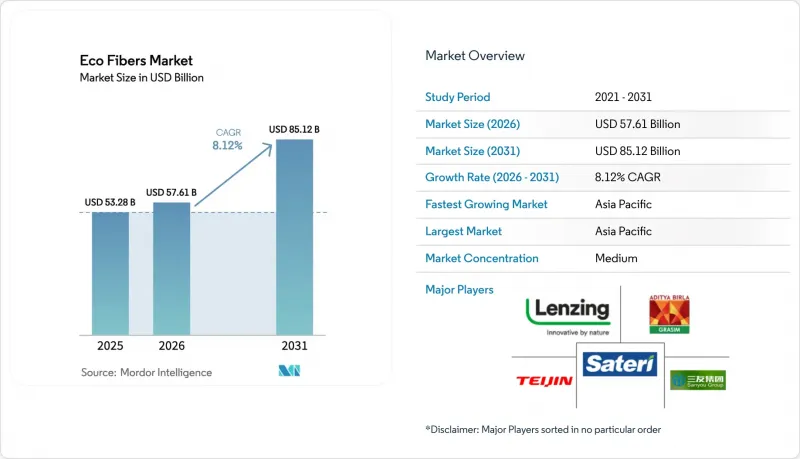
Mordor Intelligence에 의하면, 에코 섬유 시장 규모는 2025년 532억 8,000만 달러, 2026년 576억 1,000만 달러에서 2031년까지 851억 2,000만 달러로 확대한다고 예측되고 있어 2026년부터 2031년까지 연평균 복합 성장률(CAGR)은 8.12%를 나타낼 전망입니다.
본 보고서는 섬유 유형(유기 섬유, 재생 섬유, 기타 섬유), 원료 출처(식물 유래, 동물 유래 등), 용도(섬유, 산업용, 가정·가구용, 기타 용도) 및 지역(아시아태평양, 북미, 유럽, 남미, 중동 및 아프리카)별로 분류되어 있습니다. 시장 전망은 금액(달러) 기준으로 제시되어 있습니다.
세계 에코 섬유 시장 동향 및 인사이트
재활용 폴리에스터를 채택하는 패스트 패션 브랜드의 급증
주요 의류 소매업체들은 미래에 대한 공약을 5-7년에 걸친 사용 후 폴리에스터 공급량을 보장하는 구속력 있는 계약으로 전환하고 있습니다. H&M이 2025년 12월에 Recover사와 체결한 계약은 구매의 유연성을 희생하더라도 확실한 추적 가능성과 가격 고정을 확보하려는 자세를 여실히 보여주고 있습니다. ONLY 등 중견 브랜드들도 2025년 9월 이에 발맞추어 한정판 캡슐 컬렉션이 아닌 주력 컬렉션에 재생 원사를 도입했습니다. 이러한 노력으로 인해 화학 재활용에 대한 투자 회수 기간이 단축되었으며, 이는 공급업체들이 유럽 및 아시아태평양에서 생산 능력을 확대하는 데 박차를 가하고 있습니다. 원료 확보에 성공한 브랜드들은 현재 과학에 기반한 배출량 목표와 제품 수준의 탄소 발자국을 전면에 내세우며, 여전히 현물 구매에 의존하는 후발 기업들과의 평판 차이를 뚜렷이 드러내고 있습니다. 이러한 추세로 인해 에코 섬유 시장은 양극화되고 있으며, 공급을 확보한 기업은 진열대의 유리한 위치를 차지할 수 있는 반면, 기타 기업들은 새로 제정되고 있는 실사법(due diligence)에 따라 그린워싱 의혹을 받는 상황에 직면하고 있습니다.
EU의 확대 생산자 책임(EPR)이 섬유의 순환성을 촉진
2025년 10월부터 시행되는 개정 ‘폐기물 기본 지침’은 회원국들에게 2028년 4월까지 섬유 제품에 대한 EPR 제도를 도입할 것을 의무화하고 있으며, 이에 따라 브랜드는 회수 및 재활용에 대한 재정적 책임을 지게 됩니다. 요금의 에코모듈레이션을 통해 단일 소재로 회수되도록 설계된 의류일수록 요금이 낮아지는 구조가 마련되어, 분해가 용이한 섬유에 대한 수요가 촉진되고 있습니다. 분리 수거 의무화로 인해 혼합 폐기물에 섬유 제품이 혼입되는 것이 금지되어, 기계적 및 화학적 재활용 플랜트를 위한 원료 공급량이 증가하고 있습니다. ‘지속 가능한 제품을 위한 에코디자인 규정’에 기반한 디지털 제품 여권에는 섬유 유형, 화학 첨가물, 재활용 경로를 표시하는 QR 코드가 내장되어 있습니다. 이 제도는 이미 EU 역외의 정책에도 영향을 미치고 있으며, 영국에서는 의견 수렴이 시작되었고, 캘리포니아주에서는 유사한 법안이 초안되고 있습니다. 그 결과, 규정 준수 비용과 설계 기준이 국제화되면서 전 세계 브랜드들이 순환형 사회에 적합한 섬유와 검증 가능한 공급망 도입을 서두르고 있습니다.
기존 섬유와의 가격 차이
현재 재생 폴리에스터와 재생 면은 버진 소재에 비해 15-30%의 가격 프리미엄이 붙어 있어, 가격에 민감한 소비자를 대상으로 하는 소매업체의 이익률을 압박하고 있습니다. 수거, 선별, 가공의 각 공정에서는 여전히 규모의 경제가 확립되지 않았으며, 특히 지자체 쓰레기 수거 시스템이 미비한 시장에서는 이러한 경향이 두드러집니다. 화학 재활용 분야의 혁신 기업들은 신품과 동등한 품질의 제품을 생산함으로써 비용 균등화를 약속하고 있지만, 원료 오염이나 용제 회수 문제 등으로 인해 본격적인 확산은 지연되고 있습니다. 이러한 가격 격차는 남아시아와 사하라 이남 아프리카에서 가장 두드러지며, 이 지역들은 가계의 구매력이 제한적이어서 가격 상승을 감당할 의지가 낮습니다. 가공 플랜트의 처리 능력이 향상되어 단위 비용이 신재 기준을 밑돌게 될 때까지는 규제 준수나 브랜드 이미지에 의해 가격 프리미엄이 상쇄되는 선진국을 중심으로 재생 소재의 채택이 진행될 것입니다.
부문 분석
2025년, 유기농 섬유는 에코 섬유 시장 점유율의 45.22%를 차지하며, 2031년까지 연평균 성장률(CAGR) 9.72%를 기록하며 에코 섬유 시장 전체보다 빠르게 확대되고 있습니다. 이러한 성과는 소비자들이 자연의 아름다움과 생분해성을 중시하고 있음을 반영하며, 웰빙 및 환경 보호 노력에 관한 브랜드 스토리텔링을 뒷받침하고 있습니다. 이 부문을 주도하는 것은 유기농 면, 대마, 아마이며, 이들 모두 가공상의 조정을 최소화할 수 있는 기존 농업 인프라의 혜택을 받고 있습니다. 재활용 섬유는 절대량으로는 적지만, 정책적 인센티브와 성능을 버진 섬유와 동등한 수준으로 끌어올리는 기술적 돌파구에 힘입어 급속히 성장하는 분야가 되고 있습니다. 조류, 균사체, 세균 셀룰로오스로 만들어진 특수한 바이오 소재는 럭셔리 스트리트웨어와 하이엔드 스포츠 의류 분야에서 고수익성 틈새 시장을 개척하고 있습니다.
혁신의 진전에 따라 유기 섬유의 적용 범위는 가격에 민감한 카테고리로 확대되고 있습니다. 렌징(Lenzing)사의 대량 생산형 리오셀은 공정 개선을 통해 Kg당 비용을 절감하여 대중 시장으로의 적용을 가능하게 한 좋은 예입니다. ‘디지털 여권’ 준수라는 이점 또한 화학 보조제와 관련된 데이터의 복잡성을 완화함으로써 유기 원료에 유리한 요소가 되고 있습니다. 그러나 식량 및 바이오연료용 작물과의 토지 이용 경쟁은 기후 변화로 인한 수확량 변동으로 인해 더욱 심화되고 있으며, 이는 규모 확대에 대한 잠재적 제약 요인이 되고 있습니다. 재생 섬유는 토지 이용에 대한 압박을 완화하지만, 특히 유럽과 북미 이외의 지역에서는 회수 네트워크가 미비하다는 점에 의존하고 있습니다. 틈새 시장용 바이오 소재는 벤처 자금을 유치하고 있지만, 그 상용화는 발효 수율 향상과 Kg당 3달러 미만의 비용 경쟁력을 실현하는 플랜트 설계에 달려 있습니다.
지역별 분석
아시아태평양은 2025년 매출의 53.24%를 차지하며, 2031년까지 연평균 성장률(CAGR) 8.12%로 전체 에코 섬유 시장을 주도하고 있습니다. 중국의 수출 지향형 섬유 산업 클러스터에서는 유럽 및 미국의 조달 기준을 충족하기 위해 재생 폴리에스터 생산 라인 도입이 진행되고 있습니다. 한편, 국내 스포츠웨어 브랜드들은 품질 면에서 차별화를 꾀하기 위해 리요셀 채택을 확대되고 있습니다. 인도는 세계 최대의 유기농 면 생산국이라는 위상을 활용하고 있으나, 사용 후 섬유 회수에 대한 투자 부족으로 인해 재활용 처리 능력이 제한되고 있습니다. 일본과 한국은 혼합 섬유 폐기물을 버진 등급의 원료로 변환하는 화학적 재활용 시설의 시범 운영을 진행 중이며, 양국은 아세안 전역에서 기술 라이선스 제공국으로서의 위상을 확립해 가고 있습니다. 베트남과 방글라데시는 경쟁력 있는 인건비가 높이 평가되어 새로운 에코 섬유 방적 공장 유치를 성공시켰으나, 규정 준수 대응을 위한 지출이 증가함에 따라 임금 측면에서의 우위는 점차 약화되고 있습니다.
유럽은 금액 기준으로 2위를 차지하고 있으며, 의무화된 EPR(확대 생산자 책임) 수수료와 2025년 10월 시행되는 ‘디지털 제품 여권’ 규정에 힘입어 마찬가지로 성장하고 있습니다. 독일, 프랑스, 이탈리아에는 특수 섬유 분야의 혁신 기업과 선진적인 재활용 거점이 있는 반면, 오스트리아의 렌징(Lenzing)사는 이 지역에서 리요셀 분야의 리더십을 주도하고 있습니다. 그러나 에너지 가격 급등으로 인해 범용 폴리에스터 재활용 분야에서 유럽의 비용 경쟁력은 제약을 받고 있으며, 그 확장은 고부가가치 셀룰로오스계 섬유 및 효소를 이용한 탈중합에 관한 공동 연구 개발로 방향을 전환하고 있습니다. 동유럽 국가들은 리드타임 단축과 트럭 운송에 따른 배출량 감소를 원하는 서유럽 브랜드들로부터 니어쇼어링 프로젝트를 유치하고 있습니다.
북미에서는 규모는 작지만 빠르게 성장하고 있는 에코 섬유 시장이 미국에 집중되어 있으며, 애슬레저, 아웃도어 의류, 홈웨어가 주를 이루고 있습니다. 캘리포니아주에서 검토 중인 마이크로파이버 규제안은 브랜드들을 셀룰로오스계 대체 소재로 유도하고 있으며, 국내 재활용 능력에 대한 관심을 높이고 있습니다. 캐나다도 유사한 규제를 추진하고 있으며, 자동차 용도의 셀룰로오스계 복합 소재 시범 프로젝트에 자금을 지원하고 있습니다. 멕시코는 USMCA(미국·멕시코·캐나다 협정)에 따른 무관세 회랑과 짧은 납기 기간을 활용하는 니어쇼어 봉제 사업을 유치하고 있습니다.
남미 시장 점유율은 미미한 수준이며, 그 중심은 브라질입니다. 브라질에서는 사탕수수의 바가스(착즙 잔여물)가 초기 단계의 농업 잔여물 프로젝트의 기반이 되고 있지만, 환율 변동과 물류상의 제약으로 인해 규모 확대 속도는 둔화되고 있습니다. 중동 및 아프리카는 에코 섬유 생산이 아직 초기 단계에 있습니다. 이집트의 장섬유 면화와 에티오피아의 의류 산업 단지가 발판이 되고 있지만, 자본 유입은 정치적 안정과 EU 및 미국으로의 무역 접근성 지속 여부에 좌우됩니다.
기타 혜택:
- 엑셀 형식 시장 전망(ME) 시트
- 3개월간의 애널리스트 지원
자주 묻는 질문
목차
제1장 서론
제2장 조사 방법
제3장 주요 요약
제4장 시장 구도
제5장 시장 규모와 성장 예측
제6장 경쟁 구도
제7장 시장 기회와 향후 전망
JHS 26.08.26According to Mordor Intelligence, the eco fibers market size is projected to expand from USD 53.28 billion in 2025 and USD 57.61 billion in 2026 to USD 85.12 billion by 2031, registering a CAGR of 8.12% between 2026 to 2031.
This report is Segmented by Fiber Type (Organic Fibers, Recycled Fibers, and Other Fiber Types), Source Feedstock (Plant-Based, Animal-Based, and More), Application (Textile, Industrial, Household and Furnishing, and Other Applications), and Geography (Asia-Pacific, North America, Europe, South America, and Middle East and Africa). The Market Forecasts are Provided in Terms of Value (USD).
Global Eco Fibers Market Trends and Insights
Surge in Fast-Fashion Brands Adopting Recycled Polyester
Leading apparel retailers are converting aspirational pledges into binding contracts that guarantee post-consumer polyester volumes for five to seven years. H&M's December 2025 agreement with Recover underscores a willingness to trade purchase flexibility for assured traceability and price locks. Mid-tier labels such as ONLY followed in September 2025, embedding recycled yarns into core collections rather than limited capsule lines. These commitments shorten payback periods for chemical-recycling investments and encourage suppliers to scale capacity in Europe and Asia-Pacific. Brands with secured inputs now highlight science-based emissions targets and product-level carbon footprints, accentuating the reputational gap with laggards that still rely on spot buying. The trend is producing a bifurcated eco-fibers market in which supply-assured firms can command premium shelf space while others face greenwashing scrutiny under emerging due diligence laws.
EU Extended Producer Responsibility (EPR) Driving Fiber Circularity
The revised Waste Framework Directive, in force since October 2025, obliges member states to launch textile EPR schemes by April 2028, making brands financially responsible for collection and recycling . Fee eco-modulation links lower charges to garments designed for mono-material recovery, incentivizing demand for fibers that simplify dismantling. Mandatory separate collection bans textile disposal in mixed waste streams, raising feedstock availability for mechanical and chemical recycling plants. Digital Product Passports under the Ecodesign for Sustainable Products Regulation embed QR codes that surface fiber type, chemical additives, and recycling routes. The architecture is already influencing non-EU policy: the United Kingdom has opened consultations, and California is drafting a comparable bill. Consequently, compliance costs and design standards are internationalizing, pushing brands worldwide toward circular-ready fibers and verifiable supply chains.
Premium Pricing Gap vs Conventional Fibers
Recycled polyester and cotton currently carry 15-30% price uplifts versus virgin counterparts, straining margins for retailers serving cost-conscious consumers. Collection, sorting, and processing still lack scale economies, especially in markets where municipal waste systems remain informal. Chemical-recycling innovators promise cost parity by yielding virgin-grade output, yet feedstock contamination and solvent-recovery hurdles have delayed full-scale rollouts. The mismatch is most glaring in South Asia and sub-Saharan Africa, where household purchasing power limits willingness to absorb higher price tags. Until processing plants reach throughput that drives unit costs below virgin benchmarks, adoption will concentrate in developed economies where regulatory compliance or brand reputation compensates for the premium.
Other drivers and restraints analyzed in the detailed report include:
- Breakthrough Low-Impact Lyocell Spun-Bond Technology Commercializing
- Carbon-Negative Bio-Based Fibers from Agricultural Waste
- Impending Microfiber-Shedding Legislation
For complete list of drivers and restraints, kindly check the Table Of Contents.
Segment Analysis
Organic fibers captured 45.22% of the eco fibers market share in 2025, expanding more rapidly than the broader eco fibers market at a 9.72% CAGR to 2031. This performance reflects consumer perceptions of natural aesthetics and biodegradability, which reinforce brand storytelling around wellness and environmental credentials. The segment is led by organic cotton, hemp, and flax, each benefiting from embedded agricultural infrastructure that demands minimal processing adaptation. Recycled fibers, while smaller in absolute volume, represent the growing cohort, propelled by policy incentives and technology breakthroughs that lift performance to virgin-equivalent levels. Specialty bio-based options from algae, mycelium, and bacterial cellulose carve out high-margin niches in luxury streetwear and high-end sports apparel.
Innovation pipelines are extending organic-fiber reach into price-sensitive categories. Lenzing's high-volume lyocell variant demonstrates how process refinement can lower cost per kilogram and unlock mass-market applications. Digital Passport compliance advantages also favor organic inputs because they reduce data complexity related to chemical auxiliaries. Yet, land-use competition with food and biofuel crops, aggravated by climate-driven yield swings, poses a latent constraint on scalability. Recycled fibers mitigate land tension but rely on underdeveloped collection networks, especially outside Europe and North America. Niche bio-based materials attract venture funding, but commercialization hinges on fermentation yield improvements and plant design that achieves sub-USD 3 per-kilogram cost parity.
Complete Report Scope:
- By Fiber Type
- Organic Fibers
- Recycled Fibers
- Other Fiber Types (Specialty Bio-based Fibers, etc.)
- By Source Feedstock
- Plant-based
- Animal-based
- Synthetic Waste
- Agricultural Residue
- By Application
- Textile and Apparel
- Industrial
- Household and Furnishing
- Other Applications (Packaging and Composites, etc.)
- By Geography
- Asia-Pacific
- China
- India
- Japan
- South Korea
- ASEAN Countries
- Rest of Asia-Pacific
- North America
- United States
- Canada
- Mexico
- Europe
- Germany
- United Kingdom
- France
- Italy
- Rest of Europe
- South America
- Brazil
- Argentina
- Rest of South America
- Middle East and Africa
- Saudi Arabia
- South Africa
- Rest of Middle East and Africa
- Asia-Pacific
Geography Analysis
Asia-Pacific controlled 53.24% of 2025 revenue and is pacing the broader eco fibers market at an 8.12% CAGR through 2031. China's export-oriented textile clusters are integrating recycled polyester lines to meet European and U.S. sourcing standards, while domestic sportswear labels adopt lyocell to differentiate quality. India leverages its status as the world's largest organic-cotton grower, yet under-investment in post-consumer collection limits recycling throughput. Japan and South Korea are piloting chemical-recycling facilities that convert mixed-fiber waste into virgin-grade feedstock, positioning both countries as technology licensors across ASEAN. Vietnam and Bangladesh, favored for competitive labor costs, are attracting greenfield eco-fiber spinning mills, although compliance spending is diminishing wage advantages.
Europe ranks second by value and grows in parallel, propelled by obligatory EPR fees and the October 2025 Digital Product Passport rules. Germany, France, and Italy host specialty-fiber innovators and advanced recycling hubs, while Austria's Lenzing anchors the region's lyocell leadership. High energy prices, however, curb Europe's cost competitiveness in commodity polyester recycling, redirecting expansion toward high-value cellulosics and collaborative research and development in enzymatic depolymerization. Eastern European nations are attracting near-shoring projects from Western brands keen to cut lead times and trucking emissions.
North America holds a smaller but fast-growing eco-fibers market, concentrated in the United States, with athleisure, outdoor apparel, and homeware. California's potential microfiber rule is steering brands toward cellulosic alternatives and spurring interest in onshore recycling capacity. Canada advances similar regulations and funds pilot cellulose-based composites for automotive applications. Mexico draws near-shore sewing operations that exploit zero-tariff USMCA corridors and shorter delivery schedules.
South America's share is modest and tilted toward Brazil, where sugarcane bagasse underpins early-stage agricultural-residue projects, though currency volatility and logistics constraints slow scale-up. The Middle East and Africa remain nascent eco-fiber producers; Egypt's long-staple cotton and Ethiopia's garment parks provide footholds, yet capital inflows hinge on political stability and trade-access continuity to the EU and United States.
- Ananas Anam
- Bast Fibre Technologies Inc.
- Bcomp
- Circular Systems S.P.C.
- Eastman Chemical Company
- ECOLOGICAL FIBERS INC.
- Fulgar S.p.A.
- Grasim Industries Limited
- HYOSUNG TNC
- Interface, Inc.
- Lenzing AG
- Libolon
- Natural Fiber Welding Inc.
- Patagonia, Inc.
- Renewcell
- Sateri
- Tangshan Sanyou Xingda Chemical Fiber CO., Ltd.
- Teijin Frontier Co., Ltd.
- TORAY INDUSTRIES, INC.
- UNIFI, Inc.
Additional Benefits:
- The market estimate (ME) sheet in Excel format
- 3 months of analyst support
TABLE OF CONTENTS
1 Introduction
- 1.1 Study Assumptions and Market Definition
- 1.2 Scope of the Study
2 Research Methodology
3 Executive Summary
4 Market Landscape
- 4.1 Market Overview
- 4.2 Market Drivers
- 4.2.1 Surge in fast-fashion brands adopting recycled polyester
- 4.2.2 EU Extended Producer Responsibility (EPR) driving fiber circularity
- 4.2.3 Breakthrough low-impact lyocell spun-bond technology commercializing
- 4.2.4 Carbon-negative bio-based fibers from agricultural waste
- 4.2.5 Automated fiber-traceability and digital passport mandates
- 4.3 Market Restraints
- 4.3.1 Premium pricing gap vs conventional fibers
- 4.3.2 Impending micro-fibre-shedding legislation
- 4.3.3 Limited recycling infrastructure for blended textiles
- 4.4 Value Chain Analysis
- 4.5 Porter's Five Forces
- 4.5.1 Bargaining Power of Suppliers
- 4.5.2 Bargaining Power of Buyers
- 4.5.3 Threat of New Entrants
- 4.5.4 Threat of Substitute Products and Services
- 4.5.5 Intensity of Competitive Rivalry
5 Market Size and Growth Forecasts (Value)
- 5.1 By Fiber Type
- 5.1.1 Organic Fibers
- 5.1.2 Recycled Fibers
- 5.1.3 Other Fiber Types (Specialty Bio-based Fibers, etc.)
- 5.2 By Source Feedstock
- 5.2.1 Plant-based
- 5.2.2 Animal-based
- 5.2.3 Synthetic Waste
- 5.2.4 Agricultural Residue
- 5.3 By Application
- 5.3.1 Textile and Apparel
- 5.3.2 Industrial
- 5.3.3 Household and Furnishing
- 5.3.4 Other Applications (Packaging and Composites, etc.)
- 5.4 By Geography
- 5.4.1 Asia-Pacific
- 5.4.1.1 China
- 5.4.1.2 India
- 5.4.1.3 Japan
- 5.4.1.4 South Korea
- 5.4.1.5 ASEAN Countries
- 5.4.1.6 Rest of Asia-Pacific
- 5.4.2 North America
- 5.4.2.1 United States
- 5.4.2.2 Canada
- 5.4.2.3 Mexico
- 5.4.3 Europe
- 5.4.3.1 Germany
- 5.4.3.2 United Kingdom
- 5.4.3.3 France
- 5.4.3.4 Italy
- 5.4.3.5 Rest of Europe
- 5.4.4 South America
- 5.4.4.1 Brazil
- 5.4.4.2 Argentina
- 5.4.4.3 Rest of South America
- 5.4.5 Middle East and Africa
- 5.4.5.1 Saudi Arabia
- 5.4.5.2 South Africa
- 5.4.5.3 Rest of Middle East and Africa
- 5.4.1 Asia-Pacific
6 Competitive Landscape
- 6.1 Market Concentration
- 6.2 Strategic Moves
- 6.3 Market Share (%)/Ranking Analysis
- 6.4 Company Profiles (includes Global level Overview, Market level overview, Core Segments, Financials as available, Strategic Information, Market Rank/Share for key companies, Products and Services, and Recent Developments)
- 6.4.1 Ananas Anam
- 6.4.2 Bast Fibre Technologies Inc.
- 6.4.3 Bcomp
- 6.4.4 Circular Systems S.P.C.
- 6.4.5 Eastman Chemical Company
- 6.4.6 ECOLOGICAL FIBERS INC.
- 6.4.7 Fulgar S.p.A.
- 6.4.8 Grasim Industries Limited
- 6.4.9 HYOSUNG TNC
- 6.4.10 Interface, Inc.
- 6.4.11 Lenzing AG
- 6.4.12 Libolon
- 6.4.13 Natural Fiber Welding Inc.
- 6.4.14 Patagonia, Inc.
- 6.4.15 Renewcell
- 6.4.16 Sateri
- 6.4.17 Tangshan Sanyou Xingda Chemical Fiber CO., Ltd.
- 6.4.18 Teijin Frontier Co., Ltd.
- 6.4.19 TORAY INDUSTRIES, INC.
- 6.4.20 UNIFI, Inc.
7 Market Opportunities and Future Outlook
- 7.1 White-space and Unmet-need Assessment