|
시장보고서
상품코드
2114930
빙초산 시장 : 점유율 분석, 업계 동향과 통계, 성장 예측(2026-2031년)Glacial Acetic Acid - Market Share Analysis, Industry Trends & Statistics, Growth Forecasts (2026 - 2031) |
||||||
 Mordor Intelligence
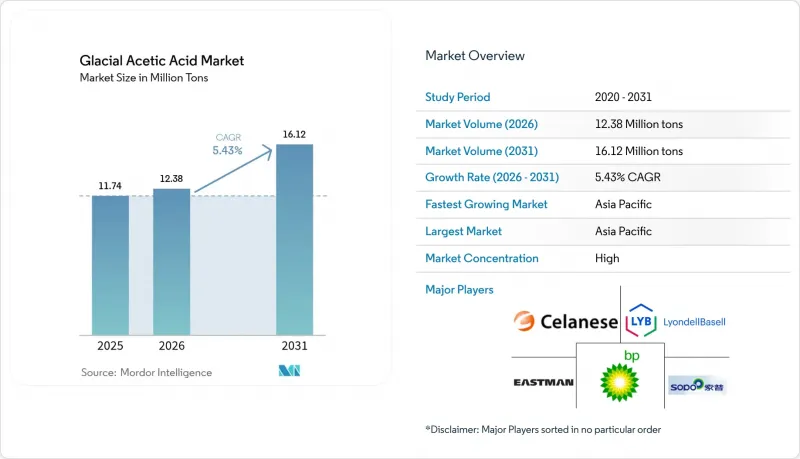
Mordor Intelligence에 의하면, 빙초산 시장 규모는 2025년 1,174만 톤에서 2026년에는 1,238만 톤으로 확대되어 2026년부터 2031년까지 CAGR 5.43%로 성장을 지속하여, 2031년에는 1,612만 톤에 이를 것으로 예측됩니다.
본 보고서에서는 업계를 등급(식품 등급, 산업용 등급, 의약품 등급), 용도(비닐아세테이트 단량체, 에스테르 제조, 무수아세트산, 용제, 식품 첨가물 등), 최종 이용 산업(화학제품 및 석유화학제품,식품 및 음료, 의약품 등), 그리고 지역(아시아태평양, 북미, 유럽, 기타 지역)별로 분류하고 있습니다.
전 세계 빙초산 시장 동향 및 인사이트
비닐아세테이트 모노머 수요에 대응하기 위해 아시아태평양의 생산 능력 확대
주요 하이라이트
- 아시아태평양의 생산자들은 VAM(비닐 아세테이트 모노머)의 원료를 확보하기 위해 대규모 아세트산 생산 설비를 증설하고 있습니다. 장쑤 소포(Jiangsu Sopo)사의 450 kt 증산 및 GNFC사의 계획 중인 200 kt 설비는 해당 지역이 자급자족을 향해 나아가고 있음을 보여줍니다. 이러한 생산 능력 확대는 세계 무역 균형에 변화를 가져와, 북미 및 유럽공급업체들이 고부가가치 파생 제품으로 전환하도록 유도하고 있습니다. 접착제, 도료, 연포장재 분야의 VAM 수요가 증가하는 가운데, 중국, 인도, 일본의 통합형 생산자들은 규모의 경제를 확실히 확보하고 있습니다. 하류 가공업체들은 공급망 단축과 운송 비용 절감이라는 혜택을 누리고 있으며, 이는 지역 제조업에 더욱 큰 활력을 불어넣고 있습니다.
아세트산 제조에서 바이오 유래 원료의 채택 확대
탄소 포집 및 바이오매스 유래 제조 공정의 상용화를 통해 전체 수명 주기 동안의 배출량이 감소하고 있습니다. Again사의 배기가스로부터 아세트산을 제조하는 공정은 메탄올에 대한 의존도를 낮추어, 지속가능성을 중시하는 구매자들을 끌어들이고 있습니다. 한편, New Iridium사의 광화학 공정은 셀룰로오스계 폐기물을 대상으로 합니다. 생산자들이 이러한 제조 공정에 관심을 보이는 배경에는 메탄올 가격 변동 위험에 대한 헤지 및 강화되는 탄소 규제에 대비하려는 측면도 있습니다. 저탄소 원료를 찾는 소비재 기업과의 장기 공급 계약은 투자의 타당성을 더욱 뒷받침하고 있습니다.
메탄올 원료 가격의 변동
2024년, 메탄올 현물 가격은 급격히 변동하여 생산자의 이익률을 압박하는 동시에 생산 능력 계획 수립을 어렵게 만들었습니다. 비통합형 플랜트가 가장 큰 타격을 입었고, 헤지 수단이나 대체 원료에 대한 관심이 다시 높아졌습니다. 메타넥스(Metanex)의 OCI 메탄올 자산 인수가 완료되면, 전 세계적인 협상력이 통합형 대기업으로 이동할 것으로 예측됩니다.
부문별 분석
2025년, 공업용 등급은 빙초산 시장에서 72.60%의 점유율을 차지하며 시장을 휩쓸었습니다. 이는 대량 생산자들이 VAM 플랜트 및 하류 화학 합성 공정에 공급했기 때문입니다. 이 부문의 규모는 비용 리더십을 가져다주고 있지만, 메탄올 가격에 대한 이익의 민감도는 여전히 남아 있습니다. 의약품 등급은 규모는 작지만, API 합성 및 주사제 제제에서 불순물 제한이 엄격해진 점을 반영하여 연평균 성장률(CAGR) 6.82%로 성장할 전망입니다. 인도 구자라트주에서 최근 이루어진 생산 능력 증설은 이 고수익률 시장을 공략하려는 생산자들의 움직임을 여실히 보여주고 있습니다.
반도체 습식 공정에서 초고순도 소재에 대한 수요는 수익성이 높은 틈새 시장으로 부상하고 있습니다. 첨단 노드에서 선폭이 미세화됨에 따라 금속 불순물에 대한 민감도가 높아지고 있으므로, 10억 분의 1 수준(ppb)의 불순물 농도를 실현할 수 있는 제조업체는 상당한 프리미엄 가격을 책정할 수 있습니다. 이러한 제품군을 통해 표준 의약품 등급이 판매량을 뒷받침하고, 전자 등급이 수익성을 확보하는 이중적인 가격 환경이 형성되고 있습니다. 이 비즈니스 기회는 반도체 공급의 자립성을 확보하려는 일본과 한국의 국가 전략과 부합하며, 공급업체에 안정적인 수주 계약을 가져다주고 있습니다.
지역별 분석
아시아태평양은 2025년 빙초산 시장의 62.60%를 차지하고 있으며, 2031년까지 연평균 성장률(CAGR) 6.72%로 확대되고 있습니다. 중국은 정부 계열 금융 기관을 통한 자금 조달과 통합된 메탄올 조달 체제에 힘입어, 전 세계 메탄올 생산 능력에서 큰 점유율을 차지하고 있습니다. 인도는 국내 생산량을 확대하고 있으며, INEOS Acetyls와 GNFC 간의 합작 투자 관련 협의 등은 인도의 수입 대체 정책을 뒷받침하고 있습니다. 일본과 한국은 전자 및 의약품용 고순도 틈새 시장에 주력하고 있어 고가 판매를 실현하고 있습니다.
북미는 화학 및 식품 산업을 기반으로 생산량에서 2위를 차지하고 있습니다. 에너지부의 바이오 유래 아세트산 프로젝트에 대한 보조금 덕분에 탄소 강도를 낮추고, 메탄올 가격 변동으로부터 해당 지역을 부분적으로 보호할 가능성이 있는 기술 실증이 가능해졌습니다. 관세 정책의 변동이 하류 폴리머 수출에 영향을 미칠 가능성이 있어, 무역 정책의 불확실성이 경계심을 높이고 있습니다.
유럽에서는 수요가 성숙 단계에 접어들었으며, 특수 등급 및 기후 변화 대응을 고려한 공정으로의 전환이 나타나고 있습니다. ‘Fit for 55’ 법안은 저탄소 아세틸에 대한 투자를 촉진하고 있지만, 아시아산 수입품으로 인한 경쟁 압박으로 인해 범용 등급 제품의 이익률은 압박을 받고 있습니다. 독일과 영국은 견조한 의약품 및 식품 부문을 배경으로 여전히 유럽 최대의 소비국으로 자리 잡고 있습니다. 중동은 저비용 원료와 건설 활동의 활성화, 특히 사우디아라비아의 ‘비전 2030’에 힘입어 혜택을 보고 있는 반면, 남미는 브라질과 아르헨티나에서의 점진적인 성장에 그쳐 발전 속도가 비교적 완만합니다.
기타 혜택:
- 엑셀 형식 시장 전망(ME) 시트
- 3개월간 애널리스트 지원
자주 묻는 질문
목차
제1장 서론
제2장 조사 방법
제3장 주요 요약
제4장 시장 구도
제5장 시장 규모와 성장 예측(수량)
제6장 경쟁 구도
제7장 시장 기회와 향후 전망
JHS 26.08.26According to Mordor Intelligence, the glacial acetic acid market size is expected to grow from 11.74 Million tons in 2025 to 12.38 Million tons in 2026 and is forecast to reach 16.12 Million tons by 2031 at 5.43% CAGR over 2026-2031.
This report Segments the Industry by Grade (Food Grade, Industrial Grade, and Pharmaceutical Grade), Application (Vinyl Acetate Monomer, Ester Production, Acetic Anhydride, Solvent, Food Additive, and More), End-Use Industry (Chemicals and Petrochemicals, Food and Beverage, Pharmaceuticals, and More) and Geography (Asia-Pacific, North America, Europe, and Rest of the World).
Global Glacial Acetic Acid Market Trends and Insights
Expanding Production Capacity in Asia-Pacific to Serve Vinyl Acetate Monomer Demand
Key Highlights
- Asia-Pacific producers are adding large-scale acetic acid units to secure VAM feedstock. Jiangsu Sopo's 450 kt expansion and GNFC's planned 200 kt unit illustrate the region's push toward self-sufficiency. This capacity wave is tilting global trade balances and nudging North American and European suppliers toward higher-value derivatives. As VAM demand in adhesives, paints, and flexible packaging climbs, integrated producers in China, India, and Japan are locking in scale advantages. Downstream converters benefit from shorter supply chains and reduced freight costs, adding momentum to regional manufacturing.
Increasing Adoption of Bio-based Feedstock in Acetic Acid Manufacturing
Commercialization of carbon-capture and biomass-based routes is lowering life-cycle emissions. Again's flue-gas-to-acetic-acid process reduces reliance on methanol and attracts sustainability-driven buyers, while New Iridium's photochemical route targets cellulosic waste streams. Producer interest in these pathways is also a hedge against methanol volatility and tightening carbon regulations. Long-term offtake agreements with consumer-goods companies seeking low-carbon ingredients further underpin investment cases.
Volatility in Methanol Feedstock Prices
Methanol spot prices swung sharply during 2024, compressing producer margins and complicating capacity planning. Unintegrated plants were hardest hit, prompting renewed interest in hedging tools and alternative feedstocks. Completion of Methanex's acquisition of OCI's methanol assets is expected to shift global bargaining power toward integrated giants.
Other drivers and restraints analyzed in the detailed report include:
- Rising Demand from Pharmaceutical Excipients in Emerging Economies
- Growth of Solvent Applications in Adhesives and Sealants
- Stringent Occupational-Safety Norms Limiting Handling and Storage
For complete list of drivers and restraints, kindly check the Table Of Contents.
Segment Analysis
Industrial Grade dominated the glacial acetic acid market with a 72.60% share in 2025 as bulk producers supplied VAM plants and downstream chemical syntheses. The segment's scale delivers cost leadership, yet profit sensitivity to methanol prices remains. Pharmaceutical Grade, though smaller, is on track for a 6.82% CAGR, reflecting stricter impurity limits in API synthesis and injectable formulations. Recent capacity additions in India's Gujarat region illustrate producer moves to capture this higher-margin pool.
Demand for ultra-high-purity material in semiconductor wet processes is emerging as a lucrative niche. Linewidth reduction in advanced nodes heightens sensitivity to metallic contaminants, so producers able to deliver parts-per-billion impurity levels can command significant premiums. These offerings create a two-tier pricing environment in which standard pharmaceutical grade supports volume while electronics grade secures profitability. The opportunity aligns with national strategies in Japan and South Korea to safeguard chip-supply sovereignty, offering suppliers stable offtake commitments.
Complete Report Scope:
- By Grade
- Food Grade
- Industrial Grade
- Pharmaceutical Grade
- By Application
- Vinyl Acetate Monomer
- Ester Production
- Acetic Anhydride
- Solvent
- Food Additive
- Textile
- Other Applications
- By End-Use Industry
- Chemicals and Petrochemicals
- Food and Beverage
- Pharmaceuticals
- Textiles and Leather
- Other End-user Industries
- By Geography
- Asia-Pacific
- China
- India
- Japan
- South Korea
- Rest of Asia-Pacific
- North America
- United States
- Canada
- Mexico
- Europe
- Germany
- United Kingdom
- France
- Italy
- Rest of Europe
- Rest of the World
- Middle East and Africa
- South America
- Asia-Pacific
Geography Analysis
Asia-Pacific held 62.60% of the glacial acetic acid market in 2025 and is advancing at a 6.72% CAGR through 2031. China holds a significant share of the global methanol capacity, supported by state-linked financing and integrated methanol sourcing. India is scaling domestic output, and joint-venture discussions such as INEOS Acetyls with GNFC underline the nation's import-replacement agenda. Japan and South Korea concentrate on high-purity niches for electronics and pharmaceuticals, fetching premium pricing.
North America ranks second by volume, anchored in the chemical and food industries. Department of Energy grants for bio-based acetic acid projects enable technology pilots that could lower carbon intensity and partially insulate the region from methanol swings. Trade policy uncertainty adds a cautionary tone, as tariff shifts may affect downstream polymer exports.
Europe shows mature demand with a tilt toward specialty grades and climate-aligned processes. Fit for 55 legislation spurs investment in low-carbon acetyls, while competitive pressure from Asian imports suppresses commodity-grade margins. Germany and the United Kingdom remain the largest European consumers, leveraging strong pharmaceutical and food sectors. The Middle East benefits from low-cost feedstocks and rising construction activity, especially under Saudi Arabia's Vision 2030, whereas South America progresses more modestly with incremental growth in Brazil and Argentina.
- Akshar Enterprises
- Ashok Alco-Chem Ltd.
- BP p.l.c.
- Celanese Corporation
- Daicel Corporation
- Eastman Chemical Company
- Gujarat Narmada Valley Fertilizers & Chemicals Limited
- INEOS
- ITW Reagents Division
- Jiangsu Sopo (Group) Co., Ltd.
- KH Chemicals
- LyondellBasell Industries Holdings B.V.
- Merck KGaA
- PCCA
- SABIC
- Shanghai Wujing Chemical Co., Ltd.
- Spectrum Chemical
- Tan Hung Phu Chemical Co. Ltd.
- Thana Acid & Chemical Co.
- Wacker Chemie AG
Additional Benefits:
- The market estimate (ME) sheet in Excel format
- 3 months of analyst support
TABLE OF CONTENTS
1 Introduction
- 1.1 Study Assumptions and Market Definition
- 1.2 Scope of the Study
2 Research Methodology
3 Executive Summary
4 Market Landscape
- 4.1 Market Overview
- 4.2 Market Drivers
- 4.2.1 Expanding Production Capacity in Asia-Pacific to Serve Vinyl Acetae Momomer( VAM) Demand
- 4.2.2 Increasing Adoption of Bio-based Feedstock in Acetic Acid Manufacturing
- 4.2.3 Rising Demand from Pharmaceutical Excipients in Emerging Economies
- 4.2.4 Growth of Solvent Applications in Adhesives and Sealants
- 4.2.5 Textile Industry Revival in Southeast Asia Boosting Acetic Acid Dyeing Agents
- 4.3 Market Restraints
- 4.3.1 Volatility in Methanol Feed-stock Prices
- 4.3.2 Stringent Occupational-Safety Norms Limiting Handling and Storage
- 4.3.3 Supply-Demand Imbalances Causing Price Suppression
- 4.4 Value Chain Analysis
- 4.5 Porter's Five Forces
- 4.5.1 Bargaining Power of Suppliers
- 4.5.2 Bargaining Power of Buyers
- 4.5.3 Threat of New Entrants
- 4.5.4 Threat of Substitute Products
- 4.5.5 Degree of Competition
5 Market Size and Growth Forecasts ( Volume)
- 5.1 By Grade
- 5.1.1 Food Grade
- 5.1.2 Industrial Grade
- 5.1.3 Pharmaceutical Grade
- 5.2 By Application
- 5.2.1 Vinyl Acetate Monomer
- 5.2.2 Ester Production
- 5.2.3 Acetic Anhydride
- 5.2.4 Solvent
- 5.2.5 Food Additive
- 5.2.6 Textile
- 5.2.7 Other Applications
- 5.3 By End-Use Industry
- 5.3.1 Chemicals and Petrochemicals
- 5.3.2 Food and Beverage
- 5.3.3 Pharmaceuticals
- 5.3.4 Textiles and Leather
- 5.3.5 Other End-user Industries
- 5.4 By Geography
- 5.4.1 Asia-Pacific
- 5.4.1.1 China
- 5.4.1.2 India
- 5.4.1.3 Japan
- 5.4.1.4 South Korea
- 5.4.1.5 Rest of Asia-Pacific
- 5.4.2 North America
- 5.4.2.1 United States
- 5.4.2.2 Canada
- 5.4.2.3 Mexico
- 5.4.3 Europe
- 5.4.3.1 Germany
- 5.4.3.2 United Kingdom
- 5.4.3.3 France
- 5.4.3.4 Italy
- 5.4.3.5 Rest of Europe
- 5.4.4 Rest of the World
- 5.4.4.1 Middle East and Africa
- 5.4.4.2 South America
- 5.4.1 Asia-Pacific
6 Competitive Landscape
- 6.1 Market Concentration
- 6.2 Strategic Moves
- 6.3 Market Share Analysis
- 6.4 Company Profiles (includes Global-level Overview, Market-level Overview, Core Segments, Financials as available, Strategic Information, Market Rank/Share for key companies, Products and Services, and Recent Developments)
- 6.4.1 Akshar Enterprises
- 6.4.2 Ashok Alco-Chem Ltd.
- 6.4.3 BP p.l.c.
- 6.4.4 Celanese Corporation
- 6.4.5 Daicel Corporation
- 6.4.6 Eastman Chemical Company
- 6.4.7 Gujarat Narmada Valley Fertilizers & Chemicals Limited
- 6.4.8 INEOS
- 6.4.9 ITW Reagents Division
- 6.4.10 Jiangsu Sopo (Group) Co., Ltd.
- 6.4.11 KH Chemicals
- 6.4.12 LyondellBasell Industries Holdings B.V.
- 6.4.13 Merck KGaA
- 6.4.14 PCCA
- 6.4.15 SABIC
- 6.4.16 Shanghai Wujing Chemical Co., Ltd.
- 6.4.17 Spectrum Chemical
- 6.4.18 Tan Hung Phu Chemical Co. Ltd.
- 6.4.19 Thana Acid & Chemical Co.
- 6.4.20 Wacker Chemie AG
7 Market Opportunities and Future Outlook
- 7.1 White-space and Unmet-Need Assessment
- 7.2 High-Purity Acetic Acid for Semiconductor Wet-Chemistry