|
시장보고서
상품코드
2114931
통합 구동 시스템 시장 : 시장 점유율 분석, 업계 동향 및 통계, 성장 예측(2026-2031년)Integrated Drive System - Market Share Analysis, Industry Trends & Statistics, Growth Forecasts (2026 - 2031) |
||||||
 Mordor Intelligence
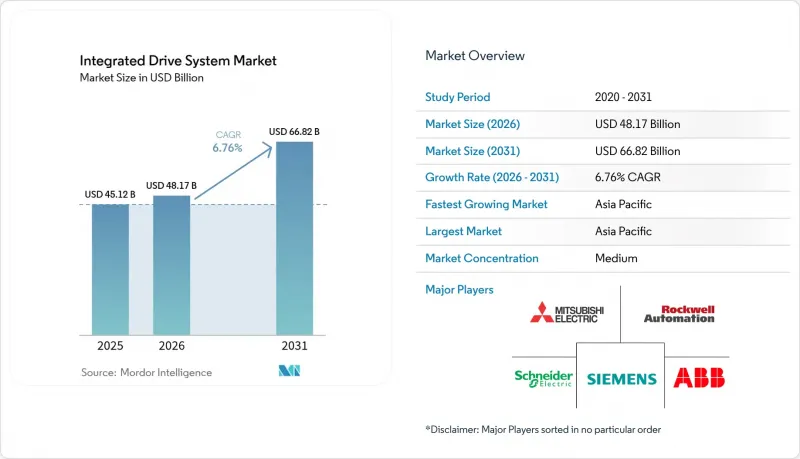
Mordor Intelligence에 의하면, 2026년 통합 구동 시스템 시장 규모는 481억 7,000만 달러로 추정되고, 2025년 451억 2,000만 달러에서 확대해, 2031년에는 668억 2,000만 달러에 이를 것으로 예측됩니다.
2026-2031년 연평균 성장률(CAGR) 6.76%로 성장할 것으로 전망됩니다.
본 보고서는 구성 요소별(하드웨어, 소프트웨어, 서비스), 구동 기술별(AC 통합형 구동 장치, DC 통합형 구동 장치, 기타), 정격 출력별(100kW), 최종 사용자 산업별(자동차, 석유 및 가스, 식음료, 기타), 지역별로 분류되어 있습니다. 시장 전망은 금액(달러) 단위로 표시되어 있습니다.
세계의 통합 구동 시스템 시장 동향 및 인사이트
인더스트리 4.0으로의 전환 및 에너지 효율화 의무화
인더스트리 4.0 로드맵과 75-200kW급에 대한 EU의 IE4 모터 규제로 인해, 공장에서는 개별 모터가 아닌 드라이브 시스템 전체를 평가해야 할 필요가 대두되고 있습니다. IEC 61800-9-2의 분류 기준은 시스템 성능을 평가함으로써 이러한 동향을 더욱 뒷받침하고 있습니다. 탄소 배출 감축을 목표로 하는 제조업체들은 저품위의 폐열을 회수하는 드라이브 개조나 유기 랭킨 사이클(ORC) 유닛의 통합을 점점 더 적극적으로 추진하고 있습니다. 이는 연간 1,180TBtu의 폐열을 발생시키는 미국의 산업 기반에 있어 최우선 과제가 되고 있습니다. 2025년까지 30가지 유형의 장치를 포괄하는 중국의 자동차용 반도체 표준화 프로그램은 현지 드라이브 시스템 생태계를 강화하고 있습니다. 드라이브에 내장된 AI 기반 분석 기능을 통해 사업자는 규제 효율 기준을 충족하면서 처리량을 향상시킬 수 있어, 완전히 통합된 솔루션의 비즈니스적 이점이 커지고 있습니다.
OEE 향상 및 예기치 못한 가동 중단 시간 감축에 대한 수요
예기치 못한 가동 중단은 에너지 집약적인 미국 제조업체에 매년 500억 달러에 가까운 손실을 초래하고 있습니다. 진동, 온도, 전류 특성 진단 기능을 내장한 통합형 드라이브는 문제 해결 시간을 단축하고 자산 가동률을 향상시킵니다. ABB의 기어리스 밀용 드라이브 클라우드 도구인 ‘Trendex’는 경암 광산 용도에서 고장 원인을 파악하는 데 걸리는 시간을 절반으로 줄여줍니다. 중금속 처리 부문에서는 지멘스의 SINAMICS로 업그레이드함으로써 센추리 알루미늄(Century Aluminium)의 가동 시간이 50% 이상 향상되었고, 일일 생산량이 30만 파운드 증가했습니다. TDK의 ‘i3 Micro’와 같은 엣지 AI 센서 모듈은 배선량을 줄이고, 예측 유지보수의 도입을 가속화합니다. OEE 향상은 EBITDA로 직접 연결되므로, 고위 운영 책임자들은 모터, 인버터, 분석 기능을 단일 인클로저에 통합하는 개조 프로그램을 점점 더 우선시하고 있습니다.
높은 설비 투자 비용 및 라이프사이클의 복잡성
통합 패키징은 개별 구성 요소에 비해 초기 비용이 높으며, 중소기업(SME)의 경우 프로젝트 예산이 2배로 늘어날 수도 있습니다. 총 소유 비용에는 엔지니어링, 교육, 보안 패치 등이 포함되며, 라이프사이클 전체에 걸쳐 하드웨어 지출의 2-3배에 달할 가능성이 있습니다. 금리 상승으로 투자 회수 장벽이 높아지는 신흥국에서는 자금 조달의 어려움이 가장 큰 과제로 대두되고 있습니다. 다기능 인클로저 내의 근본 원인 분석은 복잡하며, 전용 진단 도구나 부품이 필요하기 때문에 가동 중단 시간이 장기화될 우려가 있습니다. 따라서 경영진은 현금 흐름을 안정화하기 위해 투자를 단계적으로 실시하거나, 서비스를 포함한 계약을 협상하고 있습니다.
부문 분석
2025년에는 모터, 인버터, 기어 세트가 자동화 라인의 자본 기반을 형성함에 따라 하드웨어가 통합 구동 시스템 시장 점유율의 67.28%를 차지했습니다. 그러나 서비스 부문은 다른 모든 카테고리를 능가하며, 예측 유지보수 및 디지털 트윈을 통한 최적화 계약에 대한 수요 증가를 배경으로 2031년까지 연평균 성장률(CAGR) 8.55%를 기록할 전망입니다. 하드웨어 공급업체들은 기존 설비를 보호하고 일회성 판매를 수명 주기 전반에 걸친 수익원으로 전환하기 위해 분석 소프트웨어를 번들로 제공합니다.
서비스의 확대는 가동 시간이나 단위당 에너지 소비량과 같은 지표에 대한 고객의 관심을 반영하고 있습니다. ABB의 플릿 관리 대시보드를 도입한 광업 그룹은 실시간 진단 정보를 공유함으로써 예기치 않은 가동 중단을 줄이고 안전성을 향상시키고 있습니다. 각 OEM 업체는 클라우드 API를 활용하여 모터의 상태 데이터를 수익화하고 있는 반면, 소규모 공장에서는 막대한 설비 투자를 피할 수 있는 구독형 요금제를 채택하고 있습니다. 이러한 동향에 따라 서비스는 통합 구동 시스템 시장에서 차별화를 꾀하는 전략적 접근 방식으로 재포지셔닝되고 있습니다.
AC 플랫폼은 그 범용성과 kW당 가격을 낮추는 성숙한 공급망 덕분에 2025년에는 매출의 53.74%를 차지했습니다. 서보 및 모션 중심의 패키징은 규모는 작지만, 서브 mm 단위의 재현성이 필요한 로봇 공학, 적층 가공, 정밀 포장 라인의 성장에 힘입어 2031년까지 연평균 성장률(CAGR) 8.18%로 성장을 지속하고, 있습니다.
지멘스가 로봇 OEM 업체들과 제휴함으로써 서보 통합이 효율화되어 다축 셀의 통일된 프로그래밍이 가능해집니다. 실리콘 카바이드 스위치는 열 손실을 줄여, 서보 드라이브가 과거에는 AC 제품으로만 제한되었던 높은 듀티 사이클을 처리할 수 있게 해줍니다. 소비재 공장에서 협업 로봇의 도입 확대가 이러한 변화를 가속화하며, 모션 집약적 작업 분야의 통합 구동 시스템 시장에서 서보 솔루션이 AC 제품의 확고한 입지를 서서히 잠식할 수 있는 기반을 마련하고 있습니다.
지역별 분석
아시아태평양은 2025년에 통합 구동 시스템 시장 점유율의 40.62%를 차지한 것으로 평가되었으며, 중국의 로봇 밀도 목표와 한국의 국내 CNC 프로그램에 힘입어 연평균 성장률(CAGR) 8.62%로 확대되고 있습니다. 중국의 ‘제14차 5개년 계획’에 포함된 정부의 인센티브에 힘입어 2025년까지 로봇 보급률이 2배로 증가할 전망이며, 드라이브 시스템 수주의 장기적인 전망이 확보되고 있습니다. 한국이 독자적으로 개발한 정밀 드라이브는 수입 의존도를 낮추고 수출 역량 향상에 기여하고 있습니다. 일본 반도체 산업의 부활로 인해 리소그래피 및 패키징 부문에서 나노미터(nm) 단위의 정밀도가 요구되는 모션 축에 대한 수요가 활성화되고 있습니다.
북미는 매출액 기준 2위를 차지하고 있으며, 리쇼어링, 자산 수명 연장, 연방 정부의 모터 효율 기준이 설비 갱신을 뒷받침하고 있습니다. ABB가 위스콘신주에 1억 달러를 투자해 건설한 캠퍼스는 지역 내 제조 및 공급망 단축을 위한 공급업체의 노력을 강조하는 것입니다. CISA(미국 사이버보안 및 인프라 보안국)의 권고에 따라 사이버 보안이 이사회 차원의 우선 과제로 자리 잡으면서, 시큐어 부트 및 통신 암호화 기능을 갖춘 드라이브의 구매가 가속화되고 있습니다. 중공업 분야의 폐열 회수 개조 공사는 고효율 파워 스테이지에 대한 추가적인 수요를 창출하고 있습니다.
유럽의 동향은 IE4 모터 규정이나 팬의 전력 소비를 연간 31TWh 감축하는 것을 목표로 하는 에코디자인 규정과 같은 법적 구속력이 있는 규제에 의해 형성되고 있습니다. 지멘스는 2024년 4분기에 주당 순이익(EPS) 10.54유로(11.3달러)라는 사상 최고치를 기록하며 견조한 자동화 수요를 부각시켰습니다. 이 지역에서의 재생에너지 추진은 HVDC 컨버터 드라이브 및 해상 풍력 발전용 보조 시스템의 수주를 촉진하고 있습니다. 중동 및 아프리카, 라틴아메리카 신흥 시장에서는 광업 및 인프라 부문에서 통합형 드라이브가 채택되고 있으며, 자금 조달 수단이 성숙해짐에 따라 시범 도입 단계에서 본격적인 전개 단계로 전환되고 있습니다.
기타 혜택
- 엑셀 형식 시장 예측(ME) 시트
- 3개월간 애널리스트 지원
자주 묻는 질문
목차
제1장 서론
제2장 조사 방법
제3장 주요 요약
제4장 시장 구도
제5장 시장 규모 및 성장 예측
제6장 경쟁 구도
제7장 시장 기회 및 향후 전망
AJY 26.08.28According to Mordor Intelligence, integrated drive system market size in 2026 is estimated at USD 48.17 billion, growing from 2025 value of USD 45.12 billion with 2031 projections showing USD 66.82 billion, growing at 6.76% CAGR over 2026-2031.
This report is Segmented by Component (Hardware, Software, Services), Drive Technology (AC Integrated Drives, DC Integrated Drives, and More), Power Rating (100 KW), End-User Industry (Automotive, Oil and Gas, Food and Beverage, and More), and by Geography. The Market Forecasts are Provided in Terms of Value (USD).
Global Integrated Drive System Market Trends and Insights
Shift toward Industry 4.0 and energy-efficiency mandates
Industry 4.0 roadmaps and the EU's IE4 motor rules for 75-200 kW classes compel factories to judge complete power-drive systems rather than standalone motors. IEC 61800-9-2 classifications reinforce this trend by rating system performance. Manufacturers targeting carbon reductions increasingly retrofit drives that harvest low-grade waste heat or integrate organic Rankine cycle units, a priority for the US industrial base that generates 1,180 TBtu of such heat yearly. China's automotive semiconductor standards program covering 30 device types by 2025 bolsters local drive-system ecosystems. AI-enabled analytics embedded in drives allow operators to meet regulatory efficiency thresholds while improving throughput, enhancing the business case for fully integrated solutions.
Demand for higher OEE and reduced unplanned downtime
Unplanned stoppages cost energy-intensive US manufacturers close to USD 50 billion each year. Integrated drives with built-in vibration, thermal, and current-signature diagnostics cut troubleshooting time and lift asset availability. ABB's Trendex cloud tool for gearless mill drives halves fault-finding latency in hard-rock mining applications. In heavy metals processing, a Siemens SINAMICS upgrade boosted Century Aluminum's uptime by more than 50% and added 300,000 pounds daily output. Edge-AI sensor modules such as TDK's i3 Micro reduce cabling, accelerating predictive-maintenance rollouts. As OEE gains translate directly into EBITDA, senior operations leaders increasingly prioritize retrofit programs that centralize motor, inverter, and analytics into a single enclosure.
High capex and lifecycle complexity
Integrated packages cost more upfront than discrete components, sometimes doubling project budgets for SMEs. Total ownership extends to engineering, training, and security patches that may equal two to three times hardware outlay across life-cycles. Financing hurdles loom largest in emerging economies where interest rates elevate payback thresholds. Complexity of root-cause analysis inside multi-function enclosures can prolong downtime because specialized diagnostic tools and parts are needed. Executives therefore stage investments or negotiate service-inclusive contracts to smooth cashflow.
Other drivers and restraints analyzed in the detailed report include:
- EV power-train electrification pulling integrated e-drives
- Automation boom in emerging economies
- Inter-vendor interoperability gaps
For complete list of drivers and restraints, kindly check the Table Of Contents.
Segment Analysis
Hardware secured 67.28% of the integrated drive system market share in 2025 as motors, inverters, and gearsets form the capital backbone of automation lines. Services, however, outpace all other categories, recording an 8.55% CAGR to 2031 on rising demand for predictive maintenance and digital-twin optimization contracts. Hardware vendors bundle analytics software to protect installed bases and to convert transactional sales into lifecycle revenue streams.
The services upswing mirrors customer focus on uptime and energy-per-unit metrics. Mining groups adopting ABB fleet-management dashboards cut unscheduled stoppages and improve safety through shared real-time diagnostics. OEMs leverage cloud APIs to monetize motor health data, while smaller plants take subscription tiers that avoid large capital outlays. Those dynamics reposition services as a strategic wedge for differentiation within the integrated drive system market.
AC platforms delivered 53.74% of revenue in 2025 thanks to versatility and mature supply chains that lower price per kilowatt. Servo and motion-centric packages, though smaller, log an 8.18% CAGR to 2031, boosted by robotics, additive manufacturing, and precision packaging lines that need sub-millimeter repeatability.
Siemens' collaboration with robot OEMs streamlines servo integration, allowing unified programming of multi-axis cells. Silicon-carbide switches cut thermal losses, helping servo drives move into higher duty cycles once limited to AC variants. Rising cobot adoption in consumer-goods plants accelerates this shift, setting the stage for servo solutions to chip away at entrenched AC positions within the integrated drive system market size for motion-intensive tasks.
Complete Report Scope:
- By Component
- Hardware
- Software
- Services
- By Drive Technology
- AC Integrated Drives
- DC Integrated Drives
- Servo / Motion Integrated Drives
- Variable-Frequency Integrated Drives
- By Power Rating
- < 1 kW
- 1 - 10 kW
- 10 - 100 kW
- > 100 kW
- By End-user Industry
- Automotive
- Oil and Gas
- Food and Beverage
- Mining and Metals
- Pharmaceutical
- Chemical
- Water and Waste-water
- Others (Pulp and Paper, Textiles, etc.)
- By Geography
- North America
- United States
- Canada
- Mexico
- South America
- Brazil
- Argentina
- Rest of South America
- Europe
- Germany
- United Kingdom
- France
- Italy
- Spain
- Russia
- Rest of Europe
- Asia Pacific
- China
- Japan
- South Korea
- India
- ASEAN
- Oceania
- Rest of Asia Pacific
- Middle East and Africa
- GCC
- Turkey
- South Africa
- Rest of Middle East and Africa
- North America
Geography Analysis
Asia-Pacific commanded 40.62% of integrated drive system market share in 2025 and advances at 8.62% CAGR, lifted by China's robotics density targets and South Korea's domestic CNC programs. Government incentives outlined in China's 14th Five-Year Plan double robot penetration by 2025, securing long run visibility for drive orders. South Korea's home-grown precision drives reduce reliance on imports and foster export capabilities. Japan's semiconductor renaissance revitalizes demand for nanometer-accurate motion axes in lithography and packaging.
North America ranks second by revenue as reshoring, asset life extension, and federal motor-efficiency standards encourage upgrades. ABB's USD 100 million Wisconsin campus underscores supplier commitment to regional manufacturing and shorter supply chains. CISA advisories elevate cybersecurity to board-level priority, accelerating purchases of drives with secure-boot and encrypted communications. Waste-heat recovery retrofits in heavy industry add incremental demand for high-efficiency power stages.
Europe's pathway is framed by binding IE4 motor regulations and ecodesign rules aiming to cut fan electricity use by 31 TWh annually. Siemens posted record EPS of EUR 10.54 (USD 11.3) in Q4 2024, highlighting robust automation demand. The region's renewable push stimulates orders for HVDC converter drives and offshore-wind auxiliary systems. Emerging markets in Middle East, Africa, and Latin America adopt integrated drives in mining and infrastructure, progressing from pilot to scaled deployments as financing instruments mature.
- ABB Ltd.
- Siemens AG
- Schneider Electric SE
- Rockwell Automation Inc.
- Mitsubishi Electric Corporation
- Bosch Rexroth AG
- Emerson Electric Co.
- Yaskawa Electric Corp.
- SEW-Eurodrive GmbH and Co KG
- Danfoss Group
- Fuji Electric Co. Ltd.
- Nidec Corp.
- WEG Industria e Comercio
- Parker Hannifin Corp.
- Lenze SE
- Nord Drivesystems
- Hitachi Ltd.
- Bonfiglioli Riduttori SpA
- Kollmorgen Corp.
Additional Benefits:
- The market estimate (ME) sheet in Excel format
- 3 months of analyst support
TABLE OF CONTENTS
1 INTRODUCTION
- 1.1 Study Assumptions and Market Definition
- 1.2 Scope of the Study
2 RESEARCH METHODOLOGY
3 EXECUTIVE SUMMARY
4 MARKET LANDSCAPE
- 4.1 Market Overview
- 4.2 Market Drivers
- 4.2.1 Shift towards Industry 4.0 and energy-efficiency mandates
- 4.2.2 Demand for higher OEE and reduced unplanned downtime
- 4.2.3 EV power-train electrification pulling integrated e-drives
- 4.2.4 Automation boom in emerging economies
- 4.2.5 Embedded edge-AI enabling predictive maintenance
- 4.2.6 "Plug-and-produce" modular drive cabinets
- 4.3 Market Restraints
- 4.3.1 High capex and lifecycle complexity
- 4.3.2 Inter-vendor interoperability gaps
- 4.3.3 Cyber-security attack-surface expansion
- 4.3.4 Scarcity of commissioning talent
- 4.4 Value / Supply-Chain Analysis
- 4.5 Regulatory Landscape
- 4.6 Technological Outlook
- 4.7 Porter's Five Forces
- 4.7.1 Threat of New Entrants
- 4.7.2 Bargaining Power of Buyers
- 4.7.3 Bargaining Power of Suppliers
- 4.7.4 Threat of Substitutes
- 4.7.5 Competitive Rivalry
5 MARKET SIZE AND GROWTH FORECASTS (VALUE)
- 5.1 By Component
- 5.1.1 Hardware
- 5.1.2 Software
- 5.1.3 Services
- 5.2 By Drive Technology
- 5.2.1 AC Integrated Drives
- 5.2.2 DC Integrated Drives
- 5.2.3 Servo / Motion Integrated Drives
- 5.2.4 Variable-Frequency Integrated Drives
- 5.3 By Power Rating
- 5.3.1 < 1 kW
- 5.3.2 1 - 10 kW
- 5.3.3 10 - 100 kW
- 5.3.4 > 100 kW
- 5.4 By End-user Industry
- 5.4.1 Automotive
- 5.4.2 Oil and Gas
- 5.4.3 Food and Beverage
- 5.4.4 Mining and Metals
- 5.4.5 Pharmaceutical
- 5.4.6 Chemical
- 5.4.7 Water and Waste-water
- 5.4.8 Others (Pulp and Paper, Textiles, etc.)
- 5.5 By Geography
- 5.5.1 North America
- 5.5.1.1 United States
- 5.5.1.2 Canada
- 5.5.1.3 Mexico
- 5.5.2 South America
- 5.5.2.1 Brazil
- 5.5.2.2 Argentina
- 5.5.2.3 Rest of South America
- 5.5.3 Europe
- 5.5.3.1 Germany
- 5.5.3.2 United Kingdom
- 5.5.3.3 France
- 5.5.3.4 Italy
- 5.5.3.5 Spain
- 5.5.3.6 Russia
- 5.5.3.7 Rest of Europe
- 5.5.4 Asia Pacific
- 5.5.4.1 China
- 5.5.4.2 Japan
- 5.5.4.3 South Korea
- 5.5.4.4 India
- 5.5.4.5 ASEAN
- 5.5.4.6 Oceania
- 5.5.4.7 Rest of Asia Pacific
- 5.5.5 Middle East and Africa
- 5.5.5.1 GCC
- 5.5.5.2 Turkey
- 5.5.5.3 South Africa
- 5.5.5.4 Rest of Middle East and Africa
- 5.5.1 North America
6 COMPETITIVE LANDSCAPE
- 6.1 Market Concentration
- 6.2 Strategic Moves
- 6.3 Market Share Analysis
- 6.4 Company Profiles (includes Global level Overview, Market level overview, Core Segments, Financials as available, Strategic Information, Market Rank/Share, Products and Services, Recent Developments)
- 6.4.1 ABB Ltd.
- 6.4.2 Siemens AG
- 6.4.3 Schneider Electric SE
- 6.4.4 Rockwell Automation Inc.
- 6.4.5 Mitsubishi Electric Corporation
- 6.4.6 Bosch Rexroth AG
- 6.4.7 Emerson Electric Co.
- 6.4.8 Yaskawa Electric Corp.
- 6.4.9 SEW-Eurodrive GmbH and Co KG
- 6.4.10 Danfoss Group
- 6.4.11 Fuji Electric Co. Ltd.
- 6.4.12 Nidec Corp.
- 6.4.13 WEG Industria e Comercio
- 6.4.14 Parker Hannifin Corp.
- 6.4.15 Lenze SE
- 6.4.16 Nord Drivesystems
- 6.4.17 Hitachi Ltd.
- 6.4.18 Bonfiglioli Riduttori SpA
- 6.4.19 Kollmorgen Corp.
7 MARKET OPPORTUNITIES AND FUTURE OUTLOOK
- 7.1 White-space and Unmet-need Assessment