|
시장보고서
상품코드
2114932
특수 테이프 시장 : 시장 점유율 분석, 업계 동향 및 통계, 성장 예측(2026-2031년)Specialty Tapes - Market Share Analysis, Industry Trends & Statistics, Growth Forecasts (2026 - 2031) |
||||||
 Mordor Intelligence
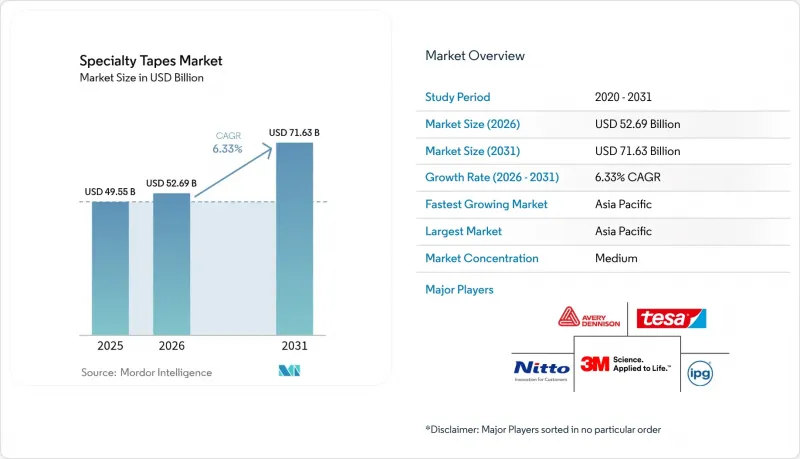
Mordor Intelligence에 의하면, 특수 테이프 시장 규모는 2025년 495억 5,000만 달러로 평가되었고, 2026년에는 526억 9,000만 달러로 추정되고, 2026-2031년 CAGR 6.33%로 성장을 지속할 전망이며, 2031년에는 716억 3,000만 달러에 이를 것으로 예측됩니다.
본 보고서는 유형별(직물·부직포, 폴리염화비닐, 폴리에틸렌테레프탈레이트, 기타), 기술별(용제형, 수성, 핫멜트, 기타), 접착 수지별(아크릴, 고무,실리콘, 기타), 최종 사용자 산업별(헬스케어, 전기 및 전자기기, 자동차, 기타), 지역별(북미, 남미, 유럽, 아시아태평양, 중동 및 아프리카)로 분류되어 있습니다.
세계의 특수 테이프 시장 동향 및 인사이트
헬스케어 및 웨어러블 기기 수요 증가
연속 혈당 모니터, 스마트 붕대, 심장용 패치 등의 의료용 웨어러블 기기에서는 강력한 초기 접착력과 저침습적인 박리성을 겸비한, 피부에 자극이 적은 테이프에 대한 의존도가 높아지고 있습니다. 원격 환자 모니터링의 도입 확대에 따라 통기성이 있고 습기 관리 기능을 갖춘 접착제에 대한 수요가 가속화되고 있으며, 에이버리 데니슨 메디컬(Avery Dennison Medical)은 장기간 착용하는 기기에서 장기적인 착용감을 중시하고 있습니다. 피부의 역동적인 움직임 속에서도 투명성을 유지하는 광학적으로 투명한 구조 덕분에 첨단 바이오 센서의 통합이 가능해졌으며, 배합 우선순위는 생체 적합성과 저외상성 박리로 이동하고 있습니다.
플렉서블 전자기기 및 전기차(EV) 배터리 팩의 성장
폴더블 스마트폰, 롤형 TV, 초박형 디스플레이에는 내부 회로를 보호하면서 수천 번의 굽힘 주기를 견디고, 흐려짐이 발생하지 않는 광학적으로 투명한 테이프가 요구됩니다. EV 배터리 모듈용 열 인터페이스 테이프는 셀 간의 열 전달을 완화하고, 열 폭주 시 팩의 안전성을 향상시킵니다. 린텍 주식회사는 반도체 패키징용 테이프에 주력하고 있으며, 첨단 칩 설계에 사용되는 리플로우 내성이 있는 EMI 차폐 솔루션을 제공합니다. 현재 배터리 팩 조립 과정에서 구조용 접착 테이프가 나사를 대체하여 경량화를 도모하는 동시에 내진동성을 높이고 있습니다.
석유화학 원료 가격 변동
원유 유래 모노머 가격이 급등하면 아크릴 수지나 고무 수지의 원가도 급등하여, 원가 상승을 하류로 전가할 수 없는 제조업체의 이익률은 압박을 받게 됩니다. 에틸렌 가격 변동은 폴리염화비닐(PVC) 기판 가격에도 파급됩니다. 유럽의 화학 제조업체들은 에너지 비용에 대한 압박이 지속되고 있다고 보고하고 있으며, 이로 인해 공급은 더욱逼迫하고 있습니다. 수직 통합과 장기 공급 계약은 비용 변동에 대한 주요 헤지 수단으로 계속 작용하고 있습니다.
부문 분석
2025년, 핫멜트 시스템은 특수 테이프 시장 규모의 42.85%를 차지했으며, 연평균 성장률(CAGR) 6.98%는 고속 자동화 라인에 적합한 무용제·속경화형 제품에 대한 꾸준한 수요를 보여줍니다. 수성 유형은 기재가 150°C의 도포 온도를 견디지 못하는 경우, 특히 정밀한 의료 진단 기기 부문에서 보급이 확대되고 있습니다.
지속가능성 목표를 배경으로, 토르 오일 지방산이나 당 유래 폴리올을 원료로 하는 바이오 유래 핫멜트 수지의 채택이 진행되고 있습니다. 헨켈(Henkel)과 팩사이즈(Pack Size)는 2025년 포장 검사에서 옥수수 유래 배합재를 사용함으로써 온실가스 배출을 32% 줄일 수 있음을 입증했습니다. 각 기기 공급업체들은 노즐 기술의 폭을 넓혀 접착제 사용량을 최대 25%까지 줄일 수 있는 패턴을 도포할 수 있게 했으며, 이는 비용 절감과 ESG 목표 모두에 부합합니다.
아크릴계는 균형 잡힌 접착성, 자외선 안정성, 비용 면에서의 우위 덕분에 2025년에는 특수 테이프 시장에서 46.75%의 점유율을 차지했습니다. 그러나 OEM 업체들이 저온 환경에서의 유연성과 신속한 조립 시의 접착력을 요구하는 가운데, 고무계 배합의 특수 테이프 시장 규모는 연평균 7.52%의 성장이 예상됩니다. 실리콘계 접착제는 최대 260°C까지의 고온 영역에 대응하며, 전자 기기의 접합이나 항공우주 부문의 마스킹에 필수적이지만, 높은 가격이 보급 확대를 저해하고 있습니다. 아크릴계 골격에 실리콘 블록을 그래프트화한 하이브리드 화학 구조가 내열성과 가격의 균형을 맞추기 위해 등장하고 있습니다.
지역별 분석
2025년에 아시아태평양이 특수 테이프 시장에서 40.85%의 점유율을 차지한 것으로 평가된 것은 해당 지역이 전자, 건설, 모빌리티 각 공급망에 통합되어 있음을 뒷받침합니다. 인도의 ‘스마트 시티 미션’은 -10°C에서 +70°C의 사용 온도 범위를 지원하는 저VOC 창문용 테이프를 우선적으로 사용하는 친환경 건물 개보수 공사에 자금을 지원하고 있습니다. 일본에서는 자동차 OEM 업체들이 도어 트림용으로 양면 아크릴 폼 테이프를 채택하여, 클립식에 비해 조립 시간을 30% 단축하고 있습니다.
북미에서는 6,000개 병원의 의료용 등급 수요와 급속히 확대되는 재택 진단 부문 수요를 활용할 수 있습니다. 유럽에서는 지역별 자동차 전동화 규제로 인해 열 관리용 테이프의 소비량이 증가하고 있습니다. 중동 및 아프리카에서는 NEOM과 같은 메가 프로젝트에서 고성능 파사드 실링 시스템이 채택됨에 따라 한 자릿수 중반대의 성장이 예상됩니다. 남미 지역 시장 점유율은 브라질의 백색 가전 및 연질 포장 생산량에 힘입고 있습니다. 국내 공급업체들은 수입 의존도를 낮추기 위해 아크릴 모노머 공장에 대한 투자를 추진하고 있습니다. 신흥 지역 전체적으로는 태양광 발전소 및 풍력 터빈에 대한 정부 보조금으로 인해, 실외에서 25년간 견딜 수 있는 자외선(UV) 내성 접착 필름 수요가 확대되고 있습니다.
기타 혜택
- 엑셀 형식 시장 예측(ME) 시트
- 3개월간의 애널리스트 지원
자주 묻는 질문
목차
제1장 서론
제2장 조사 방법
제3장 주요 요약
제4장 시장 구도
제5장 시장 규모 및 성장 예측
제6장 경쟁 구도
제7장 시장 기회 및 향후 전망
AJYAccording to Mordor Intelligence, the specialty tapes market size is expected to grow from USD 49.55 billion in 2025 to USD 52.69 billion in 2026 and is forecast to reach USD 71.63 billion by 2031 at 6.33% CAGR over 2026-2031.
This report is Segmented by Type (Woven/Non-woven, Polyvinyl Chloride, Polyethylene Terephthalate, and More), Technology (Solvent-Borne, Water-Borne, Hot-Melt, Others), Adhesive Resin (Acrylic, Rubber, Silicone, Others), End-User Industry (Healthcare, Electrical and Electronics, Automotive, and More), and Geography (North America, South America, Europe, Asia-Pacific, and Middle-East and Africa).
Global Specialty Tapes Market Trends and Insights
Expanding Healthcare and Wearable-Device Demand
Medical wearables such as continuous glucose monitors, smart bandages, and cardiac patches increasingly rely on skin-compatible tapes that combine strong initial tack with atraumatic removal. Growing adoption of remote patient monitoring accelerates demand for breathable, moisture-managing adhesives, with Avery Dennison Medical emphasizing long-term comfort in extended-wear devices. Optically clear constructions that maintain transparency under dynamic skin movement enable advanced biosensor integration, shifting formulation priorities toward biocompatibility and low-trauma removal.
Growth in Flexible Electronics and EV Battery Packs
Foldable smartphones, rollable televisions, and ultra-thin displays require optically clear tapes that endure thousands of bend cycles without haze formation while safeguarding internal circuitry. Thermal interface tapes in EV battery modules mitigate cell-to-cell heat transfer, improving pack safety during thermal runaway. LINTEC Corporation's focus on semiconductor packaging tapes targets reflow-resistant, EMI-shielding solutions for advanced chip designs. Structural adhesive tapes now replace screws in battery pack assembly, trimming weight while boosting vibration resistance.
Petrochemical Feedstock Price Volatility
Acrylic and rubber resin costs rise sharply when crude-oil-derived monomer prices spike, compressing margins for manufacturers unable to pass increases downstream. Ethylene volatility feeds through to polyvinyl chloride backings. European chemical producers report sustained energy-cost pressure, further tightening supply. Vertical integration and long-term supply contracts remain key hedges against cost swings.
Other drivers and restraints analyzed in the detailed report include:
- Construction Boom in Asia Pacific Green Buildings
- Lightweighting Trend in Auto and Rail Interiors
- Tight VOC/Solvent-Emission Regulations
For complete list of drivers and restraints, kindly check the Table Of Contents.
Segment Analysis
Hot-melt systems contributed 42.85% of specialty tapes market size in 2025, and their 6.98% CAGR indicates enduring preference for solvent-free, fast-setting options suitable for high-speed automated lines. Water-borne variants gain traction where substrates cannot tolerate 150 °C application temperatures, particularly in sensitive medical diagnostics.
Sustainability targets spur adoption of bio-sourced hot-melt resins based on tall-oil fatty acids and sugar-derived polyols. Henkel and Packsize demonstrated a 32% greenhouse-gas reduction with corn-based formulations in 2025 packaging trials. Equipment vendors broaden nozzle technology to apply patterns that cut adhesive use by up to 25%, aligning with both cost-reduction and ESG goals.
Acrylics commanded 46.75% specialty tapes market share in 2025 through balanced adhesion, UV stability, and cost profile. Specialty tapes market size for rubber-based formulations, however, is on track to expand 7.52% annually as OEMs seek flexibility under cold-temperature impact and rapid assembly adhesion. Silicone adhesives service high-temperature zones up to 260 °C, critical for electronics coupling and aerospace masking, yet their premium cost caps broader penetration. Hybrid chemistries that graft silicone blocks onto acrylic backbones emerge to balance temperature tolerance with price.
Complete Report Scope:
- By Technology
- Solvent-borne
- Water-borne
- Hot-melt
- Others
- By Adhesive Resin
- Acrylic
- Rubber
- Silicone
- Others (Cyanoacrylate, Epoxy, PU)
- By Type
- Woven / Non-woven
- Polyvinyl Chloride
- Polyethylene Terephthalate
- Paper
- Polypropylene
- Others
- By End-user Industry
- Healthcare
- Electrical and Electronics
- Automotive
- Paper and Printing
- Building and Construction
- Others
- By Geography
- Asia-Pacific
- China
- India
- Japan
- South Korea
- ASEAN
- Rest of Asia-Pacific
- North America
- United States
- Canada
- Mexico
- Europe
- Germany
- United Kingdom
- France
- Italy
- Spain
- Russia
- Rest of Europe
- South America
- Brazil
- Argentina
- Rest of South America
- Middle-East and Africa
- Saudi Arabia
- United Arab Emirates
- South Africa
- Rest of Middle-East and Africa
- Asia-Pacific
Geography Analysis
Asia Pacific's 40.85% specialty tapes market share in 2025 underscores the region's integration across electronics, construction, and mobility supply chains India's Smart Cities Mission finances green-building retrofits that favor low-VOC window tapes capable of sustaining -10 °C to +70 °C service temperatures. In Japan, automotive OEMs source double-sided acrylic foam tapes for pillar trim, cutting assembly time by 30% relative to clip-based methods.
North America capitalizes on medical-grade demand from 6,000 hospitals and a rapidly expanding at-home diagnostics sector. Europe benefits from regional automotive electrification mandates that raise thermal-management tape consumption. The Middle East and Africa posts mid-single-digit growth as megaprojects like NEOM integrate high-performance facade sealing systems. South America's share is anchored by Brazil's white-goods and flexible-packaging output; domestic suppliers invest in acrylic monomer plants to curb import dependence. Across emerging regions, government subsidies for solar farms and wind turbines enlarge demand for UV-stable adhesive films that endure 25-year outdoor exposure.
- 3M
- Adhesives Research Inc.
- Avery Dennison Corporation
- Coroplast Tape Corporation
- DuPont
- Gergonne Industrie
- Henkel AG & Co. KGaA
- Intertape Polymer Group
- Lintec Corporation
- Lohmann GmbH & Co. KG
- Nichiban Co. Ltd
- Nitto Denko Corporation
- Rogers Corporation
- Saint-Gobain
- Scapa Group plc
- Sekisui Chemical Co. Ltd
- Shurtape Technologies LLC
- Teraoka Seisakusho Co. Ltd
- tesa SE
- Vybond (Nautic Partners)
Additional Benefits:
- The market estimate (ME) sheet in Excel format
- 3 months of analyst support
TABLE OF CONTENTS
1 Introduction
- 1.1 Study Assumptions and Market Definition
- 1.2 Scope of the Study
2 Research Methodology
3 Executive Summary
4 Market Landscape
- 4.1 Market Overview
- 4.2 Market Drivers
- 4.2.1 Expanding Healthcare and Wearable-Device Demand
- 4.2.2 Growth in Flexible Electronics and EV Battery Packs
- 4.2.3 Construction Boom in Asia Pacific Green Buildings
- 4.2.4 Lightweighting Trend in Auto and Rail Interiors
- 4.2.5 Emergence Of Thermal-Management Tapes for EV Cells
- 4.3 Market Restraints
- 4.3.1 Petrochemical Feedstock Price Volatility
- 4.3.2 Tight VOC/Solvent-Emission Regulations
- 4.3.3 PFAS-Related Litigation and Reformulation Costs
- 4.4 Value Chain Analysis
- 4.5 Regulatory Landscape
- 4.6 Technological Outlook
- 4.7 Porter's Five Forces
- 4.7.1 Bargaining Power of Suppliers
- 4.7.2 Bargaining Power of Buyers
- 4.7.3 Threat of New Entrants
- 4.7.4 Threat of Substitutes
- 4.7.5 Degree of Competition
5 Market Size and Growth Forecasts (Value)
- 5.1 By Technology
- 5.1.1 Solvent-borne
- 5.1.2 Water-borne
- 5.1.3 Hot-melt
- 5.1.4 Others
- 5.2 By Adhesive Resin
- 5.2.1 Acrylic
- 5.2.2 Rubber
- 5.2.3 Silicone
- 5.2.4 Others (Cyanoacrylate, Epoxy, PU)
- 5.3 By Type
- 5.3.1 Woven / Non-woven
- 5.3.2 Polyvinyl Chloride
- 5.3.3 Polyethylene Terephthalate
- 5.3.4 Paper
- 5.3.5 Polypropylene
- 5.3.6 Others
- 5.4 By End-user Industry
- 5.4.1 Healthcare
- 5.4.2 Electrical and Electronics
- 5.4.3 Automotive
- 5.4.4 Paper and Printing
- 5.4.5 Building and Construction
- 5.4.6 Others
- 5.5 By Geography
- 5.5.1 Asia-Pacific
- 5.5.1.1 China
- 5.5.1.2 India
- 5.5.1.3 Japan
- 5.5.1.4 South Korea
- 5.5.1.5 ASEAN
- 5.5.1.6 Rest of Asia-Pacific
- 5.5.2 North America
- 5.5.2.1 United States
- 5.5.2.2 Canada
- 5.5.2.3 Mexico
- 5.5.3 Europe
- 5.5.3.1 Germany
- 5.5.3.2 United Kingdom
- 5.5.3.3 France
- 5.5.3.4 Italy
- 5.5.3.5 Spain
- 5.5.3.6 Russia
- 5.5.3.7 Rest of Europe
- 5.5.4 South America
- 5.5.4.1 Brazil
- 5.5.4.2 Argentina
- 5.5.4.3 Rest of South America
- 5.5.5 Middle-East and Africa
- 5.5.5.1 Saudi Arabia
- 5.5.5.2 United Arab Emirates
- 5.5.5.3 South Africa
- 5.5.5.4 Rest of Middle-East and Africa
- 5.5.1 Asia-Pacific
6 Competitive Landscape
- 6.1 Market Concentration
- 6.2 Strategic Moves
- 6.3 Market Share Analysis
- 6.4 Company Profiles (includes Global level Overview, Market level overview, Core Segments, Financials as available, Strategic Information, Market Rank/Share, Products and Services, Recent Developments)
- 6.4.1 3M
- 6.4.2 Adhesives Research Inc.
- 6.4.3 Avery Dennison Corporation
- 6.4.4 Coroplast Tape Corporation
- 6.4.5 DuPont
- 6.4.6 Gergonne Industrie
- 6.4.7 Henkel AG & Co. KGaA
- 6.4.8 Intertape Polymer Group
- 6.4.9 Lintec Corporation
- 6.4.10 Lohmann GmbH & Co. KG
- 6.4.11 Nichiban Co. Ltd
- 6.4.12 Nitto Denko Corporation
- 6.4.13 Rogers Corporation
- 6.4.14 Saint-Gobain
- 6.4.15 Scapa Group plc
- 6.4.16 Sekisui Chemical Co. Ltd
- 6.4.17 Shurtape Technologies LLC
- 6.4.18 Teraoka Seisakusho Co. Ltd
- 6.4.19 tesa SE
- 6.4.20 Vybond (Nautic Partners)
7 Market Opportunities and Future Outlook
- 7.1 White-space and Unmet-need Assessment
- 7.2 Development of New Products in Acrylic Foam Based Specialty Tapes