

|
시장보고서
상품코드
2114933
폴리우레탄 복합재료 시장 : 시장 점유율 분석, 업계 동향 및 통계, 성장 예측(2026-2031년)Polyurethane Composites - Market Share Analysis, Industry Trends & Statistics, Growth Forecasts (2026 - 2031) |
||||||
 Mordor Intelligence
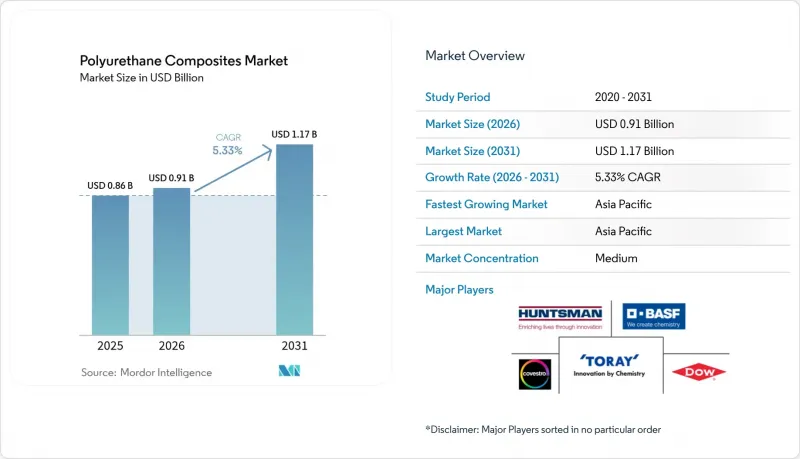
Mordor Intelligence에 의하면, 2026년 폴리우레탄 복합재료 시장 규모는 9억 1,000만 달러로 추정되고, 2025년 8억 6,000만 달러에서 확대해, 2031년에는 11억 7,000만 달러에 이를 것으로 예측됩니다.
2026-2031년 연평균 성장률(CAGR)은 5.33%가 될 것으로 전망됩니다.
본 보고서는 섬유 유형별(유리, 탄소, 기타), 수지 유형별(열경화성 PU, 열가소성 PU, 바이오 유래 PU), 최종 사용자 산업별(운송, 건축 및 건설, 전기 및 전자기기, 풍력 발전, 스포츠·레크리에이션, 기타), 지역별(북미, 남미, 유럽, 아시아태평양, 중동 및 아프리카)로 분류되어 있습니다. 시장 예측은 금액(달러) 기준으로 제시되어 있습니다.
세계의 폴리우레탄 복합재료 시장 동향 및 인사이트
운송 부문에서의 경량화 추진
자동차, 철도, 항공우주 각 제조업체는 엄격한 효율 규제와 주행 거리에 대한 기대에 부응하기 위해 폴리우레탄 복합재료를 채택하고 있습니다. 포드사의 ‘브롱코 랩터’에 채택된 복합재제 C-브레이스는 경량화와 소음·진동 저감을 동시에 실현하여 승차감을 향상시킨 좋은 사례입니다. 철도 차량 제조업체들도 더욱 엄격해진 차내 소음 기준을 충족하기 위해 폴리우레탄 유리 및 방음 부재를 채택하고 있습니다. 전기차 생산 확대에 따라 소재 대체가 진행되고 있습니다. 이는 배터리 팩이 상당한 중량 증가를 초래하는 반면, 복합재로 제작된 차체 구조가 이를 상쇄할 수 있기 때문입니다.
풍력 터빈 블레이드 길이의 급속한 확대
블레이드가 길어질수록 메가와트 단위의 출력이 증가하고 균등화 발전 비용이 낮아지기 때문에 폴리우레탄과 탄소섬유로 만들어진 강성이 높고 경량인 스파 캡에 대한 수요가 높아지고 있습니다. 베스타스(Vestas)는 다우(Dow)의 폴리우레탄-탄소 스파 기술을 검증하여, 에폭시 수지 경화 시 흔히 발생하는 공정 지연 없이 100m가 넘는 블레이드 구현의 길을 열었습니다. 미국 에너지부의 ‘Big Adaptive Rotor’ 프로그램은 경화 속도가 빠른 폴리우레탄 주입 공정의 장점을 더욱 부각시키는 물류상의 병목 현상을 여실히 드러내고 있습니다.
자동차 생산 변동
자동차 생산 대수의 변동은 수지 공급업체와 성형 제조업체공급망 계획에 혼란을 초래하고 있습니다. 코베스트로의 2023년 매출은 자동차 수요 부진이 수주량 감소로 이어지면서 20% 감소한 144억 유로를 기록했습니다. SGL 카본은 장기 복합재료 계약이 갱신 프로그램 이전에 만료됨에 따라 수익 측면에서 압박을 받고 있다고 보고했습니다. 전기차로의 전환은 예측의 불확실성을 높이고 있습니다. 이는 기존 내연기관 플랫폼과 차세대 전기차 아키텍처에는 서로 다른 재료 세트가 필요하기 때문입니다.
부문별 분석
유리섬유는 자동차, 건설, 선박 용도에서의 성숙한 공급망과 비용 효율성이라는 강점을 바탕으로 2025년 매출의 59.12%를 차지했습니다. 탄소섬유는 항공우주 산업의 회복과 풍력 발전용 블레이드의 대형화로 인해 우수한 강성 대 중량비에 대한 수요가 증가함에 따라 연평균 성장률(CAGR) 6.21%로 성장하여 폴리우레탄 복합재료 시장 전체를 상회할 전망입니다. 베스타스(Vestas)사가 차세대 터빈에 다우(Dow)사의 스퍼 캡(Spur Cap) 기술을 채택함에 따라, 탄소섬유 용도의 폴리우레탄 복합재료 시장 규모는 대폭 확대될 것으로 예측됩니다.
유리섬유는 카본 솔루션이 프리미엄 부문에 침투하는 상황에서도 그 규모상의 우위를 바탕으로, 비용 효율을 중시하는 운송 장비 및 건축 부품 부문에서의 입지를 계속해서 공고히할 것으로 전망됩니다. 각 제조업체들은 비이소시아네이트 수지와의 접착력을 높이기 위해 표면 개질 로빙의 활용을 모색하고 있으며, 이로 인해 VOC 규제 강화에도 불구하고 유리섬유의 출하량은 유지될 가능성이 있습니다.
지역별 분석
아시아태평양은 2025년에 전 세계 매출의 52.30%를 차지하고, 폴리우레탄 복합재료 시장을 독점했으며, 2031년까지 연평균 성장률(CAGR) 7.25%로 확대될 것으로 예측됩니다. 중국과 인도는 자동차 조립 확대와 풍력 발전소 건설을 통해 생산량을 견인하고 있는 반면, 동남아시아는 수지 공장에 대한 공급원으로서 프로파일렌글리콜과 특수 아민의 생산 능력을 강화하고 있습니다.
북미는 항공우주, 방위, 고부가가치 자동차 프로그램을 통해 여전히 큰 시장 점유율을 유지하고 있습니다. 청정 에너지 프로젝트에 대한 정책적 인센티브로 인해 미국에서 풍력 발전용 블레이드 및 배터리 부품 제조가 더욱 촉진되고 있습니다. 유럽 시장 동향은 엄격한 화학물질 규제와 적극적인 재생 에너지 목표에 의해 형성되고 있습니다. 이소시아네이트에 대한 REACH 규제로 인해 배합 제조업체들은 저모노머 및 바이오 유래 경로로 전환하고 있으며, 순환형 용도에서의 폴리우레탄 복합재료 사용을 확대하는 친환경 전환이 촉진되고 있습니다.
기타 혜택
- 엑셀 형식 시장 예측(ME) 시트
- 3개월간의 애널리스트 지원
자주 묻는 질문
목차
제1장 서론
제2장 조사 방법
제3장 주요 요약
제4장 시장 구도
제5장 시장 규모 및 성장 예측
제6장 경쟁 구도
제7장 시장 기회 및 향후 전망
AJY 26.08.28According to Mordor Intelligence, polyurethane composites market size market size in 2026 is estimated at USD 0.91 billion, growing from 2025 value of USD 0.86 billion with 2031 projections showing USD 1.17 billion, growing at 5.33% CAGR over 2026-2031.
This report is Segmented by Fiber Type (Glass, Carbon, Others), Resin Type (Thermoset PU, Thermoplastic PU, Bio-Based PU), End-User Industry (Transportation, Building and Construction, Electrical and Electronics, Wind Energy, Sports and Recreation, Others), and Geography (North America, South America, Europe, Asia-Pacific, and Middle-East and Africa). The Market Forecasts are Provided in Terms of Value (USD).
Global Polyurethane Composites Market Trends and Insights
Lightweighting Push in Transportation
Automotive, rail, and aerospace manufacturers are integrating polyurethane composites to comply with stringent efficiency rules and range expectations. Ford's composite C-brace on the Bronco Raptor illustrates how weight reduction can be paired with noise and vibration dampening to improve ride comfort. Railcar builders also fit polyurethane glazing and sound-barrier components to meet stricter cabin-noise limits. Growing electric-vehicle production magnifies material substitution because battery packs impose a significant mass penalty that composite body structures can offset.
Rapid Wind-Turbine Blade Length Scaling
Longer blades raise megawatt output and cut the levelized cost of energy, driving demand for stiffer and lighter spar caps made with polyurethane and carbon fiber. Vestas validated Dow's polyurethane-carbon spar technology, opening a pathway for blades that exceed 100 m without process slowdowns typical of epoxy curing. The US Department of Energy's Big Adaptive Rotor program further highlights logistics bottlenecks that favor faster-curing polyurethane infusion routes.
Automotive Production Volatility
Fluctuating vehicle output is disrupting supply-chain planning for resin suppliers and molders. Covestro's 2023 sales slipped 20% to EUR 14.4 billion as lower automotive demand translated into weaker order volumes. SGL Carbon reported revenue pressure when long-running composite contracts expired ahead of replacement programs. The pivot to electric vehicles adds forecasting uncertainty because legacy internal-combustion platforms and next-generation EV architectures call for different material sets.
Other drivers and restraints analyzed in the detailed report include:
- Construction Shift to Modular PU-SIPs Panels
- ESG-Driven Bio-Based PU Resin Adoption
- High Carbon/PU Composite Fabrication Costs
For complete list of drivers and restraints, kindly check the Table Of Contents.
Segment Analysis
Glass fiber held 59.12% of revenue in 2025 on the strength of mature supply lines and cost efficiency across automotive, construction, and marine applications. Carbon fiber is set to grow at 6.21% CAGR, outpacing the overall polyurethane composites market as aerospace rebound and wind blade scaling raise demand for superior stiffness-to-weight ratios. The polyurethane composites market size for carbon fiber applications is projected to widen substantially as Vestas adopts Dow's spar cap technology in next-generation turbines.
The scale advantages of glass fiber should keep it entrenched in cost-sensitive transportation and building parts even as carbon solutions penetrate premium segments. Manufacturers are exploring Surface-Modified roving to enhance adhesion with non-isocyanate resins, which could sustain glass volumes despite tightening VOC rules.
Complete Report Scope:
- By Fiber Type
- Glass
- Carbon
- Others
- By Resin Type
- Thermoset PU
- Thermoplastic PU
- Bio-based PU
- By End-User Industry
- Transportation
- Building and Construction
- Electrical and Electronics
- Wind Energy
- Sports and Recreation
- Others
- By Geography
- Asia-Pacific
- China
- India
- Japan
- South Korea
- Rest of Asia-Pacifc
- North America
- United States
- Canada
- Mexico
- Europe
- Germany
- United Kingdom
- France
- Italy
- Rest of Europe
- South America
- Brazil
- Argentina
- Rest of South America
- Middle-East and Africa
- Saudi Arabia
- South Africa
- Rest of Middle-East and Africa
- Asia-Pacific
Geography Analysis
Asia Pacific dominated the polyurethane composites market with 52.30% of global revenue in 2025 and is expected to climb at a 7.25% CAGR through 2031. China and India drive volumes through automotive assembly expansion and wind farm construction, while Southeast Asia boosts propylene glycol and specialty amine capacities to feed resin plants.
North America retains a substantial footprint due to aerospace, defense, and high-value automotive programs. Policy incentives for clean energy projects spur additional wind blade and battery-component fabrication across the United States. Europe's trajectory is shaped by rigorous chemical regulations and aggressive renewable-energy targets. REACH restrictions on diisocyanates are pushing formulators to low-monomer and bio-derived routes, streamlining a green transition that amplifies polyurethane composite usage in circular applications
- AOC Resins
- BASF
- Covestro AG
- Dow
- Evonik Industries AG
- Gurit Holding
- Henkel AG & Co. KGaA
- Hexcel Corporation
- Huntsman International LLC
- Linecross Ltd.
- LyondellBasell Industries Holdings B.V.
- Mitsui Chemicals Inc
- Owens Corning
- SABIC
- SGL Carbon
- Solvay
- Teijin Limited
- The Lubrizol Corporation
- TORAY INDUSTRIES, INC.
- Webasto Group
Additional Benefits:
- The market estimate (ME) sheet in Excel format
- 3 months of analyst support
TABLE OF CONTENTS
1 Introduction
- 1.1 Study Assumptions and Market Definition
- 1.2 Scope of the Study
2 Research Methodology
3 Executive Summary
4 Market Landscape
- 4.1 Market Overview
- 4.2 Market Drivers
- 4.2.1 Lightweighting Push in Transportation
- 4.2.2 Rapid Wind-Turbine Blade Length Scaling
- 4.2.3 Construction Shift to Modular PU-Sips Panels
- 4.2.4 ESG-Driven Bio-Based PU Resin Adoption
- 4.2.5 Thermal-Protective Polyurethane Battery Enclosures
- 4.3 Market Restraints
- 4.3.1 Automotive Production Volatility
- 4.3.2 High Carbon/PU Composite Fabrication Costs
- 4.3.3 Chlorine Feedstock Regulatory Risk (MDI/TDI)
- 4.4 Value Chain Analysis
- 4.5 Porter's Five Forces
- 4.5.1 Bargaining Power of Suppliers
- 4.5.2 Bargaining Power of Buyers
- 4.5.3 Threat of New Entrants
- 4.5.4 Threat of Substitutes
- 4.5.5 Degree of Competition
5 Market Size and Growth Forecasts (Value)
- 5.1 By Fiber Type
- 5.1.1 Glass
- 5.1.2 Carbon
- 5.1.3 Others
- 5.2 By Resin Type
- 5.2.1 Thermoset PU
- 5.2.2 Thermoplastic PU
- 5.2.3 Bio-based PU
- 5.3 By End-User Industry
- 5.3.1 Transportation
- 5.3.2 Building and Construction
- 5.3.3 Electrical and Electronics
- 5.3.4 Wind Energy
- 5.3.5 Sports and Recreation
- 5.3.6 Others
- 5.4 By Geography
- 5.4.1 Asia-Pacific
- 5.4.1.1 China
- 5.4.1.2 India
- 5.4.1.3 Japan
- 5.4.1.4 South Korea
- 5.4.1.5 Rest of Asia-Pacifc
- 5.4.2 North America
- 5.4.2.1 United States
- 5.4.2.2 Canada
- 5.4.2.3 Mexico
- 5.4.3 Europe
- 5.4.3.1 Germany
- 5.4.3.2 United Kingdom
- 5.4.3.3 France
- 5.4.3.4 Italy
- 5.4.3.5 Rest of Europe
- 5.4.4 South America
- 5.4.4.1 Brazil
- 5.4.4.2 Argentina
- 5.4.4.3 Rest of South America
- 5.4.5 Middle-East and Africa
- 5.4.5.1 Saudi Arabia
- 5.4.5.2 South Africa
- 5.4.5.3 Rest of Middle-East and Africa
- 5.4.1 Asia-Pacific
6 Competitive Landscape
- 6.1 Market Concentration
- 6.2 Strategic Moves
- 6.3 Market Share Analysis
- 6.4 Company Profiles (includes Global level Overview, Market level overview, Core Segments, Financials as available, Strategic Information, Market Rank/Share for key companies, Products and Services, and Recent Developments)
- 6.4.1 AOC Resins
- 6.4.2 BASF
- 6.4.3 Covestro AG
- 6.4.4 Dow
- 6.4.5 Evonik Industries AG
- 6.4.6 Gurit Holding
- 6.4.7 Henkel AG & Co. KGaA
- 6.4.8 Hexcel Corporation
- 6.4.9 Huntsman International LLC
- 6.4.10 Linecross Ltd.
- 6.4.11 LyondellBasell Industries Holdings B.V.
- 6.4.12 Mitsui Chemicals Inc
- 6.4.13 Owens Corning
- 6.4.14 SABIC
- 6.4.15 SGL Carbon
- 6.4.16 Solvay
- 6.4.17 Teijin Limited
- 6.4.18 The Lubrizol Corporation
- 6.4.19 TORAY INDUSTRIES, INC.
- 6.4.20 Webasto Group
7 Market Opportunities and Future Outlook
- 7.1 White-space and Unmet-Need Assessment


