|
시장보고서
상품코드
2114949
에피클로로히드린 시장 : 시장 점유율 분석, 업계 동향 및 통계, 성장 예측(2026-2031년)Epichlorohydrin - Market Share Analysis, Industry Trends & Statistics, Growth Forecasts (2026 - 2031) |
||||||
 Mordor Intelligence
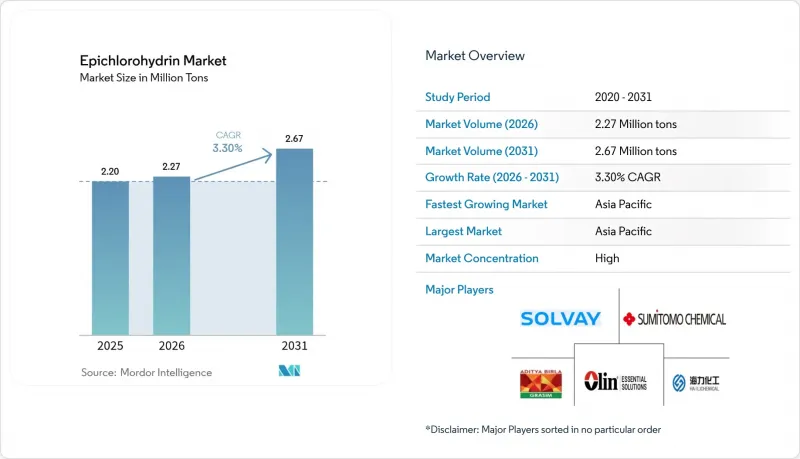
Mordor Intelligence에 의하면, 2026년 에피클로로히드린 시장 규모는 227만 톤으로 추정되고, 2025년 220만 톤으로부터 확대해, 2031년에는 267만 톤에 이를 것으로 예측됩니다.
2026-2031년 연평균 성장률(CAGR) 3.30%로 성장할 것으로 전망됩니다.
본 보고서에서는 산업을 유형별(석유 유래 에피클로로히드린, 바이오 유래 에피클로로히드린), 용도별(에폭시 수지, 특수 수처리용 화학제품, 기타), 최종 이용 산업별(건설, 페인트 및 코팅, 접착제, 기타), 지역별(아시아태평양, 북미, 유럽, 남미, 중동 및 아프리카)로 분류하고 있습니다. 시장 예측은 수량(톤) 기준으로 제시되어 있습니다.
세계의 에피클로로히드린 시장 동향 및 인사이트
바이오 유래 원료의 확보 가능성이 지속 가능한 성장을 뒷받침
바이오디젤 유래 조글리세린공급 과잉이 확대됨에 따라, 글리세린을 원료로 하는 에피클로로히드린 생산의 경제적 타당성이 강화되고 있습니다. Epicerol 기술을 채택한 플랜트에서는 프로파일렌을 원료로 하는 제조 공정에 비해 CO2 배출량을 60% 줄이고, 폐수 발생량을 최대 40분의 1로 억제할 수 있어, 엄격해지는 탄소 규제에 대응하는 동시에 그린 케미스트리의 우대 조치 대상이 됩니다. 톤당 약 1,697유로인 생산 비용은 현재 시장 가격에 거의 근접한 수준이며, 글리세린 가격의 하락에 따라 수익성 격차는 줄어들고 있습니다. AGC Chemicals Europe은 2024년에 ‘EPINITY’를 상용화했으며, Epigral Limited도 동일한 기술을 활용해 인도 내에서 생산을 시작하여 도입이 가속화되고 있음이 부각되고 있습니다. 라이프사이클 탄소 공시를 의무화하는 관할 구역이 늘어나는 가운데, 바이오 유래 에피클로로히드린은 생산자에게 지속가능성을 중시하는 고객과의 장기적인 공급 계약을 확보하기 위한 신뢰할 수 있는 길이 될 것입니다.
에폭시 수지 소비 확대가 핵심 수요를 견인
에폭시 수지는 전 세계 에피클로로히드린 생산량의 86% 이상을 흡수하며, 에피클로로히드린 시장의 기초적인 성장을 뒷받침하고 있습니다. 인프라 개보수, 산업용 보호 코팅, 자동차 및 항공우주용 첨단 복합재료로 인해 에폭시 수지의 용도는 지속적으로 확대되고 있으며, 한편 전자기기의 소형화에 따라 고순도·저염소 함유 수지 등급에 대한 수요가 증가하고 있습니다. 구자라트주에 건설된 DCM 슈리람사의 1억 2,000만 달러 규모의 에폭시 수지 복합 시설은 자사용 에피클로로히드린 공급을 확보하기 위해 설계된, 지역적 후방 통합의 좋은 사례입니다. 도료 제조업체들이 휘발성 유기 화합물(VOC) 규제를 준수하기 위해 수성 및 무용제 제품 라인을 도입함에 따라, 1제곱미터당 에폭시 수요는 증가하고 있으며, 이는 2030년까지의 성장 여지를 더욱 넓히고 있습니다.
원자재 가격 변동이 이익률을 압박
2024년, 프로파일렌과 가성소다 가격은 세계 에너지 가격의 불확실성과 염소-알칼리 플랜트의 간헐적인 가동 중단을 반영하여 계속해서 큰 변동을 보였습니다. 아시아 공급업체들은 생산 비용 감소로 일시적인 혜택을 본 반면, 유럽 생산자들은 높은 전기 요금으로 어려움을 겪으며 스프레드가 축소되었습니다. 염소-알칼리 자산을 통합한 기업들은 가격 변동의 영향을 부분적으로 상쇄할 수 있었지만, 헤지를 하지 않은 생산자들은 이익률 압박에 직면해 있으며, 이는 생산 능력 확대 계획의 지연으로 이어질 가능성이 있습니다. 바이오 공장은 대체적인 비용 기반을 제공하지만, 바이오디젤 정책에 연동되는 글리세린 가격의 영향을 받기 쉬운 상황이 지속되고 있습니다. 따라서 2025-2026년에 걸쳐서도 헤지 전략과 조달처 다각화가 조달 실무의 최우선 과제로 남을 것입니다.
부문별 분석
2025년, 석유 유래 에피클로로히드린은 세계 소비량의 87.78%를 차지했으며, 1,931.16킬로 톤에 달했으나, 바이오 유래 생산량은 더 빠르게 증가하여 같은 해 말에는 268.84킬로 톤을 기록했습니다. 바이오 유래 생산에 기인한 에피클로로히드린 시장 규모는 저탄소 화학물질에 대한 정책적 인센티브와 바이오디젤 제조 공정에서 공급되는 글리세린의 양 증가에 힘입어 연평균 성장률(CAGR) 3.96%로 확대될 것으로 예측됩니다. 대조적으로, 석유 유래 제조 경로는 유럽의 탄소세 인상과 다국적 기업 고객들이 점차 친환경 공급망으로 전환하고 있는 점으로 인해, 에피클로로히드린 시장 전체의 성장률보다 약 70베이시스포인트 낮은 성장률을 보일 것으로 예측됩니다.
에피세롤 기술을 채택한 생산자들은 알릴 염소화 공정에 비해 온실가스 배출량을 60% 줄이고, 폐수 배출량을 최대 40분의 1로 줄이고 있다고 일관되게 보고하고 있습니다. 아시아, 특히 태국과 인도에서의 조기 도입 사례는 바이오 생산 설비가 연간 50ktpa를 초과하는 규모의 경제를 달성할 수 있음을 보여주고 있으며, 다른 염소-알칼리 기업들도 유사한 기술의 라이선싱을 추진하도록 장려하고 있습니다. 예측 기간 동안 효율의 추가적인 향상과 글리세린 가격 하락으로 인해 비용 프리미엄이 축소되어, 초저염소 함유가 필수적인 틈새 시장인 전자기기용 밀봉재 시장에 바이오 제품이 침투할 가능성이 있습니다.
지역별 분석
2025년에는 아시아태평양이 1,291.84킬로톤으로 세계 수요를 주도했으며, 이는 에피클로로히드린 시장의 58.72%에 해당합니다. 4.12%라는 연평균 성장률(CAGR)의 지속적인 성장은 하류 에폭시 수지 시장의 견조한 확대, 인도의 생산 능력에 대한 투자, 첨단 소재의 자급자족을 중시하는 중국의 산업 정책에 기인합니다. 지역 생산자들은 경쟁력 있는 가격의 프로파일렌에 대한 접근성과 공급망 민첩성을 높이는 인프라 투자 지원이라는 혜택을 누리고 있습니다. 따라서 아시아태평양의 에피클로로히드린 시장 규모는 2031년까지 다른 지역에 비해 우위를 더욱 확대할 것으로 예측됩니다.
북미에서는 항공우주용 복합재료, 반도체 봉지재, 특수 코팅 부문에서 여전히 높은 소비가 유지되고 있습니다. 그러나 개정된 EPA(미국 환경보호청) 규정에 따라 의무화된 배기가스 규제 대응을 위한 설비 개조로 인해 설비 투자가 필요해지며, 이는 아시아에서 생산되는 바이오 등급 제품의 수입 증가를 촉진할 가능성이 있습니다. 유럽도 유사한 과제에 직면해 있습니다. 높은 에너지 비용, GDP 성장 둔화, 엄격한 탄소 가격 제도가 이익률을 압박하고 있어 중소 에폭시 수지 배합 제조업체들의 통합이 진행되고 있습니다. 해상 풍력 발전소 건설 및 배터리 기가팩토리에 대한 EU의 자금 지원으로 인해 고품질 에피클로로히드린 유도체에 대한 제한적인 수요가 확보되고 있습니다.
라틴아메리카, 중동 및 아프리카는 전 세계 공급량의 10% 미만을 차지할 뿐이지만, 장기적인 잠재력을 지니고 있습니다. 브라질의 인프라 컨세션 사업과 사우디아라비아의 화학 산업 다각화 계획으로 인해 지역적 수요가 집적되고 있습니다. 1인당 소비량은 현재 낮은 수준이지만, 도시화의 진전과 재생에너지 목표 달성에 따라 추가적인 성장이 예상되며, 세계 공급업체들은 수입 터미널 및 지역 혼합 거점을 구축함으로써 이러한 성장 기회를 포착할 수 있을 것으로 보입니다.
기타 혜택
- 엑셀 형식 시장 예측(ME) 시트
- 3개월간 애널리스트의 지원
자주 묻는 질문
목차
제1장 서론
제2장 조사 방법
제3장 주요 요약
제4장 시장 구도
제5장 시장 규모 및 성장 예측
제6장 경쟁 구도
제7장 시장 기회 및 향후 전망
AJY 26.08.28According to Mordor Intelligence, epichlorohydrin market size in 2026 is estimated at 2.27 Million tons, growing from 2025 value of 2.20 Million tons with 2031 projections showing 2.67 Million tons, growing at 3.30% CAGR over 2026-2031.
This report Segments the Industry by Type (Oil-Based Epichlorohydrin, Bio-Based Epichlorohydrin), Application (Epoxy Resins, Specialty Water Treatment Chemicals, and More), and End-Use Industry (Construction, Paints and Coatings, Adhesives, and More), Geography (Asia-Pacific, North-America, Europe, South America, and Middle-East and Africa). The Market Forecasts are Provided in Terms of Volume (Tons).
Global Epichlorohydrin Market Trends and Insights
Bio-based Feedstock Availability Spurs Sustainable Growth
A widening surplus of crude glycerin from biodiesel has bolstered the economic case for glycerin-to-epichlorohydrin production. Plants using Epicerol technology cut CO2 emissions by 60% and wastewater generation by up to forty-fold compared with propylene routes, meeting tightening carbon regulations and qualifying for green-chemistry incentives. Production costs around EUR 1,697 / ton are now within striking distance of prevailing market prices, narrowing the profitability gap as glycerin prices soften. AGC Chemicals Europe commercialized EPINITY in 2024, and Epigral Limited entered domestic manufacturing in India using the same technology, underlining accelerated adoption. As more jurisdictions impose lifecycle-carbon disclosures, bio-based epichlorohydrin gives producers a credible pathway to secure long-term offtake agreements with sustainability-focused customers.
Escalating Epoxy Resin Consumption Amplifies Core Demand
Epoxy resins absorb over 86% of global epichlorohydrin output, anchoring baseline growth for the epichlorohydrin market. Infrastructure upgrades, protective industrial coatings, and advanced composites for automotive and aerospace continue to widen epoxy use, while electronics miniaturization demands high-purity, low-chlorine resin grades. DCM Shriram's USD 120 million epoxy resin complex in Gujarat exemplifies regional backward integration designed to secure captive epichlorohydrin supply. As coating manufacturers introduce water-borne and solvent-free lines to meet volatile-organic-compound rules, epoxy demand per square meter rises, lengthening the growth runway through 2030.
Feedstock Price Fluctuations Pressure Margins
Propylene and caustic soda prices continued to swing widely in 2024, reflecting global energy-price uncertainty and periodic outages in chlor-alkali units. While Asian suppliers temporarily benefited from lower production costs, European producers grappled with high electricity tariffs, compressing spreads. Firms with integrated chlor-alkali assets have partially offset volatility, yet unhedged producers face margin squeeze that can delay debottlenecking plans. Bio-based units provide an alternate cost base but remain exposed to glycerin pricing tied to biodiesel policies. Hedging strategies and diversified sourcing therefore stay at the forefront of procurement practices during 2025-2026.
Other drivers and restraints analyzed in the detailed report include:
- Construction Sector Expansion Underpins Volume Uptake
- Wind-Energy Blade Manufacturing Extends Application Scope
- Tightening Environmental Regulations Elevate Compliance Burden
For complete list of drivers and restraints, kindly check the Table Of Contents.
Segment Analysis
Oil-derived epichlorohydrin retained an 87.78% share of global consumption in 2025, equating to 1,931.16 kilotons, yet bio-based volumes grew faster, closing the year at 268.84 kilotons. The epichlorohydrin market size attributable to bio-based production is expected to expand at 3.96% CAGR, lifted by policy incentives for low-carbon chemicals and expanding glycerin availability from biodiesel streams. In contrast, the oil-based route is projected to trail the overall epichlorohydrin market by nearly 70 basis points in growth due to escalating carbon fees in Europe and the gradual shift of multinational customers toward greener supply chains.
Producers employing Epicerol technology consistently report 60% lower greenhouse-gas footprints and up to forty-fold reductions in wastewater discharge relative to the allyl-chlorination pathway. Early adopters in Asia, most notably in Thailand and India, demonstrate that bio-based units can reach economies of scale above 50 ktpa, encouraging other chlor-alkali firms to license similar technology. Over the forecast horizon, incremental efficiency gains and potentially lower glycerin prices may compress the cost premium, enabling bio-based grades to penetrate niche electronic encapsulation lines where ultra-low chlorine is pivotal.
Complete Report Scope:
- By Type
- Oil-based epichlorohydrin
- Bio-based epichlorohydrin
- By Application
- Epoxy Resins
- Specialty Water Treatment Chemicals
- Synthetic Glycerin
- Epichlorohydrin Elastomers
- Other Applications(Pharmaceuticals, etc.)
- By End-Use Industry
- Construction
- Paints and Coatings
- Adhesives
- Textiles
- Other Industries(Wind Energy, Healthcare, etc.)
- By Geography
- Asia-Pacific
- China
- India
- Japan
- South Korea
- Rest of Asia-Pacific
- North America
- United States
- Canada
- Mexico
- Europe
- Germany
- United Kingdom
- France
- Italy
- Rest of Europe
- South America
- Brazil
- Argentina
- Rest of South America
- Middle East and Africa
- Saudi Arabia
- South Africa
- Rest of Middle East and Africa
- Asia-Pacific
Geography Analysis
Asia-Pacific led global demand with 1,291.84 kilotons in 2025, equating to 58.72% of the epichlorohydrin market. Continued 4.12% CAGR growth arises from robust downstream epoxy resin expansion, capacity investments in India, and Chinese industrial policy emphasizing self-reliance in advanced materials. Regional producers benefit from access to competitively priced propylene and supportive infrastructure investment, enhancing supply-chain agility. The epichlorohydrin market size in Asia-Pacific is therefore expected to widen its lead over other regions by 2031.
North America retains significant high-value consumption in aerospace composites, semiconductor encapsulation, and specialty coatings. However, emission-control retrofits mandated under revised EPA rules introduce capital expenditures that may encourage incremental imports of bio-based grades produced in Asia. Europe confronts parallel challenges: high energy costs, slower GDP growth, and stringent carbon-pricing schemes compress margins, prompting consolidation of smaller epoxy formulators. Nevertheless, EU funding for offshore-wind build-outs and battery gigafactories ensures selective demand pockets for premium epichlorohydrin derivatives.
Latin America, the Middle East, and Africa collectively account for less than 10% of global volumes but present long-term potential. Brazil's infrastructure concessions and Saudi Arabia's chemical diversification agendas create localized demand clusters. While per-capita consumption is currently low, rising urbanization and renewable-energy targets promise incremental growth that global suppliers may capture by deploying import terminals and regional blending hubs.
- AGC Vinythai
- DCM SHRIRAM CHEMICALS
- Epigral Limited
- Formosa Plastics Corporation
- Grasim Industries Ltd
- Hanwha Solutions Chemical Division Corporation
- Hexion Inc.
- Kashima Chemical Co. Ltd.
- Lotte Fine Chemical Co. Ltd.
- Nama
- Olin Corporation
- Shandong Haili Chemical Industry Co., Ltd.
- Sinochem International Corporation
- Solvay
- Sumitomo Chemical Co., Ltd.
Additional Benefits:
- The market estimate (ME) sheet in Excel format
- 3 months of analyst support
TABLE OF CONTENTS
1 Introduction
- 1.1 Study Assumptions & Market Definition
- 1.2 Scope of the Study
2 Research Methodology
3 Executive Summary
4 Market Landscape
- 4.1 Market Overview
- 4.2 Market Drivers
- 4.2.1 Shift to Bio-Based Feedstock Driven by High Availability of Glycerin
- 4.2.2 Growing Demand for Epoxy Resin in Global Market
- 4.2.3 Expansion of Building and Construction Industry
- 4.2.4 Increasing Utilziation in Wind-Turbine Blades
- 4.2.5 Growing Investment in Semiconductor Encapsulation Materials
- 4.3 Market Restraints
- 4.3.1 Volatility in Raw Material Prices
- 4.3.2 Environment Related Concerns
- 4.3.3 Rising Adoption of Non-epoxy Aliphatic Resins
- 4.4 Value Chain Analysis
- 4.5 Porter's Five Forces
- 4.5.1 Threat of New Entrants
- 4.5.2 Bargaining Power of Buyers
- 4.5.3 Bargaining Power of Suppliers
- 4.5.4 Threat of Substitute Products
- 4.5.5 Degree of Competition
5 Market Size and Growth Forecasts (Volume)
- 5.1 By Type
- 5.1.1 Oil-based epichlorohydrin
- 5.1.2 Bio-based epichlorohydrin
- 5.2 By Application
- 5.2.1 Epoxy Resins
- 5.2.2 Specialty Water Treatment Chemicals
- 5.2.3 Synthetic Glycerin
- 5.2.4 Epichlorohydrin Elastomers
- 5.2.5 Other Applications(Pharmaceuticals, etc.)
- 5.3 By End-Use Industry
- 5.3.1 Construction
- 5.3.2 Paints and Coatings
- 5.3.3 Adhesives
- 5.3.4 Textiles
- 5.3.5 Other Industries(Wind Energy, Healthcare, etc.)
- 5.4 By Geography
- 5.4.1 Asia-Pacific
- 5.4.1.1 China
- 5.4.1.2 India
- 5.4.1.3 Japan
- 5.4.1.4 South Korea
- 5.4.1.5 Rest of Asia-Pacific
- 5.4.2 North America
- 5.4.2.1 United States
- 5.4.2.2 Canada
- 5.4.2.3 Mexico
- 5.4.3 Europe
- 5.4.3.1 Germany
- 5.4.3.2 United Kingdom
- 5.4.3.3 France
- 5.4.3.4 Italy
- 5.4.3.5 Rest of Europe
- 5.4.4 South America
- 5.4.4.1 Brazil
- 5.4.4.2 Argentina
- 5.4.4.3 Rest of South America
- 5.4.5 Middle East and Africa
- 5.4.5.1 Saudi Arabia
- 5.4.5.2 South Africa
- 5.4.5.3 Rest of Middle East and Africa
- 5.4.1 Asia-Pacific
6 Competitive Landscape
- 6.1 Market Concentration
- 6.2 Strategic Moves
- 6.3 Market Share (%) Analysis
- 6.4 Company Profiles (includes Global-level Overview, Market-level Overview, Core Segments, Financials, Strategic Information, Market Rank/Share, Products & Services, Recent Developments)
- 6.4.1 AGC Vinythai
- 6.4.2 DCM SHRIRAM CHEMICALS
- 6.4.3 Epigral Limited
- 6.4.4 Formosa Plastics Corporation
- 6.4.5 Grasim Industries Ltd
- 6.4.6 Hanwha Solutions Chemical Division Corporation
- 6.4.7 Hexion Inc.
- 6.4.8 Kashima Chemical Co. Ltd.
- 6.4.9 Lotte Fine Chemical Co. Ltd.
- 6.4.10 Nama
- 6.4.11 Olin Corporation
- 6.4.12 Shandong Haili Chemical Industry Co., Ltd.
- 6.4.13 Sinochem International Corporation
- 6.4.14 Solvay
- 6.4.15 Sumitomo Chemical Co., Ltd.
7 Market Opportunities & Future Outlook
- 7.1 White-space & Unmet-Need Assessment
- 7.2 Growth of Epichlorohydrin-Based Resins in Water Treatment Industry