

|
시장보고서
상품코드
2114958
폴리머 바인더 시장 : 점유율 분석, 업계 동향과 통계, 성장 예측(2026-2031년)Polymer Binder - Market Share Analysis, Industry Trends & Statistics, Growth Forecasts (2026 - 2031) |
||||||
 Mordor Intelligence
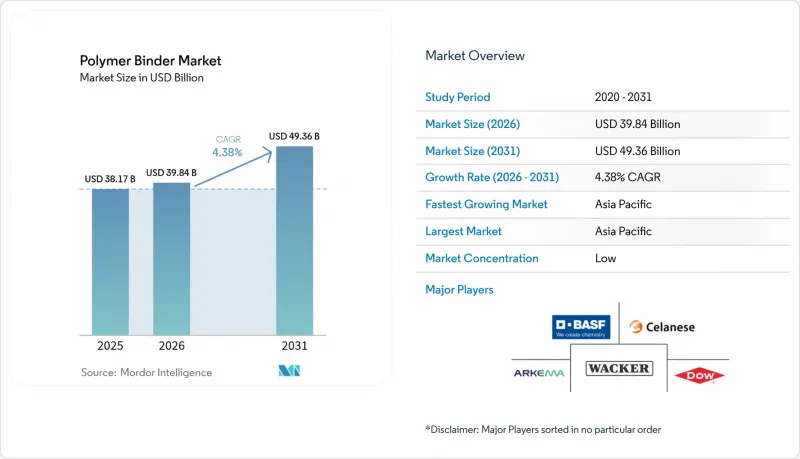
Mordor Intelligence에 의하면, 2026년 폴리머 바인더 시장 규모는 398억 4,000만 달러로 추정되고 있어 2025년 381억 7,000만 달러에서 확대해, 2031년에는 493억 6,000만 달러에 이를 것으로 예측됩니다.
2026년부터 2031년까지의 연평균 성장률(CAGR)은 4.38%가 될 것으로 전망됩니다.
본 보고서는 유형(비닐 아세테이트, 아크릴, 스티렌-아크릴, 라텍스), 형태(분말, 액체, 고형분 함량이 높은 제품),용도(코팅, 접착제, 섬유, 잉크, 금속, 기타 용도), 지역(아시아태평양, 북미, 유럽, 남미, 중동 및 아프리카)별로 분류되어 있습니다. 시장 전망은 금액(달러) 기준으로 제시되어 있습니다.
세계 폴리머 바인더 시장 동향 및 인사이트
건축 및 산업용 코팅 분야 수요 급증
도시화, 인프라 현대화, 그리고 가혹한 기후 조건 하에서의 성능에 대한 기대감 고조로 인해, 코팅제 배합 개발자들은 열대 지역의 습기나 혹독한 겨울철의 동결·해동 주기 속에서도 내구성, 오염 저항성 및 색상 유지력을 발휘하는 첨단 폴리머 바인더를 지정해야 하는 압박을 받고 있습니다. 2025년에는 새로운 건축용 도료 배합의 약 3분의 2를 수성 에멀젼이 차지하고, 이는 배출 규제의 강화와 저취 제품을 선호하는 최종 사용자의 취향을 반영한 획기적인 변화입니다. 산업 시설에서는 화학 약품에의 침지나 열충격을 견디는 바인더의 화학적 특성을 활용하여, 교량, 파이프라인, 철도 차량의 유지보수 주기를 연장하기 위해 고고형분 에폭시·아크릴 하이브리드 도료가 채택되고 있습니다. 고급 외장용 도료에는 자가 가교형 비닐 아세테이트계 시스템이 적용되어 있어, 이를 통해 공액제의 사용량을 줄이고 도막의 무결성을 해치지 않으면서 VOC 배출량을 저감하고 있습니다. 이러한 고성능화 추세는 중국, 인도, 인도네시아에서 특히 두드러지며, 이들 국가에서는 대규모 주택 건설 프로그램과 가처분 소득 증가가 맞물려 건물 외벽의 내구성에 대한 기대가 높아지고 있습니다. 다국적 도료 그룹은 공급망의 현지화를 추진하고 있으며, 신뢰성이 높은 바인더 원료에 대한 지역적 수요를 확고히 하고 있습니다.
수성·저VOC 배합으로의 급속한 전환
규제 당국은 현재 건축용 도료의 VOC 상한치를 50 g/L보다 훨씬 낮은 수준으로 하향 조정하고 있으며, 캘리포니아주와 EU의 일부 회원국에서는 기존의 용제형 시스템이 2년 이내에 틈새 제품으로 전락하게 될 것입니다. 이에 대응하여 바인더 제조업체들은 실온에서 단단하고 내화학성이 뛰어난 도막을 형성하면서도 VOC를 5 g/L보다 훨씬 낮은 수준으로 억제할 수 있는 아크릴 및 비닐아크릴 에멀젼을 개발했습니다. 예를 들어, 다우(Dow)사의 아크릴 바인더 ‘ML-520’은 오랫동안 사용되어 온 용제형 알키드 수지에 필적하는 실외 내구성을 발휘합니다. 건축가와 건강을 중시하는 주택 소유자들이 학교나 병원을 위해 무취 도료를 지정함에 따라 채택이 가속화되었고, 규제 대상 지역을 넘어 수요가 확대되는 풀 효과가 발생했습니다. 장비 공급업체들도 이에 대응하여, 스프레이 건 제조업체는 저점도 수성 도료에 최적화된 노즐을 출시하고, 오버스프레이를 줄임으로써 시공업체의 전환을 용이하게 했습니다. 수출 지향적인 도료 제조업체들이 EU의 친환경 라벨 기준을 충족하도록 배합을 조정함에 따라, 아시아 건설 시장도 빠르게 뒤따르고 있습니다. 그 결과, 수성 바인더에 대한 수요가 급증하고 수주 주기가 단축됨에 따라 일부 공급업체들은 공장을 거의 풀가동할 수밖에 없는 상황에 처해 있습니다.
제지·카펫 제조업의 구조적 쇠퇴
디지털화의 진전으로 인해 그래픽 인쇄용지 수요는 계속 줄어들고 있으며, 표면 사이징 처리에 사용되는 전분·비닐아세테이트 공중합체 바인더의 한때 안정적이었던 수요량이 점차 사라지고 있습니다. 주택 리모델링 분야의 카펫 수요도, 서로 다른 접착제 화학 성분을 사용하는 고급 비닐 타일이나 라미네이트 바닥재로 대체되고 있어, 북미 및 서유럽의 라텍스 바인더 판매에 압박을 주고 있습니다. 포장용지 및 티슈 분야는 여전히 성장하고 있지만, 이 분야에서는 더 높은 습윤 강도를 가진 첨가제나 바이오 바인더가 필요하며, 이는 서로 다른 배합 균형을 요구하기 때문에 제조업체들은 생산 라인을 재설계할 수밖에 없습니다. 인터내셔널 페이퍼(International Paper)는 DS 스미스(DS Smith)와의 합병을 발표했으며, 섬유계 포장재를 전자상거래용으로 포지셔닝함으로써 새로운 수성 바인더에 새로운 기회가 생겨나고 있습니다. 신흥 등급은 단가는 높지만 습윤 흡수율이 낮기 때문에 전체 폴리머 바인더 판매량에 미치는 순 영향은 소폭 마이너스가 될 것입니다. 2023년 이후 가동을 중단한 지역 공장의 재가동은 기대하기 어려우며, 이러한 구조적 변화가 정착되고 있습니다.
부문 분석
비닐 아세테이트는 2025년에 폴리머 바인더 시장의 37.68%를 차지하고, 2031년까지 연평균 성장률(CAGR) 5.83%를 나타낼 것으로 전망되어, 수성·저VOC 도료 및 안정적인 콜로이드 분산이 요구되는 신흥 배터리 슬러리에 대한 적응성을 입증하고 있습니다. 순 아크릴계 등 보완적인 화학계는 치킹 내성이 요구되는 고급 탑코트 배합에서 주류를 차지하고 있지만, 스티렌·아크릴계는 경제적인 실내용 도료나 특정 용지의 함침제에 사용되고 있습니다. 최근 바이오 유래 파일럿 배치 시험에서는 비닐 아세테이트에 발효 유래 아세트산을 배합해도 폴리머의 성능이 저하되지 않는 것이 입증되어, 매트릭스를 스코프 3의 탈탄소화 목표에 부합시킬 수 있게 되었습니다.
자가 가교 기술에 대한 지속적인 연구를 통해, 과거에는 순수 아크릴계 도료에서만 볼 수 있었던 특성인 실외용 도료의 블록 저항성과 초기 내수성이 향상되어, 비닐 아세테이트의 경쟁력이 더욱 높아지고 있습니다. 반응성 계면활성제를 배합함으로써 내세정성이 향상될 뿐만 아니라, 유리 계면활성제의 이동이 감소하여 실내 벽면의 오염 저항성이 향상됩니다.
지역별 분석
아시아태평양은 2025년 매출의 54.20%를 차지하며, 연평균 성장률(CAGR) 5.19%로 모든 지역을 상회하는 성장이 예상되어, 판매량 1위이자 성장의 원동력이라는 이중 역할을 확고히 하고 있습니다. 중국의 대도시권 확대와 노후된 공동주택의 개보수로 인해, 범용성이 높은 비닐아세테이트 바인더에 의존하는 외벽용 도료에 대한 막대한 수요가 유지되고 있습니다. 동시에, 중국의 배터리 제조업체들은 사상 최대 속도로 양극 활성 물질 생산 라인을 가동하고 있으며, 각사는 엄격한 불순물 허용치를 충족하는 전용 바인더 공급을 필요로 하고 있습니다.
북미에서는 규제 주도형 배합 변경으로 인해 수요가 다소 억제되고 있지만, 성숙한 시장에서의 교체 수요 주도 수요 동향이 나타나고 있습니다. 미국 주 정부 기관은 연방 기준보다 더 엄격한 VOC(휘발성 유기 화합물) 기준치를 설정하고 있으며, 캐나다 건축 기준에서는 현재 내장 탄소(embodied carbon) 목표치가 참조되고 있습니다. 유럽은 규제 면에서 선도적인 역할을 유지하고 있으며, 불소를 포함하지 않는 수성 아크릴계 및 실리콘 하이브리드계 바인더의 조기 도입을 촉구하고 있습니다. PFAS(퍼플루오로알킬 물질)에 관한 규제안이 사태에 긴박감을 더하고 있어, 배합 제조업체들은 재고 처분 및 대체 화학물질 확보에 박차를 가하고 있습니다.
기타 혜택:
- 엑셀 형식 시장 예측(ME) 시트
- 3개월간 애널리스트 지원
자주 묻는 질문
목차
제1장 서론
제2장 조사 방법
제3장 주요 요약
제4장 시장 구도
제5장 시장 규모와 성장 예측
제6장 경쟁 구도
제7장 시장 기회와 향후 전망
JHS 26.08.26According to Mordor Intelligence, polymer binder market size in 2026 is estimated at USD 39.84 billion, growing from 2025 value of USD 38.17 billion with 2031 projections showing USD 49.36 billion, growing at 4.38% CAGR over 2026-2031.
This report is Segmented by Type (Vinyl Acetate, Acrylic, Styrene-Acrylic, and Latex), Form (Powder, Liquids, and High-Solids), Application (Coatings, Adhesives, Textiles, Inks, Metals, and Other Applications), and Geography (Asia-Pacific, North America, Europe, South America, and Middle-East and Africa). The Market Forecasts are Provided in Terms of Value (USD).
Global Polymer Binder Market Trends and Insights
Surging Demand from Architectural and Industrial Coatings
Urbanization, infrastructure renewal, and higher performance expectations in harsh climates push coating formulators to specify advanced polymer binders that deliver durability, stain resistance, and color retention under tropical humidity or severe winter freeze-thaw cycles. Waterborne emulsions claimed almost two-thirds of new architectural coating formulations 2025, a milestone reflecting stricter emissions rules and end-user preferences for low-odor products. Industrial facilities are adopting high-solids epoxy-acrylic hybrids to extend maintenance intervals on bridges, pipelines, and rolling stock, drawing on binder chemistries that withstand chemical immersion and thermal shock. Premium exterior paints integrate self-crosslinking vinyl acetate systems that reduce coalescent demand, trimming VOC emissions without compromising film integrity. The upgrading trend is particularly visible in China, India, and Indonesia, where mass housing programs combine with rising disposable income to lift expectations for facade longevity. Multinational coatings groups localize supply chains, anchoring regional demand for reliable binder raw materials.
Rapid Shift Toward Waterborne Low-VOC Formulations
Regulators now push VOC limits well below 50 g/L in building coatings, turning legacy solvent-borne systems into niche products within two years in California and several EU states. Binder producers responded with acrylic and vinyl acrylic emulsions capable of forming hard, chemical-resistant films at room temperature while keeping VOC well under 5 g/L. For instance, Dow's ML-520 acrylic binder achieves exterior durability ratings comparable with long-standing solvent-borne alkyds. Architects and health-conscious homeowners accelerated adoption by specifying zero-odor paints for schools and hospitals, creating a pull effect that spreads beyond regulated regions. Equipment suppliers also adapted; spray-gun manufacturers launched tips optimized for low-viscosity water-borne paints, reducing overspray and easing the switch for contractors. Asian construction markets are following quickly as export-oriented coating companies align formulations to meet EU eco-labels. The resulting demand surge for water-compatible binders has shortened order cycles, forcing some suppliers to run plants near capacity.
Structural Decline in Paper and Carpet Manufacturing
Digitalization keeps shrinking demand for graphic printing papers, eliminating once-steady volumes for starch-vinyl acetate copolymer binders used in surface sizing. Carpet demand in residential remodeling is also waning in favor of luxury vinyl tile and laminate flooring that use different adhesive chemistries, undercutting latex binder sales in North America and Western Europe. Packaging paper and tissue segments still grow, yet they require higher wet-strength additives and bio-based binders that command different formulation balances, forcing producers to redesign lines. International Paper announced its merger with DS Smith, positions fiber-based packaging to serve e-commerce, creating pockets of opportunity for new aqueous binders. The net effect on total polymer binder volume is modestly negative because emerging grades have higher unit value but lower wet pickup rates, resulting in smaller tonnage. Regional mills idled since 2023 are unlikely to restart, cementing the structural shift.
Other drivers and restraints analyzed in the detailed report include:
- Rising Adoption of Polymer Binders in Li-Ion Battery Electrodes
- Expanding Use in Powder-Bed Additive Manufacturing Processes
- Volatility in Key Monomer Feedstock Prices
For complete list of drivers and restraints, kindly check the Table Of Contents.
Segment Analysis
Vinyl acetate held 37.68% of the polymer binder market in 2025 and is forecast to record a 5.83% CAGR through 2031, underscoring its adaptability to water-borne, low-VOC paints and to emerging battery slurries that demand stable colloidal dispersions. Complementary chemistries such as pure acrylics dominate premium topcoat formulations requiring chalking resistance, while styrene-acrylics serve economical interior paints and select paper saturations. Recent bio-attributed pilot batches demonstrate that vinyl acetate can incorporate fermentative acetic acid without altering polymer performance, aligning the matrix with Scope 3 decarbonization targets.
Continued research into self-crosslinking technology is sharpening vinyl acetate's competitive edge by boosting block resistance and early water resistance in exterior paints, features once reserved for pure acrylics. The incorporation of reactive surfactants improves scrub durability while lowering free surfactant migration, an attribute that enhances stain resistance on interior walls.
Complete Report Scope:
- By Type
- Vinyl Acetate
- Acrylic
- Styrene-Acrylic
- Latex
- By Form
- Powder
- Liquids
- High-Solids
- By Application
- Coatings
- Adhesives
- Textiles
- Inks
- Metals
- Other Applications (Additive Manufacturing Powders, Energy Storage, etc.)
- By Geography
- Asia-Pacific
- China
- Japan
- India
- South Korea
- ASEAN Countries
- Rest of Asia-Pacific
- North America
- United States
- Canada
- Mexico
- Europe
- Germany
- United Kingdom
- France
- Italy
- Spain
- Russia
- NORDIC Countries
- Rest of Europe
- South America
- Brazil
- Argentina
- Rest of South America
- Middle-East and Africa
- Saudi Arabia
- South Africa
- Rest of Middle-East and Africa
- Asia-Pacific
Geography Analysis
Asia-Pacific delivered 54.20% of 2025 revenue and is forecast to outpace all regions with a 5.19% CAGR, cementing its dual role as volume leader and growth engine. China's megacity expansions and refurbishment of older apartment blocks sustain a massive need for exterior wall coatings that rely on versatile vinyl acetate binders. At the same time, the country's battery manufacturers are commissioning cathode-active material lines at a record pace, each requiring dedicated binder supply streams with rigorous impurity thresholds.
North America exhibits mature, replacement-driven demand dynamics tempered by regulation-led formulation shifts. State agencies in the United States push VOC thresholds lower than federal baselines, while Canadian building codes now reference embodied-carbon targets. Europe upholds its role as a regulatory bellwether, compelling early adoption of fluorine-free, waterborne acrylic and silicone-hybrid binders. PFAS proposals add urgency, prompting formulators to clear inventories and secure alternative chemistries.
- AkzoNobel N.V.
- Arkema
- Ashland
- BASF
- Celanese Corporation
- Covestro AG
- DCC (Dairen Chemical Corp.)
- Dow
- Eastman Chemical Company
- Evonik Industries AG
- H.B. Fuller Co.
- Solvay
- Synthomer Plc
- The Lubrizol Corporation
- Toagosei Co., Ltd.
- Trinseo
- Wacker Chemie AG
Additional Benefits:
- The market estimate (ME) sheet in Excel format
- 3 months of analyst support
TABLE OF CONTENTS
1 Introduction
- 1.1 Study Assumptions and Market Definition
- 1.2 Scope of the Study
2 Research Methodology
3 Executive Summary
4 Market Landscape
- 4.1 Market Overview
- 4.2 Market Drivers
- 4.2.1 Surging Demand from Architectural and Industrial Coatings
- 4.2.2 Rapid Shift Toward Waterborne Low-VOC Formulations
- 4.2.3 Rising Adoption of Polymer Binders in Li-Ion Battery Electrodes
- 4.2.4 Expanding Use in Powder-Bed Additive Manufacturing Processes
- 4.2.5 Bio-Based Binder Research and Development for Circular-Economy Compliance
- 4.3 Market Restraints
- 4.3.1 Structural Decline in Paper and Carpet Manufacturing
- 4.3.2 Volatility in Key Monomer Feedstock Prices
- 4.3.3 Tightening PFAS-Related Regulations on Fluoropolymer Binders
- 4.4 Value Chain Analysis
- 4.5 Porter's Five Forces
- 4.5.1 Threat of New Entrants
- 4.5.2 Bargaining Power of Buyers
- 4.5.3 Bargaining Power of Suppliers
- 4.5.4 Threat of Substitute Products
- 4.5.5 Degree of Competition
5 Market Size and Growth Forecasts (Value)
- 5.1 By Type
- 5.1.1 Vinyl Acetate
- 5.1.2 Acrylic
- 5.1.3 Styrene-Acrylic
- 5.1.4 Latex
- 5.2 By Form
- 5.2.1 Powder
- 5.2.2 Liquids
- 5.2.3 High-Solids
- 5.3 By Application
- 5.3.1 Coatings
- 5.3.2 Adhesives
- 5.3.3 Textiles
- 5.3.4 Inks
- 5.3.5 Metals
- 5.3.6 Other Applications (Additive Manufacturing Powders, Energy Storage, etc.)
- 5.4 By Geography
- 5.4.1 Asia-Pacific
- 5.4.1.1 China
- 5.4.1.2 Japan
- 5.4.1.3 India
- 5.4.1.4 South Korea
- 5.4.1.5 ASEAN Countries
- 5.4.1.6 Rest of Asia-Pacific
- 5.4.2 North America
- 5.4.2.1 United States
- 5.4.2.2 Canada
- 5.4.2.3 Mexico
- 5.4.3 Europe
- 5.4.3.1 Germany
- 5.4.3.2 United Kingdom
- 5.4.3.3 France
- 5.4.3.4 Italy
- 5.4.3.5 Spain
- 5.4.3.6 Russia
- 5.4.3.7 NORDIC Countries
- 5.4.3.8 Rest of Europe
- 5.4.4 South America
- 5.4.4.1 Brazil
- 5.4.4.2 Argentina
- 5.4.4.3 Rest of South America
- 5.4.5 Middle-East and Africa
- 5.4.5.1 Saudi Arabia
- 5.4.5.2 South Africa
- 5.4.5.3 Rest of Middle-East and Africa
- 5.4.1 Asia-Pacific
6 Competitive Landscape
- 6.1 Market Concentration
- 6.2 Strategic Moves
- 6.3 Market Share(%)/Ranking Analysis
- 6.4 Company Profiles (includes Global level Overview, Market level overview, Core Segments, Financials as available, Strategic Information, Market Rank/Share for key companies, Products and Services, and Recent Developments)
- 6.4.1 AkzoNobel N.V.
- 6.4.2 Arkema
- 6.4.3 Ashland
- 6.4.4 BASF
- 6.4.5 Celanese Corporation
- 6.4.6 Covestro AG
- 6.4.7 DCC (Dairen Chemical Corp.)
- 6.4.8 Dow
- 6.4.9 Eastman Chemical Company
- 6.4.10 Evonik Industries AG
- 6.4.11 H.B. Fuller Co.
- 6.4.12 Solvay
- 6.4.13 Synthomer Plc
- 6.4.14 The Lubrizol Corporation
- 6.4.15 Toagosei Co., Ltd.
- 6.4.16 Trinseo
- 6.4.17 Wacker Chemie AG
7 Market Opportunities and Future Outlook
- 7.1 White-space and Unmet-Need Assessment


