

|
시장보고서
상품코드
2114963
히드라진 수화물 시장 : 시장 점유율 분석, 업계 동향 및 통계, 성장 예측(2026-2031년)Hydrazine Hydrate - Market Share Analysis, Industry Trends & Statistics, Growth Forecasts (2026 - 2031) |
||||||
 Mordor Intelligence
Mordor Intelligence에 의하면, 히드라진 수화물 시장 규모는 2025년에 223.74 킬로톤으로 평가되었고, 2026년 238.44 킬로톤에서 2031년까지 327.62 킬로톤에 이를 것으로 예측되며, 예측 기간 CAGR은 6.57%입니다(2026-2031년).
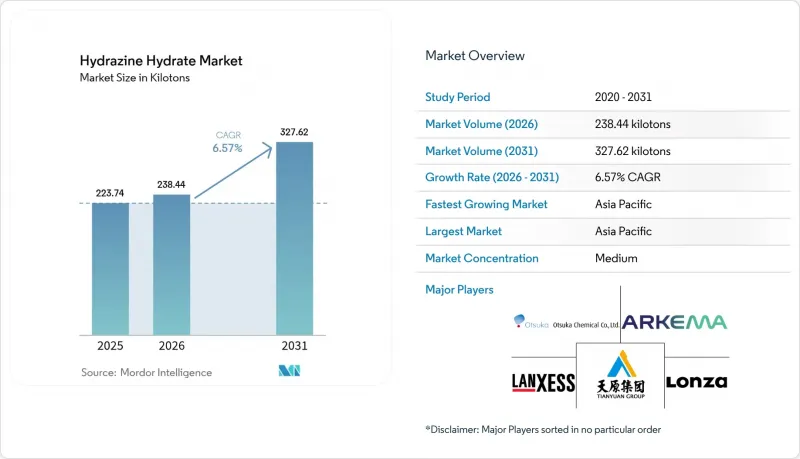
본 보고서는 제조 공정별(라시그법, 바이엘-케타진법, 요소법, H₂O₂-케타진법), 농도별(55% 미만, 55-80%, 80-100%, 100% 무수), 용도별(중합·발포제, 의약품, 농업용 화학제품, 수처리, 기타 용도), 지역별(아시아태평양, 북미, 유럽, 남미, 중동 및 아프리카)로 분류되어 있습니다.
세계의 히드라진 수화물 시장 동향 및 인사이트
중합·발포제 제조업체 수요 증가
GWP(지구 온난화 지수)가 높은 하이드로플루오로카본(HFC)에 대한 규제로 인한 단계적 폐지에 따라, 폴리머 제조업체들은 히드라진계 화학 발포제로의 전환을 불가피하게 하고 있으며, 이에 따라 히드라진 수화물 시장에는 지속적인 수요가 예상됩니다. 특히, 건축용 단열재나 자동차 경량화에 널리 사용되는 경질 및 연질 폴리우레탄 폼 분야에서 수요가 현저히 증가하고 있습니다. 히드라진은 사슬 연장제와 안정제라는 두 가지 역할을 수행함으로써 배합의 복잡성을 줄이고 셀 균일성을 향상시킵니다. 이를 통해 가공업체는 더욱 엄격해진 에너지 효율 기준을 충족할 수 있게 됩니다. 4세대 하이드로플루오로올레핀을 채택하는 발포체 제조업체는 가공 조건이 중복되기 때문에 히드라진계 시스템을 유지하는 경향이 있으며, 이를 통해 전환 비용을 절감할 수 있습니다. 바이오 폴리머에 대한 노력도 수요의 새로운 축이 되고 있습니다. 이는 제조업체들이 히드라진을 매개로 하는 반응과 호환되는 재생 가능한 원료를 검토하고 있기 때문입니다.
의약품 원료의약품(API) 생산 확대
미국과 유럽에서 추진되고 있는 국내 복귀 정책은 히드라진 수화물의 플로우 케미스트리와의 친화성을 활용한 연속 제조에 대한 투자 열풍을 일으키고 있습니다. 이 화합물은 현재 항바이러스제 및 항암제 파이프라인에 포함된 변형 뉴클레오시드 및 뉴클레오티드 합성에서 핵심적인 역할을 하고 있습니다. 중국과 인도는 다목적 API 블록의 생산 규모를 지속적으로 확대하고 있어, 아시아태평양의 히드라진 수화물 시장 우위를 더욱 공고히 하고 있습니다. 새로운 제로 백그라운드 형광 프로브를 통해 반응기 내 히드라진의 실시간 검출이 가능해져 품질 관리가 향상되고 배치 불량을 최소화할 수 있습니다. 의약품 개발의 장기적인 과정으로 인해 수요 예측 가능성이 높아져, 다른 최종 시장의 단기적인 변동으로부터 의약품 수요가 보호받고 있습니다.
엄격한 독성 및 운송 규제
EU의 REACH 규정에 따라 히드라진이 ‘극히 우려되는 물질’로 지정됨에 따라, 제조업체와 사용자는 막대한 비용이 드는 승인 신청 서류 작성을 강요받고 있으며, 이에 따라 더 안전한 유사 화합물의 연구 개발이 촉진되고 있습니다. 운송 측면도 마찬가지로 복잡합니다. 유엔 모델 규정에서는 히드라진이 제8류 부식성 물질과 제3류 인화성 액체로 분류되어 있으며, 단열성이 있고 내압 기준을 충족하는 용기의 사용 및 인증을 받은 취급자의 배치가 의무화되어 있습니다. 미국은 2024년에 국내 규정을 최신 국제 기준에 부합하도록 개정함에 따라, 공급망 전반에 걸쳐 라벨 재표기 및 추가 교육이 필요하게 되었습니다. 항공우주 산업의 주요 기업들은 사용 면제 연장을 요구하며 로비 활동을 펼치고 있지만, EU로부터 140만 유로의 자금을 지원받은 대체 추진제 프로그램은 장기적으로 히드라진을 단계적으로 감축하겠다는 정치적 의향을 보이고 있습니다.
부문 분석
바이엘 케타딘 공법은 오랜 기간 구축된 세계 생산 능력 네트워크와 확고한 촉매 노하우를 바탕으로 2025년에도 히드라진 수화물 시장에서 45.23%라는 압도적인 점유율을 유지했습니다. H2O2-케타진 공법은 비교적 새로운 기술이지만, 에너지 소비 밀도가 낮고 폐기물 처리가 간소화된 점을 바탕으로 연평균 성장률(CAGR) 7.29%라는 빠른 속도로 생산 설비를 증설하고 있습니다.
플랜트의 병목 현상 해소 전략으로는 현재 막을 이용한 케타딘 정제 기술이 도입되고 있습니다. 이를 통해 용매를 회수하고, 부지 면적을 대폭 확대하지 않고도 플랜트 전체의 생산 능력을 향상시킬 수 있습니다. 라이선싱 기업들은 디지털 트윈을 공정 패키지에 통합하여 실시간 에너지 최적화 및 예측 유지보수를 가능하게 하고 있습니다. 티타늄 반응기를 공급하는 각 OEM 업체들은 아시아태평양 고객들이 현지 조달 규제에 대응하고 수입 리스크를 회피하기 위해 서두르는 가운데, 수주 잔고가 증가하고 있다고 보고하고 있습니다. 이러한 동향에 따라 히드라진 수화물 시장은 에너지 효율이 높은 플로우시트가 높이 평가되는 혁신의 궤도를 유지하고 있습니다.
지역별 분석
2025년, 아시아태평양은 전 세계 소비량의 52.70%를 차지했으며, 이는 업스트림의 과산화수소부터 하류의 폴리머 폼 가공업체에 이르기까지 깊은 수직 통합을 반영하고 있습니다. 중국은 전 세계 설비 용량의 상당 부분을 차지하고 있으며, H2O2-케타딘 생산 라인을 지속적으로 증설하고 있지만, 최근의 원료 공급 중단은 구매자들에게 공급망의 잠재적 취약성을 재인식하게 하는 결과를 낳았습니다. 인도의 API(의약품 원료) 생산 연계형 인센티브는 브라운필드 확장을 촉진하고 있으며, 이로 인해 2030년까지 국내 수요가 30킬로톤 증가할 가능성이 있습니다. 일본은 히드라진 처리 시스템용 독자적인 야금 기술을 활용하여, 연료전지 및 반도체 용도의 고순도 등급 분야에서 틈새 시장의 리더십을 유지하고 있습니다.
북미에서는 방위용 추진제 수주, 국내 API 생산의 국내 회귀, 초기 단계에 있는 고정형 연료전지 도입에 힘입어 현저한 성장이 나타나고 있습니다. 마이크로그리드의 복원력(내장애성) 향상을 위한 연방 정부의 보조금에는 히드라진 기술의 직접적인 실증 시험장에 대한 자금 배분이 포함되어 있으며, 비용 목표가 달성되면 수요가 더욱 확대될 가능성이 있습니다. 캐나다 온타리오주와 퀘벡주에 위치한 특수 화학 물질 허브는 장기 계약을 바탕으로 히드라진 수화물을 조달하고 있으며, 2024년에 강화된 국경 간 운송 제한에 대한 리스크 헤지를 도모하고 있습니다.
유럽의 상황은 복잡합니다. REACH 승인에 드는 비용과 SVHC(고위험 물질) 지정에 따라 규정 준수 장벽이 높아져 일부 하류 사용자는 대체 화학 물질로 전환할 수밖에 없지만, 항공우주 및 첨단 소재 기업들은 공급 중단을 방지하기 위해 적용 제외 조치를 확보하고 있습니다. 유럽의 생산자들은 원료의 탈탄소화를 도모하기 위해 그린 수소와 연계된 과산화수소 전해 장치에 투자하고 있으며, 스코프 3 보고가 의무화되면 프리미엄 가격으로 판매할 것을 기대하고 있습니다. 이러한 동향들이 맞물리면서, 히드라진 수화물 시장은 확고한 세계 시장으로서의 지위를 유지하면서도, 무역 흐름의 구조적 결정 요인으로서 지역별 규제 차이가 부각되고 있습니다.
기타 혜택
- 엑셀 형식 시장 예측(ME) 시트
- 3개월간의 애널리스트 지원
자주 묻는 질문
목차
제1장 서론
제2장 조사 방법
제3장 주요 요약
제4장 시장 구도
제5장 시장 규모 및 성장 예측
제6장 경쟁 구도
제7장 시장 기회 및 향후 전망
AJY 26.08.28According to Mordor Intelligence, the hydrazine hydrate market size was valued at 223.74 kilotons in 2025 and estimated to grow from 238.44 kilotons in 2026 to reach 327.62 kilotons by 2031, at a CAGR of 6.57% during the forecast period (2026-2031).
This report is Segmented by Production Process (Raschig Process, Bayer Ketazine Process, Urea Process, H2o2-ketazine Process), Concentration (Less Than 55%, 55-80%, 80-100%, 100% Anhydrous), Application (Polymerization and Blowing Agents, Pharmaceuticals, Agrochemicals, Water Treatment, Other Applications), and Geography (Asia-Pacific, North America, Europe, South America, Middle East and Africa).
Global Hydrazine Hydrate Market Trends and Insights
Growing Demand from Polymerization and Blowing-Agent Manufacturers
Regulatory phase-outs of high-GWP hydrofluorocarbons have pushed polymer producers toward hydrazine-based chemical blowing agents, giving the hydrazine hydrate market sustained volume visibility. Demand is most vivid in rigid and flexible polyurethane foams used across building insulation and automotive lightweighting. Hydrazine's dual role as chain extender and stabilizer trims formulation complexity and improves cell uniformity, which helps converters meet tighter energy-efficiency codes. Foam makers adopting fourth-generation hydrofluoroolefins tend to retain hydrazine systems because processing windows overlap, curbing changeover costs. Bio-based polymer initiatives add another leg of demand as producers test renewable feedstocks compatible with hydrazine-mediated reactions.
Expanding Pharmaceutical API Production
National reshoring policies championed in the United States and Europe have triggered a wave of continuous-manufacturing investments that favor hydrazine hydrate's flow-chemistry compatibility. The compound is central to synthesizing modified nucleosides and nucleotides now embedded in antiviral and oncology pipelines. China and India continue to scale multipurpose API blocks, reinforcing Asia-Pacific's lead in the hydrazine hydrate market. Novel zero-background fluorescence probes allow real-time hydrazine detection inside reactors, sharpening quality control and minimizing batch failures. Long drug-development timelines anchor predictable offtake, insulating pharmaceutical demand from short-cycle swings in other end markets.
Stringent Toxicity and Transport Regulations
Hydrazine's listing as a substance of very high concern under EU REACH forces producers and users into costly authorization dossiers and drives R&D into safer analogues. Shipping is equally complex: United Nations Model Regulations classify hydrazine as a Class 8 corrosive and Class 3 flammable liquid, obliging insulated, pressure-rated containers and certified handlers. The United States harmonized domestic rules with updated international standards in 2024, prompting relabeling and extra training across the supply chain. Aerospace primes lobby for extended use exemptions, but alternative propellant programs backed by EUR 1.4 million in EU funding signal political intent to phase down hydrazine over the long run.
Other drivers and restraints analyzed in the detailed report include:
- Stricter Global Effluent Norms Boosting Water-Treatment Usage
- Adoption of Hydrazine-Based Corrosion Inhibitors in Stationary Fuel Cells
- High Insurance and Handling Costs Due to Explosion Risk
For complete list of drivers and restraints, kindly check the Table Of Contents.
Segment Analysis
The Bayer Ketazine Process retained a commanding 45.23% hydrazine hydrate market share in 2025 because of long-established global capacity networks and robust catalyst know-how. H2O2-ketazine lines, while newer, are adding units at a brisk 7.29% CAGR, underpinned by lower energy intensity and simplified waste treatment.
Plant debottlenecking strategies now involve membrane-based ketazine purification that recovers solvent and drives overall plant capacity without major plot-space additions. Licensing houses bundle digital twins with process packages, allowing real-time energy optimization and predictive maintenance. OEMs supplying titanium reactors report rising backlogs as Asia-Pacific customers race to meet local content rules and avoid import exposure. These dynamics keep the hydrazine hydrate market on an innovation trajectory that rewards energy-efficient flowsheets.
Complete Report Scope:
- By Production Process
- Raschig Process
- Bayer Ketazine Process
- Urea Process
- H2O2-Ketazine Process
- By Concentration
- Less than 55%
- 55-80%
- 80-100%
- 100% (Anhydrous)
- By Application
- Polymerization and Blowing Agents
- Pharmaceuticals
- Agrochemicals
- Water Treatment
- Other Applications (Rocket Propellants and Energy, etc.)
- By Geography
- Asia-Pacific
- China
- Japan
- India
- South Korea
- ASEAN Countries
- Rest of Asia-Pacific
- North America
- United States
- Canada
- Mexico
- Europe
- Germany
- United Kingdom
- France
- Italy
- Spain
- Russia
- NORDIC Countries
- Rest of Europe
- South America
- Brazil
- Argentina
- Rest of South America
- Middle East and Africa
- Saudi Arabia
- South Africa
- Rest of Middle East and Africa
- Asia-Pacific
Geography Analysis
Asia-Pacific anchored 52.70% of global consumption in 2025, reflecting deep vertical integration from upstream hydrogen peroxide to downstream polymer foam converters. China holds a significant share of the world's installed capacity and continues to add H2O2-ketazine lines, although recent feedstock outages reminded buyers of latent supply-chain fragility. India's production-linked incentives for APIs are catalyzing brownfield expansions that could lift national demand by 30 kilo tons before 2030. Japan maintains a niche leadership in high-purity grades for fuel-cell and semiconductor use, leveraging proprietary metallurgy for hydrazine handling systems.
North America demonstrates significant growth, driven by defense-grade propellant offtake, domestic API reshoring, and early-stage stationary fuel-cell rollouts. Federal grants for microgrid resilience include funding carve-outs for direct hydrazine technology testbeds, potentially deepening demand if cost targets are met. Canada's specialty chemical hubs in Ontario and Quebec source hydrazine hydrate under long-term contracts, insuring against cross-border transport constraints tightened in 2024.
Europe represents a mixed picture: REACH authorization costs and SVHC status raise compliance barriers, nudging some downstream users toward alternative chemistries, yet aerospace and advanced materials firms secure exemptions to prevent supply disruptions. Continental producers invest in green-hydrogen-linked hydrogen peroxide electrolyzers to decarbonize feedstocks, positioning for premium pricing once scope-3 reporting becomes mandatory. Together, these dynamics keep the hydrazine hydrate market firmly global while spotlighting regional regulatory divergence as a structural determinant of trade flows.
- Arkema
- Capot Chemical Co.,Ltd.
- Chemtex Speciality Limited
- Gujarat Alkalies and Chemicals Limited
- Haihang Industry
- Hangzhou Dayangchem Co. Ltd
- HPL Additives Limited.
- Hunan Zhuzhou Chemical Industry Group
- IRO Water Treatment Co., Ltd.
- LANXESS
- Lonza
- Matrix Fine Chemicals GmbH
- NIPPON CARBIDE INDUSTRIES CO., INC.
- Otsuka Chemical Co.,Ltd.
- Shandong ThFine Chemical Co., Ltd
- Thermo Fisher Scientific Inc.
- Vizag Chemicals
- Weifang Yaxing Chemical Co., Ltd.
- Yibin Tianyuan Group
Additional Benefits:
- The market estimate (ME) sheet in Excel format
- 3 months of analyst support
TABLE OF CONTENTS
1 Introduction
- 1.1 Study Assumptions and Market Definition
- 1.2 Scope of the Study
2 Research Methodology
3 Executive Summary
4 Market Landscape
- 4.1 Market Overview
- 4.2 Market Drivers
- 4.2.1 Growing demand from polymerization and blowing-agent manufacturers
- 4.2.2 Expanding pharmaceutical API production
- 4.2.3 Stricter global effluent norms boosting water-treatment usage
- 4.2.4 Adoption of hydrazine-based corrosion inhibitors in stationary fuel cells
- 4.2.5 Process innovations lowering energy cost of H2O2-ketazine route
- 4.3 Market Restraints
- 4.3.1 Stringent toxicity and transport regulations
- 4.3.2 High insurance / handling costs due to explosion risk
- 4.3.3 Feed-stock shortages of high-grade H2O2 in Asia
- 4.4 Value Chain Analysis
- 4.5 Porter's Five Forces
- 4.5.1 Bargaining Power of Suppliers
- 4.5.1.1 Bargaining Power of Buyers
- 4.5.1.2 Threat of New Entrants
- 4.5.1.3 Threat of Substitutes
- 4.5.1.4 Competitive Rivalry
- 4.5.1 Bargaining Power of Suppliers
5 Market Size and Growth Forecasts (Volume)
- 5.1 By Production Process
- 5.1.1 Raschig Process
- 5.1.2 Bayer Ketazine Process
- 5.1.3 Urea Process
- 5.1.4 H2O2-Ketazine Process
- 5.2 By Concentration
- 5.2.1 Less than 55%
- 5.2.2 55-80%
- 5.2.3 80-100%
- 5.2.4 100% (Anhydrous)
- 5.3 By Application
- 5.3.1 Polymerization and Blowing Agents
- 5.3.2 Pharmaceuticals
- 5.3.3 Agrochemicals
- 5.3.4 Water Treatment
- 5.3.5 Other Applications (Rocket Propellants and Energy, etc.)
- 5.4 By Geography
- 5.4.1 Asia-Pacific
- 5.4.1.1 China
- 5.4.1.2 Japan
- 5.4.1.3 India
- 5.4.1.4 South Korea
- 5.4.1.5 ASEAN Countries
- 5.4.1.6 Rest of Asia-Pacific
- 5.4.2 North America
- 5.4.2.1 United States
- 5.4.2.2 Canada
- 5.4.2.3 Mexico
- 5.4.3 Europe
- 5.4.3.1 Germany
- 5.4.3.2 United Kingdom
- 5.4.3.3 France
- 5.4.3.4 Italy
- 5.4.3.5 Spain
- 5.4.3.6 Russia
- 5.4.3.7 NORDIC Countries
- 5.4.3.8 Rest of Europe
- 5.4.4 South America
- 5.4.4.1 Brazil
- 5.4.4.2 Argentina
- 5.4.4.3 Rest of South America
- 5.4.5 Middle East and Africa
- 5.4.5.1 Saudi Arabia
- 5.4.5.2 South Africa
- 5.4.5.3 Rest of Middle East and Africa
- 5.4.1 Asia-Pacific
6 Competitive Landscape
- 6.1 Market Concentration
- 6.2 Strategic Moves
- 6.3 Market Share(%)/Ranking Analysis
- 6.4 Company Profiles (includes Global level Overview, Market level overview, Core Segments, Financials as available, Strategic Information, Market Rank/Share, Products & Services, Recent Developments)
- 6.4.1 Arkema
- 6.4.2 Capot Chemical Co.,Ltd.
- 6.4.3 Chemtex Speciality Limited
- 6.4.4 Gujarat Alkalies and Chemicals Limited
- 6.4.5 Haihang Industry
- 6.4.6 Hangzhou Dayangchem Co. Ltd
- 6.4.7 HPL Additives Limited.
- 6.4.8 Hunan Zhuzhou Chemical Industry Group
- 6.4.9 IRO Water Treatment Co., Ltd.
- 6.4.10 LANXESS
- 6.4.11 Lonza
- 6.4.12 Matrix Fine Chemicals GmbH
- 6.4.13 NIPPON CARBIDE INDUSTRIES CO., INC.
- 6.4.14 Otsuka Chemical Co.,Ltd.
- 6.4.15 Shandong ThFine Chemical Co., Ltd
- 6.4.16 Thermo Fisher Scientific Inc.
- 6.4.17 Vizag Chemicals
- 6.4.18 Weifang Yaxing Chemical Co., Ltd.
- 6.4.19 Yibin Tianyuan Group
7 Market Opportunities and Future Outlook
- 7.1 White-space and Unmet-need Assessment
- 7.2 Technology shift to low-carbon H2 route


