

|
시장보고서
상품코드
2114970
디지털 잉크 시장 : 점유율 분석, 업계 동향과 통계, 성장 예측(2026-2031년)Digital Inks - Market Share Analysis, Industry Trends & Statistics, Growth Forecasts (2026 - 2031) |
||||||
 Mordor Intelligence
Mordor Intelligence에 의하면, 2026년 디지털 잉크 시장 규모는 49억 달러로 추정되고 있어 2025년 46억 2,000만 달러에서 확대해, 2031년에는 66억 달러에 이를 것으로 예측됩니다.
2026년부터 2031년까지 연평균 성장률(CAGR) 6.13%로 성장할 것으로 전망됩니다.
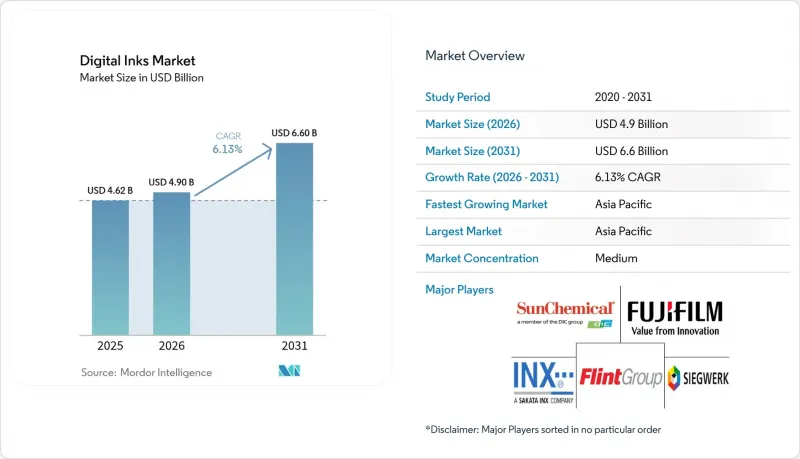
본 보고서는 잉크 유형(용제형, 수성형 등), 인쇄 기술(드롭 온 디맨드 잉크젯, 연속 잉크젯 등), 용도(포장, 자동차 및 기술 마킹 등), 지역(아시아태평양, 북미, 유럽, 남미, 중동 및 아프리카)별로 분류되어 있습니다. 시장 전망은 금액(달러) 기준으로 제시되어 있습니다.
세계 디지털 잉크 시장 동향 및 인사이트
포장 및 간판 분야의 UV 경화형 잉크 수요 급증
자외선 조사를 통한 순간적인 중합으로 건조에 따른 병목 현상이 해소되어, 용제형 시스템에 비해 처리량 향상과 에너지 절약이 가능합니다. VOC(휘발성 유기 화합물) 배출이 최소화되므로 UV 경화형 잉크는 규제 준수를 위한 효과적인 수단이 되고 있으며, 듀폰(DuPont) 등의 제조업체는 색 농도를 저해하지 않으면서 식품 접촉 기준을 충족하는 수성 안료 시리즈를 상품화하고 있습니다. 포장 가공 업체들은 배리어 성능을 유지하면서 유리, 금속, 다층 폴리머 필름에 장식을 할 수 있는 점을 높이 평가하고 있는 반면, 옥외 간판 설치 업체들은 잉크의 뛰어난 내후성과 색상 유지력을 중시하고 있습니다. 유지보수 비용 절감과 인쇄기의 열 부하를 경감시키는 중파장 LED 경화 모듈의 보급 확대도 도입 가속화를 더욱 뒷받침하고 있습니다. 이러한 장점들이 어우러져 UV 경화형 시스템은 선진국 및 신흥국의 인쇄 거점 모두에서 착실하게 보급이 진행되고 있습니다.
섬유 디지털화에서 잉크젯 인쇄의 급속한 보급
디지털 잉크젯 기술은 물을 대량으로 소비하는 염색 라인을 대체하여, 정밀한 잉크 분사를 통해 특정 면 및 폴리에스테르 소재에서 물 사용량을 최대 95%까지 절감합니다. 교세라와 엡손 등의 장비 제조업체는 폭 2m의 웹을 처리할 수 있는 프린트 바를 개발하여, 산업 수준의 속도로 롤 투 롤 원단 인쇄를 가능하게 했습니다. 엡손의 아키타 및 도호쿠 신공장을 포함한 생산 능력 확대는 패션 분야의 대량 맞춤화와 관련된 장기적인 수요에 대한 확신을 보여줍니다. RIP 소프트웨어에 통합된 인공지능을 통해 워크플로우 설정이 신속하게 이루어지고, 알고리즘을 통한 패턴 생성이 가능해져 디자인에서 샘플 제작까지의 주기가 단축됩니다. 구매자는 최소 주문 수량 인하 및 일련번호를 통한 의류 식별과 같은 이점을 얻을 수 있으며, 이러한 요소들은 온쇼어 또는 니어쇼어 마이크로 팩토리로의 조달 전환을 촉진하는 요인이 되고 있습니다.
안료 및 원자재 가격 변동
이산화티타늄과 특수 유기 안료는 잉크 제조 비용에서 큰 비중을 차지하고 있으며, 중국 및 멕시코산 수입품에 대한 관세로 인한 가격 변동이 밸류체인 전체의 이익률을 압박하고 있습니다. 특수 화학제품 공급업체들은 지정학적 혼란에 직면해 있으며, 이로 인해 납기 불안정 및 헤지 어려움이라는 파급 효과가 발생하고 있어, 잉크 배합 업체들은 이중 조달 및 지수 연동형 계약 도입을 검토할 수밖에 없는 상황입니다. 인쇄 서비스 제공업체(PSP)는 이익률을 지키기 위해 원가 전가를 하거나 발색이 옅은 디자인을 채택하고 있지만, 가격에 민감한 광고 및 섬유 분야에서는 이러한 대책에 저항이 발생하고 있습니다. 기업들이 불확실성에 대비해 안전 재고를 확보함에 따라 운전자본 집약도가 높아지고 있어, 시장에 신규 진입하려는 업체들에게는 진입 장벽이 높아지고 있습니다.
부문 분석
2025년 매출에서 용제형 잉크가 차지하는 비중은 35.55%였으나, UV 경화형 잉크와 연계된 디지털 잉크 시장 규모는 2031년까지 연평균 성장률(CAGR) 6.86%로 확대될 것으로 예측됩니다. 이 잉크의 성능상의 장점으로는 인쇄기 위에서 수 초 단위로 경화되는 점과 VOC 함량이 극히 적다는 점을 들 수 있으며, 이는 포장 가공업체가 추구하는 워크플로우 효율화 및 식품 안전성 확보라는 요구와 부합합니다. 수성 안료 잉크는 라벨 및 플렉서블 파우치 분야에서 보급이 가속화되고 있습니다. 이는 저취성이라는 특성 덕분에 배기 설비를 업그레이드하지 않고도 인원이 많은 생산 현장 내에서도 인쇄기를 가동할 수 있기 때문입니다. 틈새 시장인 유성 잉크 시스템은 높은 성막 온도나 윤활 기능이 필요한 열가소성 기재에서 여전히 중요하지만, 판매량 전망은 제한적입니다.
전도성 잉크 및 기타 기능성 잉크 분야에서도 새로운 기회가 확대되고 있으며, 그래핀을 풍부하게 함유한 배합을 통해 7.3×10? S/m에 가까운 전도성을 달성하면서도 800%의 신축성을 유지할 수 있어, 의료용 패치나 구부릴 수 있는 회로 등에 적합합니다. 광물유의 단계적 폐지를 규정한 유럽 지침에 따라, 보다 친환경적인 대체재의 도입이 전략적으로 시급한 과제가 되고 있으며, 공급업체들은 건조 속도와 선명한 발색을 유지할 수 있는 바이오 유래 희석제의 시험을 진행하고 있습니다. 규제 준수 기한이 다가오는 가운데, 용제형 잉크는 시장 점유율 축소 위험에 직면한 반면, UV 경화형 및 수성 잉크는 디지털 잉크 시장에서 주류로 자리 잡고 있습니다.
지역별 분석
아시아태평양은 2025년에 디지털 잉크 시장의 48.10%를 차지하고, 2031년까지 연평균 성장률(CAGR) 6.95%로 확대될 것으로 전망됩니다. 중국은 골판지 및 전자기기 생산 확대에 힘입어 지역 성장을 주도하고 있는 반면, 일본은 고정밀 부품과 섬유 및 산업용 프린터 설치 대수 증가에 기여하고 있습니다. 인도에서는 생산 능력에 대한 투자가 가속화되고 있으며, 그 일례로 구자라트 주에 건설된 DIC 인도의 11억 루피 규모 시설에서는 톨루엔이 함유되지 않은 액체 잉크가 생산되고 있습니다. 한국과 대만은 전자기기 제조 노하우를 활용하여 디스플레이 및 센서 용도에서 전도성 잉크의 채택 확대를 도모하고 있습니다. 베트남 등 아세안(ASEAN) 국가들은 의류 수출 붐의 혜택을 받고 있으며, 이는 저수량 섬유 인쇄에 대한 수요를 촉진하고 있습니다.
북미는 계속해서 혁신의 거점이며, 규제 측면에서의 주도적인 역할이 UV 경화형 및 에코솔벤트형 잉크의 급속한 보급을 뒷받침하고 있습니다. 미국의 활기찬 전자상거래 분야는 온디맨드 포장 시장의 성장을 자극하고, 옴니채널 풀필먼트 센터 주변에서의 인쇄기 도입을 촉진하고 있습니다. 캐나다와 멕시코는 수지 및 안료를 공급하고 있으나, 관세로 인한 비용 변동에 직면해 있으며, 이에 대응하기 위해 대체 조달 및 현지 블렌딩 전략이 마련되고 있습니다. INX International사의 연간 매출액 16억 달러는 디지털 잉크 시장에서 해당 지역의 산업 규모와 연구 개발에 대한 노력을 여실히 보여주고 있습니다.
유럽은 재활용 가능한 소재와 저독성 배합을 의무화하는 순환형 경제 정책을 조기에 도입함으로써 세계적 기준을 형성하고 있습니다. 독일의 엔지니어링 전통이 설비 발전을 뒷받침하는 한편, 프랑스는 정책 수단을 활용하여 식품 포장 분야에서 광물유계 잉크의 퇴출을 추진하고 있습니다. 북유럽 국가들의 혁신은 리그닌이나 톨유에서 유래한 생분해성 바인더에 초점을 맞추고 있어, 임업이 활발한 경제 구조와 조화를 이루고 있습니다. 이탈리아는 패션 인쇄 분야에서의 리더십을 강화하고 있으며, 영국은 라벨 및 특수 그래픽스 분야에서의 강점을 유지하고 있습니다. 러시아는 무역상의 제약에 직면해 있지만, 산업용 마킹 잉크에 대한 국내 수요는 지속되고 있으며, 동유럽은 니어쇼어 생산 거점으로 성장하고 있습니다. 남미, 중동 및 아프리카는 시장 규모는 작지만, 인프라 현대화가 진행되고 있으며, 외국인 직접 투자가 연포장 및 섬유 인쇄 클러스터에 자금을 지원하고 있는 지역에서는 두 자릿수의 현지 성장률을 보이고 있습니다.
기타 혜택:
- 엑셀 형식 시장 예측(ME) 시트
- 3개월간의 애널리스트 지원
자주 묻는 질문
목차
제1장 서론
제2장 조사 방법
제3장 주요 요약
제4장 시장 구도
제5장 시장 규모와 성장 예측
제6장 경쟁 구도
제7장 시장 기회와 향후 전망
JHS 26.08.26According to Mordor Intelligence, digital inks market size in 2026 is estimated at USD 4.9 billion, growing from 2025 value of USD 4.62 billion with 2031 projections showing USD 6.6 billion, growing at 6.13% CAGR over 2026-2031.
This report is Segmented by Ink Type (Solvent-Based, Water-Based, and More), Printing Technology (Drop-On-Demand Inkjet, Continuous Inkjet, and More), Application (Packaging, Automotive and Technical Markings, and More), and Geography (Asia-Pacific, North America, Europe, South America, and Middle East and Africa). The Market Forecasts are Provided in Terms of Value (USD).
Global Digital Inks Market Trends and Insights
Surge in Demand for UV-Curable Inks in Packaging and Signage
Instant polymerization under ultraviolet light eliminates drying bottlenecks, enabling higher throughput and energy savings compared with solvent systems. Minimal VOC emissions make UV-curable inks an effective route to regulatory compliance, and producers such as DuPont have commercialized water-based pigment series that meet food-contact norms without sacrificing color density. Packaging converters value the ability to decorate glass, metal, and multilayer polymer films while maintaining barrier integrity, whereas outdoor signage installers rely on the inks' superior weather fastness and color retention. Accelerated adoption is further supported by lower maintenance costs and the growing availability of mid-radiant LED curing modules that reduce press heat loads. These combined benefits place UV-curable systems on a steady adoption path across both developed and emerging printing hubs.
Rapid Adoption of Inkjet Printing for Textile Digitalization
Digital inkjet technology replaces water-intensive dyeing lines with precision deposition that cuts water use by up to 95% on certain cotton and polyester substrates. Equipment makers such as Kyocera and Epson have scaled print bars capable of 2 m web widths, allowing roll-to-roll fabric printing at industrial speeds. Capacity expansions, including Epson's new Akita and Tohoku facilities, signal confidence in long-run demand linked to fashion mass customization. Artificial intelligence embedded in RIP software accelerates workflow setup and enables algorithmic pattern generation, trimming design-to-sample cycles. Buyers gain smaller minimum-order quantities and serialized garment identification, benefits that reinforce sourcing shifts toward on-shore or near-shore micro-factories.
Volatility in Pigment and Raw-Material Prices
Titanium dioxide and specialty organic pigments account for a high proportion of ink-making costs, and price swings driven by tariffs on Chinese and Mexican imports compress profit margins throughout the value chain. Specialty chemicals suppliers face geopolitical disruptions that ripple into inconsistent lead times and hedging difficulties, compelling ink formulators to consider dual-sourcing and index-linked contracts. Print service providers (PSPs) add cost surcharges or adopt lighter coverage designs to protect margins, though these tactics face resistance in price-sensitive advertising and textile segments. Working-capital intensity rises as firms hold safety stock to buffer uncertainty, raising barriers for smaller market entrants.
Other drivers and restraints analyzed in the detailed report include:
- Rising Uptake of Eco-Solvent Inks on Sustainability Grounds
- Emergence of Conductive Nano-Inks for Flexible Electronics
- Stringent Global VOC-Emission Regulations on Solvent Inks
For complete list of drivers and restraints, kindly check the Table Of Contents.
Segment Analysis
Solvent-based inks commanded 35.55% of 2025 revenue, yet the digital inks market size attached to UV-curable grades is forecast to outpace at a 6.86% CAGR through 2031. Performance advantages include on-press curing within seconds and negligible VOC content, which align with packaging converters' push for leaner workflows and food-safety assurance. Water-based pigments accelerate in label and flexible-pouch formats as low-odor characteristics allow presses to run inside populated production halls without extraction upgrades. Niche oil-based systems remain relevant for thermoplastic substrates that demand elevated film-forming temperatures and lubricant functionality, though volume prospects stay limited.
A separate opportunity unfolds in conductive and other functional inks, where graphene-rich formulations achieve conductivities approaching 7.3 X 10⁵ S/m while retaining 800% stretchability, making them attractive for medical patches and bendable circuitry. European directives phasing out mineral oils amplify strategic urgency for greener alternatives, prompting suppliers to test bio-sourced diluents that match drying speeds and color vibrancy. As compliance deadlines tighten, solvent lines risk market share attrition, whereas UV-curable and water-based chemistries advance toward mainstream status inside the digital inks market.
Complete Report Scope:
- By Ink Type
- Solvent-based Inks
- Water-based Inks
- UV-Curable Inks
- Oil-based Inks
- Other Types (Conductive and Functional Inks, etc.)
- By Printing Technology
- Drop-on-Demand Inkjet
- Continuous Inkjet (CIJ)
- UV Inkjet
- Digital Screen Printing
- Other Technologies (Hybride inkjets, etc.)
- By Application
- Packaging
- Automotive and Technical Markings
- Construction
- Promotional Materials
- Textiles
- Other Applications (Commercial and Industrial Signage/Displays, etc.)
- By Geography
- Asia-Pacific
- China
- Japan
- India
- South Korea
- ASEAN Countries
- Rest of Asia-Pacific
- North America
- United States
- Canada
- Mexico
- Europe
- Germany
- United Kingdom
- France
- Italy
- Spain
- Russia
- NORDIC Countries
- Rest of Europe
- South America
- Brazil
- Argentina
- Rest of South America
- Middle East and Africa
- Saudi Arabia
- South Africa
- Rest of Middle East and Africa
- Asia-Pacific
Geography Analysis
Asia-Pacific controlled 48.10% of the digital inks market in 2025 and is projected to advance at 6.95% CAGR through 2031. China anchors regional momentum with expansive corrugated and electronics production, while Japan delivers high-precision components and growing installation bases for textile and industrial printers. India accelerates capacity investments, illustrated by DIC India's INR 1.1 billion facility in Gujarat producing toluene-free liquid inks . South Korea and Taiwan leverage electronics manufacturing know-how to expand conductive ink adoption in display and sensor applications. ASEAN economies such as Vietnam benefit from garment export booms that trigger demand for low-water textile printing.
North America remains an innovation hub where regulatory leadership nudges rapid uptake of UV-curable and eco-solvent chemistries. The United States' vibrant e-commerce sector stimulates on-demand packaging growth, fostering press installations around omnichannel fulfillment centers. Canada and Mexico supply resins and pigments but face tariff-driven cost variability, prompting contingency sourcing and localized blending strategies. INX International's USD 1.6 billion annual sales underscore the region's industrial depth and R&D commitment in the digital inks market
Europe shapes global standards through early adoption of circular-economy policies that mandate recyclable materials and low-toxicity formulas. Germany's engineering heritage underpins equipment advances, while France channels policy instruments to eliminate mineral-oil-based inks in food packaging. Nordic innovation focuses on biodegradable binders derived from lignin and tall oil, aligning with forestry-rich economies. Italy reinforces leadership in fashion print applications, and the United Kingdom sustains strength in label and specialty graphics. Although Russia faces trade constraints, domestic demand persists for industrial marking inks, while Eastern Europe grows as a near-shore production base. South America and Middle East and Africa, though smaller by value, reveal double-digit local growth where infrastructure modernizes and foreign direct investment funds flexible packaging and textile print clusters.
- Artience Co., Ltd.
- ATLANTA
- Brother Industries, Ltd.
- Canon Inc.
- DIC Corporation
- DuPont
- Epson India Pvt Ltd.
- Flint Group
- FUJIFILM Speciality Ink Systems Limited
- HP Development Company, L.P
- INX International Ink Co.
- Kornit Digital
- Marabu GmbH & Co. KG
- MIMAKI ENGINEERING CO., LTD.
- Nazdar
- Ricoh UK Products Limited.
- Siegwerk Druckfarben AG & Co. KGaA
- Wikoff Color Corporation
Additional Benefits:
- The market estimate (ME) sheet in Excel format
- 3 months of analyst support
TABLE OF CONTENTS
1 Introduction
- 1.1 Study Assumptions and Market Definition
- 1.2 Scope of the Study
2 Research Methodology
3 Executive Summary
4 Market Landscape
- 4.1 Market Overview
- 4.2 Market Drivers
- 4.2.1 Surge in Demand for UV-Curable Inks in Packaging and Signage
- 4.2.2 Rapid Adoption of Inkjet Printing for Textile Digitalization
- 4.2.3 Rising Uptake of Eco-Solvent Inks on Sustainability Grounds
- 4.2.4 Emergence of Conductive Nano-Inks for Flexible Electronics
- 4.2.5 Expansion of E-Commerce and On-Demand Packaging
- 4.3 Market Restraints
- 4.3.1 Volatility in Pigment and Raw-Material Prices
- 4.3.2 Stringent Global VOC-Emission Regulations on Solvent Inks
- 4.3.3 Durability Issues on Polyester and Blended Substrates
- 4.4 Value Chain Analysis
- 4.5 Porter's Five Forces
- 4.5.1 Threat of New Entrants
- 4.5.2 Bargaining Power of Buyers
- 4.5.3 Bargaining Power of Suppliers
- 4.5.4 Threat of Substitute Products
- 4.5.5 Intensity of Competitive Rivalry
5 Market Size and Growth Forecasts (Value)
- 5.1 By Ink Type
- 5.1.1 Solvent-based Inks
- 5.1.2 Water-based Inks
- 5.1.3 UV-Curable Inks
- 5.1.4 Oil-based Inks
- 5.1.5 Other Types (Conductive and Functional Inks, etc.)
- 5.2 By Printing Technology
- 5.2.1 Drop-on-Demand Inkjet
- 5.2.2 Continuous Inkjet (CIJ)
- 5.2.3 UV Inkjet
- 5.2.4 Digital Screen Printing
- 5.2.5 Other Technologies (Hybride inkjets, etc.)
- 5.3 By Application
- 5.3.1 Packaging
- 5.3.2 Automotive and Technical Markings
- 5.3.3 Construction
- 5.3.4 Promotional Materials
- 5.3.5 Textiles
- 5.3.6 Other Applications (Commercial and Industrial Signage/Displays, etc.)
- 5.4 By Geography
- 5.4.1 Asia-Pacific
- 5.4.1.1 China
- 5.4.1.2 Japan
- 5.4.1.3 India
- 5.4.1.4 South Korea
- 5.4.1.5 ASEAN Countries
- 5.4.1.6 Rest of Asia-Pacific
- 5.4.2 North America
- 5.4.2.1 United States
- 5.4.2.2 Canada
- 5.4.2.3 Mexico
- 5.4.3 Europe
- 5.4.3.1 Germany
- 5.4.3.2 United Kingdom
- 5.4.3.3 France
- 5.4.3.4 Italy
- 5.4.3.5 Spain
- 5.4.3.6 Russia
- 5.4.3.7 NORDIC Countries
- 5.4.3.8 Rest of Europe
- 5.4.4 South America
- 5.4.4.1 Brazil
- 5.4.4.2 Argentina
- 5.4.4.3 Rest of South America
- 5.4.5 Middle East and Africa
- 5.4.5.1 Saudi Arabia
- 5.4.5.2 South Africa
- 5.4.5.3 Rest of Middle East and Africa
- 5.4.1 Asia-Pacific
6 Competitive Landscape
- 6.1 Market Concentration
- 6.2 Strategic Moves
- 6.3 Market Share(%)/Ranking Analysis
- 6.4 Company Profiles {(includes Global level Overview, Market level overview, Core Segments, Financials as available, Strategic Information, Market Rank/Share for key companies, Products and Services, and Recent Developments)}
- 6.4.1 Artience Co., Ltd.
- 6.4.2 ATLANTA
- 6.4.3 Brother Industries, Ltd.
- 6.4.4 Canon Inc.
- 6.4.5 DIC Corporation
- 6.4.6 DuPont
- 6.4.7 Epson India Pvt Ltd.
- 6.4.8 Flint Group
- 6.4.9 FUJIFILM Speciality Ink Systems Limited
- 6.4.10 HP Development Company, L.P
- 6.4.11 INX International Ink Co.
- 6.4.12 Kornit Digital
- 6.4.13 Marabu GmbH & Co. KG
- 6.4.14 MIMAKI ENGINEERING CO., LTD.
- 6.4.15 Nazdar
- 6.4.16 Ricoh UK Products Limited.
- 6.4.17 Siegwerk Druckfarben AG & Co. KGaA
- 6.4.18 Wikoff Color Corporation
7 Market Opportunities and Future Outlook
- 7.1 White-space and Unmet-need Assessment


