|
시장보고서
상품코드
2114972
과망간산칼륨 시장 : 시장 점유율 분석, 업계 동향 및 통계, 성장 예측(2026-2031년)Potassium Permanganate - Market Share Analysis, Industry Trends & Statistics, Growth Forecasts (2026 - 2031) |
||||||
 Mordor Intelligence
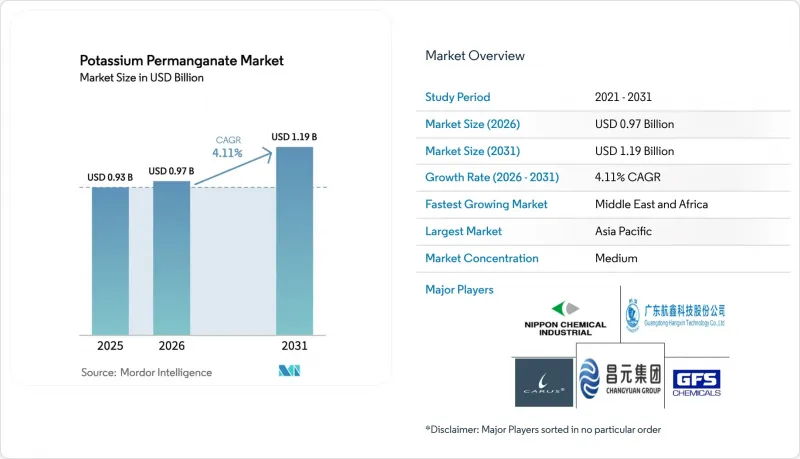
Mordor Intelligence에 의하면, 과망간산칼륨 시장 규모는 2025년 9억 3,000만 달러로 평가되었고, 2026년에는 9억 7,000만 달러로 추정되고, 2031년까지 11억 9,000만 달러에 이를 것으로 예상되며, 2026-2031년 CAGR 4.11%로 성장할 전망입니다.
본 보고서는 형태별(결정성 고체, 분말, 수성 용액), 최종 사용자 산업별(화학제품 및 석유화학제품, 제지 및 펄프, 광업, 발전, 석유 및 가스, 식음료 가공, 기타), 지역별(아시아태평양, 북미, 유럽, 남미, 중동 및 아프리카)로 분류되어 있습니다. 시장 전망은 금액(달러) 기준으로 제시되어 있습니다.
세계의 과망간산칼륨 시장 동향 및 인사이트
고품질 수처리에 대한 수요 증가
수자원이 부족한 지역에서는 용존 망간의 기준치가 0.05mg/L로 상향 조정되었으며, 상수도 유틸리티자들은 트리할로메탄을 생성하지 않고 금속을 산화시킬 수 있기 때문에 염소보다 과망간산칼륨을 선호하여 사용하고 있습니다. 아랍에미리트의 해수 담수화 시설에서는 역삼투막 업스트림에 2-4mg/L를 첨가하고 있으며, 이를 통해 생물 오염을 방지하고 막의 수명을 연장함으로써 톤당 평균 300달러의 약제 비용을 상쇄하고 있습니다. 이 나라의 1,585 MIGD에 달하는 해수 담수화 설비 설치 용량은 연간 2,400톤을 넘는 수요에 해당하며, 폐수의 95% 재이용이라는 국가 목표에 따라 소비량은 더욱 확대될 전망입니다. NSF/ANSI 60 인증을 통해 인증된 배합 제품만이 도시 상수도 관로에 공급된다는 것이 보장됩니다. 이로 인해 공급업체의 교체가 억제되고, 감사된 생산 기록을 유지하고 있는 기존 공급업체가 유리한 입지를 차지하게 됩니다.
의약품 합성 용도의 확대
제조업체들은 중금속 폐기물 처리 책임을 회피하기 위해 크롬계 산화제에서 과망간산염으로 전환하고 있습니다. 산화 선택성이 2% 향상되면 100톤 규모의 API 생산 라인에서 연간 약 50만 달러의 비용 절감이 가능해지며, 산화제 가격이 상승하더라도 공정의 경제성은 충분히 매력적입니다. 21 CFR 250.108에 따른 FDA 규정에서는 결정질 제품의 판매가 처방약으로 제한되어 있지만, 0.04% 이하의 희석 용액에 대해서는 팬데믹 당시 알코올계 소독제가 부족했을 때 수요가 확대되었던 외용 소독제 용도로 계속해서 구입할 수 있습니다. 인도의 수출 전략에는 REACH 규정을 준수하는 무기 산화제가 포함되어 있으며, 전 세계 주요 기업들이 공급업체 목록을 합리화하는 가운데 현지 공급업체들이 유럽으로부터 주문을 확보할 수 있는 입지에 서 있습니다.
건강 및 피부 독성에 대한 우려
산업안전규정에 따르면 과망간산염 농도가 0.04%를 초과할 경우 장갑, 안면 보호대, 유출 방지 시스템의 사용이 의무화되어 있으며, 중규모 수처리 시설에서는 연간 1만 5,000달러의 규정 준수 비용이 발생합니다. WHO 보고서에서는 설치류에 대한 유전독성 작용이 지적되었으며, 지침 개정까지는 이르지 않았지만 경계가 높아지고 있습니다. 그로 인해 상수도 유틸리티자는 안전을 우선시하여 낮은 투여율을 채택하고 있으며, 경우에 따라 산화 효과가 저하될 수도 있습니다.
부문 분석
2025년, 결정성 고체는 2년간의 저장 안정성과 유효 성분 1kg당 운송 비용이 낮다는 강점을 바탕으로 과망간산칼륨 시장에서 48.37%의 점유율을 차지했습니다. 인도 및 사하라 이남 아프리카의 유틸리티자들은 봉지형 제품에 적합한 중력 용해 탱크에 의존하고 있는 반면, 양식장에서는 기생충의 생활 주기에 맞추어 연못 옆에서 결정체를 용해시키고 있습니다. 그러나 걸프 연안 국가들의 해수 담수화 플랜트에서 자동 투여로 전환됨에 따라, 작업자가 분진 노출 및 발열 반응을 피할 수 있기 때문에 액체 형태를 선호하는 경향이 있습니다. 아랍에미리트의 100MIGD 규모 해수 담수화 플랜트 1곳에서는 연간 약 300톤을 소비하고 있으며, 중간 벌크 컨테이너(IBC)를 이용한 액체 벌크 운송은 기온 45℃의 환경에서 물류 효율을 높여줍니다. 또한, 화학 플랜트에서도 PLC 제어 펌프를 통해 폐쇄 루프 산화 탱크로 공급되는 용액이 선호되고 있습니다. 이를 통해 투여량을 보다 정밀하게 제어할 수 있어 망간 슬러지의 처리량을 줄일 수 있습니다.
수성 용액은 연평균 성장률(CAGR) 5.64%를 나타낼 것으로 예측되며, 2031년까지 가장 빠르게 성장하는 형태 카테고리가 될 전망입니다. 실시간 분광광도계 센서가 공정 유체 내 0.45μM의 과망간산염을 감지함으로써, 사업자는 투여량을 지속적으로 최적화하고 과다 투여로 인한 비용을 절감할 수 있습니다. 분말은 결정보다 용해성이 높지만, 장기 보관 시 부식 문제에 직면해 있습니다. 그러나 현장에서의 화학적 산화를 위해 신속한 용해가 중요한 광산 현장에서는 여전히 사용되고 있습니다. 그 결과, 과망간산칼륨 시장은 제형 측면에서 다양화를 거듭하고 있으며, 여러 제형을 아우르는 제품 포트폴리오를 제공하는 공급업체들은 고객이 투여 인프라를 업그레이드할 때 교차 판매 기회를 포착하고 있습니다.
지역별 분석
2025년, 아시아태평양은 중국의 수출 지향적 공급 기반에 힘입어 과망간산칼륨 시장 매출의 46.28%를 차지했습니다. 충칭 창위안 그룹은 룽창과 바이인에서 수직 통합형 거점을 운영하고 있으며, 전 세계 생산량의 60%, 중국 수출의 90%를 차지하고 있습니다. 2023년 Carus의 가동 중단 이후, 인도는 북미의 주요 공급국이 되어 2025년 1월 한 달 동안만 161톤을 수출했습니다. 일본과 한국에서는 의약품 합성 및 반도체 팹의 초순수 플랜트에서 과망간산칼륨이 사용되고 있는 반면, 호주에서는 상수도 및 연어 양식에 활용되고 있습니다.
중동 및 아프리카는 연평균 성장률(CAGR) 5.43%로 가장 빠른 성장을 이룰 것으로 예측됩니다. 걸프협력회의(GCC) 회원국의 상수도 유틸리티자들은 국가의 물 안보 목표를 달성하기 위해 해수 담수화의 전처리 및 폐수 재활용 공정 전반에 과망간산염을 투여하고 있으며, 남아프리카의 광산에서는 바르 강으로 방류하기 전에 산성 광산 배수를 산화 처리하고 있습니다. 주바이르와 얀부에 위치한 사우디아라비아의 석유화학 단지에서는 왕립위원회의 배출 기준을 준수하기 위해 냉각수의 생물막을 제어하고, 황화수소 배출을 줄이기 위해 과망간산염을 채택하고 있습니다.
북미에서는 Carus사의 화재가 지역 공급의 취약성을 여실히 드러내면서, 상수도 유틸리티 사업자들은 공급원의 다각화를 도모하는 한편, 즉각적인 효과가 있는 대체품으로서 과망간산나트륨의 시범 도입을 추진하고 있습니다. 캐나다에서 가장 큰 소비량은 맛과 냄새를 줄이기 위한 오대호 지표수 처리 시설에서 발생하지만, 멕시코 수요는 소노라주의 광업과 USMCA(미국·멕시코·캐나다 협정) 자금에 의한 상하수도 시설 개보수 프로젝트로 나뉘어 있습니다. 유럽에서는 대규모 처리 시설에서 이산화염소가 주류를 이루고 있어 과망간산염 수요는 완만한 증가에 그치고 있지만, 독일과 네덜란드의 브라운필드(기존 오염지) 정화 프로젝트에서는 염소계 용매로 오염된 구역에 대한 현장 화학적 산화 처리에 계속해서 과망간산염이 지정되고 있습니다. 남미의 소비는 생물학적 안전성이 확보된 산화제가 필요한 칠레의 연어 양식장이나 브라질의 틸라피아 양식장과 관련이 있는 반면, 아르헨티나의 와이너리에서는 유황 잔류물을 방지하기 위해 과망간산염을 사용하여 오크통을 살균하고 있습니다.
기타 혜택
- 엑셀 형식 시장 예측(ME) 시트
- 3개월간의 애널리스트 지원
자주 묻는 질문
목차
제1장 서론
제2장 조사 방법
제3장 주요 요약
제4장 시장 구도
제5장 시장 규모 및 성장 예측
제6장 경쟁 구도
제7장 시장 기회 및 향후 전망
AJY 26.08.28According to Mordor Intelligence, the potassium permanganate market size is expected to increase from USD 0.93 billion in 2025 to USD 0.97 billion in 2026 and reach USD 1.19 billion by 2031, growing at a CAGR of 4.11% over 2026-2031.
This report is Segmented by Form (Crystalline Solids, Powders, and Aqueous Solutions), End-User Industry (Chemical and Petrochemicals, Paper and Pulp, Mining, Power Generation, Oil and Gas, Food and Beverage Processing, and Others), and Geography (Asia-Pacific, North America, Europe, South America, and Middle-East and Africa). The Market Forecasts are Provided in Terms of Value (USD).
Global Potassium Permanganate Market Trends and Insights
Growing Need for High-Quality Water Treatment
Water-scarce regions have tightened dissolved manganese limits to 0.05 mg/L, and utilities now prefer permanganate over chlorine because it oxidizes metals without producing trihalomethanes. Desalination complexes in the United Arab Emirates dose 2-4 mg/L upstream of reverse-osmosis membranes, preventing biofouling and extending membrane life, which offsets chemical costs that average USD 300 per metric ton. The country's 1,585 MIGD installed desalination capacity translates to more than 2,400 metric tons of annual demand, and national targets for 95% wastewater reuse will deepen consumption. Certification under NSF/ANSI 60 ensures only qualified formulations enter municipal pipelines, which limits supplier churn and favors incumbents that maintain audited production records.
Expanding Pharmaceutical Synthesis Applications
Manufacturers have shifted from chromium-based oxidants toward permanganate to avoid heavy-metal disposal liabilities. A 2% increase in oxidation selectivity saves about USD 0.5 million annually for a 100-metric-ton API line, making process economics compelling even at higher oxidizer prices. FDA rules under 21 CFR 250.108 restrict crystal sales to prescription status, yet dilute solutions below 0.04% remain available for topical antiseptics, a category that expanded during pandemic shortages of alcohol disinfectants. India's export strategy includes REACH-compliant inorganic oxidizers, positioning local suppliers to win European orders as global majors rationalize their vendor lists.
Health and Dermal Toxicity Concerns
Occupational-safety rules require gloves, face shields, and spill-containment systems when permanganate concentration exceeds 0.04%, adding up to USD 15,000 in annual compliance costs for a mid-size water plant. WHO reports cited genotoxic effects in rodents, raising caution even though no guideline revision followed. Utilities therefore err on low dose rates, sometimes compromising oxidation effectiveness.
Other drivers and restraints analyzed in the detailed report include:
- Rapid Industrial Adoption in Aquaculture Biosecurity
- Emerging Demand for Permanganate-Based Battery Electrolyte Additives
- Availability of Benign Competing Oxidizers
For complete list of drivers and restraints, kindly check the Table Of Contents.
Segment Analysis
Crystalline solids held 48.37% of Potassium Permanganate Market market share in 2025 on the strength of two-year shelf stability and lower freight cost per active kilogram. Utilities in India and sub-Saharan Africa rely on gravity dissolving tanks that suit bagged material, while aquaculture farms dissolve crystals pond-side to match parasite cycles. The shift toward automated dosing in Gulf desalination plants, however, favors liquid formats because workers avoid dust exposure and exothermic reactions. A single 100 MIGD desalination unit in the United Arab Emirates consumes roughly 300 metric tons annually, and bulk liquid delivery in intermediate bulk containers streamlines logistics in 45 °C heat. Chemical plants also prefer solutions that feed closed-loop oxidation tanks through PLC-controlled pumps, enabling tighter dose control and reducing manganese-sludge disposal.
Aqueous solutions are projected to grow at a 5.64% CAGR, making them the fastest form category through 2031. Real-time spectrophotometric sensors detect 0.45 µM permanganate in process streams, which allows operators to optimize dosing continuously and cut over-feed costs. Powders, while more soluble than crystals, face corrosion issues in long-term storage yet still find use in mining sites that value rapid dissolution for in-situ chemical oxidation. As a result, the Potassium Permanganate Market market continues to diversify across form factors, and suppliers that offer multi-format portfolios capture cross-selling opportunities when customers upgrade dosing infrastructure.
Complete Report Scope:
- By Form
- Crystalline Solids
- Powders
- Aqueous Solutions
- By End-user Industry
- Chemical and Petrochemicals Industry
- Paper and Pulp
- Mining
- Power Generation
- Oil and Gas
- Food and Beverage Processing Industry
- Other End-User Industries
- By Geography
- Asia-Pacific
- China
- India
- Japan
- South Korea
- ASEAN Countries
- Rest of Asia-Pacific
- North America
- United States
- Canada
- Mexico
- Europe
- Germany
- United Kingdom
- France
- Italy
- NORDIC Countries
- Rest of Europe
- South America
- Brazil
- Argentina
- Rest of South America
- Middle-East and Africa
- South Africa
- Saudi Arabia
- Rest of Middle-East and Africa
- Asia-Pacific
Geography Analysis
Asia-Pacific generated 46.28% of Potassium Permanganate Market market revenue in 2025, anchored by China's export-oriented supply base. Chongqing Changyuan Group operates vertically integrated sites in Rongchang and Baiyin that claim 60% of global output and 90% of Chinese exports. India became the primary supplier to North America after the 2023 Carus outage, shipping 161 metric tons in January 2025 alone. Japan and South Korea use permanganate in pharmaceutical syntheses and ultrapure water plants for semiconductor fabs, while Australia deploys it in municipal water and salmon aquaculture.
The Middle-East and Africa region is forecast to post the swiftest growth at 5.43% CAGR. Gulf Cooperation Council utilities dose permanganate throughout desalination pretreatment and wastewater recycling to hit national water-security targets, and South African mines oxidize acid-mine drainage before discharge to the Vaal River. Saudi petrochemical complexes in Jubail and Yanbu employ permanganate to control cooling-water biofilms and reduce hydrogen sulfide emissions, aligning with Royal Commission discharge standards.
In North America, the Carus fire demonstrated regional supply fragility, prompting utilities to diversify sources and test sodium permanganate as an immediate substitute. Canada's largest volumes come from Great Lakes surface-water plants that mitigate taste and odor, whereas Mexican demand is split between mining in Sonora and municipal upgrades supported by USMCA funds. Europe shows modest growth as chlorine dioxide dominates large plants, yet brownfield remediation projects in Germany and the Netherlands continue to specify permanganate for in-situ chemical oxidation of chlorinated solvent plumes. South America's consumption is tied to Chilean salmon farms and Brazilian tilapia ponds that demand biosecure oxidants, while Argentine wineries sanitize barrels with permanganate to avoid sulfur residues.
- Carus Group Inc.
- Changsha Yonta
- Chongqing Changyuan Group Limited
- GFS Chemicals, Inc.
- Hangxin Technology
- Hebei Huiyang Chemical
- Hubei Xiangyun (Group) Chemical Co., Ltd.
- Libox Chem (India) Pvt. Ltd.
- Magnesia GmbH
- Milport Enterprises, Inc.
- Mubychem Group
- Nippon Chemical Industrial CO., LTD.
- Otto Chemie Pvt. Ltd.
- Rusan Pharma
- Seidler Chemical Co.
- Univar Solutions Inc,
- Universal Chemicals & Industries Pvt. Ltd.
Additional Benefits:
- The market estimate (ME) sheet in Excel format
- 3 months of analyst support
TABLE OF CONTENTS
1 Introduction
- 1.1 Study Assumptions and Market Definition
- 1.2 Scope of the Study
2 Research Methodology
3 Executive Summary
4 Market Landscape
- 4.1 Market Overview
- 4.2 Market Drivers
- 4.2.1 Growing Need for High-Quality Water Treatment
- 4.2.2 Expanding Pharmaceutical Synthesis Applications
- 4.2.3 Rapid Industrial Adoption in Aquaculture Bio-Security
- 4.2.4 Emerging Demand for Permanganate-Based Battery Electrolyte Additives
- 4.2.5 Advanced Odor-Control Solutions in Industrial Wastewater
- 4.3 Market Restraints
- 4.3.1 Health and Dermal-Toxicity Concerns
- 4.3.2 Availability of Benign Competing Oxidizers (e.g., Sodium Hypochlorite)
- 4.3.3 Volatile Supply of High-Grade Mno2 Feedstock
- 4.4 Value Chain Analysis
- 4.5 Porter's Five Forces
- 4.5.1 Bargaining Power of Suppliers
- 4.5.2 Bargaining Power of Buyers
- 4.5.3 Threat of New Entrants
- 4.5.4 Threat of Substitutes
- 4.5.5 Degree of Competition
5 Market Size and Growth Forecasts (Value)
- 5.1 By Form
- 5.1.1 Crystalline Solids
- 5.1.2 Powders
- 5.1.3 Aqueous Solutions
- 5.2 By End-user Industry
- 5.2.1 Chemical and Petrochemicals Industry
- 5.2.2 Paper and Pulp
- 5.2.3 Mining
- 5.2.4 Power Generation
- 5.2.5 Oil and Gas
- 5.2.6 Food and Beverage Processing Industry
- 5.2.7 Other End-User Industries
- 5.3 By Geography
- 5.3.1 Asia-Pacific
- 5.3.1.1 China
- 5.3.1.2 India
- 5.3.1.3 Japan
- 5.3.1.4 South Korea
- 5.3.1.5 ASEAN Countries
- 5.3.1.6 Rest of Asia-Pacific
- 5.3.2 North America
- 5.3.2.1 United States
- 5.3.2.2 Canada
- 5.3.2.3 Mexico
- 5.3.3 Europe
- 5.3.3.1 Germany
- 5.3.3.2 United Kingdom
- 5.3.3.3 France
- 5.3.3.4 Italy
- 5.3.3.5 NORDIC Countries
- 5.3.3.6 Rest of Europe
- 5.3.4 South America
- 5.3.4.1 Brazil
- 5.3.4.2 Argentina
- 5.3.4.3 Rest of South America
- 5.3.5 Middle-East and Africa
- 5.3.5.1 South Africa
- 5.3.5.2 Saudi Arabia
- 5.3.5.3 Rest of Middle-East and Africa
- 5.3.1 Asia-Pacific
6 Competitive Landscape
- 6.1 Market Concentration
- 6.2 Strategic Moves
- 6.3 Market Share/Ranking Analysis
- 6.4 Company Profiles (includes Global level Overview, Market level overview, Core Segments, Financials, Strategic Information, Market Rank/Share, Products and Services, Recent Developments)
- 6.4.1 Carus Group Inc.
- 6.4.2 Changsha Yonta
- 6.4.3 Chongqing Changyuan Group Limited
- 6.4.4 GFS Chemicals, Inc.
- 6.4.5 Hangxin Technology
- 6.4.6 Hebei Huiyang Chemical
- 6.4.7 Hubei Xiangyun (Group) Chemical Co., Ltd.
- 6.4.8 Libox Chem (India) Pvt. Ltd.
- 6.4.9 Magnesia GmbH
- 6.4.10 Milport Enterprises, Inc.
- 6.4.11 Mubychem Group
- 6.4.12 Nippon Chemical Industrial CO., LTD.
- 6.4.13 Otto Chemie Pvt. Ltd.
- 6.4.14 Rusan Pharma
- 6.4.15 Seidler Chemical Co.
- 6.4.16 Univar Solutions Inc,
- 6.4.17 Universal Chemicals & Industries Pvt. Ltd.
7 Market Opportunities and Future Outlook
- 7.1 White-space and Unmet-Need Assessment