

|
시장보고서
상품코드
2114973
내충격 유리 시장 : 점유율 분석, 업계 동향과 통계, 성장 예측(2026-2031년)Impact Resistant Glass - Market Share Analysis, Industry Trends & Statistics, Growth Forecasts (2026 - 2031) |
||||||
 Mordor Intelligence
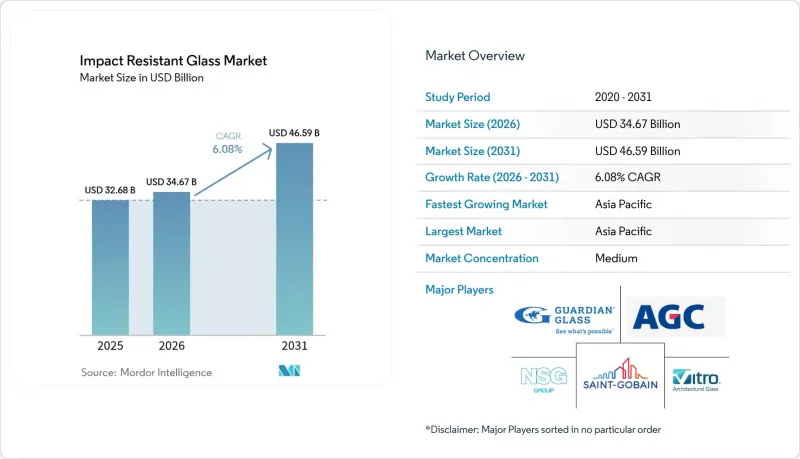
Mordor Intelligence에 의하면, 내충격 유리 시장 규모는 2025년에 326억 8,000만 달러로 평가되었고 2026년 346억 7,000만 달러에서 2031년까지 465억 9,000만 달러에 이를 것으로 예측되며, 예측 기간(2026-2031년) CAGR은 6.08%를 나타낼 전망입니다.
본 보고서에서는 업계를 제품 유형(접합 유리, 강화 유리 등), 중간막(폴리비닐부티랄(PVB), 이오노플라스트 폴리머 등), 용도(파사드, 커튼월, 창문 등),최종 사용자 산업(건설, 자동차 등), 지역(아시아태평양, 북미 등)별로 분류하고 있습니다. 시장 예측은 금액(미 달러) 기준으로 제시되어 있습니다.
전 세계 내충격 유리 시장 동향 및 인사이트
허리케인이 빈번히 발생하는 지역의 건축 분야에서의 채택 확대
2023년판 플로리다주 건축 기준법에 따라 바람에 날아오는 파편의 영향 범위가 확대됨에 따라, 개발업자들은 시속 120마일의 풍압을 견딜 수 있는 유리 사양을 지정할 수밖에 없게 되었습니다. 루이지애나주와 텍사스주에서도 유사한 개정이 이루어지고 있어, 수요는 기존의 강풍 허리케인 구역 범위를 넘어 확대되고 있습니다. 허리케인 ‘이안’ 이후의 보험 청구 데이터에 따르면, 기준에 부합하는 창문을 채택한 건물에서는 보험금 지급액이 75% 감소한 것으로 나타났습니다. 건설업체에게는 피해 경감은 물론, 추가 설비 투자를 상쇄해 주는 최대 55%의 보험료 할인이라는 이중의 이점이 있습니다. 그 결과, 내충격 유리 시장은 해안 지역의 신규 공동주택 프로젝트와 공립학교에서 지속적으로 채택되고 있습니다. 각 공급업체는 조지아주와 텍사스주에서 접합유리 생산 라인을 확대하여 운송 비용을 절감하는 동시에, 태풍 시즌 동안 건설 현장으로의 적시 납품을 보장하고 있습니다.
자동차용 유리에 대한 안전 규제의 강화
연방 자동차 안전 기준(FMVSS) 205에서는 전면 유리에 내장된 카메라 및 LiDAR 장치를 지원하기 위해 더 높은 내충격 기준이 의무화되어 있습니다. 코닝(Corning)사의 ‘Fusion5’ 접합 유리는 이러한 시험 기준을 충족하면서도 무게를 12% 줄여, 전기차의 주행 거리 목표 달성을 지원하고 있습니다. 유럽에서는 ECE R43의 개정을 통해 기준이 조화되었으며, 2026년에 출시될 OEM 플랫폼에서는 이미 접합 유리 사이드라이트의 채택이 확정되었습니다. 따라서 내충격 유리 시장은 전 세계적인 도입의 동기화에 따른 혜택을 받고 있으며, 이로 인해 새로운 오토클레이브에 대한 투자 회수 기간이 단축되고 있습니다. 1차 유리 제조업체들은 광학 성능과 강성을 높이기 위해 얇은 이오노플라스트 층을 채택하는 전기차 스타트업 기업들과 다년 계약 협상을 진행하고 있습니다.
높은 생산 비용과 설비 투자 비용
접합 유리 및 강화 유리 생산 라인용 용광로 업그레이드 비용은 기본적인 플로트 유리 설비에 비해 30-40% 더 비싸, 소규모 가공 업체 시장 진입을 제한하고 있습니다. 미국 에너지 정보국(EIA) 보고서에 따르면, 유리 공장은 천연가스를 73%, 전력을 24% 소비하고 있어 연료 가격의 이중 변동 위험에 노출되어 있습니다. 생산자물가지수(PPI) 데이터에 따르면 2024년에는 4.5%의 상승이 예상되지만, 도급업체들은 이 비용을 발주처에 전가하는 데 소극적이어서 이익률이 압박받고 있습니다. 그 결과, AGC와 같이 다지역에 진출한 기업이 아니라면, 1개 거점당 3억 달러를 초과하는 연속적인 설비 투자를 정당화하기 어렵습니다. 따라서 내충격 유리 시장에서는 대규모 용해로가 개보수를 위해 가동을 중단할 때마다 생산 능력의 병목 현상이 발생할 위험이 있습니다.
부문 분석
접합 유리는 2025년 매출의 44.62%를 차지하며, 충격을 받은 후에도 파편이 뭉쳐 있는 상태를 유지하는 폴리비닐부티랄 층 덕분에 내충격 유리 시장의 기반을 형성하고 있습니다. 해안 지역의 건설업체와 앞유리 기판을 선정하는 자동차 제조업체는 건축 기준 및 안전 감사 요건을 충족하기 위해 이 특성에 의존하고 있습니다. 강화 유리는 새로운 롤러식 급속 냉각 설계로 평탄도가 향상되고 에너지 소비가 감소함에 따라 2031년까지 연평균 성장률(CAGR) 7.39%로 성장을 가속화하고 있습니다. 생산 기술의 혁신으로 가공 업체들은 단위 비용을 절감하면서 대형 패널을 공급할 수 있게 되었으며, 이는 건축가들이 중층 사무실 건물에 강화 유리 벽을 지정하도록 유도하고 있습니다. 열강화 유리는 어닐링 유리와 완전 강화 유리 사이의 좁은 간극을 메우는 존재로, 열 응력에 노출되는 초대형 유리판에 선호되어 채택되고 있습니다. AGC사의 ‘Temperlite’ 플랫폼은 자동차 등급의 광학적 특성을 유지하면서 내충격을 5배로 높였습니다. 섬유 복합재를 내장한 특수한 하이브리드 유리는 폭발 방지 시설이나 군사 시설에 채택되고 있지만, 현재로서는 내충격 유리 업계 전체에서 극히 일부에 불과합니다.
2세대 접합 유리는 이온 오플라스트 층을 통합함으로써 조립체를 충분히 보강하고 두께를 줄였습니다. 이러한 재설계로 인해 파사드의 무게가 경감되고, 알루미늄 마리온의 크기도 축소됩니다. 이러한 변화로 인해 커튼월의 골조 및 설치 공수 측면에서 현저한 비용 절감이 실현되어, 중간막의 가격 프리미엄이 지속되는 경우에도 접합 유리의 경제성은 향상되고 있습니다. 따라서 강화 유리의 생산량은 더욱 빠르게 증가할 가능성이 있으며, 접합 유리의 매출은 견조한 추세를 유지하며 2031년까지 내충격 유리 시장 규모의 상당 부분을 계속 지탱할 것입니다.
2025년 수요 중 폴리비닐부티랄이 48.63%를 차지했습니다. 오토클레이브 처리에 대한 내성과 재활용 가능성 면에서의 실적을 바탕으로, 전면 유리 및 주택용 문용 주요 중간막으로서의 지위를 유지하고 있습니다. 이스트만사가 최근 발표한 ‘Saflex LiteCarbon Clear’는 내장된 탄소량을 줄여 상업용 고층 빌딩에서 LEED 크레딧 획득을 목표로 하고 있습니다. 한편, 이오노플라스트 배합은 높은 전단 탄성률 덕분에 더 얇은 유리 적층 및 경량 자동차용 유리를 구현할 수 있어 연평균 성장률(CAGR) 7.46%로 성장할 것으로 전망됩니다. 각 OEM 업체들은 광학 기기에 정밀한 위치 정렬이 요구되는 경우 이오노플라스트를 선택하고 있습니다. EVA 중간막은 태양광 발전용 유리나 배선을 내장한 스마트 파사드 분야에서 시장 점유율을 확대되고 있습니다. 이는 EVA의 접착부가 국부적인 고온을 견딜 수 있기 때문입니다. 학술적 시험을 통해 EVA의 강성이 PVB와 동등한 것으로 확인되었으며, 공급 규모가 확대되면 더 광범위한 채택이 진행될 것으로 시사되고 있습니다. TPU 및 다층 라미네이트는 사양상의 가치가 재료비를 훨씬 상회하는 ‘폭풍 저항성’이라는 프리미엄 틈새 시장을 차지하고 있으며, 내충격 유리 시장의 추가적인 다양화에 기여하고 있습니다.
유럽의 개발업체들은 PVB 스크랩의 매립 처분을 제한하는 순환형 경제 지침을 준수하기 위해 바이오 폴리머의 활용을 모색하고 있습니다. 재활용 시범 사업에서는 사용된 중간막을 분쇄하여 바닥재나 실런트의 원료로 재활용하고 있으며, 이는 유리 공장의 EHS(환경·안전·위생) 예산을 압박하고 있는 폐기물 처리의 병목 현상을 완화할 가능성이 있습니다. 상업적 규모의 생산이 시작되기 전까지는 PVB가 주류를 유지할 것이지만, 이오노플라스트의 마케팅에서는 높은 자외선 노출 하에서도 투명성을 유지할 수 있다는 점이 강조되고 있으며, 이는 열대 지역에서의 설치 시 특히 높이 평가되는 요소입니다.
지역별 분석
아시아태평양은 2025년 시장 규모의 39.88%를 차지하며, 연평균 성장률(CAGR) 7.62%를 기록할 전망입니다. 대규모 고속철도역을 포함한 중국의 인프라 정비 계획에서는 대형 접합 유리 천창이 채택되고 있으며, 이것이 연속 소성로의 가동량을 뒷받침하고 있습니다. 인도의 스마트 시티 추진과 상업용 타워 붐이 생산량을 확대하는 한편, 필리핀과 베트남의 폭풍우 대책 지침에 따라 학교와 병원에서 내충격 유리의 채택이 촉진되고 있습니다. 푸야오(Fuyao)의 91억 달러 규모의 다중 거점 확장은 플로트 유리 생산 능력과 하류 라미네이트 가공 능력을 강화하여, 지역 내 운송 효율을 최적화하고 자동차 수출 플랫폼에 대한 신속한 공급을 보장하고 있습니다. 그 결과, 이 지역공급업체들이 가격 기준을 형성하고 있으며, 이는 전 세계 입찰에 파급되어 내충격 유리 시장 동향에 영향을 미치고 있습니다.
북미는 시장 규모에서 2위를 차지하고 있습니다. 플로리다주에서는 과거 저위험으로 간주되던 카운티에 대해서도 바람에 의한 비산물에 관한 규제가 확대 적용되면서 수주 전망이 밝아지고 있습니다. 보험 환급금은 신축 및 개보수 모두에 대한 경제적 인센티브를 더욱 높이고 있습니다. 국내 플로트 유리 공급은 여전히 부족하며, 연방 관보에는 아시아산 수입품에 대한 반덤핑 조사가 보도되어 현지 가격 결정력을 지키기 위한 원가 전가가 이루어질 가능성이 시사되고 있습니다. 미시간주와 테네시주의 자동차 제조업체들은 ADAS 센서를 통합한 접합 유리 형태로 전면 유리 생산 라인을 전환하고 있어, 해안 지역의 건설 수요에 그치지 않고 수요를 더욱 강화하고 있습니다. 이러한 요인들이 복합적으로 작용하여 에너지 비용의 변동이 있더라도 안정적인 성장이 보장되고 있습니다.
유럽은 지속가능성의 선두주자로서 나아가고 있습니다. 프랑스에 위치한 생고뱅(Saint-Gobain)의 하이브리드 전기로는 CO2 배출량을 75% 감축하고 있으며, 그 생산물은 저탄소 건축 인증 요건을 충족하고 있습니다. EU의 ‘리노베이션 웨이브(Renovation Wave)’ 프로그램을 통해 파사드 개보수를 위한 자금이 확보되면서 노후화된 주택 재고에 더 많은 적층 패널이 도입되고 있습니다. 독일과 오스트리아는 재생에너지 통합을 지원하고 있어, EVA 적층형 태양광 발전 유리에 대한 초기 도입 사례가 나타나고 있습니다. 동시에 보안 평가 기준의 발전에 따라, 대사관 및 기차역을 위한 내폭성 유리 사양이 주목을 받고 있습니다. 공급망은 강력한 재활용 의무의 혜택을 받고 있으며, 이로 인해 생산자들은 사용 후 PVB 솔루션의 혁신을 요구받고 있어, 전체 내충격 유리 시장의 제품 설계 선택지에 영향을 미치고 있습니다.
기타 혜택:
- 엑셀 형식 시장 예측(ME) 시트
- 3개월간의 애널리스트 지원
자주 묻는 질문
목차
제1장 서론
제2장 조사 방법
제3장 주요 요약
제4장 시장 구도
제5장 시장 규모와 성장 예측
제6장 경쟁 구도
제7장 시장 기회와 향후 전망
JHS 26.08.26According to Mordor Intelligence, the impact resistant glass market size was valued at USD 32.68 billion in 2025 and estimated to grow from USD 34.67 billion in 2026 to reach USD 46.59 billion by 2031, at a CAGR of 6.08% during the forecast period (2026-2031).
This report Segments the Industry by Product Type (Laminated Glass, Tempered Glass, and More), Interlayer (Polyvinyl Butyral (PVB), Ionoplast Polymer, and More), Application (Facades, Curtain Walls and Windows, and More), End-User Industry (Construction, Automotive, and More), and Geography (Asia-Pacific, North America, and More). The Market Forecasts are Provided in Terms of Value (USD).
Global Impact Resistant Glass Market Trends and Insights
Growing Adoption in Hurricane-Prone Construction
Wider wind-borne debris zones under the 2023 Florida Building Code compel developers to specify glazing able to withstand 120 mph wind impacts. Louisiana and Texas mirror these updates, so demand extends beyond traditional High Velocity Hurricane Zones. Claim data after Hurricane Ian showed 75% fewer payouts for properties using compliant windows. Builders see a dual return: reduced damage plus up to 55% insurer discounts that offset incremental capex. As a result, the impact resistant glass market gains constant specification in new coastal multifamily projects and public schools. Suppliers scale laminated lines in Georgia and Texas to curb freight costs and guarantee just-in-time deliveries to storm-season job sites.
Stricter Automotive Glazing Safety Regulations
Federal Motor Vehicle Safety Standard 205 now requires higher impact thresholds that accommodate cameras and lidar units embedded in windshields. Corning's Fusion5 laminate meets these tests while cutting weight by 12% to support electric vehicle range targets. Europe aligns through ECE R43 updates, and OEM platforms launching in 2026 already lock in laminated side-lites. Therefore, the impact resistant glass market benefits from synchronized global rollouts that shorten payback on new autoclave investments. Tier-one glass producers are negotiating multiyear contracts with EV startups that favor thin ionoplast layers for optics and stiffness.
High Production & Capital Costs
Furnace upgrades for laminated or tempered lines cost 30-40% more than basic float glass setups, limiting entry by small fabricators. The U.S. Energy Information Administration reports that glass plants consume 73% natural gas and 24% electricity, exposing them to dual fuel price curves. Producer Price Index data show a 4.5% climb in 2024 that contractors resist passing to owners, squeezing margins. Consequently, only multiregional firms such as AGC can justify back-to-back capital projects that exceed USD 300 million per site. Therefore, the impact resistant glass market risks capacity pinch points whenever a large furnace goes offline for a rebuild.
Other drivers and restraints analyzed in the detailed report include:
- Infrastructure Security Investments
- Climate-Resilience Retrofitting of Legacy Buildings
- Raw-Material & Energy Price Volatility
For complete list of drivers and restraints, kindly check the Table Of Contents.
Segment Analysis
Laminated glass retained 44.62% of 2025 revenue and anchors the impact resistant glass market thanks to polyvinyl butyral layers that keep shards intact after impact. Builders in coastal zones and automakers selecting windshield substrates rely on this characteristic to satisfy code and safety audits. Tempered glass picks up speed at a 7.39% CAGR to 2031 because new roller quench designs improve flatness and cut energy usage. Production innovations let fabricators supply large panels at lower unit cost, encouraging architects to specify tempered walls in mid-rise offices. Heat-strengthened glass serves a narrow gap between annealed and fully tempered, favored for oversized lites that face thermal stress. AGC's Temperlite platform delivers five-fold shock resistance while maintaining automotive-grade optics. Specialty hybrid panes that embed fiber composites enter blast and military facilities, but today they still form a small slice of the impact resistant glass industry.
Second-generation laminated formats integrate ionoplast layers that stiffen assemblies enough to trim thickness. This redesign lowers facade weight and decreases aluminum mullion size. The shift yields measurable savings in curtain-wall framing and installation labor, lifting laminated economics even when interlayer price premiums persist. Thus, while tempered volumes may rise faster, laminated revenue remains robust and underpins much of the impact resistant glass market size through 2031.
Polyvinyl butyral commanded 48.63% of the 2025 demand. Its track record with autoclave cycles and recyclability keeps it the go-to interlayer for windshields and residential doors. Eastman's recent Saflex LiteCarbon Clear variant reduces embodied carbon and targets LEED credits for commercial towers. Ionoplast formulations, however, should climb 7.46% CAGR as their high shear modulus enables thinner glass stacks and lighter vehicle glazing. OEMs select ionoplast where optical devices need precise alignment. EVA interlayers gain share in photovoltaic glass and smart facades that carry wiring because EVA bonds handle higher localized temperatures. Academic tests confirm EVA stiffness comparable with PVB, hinting at wider adoption once supply scales. TPU and multilayer laminates occupy premium blast-rated niches where specification value dwarfs material cost, further diversifying the impact resistant glass market.
Developers in Europe explore biopolymers to comply with circular-economy directives that restrict landfill disposal of PVB scrap. Recycling pilots grind used interlayers into feedstock for flooring and sealants, potentially easing disposal bottlenecks that weigh on glass plant EHS budgets. Until commercial volumes emerge, PVB remains dominant, but ionoplast marketing underscores its transparency retention at elevated UV loads, a factor resonating in tropical installations.
Complete Report Scope:
- By Product Type
- Laminated Glass
- Tempered (Heat-treated) Glass
- Heat-Strengthened Glass
- Hybrid/Other Impact Resistant Glass
- By Interlayer
- Polyvinyl Butyral (PVB)
- Ionoplast Polymer
- Ethylene-Vinyl Acetate (EVA)
- Other Interlayers (Thermoplastic Polyurethane (TPU), etc.)
- By Application
- Facades, Curtain Walls & Windows
- Structural Glazing & Floors
- Windscreens & Side-lites
- Security & Blast-Resistant Installations
- By End-User Industry
- Construction
- Automotive
- Other End User Industries (Aerospace and Defense, etc.)
- By Geography
- Asia-Pacifc
- China
- India
- Japan
- South Korea
- Rest of Asia-Pacific
- North America
- United States
- Canada
- Mexico
- Europe
- Germany
- United Kingdom
- France
- Italy
- Rest of Europe
- South America
- Brazil
- Argentina
- Rest of South America
- Middle East and Africa
- Saudi Arabia
- South Africa
- Rest of Middle East and Africa
- Asia-Pacifc
Geography Analysis
Asia-Pacific contributed 39.88% of 2025 value and should post 7.62% CAGR. Chinese infrastructure programs, including expansive high-speed rail stations, embed large laminated skylights that feed continuous furnace workloads. India's smart-city push and commercial tower boom extend volume, while storm-preparedness guidelines in Philippines and Vietnam lift specification of impact panes in schools and hospitals. Fuyao's multi-site expansion worth USD 9.1 billion increases float capacity plus downstream laminating, ensuring regional freight optimization and rapid supply for automotive export platforms. Hence suppliers there shape pricing norms that spill into global tenders and influence the trajectory of the impact resistant glass market.
North America ranks second in size. Florida's broader wind-borne debris rules apply to counties once considered low-risk, strengthening pipeline visibility. Insurance rebates magnify the financial incentive for both new builds and retrofits. Domestic float supply remains tight; the Federal Register notes antidumping probes into Asian imports, suggesting possible cost pass-throughs that defend local pricing power. Automakers in Michigan and Tennessee retool windshield lines to laminated formats that integrate ADAS sensors, reinforcing demand beyond coastal construction. Combined, these forces lock in stable growth even as energy bills fluctuate.
Europe advances as a sustainability leader. Saint-Gobain's hybrid electric furnace in France cuts CO2 by 75%, and the output qualifies for low-carbon building certifications. EU renovation wave programs free funds for facade upgrades, channeling more laminated panels into aging housing stock. Germany and Austria support renewable energy integration, so EVA-laminated photovoltaic glazing finds early adopters. Simultaneously, blast-resistant glass specifications for embassies and rail stations gain traction amid evolving security assessments. Supply chains benefit from strong recycling mandates that pressure producers to innovate end-of-life PVB solutions, influencing product design choices across the impact resistant glass market.
- AGC Inc.
- CGS Holding
- Eastman Chemical Company
- Fuyao Glass Industry Group
- Guardian Industries Holdings
- MITER Brands
- Nippon Sheet Glass Co., Ltd
- Saint-Gobain
- Schott AG
- Sisecam
- Trulite
- Vitro Architectural Glass
- Xinyi Glass Holdings Limited.
Additional Benefits:
- The market estimate (ME) sheet in Excel format
- 3 months of analyst support
TABLE OF CONTENTS
1 Introduction
- 1.1 Study Assumptions & Market Definition
- 1.2 Scope of the Study
2 Research Methodology
3 Executive Summary
4 Market Landscape
- 4.1 Market Overview
- 4.2 Market Drivers
- 4.2.1 Growing adoption in hurricane-prone construction
- 4.2.2 Stricter automotive glazing safety regulations
- 4.2.3 Infrastructure security investments
- 4.2.4 Climate-resilience retrofitting of legacy buildings
- 4.2.5 Insurance premium incentives for impact-rated facades
- 4.3 Market Restraints
- 4.3.1 High production & capital costs
- 4.3.2 Raw-material & energy price volatility
- 4.3.3 Laminate recycling & landfill restrictions
- 4.4 Value Chain Analysis
- 4.5 Porter's Five Forces
- 4.5.1 Threat of New Entrants
- 4.5.2 Bargaining Power of Buyers
- 4.5.3 Bargaining Power of Suppliers
- 4.5.4 Threat of Substitutes
- 4.5.5 Degree of Competition
5 Market Size & Growth Forecasts (Value)
- 5.1 By Product Type
- 5.1.1 Laminated Glass
- 5.1.2 Tempered (Heat-treated) Glass
- 5.1.3 Heat-Strengthened Glass
- 5.1.4 Hybrid/Other Impact Resistant Glass
- 5.2 By Interlayer
- 5.2.1 Polyvinyl Butyral (PVB)
- 5.2.2 Ionoplast Polymer
- 5.2.3 Ethylene-Vinyl Acetate (EVA)
- 5.2.4 Other Interlayers (Thermoplastic Polyurethane (TPU), etc.)
- 5.3 By Application
- 5.3.1 Facades, Curtain Walls & Windows
- 5.3.2 Structural Glazing & Floors
- 5.3.3 Windscreens & Side-lites
- 5.3.4 Security & Blast-Resistant Installations
- 5.4 By End-User Industry
- 5.4.1 Construction
- 5.4.2 Automotive
- 5.4.3 Other End User Industries (Aerospace and Defense, etc.)
- 5.5 By Geography
- 5.5.1 Asia-Pacifc
- 5.5.1.1 China
- 5.5.1.2 India
- 5.5.1.3 Japan
- 5.5.1.4 South Korea
- 5.5.1.5 Rest of Asia-Pacific
- 5.5.2 North America
- 5.5.2.1 United States
- 5.5.2.2 Canada
- 5.5.2.3 Mexico
- 5.5.3 Europe
- 5.5.3.1 Germany
- 5.5.3.2 United Kingdom
- 5.5.3.3 France
- 5.5.3.4 Italy
- 5.5.3.5 Rest of Europe
- 5.5.4 South America
- 5.5.4.1 Brazil
- 5.5.4.2 Argentina
- 5.5.4.3 Rest of South America
- 5.5.5 Middle East and Africa
- 5.5.5.1 Saudi Arabia
- 5.5.5.2 South Africa
- 5.5.5.3 Rest of Middle East and Africa
- 5.5.1 Asia-Pacifc
6 Competitive Landscape
- 6.1 Market Concentration
- 6.2 Strategic Moves
- 6.3 Market Share Analysis
- 6.4 Company Profiles (includes Global level Overview, Market level overview, Core Segments, Financials as available, Strategic Information, Market Rank/Share for key companies, Products & Services, and Recent Developments)
- 6.4.1 AGC Inc.
- 6.4.2 CGS Holding
- 6.4.3 Eastman Chemical Company
- 6.4.4 Fuyao Glass Industry Group
- 6.4.5 Guardian Industries Holdings
- 6.4.6 MITER Brands
- 6.4.7 Nippon Sheet Glass Co., Ltd
- 6.4.8 Saint-Gobain
- 6.4.9 Schott AG
- 6.4.10 Sisecam
- 6.4.11 Trulite
- 6.4.12 Vitro Architectural Glass
- 6.4.13 Xinyi Glass Holdings Limited.
7 Market Opportunities & Future Outlook
- 7.1 White-space & Unmet-Need Assessment
- 7.2 Increasing Demand for Safety and Security


