|
시장보고서
상품코드
2114976
안티블록 첨가제 시장 : 시장 점유율 분석, 업계 동향 및 통계, 성장 예측(2026-2031년)Antiblock Additive - Market Share Analysis, Industry Trends & Statistics, Growth Forecasts (2026 - 2031) |
||||||
 Mordor Intelligence
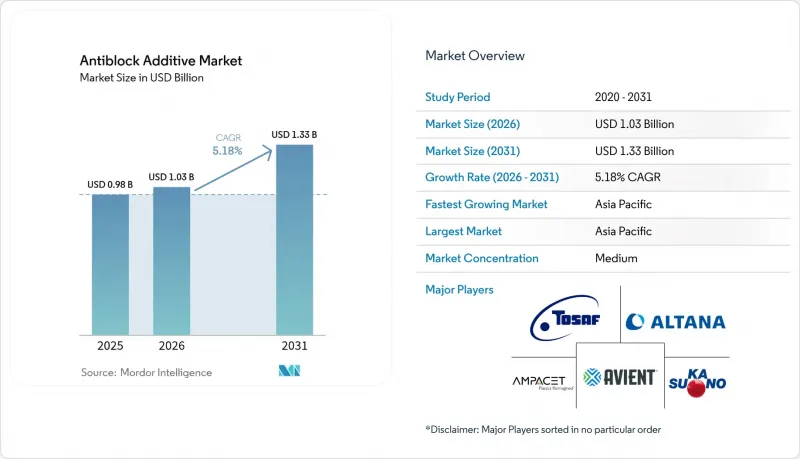
Mordor Intelligence에 의하면, 2026년 안티블록 첨가제 시장 규모는 10억 3,000만 달러로 추정되고, 2025년 9억 8,000만 달러에서 확대해, 2031년에는 13억 3,000만 달러에 이를 것으로 예측됩니다.
2026-2031년 연평균 성장률(CAGR)은 5.18%가 될 것으로 전망됩니다.
본 보고서는 제품 유형별(유기계 및 무기계), 폴리머 유형별(저밀도 폴리에틸렌(LDPE), 선형 저밀도 폴리에틸렌별(LLDPE), 고밀도 폴리에틸렌별(HDPE), 폴리염화비닐별(PVC), 기타), 용도별(식품 포장, 농업, 기타), 지역별(아시아태평양, 북미, 유럽, 남미, 중동 및 아프리카)로 분류되어 있습니다. 시장 예측은 금액(달러) 기준으로 제시되어 있습니다.
세계의 안티블록 첨가제 시장 동향 및 인사이트
연질·경질 식품 포장 필름 수요 급증
각 식품 제조업체들은 즉석 식품 및 분량 조절이 완료된 제품 라인에 대응하기 위해 연질 필름과 경질 필름의 도입을 지속적으로 가속화하고 있습니다. 현대식 고속 FFS(Form-Fill-Seal) 장비에서는 투명성과 밀봉성을 저해하지 않으면서 필름 층을 분리시켜 주는 안티블록제가 요구되고 있습니다. 바이오 ‘Optislip’ 등급은 표면 이동층이 적은 첨가량으로도 블록 현상을 저감한다는 것이 입증되었습니다. 필름 두께가 얇아짐에 따라 표면 간의 접촉이 증가하여, 표면 거칠기를 제어하는 것의 중요성이 더욱 커지고 있습니다. 전 세계 레디밀 매출 성장과 유통기한 연장을 요구하는 규제 동향이 맞물리면서, 반복적인 온도 사이클을 견딜 수 있는 고품질 안티블록 시스템에 대한 수요가 높아지고 있습니다. 그 결과, 안티블록 첨가제는 단순한 비용 항목에서 성능 향상을 가능하게 하는 요소로 전환되고 있으며, 공급업체는 부가가치가 높은 포장 계약에서 더 높은 가격을 책정할 수 있게 되었습니다.
온실 및 멀치 필름 농업의 확대
정밀 농업 및 기후 제어 재배의 보급으로 인해, 설치 및 회수가 용이한 안티블록 기술을 채택한 온실용 커버와 멀칭 필름의 급속한 보급이 진행되고 있습니다. 광합성을 최적화하기 위해서는 광투과율을 높게 유지해야 합니다. 따라서 2,000-3,000ppm(parts per million)의 첨가량이 필요하지만, 시판되는 실리카와 동등한 안티블록 성능을 갖추고, 폐기물의 유가화라는 목표에도 기여하는 벼 껍질 재 유래 실리카 등의 첨가제가 주목받고 있습니다. 생분해성 멀칭 필름은 토양 분해성 폴리머 매트릭스에 매끄럽게 통합되는 유기 안티블록 솔루션에 있어 매력적인 틈새 시장을 창출하고 있습니다. 인도, 중국, 걸프협력회의(GCC) 회원국에서 시장 확대는 각국 정부가 식량 안보 향상을 목표로 하는 가운데, 이러한 촉진요인이 장기적인 것임을 뒷받침하고 있습니다.
광학 필름의 헤이즈 및 광택 저하
고급 디스플레이용 필름이나 투명 배리어 필름은 헤이즈 허용 범위가 극히 좁기 때문에 안티블록 첨가량을 산업 표준 수준보다 훨씬 낮은 수준으로 억제해야 합니다. 기존의 실리카나 탈크 입자는 가시광선을 산란시키고, 엘카미드와의 상호작용으로 인해 변색을 유발하는 복합체가 형성되어 진열 시의 매력을 저해할 가능성이 있습니다. 전자기기용 라미네이트에는 고도의 저이행성 슬립제를 사용하여 표면의 요철 손실을 보완하는 이중 기능의 배합이 요구되지만, 연구 개발 비용과 인증까지의 리드타임이 상용화를 지연시키고 있습니다. 이러한 제약은 프리미엄 부문에 특히 큰 영향을 미치고 있으며, 단위당 수익성은 양호함에도 불구하고 첨가제 사용량 증가를 둔화시키고 있습니다.
부문 분석
2025년, 무기계 약제는 전 세계 안티블록 첨가제 시장 점유율의 64.10%를 차지했습니다. 이는 주로 폴리에틸렌 및 폴리프로필렌에 쉽게 혼합되고 비용 효율이 뛰어난 실리카, 규조토, 활석에 의한 솔루션 덕분입니다. 그러나 유럽화학물질청(ECHA)이 결정질 실리카의 노출 한도치를 강화하는 방안을 검토하고 있어, 이 부문은 규제 측면에서 역풍에 직면해 있습니다. 유기계 솔루션, 지방산 아미드, 식물성 왁스, 전분·탄산칼슘 복합재는 연평균 성장률(CAGR) 6.00%로 확대되고 있으며, 공급업체들이 입자 형태와 표면 에너지를 개선함에 따라 성능 면에서의 격차를 좁혀가고 있습니다. 미세 분쇄된 쉘형 왁스와 나노 실리카를 결합한 하이브리드 시스템은 배합 설계자가 블로킹 저항성이나 광학적 투명성을 저해하지 않으면서도 광물 첨가량을 30% 줄일 수 있음을 보여줍니다. 필름 재활용 업체들은 이러한 바이오 대체재를 선호하여 채택하고 있습니다. 이는 재분쇄 시 잔류 마모를 일으키지 않아 순환 경제 목표 달성에 기여하기 때문입니다. 그 결과, 범용 및 프리미엄 용도 모두에서 유기 소재의 점유율 확대가 예상되며, 총 수요가 확대되는 가운데도 수량 기준 격차는 축소될 전망입니다.
유기계 제품의 성장세는 지방산 사슬을 폴리머 주사슬에 고정하여 이온 이동 및 블룸 현상을 억제하는 반응성 압출 그래프트화 등의 분산 기술 향상으로 인해 더욱 가속화되고 있습니다. 원유 가격이 배럴당 75달러를 넘는 수준에서는 석유화학 원료에 의한 무기계 가공 비용이 상승하기 때문에 비용 면에서의 동등성이 달성 가능해지고 있습니다. 따라서, 특히 재활용 규제가 엄격한 지역이나 소비자용 친환경 라벨 제도가 잘 정비된 지역에서 안티블록 첨가제 시장은 완만하기는 하지만 유기계로의 불가역적인 전환을 보이고 있습니다.
지역별 분석
아시아태평양은 2025년에 전 세계 안티블록 첨가제 시장 점유율의 30.30%를 차지한 것으로 평가되었으며, 중국의 수지부터 필름에 이르는 통합 클러스터와 인도의 전자상거래 붐에 힘입어 연평균 성장률(CAGR) 6.05%로 확대되고 있습니다. 에틸렌, 프로파일렌, 광물성 충전제의 현지 공급이 구조적인 비용 우위를 가져오는 한편, 국내 브랜드는 더 얇은 두께의 제품으로 전환하고 있어 이에 따라 첨가제의 단위 소비량이 증가하고 있습니다. 에보닉(Evonik) 등 다국적 기업들은 유기 개질 첨가제의 원료를 지역 내에서 확보하기 위해 난징의 특수 아민 생산 능력에 2억 달러를 투자했습니다.
북미에서는 냉동 식품 제조업체들이 더 가벼운 봉지로 전환을 추진하고, 의약품 포장 제조업체들이 엄격한 사양을 고수함에 따라 2025년에는 한 자릿수 중반의 꾸준한 성장이 예상됩니다. FDA의 규정 준수 요건은 기존 기업에 유리하게 작용하여, 미국에 기반을 둔 마스터배치 기업에 안정적인 이익률을 가져다주고 있습니다. 또한, 이 지역은 사용 후 재활용(PCR) 필름의 순환 이용을 선도하고 있으며, 이를 위해서는 재가공 시 열 이력에 내성이 있는 견고한 안티블록 포장이 요구됩니다.
유럽에서는 시험 비용을 상승시키는 엄격한 REACH(화학물질의 등록, 평가, 허가 및 제한) 문서 작성 부담에도 불구하고, 안티블록제 수요는 완만하게 증가했습니다. 포장의 재활용 가능성에 대한 목표에 따라 바이오 왁스 솔루션의 채택이 가속화되고 있으며, ECHA가 제안한 실리카 함량 상한 규제가 이러한 전환을 더욱 뒷받침하고 있습니다. 서유럽의 컨버터들은 단일 소재 라미네이트의 채택을 주도하고 있으며, 다운스트림 공정과의 호환성을 검증하기 위해 첨가제 공급업체 및 재활용 컨소시엄과의 협력이 촉진되고 있습니다.
남미에서는 특히 브라질의 보호재배 프로젝트에서 농업용 필름 소비량이 증가했습니다. 특수 안티블록 등급의 경우 여전히 수입 의존도가 높아, 컨버터들은 환율 변동 위험에 노출되어 있습니다. 중동 및 아프리카는 시장 규모는 작지만, 걸프 국가 및 북아프리카의 감귤류 산지에서 온실 재배로의 채택이 견조합니다. 사우디아라비아의 지역 수지 생산 능력은 리드타임을 관리하기 위해 현지에서 첨가제를 조달하는 경향이 강해지고 있는 필름 공장을 뒷받침하고 있습니다.
이러한 지역별 다양한 상황은 원료와의 근접성, 규제 체계, 최종 이용 산업이 수요 추이를 어떻게 형성하고 있는지를 여실히 보여주고 있으며, 아시아가 수량 면에서 주도적인 위치를 공고히 하는 한편, 유럽과 북미는 지속가능성을 원동력으로 한 혁신을 주도하고 있습니다.
기타 혜택
- 엑셀 형식 시장 전망(ME) 시트
- 3개월간의 애널리스트 지원
자주 묻는 질문
목차
제1장 서론
제2장 조사 방법
제3장 주요 요약
제4장 시장 구도
제5장 시장 규모 및 성장 예측
제6장 경쟁 구도
제7장 시장 기회 및 향후 전망
AJY 26.08.28According to Mordor Intelligence, the anti-block additive market size in 2026 is estimated at USD 1.03 billion, growing from 2025 value of USD 0.98 billion with 2031 projections showing USD 1.33 billion, growing at 5.18% CAGR over 2026-2031.
This report is Segmented by Product Type (Organic and Inorganic), Polymer Type (Low Density Polyethylene, Linear Low-Density Polyethylene, High-Density Polyethylene, Polyvinyl Chloride, and More), Application (Food Packaging, Agriculture, and More), and Geography (Asia-Pacific, North America, Europe, South America, and Middle East and Africa). The Market Forecasts are Provided in Terms of Value (USD).
Global Antiblock Additive Market Trends and Insights
Surge in Flexible and Rigid Food Packaging Film Demand
Food manufacturers continue to accelerate flexible and rigid film adoption to support ready-to-eat and portion-controlled product lines. Modern high-speed form-fill-seal equipment requires antiblock agents that keep film layers separate without impairing clarity or sealability; bio-based Optislip grades demonstrate how surface-migration layers reduce blocking at lower loadings . Thinner gauge initiatives heighten surface-to-surface contact, further elevating the importance of controllable surface roughness. Global ready-meal sales growth and regulatory pushes for extended shelf life collectively intensify demand for premium antiblock systems that withstand repeated temperature cycling. Consequently, anti-block additives transition from a cost item to a performance enabler, allowing suppliers to defend higher price points in value-added packaging contracts.
Expansion of Greenhouse and Mulch-film Agriculture
Precision farming and climate-controlled cultivation spur rapid uptake of greenhouse covers and mulch films that rely on anti-block technology to ease roll-out and retrieval. Optical transmittance must remain high to optimize photosynthesis; therefore, agents such as rice-husk-ash silica are gaining traction despite requiring 2,000-3,000 ppm (parts per million) loading, as they match the blocking resistance of commercial silica while supporting waste-valorization goals. Biodegradable mulch films create an attractive niche for organic antiblock solutions that integrate seamlessly into soil-degradable polymer matrices. Market expansion in India, China, and Gulf Cooperation Council states underscores the long-term nature of this driver as governments seek food-security gains.
Haze and Gloss Deterioration in Optical Films
High-end display and transparent barrier films tolerate negligible haze, forcing antiblock loadings well below standard industrial levels. Conventional silica or talc particles scatter visible light, and interactions with erucamide can form discoloring complexes that reduce shelf appeal. Electronics laminates require dual-function formulations that offset the loss of surface asperities with advanced low-migration slip aids, yet the R&D cost and qualification timelines slow commercialization. This constraint disproportionately affects the premium segment, dampening additive volume growth despite healthy unit economics.
Other drivers and restraints analyzed in the detailed report include:
- Rapid Growth of High-clarity BOPP Lines
- Brand-owner Shift Toward Mono-material Recyclability
- Stringent Migration Limits in Pharmaceutical Blister Packs
For complete list of drivers and restraints, kindly check the Table Of Contents.
Segment Analysis
In 2025, inorganic agents captured 64.10% of the global Anti-block Additives market share, largely through cost-effective silica, diatomite, and talc solutions that blend readily into polyethylene and polypropylene. However, the segment faces regulatory headwinds as the European Chemicals Agency (ECHA) weighs stricter crystalline-silica exposure limits. Organic solutions, fatty-acid amides, plant waxes, and starch-calcium carbonate composites are advancing at a 6.00% CAGR, closing the performance gap as suppliers refine particle morphology and surface energy. Hybrid systems combining micronized shell-based wax with nano-silica illustrate how formulators can cut mineral loading by 30% without losing blocking resistance or optical clarity. Film recyclers favor these bio-based alternatives because they leave no residual abrasion in regrind, supporting circular-economy targets. Consequently, organic share gains are expected across commodity and premium applications, narrowing volume spreads even as total demand expands.
Organic momentum is further fueled by improved dispersion techniques such as reactive-extrusion grafting that locks fatty-acid chains onto polymer backbones, limiting migration and bloom. Cost parity is becoming reachable at crude-oil price levels above USD 75/bbl, where petrochemical feedstocks inflate inorganic processing costs. The antiblock additives market therefore exhibits a gradual but irreversible tilt toward organics, especially in regions with robust recycling mandates or consumer eco-label programs.
Complete Report Scope:
- By Product Type
- Organic
- Inorganic
- By Polymer Type
- Low Density Polyethylene (LDPE)
- Linear Low-density Polyethylene (LLDPE)
- High-density polyethylene (HDPE)
- Biaxially-oriented Polypropylene (BOPP)
- Polyvinyl Chloride (PVC)
- Other Polymer Types (Polyethylene Terephthalate (PET), etc.)
- By Application
- Food Packaging
- Pharmaceutical
- Industrial
- Agriculture
- Other Applications (Consumer Goods, etc.)
- By Geography
- Asia-Pacific
- China
- Japan
- India
- South Korea
- ASEAN Countries
- Rest of Asia-Pacific
- North America
- United States
- Canada
- Mexico
- Europe
- Germany
- United Kingdom
- France
- Italy
- Spain
- Russia
- NORDIC Countries
- Rest of Europe
- South America
- Brazil
- Argentina
- Rest of South America
- Middle East and Africa
- Saudi Arabia
- South Africa
- Rest of Middle East and Africa
- Asia-Pacific
Geography Analysis
Asia-Pacific recorded 30.30% of the global Antiblock Additives market share in 2025 and is advancing at a 6.05% CAGR, driven by China's integrated resin-to-film clusters and India's e-commerce boom. Local supply of ethylene, propylene, and mineral fillers provides structural cost advantages, while domestic brands upgrade to thinner gauges, lifting unit additive consumption. Multinationals such as Evonik invested USD 200 Million in Nanjing specialty amine capacity to secure regional availability of raw materials for organo-modified additives.
North America exhibited steady mid-single-digit growth in 2025 as frozen-food producers switched to lighter bags and pharmaceutical packagers maintained stringent specification lock-ins. FDA compliance requirements favor incumbents, giving US-based masterbatch companies stable margins. The region also pioneers post-consumer-recycled (PCR) film loops, which require robust antiblock packages tolerant to reprocessing heat histories.
Europe's antiblock demand climbed modestly despite stringent REACH (Registration, Evaluation, Authorization, and Restriction of Chemicals) documentation burdens that raise testing costs. Packaging recyclability goals are accelerating the adoption of bio-wax solutions, and ECHA's proposed silica limits intensify this pivot. Western European converters lead mono-material laminate adoption, fostering collaboration between additive suppliers and recycling consortia to validate downstream process compatibility.
South America saw rising agricultural film consumption, notably in Brazil's protected horticulture projects. Import dependence remains high for specialized antiblock grades, exposing converters to currency fluctuations. Middle East & Africa, though smaller in value, enjoy strong greenhouse adoption in Gulf states and North African citrus regions. Regional resin capacities in Saudi Arabia support film plants that increasingly source additives locally to manage lead times.
The geographic mosaic underscores how proximity to raw materials, regulatory regimes, and end-use industries shapes demand trajectories, reinforcing Asia's volume leadership while Europe and North America steer sustainability-driven innovation.
- Ampacet Corporation
- ATLANTA
- Avient Corporation
- Cargill, Incorporated
- Evonik Industries AG
- Fine Organic Industries Limited
- Imerys
- Lifeline Technologies
- LyondellBasell Industries Holdings B.V.
- Mitsui Chemicals Inc.
- Momentive
- National Plastics Color, Inc.
- RTP Company
- Sukano
- Tosaf Compounds Ltd.
- W. R. Grace and Co.
Additional Benefits:
- The market estimate (ME) sheet in Excel format
- 3 months of analyst support
TABLE OF CONTENTS
1 Introduction
- 1.1 Study Assumptions and Market Definition
- 1.2 Scope of the Study
2 Research Methodology
3 Executive Summary
4 Market Landscape
- 4.1 Market Overview
- 4.2 Market Drivers
- 4.2.1 Surge in Flexible- and Rigid-food-packaging Film Demand
- 4.2.2 Expansion of Greenhouse and Mulch-film Agriculture
- 4.2.3 Rapid Growth of High-clarity BOPP Lines
- 4.2.4 Brand-owner Shift Toward Mono-material Recyclability
- 4.2.5 Expansion of E-commerce Sector Creating Non-sticking Packaging Films Demand
- 4.3 Market Restraints
- 4.3.1 Haze and Gloss Deterioration in Optical Films
- 4.3.2 Stringent Migration Limits in Pharmaceutical Blister Packs
- 4.3.3 Supply Risk of High-purity Sodium-based Inorganic Agents
- 4.4 Value Chain Analysis
- 4.5 Porter's Five Forces
- 4.5.1 Bargaining Power of Suppliers
- 4.5.2 Bargaining Power of Buyers
- 4.5.3 Threat of New Entrants
- 4.5.4 Threat of Substitutes
- 4.5.5 Degree of Competition
5 Market Size and Growth Forecasts (Value)
- 5.1 By Product Type
- 5.1.1 Organic
- 5.1.2 Inorganic
- 5.2 By Polymer Type
- 5.2.1 Low Density Polyethylene (LDPE)
- 5.2.2 Linear Low-density Polyethylene (LLDPE)
- 5.2.3 High-density polyethylene (HDPE)
- 5.2.4 Biaxially-oriented Polypropylene (BOPP)
- 5.2.5 Polyvinyl Chloride (PVC)
- 5.2.6 Other Polymer Types (Polyethylene Terephthalate (PET), etc.)
- 5.3 By Application
- 5.3.1 Food Packaging
- 5.3.2 Pharmaceutical
- 5.3.3 Industrial
- 5.3.4 Agriculture
- 5.3.5 Other Applications (Consumer Goods, etc.)
- 5.4 By Geography
- 5.4.1 Asia-Pacific
- 5.4.1.1 China
- 5.4.1.2 Japan
- 5.4.1.3 India
- 5.4.1.4 South Korea
- 5.4.1.5 ASEAN Countries
- 5.4.1.6 Rest of Asia-Pacific
- 5.4.2 North America
- 5.4.2.1 United States
- 5.4.2.2 Canada
- 5.4.2.3 Mexico
- 5.4.3 Europe
- 5.4.3.1 Germany
- 5.4.3.2 United Kingdom
- 5.4.3.3 France
- 5.4.3.4 Italy
- 5.4.3.5 Spain
- 5.4.3.6 Russia
- 5.4.3.7 NORDIC Countries
- 5.4.3.8 Rest of Europe
- 5.4.4 South America
- 5.4.4.1 Brazil
- 5.4.4.2 Argentina
- 5.4.4.3 Rest of South America
- 5.4.5 Middle East and Africa
- 5.4.5.1 Saudi Arabia
- 5.4.5.2 South Africa
- 5.4.5.3 Rest of Middle East and Africa
- 5.4.1 Asia-Pacific
6 Competitive Landscape
- 6.1 Market Concentration
- 6.2 Strategic Moves
- 6.3 Market Share(%)/Ranking Analysis
- 6.4 Company Profiles (includes Global level Overview, Market level overview, Core Segments, Financials, Strategic Info, Market Rank/Share, Products & Services, Recent Developments)
- 6.4.1 Ampacet Corporation
- 6.4.2 ATLANTA
- 6.4.3 Avient Corporation
- 6.4.4 Cargill, Incorporated
- 6.4.5 Evonik Industries AG
- 6.4.6 Fine Organic Industries Limited
- 6.4.7 Imerys
- 6.4.8 Lifeline Technologies
- 6.4.9 LyondellBasell Industries Holdings B.V.
- 6.4.10 Mitsui Chemicals Inc.
- 6.4.11 Momentive
- 6.4.12 National Plastics Color, Inc.
- 6.4.13 RTP Company
- 6.4.14 Sukano
- 6.4.15 Tosaf Compounds Ltd.
- 6.4.16 W. R. Grace and Co.
7 Market Opportunities and Future Outlook
- 7.1 White-space and Unmet-need Assessment
- 7.2 Growing Medical-device Blister and Vial Usage of Antiblock Additive
- 7.3 Nano-silica Antiblock for Optical-grade PET Film