

|
시장보고서
상품코드
2114978
글리옥살 시장 : 점유율 분석, 업계 동향과 통계, 성장 예측(2026-2031년)Glyoxal - Market Share Analysis, Industry Trends & Statistics, Growth Forecasts (2026 - 2031) |
||||||
 Mordor Intelligence
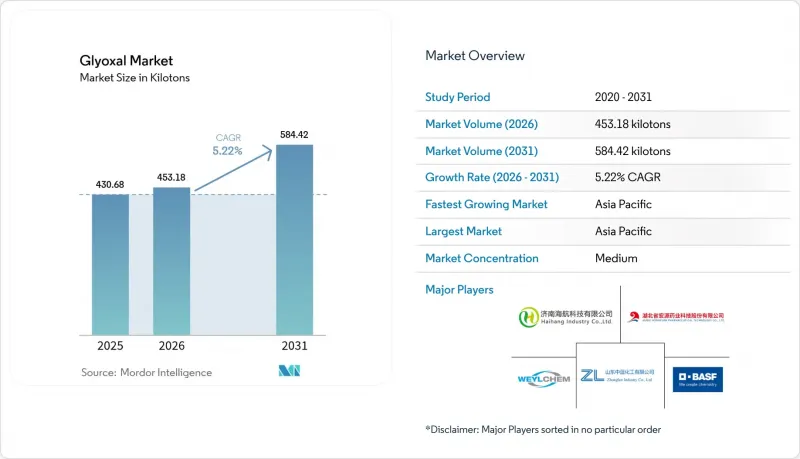
Mordor Intelligence에 의하면, 글리옥살 시장 규모는 2025년에 430.68 킬로톤이라고 평가되어 2026년 453.18 킬로톤에서 2031년까지 584.42 킬로톤에 이를 것으로 예측되며, 예측 기간(2026-2031년) CAGR은 5.22%를 나타낼 전망입니다.
본 보고서는 물리적 형태(액체 용액, 고체/분말), 용도(가교제, 화학 중간체 및 합성, 기타 용도), 최종 사용자 산업(접착제 및 실란트, 중간체 등), 지역(아시아태평양, 북미, 유럽, 남미, 중동 및 아프리카)별로 분류되어 있습니다. 시장 예측은 수량(톤) 기준으로 제시되어 있습니다.
세계 글리옥살 시장 동향 및 인사이트
개발도상국에서의 섬유 및 의류 생산 증가
중국은 2023년에 137억 달러 상당의 실을 수출했으며, 그 중 70%를 면사가 차지했습니다. 이러한 생산 규모에서는 글리옥살을 이용한 가교 처리를 활용한 내구성 프레스 가공 및 항균 가공이 필수적입니다. 이 화합물의 생분해성은 유럽연합(EU) 및 북미의 더 엄격한 수입 규제를 충족하며, ‘더 깨끗한’ 의류를 판매하는 브랜드에게 포름알데히드를 대체할 수 있는 바람직한 선택지가 되고 있습니다. 2025년부터 가동될 BASF의 잔장(湛江) 복합 단지는 주요 공급업체들이 물류 경로를 단축하고 베트남, 방글라데시, 인도로부터 추가 주문을 확보하기 위해 아시아에 생산 거점을 집중하고 있음을 보여주는 좋은 사례입니다. 중기적인 영향은 새로운 방적 및 염색 공장의 건설 주기가 보통 2-4년이라는 사실에서 기인합니다. 이러한 공장의 규모가 확대됨에 따라, 글리옥살에 대한 시장 수요는 섬유 처리량과 연동될 것입니다. 주름 방지 및 항균 처리가 된 원단이 1미터 늘어날 때마다 정해진 양의 알데히드 함량이 필요하기 때문입니다.
수성 접착제에서 가교제로서의 용도 확대
세계적으로 배출 규제가 엄격해짐에 따라 용제형 목재·용지용 접착제의 단계적 폐지가 가속화되고 있으며, 수성 시스템에서 글리옥살의 매력이 높아지고 있습니다. 셀룰로오스 기질에서 안정적인 헤미아세탈 결합을 형성하는 그 특성 덕분에, 접착제 배합자는 접착 강도를 저하시키지 않으면서도 낮은 VOC 기준을 충족할 수 있게 됩니다. BASF는 2025년 4월에 디올 및 그 유도체의 가격 인상을 단행했습니다. 이러한 움직임은 원자재 비용의 광범위한 상승을 반영하는 것이며, 각 변환 업체에 단일 성분 배합을 가능하게 하는 글리옥살과 같은 보다 효율적인 경화제를 요구하도록 압력을 가하고 있습니다. 원자재 승인이 이루어지면, 접착제 공장은 일반적으로 1 회계연도 이내에 믹서나 반응 장치를 비교적 신속하게 개조하기 때문에 이 요인에 의한 영향은 단기적인 수준에 그칠 것입니다. 북미의 건축자재 제조업체들은 EPA의 IRIS 프로그램에 따른 포름알데히드의 재분류 가능성에 선제적으로 대응하기 위한 직접적인 수단으로 글리옥살을 활용하고 있습니다.
독성에 대한 우려와 더욱 엄격해진 작업장 노출 한계치
규제 당국은 잠재적인 유전독성에 대한 우려로 디알데히드를 엄격히 감시하고 있습니다. WHO의 2024년 검토 보고서에서는 글리옥살이 최종 당화 산물(AGEs)의 형성에 관여한다는 점이 지적되어, 직업적 노출 한계치를 강화해야 한다는 목소리가 높아지고 있습니다. 유럽화학물질청(ECHA)은 현재 0.1 mg/m³인 작업장 노출 기준치를 재평가하고 있으며, OSHA도 이에 발맞추어 데이터 수집을 시작했습니다. 이로 인해 소규모 공장에는 최대 200만 달러의 환기 설비 업그레이드 비용이 발생할 가능성이 있습니다. 이러한 규정 준수 비용으로 인해 수익성을 확보하지 못하는 생산자가 시장에서 철수하고, 자본력이 강한 기업에 의한 공급 집중이 진행될 가능성이 있습니다. 단기적인 압박은 유럽과 북미에서 가장 심각합니다. 이 지역에서는 규제 당국이 새로운 기준이 발효된 지 몇 주 이내에 공장을 감사할 수 있기 때문에 생산 증가세가 일시적으로 둔화될 우려가 있습니다.
부문별 분석
2025년 소비량 중 액상 등급이 87.12%를 차지했습니다. 이는 펌프로 이송이 가능하고 즉시 사용할 수 있는 알데히드 용액이 공장 수준에서 선호되고 있음을 반영합니다. 자동 투여를 통해 배치 간 편차가 줄어들고 사이클 시간이 단축됨에 따라, 액상 글리옥살 시장 규모는 연평균 성장률(CAGR) 5.78%로 전체 수요를 상회하는 속도로 확대되고 있습니다. 분말 형태는 편의성보다 중량 기준 계량 및 저장 안정성이 우선시되는 외딴 지역의 유전 운영에서 여전히 중요한 역할을 하고 있습니다. 방글라데시와 에티오피아 전역에서 컨테이너형 섬유 화학제품 ‘키친(Kitchen)’ 설비의 도입이 진행되고 있는 것이 2031년까지 액상 등급 시장 침투를 뒷받침하고 있습니다. 고체 글리옥살 유도체는 수지 캡슐 및 지연 제어형 접착제 키트에서 여전히 중요하지만, 부피가 큰 고체의 운송 비용 상승으로 인해 가공업체들은 대신 현장에서 액체 제제를 조제하고 있습니다.
높은 가공 효율이야말로 패션, 홈 텍스타일 및 산업용 섬유 생산자들에게 액체 용액이 여전히 선호되는 사양인 이유입니다. 인라인 pH 제어 주입을 통해 균일한 고정화가 보장되며, 데님 마감 시험에서는 재작업률을 4% 낮출 수 있었습니다. 이러한 비용상의 이점으로 인해, 분말 제품에 비해 소폭의 가격 프리미엄이 정당화됩니다. 또한, 산화성 고형물 운송에 관한 규제가 강화됨에 따라, 불연성으로 분류되는 액체 제품은 IMDG 규정에 따른 서류 절차가 간소화된다는 물류상의 이점이 있으며, 이것이 액체 제품의 점유율이 점진적으로 확대되는 데 기여하고 있습니다.
지역별 분석
아시아태평양은 2025년에 전 세계 총량의 44.55%를 차지하고, 2031년까지 연평균 성장률(CAGR) 6.30%로 확대될 것으로 전망되는데, 이는 전 세계 글리옥살 시장의 연평균 성장률(CAGR)을 1퍼센트 포인트 이상 상회하는 수치입니다. 중국의 원사 수출이 원동력이 되어 원단 마감에 대한 수요를 뒷받침하는 한편, 인도의 제약 산업 확장이 중간 소비를 자극하고 있습니다. 일본과 한국은 글리옥살 기반 전해질을 평가하는 첨단 배터리 프로그램을 통해 혁신을 주도하고 있습니다. 이 지역의 통합된 석유화학 체인은 에틸렌글리콜 원료공급 충격을 완화하여 아시아태평양 생산자들에게 구조적인 비용 우위를 제공합니다.
북미는 확립된 화학 인프라와 저배출 접착제를 뒷받침하는 규제 동력에 힘입어 여전히 2위 지역 클러스터로서의 위상을 유지하고 있습니다. 미국 국방부가 국내 글리옥살 생산에 2,400만 달러 규모의 5개년 자금을 지원하기로 한 것은 특수 코팅 분야에서 이 화합물의 중요성을 여실히 보여주고 있습니다. 견조한 주택 착공 건수와 리모델링 지출이 접착제 수요를 뒷받침하는 한편, 셰일 관련 심해 타이백 공사로 인해 유전용 화학제품 수요가 확대되고 있습니다. 중요한 점은 이 대륙에서 OSHA(직업안전보건청)의 엄격한 감독으로 인해 고순도 및 저포름알데히드 사양이 요구되고 있으며, 이는 고품질의 글리옥살 함유 제품에 유리하게 작용하고 있습니다.
유럽에서는 엄격한 직업적 노출 규제로 인해 수요가 성숙기에 접어들었으나, 고부가가치의 특수 화학제품 틈새 시장이 수요를 지탱하고 있습니다. BASF사의 루트비히스하펜 공장(연산 6만 톤)이 지역공급을 확보하고 있으며, 이탈리아와 네덜란드의 소규모 틈새 제조업체들이 이를 보완하고 있습니다. 일회용 플라스틱 지침에 힘입어 종이 및 판지 식품 포장재로의 전환이 가속화됨에 따라, 글리옥살계 살균제 수요가 더욱 증가할 것으로 예측됩니다. 그러나 에너지 비용 상승과 REACH 규제의 강화로 인해 이익률이 압박받을 가능성이 있어, 유럽의 가공업체들은 특정 대량 배합 제품의 생산을 동유럽이나 튀르키예로 이전하는 움직임을 보이고 있습니다.
기타 혜택:
- 엑셀 형식 시장 예측(ME) 시트
- 3개월간의 애널리스트 지원
자주 묻는 질문
목차
제1장 서론
제2장 조사 방법
제3장 주요 요약
제4장 시장 구도
제5장 시장 규모와 성장 예측
제6장 경쟁 구도
제7장 시장 기회와 향후 전망
JHS 26.08.26According to Mordor Intelligence, the glyoxal market size was valued at 430.68 kilotons in 2025 and estimated to grow from 453.18 kilotons in 2026 to reach 584.42 kilotons by 2031, at a CAGR of 5.22% during the forecast period (2026-2031).
This report is Segmented by Physical Form (Liquid Solution, Solid/Powder), Application (Cross-Linking Agents, Chemical Intermediates and Synthesis, Other Applications), End-User Industry (Adhesives and Sealants, Intermediates, and More), and Geography (Asia-Pacific, North America, Europe, South America, Middle East and Africa). The Market Forecasts are Provided in Terms of Volume (Tons).
Global Glyoxal Market Trends and Insights
Rising Textile and Apparel Production in Developing Economies
China exported USD 13.7 billion in yarn during 2023, with cotton yarn comprising 70% of shipments, an output scale that necessitates durable-press and antimicrobial finishing aided by glyoxal cross-linking. The compound's biodegradability meets stricter import regulations in the European Union and North America, making it a preferred alternative to formaldehyde for brands marketing "cleaner" garments. BASF's Zhanjiang complex, operational from 2025, exemplifies how major suppliers are co-locating capacity in Asia to shorten logistics lanes and capture incremental orders from Vietnam, Bangladesh and India. Medium-term impact is tied to the typical 2-4 year build-out cycle of new spinning and dyeing mills. As these plants scale, glyoxal market demand should parallel fiber throughput because every incremental meter of fabric finished with wrinkle-free or antimicrobial chemistry contains a defined aldehyde loading.
Expanding Use as Cross-Linking Agent in Water-Borne Adhesives
Stringent global emission rules have accelerated the phase-down of solvent-borne wood and paper adhesives, elevating glyoxal's attractiveness in aqueous systems. Its ability to generate stable hemi-acetal bridges in cellulose substrates allows adhesive formulators to meet low-VOC thresholds without sacrificing bond strength. BASF enacted price increases on diols and derivatives in April 2025, a move that reflects broader raw-material cost inflation and pressures converters to seek more efficient curatives such as glyoxal that enable single-component formulations. The driver exerts short-term impact because adhesive plants retrofit mixers and reactors relatively quickly-typically within a fiscal year-once raw-material approvals are secured. North American building-products makers view glyoxal as a direct pathway to keep ahead of potential formaldehyde re-classification under the EPA's IRIS program.
Toxicological Concerns and Stricter Workplace Exposure Limits
Regulators scrutinize dialdehydes because of potential genotoxicity; WHO's 2024 review flagged glyoxal for advanced glycation end-product formation, prompting calls to tighten occupational limits. The European Chemicals Agency is reassessing the current 0.1 mg/m3 workplace exposure threshold, and OSHA initiated a parallel data-collection effort that could impose ventilation upgrades costing small mills up to USD 2 million. These compliance costs may drive marginal producers from the market, consolidating supply under better-capitalized companies. Short-term pressure is most acute in Europe and North America, where enforcement staff can audit plants within weeks of new limits taking effect, temporarily dampening production growth.
Other drivers and restraints analyzed in the detailed report include:
- Growing Demand for Oil-Field Chemicals in Deep-Water Drilling
- Glyoxal Adoption as Biodegradable Biocide in Paper and Board Packaging
- Price Volatility of Ethylene Glycol Feedstock
For complete list of drivers and restraints, kindly check the Table Of Contents.
Segment Analysis
Liquid grades commanded 87.12% of 2025 consumption, reflecting plant-level preferences for pumpable, ready-to-use aldehyde solutions. Automated dosing lowers batch variability and shortens cycle times, factors that have helped the liquid glyoxal market size outpace overall demand at a 5.78% CAGR. Powder forms maintain relevance in remote oil-field operations where weight-based metering and storage stability trump convenience. Growth in containerized textile-chemical "kitchen" installations across Bangladesh and Ethiopia supports continued liquid-grade penetration through 2031. Solid glyoxal derivatives remain important in resin capsules and latency-controlled adhesive kits, but rising freight costs for bulky solids encourage converters to formulate on-site liquids instead.
Processing efficiency explains why liquid solutions remain the preferred specification for fashion, home-textile and technical-fabric producers. Inline pH-controlled injection ensures homogeneous fixation, reducing rework rates by 4% in denim finishing trials. This cost benefit justifies modest price premiums over powders. Moreover, regulations governing shipping of oxidizable solids are tightening; liquids classed as non-combustible enjoy simpler documentation under IMDG rules, a logistics advantage that supports the liquid share's incremental expansion.
Complete Report Scope:
- By Physical Form
- Liquid Solution
- Solid / Powder
- Application
- Cross-linking Agents
- Chemical Intermediates and Synthesis
- Other Applications (Biocides and Preservatives, etc.)
- By End-User Industry
- Adhesives and Sealants
- Intermediates
- Oil and Gas Exploration
- Paints and Coatings
- Textile
- Other End-User Industries (Pharmaceuticals, etc.)
- By Geography
- Asia-Pacific
- China
- Japan
- India
- South Korea
- ASEAN Countries
- Rest of Asia-Pacific
- North America
- United States
- Canada
- Mexico
- Europe
- Germany
- United Kingdom
- France
- Italy
- Spain
- Russia
- NORDIC Countries
- Rest of Europe
- South America
- Brazil
- Argentina
- Rest of South America
- Middle East and Africa
- Saudi Arabia
- South Africa
- Rest of Middle East and Africa
- Asia-Pacific
Geography Analysis
Asia-Pacific captured 44.55% of worldwide volume in 2025 and is forecast to expand at a 6.30% CAGR to 2031, more than one percentage point above the global glyoxal market CAGR. China's yarn export engine exemplifies underlying fabric-finishing demand, while India's pharmaceutical build-out stimulates intermediate consumption. Japan and South Korea contribute innovation pull through advanced battery programs evaluating glyoxal-based electrolytes. The region's integrated petrochemical chains mitigate ethylene-glycol feedstock shocks, giving APAC producers a structural cost edge.
North America remains the second-largest regional cluster due to established chemical infrastructures and legislative momentum behind low-emission adhesives. The Department of Defense's USD 24 million, five-year funding for domestic glyoxal manufacturing underscores the compound's criticality in specialty coatings. Robust housing starts and remodeling spending sustain adhesive demand, while shale-related deep-water tie-backs extend oil-field chemical requirements. Importantly, the continent's stringent OSHA oversight drives higher-purity and lower-formaldehyde specifications, favoring premium glyoxal formulations.
Europe displays mature demand tempered by stringent occupational exposure regulation but benefits from high-value specialty chemical niches. BASF's 60,000-ton Ludwigshafen train secures regional supply, complemented by smaller niche makers in Italy and the Netherlands. Transition toward paper-board food packaging, propelled by the Single-Use Plastics Directive, is forecast to add incremental glyoxal biocide volumes. However, rising energy costs and tightened REACH dossiers may compress margins, motivating European converters to shift certain high-volume formulations to Eastern Europe and Turkiye.
- Amzole India Pvt Ltd
- BASF
- Haihang Industry
- hubei hongyuan pharmaceutical technology co., ltd
- Jinan Huashihang Chemical Co., Ltd.
- INEOS
- Merck KGaA
- Otto Chemie Pvt. Ltd.
- Spectrum Chemical
- Thermo Fisher Scientific
- Tokyo Chemical Industry India Pvt. Ltd.
- WeylChem International GmbH
- Zhonglan Industry Co.,Ltd.
Additional Benefits:
- The market estimate (ME) sheet in Excel format
- 3 months of analyst support
TABLE OF CONTENTS
1 Introduction
- 1.1 Study Assumptions and Market Definition
- 1.2 Scope of the Study
2 Research Methodology
3 Executive Summary
4 Market Landscape
- 4.1 Market Overview
- 4.2 Market Drivers
- 4.2.1 Rising textile and apparel production in developing economies
- 4.2.2 Expanding use as a cross-linking agent in water-borne adhesives
- 4.2.3 Growing demand for oil-field chemicals in deep-water drilling
- 4.2.4 Glyoxal adoption as a biodegradable biocide in paper and board packaging
- 4.2.5 Emerging role in silicon-anode battery electrolyte formulations
- 4.3 Market Restraints
- 4.3.1 Toxicological concerns and stricter workplace exposure limits
- 4.3.2 Price volatility of ethylene glycol feedstock
- 4.3.3 Competition from dialdehyde starch and other green cross-linkers
- 4.4 Value Chain Analysis
- 4.5 Porter's Five Forces
- 4.5.1 Threat of New Entrants
- 4.5.2 Bargaining Power of Buyers
- 4.5.3 Bargaining Power of Suppliers
- 4.5.4 Threat of Substitute Products
- 4.5.5 Degree of Competition
5 Market Size and Growth Forecasts (Volume)
- 5.1 By Physical Form
- 5.1.1 Liquid Solution
- 5.1.2 Solid / Powder
- 5.2 Application
- 5.2.1 Cross-linking Agents
- 5.2.2 Chemical Intermediates and Synthesis
- 5.2.3 Other Applications (Biocides and Preservatives, etc.)
- 5.3 By End-User Industry
- 5.3.1 Adhesives and Sealants
- 5.3.2 Intermediates
- 5.3.3 Oil and Gas Exploration
- 5.3.4 Paints and Coatings
- 5.3.5 Textile
- 5.3.6 Other End-User Industries (Pharmaceuticals, etc.)
- 5.4 By Geography
- 5.4.1 Asia-Pacific
- 5.4.1.1 China
- 5.4.1.2 Japan
- 5.4.1.3 India
- 5.4.1.4 South Korea
- 5.4.1.5 ASEAN Countries
- 5.4.1.6 Rest of Asia-Pacific
- 5.4.2 North America
- 5.4.2.1 United States
- 5.4.2.2 Canada
- 5.4.2.3 Mexico
- 5.4.3 Europe
- 5.4.3.1 Germany
- 5.4.3.2 United Kingdom
- 5.4.3.3 France
- 5.4.3.4 Italy
- 5.4.3.5 Spain
- 5.4.3.6 Russia
- 5.4.3.7 NORDIC Countries
- 5.4.3.8 Rest of Europe
- 5.4.4 South America
- 5.4.4.1 Brazil
- 5.4.4.2 Argentina
- 5.4.4.3 Rest of South America
- 5.4.5 Middle East and Africa
- 5.4.5.1 Saudi Arabia
- 5.4.5.2 South Africa
- 5.4.5.3 Rest of Middle East and Africa
- 5.4.1 Asia-Pacific
6 Competitive Landscape
- 6.1 Market Concentration
- 6.2 Strategic Moves
- 6.3 Market Share(%)/Ranking Analysis
- 6.4 Company Profiles (includes Global level Overview, Market level overview, Core Segments, Financials as available, Strategic Information, Market Rank/Share for key companies, Products and Services, and Recent Developments)
- 6.4.1 Amzole India Pvt Ltd
- 6.4.2 BASF
- 6.4.3 Haihang Industry
- 6.4.4 hubei hongyuan pharmaceutical technology co., ltd
- 6.4.5 Jinan Huashihang Chemical Co., Ltd.
- 6.4.6 INEOS
- 6.4.7 Merck KGaA
- 6.4.8 Otto Chemie Pvt. Ltd.
- 6.4.9 Spectrum Chemical
- 6.4.10 Thermo Fisher Scientific
- 6.4.11 Tokyo Chemical Industry India Pvt. Ltd.
- 6.4.12 WeylChem International GmbH
- 6.4.13 Zhonglan Industry Co.,Ltd.
7 Market Opportunities and Future Outlook
- 7.1 White-space and Unmet-Need Assessment


